薛健鑫, 蔡昆修, 何星翰


                1
   Introduction
   Work progress
   SR Algorithm
   Evaluation
   SR video player demo
   Conclusion


                           2
   Super-resolution are techniques that improve
    image quality from low-resolution.


                                                   3
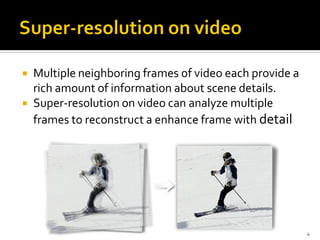
   Multiple neighboring frames of video each provide a
    rich amount of information about scene details.
   Super-resolution on video can analyze multiple
    frames to reconstruct a enhance frame with detail


                                                          4
   Retrieving image stream
     From OpenCV
   Super-resolution processing
     Algorithm : FGSR, FRSR
     GPU speedup investigation
   Video player


                                  5
   Fast General Super-Resolution (FGSR)
     For general video use
     Fast, cheap, bad result
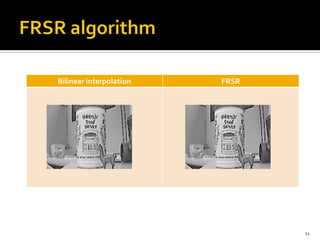
   Fast & Robust Super-Resolution(FRSR)
     Only appropriate for translational motion
     Slow, better result


                                                  6
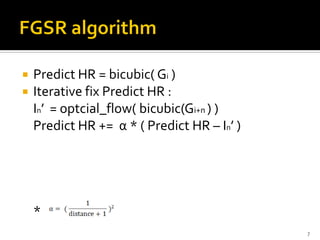
   Predict HR = bicubic( Gi )
   Iterative fix Predict HR :
    In’ = optcial_flow( bicubic(Gi+n ) )
    Predict HR += α * ( Predict HR – In’ )


    *
                                             7
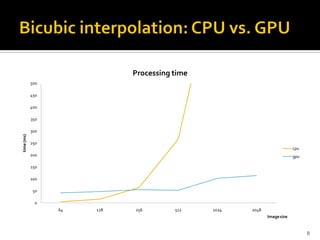
Processing time
            500

            450

            400

            350

            300
time (ms)


            250
                                                                          cpu
            200                                                           gpu

            150

            100

             50

              0
                  64   128   256        512    1024   2048
                                                             Image size


                                                                                8
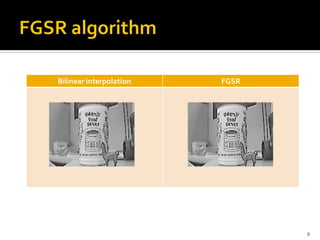
Bilinear interpolation   FGSR


                                9
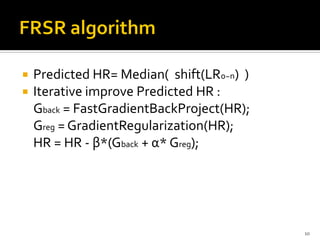
   Predicted HR= Median( shift(LR0~n) )
   Iterative improve Predicted HR :
    Gback = FastGradientBackProject(HR);
    Greg = GradientRegularization(HR);
    HR = HR - β*(Gback + α* Greg);


                                           10
Bilinear interpolation   FRSR


                                11
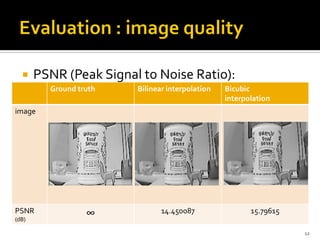
    PSNR (Peak Signal to Noise Ratio):
         Ground truth   Bilinear interpolation   Bicubic
                                                 interpolation
image


PSNR              ∞            14.450087                15.79615
(dB)

                                                                   12
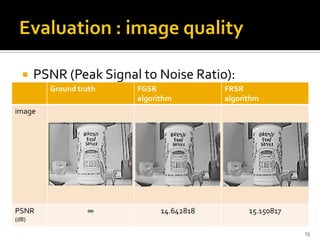
    PSNR (Peak Signal to Noise Ratio):
         Ground truth   FGSR              FRSR
                        algorithm         algorithm
image


PSNR              ∞           14.642818         15.150817
(dB)

                                                            13
14
   Problem on super-resolution:
     Optical flow
     Occlusion/ disocclusion
     Insufficient information from neighboring frames
   Still have much space to improve


                                                         15
 Sina Farsiu, Dirk Robinson, Michael Elad, Peyman Milanfar.
  Fast and Robust Multi-Frame Super-Resolution. In IEEE
  Transactions on Image Processing2003.
 Zhongding Jiang, Tien-tsin Wong, Hujun Bao. Practical
  Super-Resolution from Dynamic Video Sequences. In Proc. of
  IEEE CVPR2003.


                                                               16
THE END

          17

Gpgpu presentation final

  • 1.
  • 2.
    Introduction  Work progress  SR Algorithm  Evaluation  SR video player demo  Conclusion 2
  • 3.
    Super-resolution are techniques that improve image quality from low-resolution. 3
  • 4.
    Multiple neighboring frames of video each provide a rich amount of information about scene details.  Super-resolution on video can analyze multiple frames to reconstruct a enhance frame with detail 4
  • 5.
    Retrieving image stream  From OpenCV  Super-resolution processing  Algorithm : FGSR, FRSR  GPU speedup investigation  Video player 5
  • 6.
    Fast General Super-Resolution (FGSR)  For general video use  Fast, cheap, bad result  Fast & Robust Super-Resolution(FRSR)  Only appropriate for translational motion  Slow, better result 6
  • 7.
    Predict HR = bicubic( Gi )  Iterative fix Predict HR : In’ = optcial_flow( bicubic(Gi+n ) ) Predict HR += α * ( Predict HR – In’ ) * 7
  • 8.
    Processing time 500 450 400 350 300 time (ms) 250 cpu 200 gpu 150 100 50 0 64 128 256 512 1024 2048 Image size 8
  • 9.
  • 10.
    Predicted HR= Median( shift(LR0~n) )  Iterative improve Predicted HR : Gback = FastGradientBackProject(HR); Greg = GradientRegularization(HR); HR = HR - β*(Gback + α* Greg); 10
  • 11.
  • 12.
    PSNR (Peak Signal to Noise Ratio): Ground truth Bilinear interpolation Bicubic interpolation image PSNR ∞ 14.450087 15.79615 (dB) 12
  • 13.
    PSNR (Peak Signal to Noise Ratio): Ground truth FGSR FRSR algorithm algorithm image PSNR ∞ 14.642818 15.150817 (dB) 13
  • 14.
  • 15.
    Problem on super-resolution:  Optical flow  Occlusion/ disocclusion  Insufficient information from neighboring frames  Still have much space to improve 15
  • 16.
     Sina Farsiu,Dirk Robinson, Michael Elad, Peyman Milanfar. Fast and Robust Multi-Frame Super-Resolution. In IEEE Transactions on Image Processing2003.  Zhongding Jiang, Tien-tsin Wong, Hujun Bao. Practical Super-Resolution from Dynamic Video Sequences. In Proc. of IEEE CVPR2003. 16
  • 17.