Communicating at Workplace
What is Communication?
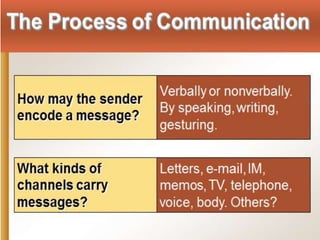
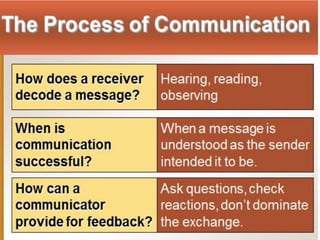
• The imparting or exchanging of information by
speaking, writing, or using some other
medium.
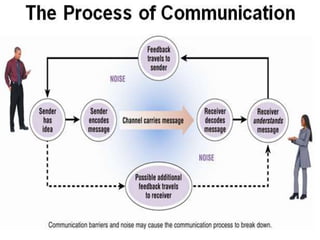
• Communication is the act of developing
meaning among entities or groups through
the use of sufficiently mutually understood
signs, symbols, and semiotic conventions.
Importance of Communication at
Workplace
Good communication skills
are essential for
 Job placement
 Job performance
 Career advancement
 Success in the new world of work
Factors that Affect You in the New
Workplace
• Heightened global competition
• Flattened management hierarchies
• Expanded team-based management
• Innovative communication technology
• New work environments
• Increasingly diverse workforce
• Renewed emphasis on ethics
• Success in the new workplace requires
excellent communication skills.
Example of a miscommunication
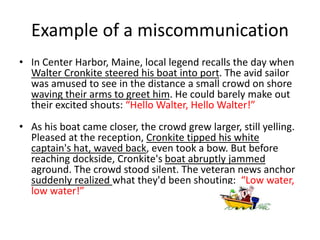
• In Center Harbor, Maine, local legend recalls the day when
Walter Cronkite steered his boat into port. The avid sailor
was amused to see in the distance a small crowd on shore
waving their arms to greet him. He could barely make out
their excited shouts: “Hello Walter, Hello Walter!”
• As his boat came closer, the crowd grew larger, still yelling.
Pleased at the reception, Cronkite tipped his white
captain's hat, waved back, even took a bow. But before
reaching dockside, Cronkite's boat abruptly jammed
aground. The crowd stood silent. The veteran news anchor
suddenly realized what they'd been shouting: “Low water,
low water!”
Barriers to Communication
(Interpersonal)
• Bypassing
• Limited frame of reference
• Lack of language skills
• Lack of listening skills
• Emotional interference
• Physical distractions
Barriers to Communication
(Organizational)
• Closed communication climate
• Top-heavy organizational structure
• Long lines of communication
• Lack of trust between management and
employees
• Competition for power, status, rewards
Additional Communication Barriers
• Fear of reprisal for honest communication
• Differing frames of reference among
communicators
• Lack of communication skills
• Ego involvement
• Turf wars
Organizational Communication
• Functions: internal and external
• Form: oral and written
• Form: channel selection dependent on
• Message content
• Need for immediate response
• Audience size and distance
• Audience reaction
• Need to show empathy, friendliness, formality
• Flow:
• Formal: down, up, horizontal
• Informal: grapevine
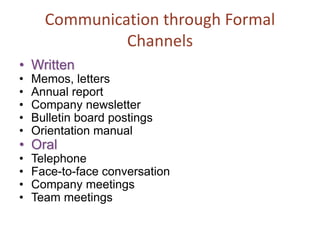
Communication through Formal
Channels
• Written
• Memos, letters
• Annual report
• Company newsletter
• Bulletin board postings
• Orientation manual
• Oral
• Telephone
• Face-to-face conversation
• Company meetings
• Team meetings
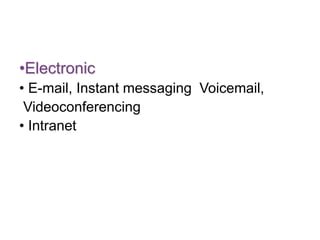
•Electronic
• E-mail, Instant messaging Voicemail,
Videoconferencing
• Intranet
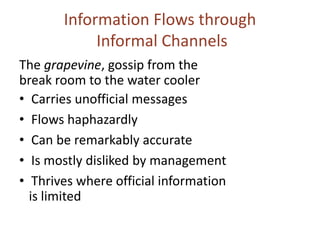
Information Flows through
Informal Channels
The grapevine, gossip from the
break room to the water cooler
• Carries unofficial messages
• Flows haphazardly
• Can be remarkably accurate
• Is mostly disliked by management
• Thrives where official information
is limited
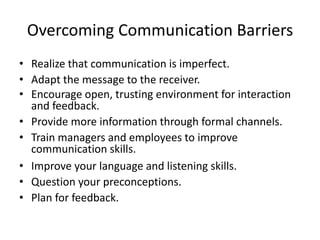
Overcoming Communication Barriers
• Realize that communication is imperfect.
• Adapt the message to the receiver.
• Encourage open, trusting environment for interaction
and feedback.
• Provide more information through formal channels.
• Train managers and employees to improve
communication skills.
• Improve your language and listening skills.
• Question your preconceptions.
• Plan for feedback.
Modern Communication
• Computers are a key part of modern
communication.
• When you use a computer, English is very
useful.
• Why? One reason is because English is an
international language.
• Online communication - The language of online
communication is called “Internet language” . It is
a slang that Internet users have created with the
purpose of saving keystrokes
• E-mail
• Chat Rooms
• Blog
• E – commerce
• Social Media

Communicating At Workplace

  • 1.
  • 2.
    What is Communication? •The imparting or exchanging of information by speaking, writing, or using some other medium. • Communication is the act of developing meaning among entities or groups through the use of sufficiently mutually understood signs, symbols, and semiotic conventions.
  • 3.
    Importance of Communicationat Workplace Good communication skills are essential for  Job placement  Job performance  Career advancement  Success in the new world of work
  • 4.
    Factors that AffectYou in the New Workplace • Heightened global competition • Flattened management hierarchies • Expanded team-based management • Innovative communication technology • New work environments • Increasingly diverse workforce • Renewed emphasis on ethics • Success in the new workplace requires excellent communication skills.
  • 8.
    Example of amiscommunication • In Center Harbor, Maine, local legend recalls the day when Walter Cronkite steered his boat into port. The avid sailor was amused to see in the distance a small crowd on shore waving their arms to greet him. He could barely make out their excited shouts: “Hello Walter, Hello Walter!” • As his boat came closer, the crowd grew larger, still yelling. Pleased at the reception, Cronkite tipped his white captain's hat, waved back, even took a bow. But before reaching dockside, Cronkite's boat abruptly jammed aground. The crowd stood silent. The veteran news anchor suddenly realized what they'd been shouting: “Low water, low water!”
  • 9.
    Barriers to Communication (Interpersonal) •Bypassing • Limited frame of reference • Lack of language skills • Lack of listening skills • Emotional interference • Physical distractions
  • 10.
    Barriers to Communication (Organizational) •Closed communication climate • Top-heavy organizational structure • Long lines of communication • Lack of trust between management and employees • Competition for power, status, rewards
  • 11.
    Additional Communication Barriers •Fear of reprisal for honest communication • Differing frames of reference among communicators • Lack of communication skills • Ego involvement • Turf wars
  • 12.
    Organizational Communication • Functions:internal and external • Form: oral and written • Form: channel selection dependent on • Message content • Need for immediate response • Audience size and distance • Audience reaction • Need to show empathy, friendliness, formality • Flow: • Formal: down, up, horizontal • Informal: grapevine
  • 13.
    Communication through Formal Channels •Written • Memos, letters • Annual report • Company newsletter • Bulletin board postings • Orientation manual • Oral • Telephone • Face-to-face conversation • Company meetings • Team meetings
  • 14.
    •Electronic • E-mail, Instantmessaging Voicemail, Videoconferencing • Intranet
  • 15.
    Information Flows through InformalChannels The grapevine, gossip from the break room to the water cooler • Carries unofficial messages • Flows haphazardly • Can be remarkably accurate • Is mostly disliked by management • Thrives where official information is limited
  • 16.
    Overcoming Communication Barriers •Realize that communication is imperfect. • Adapt the message to the receiver. • Encourage open, trusting environment for interaction and feedback. • Provide more information through formal channels. • Train managers and employees to improve communication skills. • Improve your language and listening skills. • Question your preconceptions. • Plan for feedback.
  • 17.
    Modern Communication • Computersare a key part of modern communication. • When you use a computer, English is very useful. • Why? One reason is because English is an international language.
  • 18.
    • Online communication- The language of online communication is called “Internet language” . It is a slang that Internet users have created with the purpose of saving keystrokes • E-mail • Chat Rooms • Blog • E – commerce • Social Media