Heat
Treatment of
Metals
Heat-Treatment
 Heat treatment is a method used to alter the
physical, and sometimes chemical properties of a
material. The most common application is
metallurgical
 It involves the use of heating or chilling, normally to
extreme temperatures, to achieve a desired result
such as hardening or softening of a material
It applies only to processes where the heating and
cooling are done for the specific purpose of
altering properties intentionally
Generally, heat treatment uses phase
transformation during heating and cooling to
change a microstructure in a solid state.
Types of Heat-Treatment (Steel)
 Annealing
 Tempering, and Quenching
 Precipitation hardening
 Case hardening
Annealing
A heat treatment process in which a metal is exposed to an
elevated temperature for an extended time period and
then slowly cooled.
Purpose:
1.Relieve stresses of cold working
2.Increase softness, ductility and toughness
3.Produce specific microstructure
Annealing
α+Fe3C

T
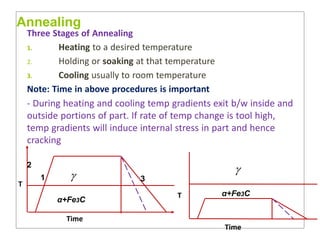
Three Stages of Annealing
1. Heating to a desired temperature
2. Holding or soaking at that temperature
3. Cooling usually to room temperature
Note: Time in above procedures is important
- During heating and cooling temp gradients exit b/w inside and
outside portions of part. If rate of temp change is tool high,
temp gradients will induce internal stress in part and hence
cracking
2
Time
Time
α+Fe3C

T
1 3
Types of Annealing
1. Stress-Relief Annealing (or Stress-relieving)
2. Normalizing
3. Full Annealing
4. Spheroidizing Annealing (or Spheroidizing )
5. Isothermal Annealing
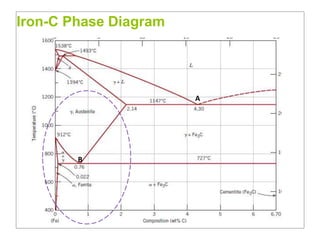
Iron-C Phase Diagram
A
B
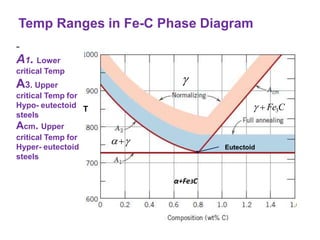
Temp Ranges in Fe-C Phase Diagram
-
A1. Lower
critical Temp
A3. Upper
critical Temp for
Hypo- eutectoid
steels
Acm. Upper
critical Temp for
Hyper- eutectoid
steels
Eutectoid
α+Fe3C


  Fe3C
T
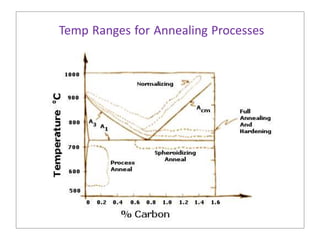
Temp Ranges for Annealing Processes
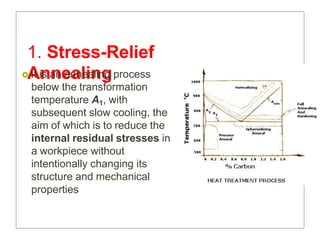
1. Stress-Relief
Annealing
 It is an annealing process
below the transformation
temperature A1, with
subsequent slow cooling, the
aim of which is to reduce the
internal residual stresses in
a workpiece without
intentionally changing its
structure and mechanical
properties
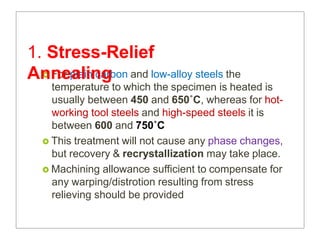
 For plain carbon and low-alloy steels the
temperature to which the specimen is heated is
usually between 450 and 650˚C, whereas for hot-
working tool steels and high-speed steels it is
between 600 and 750˚C
 This treatment will not cause any phase changes,
but recovery & recrystallization may take place.
 Machining allowance sufficient to compensate for
any warping/distrotion resulting from stress
relieving should be provided
1. Stress-Relief
Annealing
Causes of Residual Stresses
1.Mechanical factors (e.g., cold-working during
metal forming/machining)
2.Thermal factors (e.g., thermal stresses caused by
temperature gradients within the work-piece during
heating or cooling)
3.Metallurgical factors (e.g., phase transformation
upon cooling wherein parent and product phases have
different densities
- In the heat treatment of metals, quenching or rapid
cooling is the cause of the greatest residual stresses
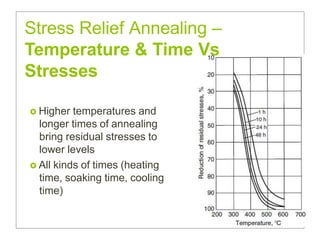
 Higher temperatures and
longer times of annealing
bring residual stresses to
lower levels
 All kinds of times (heating
time, soaking time, cooling
time)
Stress Relief Annealing –
Temperature & Time Vs
Stresses
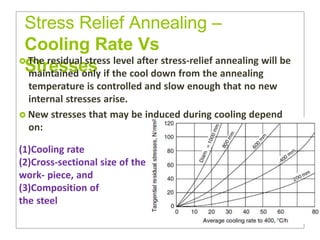
Stress Relief Annealing –
Cooling Rate Vs
Stresses
 The residual stress level after stress-relief annealing will be
maintained only if the cool down from the annealing
temperature is controlled and slow enough that no new
internal stresses arise.
 New stresses that may be induced during cooling depend
on:
(1)Cooling rate
(2)Cross-sectional size of the
work- piece, and
(3)Composition of
the steel
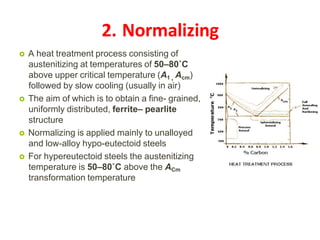
2. Normalizing
 A heat treatment process consisting of
austenitizing at temperatures of 50–80˚C
above upper critical temperature (A1 , Acm)
followed by slow cooling (usually in air)
 The aim of which is to obtain a fine- grained,
uniformly distributed, ferrite– pearlite
structure
 Normalizing is applied mainly to unalloyed
and low-alloy hypo-eutectoid steels
 For hypereutectoid steels the austenitizing
temperature is 50–80˚C above the ACm
transformation temperature
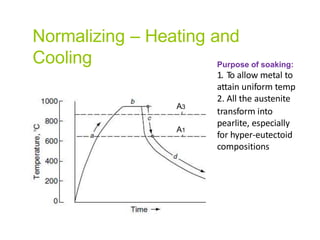
Normalizing – Heating and
Cooling
A3
A1
Purpose of soaking:
1. To allow metal to
attain uniform temp
2. All the austenite
transform into
pearlite, especially
for hyper-eutectoid
compositions
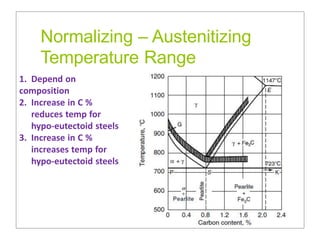
Normalizing – Austenitizing
Temperature Range
1. Depend on
composition
2. Increase in C %
reduces temp for
hypo-eutectoid steels
3. Increase in C %
increases temp for
hypo-eutectoid steels
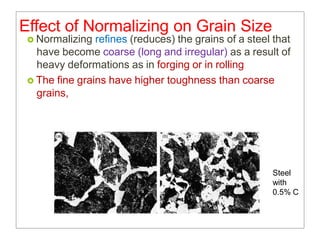
Effect of Normalizing on Grain Size
 Normalizing refines (reduces) the grains of a steel that
have become coarse (long and irregular) as a result of
heavy deformations as in forging or in rolling
 The fine grains have higher toughness than coarse
grains,
Steel
with
0.5% C
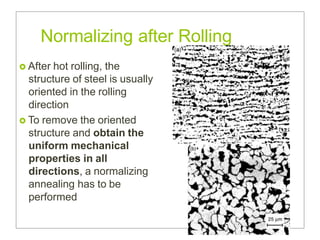
Normalizing after Rolling
 After hot rolling, the
structure of steel is usually
oriented in the rolling
direction
 To remove the oriented
structure and obtain the
uniform mechanical
properties in all
directions, a normalizing
annealing has to be
performed
Normalizing after Forging
•  After forging at high temperatures,
especially with work-pieces that vary
widely in cross sectional size, because of
the different rates of cooling from the
forging temperature, a heterogeneous
structure is obtained that can be made
uniform by normalizing
•  Normalizing is also done to improve
• machinability of low-c steels
Normalizing – Holding Time
 Holding time at austenitizing temperature may
be calculated using the empirical formula:
t = 60 + D
where t is the holding time (min) and D is the
maximum diameter of the workpiece (mm).
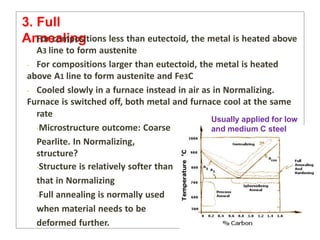
3. Full
Annealing
- For compositions less than eutectoid, the metal is heated above
A3 line to form austenite
- For compositions larger than eutectoid, the metal is heated
above A1 line to form austenite and Fe3C
- Cooled slowly in a furnace instead in air as in Normalizing.
Furnace is switched off, both metal and furnace cool at the same
rate
-Microstructure outcome: Coarse
Pearlite. In Normalizing,
structure?
-Structure is relatively softer than
that in Normalizing
-Full annealing is normally used
when material needs to be
deformed further.
Usually applied for low
and medium C steel
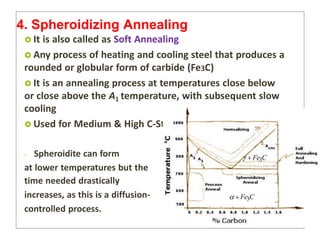
4. Spheroidizing Annealing
 It is also called as Soft Annealing
 Any process of heating and cooling steel that produces a
rounded or globular form of carbide (Fe3C)
 It is an annealing process at temperatures close below
or close above the A1 temperature, with subsequent slow
cooling
 Used for Medium & High C-Steels
- Spheroidite can form
at lower temperatures but the
time needed drastically
increases, as this is a diffusion-
controlled process.
  Fe3C
  Fe3C
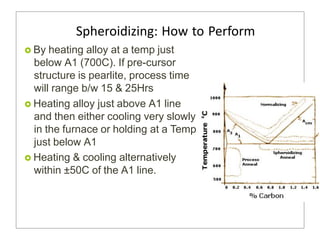
Spheroidizing: How to Perform
 By heating alloy at a temp just
below A1 (700C). If pre-cursor
structure is pearlite, process time
will range b/w 15 & 25Hrs
 Heating alloy just above A1 line
and then either cooling very slowly
in the furnace or holding at a Temp
just below A1
 Heating & cooling alternatively
within ±50C of the A1 line.
Spheroidizing - Purpose
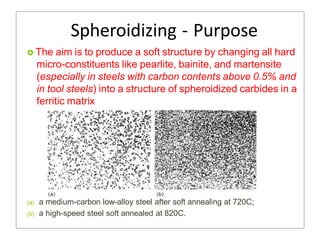
 The aim is to produce a soft structure by changing all hard
micro-constituents like pearlite, bainite, and martensite
(especially in steels with carbon contents above 0.5% and
in tool steels) into a structure of spheroidized carbides in a
ferritic matrix
(a) a medium-carbon low-alloy steel after soft annealing at 720C;
(b) a high-speed steel soft annealed at 820C.
Spheroidizing - Uses
 Such a soft structure is required for good
machinability of steels having more than
0.6%C and for all cold-working processes
that include plastic deformation.
 Spheroidite steel is the softest and most
ductile form of steel
5. Isothermal Annealing
 Spheroidizing is more useful for improving machinability of
high C steel than that of low and medium C steels.
 In fact, spherodized low and medium C steels become over
soft for machining and give long shavings which accumulate
on tool cutting edge and produce poor surface.
 Hypoeutectoid low-carbon steels as well as medium-carbon
structural steels are often isothermally annealed, for best
machinability
 An isothermally annealed structure should have the following
characteristics:
1. High proportion of ferrite
2. Uniformly distributed pearlite grains
3. Fine lamellar pearlite grains
Process – Isothermal Annealing
 Austenitizing
followed by a fast
cooling to the
temperature range of
pearlite formation
(usually about 650˚C.)
 Holding at this
temperature until the
complete
transformation of
pearlite
 and cooling to room
temperature at an
arbitrary cooling rate
  Fe3C

?

4- HEAT TREATMENT.ppt

  • 1.
  • 2.
    Heat-Treatment  Heat treatmentis a method used to alter the physical, and sometimes chemical properties of a material. The most common application is metallurgical  It involves the use of heating or chilling, normally to extreme temperatures, to achieve a desired result such as hardening or softening of a material It applies only to processes where the heating and cooling are done for the specific purpose of altering properties intentionally Generally, heat treatment uses phase transformation during heating and cooling to change a microstructure in a solid state.
  • 4.
    Types of Heat-Treatment(Steel)  Annealing  Tempering, and Quenching  Precipitation hardening  Case hardening
  • 5.
    Annealing A heat treatmentprocess in which a metal is exposed to an elevated temperature for an extended time period and then slowly cooled. Purpose: 1.Relieve stresses of cold working 2.Increase softness, ductility and toughness 3.Produce specific microstructure
  • 6.
    Annealing α+Fe3C  T Three Stages ofAnnealing 1. Heating to a desired temperature 2. Holding or soaking at that temperature 3. Cooling usually to room temperature Note: Time in above procedures is important - During heating and cooling temp gradients exit b/w inside and outside portions of part. If rate of temp change is tool high, temp gradients will induce internal stress in part and hence cracking 2 Time Time α+Fe3C  T 1 3
  • 7.
    Types of Annealing 1.Stress-Relief Annealing (or Stress-relieving) 2. Normalizing 3. Full Annealing 4. Spheroidizing Annealing (or Spheroidizing ) 5. Isothermal Annealing
  • 8.
  • 9.
    Temp Ranges inFe-C Phase Diagram - A1. Lower critical Temp A3. Upper critical Temp for Hypo- eutectoid steels Acm. Upper critical Temp for Hyper- eutectoid steels Eutectoid α+Fe3C     Fe3C T
  • 10.
    Temp Ranges forAnnealing Processes
  • 11.
    1. Stress-Relief Annealing  Itis an annealing process below the transformation temperature A1, with subsequent slow cooling, the aim of which is to reduce the internal residual stresses in a workpiece without intentionally changing its structure and mechanical properties
  • 12.
     For plaincarbon and low-alloy steels the temperature to which the specimen is heated is usually between 450 and 650˚C, whereas for hot- working tool steels and high-speed steels it is between 600 and 750˚C  This treatment will not cause any phase changes, but recovery & recrystallization may take place.  Machining allowance sufficient to compensate for any warping/distrotion resulting from stress relieving should be provided 1. Stress-Relief Annealing
  • 13.
    Causes of ResidualStresses 1.Mechanical factors (e.g., cold-working during metal forming/machining) 2.Thermal factors (e.g., thermal stresses caused by temperature gradients within the work-piece during heating or cooling) 3.Metallurgical factors (e.g., phase transformation upon cooling wherein parent and product phases have different densities - In the heat treatment of metals, quenching or rapid cooling is the cause of the greatest residual stresses
  • 14.
     Higher temperaturesand longer times of annealing bring residual stresses to lower levels  All kinds of times (heating time, soaking time, cooling time) Stress Relief Annealing – Temperature & Time Vs Stresses
  • 15.
    Stress Relief Annealing– Cooling Rate Vs Stresses  The residual stress level after stress-relief annealing will be maintained only if the cool down from the annealing temperature is controlled and slow enough that no new internal stresses arise.  New stresses that may be induced during cooling depend on: (1)Cooling rate (2)Cross-sectional size of the work- piece, and (3)Composition of the steel
  • 16.
    2. Normalizing  Aheat treatment process consisting of austenitizing at temperatures of 50–80˚C above upper critical temperature (A1 , Acm) followed by slow cooling (usually in air)  The aim of which is to obtain a fine- grained, uniformly distributed, ferrite– pearlite structure  Normalizing is applied mainly to unalloyed and low-alloy hypo-eutectoid steels  For hypereutectoid steels the austenitizing temperature is 50–80˚C above the ACm transformation temperature
  • 17.
    Normalizing – Heatingand Cooling A3 A1 Purpose of soaking: 1. To allow metal to attain uniform temp 2. All the austenite transform into pearlite, especially for hyper-eutectoid compositions
  • 18.
    Normalizing – Austenitizing TemperatureRange 1. Depend on composition 2. Increase in C % reduces temp for hypo-eutectoid steels 3. Increase in C % increases temp for hypo-eutectoid steels
  • 19.
    Effect of Normalizingon Grain Size  Normalizing refines (reduces) the grains of a steel that have become coarse (long and irregular) as a result of heavy deformations as in forging or in rolling  The fine grains have higher toughness than coarse grains, Steel with 0.5% C
  • 20.
    Normalizing after Rolling After hot rolling, the structure of steel is usually oriented in the rolling direction  To remove the oriented structure and obtain the uniform mechanical properties in all directions, a normalizing annealing has to be performed
  • 21.
    Normalizing after Forging • After forging at high temperatures, especially with work-pieces that vary widely in cross sectional size, because of the different rates of cooling from the forging temperature, a heterogeneous structure is obtained that can be made uniform by normalizing •  Normalizing is also done to improve • machinability of low-c steels
  • 22.
    Normalizing – HoldingTime  Holding time at austenitizing temperature may be calculated using the empirical formula: t = 60 + D where t is the holding time (min) and D is the maximum diameter of the workpiece (mm).
  • 23.
    3. Full Annealing - Forcompositions less than eutectoid, the metal is heated above A3 line to form austenite - For compositions larger than eutectoid, the metal is heated above A1 line to form austenite and Fe3C - Cooled slowly in a furnace instead in air as in Normalizing. Furnace is switched off, both metal and furnace cool at the same rate -Microstructure outcome: Coarse Pearlite. In Normalizing, structure? -Structure is relatively softer than that in Normalizing -Full annealing is normally used when material needs to be deformed further. Usually applied for low and medium C steel
  • 24.
    4. Spheroidizing Annealing It is also called as Soft Annealing  Any process of heating and cooling steel that produces a rounded or globular form of carbide (Fe3C)  It is an annealing process at temperatures close below or close above the A1 temperature, with subsequent slow cooling  Used for Medium & High C-Steels - Spheroidite can form at lower temperatures but the time needed drastically increases, as this is a diffusion- controlled process.   Fe3C   Fe3C
  • 25.
    Spheroidizing: How toPerform  By heating alloy at a temp just below A1 (700C). If pre-cursor structure is pearlite, process time will range b/w 15 & 25Hrs  Heating alloy just above A1 line and then either cooling very slowly in the furnace or holding at a Temp just below A1  Heating & cooling alternatively within ±50C of the A1 line.
  • 26.
    Spheroidizing - Purpose The aim is to produce a soft structure by changing all hard micro-constituents like pearlite, bainite, and martensite (especially in steels with carbon contents above 0.5% and in tool steels) into a structure of spheroidized carbides in a ferritic matrix (a) a medium-carbon low-alloy steel after soft annealing at 720C; (b) a high-speed steel soft annealed at 820C.
  • 27.
    Spheroidizing - Uses Such a soft structure is required for good machinability of steels having more than 0.6%C and for all cold-working processes that include plastic deformation.  Spheroidite steel is the softest and most ductile form of steel
  • 28.
    5. Isothermal Annealing Spheroidizing is more useful for improving machinability of high C steel than that of low and medium C steels.  In fact, spherodized low and medium C steels become over soft for machining and give long shavings which accumulate on tool cutting edge and produce poor surface.  Hypoeutectoid low-carbon steels as well as medium-carbon structural steels are often isothermally annealed, for best machinability  An isothermally annealed structure should have the following characteristics: 1. High proportion of ferrite 2. Uniformly distributed pearlite grains 3. Fine lamellar pearlite grains
  • 29.
    Process – IsothermalAnnealing  Austenitizing followed by a fast cooling to the temperature range of pearlite formation (usually about 650˚C.)  Holding at this temperature until the complete transformation of pearlite  and cooling to room temperature at an arbitrary cooling rate   Fe3C  ?