HEAT TREATMENT
Intro & Annealing
Introduction
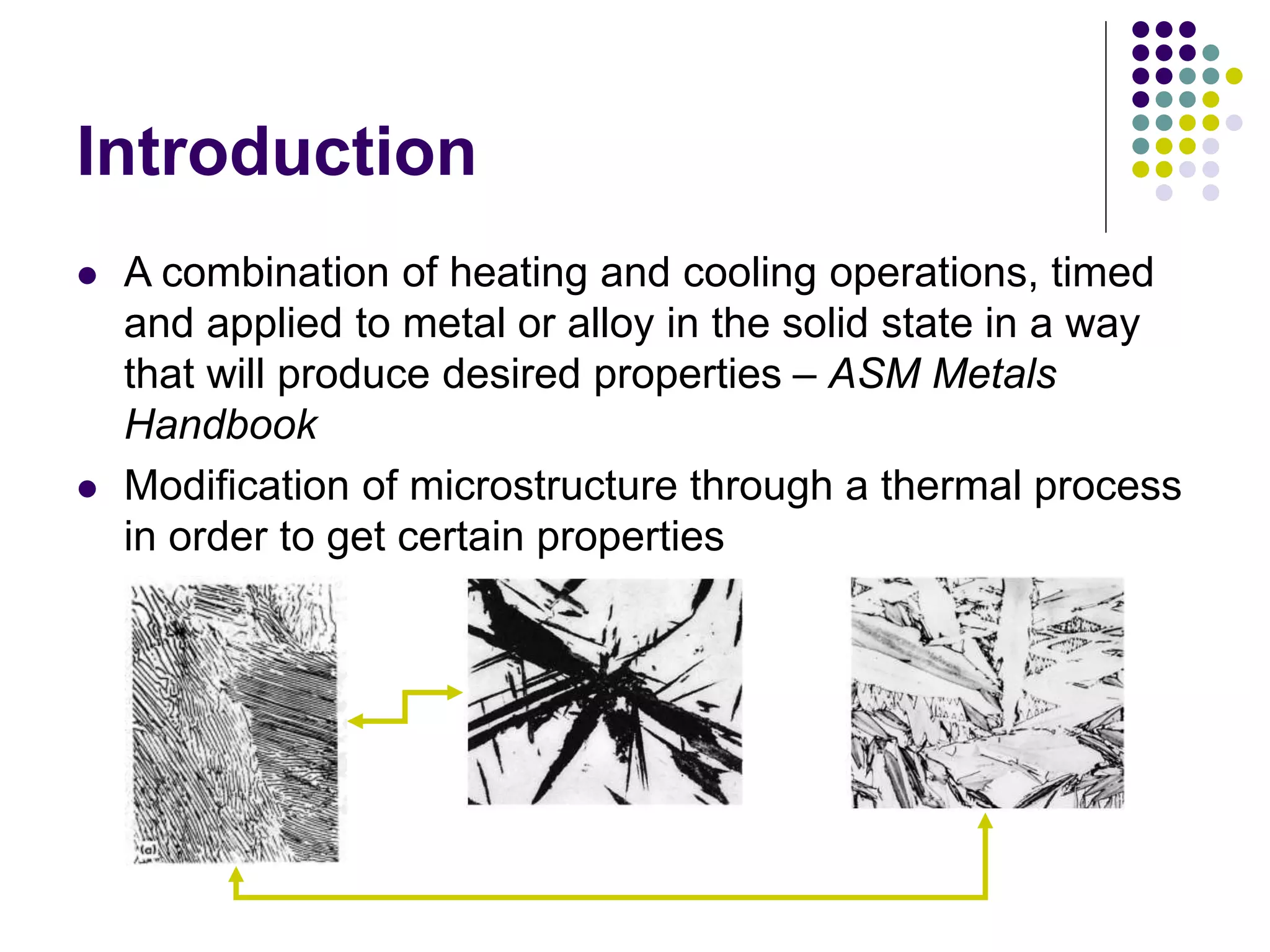
 A combination of heating and cooling operations, timed
and applied to metal or alloy in the solid state in a way
that will produce desired properties – ASM Metals
Handbook
 Modification of microstructure through a thermal process
in order to get certain properties
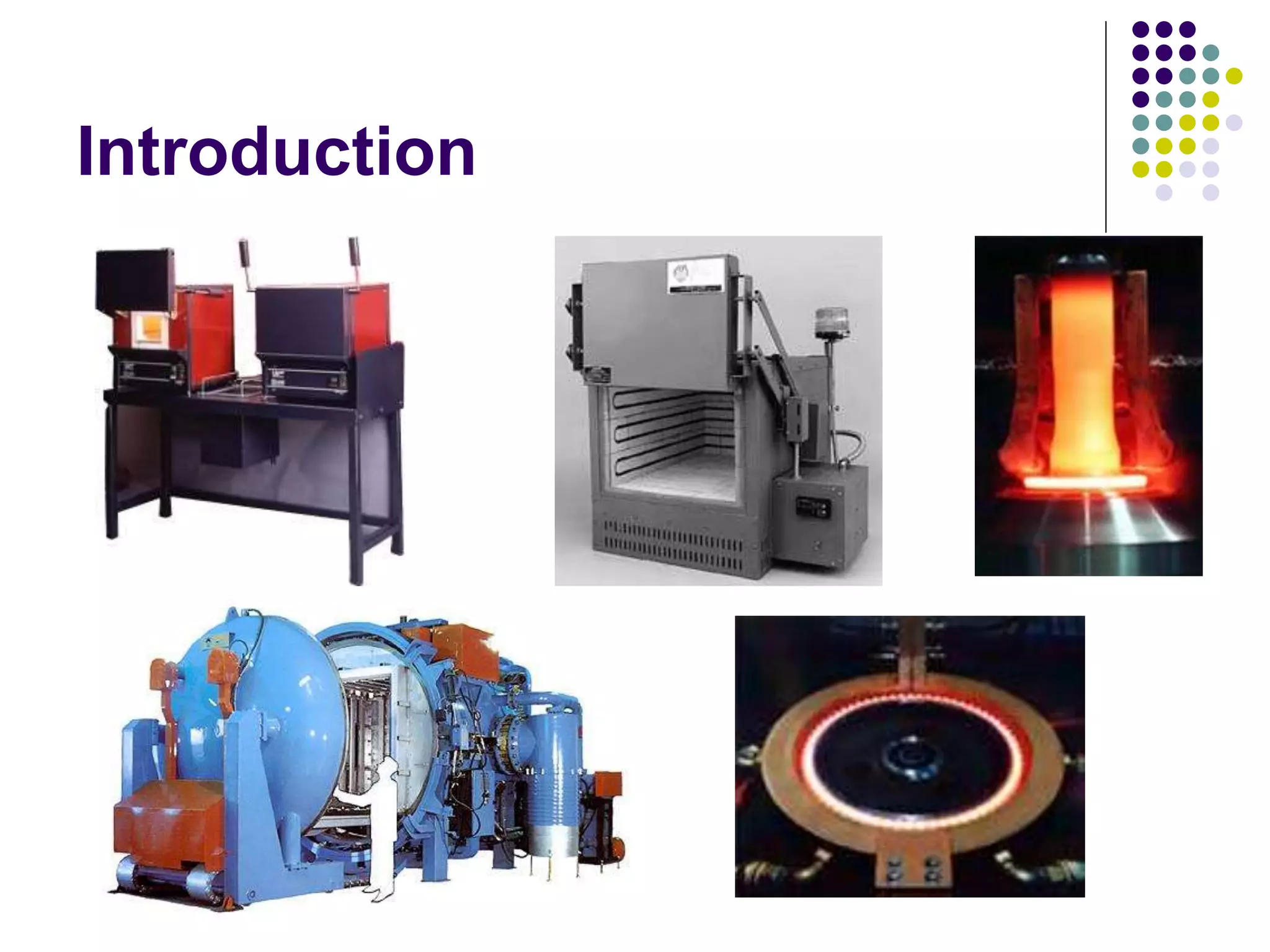
Introduction
 General procedure:
heating  holding  cooling
Holding (time)
Introduction
 Annealing
 Hardening
 Tempering
 Surface hardening
 Do not forget about I-T and C-T diagram
 More about steels
Introduction
Annealing
 A heat treatment in which a material is
exposed to an elevated temperature for an
extended time period and then slowly cooled
 Purposes:
- Relieve stresses
- Increase softness, ductility, and toughness
- Produce a specific microstructure
Annealing
 Stages: heating to desired temperature,
holding or soaking, then cooling
 Time and temperature dependence;
- Internal stress
- Sufficient time for transformation
- Diffusion
Annealing
 Process annealing
 Stress relief annealing
 Normalizing
 Full annealing
 Spheroidizing
 Homogenizing
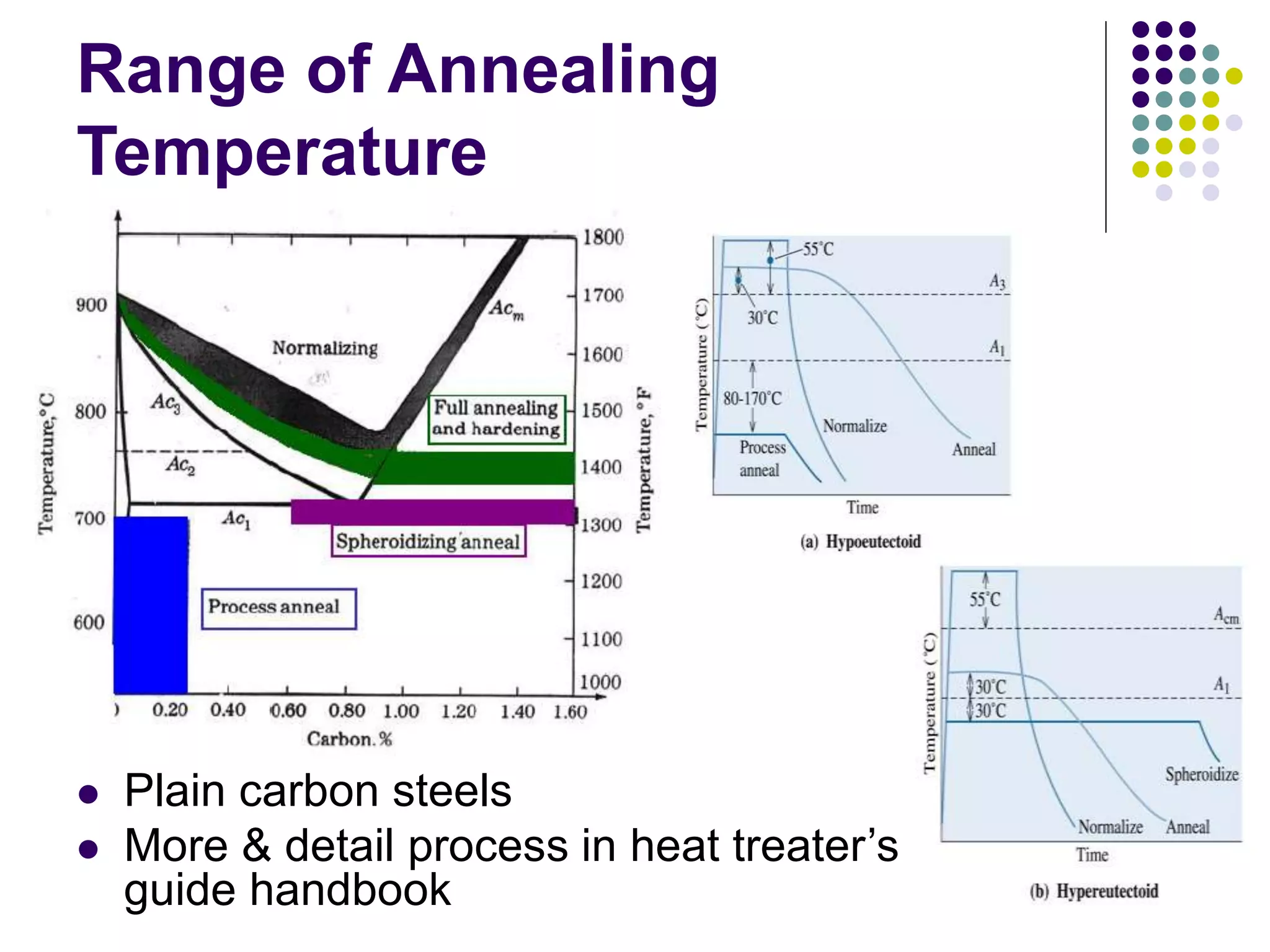
Range of Annealing
Temperature
 Plain carbon steels
 More & detail process in heat treater’s
guide handbook
Process annealing
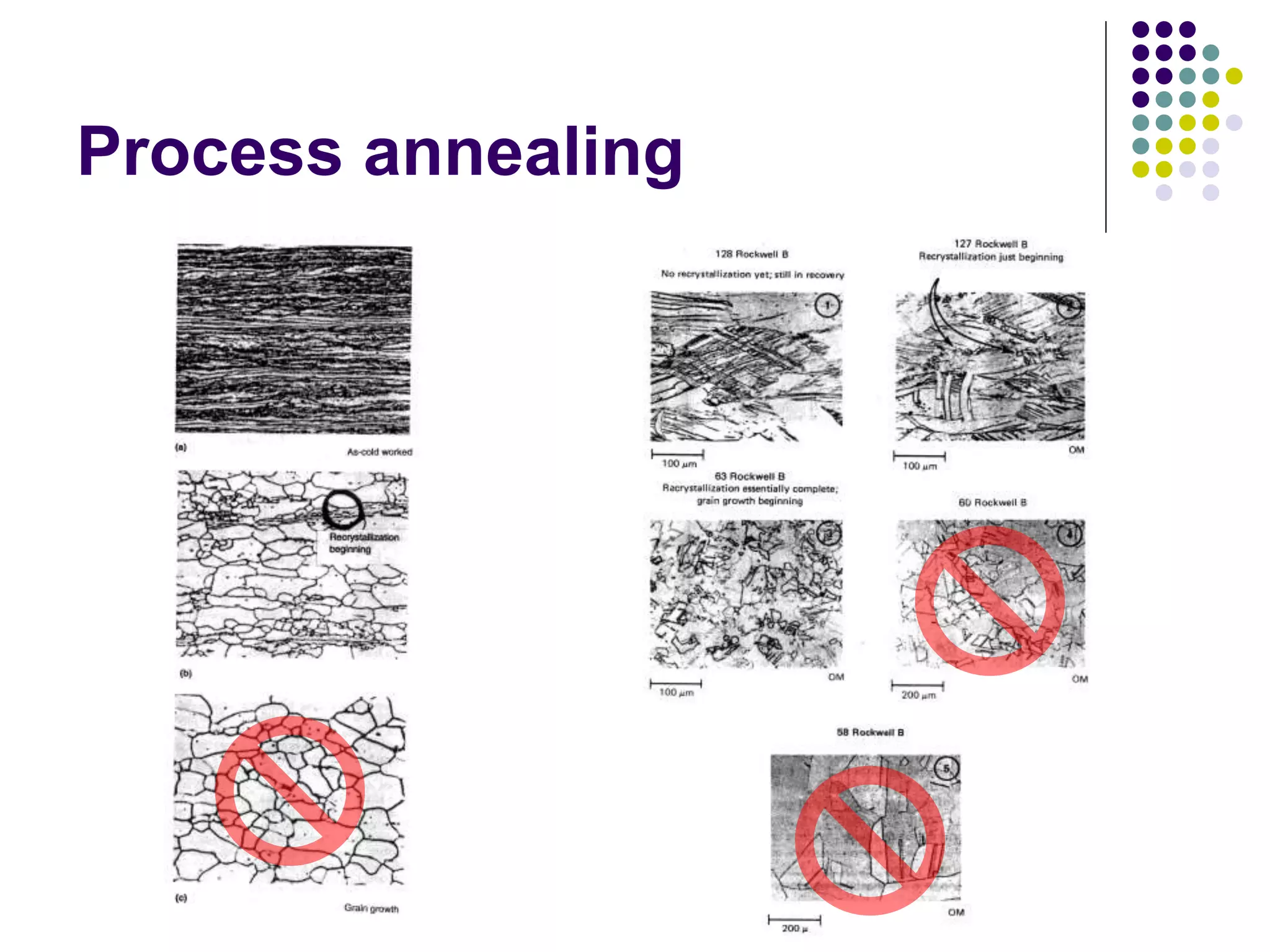
 Heat treatment that is used to negate the effects of
cold work—that is, to soften and increase the
ductility of a previously strain-hardened metal
 It is commonly utilized during fabrication procedures
that require extensive plastic deformation, to allow a
continuation of deformation without fracture or
excessive energy consumption
 Recovery and recrystallization processes are
allowed to occur  fine grained microstructure 
heat treatment stop before grain growth
Process annealing
 Surface oxidation or scaling may be prevented or
minimized by annealing at a relatively low
temperature (but above the recrystallization
temperature) or in a nonoxidizing atmosphere
 Some people call it recrystallization annealing
 Common: 1 hour at 600-650 C
 Yield strength and tensile strength drastically
reduced
 Commonly used in the production of steel wires,
nails, etc
Process annealing
Stress relief annealing
 Heat treatment that is used to eliminate internal or
residual stresses in metallic components
 Internal stress  distortion and warpage
 Source of internal stress:
- plastic deformation processes such as machining
and grinding
- nonuniform cooling of a piece that was processed
or fabricated at an elevated temperature, such as a
weld or a casting
- a phase transformation that is induced upon
cooling wherein parent and product phases have
different densities
Stress relief annealing
 General process: heating to the
recommended temperature, held there long
enough to attain a uniform temperature, and
finally cooled to room temperature in air
 Annealing temperature relative low, up to 678
C  effects of cold working and other heat
treatments are not affected
Full annealing
 Heat treatment that is used to fully soften a carbon
steel, such that the steel is in its most ductile state
 Often utilized in low- and medium carbon steels that
will be machined or will experience extensive plastic
deformation during a forming operation.
 Process: heating to about 50 C above A3 line for
hypoeutectoid steel, and 50 C above A1 for
hypereutectoid steel “austenitizing”  holding 
furnace cooled
Full annealing
 The microstructural product of this anneal is
coarse pearlite (in addition to proeutectoid
phase)
 Time consuming
 Yields a microstructure having small grains
and a uniform grain structure
 Typical cooling rate 1 C/min
Normalizing
 Heat treatment that is used to refine the
grains (i.e., to decrease the average grain
size) and produce a more uniform and
desirable size distribution; fine-grained
pearlitic steels are tougher than coarse-
grained ones
 Process: heating to about 55 C above A3 line
for hypoeutectoid steel, and 55 C above Acm
line for hypereutectoid steel “austenitizing”
 holding  air cooled
Normalizing
 Cooling rate 5-10 C/min
 Produce fine pearlite structurehigher
strength, hardness than product of full
annealing
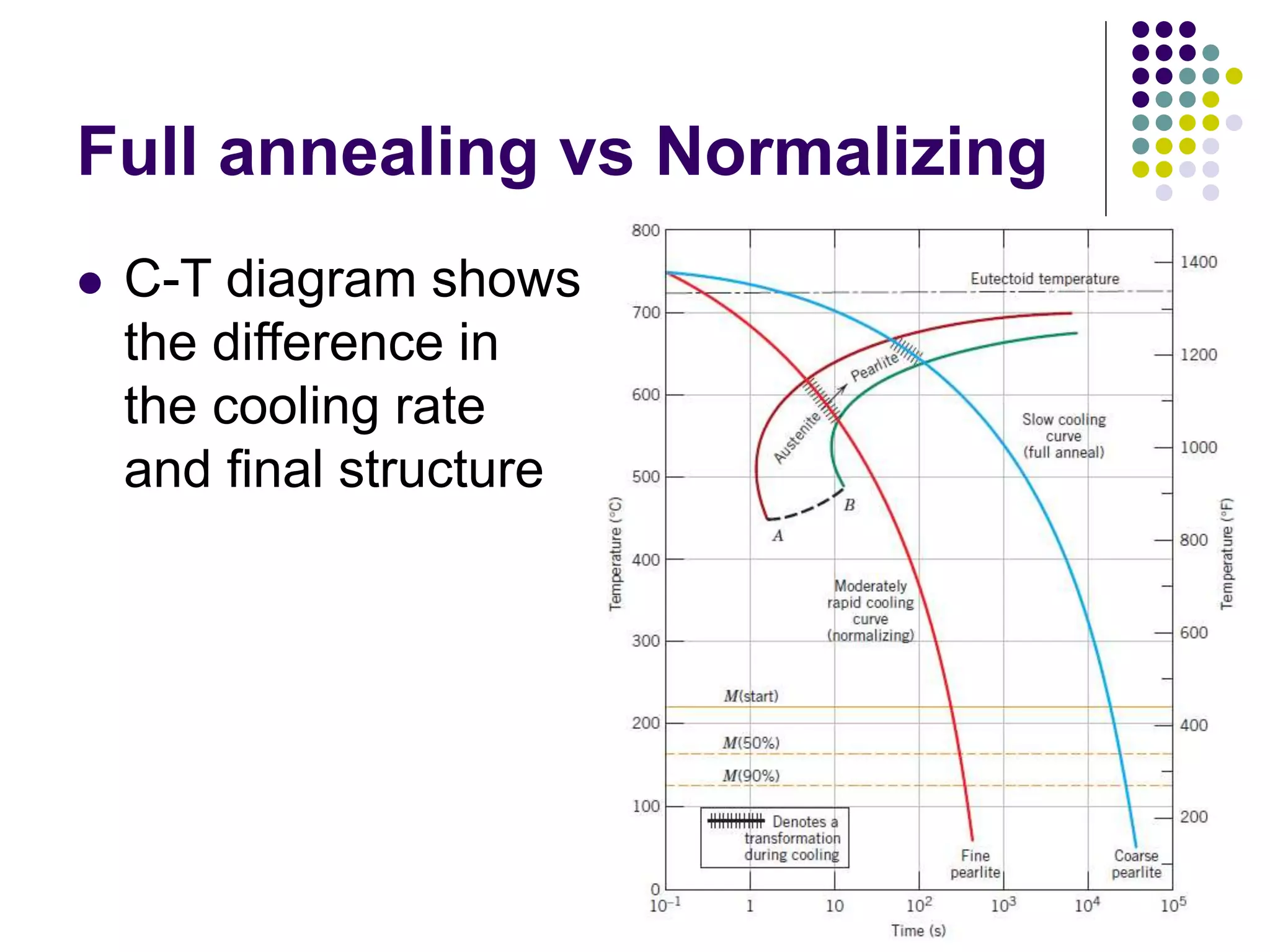
Full annealing vs Normalizing
 C-T diagram shows
the difference in
the cooling rate
and final structure
Full annealing vs Normalizing
 Microstructure 
mechanical properties
Spheroidizing
 Heat treatment that is used to develop spheroidite
structure
 Spheroidized steels have a maximum softness and
ductility and are easily machined or deformed 
improving machinability
 Common for medium and high carbon steels
 Coalescence of the Fe3C to form the spheroid particles
during spheroidizing
 To some degree, the rate at which spheroidite forms
depends on prior microstructure. For example, it is
slowest for pearlite, and the finer the pearlite, the more
rapid the rate. Also, prior cold work increases the
spheroidizing reaction rate.
Spheroidizing
Methods:
 Heating the alloy at a temperature just below the
eutectoid or at about 700 C in the +Fe3C region of
the phase diagram. If the precursor microstructure
contains pearlite, spheroidizing times will ordinarily
range between 15 and 25 h.
 Heating to a temperature just above the eutectoid
temperature, and then either cooling very slowly in
the furnace, or holding at a temperature just below
the eutectoid temperature.
 Heating and cooling alternately within about 50 C of
the A1 line
Spheroidizing
Homogenizing
 Heat treatment that is used to eliminate the
effect of segregation
 Time consuming
 Requires annealing after homogenizing
Mechanical properties after
annealing
 Difference of
microstructure
leads to difference
in mechanical
properties

HEAT_TREATMENT_annealing_ppt.ppt

  • 1.
  • 2.
    Introduction  A combinationof heating and cooling operations, timed and applied to metal or alloy in the solid state in a way that will produce desired properties – ASM Metals Handbook  Modification of microstructure through a thermal process in order to get certain properties
  • 3.
    Introduction  General procedure: heating holding  cooling Holding (time)
  • 4.
    Introduction  Annealing  Hardening Tempering  Surface hardening  Do not forget about I-T and C-T diagram  More about steels
  • 5.
  • 6.
    Annealing  A heattreatment in which a material is exposed to an elevated temperature for an extended time period and then slowly cooled  Purposes: - Relieve stresses - Increase softness, ductility, and toughness - Produce a specific microstructure
  • 7.
    Annealing  Stages: heatingto desired temperature, holding or soaking, then cooling  Time and temperature dependence; - Internal stress - Sufficient time for transformation - Diffusion
  • 8.
    Annealing  Process annealing Stress relief annealing  Normalizing  Full annealing  Spheroidizing  Homogenizing
  • 9.
    Range of Annealing Temperature Plain carbon steels  More & detail process in heat treater’s guide handbook
  • 10.
    Process annealing  Heattreatment that is used to negate the effects of cold work—that is, to soften and increase the ductility of a previously strain-hardened metal  It is commonly utilized during fabrication procedures that require extensive plastic deformation, to allow a continuation of deformation without fracture or excessive energy consumption  Recovery and recrystallization processes are allowed to occur  fine grained microstructure  heat treatment stop before grain growth
  • 11.
    Process annealing  Surfaceoxidation or scaling may be prevented or minimized by annealing at a relatively low temperature (but above the recrystallization temperature) or in a nonoxidizing atmosphere  Some people call it recrystallization annealing  Common: 1 hour at 600-650 C  Yield strength and tensile strength drastically reduced  Commonly used in the production of steel wires, nails, etc
  • 12.
  • 13.
    Stress relief annealing Heat treatment that is used to eliminate internal or residual stresses in metallic components  Internal stress  distortion and warpage  Source of internal stress: - plastic deformation processes such as machining and grinding - nonuniform cooling of a piece that was processed or fabricated at an elevated temperature, such as a weld or a casting - a phase transformation that is induced upon cooling wherein parent and product phases have different densities
  • 14.
    Stress relief annealing General process: heating to the recommended temperature, held there long enough to attain a uniform temperature, and finally cooled to room temperature in air  Annealing temperature relative low, up to 678 C  effects of cold working and other heat treatments are not affected
  • 15.
    Full annealing  Heattreatment that is used to fully soften a carbon steel, such that the steel is in its most ductile state  Often utilized in low- and medium carbon steels that will be machined or will experience extensive plastic deformation during a forming operation.  Process: heating to about 50 C above A3 line for hypoeutectoid steel, and 50 C above A1 for hypereutectoid steel “austenitizing”  holding  furnace cooled
  • 16.
    Full annealing  Themicrostructural product of this anneal is coarse pearlite (in addition to proeutectoid phase)  Time consuming  Yields a microstructure having small grains and a uniform grain structure  Typical cooling rate 1 C/min
  • 17.
    Normalizing  Heat treatmentthat is used to refine the grains (i.e., to decrease the average grain size) and produce a more uniform and desirable size distribution; fine-grained pearlitic steels are tougher than coarse- grained ones  Process: heating to about 55 C above A3 line for hypoeutectoid steel, and 55 C above Acm line for hypereutectoid steel “austenitizing”  holding  air cooled
  • 18.
    Normalizing  Cooling rate5-10 C/min  Produce fine pearlite structurehigher strength, hardness than product of full annealing
  • 19.
    Full annealing vsNormalizing  C-T diagram shows the difference in the cooling rate and final structure
  • 20.
    Full annealing vsNormalizing  Microstructure  mechanical properties
  • 21.
    Spheroidizing  Heat treatmentthat is used to develop spheroidite structure  Spheroidized steels have a maximum softness and ductility and are easily machined or deformed  improving machinability  Common for medium and high carbon steels  Coalescence of the Fe3C to form the spheroid particles during spheroidizing  To some degree, the rate at which spheroidite forms depends on prior microstructure. For example, it is slowest for pearlite, and the finer the pearlite, the more rapid the rate. Also, prior cold work increases the spheroidizing reaction rate.
  • 22.
    Spheroidizing Methods:  Heating thealloy at a temperature just below the eutectoid or at about 700 C in the +Fe3C region of the phase diagram. If the precursor microstructure contains pearlite, spheroidizing times will ordinarily range between 15 and 25 h.  Heating to a temperature just above the eutectoid temperature, and then either cooling very slowly in the furnace, or holding at a temperature just below the eutectoid temperature.  Heating and cooling alternately within about 50 C of the A1 line
  • 23.
  • 24.
    Homogenizing  Heat treatmentthat is used to eliminate the effect of segregation  Time consuming  Requires annealing after homogenizing
  • 25.
    Mechanical properties after annealing Difference of microstructure leads to difference in mechanical properties