THIRUNAVUKARASU.H
13MY12
PSG TECH KOVAI
Annealing , normalizing ,
quenching , martensitic
transformation .
Annealing
 heat treatment that alters the
microstructure of a material
causing changes in properties
such as strength, hardness, and
ductility
 It the process of heating solid metal
to high temperatures and cooling it
slowly so that its particles arrange
into a defined lattice
Stages in annealing
 Heating to the desired temperature ,
 Holding or soaking at that temperature,
 Cooling or quenching ,usually to room
temperature .
 In practice annealing concept is most widely
used in heat treatment of iron and steals
Purpose of annealing
 It is used to achieve one or more of the following
purpose .
1. To relive or remove stresses
2. To include softness
3. To alter ductility
, toughness, electrical, magnetic.
4. To Refine grain size
5. To remove gases
6. To produce a definite microstructure .
Application
 Annealing process is employed in following
application
 Casting
 Forging
 Rolled stock
 Press work ….
Types of annealing
 Full annealing
 Process annealing
 Stress relief annealing
 Re crystallization annealing , and
 Spheroidise annealing.
Full annealing
 Heating the steal to a temperature at or near the
critical point , holding there for a time period and
then allowing it to cool slowly in the furnace itself .
Example
In full annealing of hypoeutectoid steels less
than 0.77% is heated to 723 to 910 C above A3
line convert to single phase austenite cooled
slowly in room temperature .
Resulting structure is coarse pearlite with
excess of ferrite it is quite soft and more ductile
 cooling rate of full annealing is 30-40 C
Full annealing
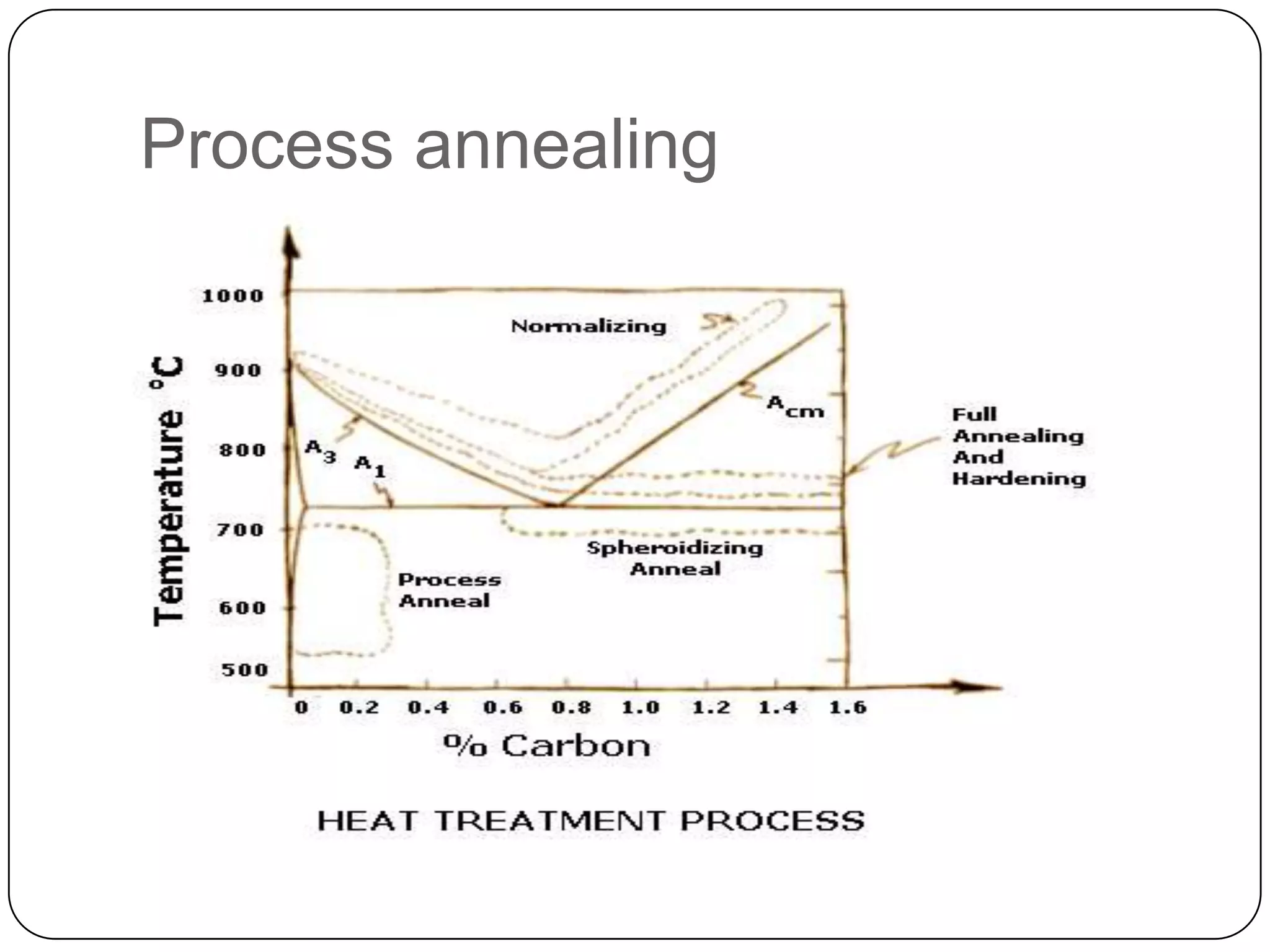
Process annealing
 Process annealing is a heat treatment that is often
used to soften and increase the ductility of a
previously strain hardened metal . Ductility is
important in shaping and creating a more refined
piece of work through processes such
as rolling, drawing, forging, spinning, extruding and he
ading.
 Example
it is extensively employed for steel wires and sheet
products (especially low carbon steels) A1
temperature and cooled at any desired rate
 The temperature range for process annealing ranges
from 260 °C (500 °F) to 760 °C (1400 °F), depending
on the alloy in question.
Process annealing
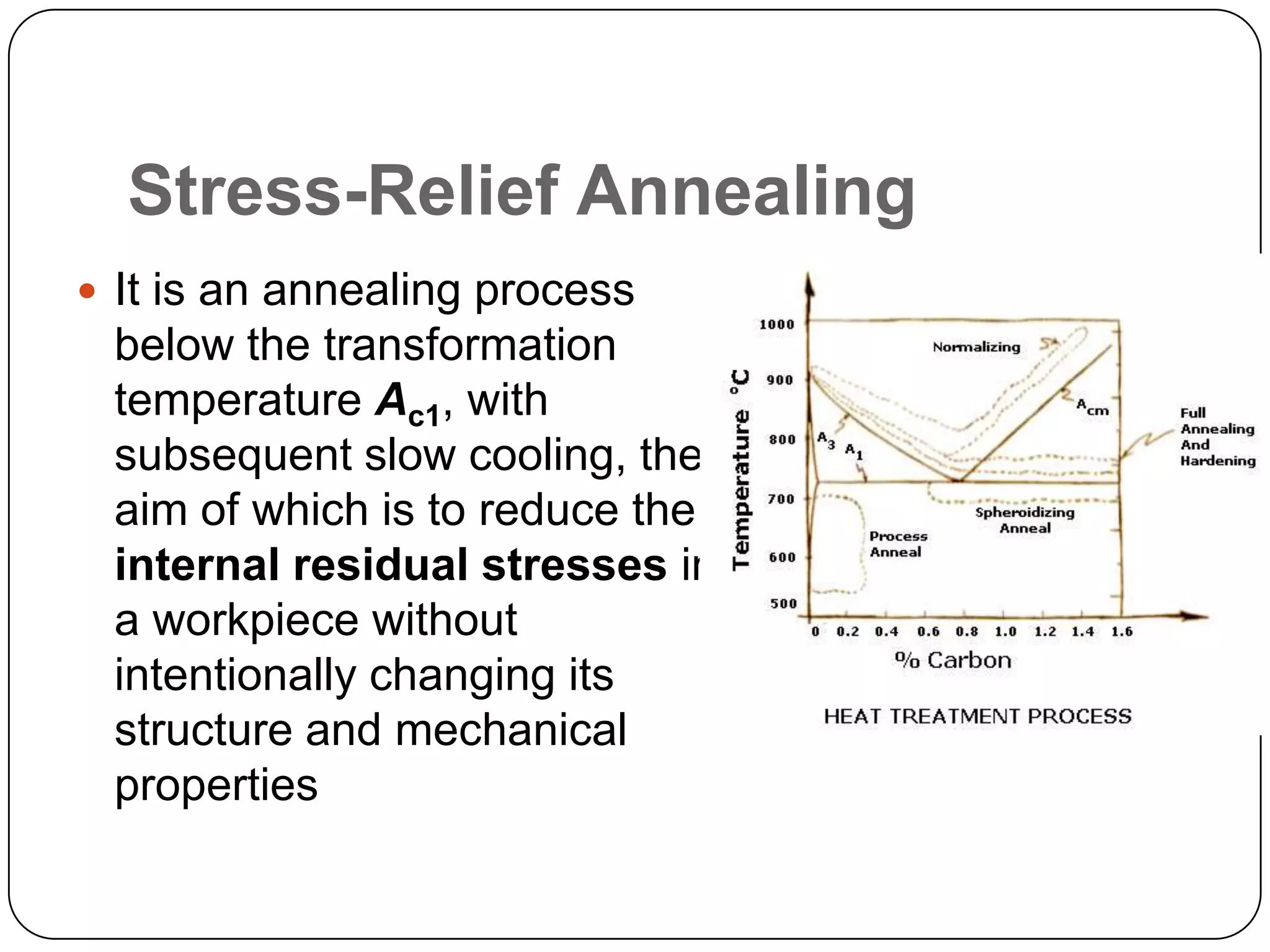
Stress-Relief Annealing
 It is an annealing process
below the transformation
temperature Ac1, with
subsequent slow cooling, the
aim of which is to reduce the
internal residual stresses in
a workpiece without
intentionally changing its
structure and mechanical
properties
Causes of Residual Stresses
1. Thermal factors (e.g., thermal stresses
caused by temperature gradients within the
workpiece during heating or cooling)
2. Mechanical factors (e.g., cold-working)
3. Metallurgical factors (e.g., transformation
of the microstructure)
How to Remove Residual Stresses?
 R.S. can be reduced only by a plastic deformation
in the microstructure.
 This requires that the yield strength of the
material be lowered below the value of the residual
stresses.
 The more the yield strength is lowered, the greater
the plastic deformation and correspondingly the
greater the possibility or reducing the residual
stresses
 The yield strength and the ultimate tensile strength
of the steel both decrease with increasing
temperature
Stress-Relief Annealing
Process
 For plain carbon and low-alloy steels the
temperature to which the specimen is heated is
usually between 450 and 650˚C, whereas for
hot-working tool steels and high-speed steels it
is between 600 and 750˚C
 This treatment will not cause any phase
changes, but recrystallization may take place.
 Machining allowance sufficient to compensate
for any warping resulting from stress relieving
should be provided
Stress-Relief Annealing – R.S.
 In the heat treatment of metals, quenching or rapid
cooling is the cause of the greatest residual
stresses
 To activate plastic deformations, the local residual
stresses must be above the yield strength of the
material.
 Because of this fact, steels that have a high yield
strength at elevated temperatures can withstand
higher levels of residual stress than those that
have a low yield strength at elevated temperatures
 Soaking time also has an influence on the effect of
stress-relief annealing
Spheroidise annealing
 The process is limited to steels in excess of 0.5% carbon
and consists of heating the steel to temperature about A1
(727°C). At this temperature any cold worked ferrite will
recrystallise and the iron carbide present in pearlite will
form as spheroids or “ball up”. As a result of change of
carbides shape the strength and hardness are reduced.
 To remove coarse pearlite and making machining process
easy .
 It forms spherodite structure of maximum soft and ductility
easy to machining and deforming.
Objectives
 To soften steels
 To increase ductility and toughness
 To improve machinablity and formability
Materials
 Spheroidzing is extensively employed for
 Medium carbon steel
 High carbon (tool steel)
2. Normalizing
 A heat treatment process consisting
of austenitizing at temperatures of
30–80˚C above the AC3
transformation temperature followed
by slow cooling (usually in air)
 The aim of which is to obtain a fine-
grained, uniformly distributed,
ferrite–pearlite structure
 Normalizing is applied mainly to
unalloyed and low-alloy
hypoeutectoid steels
 For hypereutectoid steels the
austenitizing temperature is 30–
80˚C above the AC1 or ACm
Quenching
 Quenching is the rapid cooling of metal or an alloy
from an elevated temperature.
 This is usually done with water, brine, oil, polymer, or
even forced or still air.
 There are two types of quenching – the first is cooling
to obtain an acceptable microstructure and
mechanical properties that will meet minimum specs
after tempering.
 The second consists of rapid cooling of iron-base
alloys and nonferrous metals to retain uniformity in
the material. Quenching is performed to control the
transformation of austentite and to form the
microstructure. When only selected areas of the
material are quenched, the process is called selective
quenching
Quenching
 Soaking temperature 30-50°C above A3 or A1, then fast cooling
(in water or oil) with cooling rate exceeding a critical value. The
critical cooling rate is required to obtain non-equilibrium
structure called martensite. During fast cooling austenite cannot
transform to ferrite and pearlite by atomic diffusion.
 Martensite is supersaturated solid solution of carbon in α-iron
(greatly supersaturated ferrite) with tetragonal body centered
structure. Martensite is very hard and brittle. Martensite has a
“needle-like” structure.
 Kinetics of martensite transformation is presented by TTT
diagrams (Time-Temperature-Transformation). With the
quenching-hardening process the speed of quenching can affect
the amount of marteniste formed. This severe cooling rate will
be affected by the component size and quenching medium type
Martensite, “Martensitic
Transformation”
 In an alloy, martensite is a metastable transitional structure between two
allotropic modifications whose abilities to dissolve a solute differ, the high
temperature phase having the greater solubility.
 The amount of high temperature phase transformed to martensite depends
upon the temperature attained in cooling. Martensite is also a metastable
phase of steel, formed by the transformation of austentite below a specified
temperature.
 Martensite is characterized by an interstitial supersaturated solid solution of
carbon in iron having a body-centered tetragonal lattice that resembles an
acicular, needlelike pattern that can be observed in laboratory testing.
 Martensitic transformation is a reaction that takes place in some metals
during the cooling phase causing the formation of the acircular structures
called “martensite
End

Annealing , normalizing , quenching , martensitic transformation (1)

  • 1.
    THIRUNAVUKARASU.H 13MY12 PSG TECH KOVAI Annealing, normalizing , quenching , martensitic transformation .
  • 2.
    Annealing  heat treatmentthat alters the microstructure of a material causing changes in properties such as strength, hardness, and ductility  It the process of heating solid metal to high temperatures and cooling it slowly so that its particles arrange into a defined lattice
  • 3.
    Stages in annealing Heating to the desired temperature ,  Holding or soaking at that temperature,  Cooling or quenching ,usually to room temperature .  In practice annealing concept is most widely used in heat treatment of iron and steals
  • 4.
    Purpose of annealing It is used to achieve one or more of the following purpose . 1. To relive or remove stresses 2. To include softness 3. To alter ductility , toughness, electrical, magnetic. 4. To Refine grain size 5. To remove gases 6. To produce a definite microstructure .
  • 5.
    Application  Annealing processis employed in following application  Casting  Forging  Rolled stock  Press work ….
  • 6.
    Types of annealing Full annealing  Process annealing  Stress relief annealing  Re crystallization annealing , and  Spheroidise annealing.
  • 7.
    Full annealing  Heatingthe steal to a temperature at or near the critical point , holding there for a time period and then allowing it to cool slowly in the furnace itself . Example In full annealing of hypoeutectoid steels less than 0.77% is heated to 723 to 910 C above A3 line convert to single phase austenite cooled slowly in room temperature . Resulting structure is coarse pearlite with excess of ferrite it is quite soft and more ductile  cooling rate of full annealing is 30-40 C
  • 8.
  • 9.
    Process annealing  Processannealing is a heat treatment that is often used to soften and increase the ductility of a previously strain hardened metal . Ductility is important in shaping and creating a more refined piece of work through processes such as rolling, drawing, forging, spinning, extruding and he ading.  Example it is extensively employed for steel wires and sheet products (especially low carbon steels) A1 temperature and cooled at any desired rate  The temperature range for process annealing ranges from 260 °C (500 °F) to 760 °C (1400 °F), depending on the alloy in question.
  • 10.
  • 11.
    Stress-Relief Annealing  Itis an annealing process below the transformation temperature Ac1, with subsequent slow cooling, the aim of which is to reduce the internal residual stresses in a workpiece without intentionally changing its structure and mechanical properties
  • 12.
    Causes of ResidualStresses 1. Thermal factors (e.g., thermal stresses caused by temperature gradients within the workpiece during heating or cooling) 2. Mechanical factors (e.g., cold-working) 3. Metallurgical factors (e.g., transformation of the microstructure)
  • 13.
    How to RemoveResidual Stresses?  R.S. can be reduced only by a plastic deformation in the microstructure.  This requires that the yield strength of the material be lowered below the value of the residual stresses.  The more the yield strength is lowered, the greater the plastic deformation and correspondingly the greater the possibility or reducing the residual stresses  The yield strength and the ultimate tensile strength of the steel both decrease with increasing temperature
  • 14.
    Stress-Relief Annealing Process  Forplain carbon and low-alloy steels the temperature to which the specimen is heated is usually between 450 and 650˚C, whereas for hot-working tool steels and high-speed steels it is between 600 and 750˚C  This treatment will not cause any phase changes, but recrystallization may take place.  Machining allowance sufficient to compensate for any warping resulting from stress relieving should be provided
  • 15.
    Stress-Relief Annealing –R.S.  In the heat treatment of metals, quenching or rapid cooling is the cause of the greatest residual stresses  To activate plastic deformations, the local residual stresses must be above the yield strength of the material.  Because of this fact, steels that have a high yield strength at elevated temperatures can withstand higher levels of residual stress than those that have a low yield strength at elevated temperatures  Soaking time also has an influence on the effect of stress-relief annealing
  • 16.
    Spheroidise annealing  Theprocess is limited to steels in excess of 0.5% carbon and consists of heating the steel to temperature about A1 (727°C). At this temperature any cold worked ferrite will recrystallise and the iron carbide present in pearlite will form as spheroids or “ball up”. As a result of change of carbides shape the strength and hardness are reduced.  To remove coarse pearlite and making machining process easy .  It forms spherodite structure of maximum soft and ductility easy to machining and deforming. Objectives  To soften steels  To increase ductility and toughness  To improve machinablity and formability
  • 17.
    Materials  Spheroidzing isextensively employed for  Medium carbon steel  High carbon (tool steel)
  • 18.
    2. Normalizing  Aheat treatment process consisting of austenitizing at temperatures of 30–80˚C above the AC3 transformation temperature followed by slow cooling (usually in air)  The aim of which is to obtain a fine- grained, uniformly distributed, ferrite–pearlite structure  Normalizing is applied mainly to unalloyed and low-alloy hypoeutectoid steels  For hypereutectoid steels the austenitizing temperature is 30– 80˚C above the AC1 or ACm
  • 19.
    Quenching  Quenching isthe rapid cooling of metal or an alloy from an elevated temperature.  This is usually done with water, brine, oil, polymer, or even forced or still air.  There are two types of quenching – the first is cooling to obtain an acceptable microstructure and mechanical properties that will meet minimum specs after tempering.  The second consists of rapid cooling of iron-base alloys and nonferrous metals to retain uniformity in the material. Quenching is performed to control the transformation of austentite and to form the microstructure. When only selected areas of the material are quenched, the process is called selective quenching
  • 20.
    Quenching  Soaking temperature30-50°C above A3 or A1, then fast cooling (in water or oil) with cooling rate exceeding a critical value. The critical cooling rate is required to obtain non-equilibrium structure called martensite. During fast cooling austenite cannot transform to ferrite and pearlite by atomic diffusion.  Martensite is supersaturated solid solution of carbon in α-iron (greatly supersaturated ferrite) with tetragonal body centered structure. Martensite is very hard and brittle. Martensite has a “needle-like” structure.  Kinetics of martensite transformation is presented by TTT diagrams (Time-Temperature-Transformation). With the quenching-hardening process the speed of quenching can affect the amount of marteniste formed. This severe cooling rate will be affected by the component size and quenching medium type
  • 21.
    Martensite, “Martensitic Transformation”  Inan alloy, martensite is a metastable transitional structure between two allotropic modifications whose abilities to dissolve a solute differ, the high temperature phase having the greater solubility.  The amount of high temperature phase transformed to martensite depends upon the temperature attained in cooling. Martensite is also a metastable phase of steel, formed by the transformation of austentite below a specified temperature.  Martensite is characterized by an interstitial supersaturated solid solution of carbon in iron having a body-centered tetragonal lattice that resembles an acicular, needlelike pattern that can be observed in laboratory testing.  Martensitic transformation is a reaction that takes place in some metals during the cooling phase causing the formation of the acircular structures called “martensite
  • 22.

Editor's Notes

  • #12 Critical Temperature of Steel is 724°C
  • #14 Last -> Because of this, stress-relief annealing means a through-heating process at a correspondingly high temperature
  • #16 … A high level of residual stress is generally to be expected with workpieces that have a large cross section, are quenched at a high cooling rate, and are made of a steel of low hardenability..… i.e., on the reduction of residual stressesSoaking time -> The hold time at maximum temperature for a heat-treatment process
  • #19 Hypoeutectoid -> At L.H.S of Eutectoid pointFor hypereutectoid steels, normalizing is a special process