Letter to Editor
LETTER TO THE
EDITOR
mohammad.kool@hotmail.com
WHAT IS A LETTER TO THE EDITOR?
 You feel strongly about an issue, and you want to let people know what you think.
 You believe you can even influence people to take some action if you speak your
mind.
 But, you want to reach an audience larger than just your friends or your group
membership.
 Letters to the editor can be an effective way to get the word out.
 They can take a position for or against an issue, or simply inform, or both.
………………………………………….Continued
 They can convince readers by using emotions, or facts, or emotions and facts
combined.
 Letters to the editor are usually short and tight, rarely longer than 300 words.
WHY SHOULD YOU WRITE A LETTER TO
THE EDITOR?
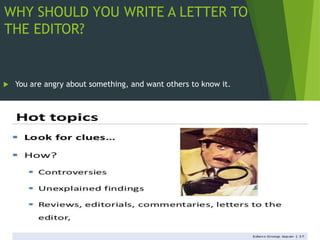
 You are angry about something, and want others to know it.
………………………………..Continued
 Or you want to.
 You think that an issue is so important that you have to speak out.
 Part of your group's strategy is to persuade others to take a specific action.
 Suggest an idea to others.
 Influence public opinion.
 Educate the general public on a specific matter.
 Influence policy-makers or elected officials directly or indirectly.
 Publicize the work of your group and attract volunteers or program participants.
HOW DO YOU WRITE A LETTER TO
THE EDITOR?
 OPEN THE LETTER WITH A SIMPLE SALUTATION.
Don't worry if you don't know the editor's name. A simple “Dear Editor” is
sufficient. If you have the editor's name, you should use it to increase the
possibilities of your letter being read.
 GRAB THE READER'S ATTENTION.
Your opening sentence is very important. It should tell readers what you’re
writing about, and make them want to read more.
EXPLAIN WHAT THE LETTER IS
ABOUT AT THE START.
 Throughout your letter, remember the rule.
 Be quick
 Be concise, and then
 Be quiet.
 Don't make the editor or the general public wait to find
out what you want to say. Tell them your key point at
the beginning.
EXPLAIN WHY THE ISSUE IS
IMPORTANT.
 If you are motivated enough to write a letter to a
newspaper or magazine, the importance of your topic
may seem clear to you.
 Remember, though, that the general public probably
doesn't share your background or the interest.
 Explain the issue and its importance simply. Use plain
language that most people will understand.
………………………………Continued
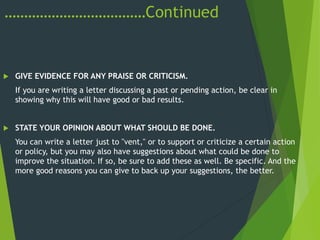
 GIVE EVIDENCE FOR ANY PRAISE OR CRITICISM.
If you are writing a letter discussing a past or pending action, be clear in
showing why this will have good or bad results.
 STATE YOUR OPINION ABOUT WHAT SHOULD BE DONE.
You can write a letter just to ''vent," or to support or criticize a certain action
or policy, but you may also have suggestions about what could be done to
improve the situation. If so, be sure to add these as well. Be specific. And the
more good reasons you can give to back up your suggestions, the better.
………………………….….Continued
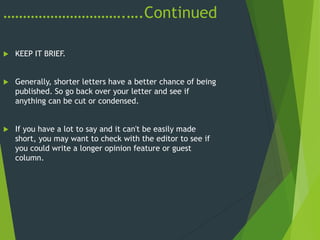
 KEEP IT BRIEF.
 Generally, shorter letters have a better chance of being
published. So go back over your letter and see if
anything can be cut or condensed.
 If you have a lot to say and it can't be easily made
short, you may want to check with the editor to see if
you could write a longer opinion feature or guest
column.
…………………………..Continued
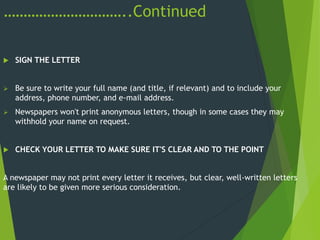
 SIGN THE LETTER
 Be sure to write your full name (and title, if relevant) and to include your
address, phone number, and e-mail address.
 Newspapers won't print anonymous letters, though in some cases they may
withhold your name on request.
 CHECK YOUR LETTER TO MAKE SURE IT'S CLEAR AND TO THE POINT
A newspaper may not print every letter it receives, but clear, well-written letters
are likely to be given more serious consideration.
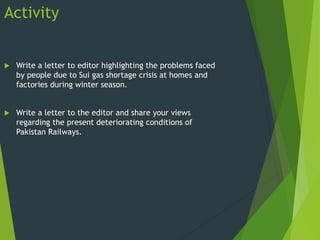
Activity
 Write a letter to editor highlighting the problems faced
by people due to Sui gas shortage crisis at homes and
factories during winter season.
 Write a letter to the editor and share your views
regarding the present deteriorating conditions of
Pakistan Railways.
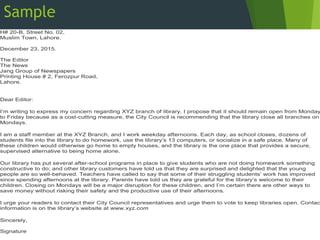
Sample
H# 20-B, Street No. 02,
Muslim Town, Lahore.
December 23, 2015.
The Editor
The News
Jang Group of Newspapers
Printing House # 2, Ferozpur Road,
Lahore.
Dear Editor:
I’m writing to express my concern regarding XYZ branch of library. I propose that it should remain open from Monday
to Friday because as a cost-cutting measure, the City Council is recommending that the library close all branches on
Mondays.
I am a staff member at the XYZ Branch, and I work weekday afternoons. Each day, as school closes, dozens of
students file into the library to do homework, use the library’s 13 computers, or socialize in a safe place. Many of
these children would otherwise go home to empty houses, and the library is the one place that provides a secure,
supervised alternative to being home alone.
Our library has put several after-school programs in place to give students who are not doing homework something
constructive to do; and other library customers have told us that they are surprised and delighted that the young
people are so well-behaved. Teachers have called to say that some of their struggling students’ work has improved
since spending afternoons at the library. Parents have told us they are grateful for the library’s welcome to their
children. Closing on Mondays will be a major disruption for these children, and I’m certain there are other ways to
save money without risking their safety and the productive use of their afternoons.
I urge your readers to contact their City Council representatives and urge them to vote to keep libraries open. Contac
information is on the library’s website at www.xyz.com
Sincerely,
Signature
Thank You

Letter to editor

  • 1.
    Letter to Editor LETTERTO THE EDITOR mohammad.kool@hotmail.com
  • 2.
    WHAT IS ALETTER TO THE EDITOR?  You feel strongly about an issue, and you want to let people know what you think.  You believe you can even influence people to take some action if you speak your mind.  But, you want to reach an audience larger than just your friends or your group membership.  Letters to the editor can be an effective way to get the word out.  They can take a position for or against an issue, or simply inform, or both.
  • 3.
    ………………………………………….Continued  They canconvince readers by using emotions, or facts, or emotions and facts combined.  Letters to the editor are usually short and tight, rarely longer than 300 words.
  • 4.
    WHY SHOULD YOUWRITE A LETTER TO THE EDITOR?  You are angry about something, and want others to know it.
  • 5.
    ………………………………..Continued  Or youwant to.  You think that an issue is so important that you have to speak out.  Part of your group's strategy is to persuade others to take a specific action.  Suggest an idea to others.  Influence public opinion.  Educate the general public on a specific matter.  Influence policy-makers or elected officials directly or indirectly.  Publicize the work of your group and attract volunteers or program participants.
  • 6.
    HOW DO YOUWRITE A LETTER TO THE EDITOR?  OPEN THE LETTER WITH A SIMPLE SALUTATION. Don't worry if you don't know the editor's name. A simple “Dear Editor” is sufficient. If you have the editor's name, you should use it to increase the possibilities of your letter being read.  GRAB THE READER'S ATTENTION. Your opening sentence is very important. It should tell readers what you’re writing about, and make them want to read more.
  • 7.
    EXPLAIN WHAT THELETTER IS ABOUT AT THE START.  Throughout your letter, remember the rule.  Be quick  Be concise, and then  Be quiet.  Don't make the editor or the general public wait to find out what you want to say. Tell them your key point at the beginning.
  • 8.
    EXPLAIN WHY THEISSUE IS IMPORTANT.  If you are motivated enough to write a letter to a newspaper or magazine, the importance of your topic may seem clear to you.  Remember, though, that the general public probably doesn't share your background or the interest.  Explain the issue and its importance simply. Use plain language that most people will understand.
  • 9.
    ………………………………Continued  GIVE EVIDENCEFOR ANY PRAISE OR CRITICISM. If you are writing a letter discussing a past or pending action, be clear in showing why this will have good or bad results.  STATE YOUR OPINION ABOUT WHAT SHOULD BE DONE. You can write a letter just to ''vent," or to support or criticize a certain action or policy, but you may also have suggestions about what could be done to improve the situation. If so, be sure to add these as well. Be specific. And the more good reasons you can give to back up your suggestions, the better.
  • 10.
    ………………………….….Continued  KEEP ITBRIEF.  Generally, shorter letters have a better chance of being published. So go back over your letter and see if anything can be cut or condensed.  If you have a lot to say and it can't be easily made short, you may want to check with the editor to see if you could write a longer opinion feature or guest column.
  • 11.
    …………………………..Continued  SIGN THELETTER  Be sure to write your full name (and title, if relevant) and to include your address, phone number, and e-mail address.  Newspapers won't print anonymous letters, though in some cases they may withhold your name on request.  CHECK YOUR LETTER TO MAKE SURE IT'S CLEAR AND TO THE POINT A newspaper may not print every letter it receives, but clear, well-written letters are likely to be given more serious consideration.
  • 12.
    Activity  Write aletter to editor highlighting the problems faced by people due to Sui gas shortage crisis at homes and factories during winter season.  Write a letter to the editor and share your views regarding the present deteriorating conditions of Pakistan Railways.
  • 13.
    Sample H# 20-B, StreetNo. 02, Muslim Town, Lahore. December 23, 2015. The Editor The News Jang Group of Newspapers Printing House # 2, Ferozpur Road, Lahore. Dear Editor: I’m writing to express my concern regarding XYZ branch of library. I propose that it should remain open from Monday to Friday because as a cost-cutting measure, the City Council is recommending that the library close all branches on Mondays. I am a staff member at the XYZ Branch, and I work weekday afternoons. Each day, as school closes, dozens of students file into the library to do homework, use the library’s 13 computers, or socialize in a safe place. Many of these children would otherwise go home to empty houses, and the library is the one place that provides a secure, supervised alternative to being home alone. Our library has put several after-school programs in place to give students who are not doing homework something constructive to do; and other library customers have told us that they are surprised and delighted that the young people are so well-behaved. Teachers have called to say that some of their struggling students’ work has improved since spending afternoons at the library. Parents have told us they are grateful for the library’s welcome to their children. Closing on Mondays will be a major disruption for these children, and I’m certain there are other ways to save money without risking their safety and the productive use of their afternoons. I urge your readers to contact their City Council representatives and urge them to vote to keep libraries open. Contac information is on the library’s website at www.xyz.com Sincerely, Signature
  • 14.