Properties
and
Measuring
Variables
GasesGases
REVIEW
Properties of GasesProperties of Gases
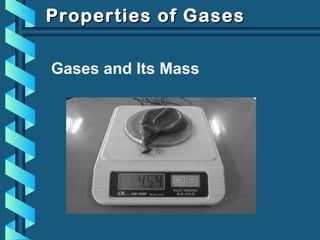
Gases and Its Mass
Properties of GasesProperties of Gases
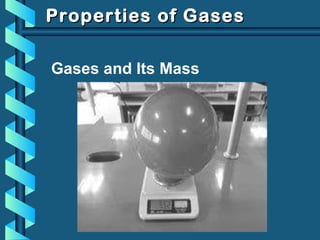
Gases and Its Mass
Properties of GasesProperties of Gases
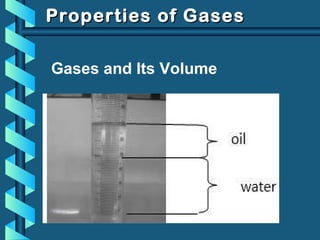
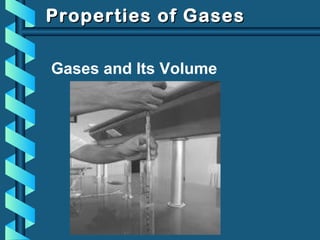
Gases and Its Volume
Properties of GasesProperties of Gases
Gases and Its Volume
Properties of GasesProperties of Gases
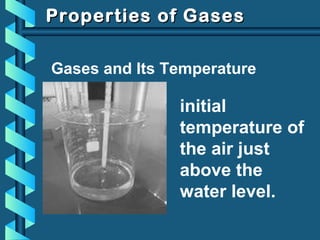
Gases and Its Temperature
initial
temperature of
the air just
above the
water level.
Properties of GasesProperties of Gases
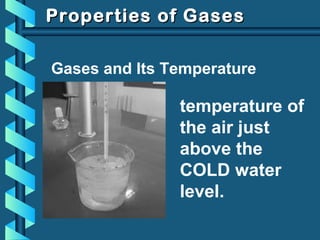
Gases and Its Temperature
temperature of
the air just
above the
COLD water
level.
Properties of GasesProperties of Gases
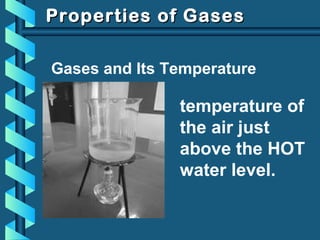
Gases and Its Temperature
temperature of
the air just
above the HOT
water level.
Properties of GasesProperties of Gases
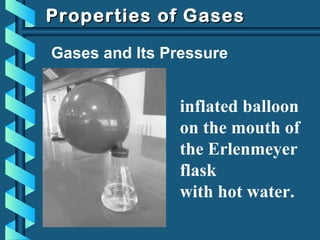
Gases and Its Pressure
inflated balloon
on the mouth of
the Erlenmeyer
flask
with hot water.
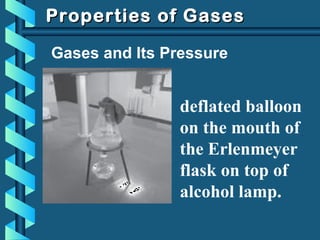
Properties of GasesProperties of Gases
Gases and Its Pressure
deflated balloon
on the mouth of
the Erlenmeyer
flask on top of
alcohol lamp.
Properties of GasesProperties of Gases
Based on experiments we
can summarized that Gases
have ____.
MASS
TEMPERATURE
VOLUME
PRESSURE
Properties of GasesProperties of Gases
MASS- quantitative measure of
inertia, a fundamental property of
all matter.
MASS NOT EQUAL TO WEIGHT
W=mg
= mass x gravity
UNIT: g or kg
Properties of GasesProperties of Gases
VOLUME- the amount of space
that a substance or object
occupies, or that is enclosed
within a container
UNIT: mL or L
1L=1 000mL
Properties of GasesProperties of Gases
TEMPERATURE- is how hot or
cold a thing is
UNIT: C (degrees Celsius)
convert to K (Kelvin)
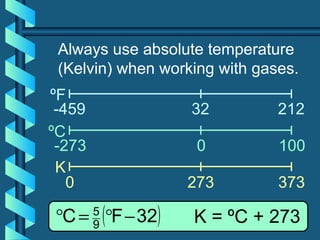
ºF
ºC
K
-459 32 212
-273 0 100
0 273 373
( )32FC 9
5
−°=° K = ºC + 273
Always use absolute temperature
(Kelvin) when working with gases.
Properties of GasesProperties of Gases
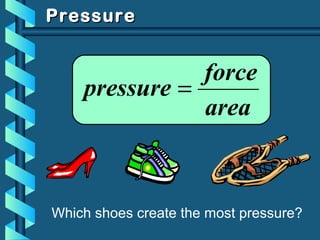
PRESSURE -is defined as force
per unit area.
PressurePressure
area
force
pressure =
Which shoes create the most pressure?
PressurePressure
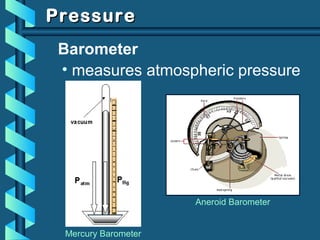
Barometer
• measures atmospheric pressure
Mercury Barometer
Aneroid Barometer
PressurePressure
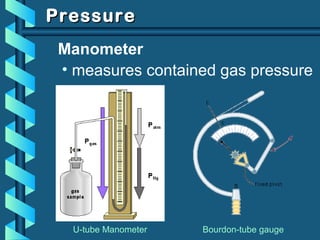
Manometer
• measures contained gas pressure
U-tube Manometer Bourdon-tube gauge
PressurePressure
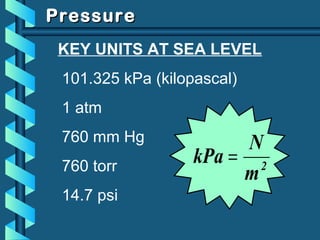
2
m
N
kPa =
KEY UNITS AT SEA LEVEL
101.325 kPa (kilopascal)
1 atm
760 mm Hg
760 torr
14.7 psi
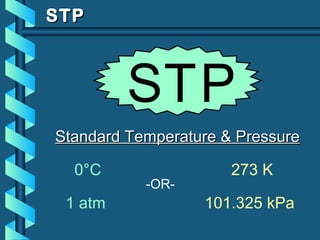
STPSTP
Standard Temperature & PressureStandard Temperature & Pressure
0°C 273 K
1 atm 101.325 kPa
-OR-
STP
The LAWS OThe LAWS O
GASESGASES
A. Boyle’s LawA. Boyle’s Law
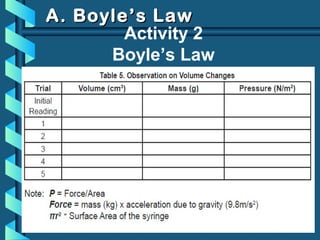
Activity 2
Boyle’s Law
Objective:
• Investigate the relationship
between volume and pressure of
gases at constant temperature.
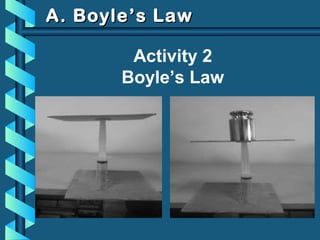
A. Boyle’s LawA. Boyle’s Law
Activity 2
Boyle’s Law
A. Boyle’s LawA. Boyle’s Law
Activity 2
Boyle’s Law
A. Boyle’s LawA. Boyle’s Law
Activity 2
Boyle’s Law
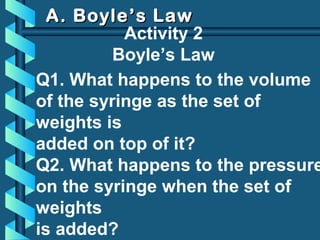
Q1. What happens to the volume
of the syringe as the set of
weights is
added on top of it?
Q2. What happens to the pressure
on the syringe when the set of
weights
is added?
A. Boyle’s LawA. Boyle’s Law
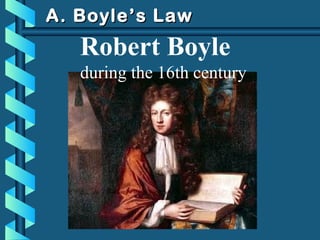
Robert Boyle
during the 16th century
A. Boyle’s LawA. Boyle’s Law
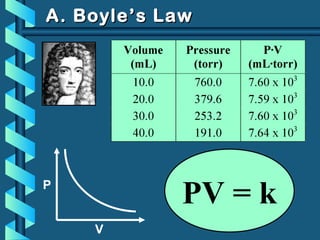
P
V
PV = k
A. Boyle’s LawA. Boyle’s Law
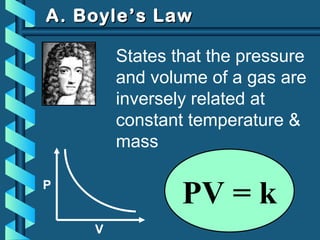
States that the pressure
and volume of a gas are
inversely related at
constant temperature &
mass
P
V
PV = k
A. Boyle’s LawA. Boyle’s Law
The Sci Guys_ Science at Home - SE
REFER TO VIDEO
A. Boyle’s LawA. Boyle’s Law
Chemistry_ Boyle's Law (Gas Laws)
REFER TO VIDEO
A. Boyle’s LawA. Boyle’s Law
1ST
QUIZ
k
T
V
=V
T
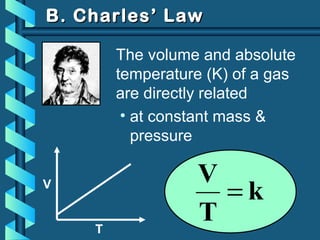
B. Charles’ LawB. Charles’ Law
k
T
V
=V
T
B. Charles’ LawB. Charles’ Law
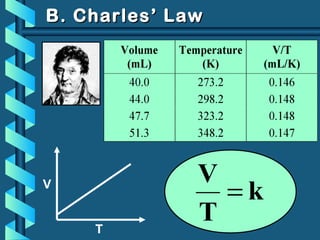
The volume and absolute
temperature (K) of a gas
are directly related
• at constant mass &
pressure
k
T
P
=P
T
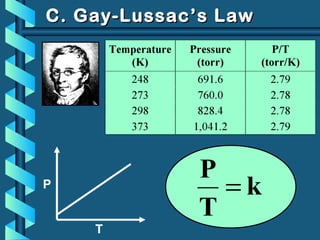
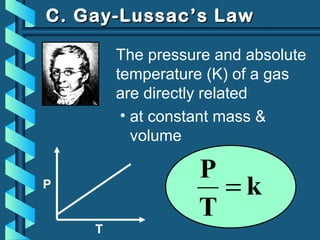
C. Gay-Lussac’s LawC. Gay-Lussac’s Law
k
T
P
=P
T
C. Gay-Lussac’s LawC. Gay-Lussac’s Law
The pressure and absolute
temperature (K) of a gas
are directly related
• at constant mass &
volume
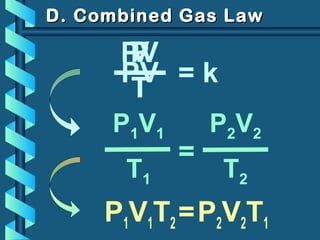
= kPV
P
T
V
T
PV
T
D. Combined Gas LawD. Combined Gas Law
P1V1
T1
=
P2V2
T2
P1V1T2 =P2V2T1
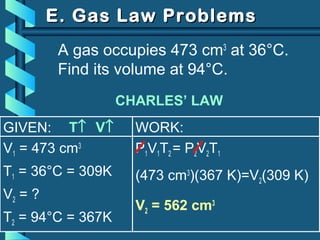
GIVEN:
V1 = 473 cm3
T1 = 36°C = 309K
V2 = ?
T2 = 94°C = 367K
WORK:
P1V1T2 = P2V2T1
E. Gas Law ProblemsE. Gas Law Problems
A gas occupies 473 cm3
at 36°C.
Find its volume at 94°C.
CHARLES’ LAW
T↑ V↑
(473 cm3
)(367 K)=V2(309 K)
V2 = 562 cm3
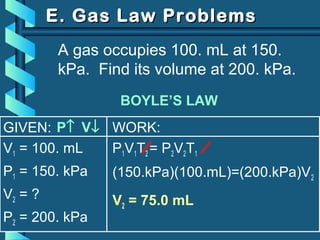
GIVEN:
V1 = 100. mL
P1 = 150. kPa
V2 = ?
P2 = 200. kPa
WORK:
P1V1T2 = P2V2T1
E. Gas Law ProblemsE. Gas Law Problems
A gas occupies 100. mL at 150.
kPa. Find its volume at 200. kPa.
BOYLE’S LAW
P↑ V↓
(150.kPa)(100.mL)=(200.kPa)V2
V2 = 75.0 mL
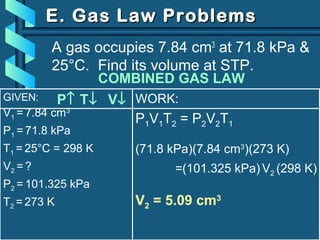
GIVEN:
V1 = 7.84 cm3
P1 = 71.8 kPa
T1 = 25°C = 298 K
V2 = ?
P2 = 101.325 kPa
T2 = 273 K
WORK:
P1V1T2 = P2V2T1
(71.8 kPa)(7.84 cm3
)(273 K)
=(101.325 kPa) V2 (298 K)
V2 = 5.09 cm3
E. Gas Law ProblemsE. Gas Law Problems
A gas occupies 7.84 cm3
at 71.8 kPa &
25°C. Find its volume at STP.
P↑ T↓ V↓
COMBINED GAS LAW
GIVEN:
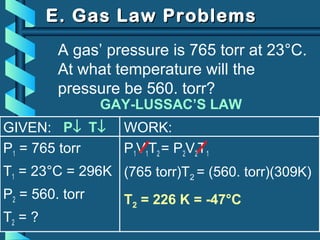
P1 = 765 torr
T1 = 23°C = 296K
P2 = 560. torr
T2 = ?
WORK:
P1V1T2 = P2V2T1
E. Gas Law ProblemsE. Gas Law Problems
A gas’ pressure is 765 torr at 23°C.
At what temperature will the
pressure be 560. torr?
GAY-LUSSAC’S LAW
P↓ T↓
(765 torr)T2 = (560. torr)(309K)
T2 = 226 K = -47°C
Ideal Gas Law
The moleThe mole
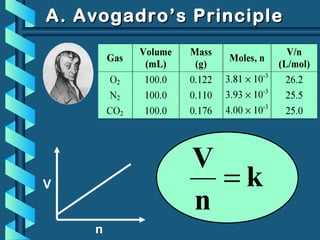
k
n
V
=V
n
A. Avogadro’s PrincipleA. Avogadro’s Principle
k
n
V
=V
n
A. Avogadro’s PrincipleA. Avogadro’s Principle
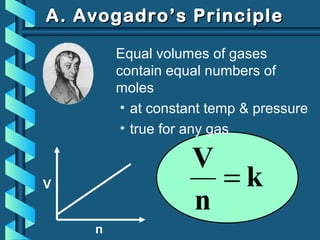
Equal volumes of gases
contain equal numbers of
moles
• at constant temp & pressure
• true for any gas
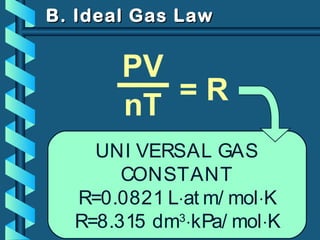
PV
T
V
n
PV
nT
B. Ideal Gas LawB. Ideal Gas Law
= k
UNI VERSAL GAS
CONSTANT
R=0.0821 L⋅at m/ mol⋅K
R=8.315 dm3
⋅kPa/ mol⋅K
= R
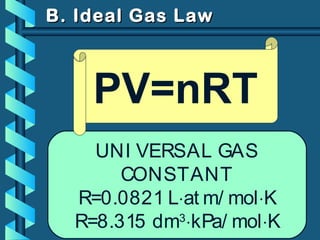
B. Ideal Gas LawB. Ideal Gas Law
UNI VERSAL GAS
CONSTANT
R=0.0821 L⋅at m/ mol⋅K
R=8.315 dm3
⋅kPa/ mol⋅K
PV=nRT
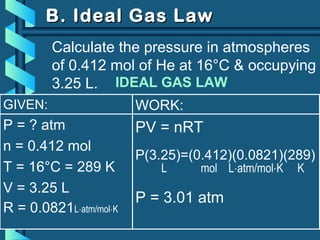
GIVEN:
P = ? atm
n = 0.412 mol
T = 16°C = 289 K
V = 3.25 L
R = 0.0821L⋅atm/mol⋅K
WORK:
PV = nRT
P(3.25)=(0.412)(0.0821)(289)
L mol L⋅atm/mol⋅K K
P = 3.01 atm
B. Ideal Gas LawB. Ideal Gas Law
Calculate the pressure in atmospheres
of 0.412 mol of He at 16°C & occupying
3.25 L. IDEAL GAS LAW
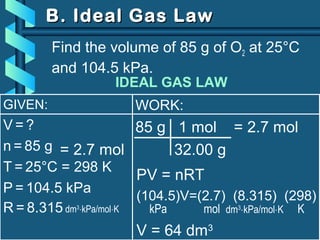
GIVEN:
V = ?
n = 85 g
T = 25°C = 298 K
P = 104.5 kPa
R = 8.315 dm3
⋅kPa/mol⋅K
B. Ideal Gas LawB. Ideal Gas Law
Find the volume of 85 g of O2 at 25°C
and 104.5 kPa.
= 2.7 mol
WORK:
85 g 1 mol = 2.7 mol
32.00 g
PV = nRT
(104.5)V=(2.7) (8.315) (298)
kPa mol dm3
⋅kPa/mol⋅K K
V = 64 dm3
IDEAL GAS LAW
ReactionsReactions
IV. Gas Stoichiometry
at Non-STP Conditions
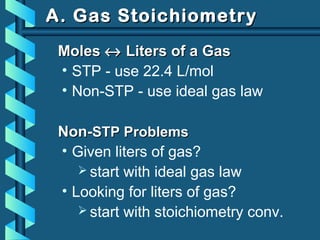
A. Gas StoichiometryA. Gas Stoichiometry
MolesMoles ↔↔ Liters of a GasLiters of a Gas
• STP - use 22.4 L/mol
• Non-STP - use ideal gas law
Non-Non-STP ProblemsSTP Problems
• Given liters of gas?
 start with ideal gas law
• Looking for liters of gas?
 start with stoichiometry conv.
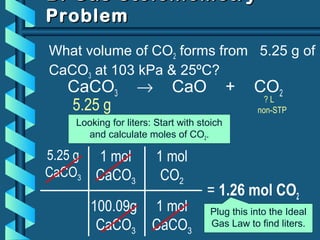
1 mol
CaCO3
100.09g
CaCO3
B. Gas StoichiometryB. Gas Stoichiometry
ProblemProblem
What volume of CO2 forms from 5.25 g of
CaCO3 at 103 kPa & 25ºC?
5.25 g
CaCO3
= 1.26 mol CO2
CaCO3 → CaO + CO2
1 mol
CO2
1 mol
CaCO3
5.25 g ? L
non-STP
Looking for liters: Start with stoich
and calculate moles of CO2.
Plug this into the Ideal
Gas Law to find liters.
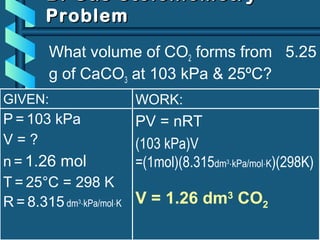
WORK:
PV = nRT
(103 kPa)V
=(1mol)(8.315dm3
⋅kPa/mol⋅K)(298K)
V = 1.26 dm3
CO2
B. Gas StoichiometryB. Gas Stoichiometry
ProblemProblem
What volume of CO2 forms from 5.25
g of CaCO3 at 103 kPa & 25ºC?
GIVEN:
P = 103 kPa
V = ?
n = 1.26 mol
T = 25°C = 298 K
R = 8.315 dm3
⋅kPa/mol⋅K
WORK:
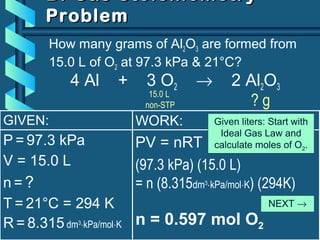
PV = nRT
(97.3 kPa) (15.0 L)
= n (8.315dm3
⋅kPa/mol⋅K) (294K)
n = 0.597 mol O2
B. Gas StoichiometryB. Gas Stoichiometry
ProblemProblem
How many grams of Al2O3 are formed from
15.0 L of O2 at 97.3 kPa & 21°C?
GIVEN:
P = 97.3 kPa
V = 15.0 L
n = ?
T = 21°C = 294 K
R = 8.315 dm3
⋅kPa/mol⋅K
4 Al + 3 O2 → 2 Al2O3
15.0 L
non-STP ? g
Given liters: Start with
Ideal Gas Law and
calculate moles of O2.
NEXT →
2 mol
Al2O3
3 mol O2
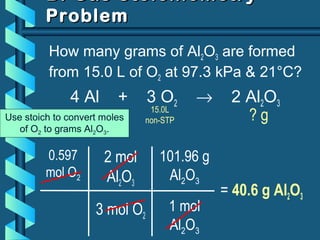
B. Gas StoichiometryB. Gas Stoichiometry
ProblemProblem
How many grams of Al2O3 are formed
from 15.0 L of O2 at 97.3 kPa & 21°C?
0.597
mol O2
= 40.6 g Al2O3
4 Al + 3 O2 → 2 Al2O3
101.96 g
Al2O3
1 mol
Al2O3
15.0L
non-STP ? gUse stoich to convert moles
of O2 to grams Al2O3.
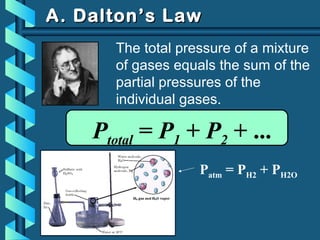
A. Dalton’s LawA. Dalton’s Law
The total pressure of a mixture
of gases equals the sum of the
partial pressures of the
individual gases.
Ptotal = P1 + P2 + ...
Patm = PH2 + PH2O
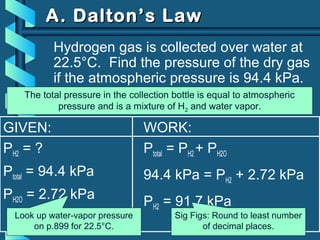
GIVEN:
PH2 = ?
Ptotal = 94.4 kPa
PH2O = 2.72 kPa
WORK:
Ptotal = PH2 + PH2O
94.4 kPa = PH2 + 2.72 kPa
PH2 = 91.7 kPa
A. Dalton’s LawA. Dalton’s Law
Hydrogen gas is collected over water at
22.5°C. Find the pressure of the dry gas
if the atmospheric pressure is 94.4 kPa.
Look up water-vapor pressure
on p.899 for 22.5°C.
Sig Figs: Round to least number
of decimal places.
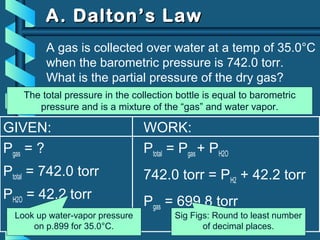
The total pressure in the collection bottle is equal to atmospheric
pressure and is a mixture of H2 and water vapor.
GIVEN:
Pgas = ?
Ptotal = 742.0 torr
PH2O = 42.2 torr
WORK:
Ptotal = Pgas + PH2O
742.0 torr = PH2 + 42.2 torr
Pgas = 699.8 torr
A gas is collected over water at a temp of 35.0°C
when the barometric pressure is 742.0 torr.
What is the partial pressure of the dry gas?
DALTON’S LAW
Look up water-vapor pressure
on p.899 for 35.0°C.
Sig Figs: Round to least number
of decimal places.
A. Dalton’s LawA. Dalton’s Law
The total pressure in the collection bottle is equal to barometric
pressure and is a mixture of the “gas” and water vapor.
B. Graham’s LawB. Graham’s Law
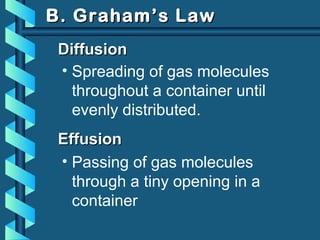
DiffusionDiffusion
• Spreading of gas molecules
throughout a container until
evenly distributed.
EffusionEffusion
• Passing of gas molecules
through a tiny opening in a
container
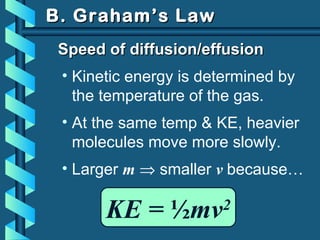
B. Graham’s LawB. Graham’s Law
KE = ½mv2
Speed of diffusion/effusionSpeed of diffusion/effusion
• Kinetic energy is determined by
the temperature of the gas.
• At the same temp & KE, heavier
molecules move more slowly.
• Larger m ⇒ smaller v because…
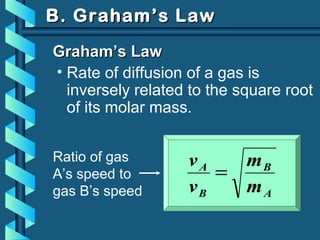
B. Graham’s LawB. Graham’s Law
Graham’s LawGraham’s Law
• Rate of diffusion of a gas is
inversely related to the square root
of its molar mass.
A
B
B
A
m
m
v
v
=
Ratio of gas
A’s speed to
gas B’s speed
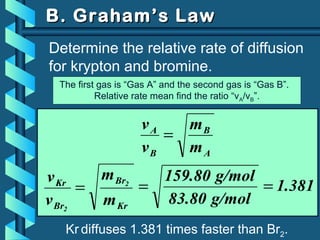
Determine the relative rate of diffusion
for krypton and bromine.
1.381=
Kr diffuses 1.381 times faster than Br2.
Kr
Br
Br
Kr
m
m
v
v 2
2
=
A
B
B
A
m
m
v
v
=
g/mol83.80
g/mol159.80
=
B. Graham’s LawB. Graham’s Law
The first gas is “Gas A” and the second gas is “Gas B”.
Relative rate mean find the ratio “vA/vB”.
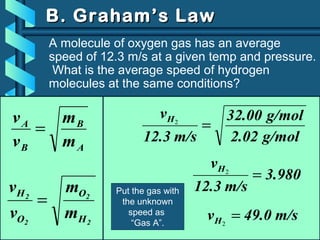
A molecule of oxygen gas has an average
speed of 12.3 m/s at a given temp and pressure.
What is the average speed of hydrogen
molecules at the same conditions?
A
B
B
A
m
m
v
v
=
2
2
2
2
H
O
O
H
m
m
v
v
=
g/mol2.02
g/mol32.00
m/s12.3
vH
=2
B. Graham’s LawB. Graham’s Law
3.980
m/s12.3
vH
=2
m/s49.0vH =2
Put the gas with
the unknown
speed as
“Gas A”.
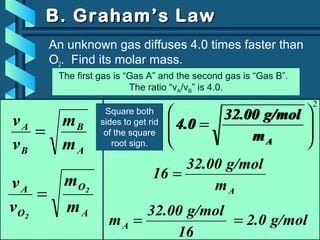
An unknown gas diffuses 4.0 times faster than
O2. Find its molar mass.
Am
g/mol32.00
16 =
A
B
B
A
m
m
v
v
=
A
O
O
A
m
m
v
v 2
2
=
Am
g/mol32.00
4.0 =
16
g/mol32.00
mA =
2








=
Am
g/mol32.00
4.0
g/mol2.0=
B. Graham’s LawB. Graham’s Law
The first gas is “Gas A” and the second gas is “Gas B”.
The ratio “vA/vB” is 4.0.
Square both
sides to get rid
of the square
root sign.

BOYLE'S LAW SCIENCE GRADE 10

  • 1.
  • 2.
    Properties of GasesPropertiesof Gases Gases and Its Mass
  • 3.
    Properties of GasesPropertiesof Gases Gases and Its Mass
  • 4.
    Properties of GasesPropertiesof Gases Gases and Its Volume
  • 5.
    Properties of GasesPropertiesof Gases Gases and Its Volume
  • 6.
    Properties of GasesPropertiesof Gases Gases and Its Temperature initial temperature of the air just above the water level.
  • 7.
    Properties of GasesPropertiesof Gases Gases and Its Temperature temperature of the air just above the COLD water level.
  • 8.
    Properties of GasesPropertiesof Gases Gases and Its Temperature temperature of the air just above the HOT water level.
  • 9.
    Properties of GasesPropertiesof Gases Gases and Its Pressure inflated balloon on the mouth of the Erlenmeyer flask with hot water.
  • 10.
    Properties of GasesPropertiesof Gases Gases and Its Pressure deflated balloon on the mouth of the Erlenmeyer flask on top of alcohol lamp.
  • 11.
    Properties of GasesPropertiesof Gases Based on experiments we can summarized that Gases have ____. MASS TEMPERATURE VOLUME PRESSURE
  • 12.
    Properties of GasesPropertiesof Gases MASS- quantitative measure of inertia, a fundamental property of all matter. MASS NOT EQUAL TO WEIGHT W=mg = mass x gravity UNIT: g or kg
  • 13.
    Properties of GasesPropertiesof Gases VOLUME- the amount of space that a substance or object occupies, or that is enclosed within a container UNIT: mL or L 1L=1 000mL
  • 14.
    Properties of GasesPropertiesof Gases TEMPERATURE- is how hot or cold a thing is UNIT: C (degrees Celsius) convert to K (Kelvin)
  • 15.
    ºF ºC K -459 32 212 -2730 100 0 273 373 ( )32FC 9 5 −°=° K = ºC + 273 Always use absolute temperature (Kelvin) when working with gases.
  • 16.
    Properties of GasesPropertiesof Gases PRESSURE -is defined as force per unit area.
  • 17.
  • 18.
    PressurePressure Barometer • measures atmosphericpressure Mercury Barometer Aneroid Barometer
  • 19.
    PressurePressure Manometer • measures containedgas pressure U-tube Manometer Bourdon-tube gauge
  • 20.
    PressurePressure 2 m N kPa = KEY UNITSAT SEA LEVEL 101.325 kPa (kilopascal) 1 atm 760 mm Hg 760 torr 14.7 psi
  • 21.
    STPSTP Standard Temperature &PressureStandard Temperature & Pressure 0°C 273 K 1 atm 101.325 kPa -OR- STP
  • 22.
    The LAWS OTheLAWS O GASESGASES
  • 23.
    A. Boyle’s LawA.Boyle’s Law Activity 2 Boyle’s Law Objective: • Investigate the relationship between volume and pressure of gases at constant temperature.
  • 24.
    A. Boyle’s LawA.Boyle’s Law Activity 2 Boyle’s Law
  • 25.
    A. Boyle’s LawA.Boyle’s Law Activity 2 Boyle’s Law
  • 26.
    A. Boyle’s LawA.Boyle’s Law Activity 2 Boyle’s Law Q1. What happens to the volume of the syringe as the set of weights is added on top of it? Q2. What happens to the pressure on the syringe when the set of weights is added?
  • 27.
    A. Boyle’s LawA.Boyle’s Law Robert Boyle during the 16th century
  • 28.
    A. Boyle’s LawA.Boyle’s Law P V PV = k
  • 29.
    A. Boyle’s LawA.Boyle’s Law States that the pressure and volume of a gas are inversely related at constant temperature & mass P V PV = k
  • 30.
    A. Boyle’s LawA.Boyle’s Law The Sci Guys_ Science at Home - SE REFER TO VIDEO
  • 31.
    A. Boyle’s LawA.Boyle’s Law Chemistry_ Boyle's Law (Gas Laws) REFER TO VIDEO
  • 32.
    A. Boyle’s LawA.Boyle’s Law 1ST QUIZ
  • 33.
  • 34.
    k T V =V T B. Charles’ LawB.Charles’ Law The volume and absolute temperature (K) of a gas are directly related • at constant mass & pressure
  • 35.
  • 36.
    k T P =P T C. Gay-Lussac’s LawC.Gay-Lussac’s Law The pressure and absolute temperature (K) of a gas are directly related • at constant mass & volume
  • 37.
    = kPV P T V T PV T D. CombinedGas LawD. Combined Gas Law P1V1 T1 = P2V2 T2 P1V1T2 =P2V2T1
  • 38.
    GIVEN: V1 = 473cm3 T1 = 36°C = 309K V2 = ? T2 = 94°C = 367K WORK: P1V1T2 = P2V2T1 E. Gas Law ProblemsE. Gas Law Problems A gas occupies 473 cm3 at 36°C. Find its volume at 94°C. CHARLES’ LAW T↑ V↑ (473 cm3 )(367 K)=V2(309 K) V2 = 562 cm3
  • 39.
    GIVEN: V1 = 100.mL P1 = 150. kPa V2 = ? P2 = 200. kPa WORK: P1V1T2 = P2V2T1 E. Gas Law ProblemsE. Gas Law Problems A gas occupies 100. mL at 150. kPa. Find its volume at 200. kPa. BOYLE’S LAW P↑ V↓ (150.kPa)(100.mL)=(200.kPa)V2 V2 = 75.0 mL
  • 40.
    GIVEN: V1 = 7.84cm3 P1 = 71.8 kPa T1 = 25°C = 298 K V2 = ? P2 = 101.325 kPa T2 = 273 K WORK: P1V1T2 = P2V2T1 (71.8 kPa)(7.84 cm3 )(273 K) =(101.325 kPa) V2 (298 K) V2 = 5.09 cm3 E. Gas Law ProblemsE. Gas Law Problems A gas occupies 7.84 cm3 at 71.8 kPa & 25°C. Find its volume at STP. P↑ T↓ V↓ COMBINED GAS LAW
  • 41.
    GIVEN: P1 = 765torr T1 = 23°C = 296K P2 = 560. torr T2 = ? WORK: P1V1T2 = P2V2T1 E. Gas Law ProblemsE. Gas Law Problems A gas’ pressure is 765 torr at 23°C. At what temperature will the pressure be 560. torr? GAY-LUSSAC’S LAW P↓ T↓ (765 torr)T2 = (560. torr)(309K) T2 = 226 K = -47°C
  • 42.
    Ideal Gas Law ThemoleThe mole
  • 43.
  • 44.
    k n V =V n A. Avogadro’s PrincipleA.Avogadro’s Principle Equal volumes of gases contain equal numbers of moles • at constant temp & pressure • true for any gas
  • 45.
    PV T V n PV nT B. Ideal GasLawB. Ideal Gas Law = k UNI VERSAL GAS CONSTANT R=0.0821 L⋅at m/ mol⋅K R=8.315 dm3 ⋅kPa/ mol⋅K = R
  • 46.
    B. Ideal GasLawB. Ideal Gas Law UNI VERSAL GAS CONSTANT R=0.0821 L⋅at m/ mol⋅K R=8.315 dm3 ⋅kPa/ mol⋅K PV=nRT
  • 47.
    GIVEN: P = ?atm n = 0.412 mol T = 16°C = 289 K V = 3.25 L R = 0.0821L⋅atm/mol⋅K WORK: PV = nRT P(3.25)=(0.412)(0.0821)(289) L mol L⋅atm/mol⋅K K P = 3.01 atm B. Ideal Gas LawB. Ideal Gas Law Calculate the pressure in atmospheres of 0.412 mol of He at 16°C & occupying 3.25 L. IDEAL GAS LAW
  • 48.
    GIVEN: V = ? n= 85 g T = 25°C = 298 K P = 104.5 kPa R = 8.315 dm3 ⋅kPa/mol⋅K B. Ideal Gas LawB. Ideal Gas Law Find the volume of 85 g of O2 at 25°C and 104.5 kPa. = 2.7 mol WORK: 85 g 1 mol = 2.7 mol 32.00 g PV = nRT (104.5)V=(2.7) (8.315) (298) kPa mol dm3 ⋅kPa/mol⋅K K V = 64 dm3 IDEAL GAS LAW
  • 49.
  • 50.
    A. Gas StoichiometryA.Gas Stoichiometry MolesMoles ↔↔ Liters of a GasLiters of a Gas • STP - use 22.4 L/mol • Non-STP - use ideal gas law Non-Non-STP ProblemsSTP Problems • Given liters of gas?  start with ideal gas law • Looking for liters of gas?  start with stoichiometry conv.
  • 51.
    1 mol CaCO3 100.09g CaCO3 B. GasStoichiometryB. Gas Stoichiometry ProblemProblem What volume of CO2 forms from 5.25 g of CaCO3 at 103 kPa & 25ºC? 5.25 g CaCO3 = 1.26 mol CO2 CaCO3 → CaO + CO2 1 mol CO2 1 mol CaCO3 5.25 g ? L non-STP Looking for liters: Start with stoich and calculate moles of CO2. Plug this into the Ideal Gas Law to find liters.
  • 52.
    WORK: PV = nRT (103kPa)V =(1mol)(8.315dm3 ⋅kPa/mol⋅K)(298K) V = 1.26 dm3 CO2 B. Gas StoichiometryB. Gas Stoichiometry ProblemProblem What volume of CO2 forms from 5.25 g of CaCO3 at 103 kPa & 25ºC? GIVEN: P = 103 kPa V = ? n = 1.26 mol T = 25°C = 298 K R = 8.315 dm3 ⋅kPa/mol⋅K
  • 53.
    WORK: PV = nRT (97.3kPa) (15.0 L) = n (8.315dm3 ⋅kPa/mol⋅K) (294K) n = 0.597 mol O2 B. Gas StoichiometryB. Gas Stoichiometry ProblemProblem How many grams of Al2O3 are formed from 15.0 L of O2 at 97.3 kPa & 21°C? GIVEN: P = 97.3 kPa V = 15.0 L n = ? T = 21°C = 294 K R = 8.315 dm3 ⋅kPa/mol⋅K 4 Al + 3 O2 → 2 Al2O3 15.0 L non-STP ? g Given liters: Start with Ideal Gas Law and calculate moles of O2. NEXT →
  • 54.
    2 mol Al2O3 3 molO2 B. Gas StoichiometryB. Gas Stoichiometry ProblemProblem How many grams of Al2O3 are formed from 15.0 L of O2 at 97.3 kPa & 21°C? 0.597 mol O2 = 40.6 g Al2O3 4 Al + 3 O2 → 2 Al2O3 101.96 g Al2O3 1 mol Al2O3 15.0L non-STP ? gUse stoich to convert moles of O2 to grams Al2O3.
  • 55.
    A. Dalton’s LawA.Dalton’s Law The total pressure of a mixture of gases equals the sum of the partial pressures of the individual gases. Ptotal = P1 + P2 + ... Patm = PH2 + PH2O
  • 56.
    GIVEN: PH2 = ? Ptotal= 94.4 kPa PH2O = 2.72 kPa WORK: Ptotal = PH2 + PH2O 94.4 kPa = PH2 + 2.72 kPa PH2 = 91.7 kPa A. Dalton’s LawA. Dalton’s Law Hydrogen gas is collected over water at 22.5°C. Find the pressure of the dry gas if the atmospheric pressure is 94.4 kPa. Look up water-vapor pressure on p.899 for 22.5°C. Sig Figs: Round to least number of decimal places. The total pressure in the collection bottle is equal to atmospheric pressure and is a mixture of H2 and water vapor.
  • 57.
    GIVEN: Pgas = ? Ptotal= 742.0 torr PH2O = 42.2 torr WORK: Ptotal = Pgas + PH2O 742.0 torr = PH2 + 42.2 torr Pgas = 699.8 torr A gas is collected over water at a temp of 35.0°C when the barometric pressure is 742.0 torr. What is the partial pressure of the dry gas? DALTON’S LAW Look up water-vapor pressure on p.899 for 35.0°C. Sig Figs: Round to least number of decimal places. A. Dalton’s LawA. Dalton’s Law The total pressure in the collection bottle is equal to barometric pressure and is a mixture of the “gas” and water vapor.
  • 58.
    B. Graham’s LawB.Graham’s Law DiffusionDiffusion • Spreading of gas molecules throughout a container until evenly distributed. EffusionEffusion • Passing of gas molecules through a tiny opening in a container
  • 59.
    B. Graham’s LawB.Graham’s Law KE = ½mv2 Speed of diffusion/effusionSpeed of diffusion/effusion • Kinetic energy is determined by the temperature of the gas. • At the same temp & KE, heavier molecules move more slowly. • Larger m ⇒ smaller v because…
  • 60.
    B. Graham’s LawB.Graham’s Law Graham’s LawGraham’s Law • Rate of diffusion of a gas is inversely related to the square root of its molar mass. A B B A m m v v = Ratio of gas A’s speed to gas B’s speed
  • 61.
    Determine the relativerate of diffusion for krypton and bromine. 1.381= Kr diffuses 1.381 times faster than Br2. Kr Br Br Kr m m v v 2 2 = A B B A m m v v = g/mol83.80 g/mol159.80 = B. Graham’s LawB. Graham’s Law The first gas is “Gas A” and the second gas is “Gas B”. Relative rate mean find the ratio “vA/vB”.
  • 62.
    A molecule ofoxygen gas has an average speed of 12.3 m/s at a given temp and pressure. What is the average speed of hydrogen molecules at the same conditions? A B B A m m v v = 2 2 2 2 H O O H m m v v = g/mol2.02 g/mol32.00 m/s12.3 vH =2 B. Graham’s LawB. Graham’s Law 3.980 m/s12.3 vH =2 m/s49.0vH =2 Put the gas with the unknown speed as “Gas A”.
  • 63.
    An unknown gasdiffuses 4.0 times faster than O2. Find its molar mass. Am g/mol32.00 16 = A B B A m m v v = A O O A m m v v 2 2 = Am g/mol32.00 4.0 = 16 g/mol32.00 mA = 2         = Am g/mol32.00 4.0 g/mol2.0= B. Graham’s LawB. Graham’s Law The first gas is “Gas A” and the second gas is “Gas B”. The ratio “vA/vB” is 4.0. Square both sides to get rid of the square root sign.