EYE TRAUMA
Linda Warren
RN MSN CCRN
NUR 335
OBJECTIVES
■ Understand the pathophysiology of eye trauma.
■ Gain knowledge of mechanisms of sustaining eye trauma.
■ Explain preventative measures to avoid eye trauma and importance of nursing
education.
■ Show knowledge and application of therapeutic intervention for eye trauma.
■ Show knowledge of pharmacological intervention.
■ Understand ways to monitor therapeutic interventions.
■ Gain knowledge of the rehabilitation needs of eye trauma patients.
■ Demonstrate knowledge of patient outcomes and outcome measures.
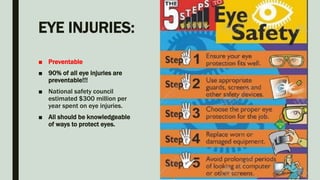
EYE INJURIES:
■ Preventable
■ 90% of all eye injuries are
preventable!!!
■ National safety council
estimated $300 million per
year spent on eye injuries.
■ All should be knowledgeable
of ways to protect eyes.
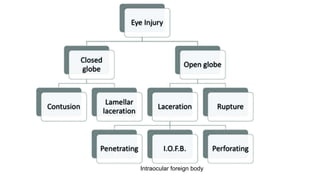
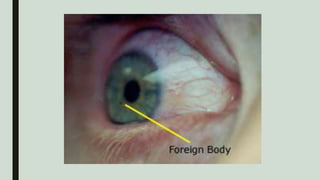
Intraocular foreign body
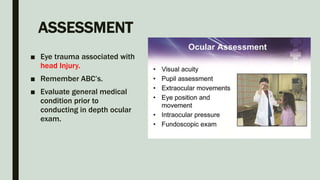
ASSESSMENT
■ Eye trauma associated with
head Injury.
■ Remember ABC’s.
■ Evaluate general medical
condition prior to
conducting in depth ocular
exam.
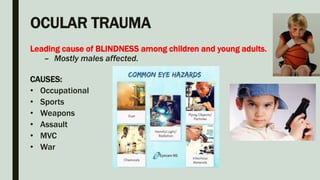
OCULAR TRAUMA
Leading cause of BLINDNESS among children and young adults.
– Mostly males affected.
CAUSES:
• Occupational
• Sports
• Weapons
• Assault
• MVC
• War
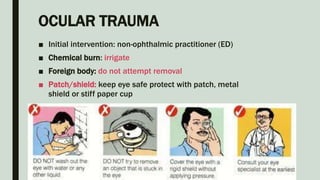
OCULAR TRAUMA
■ Initial intervention: non-ophthalmic practitioner (ED)
■ Chemical burn: irrigate
■ Foreign body: do not attempt removal
■ Patch/shield: keep eye safe protect with patch, metal
shield or stiff paper cup
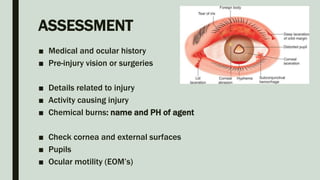
ASSESSMENT
■ Medical and ocular history
■ Pre-injury vision or surgeries
■ Details related to injury
■ Activity causing injury
■ Chemical burns: name and PH of agent
■ Check cornea and external surfaces
■ Pupils
■ Ocular motility (EOM’s)
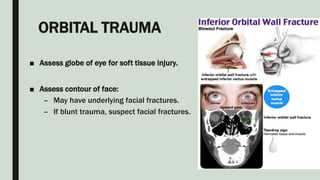
ORBITAL TRAUMA
■ Assess globe of eye for soft tissue injury.
■ Assess contour of face:
– May have underlying facial fractures.
– If blunt trauma, suspect facial fractures.
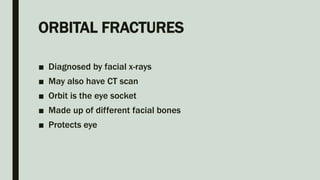
ORBITAL FRACTURES
■ Diagnosed by facial x-rays
■ May also have CT scan
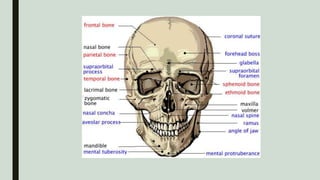
■ Orbit is the eye socket
■ Made up of different facial bones
■ Protects eye
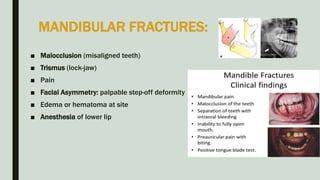
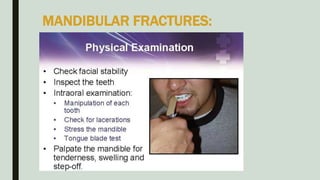
MANDIBULAR FRACTURES:
■ Malocclusion (misaligned teeth)
■ Trismus (lock-jaw)
■ Pain
■ Facial Asymmetry: palpable step-off deformity
■ Edema or hematoma at site
■ Anesthesia of lower lip
MANDIBULAR FRACTURES:
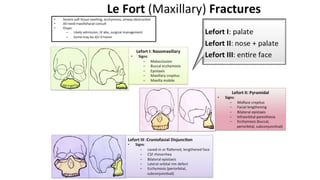
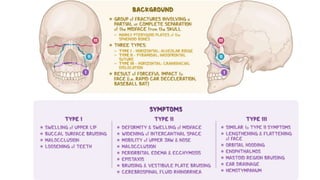
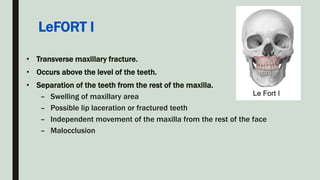
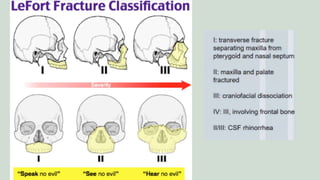
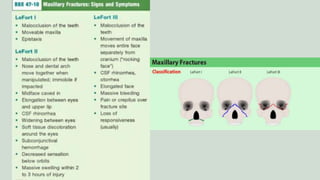
• Transverse maxillary fracture.
• Occurs above the level of the teeth.
• Separation of the teeth from the rest of the maxilla.
– Swelling of maxillary area
– Possible lip laceration or fractured teeth
– Independent movement of the maxilla from the rest of the face
– Malocclusion
LeFORT I
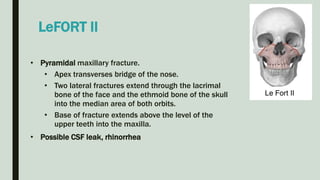
• Pyramidal maxillary fracture.
• Apex transverses bridge of the nose.
• Two lateral fractures extend through the lacrimal
bone of the face and the ethmoid bone of the skull
into the median area of both orbits.
• Base of fracture extends above the level of the
upper teeth into the maxilla.
• Possible CSF leak, rhinorrhea
LeFORT II
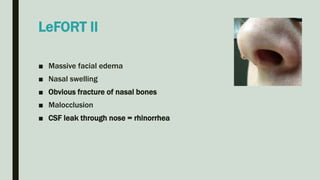
LeFORT II
■ Massive facial edema
■ Nasal swelling
■ Obvious fracture of nasal bones
■ Malocclusion
■ CSF leak through nose = rhinorrhea
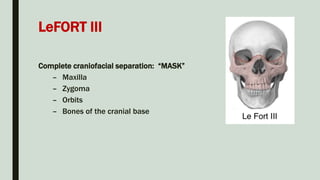
LeFORT III
Complete craniofacial separation: “MASK”
– Maxilla
– Zygoma
– Orbits
– Bones of the cranial base
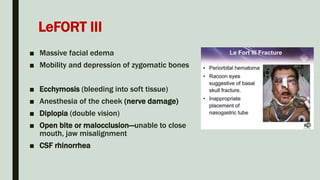
LeFORT III
■ Massive facial edema
■ Mobility and depression of zygomatic bones
■ Ecchymosis (bleeding into soft tissue)
■ Anesthesia of the cheek (nerve damage)
■ Diplopia (double vision)
■ Open bite or malocclusion—unable to close
mouth, jaw misalignment
■ CSF rhinorrhea
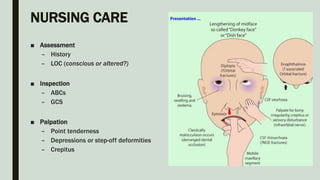
NURSING CARE
■ Assessment
– History
– LOC (conscious or altered?)
■ Inspection
– ABCs
– GCS
■ Palpation
– Point tenderness
– Depressions or step-off deformities
– Crepitus
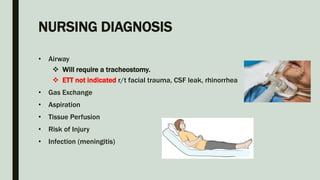
NURSING DIAGNOSIS
• Airway
 Will require a tracheostomy.
 ETT not indicated r/t facial trauma, CSF leak, rhinorrhea
• Gas Exchange
• Aspiration
• Tissue Perfusion
• Risk of Injury
• Infection (meningitis)
ORBITAL FRACTURES
■ Blowout
■ Maxillary
■ Orbital roof
■ Midfacial
■ Orbital apex
■ Zygomatic
■ Associated with soft tissue injury and optic nerve injury
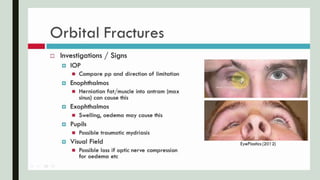
BLOW-OUT FRACTURE
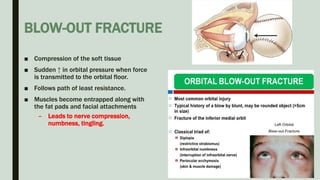
■ Compression of the soft tissue
■ Sudden ↑ in orbital pressure when force
is transmitted to the orbital floor.
■ Follows path of least resistance.
■ Muscles become entrapped along with
the fat pads and facial attachments
– Leads to nerve compression,
numbness, tingling.
BLOW-OUT FRACTURE
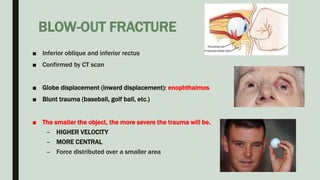
■ Inferior oblique and inferior rectus
■ Confirmed by CT scan
■ Globe displacement (inward displacement): enophthalmos
■ Blunt trauma (baseball, golf ball, etc.)
■ The smaller the object, the more severe the trauma will be.
– HIGHER VELOCITY
– MORE CENTRAL
– Force distributed over a smaller area
ORBITAL ROOF FRACTURE
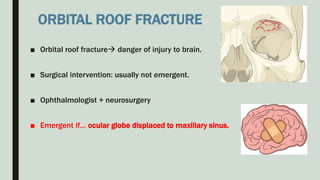
■ Orbital roof fracture danger of injury to brain.
■ Surgical intervention: usually not emergent.
■ Ophthalmologist + neurosurgery
■ Emergent if… ocular globe displaced to maxillary sinus.
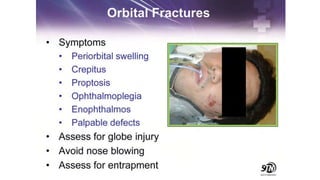
ASSESSMENT of ORBITAL FRACTURES
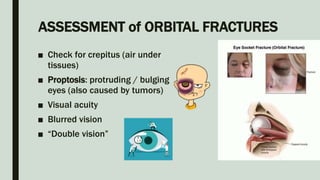
■ Check for crepitus (air under
tissues)
■ Proptosis: protruding / bulging
eyes (also caused by tumors)
■ Visual acuity
■ Blurred vision
■ “Double vision”
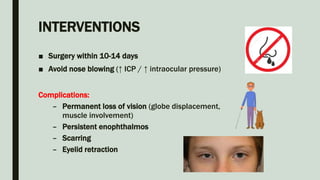
INTERVENTIONS
■ Surgery within 10-14 days
■ Avoid nose blowing (↑ ICP / ↑ intraocular pressure)
Complications:
– Permanent loss of vision (globe displacement,
muscle involvement)
– Persistent enophthalmos
– Scarring
– Eyelid retraction
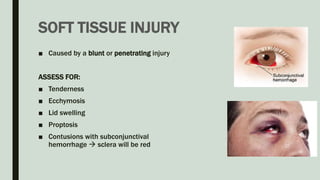
SOFT TISSUE INJURY
■ Caused by a blunt or penetrating injury
ASSESS FOR:
■ Tenderness
■ Ecchymosis
■ Lid swelling
■ Proptosis
■ Contusions with subconjunctival
hemorrhage  sclera will be red
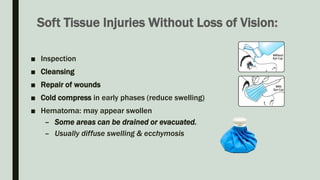
Soft Tissue Injuries Without Loss of Vision:
■ Inspection
■ Cleansing
■ Repair of wounds
■ Cold compress in early phases (reduce swelling)
■ Hematoma: may appear swollen
– Some areas can be drained or evacuated.
– Usually diffuse swelling & ecchymosis
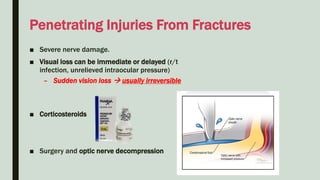
Penetrating Injuries From Fractures
■ Severe nerve damage.
■ Visual loss can be immediate or delayed (r/t
infection, unrelieved intraocular pressure)
– Sudden vision loss  usually irreversible
■ Corticosteroids
■ Surgery and optic nerve decompression
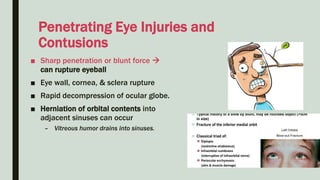
Penetrating Eye Injuries and
Contusions
■ Sharp penetration or blunt force 
can rupture eyeball
■ Eye wall, cornea, & sclera rupture
■ Rapid decompression of ocular globe.
■ Herniation of orbital contents into
adjacent sinuses can occur
– Vitreous humor drains into sinuses.
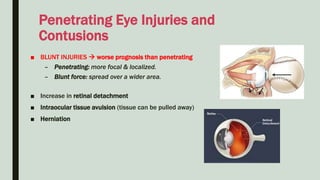
■ BLUNT INJURIES  worse prognosis than penetrating
– Penetrating: more focal & localized.
– Blunt force: spread over a wider area.
■ Increase in retinal detachment
■ Intraocular tissue avulsion (tissue can be pulled away)
■ Herniation
Penetrating Eye Injuries and
Contusions
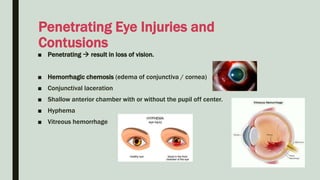
■ Penetrating  result in loss of vision.
■ Hemorrhagic chemosis (edema of conjunctiva / cornea)
■ Conjunctival laceration
■ Shallow anterior chamber with or without the pupil off center.
■ Hyphema
■ Vitreous hemorrhage
Penetrating Eye Injuries and
Contusions
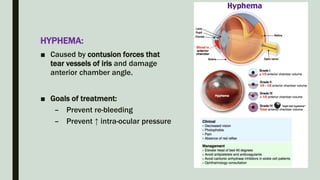
HYPHEMA:
■ Caused by contusion forces that
tear vessels of iris and damage
anterior chamber angle.
■ Goals of treatment:
– Prevent re-bleeding
– Prevent ↑ intra-ocular pressure
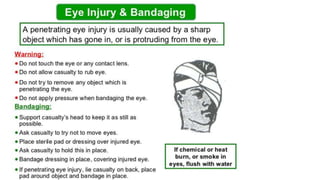
■ Protect the eye from further damage by using an eye shield.
■ Administer systemic analgesics.
■ Administer prophylactic broad-spectrum ABX.
■ Administer anti-emetics if the patient has N/V (prevent ↑ IOP).
■ Tetanus prophylaxis.
■ NPO status in preparation for surgery.
■ Carefully document all findings and actions taken.
 Defer IOP measurements in patients with lacerations.
 Avoid any pressure on the globe (DO NOT press on the sclera)!!
 Do not attempt to pull out any foreign material that may be sticking out of the eye.
INTERVENTIONS
INTERVENTIONS
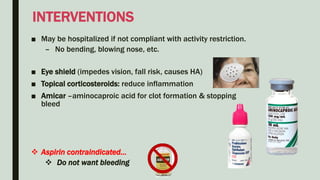
■ May be hospitalized if not compliant with activity restriction.
– No bending, blowing nose, etc.
■ Eye shield (impedes vision, fall risk, causes HA)
■ Topical corticosteroids: reduce inflammation
■ Amicar –aminocaproic acid for clot formation & stopping
bleed
 Aspirin contraindicated…
 Do not want bleeding
SEVERE EYE INJURIES
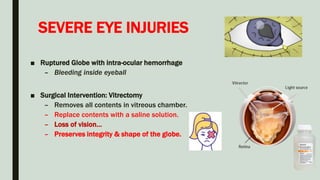
■ Ruptured Globe with intra-ocular hemorrhage
– Bleeding inside eyeball
■ Surgical Intervention: Vitrectomy
– Removes all contents in vitreous chamber.
– Replace contents with a saline solution.
– Loss of vision…
– Preserves integrity & shape of the globe.
SEVERE EYE INJURIES
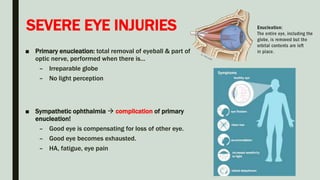
■ Primary enucleation: total removal of eyeball & part of
optic nerve, performed when there is…
– Irreparable globe
– No light perception
■ Sympathetic ophthalmia  complication of primary
enucleation!
– Good eye is compensating for loss of other eye.
– Good eye becomes exhausted.
– HA, fatigue, eye pain
FOREIGN BODIES
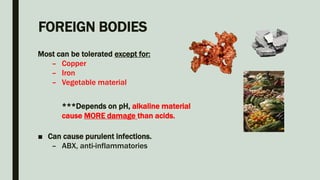
Most can be tolerated except for:
– Copper
– Iron
– Vegetable material
***Depends on pH, alkaline material
cause MORE damage than acids.
■ Can cause purulent infections.
– ABX, anti-inflammatories
FOREIGN BODIES
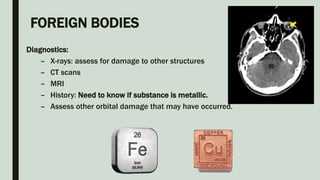
Diagnostics:
– X-rays: assess for damage to other structures
– CT scans
– MRI
– History: Need to know if substance is metallic.
– Assess other orbital damage that may have occurred.
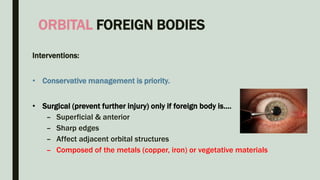
ORBITAL FOREIGN BODIES
Interventions:
• Conservative management is priority.
• Surgical (prevent further injury) only if foreign body is….
– Superficial & anterior
– Sharp edges
– Affect adjacent orbital structures
– Composed of the metals (copper, iron) or vegetative materials
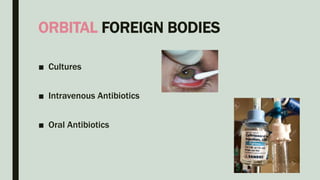
ORBITAL FOREIGN BODIES
■ Cultures
■ Intravenous Antibiotics
■ Oral Antibiotics
OCULAR FOREIGN BODIES
■ C/O blurred vision and discomfort
■ Question recent injuries or exposures.
■ Many causes of eye injury may have occurred days earlier.
OCULAR FOREIGN BODIES
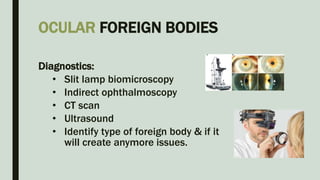
Diagnostics:
• Slit lamp biomicroscopy
• Indirect ophthalmoscopy
• CT scan
• Ultrasound
• Identify type of foreign body & if it
will create anymore issues.
OCULAR FOREIGN BODIES
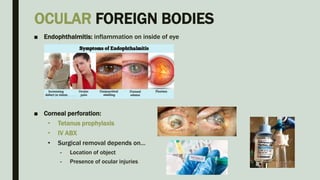
■ Endophthalmitis: inflammation on inside of eye
■ Corneal perforation:
• Tetanus prophylaxis
• IV ABX
• Surgical removal depends on…
- Location of object
- Presence of ocular injuries
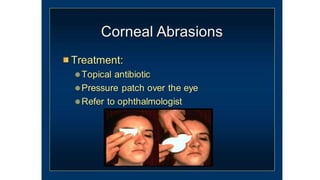
CORNEAL ABRASIONS:
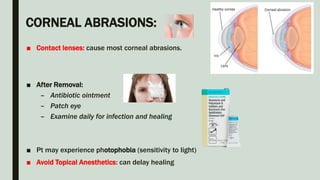
■ Contact lenses: cause most corneal abrasions.
■ After Removal:
– Antibiotic ointment
– Patch eye
– Examine daily for infection and healing
■ Pt may experience photophobia (sensitivity to light)
■ Avoid Topical Anesthetics: can delay healing
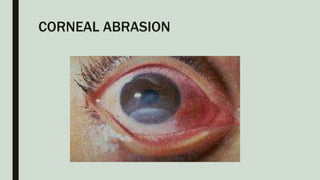
CORNEAL ABRASION
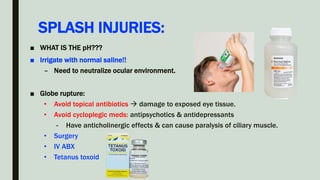
SPLASH INJURIES:
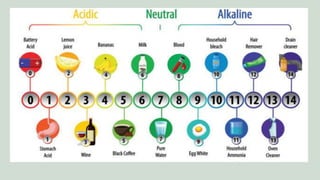
■ WHAT IS THE pH???
■ Irrigate with normal saline!!
– Need to neutralize ocular environment.
■ Globe rupture:
• Avoid topical antibiotics  damage to exposed eye tissue.
• Avoid cycloplegic meds: antipsychotics & antidepressants
- Have anticholinergic effects & can cause paralysis of ciliary muscle.
• Surgery
• IV ABX
• Tetanus toxoid
OCULAR BURNS
■ Is causative agent alkali or acidic?
■ Heat or Fire
■ Mace or Tear gas
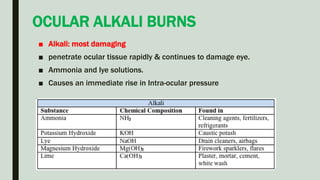
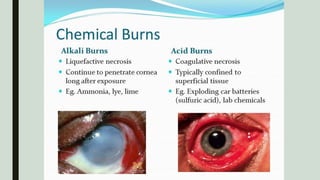
OCULAR ALKALI BURNS
■ Alkali: most damaging
■ penetrate ocular tissue rapidly & continues to damage eye.
■ Ammonia and lye solutions.
■ Causes an immediate rise in Intra-ocular pressure
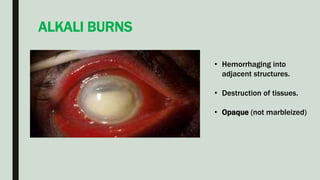
ALKALI BURNS
• Hemorrhaging into
adjacent structures.
• Destruction of tissues.
• Opaque (not marbleized)
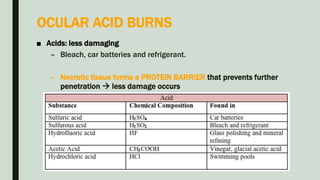
OCULAR ACID BURNS
■ Acids: less damaging
– Bleach, car batteries and refrigerant.
– Necrotic tissue forms a PROTEIN BARRIER that prevents further
penetration  less damage occurs
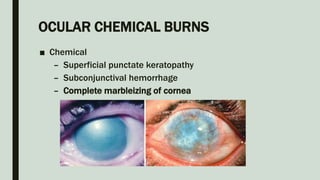
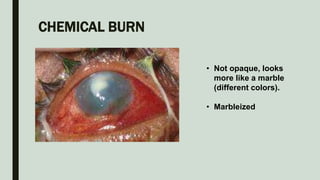
OCULAR CHEMICAL BURNS
■ Chemical
– Superficial punctate keratopathy
– Subconjunctival hemorrhage
– Complete marbleizing of cornea
CHEMICAL BURN
• Not opaque, looks
more like a marble
(different colors).
• Marbleized
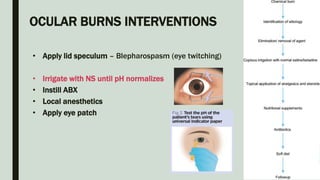
OCULAR BURNS INTERVENTIONS
• Apply lid speculum – Blepharospasm (eye twitching)
• Irrigate with NS until pH normalizes
• Instill ABX
• Local anesthetics
• Apply eye patch
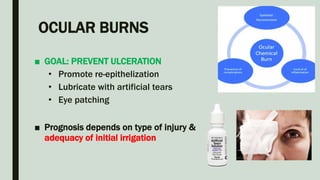
OCULAR BURNS
■ GOAL: PREVENT ULCERATION
• Promote re-epithelization
• Lubricate with artificial tears
• Eye patching
■ Prognosis depends on type of injury &
adequacy of initial irrigation
OCULAR BURNS
■ Long-Term treatment
– Restoration of ocular surface by grafting
– Surgical restoration of corneal integrity
OCULAR BURNS
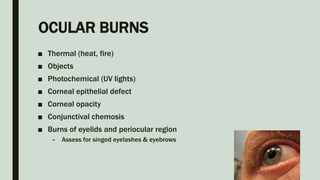
■ Thermal (heat, fire)
■ Objects
■ Photochemical (UV lights)
■ Corneal epithelial defect
■ Corneal opacity
■ Conjunctival chemosis
■ Burns of eyelids and periocular region
– Assess for singed eyelashes & eyebrows
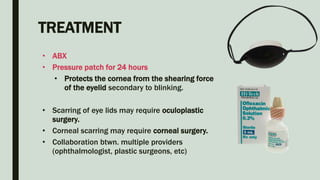
TREATMENT
• ABX
• Pressure patch for 24 hours
• Protects the cornea from the shearing force
of the eyelid secondary to blinking.
• Scarring of eye lids may require oculoplastic
surgery.
• Corneal scarring may require corneal surgery.
• Collaboration btwn. multiple providers
(ophthalmologist, plastic surgeons, etc)
NURSING DIAGNOSIS
• Learning deficit
• Body image changes
• Lifestyle changes
• Occupational changes

Eye trauma

  • 1.
  • 2.
    OBJECTIVES ■ Understand thepathophysiology of eye trauma. ■ Gain knowledge of mechanisms of sustaining eye trauma. ■ Explain preventative measures to avoid eye trauma and importance of nursing education. ■ Show knowledge and application of therapeutic intervention for eye trauma. ■ Show knowledge of pharmacological intervention. ■ Understand ways to monitor therapeutic interventions. ■ Gain knowledge of the rehabilitation needs of eye trauma patients. ■ Demonstrate knowledge of patient outcomes and outcome measures.
  • 3.
    EYE INJURIES: ■ Preventable ■90% of all eye injuries are preventable!!! ■ National safety council estimated $300 million per year spent on eye injuries. ■ All should be knowledgeable of ways to protect eyes.
  • 4.
  • 5.
    ASSESSMENT ■ Eye traumaassociated with head Injury. ■ Remember ABC’s. ■ Evaluate general medical condition prior to conducting in depth ocular exam.
  • 6.
    OCULAR TRAUMA Leading causeof BLINDNESS among children and young adults. – Mostly males affected. CAUSES: • Occupational • Sports • Weapons • Assault • MVC • War
  • 7.
    OCULAR TRAUMA ■ Initialintervention: non-ophthalmic practitioner (ED) ■ Chemical burn: irrigate ■ Foreign body: do not attempt removal ■ Patch/shield: keep eye safe protect with patch, metal shield or stiff paper cup
  • 9.
    ASSESSMENT ■ Medical andocular history ■ Pre-injury vision or surgeries ■ Details related to injury ■ Activity causing injury ■ Chemical burns: name and PH of agent ■ Check cornea and external surfaces ■ Pupils ■ Ocular motility (EOM’s)
  • 10.
    ORBITAL TRAUMA ■ Assessglobe of eye for soft tissue injury. ■ Assess contour of face: – May have underlying facial fractures. – If blunt trauma, suspect facial fractures.
  • 11.
    ORBITAL FRACTURES ■ Diagnosedby facial x-rays ■ May also have CT scan ■ Orbit is the eye socket ■ Made up of different facial bones ■ Protects eye
  • 13.
    MANDIBULAR FRACTURES: ■ Malocclusion(misaligned teeth) ■ Trismus (lock-jaw) ■ Pain ■ Facial Asymmetry: palpable step-off deformity ■ Edema or hematoma at site ■ Anesthesia of lower lip
  • 14.
  • 17.
    • Transverse maxillaryfracture. • Occurs above the level of the teeth. • Separation of the teeth from the rest of the maxilla. – Swelling of maxillary area – Possible lip laceration or fractured teeth – Independent movement of the maxilla from the rest of the face – Malocclusion LeFORT I
  • 18.
    • Pyramidal maxillaryfracture. • Apex transverses bridge of the nose. • Two lateral fractures extend through the lacrimal bone of the face and the ethmoid bone of the skull into the median area of both orbits. • Base of fracture extends above the level of the upper teeth into the maxilla. • Possible CSF leak, rhinorrhea LeFORT II
  • 19.
    LeFORT II ■ Massivefacial edema ■ Nasal swelling ■ Obvious fracture of nasal bones ■ Malocclusion ■ CSF leak through nose = rhinorrhea
  • 20.
    LeFORT III Complete craniofacialseparation: “MASK” – Maxilla – Zygoma – Orbits – Bones of the cranial base
  • 21.
    LeFORT III ■ Massivefacial edema ■ Mobility and depression of zygomatic bones ■ Ecchymosis (bleeding into soft tissue) ■ Anesthesia of the cheek (nerve damage) ■ Diplopia (double vision) ■ Open bite or malocclusion—unable to close mouth, jaw misalignment ■ CSF rhinorrhea
  • 23.
    NURSING CARE ■ Assessment –History – LOC (conscious or altered?) ■ Inspection – ABCs – GCS ■ Palpation – Point tenderness – Depressions or step-off deformities – Crepitus
  • 25.
    NURSING DIAGNOSIS • Airway Will require a tracheostomy.  ETT not indicated r/t facial trauma, CSF leak, rhinorrhea • Gas Exchange • Aspiration • Tissue Perfusion • Risk of Injury • Infection (meningitis)
  • 26.
    ORBITAL FRACTURES ■ Blowout ■Maxillary ■ Orbital roof ■ Midfacial ■ Orbital apex ■ Zygomatic ■ Associated with soft tissue injury and optic nerve injury
  • 28.
    BLOW-OUT FRACTURE ■ Compressionof the soft tissue ■ Sudden ↑ in orbital pressure when force is transmitted to the orbital floor. ■ Follows path of least resistance. ■ Muscles become entrapped along with the fat pads and facial attachments – Leads to nerve compression, numbness, tingling.
  • 29.
    BLOW-OUT FRACTURE ■ Inferioroblique and inferior rectus ■ Confirmed by CT scan ■ Globe displacement (inward displacement): enophthalmos ■ Blunt trauma (baseball, golf ball, etc.) ■ The smaller the object, the more severe the trauma will be. – HIGHER VELOCITY – MORE CENTRAL – Force distributed over a smaller area
  • 30.
    ORBITAL ROOF FRACTURE ■Orbital roof fracture danger of injury to brain. ■ Surgical intervention: usually not emergent. ■ Ophthalmologist + neurosurgery ■ Emergent if… ocular globe displaced to maxillary sinus.
  • 31.
    ASSESSMENT of ORBITALFRACTURES ■ Check for crepitus (air under tissues) ■ Proptosis: protruding / bulging eyes (also caused by tumors) ■ Visual acuity ■ Blurred vision ■ “Double vision”
  • 33.
    INTERVENTIONS ■ Surgery within10-14 days ■ Avoid nose blowing (↑ ICP / ↑ intraocular pressure) Complications: – Permanent loss of vision (globe displacement, muscle involvement) – Persistent enophthalmos – Scarring – Eyelid retraction
  • 35.
    SOFT TISSUE INJURY ■Caused by a blunt or penetrating injury ASSESS FOR: ■ Tenderness ■ Ecchymosis ■ Lid swelling ■ Proptosis ■ Contusions with subconjunctival hemorrhage  sclera will be red
  • 36.
    Soft Tissue InjuriesWithout Loss of Vision: ■ Inspection ■ Cleansing ■ Repair of wounds ■ Cold compress in early phases (reduce swelling) ■ Hematoma: may appear swollen – Some areas can be drained or evacuated. – Usually diffuse swelling & ecchymosis
  • 37.
    Penetrating Injuries FromFractures ■ Severe nerve damage. ■ Visual loss can be immediate or delayed (r/t infection, unrelieved intraocular pressure) – Sudden vision loss  usually irreversible ■ Corticosteroids ■ Surgery and optic nerve decompression
  • 38.
    Penetrating Eye Injuriesand Contusions ■ Sharp penetration or blunt force  can rupture eyeball ■ Eye wall, cornea, & sclera rupture ■ Rapid decompression of ocular globe. ■ Herniation of orbital contents into adjacent sinuses can occur – Vitreous humor drains into sinuses.
  • 39.
    ■ BLUNT INJURIES worse prognosis than penetrating – Penetrating: more focal & localized. – Blunt force: spread over a wider area. ■ Increase in retinal detachment ■ Intraocular tissue avulsion (tissue can be pulled away) ■ Herniation Penetrating Eye Injuries and Contusions
  • 40.
    ■ Penetrating result in loss of vision. ■ Hemorrhagic chemosis (edema of conjunctiva / cornea) ■ Conjunctival laceration ■ Shallow anterior chamber with or without the pupil off center. ■ Hyphema ■ Vitreous hemorrhage Penetrating Eye Injuries and Contusions
  • 41.
    HYPHEMA: ■ Caused bycontusion forces that tear vessels of iris and damage anterior chamber angle. ■ Goals of treatment: – Prevent re-bleeding – Prevent ↑ intra-ocular pressure
  • 42.
    ■ Protect theeye from further damage by using an eye shield. ■ Administer systemic analgesics. ■ Administer prophylactic broad-spectrum ABX. ■ Administer anti-emetics if the patient has N/V (prevent ↑ IOP). ■ Tetanus prophylaxis. ■ NPO status in preparation for surgery. ■ Carefully document all findings and actions taken.  Defer IOP measurements in patients with lacerations.  Avoid any pressure on the globe (DO NOT press on the sclera)!!  Do not attempt to pull out any foreign material that may be sticking out of the eye. INTERVENTIONS
  • 43.
    INTERVENTIONS ■ May behospitalized if not compliant with activity restriction. – No bending, blowing nose, etc. ■ Eye shield (impedes vision, fall risk, causes HA) ■ Topical corticosteroids: reduce inflammation ■ Amicar –aminocaproic acid for clot formation & stopping bleed  Aspirin contraindicated…  Do not want bleeding
  • 44.
    SEVERE EYE INJURIES ■Ruptured Globe with intra-ocular hemorrhage – Bleeding inside eyeball ■ Surgical Intervention: Vitrectomy – Removes all contents in vitreous chamber. – Replace contents with a saline solution. – Loss of vision… – Preserves integrity & shape of the globe.
  • 45.
    SEVERE EYE INJURIES ■Primary enucleation: total removal of eyeball & part of optic nerve, performed when there is… – Irreparable globe – No light perception ■ Sympathetic ophthalmia  complication of primary enucleation! – Good eye is compensating for loss of other eye. – Good eye becomes exhausted. – HA, fatigue, eye pain
  • 46.
    FOREIGN BODIES Most canbe tolerated except for: – Copper – Iron – Vegetable material ***Depends on pH, alkaline material cause MORE damage than acids. ■ Can cause purulent infections. – ABX, anti-inflammatories
  • 47.
    FOREIGN BODIES Diagnostics: – X-rays:assess for damage to other structures – CT scans – MRI – History: Need to know if substance is metallic. – Assess other orbital damage that may have occurred.
  • 49.
    ORBITAL FOREIGN BODIES Interventions: •Conservative management is priority. • Surgical (prevent further injury) only if foreign body is…. – Superficial & anterior – Sharp edges – Affect adjacent orbital structures – Composed of the metals (copper, iron) or vegetative materials
  • 50.
    ORBITAL FOREIGN BODIES ■Cultures ■ Intravenous Antibiotics ■ Oral Antibiotics
  • 51.
    OCULAR FOREIGN BODIES ■C/O blurred vision and discomfort ■ Question recent injuries or exposures. ■ Many causes of eye injury may have occurred days earlier.
  • 52.
    OCULAR FOREIGN BODIES Diagnostics: •Slit lamp biomicroscopy • Indirect ophthalmoscopy • CT scan • Ultrasound • Identify type of foreign body & if it will create anymore issues.
  • 53.
    OCULAR FOREIGN BODIES ■Endophthalmitis: inflammation on inside of eye ■ Corneal perforation: • Tetanus prophylaxis • IV ABX • Surgical removal depends on… - Location of object - Presence of ocular injuries
  • 54.
    CORNEAL ABRASIONS: ■ Contactlenses: cause most corneal abrasions. ■ After Removal: – Antibiotic ointment – Patch eye – Examine daily for infection and healing ■ Pt may experience photophobia (sensitivity to light) ■ Avoid Topical Anesthetics: can delay healing
  • 55.
  • 56.
    SPLASH INJURIES: ■ WHATIS THE pH??? ■ Irrigate with normal saline!! – Need to neutralize ocular environment. ■ Globe rupture: • Avoid topical antibiotics  damage to exposed eye tissue. • Avoid cycloplegic meds: antipsychotics & antidepressants - Have anticholinergic effects & can cause paralysis of ciliary muscle. • Surgery • IV ABX • Tetanus toxoid
  • 58.
    OCULAR BURNS ■ Iscausative agent alkali or acidic? ■ Heat or Fire ■ Mace or Tear gas
  • 59.
    OCULAR ALKALI BURNS ■Alkali: most damaging ■ penetrate ocular tissue rapidly & continues to damage eye. ■ Ammonia and lye solutions. ■ Causes an immediate rise in Intra-ocular pressure
  • 60.
    ALKALI BURNS • Hemorrhaginginto adjacent structures. • Destruction of tissues. • Opaque (not marbleized)
  • 61.
    OCULAR ACID BURNS ■Acids: less damaging – Bleach, car batteries and refrigerant. – Necrotic tissue forms a PROTEIN BARRIER that prevents further penetration  less damage occurs
  • 63.
    OCULAR CHEMICAL BURNS ■Chemical – Superficial punctate keratopathy – Subconjunctival hemorrhage – Complete marbleizing of cornea
  • 64.
    CHEMICAL BURN • Notopaque, looks more like a marble (different colors). • Marbleized
  • 65.
    OCULAR BURNS INTERVENTIONS •Apply lid speculum – Blepharospasm (eye twitching) • Irrigate with NS until pH normalizes • Instill ABX • Local anesthetics • Apply eye patch
  • 66.
    OCULAR BURNS ■ GOAL:PREVENT ULCERATION • Promote re-epithelization • Lubricate with artificial tears • Eye patching ■ Prognosis depends on type of injury & adequacy of initial irrigation
  • 67.
    OCULAR BURNS ■ Long-Termtreatment – Restoration of ocular surface by grafting – Surgical restoration of corneal integrity
  • 68.
    OCULAR BURNS ■ Thermal(heat, fire) ■ Objects ■ Photochemical (UV lights) ■ Corneal epithelial defect ■ Corneal opacity ■ Conjunctival chemosis ■ Burns of eyelids and periocular region – Assess for singed eyelashes & eyebrows
  • 69.
    TREATMENT • ABX • Pressurepatch for 24 hours • Protects the cornea from the shearing force of the eyelid secondary to blinking. • Scarring of eye lids may require oculoplastic surgery. • Corneal scarring may require corneal surgery. • Collaboration btwn. multiple providers (ophthalmologist, plastic surgeons, etc)
  • 71.
    NURSING DIAGNOSIS • Learningdeficit • Body image changes • Lifestyle changes • Occupational changes