INTRODUCTION
TO OCULAR
TRAUMA
P R E S E N T E R : D R . I D D I N D YA B AW E
M O D U L ATO R : D R . A M PA I R E A N N E M U S I K A
M A K E R E R E U N I V E R S I T Y
D E P A R T M E N T O F O P H T H A L M O L O G Y
A U G U S T 2 0 2 1
OUTLINE
• Introduction to ocular injuries
• Modes of ocular trauma
• Relevant studies
• Assessment of the injured eye
WHAT IS OCULAR INJURY
• Damage or trauma inflicted to the eye by external means
• The concept includes both surface injuries and intraocular injuries. During trauma soft
tissues and bony structures around the eye maybe involved
WHY LEARN ABOUT OCULAR TRAUMA?
• Cause of blindness or partial visual loss in half million people worldwide.
• Results in significant time off work
• Interesting to manage and challenging
• The results can be very rewarding
BACKGROUND
• Remains a major source of blindness in developed and developing world
• Eye injuries occur in economically active people:
-Usually Male,
- Average age of 39 years,
• Place of injury:
-Home (30.2%),
-Workplace (19.6%),
-Sports and leisure facilities (15.8%).
.
• .
BACKGROUND
• Causes:
-Tools, or Machinery (Home/work) – Approx 25%,
-assault (20%).
-Sports related activities (12.5%),
-war related injuries
• Eye injuries come at a high cost to society and are largely avoidable – severe anxiety,
loss of career opportunities, impaired quality of life, time off work
INTRODUCTION
• Injuries have their effect depending upon their severity
• Mild injuries have no residual effect
• Moderate and severe injuries can have vision threatening effects like loss of vision and
collateral damage to the ocular and orbital structures.
• Sympathetic ophthalmitis of the normal eye can occur
.
• .
.
• .
.
• The vulnerable population are those involved in sports, industrial, farmers and
construction workers
• Mild injuries require conservative management whereas the severe injuries require
vigorous treatment.
.
• .
.
• .
.
• .
MODES OF OCULAR TRAUMA
• Wooden stick
• Stone
• Bull’s horn
• Motor vehicle accidents including fall from height, fall at home
• Fist blos
• War injuries including blast injuries
• Sports injuries (cricket ball injury, cork injuries)
INTRAOCULAR FOREIGN BODY
• USA –One IOFB in 18-49% of penetrating injuries
• Singapore survey – Annual rate of penetrating injuries 3.7 cases per 100,000 and IOFB is
present in 15% of these cases
• Males greater than female
• Age group – 20-40 years
• History is important
• Trauma at work – medicolegal issue and compensation
• Imaging very important
INJURIES IN PEDIATRIC AGE GROUP
• Ocular trauma is one of the treatable causes of blindness in children
• Ocular trauma is more in male children than female
• Outdoor activities are the most common causes
• Infants have ocular injury by the finger nail trauma due to rough handling by the
parents and the caretakers
MODE OF INJURY IN CHILDREN
• Domestic environment trauma: This included cases of injury due to stationary items, household items
• Trauma sustained during outdoor activities: This included cases of injuries while playing with ball,
stone, pellets, bow and arrow, wooden top, sticks
• Fire cracker injuries
• Road traffic accidents
• Animal attacks
• Agriculture field and work place related injuries: Injuries sustained in agricultural fields and other
places not meant for recreation
.
.
.
• .
OCULAR INJURY IN THE GERIATRIC
AGE GROUP
• The old age population > 60yr is prone for the injuries due to:
1) frequent falls,
2) road traffic accidents,
Sex predilection: females > males,
The visual prognosis is poor in the old age compared to other population
TYPES OF INJURIES
• Mechanical
• Chemical
• Thermal
• Radiational
• Electrical
MECHANICAL INJURIES
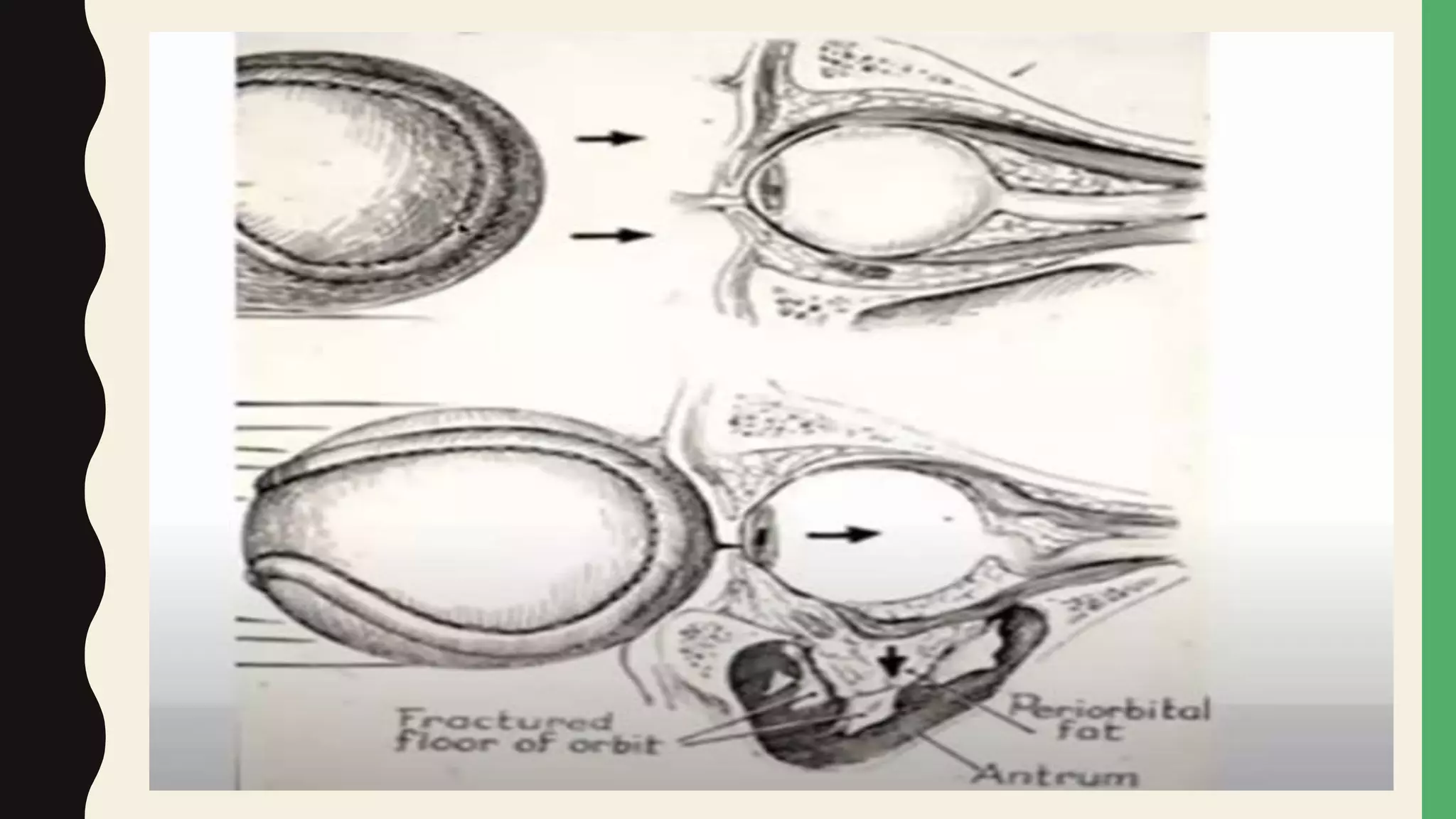
• The definitions proposed by Birmingham Eye Trauma Terminology (BETT) and as such
adopted by ‘American Ocular Trauma Society’ (AOTS) for mechanical ocular injuries are
as follows:-
• 1) Closed Globe Injuries: - Do not have a full thickness wound but there is intraocular
damage. Includes contusion and lamellar laceration.
• 2) Open globe injuries:- A full thickness wound of the sclera or cornea or both.
It includes rupture and laceration of eyeball.
BETTS ANIMATION
.
• .
.
• .
.
• .
.
• .
CHEMICAL INJURIES
• Injuries with chemical include: alkali injuries and acid injuries
• Complications include scarring of eye and permanent visual loss
CHEMICAL INJURY
• Key principles
• Irrigation is key and makes the biggest difference
• If minor epithelial damage then antibiotics and lubricants will suffice
• Very low threshold to refer in to local eye A & E Dept.
• Will then be graded and managed accordingly
.
• .
.
• .
.
• .
.
• .
.
• .
.
• .
.
• .
.
• .
.
• .
.
• .
THERMAL BURNS
• The thermal burns occur from fire or hot fluids
• Bilateral involvement of the eye with delayed onset 2-3 weeks after the initial burn
occurs
• Conjuctiva and cornea are effected in severe cases.
ELECTRIC INJURIES
• Source of electricity live electricity wire or flash of lightening
• Passage of electric current to the eye will involve the following injuries:
• Symptoms and signs:
-Conjuctiva: congested
-Iris and ciliary body: inflamed
-Lens: ‘electric cataract’- posterior sub capsular cataract
-Retinal haemorrhages
-Optic neuritis.
RADIATION INJURIES
• 1) Ultraviolet radiations:
• Photophthalmia: - occurrence of multiple epithelial erosions due to effect of UV rays
(290-311 micro) and senile cataract.
• Causes: Exposure to short circuit
• Industrial welders and cinema operators
• Snow blindness: - due to reflected UV rays from the snow surface
.
• 2) Infrared radiations: Solar retinopathy/eclipse retinopathy
• Causes: due to direct/indirect sun viewing.
• Welding arc exposure
• Lightening retinopathy
• Retinal photoxicity from ophthalmic instruments like operating microscope
.
• 3) Ionising radiational injuries:
• They are caused following the radiation therapy for the tumors.
• Radiation keratoconjuctivitis
• Radiation dermatitis of the lid
• The severity of the keratoconjuctivitis depends on the amount of radiation used for
therapy
RADIATION CATARACT
• 1) Infrared cataract: - discoid posterior subcapsular cataract
-Seen in the workers of glass industries
-Also known as ‘glass blowers or glass workers cataract.
• 2)Irradiation cataract:- exposure to X rays, gamma rays and neutrons
-6 months to few years is the time between exposure and development of cataract.
INJURIES WITH NON-ORGANIC AND
ORGANIC MATERIALS
• Organic materials tends to produce proliferative reaction and formation of granulation
tissue
• Injury with leaves, fronds, thorns, wood and caterpillar hair are organic injuries.
• Injuries with glass, plastics, stone, gold, silver are non-organic materials causing injury.
ASSESSMENT OF THE INJURED EYE
• Detailed history and meticulous note-taking
• Detailed examination
• Special investigations: -XR, CT, U/S
ORBITAL FRACTURES
LE FORT
IMPORTANT INFORMATION IN THE
HISTORY
• How the injury was sustained
• History of high velocity injury
• Circumstances of the injury should be carefully recorded - medico-legal implications
EXAMINATION
• A good examination is vital
• Critical to test the visual acutity/RAPD
• A visual acuity of 6/6 or 20/20 does not exclude a penetrating eye injury
• Gross external examination
• Ocular movements
• Slit lamp exam
• Fundus exam is possible
INVESTIGATIONS
• X-ray: -orbital fractures/suspected IOFB
• CT: -orbital fractures/IOFB
• MRI: - occult scleral ruptures, large haemorrhagic CD’s, dense VH
• B-scan: - VH, PVD, RD, CD. IOFB
CLINICAL PRESENTATION
• Examples in practice and management principles
.
• .
.
• .
PLANNING FOR REMOVAL
• Explain what you’re going to do and ask patient if ok to proceed
• Anaesthetise the eye with topical drops
• Forehead all the way forward
• Keep the light to a minimum
• Hold the eyelid open (top lid)
• Keep needle parallel to the eye
• Topical antibiotics for a few days afterwards
.
• .
ALWAYS BE ALERT
• Especially as examination may be deceptive
IMAGING IS VERY IMPORTANT IN
SUCH CASES
• .
.
• .
ALWAYS BE THOROUGH
.
• .
.
• .
.
• .
.
• .
.
• .
.
• .
.
• .
.
• .
REFERENCES
• 1. Kuhn F, Morris R, Witherspoon CD, Heimann K, Jeffers JB, Treister G.A standardized
classification of ocular trauma. Ophthalmology. 1996 Feb;103(2):240-3.
• 2. Kuhn F1 Morris R, Witherspoon CD, Heimann K, Jeffers JB, Treister G. A standardized
classification of ocular trauma. Graefes Arch Clin Exp Ophthalmol. 1996 Jun;234(6):399-403.
• 3. Pieramici DJ, Sternberg P Jr, Aaberg TM Sr, Bridges WZ Jr, Capone A Jr, Cardillo JA, de Juan
E Jr, Kuhn F, Meredith TA, Mieler WF, Olsen TW, Rubsamen P, Stout T. A system for classifying
mechanical injuries of the eye (globe). The Ocular Trauma Classification Group.Am J
Ophthalmol. 1997 Jun;123(6):820-31.
• 4. Kuhn F, Morris R, Witherspoon CD, Mester V.J Fr Ophtalmol. The Birmingham Eye Trauma
Terminology system (BETT). 2004 Feb;27(2):206-10.

Introduction to ocular trauma Dr. Iddi Slides.pptx

  • 1.
    INTRODUCTION TO OCULAR TRAUMA P RE S E N T E R : D R . I D D I N D YA B AW E M O D U L ATO R : D R . A M PA I R E A N N E M U S I K A M A K E R E R E U N I V E R S I T Y D E P A R T M E N T O F O P H T H A L M O L O G Y A U G U S T 2 0 2 1
  • 2.
    OUTLINE • Introduction toocular injuries • Modes of ocular trauma • Relevant studies • Assessment of the injured eye
  • 3.
    WHAT IS OCULARINJURY • Damage or trauma inflicted to the eye by external means • The concept includes both surface injuries and intraocular injuries. During trauma soft tissues and bony structures around the eye maybe involved
  • 4.
    WHY LEARN ABOUTOCULAR TRAUMA? • Cause of blindness or partial visual loss in half million people worldwide. • Results in significant time off work • Interesting to manage and challenging • The results can be very rewarding
  • 5.
    BACKGROUND • Remains amajor source of blindness in developed and developing world • Eye injuries occur in economically active people: -Usually Male, - Average age of 39 years, • Place of injury: -Home (30.2%), -Workplace (19.6%), -Sports and leisure facilities (15.8%).
  • 6.
  • 7.
    BACKGROUND • Causes: -Tools, orMachinery (Home/work) – Approx 25%, -assault (20%). -Sports related activities (12.5%), -war related injuries • Eye injuries come at a high cost to society and are largely avoidable – severe anxiety, loss of career opportunities, impaired quality of life, time off work
  • 8.
    INTRODUCTION • Injuries havetheir effect depending upon their severity • Mild injuries have no residual effect • Moderate and severe injuries can have vision threatening effects like loss of vision and collateral damage to the ocular and orbital structures. • Sympathetic ophthalmitis of the normal eye can occur
  • 9.
  • 10.
  • 11.
    . • The vulnerablepopulation are those involved in sports, industrial, farmers and construction workers • Mild injuries require conservative management whereas the severe injuries require vigorous treatment.
  • 12.
  • 13.
  • 14.
  • 15.
    MODES OF OCULARTRAUMA • Wooden stick • Stone • Bull’s horn • Motor vehicle accidents including fall from height, fall at home • Fist blos • War injuries including blast injuries • Sports injuries (cricket ball injury, cork injuries)
  • 16.
    INTRAOCULAR FOREIGN BODY •USA –One IOFB in 18-49% of penetrating injuries • Singapore survey – Annual rate of penetrating injuries 3.7 cases per 100,000 and IOFB is present in 15% of these cases • Males greater than female • Age group – 20-40 years • History is important • Trauma at work – medicolegal issue and compensation • Imaging very important
  • 17.
    INJURIES IN PEDIATRICAGE GROUP • Ocular trauma is one of the treatable causes of blindness in children • Ocular trauma is more in male children than female • Outdoor activities are the most common causes • Infants have ocular injury by the finger nail trauma due to rough handling by the parents and the caretakers
  • 18.
    MODE OF INJURYIN CHILDREN • Domestic environment trauma: This included cases of injury due to stationary items, household items • Trauma sustained during outdoor activities: This included cases of injuries while playing with ball, stone, pellets, bow and arrow, wooden top, sticks • Fire cracker injuries • Road traffic accidents • Animal attacks • Agriculture field and work place related injuries: Injuries sustained in agricultural fields and other places not meant for recreation
  • 19.
  • 20.
  • 21.
  • 22.
    OCULAR INJURY INTHE GERIATRIC AGE GROUP • The old age population > 60yr is prone for the injuries due to: 1) frequent falls, 2) road traffic accidents, Sex predilection: females > males, The visual prognosis is poor in the old age compared to other population
  • 23.
    TYPES OF INJURIES •Mechanical • Chemical • Thermal • Radiational • Electrical
  • 24.
    MECHANICAL INJURIES • Thedefinitions proposed by Birmingham Eye Trauma Terminology (BETT) and as such adopted by ‘American Ocular Trauma Society’ (AOTS) for mechanical ocular injuries are as follows:- • 1) Closed Globe Injuries: - Do not have a full thickness wound but there is intraocular damage. Includes contusion and lamellar laceration. • 2) Open globe injuries:- A full thickness wound of the sclera or cornea or both. It includes rupture and laceration of eyeball.
  • 25.
  • 26.
  • 27.
  • 28.
  • 29.
  • 30.
    CHEMICAL INJURIES • Injurieswith chemical include: alkali injuries and acid injuries • Complications include scarring of eye and permanent visual loss
  • 31.
    CHEMICAL INJURY • Keyprinciples • Irrigation is key and makes the biggest difference • If minor epithelial damage then antibiotics and lubricants will suffice • Very low threshold to refer in to local eye A & E Dept. • Will then be graded and managed accordingly
  • 32.
  • 33.
  • 34.
  • 35.
  • 36.
  • 37.
  • 38.
  • 39.
  • 40.
  • 41.
  • 42.
    THERMAL BURNS • Thethermal burns occur from fire or hot fluids • Bilateral involvement of the eye with delayed onset 2-3 weeks after the initial burn occurs • Conjuctiva and cornea are effected in severe cases.
  • 43.
    ELECTRIC INJURIES • Sourceof electricity live electricity wire or flash of lightening • Passage of electric current to the eye will involve the following injuries: • Symptoms and signs: -Conjuctiva: congested -Iris and ciliary body: inflamed -Lens: ‘electric cataract’- posterior sub capsular cataract -Retinal haemorrhages -Optic neuritis.
  • 44.
    RADIATION INJURIES • 1)Ultraviolet radiations: • Photophthalmia: - occurrence of multiple epithelial erosions due to effect of UV rays (290-311 micro) and senile cataract. • Causes: Exposure to short circuit • Industrial welders and cinema operators • Snow blindness: - due to reflected UV rays from the snow surface
  • 45.
    . • 2) Infraredradiations: Solar retinopathy/eclipse retinopathy • Causes: due to direct/indirect sun viewing. • Welding arc exposure • Lightening retinopathy • Retinal photoxicity from ophthalmic instruments like operating microscope
  • 46.
    . • 3) Ionisingradiational injuries: • They are caused following the radiation therapy for the tumors. • Radiation keratoconjuctivitis • Radiation dermatitis of the lid • The severity of the keratoconjuctivitis depends on the amount of radiation used for therapy
  • 47.
    RADIATION CATARACT • 1)Infrared cataract: - discoid posterior subcapsular cataract -Seen in the workers of glass industries -Also known as ‘glass blowers or glass workers cataract. • 2)Irradiation cataract:- exposure to X rays, gamma rays and neutrons -6 months to few years is the time between exposure and development of cataract.
  • 48.
    INJURIES WITH NON-ORGANICAND ORGANIC MATERIALS • Organic materials tends to produce proliferative reaction and formation of granulation tissue • Injury with leaves, fronds, thorns, wood and caterpillar hair are organic injuries. • Injuries with glass, plastics, stone, gold, silver are non-organic materials causing injury.
  • 49.
    ASSESSMENT OF THEINJURED EYE • Detailed history and meticulous note-taking • Detailed examination • Special investigations: -XR, CT, U/S
  • 50.
  • 51.
  • 52.
    IMPORTANT INFORMATION INTHE HISTORY • How the injury was sustained • History of high velocity injury • Circumstances of the injury should be carefully recorded - medico-legal implications
  • 53.
    EXAMINATION • A goodexamination is vital • Critical to test the visual acutity/RAPD • A visual acuity of 6/6 or 20/20 does not exclude a penetrating eye injury • Gross external examination • Ocular movements • Slit lamp exam • Fundus exam is possible
  • 54.
    INVESTIGATIONS • X-ray: -orbitalfractures/suspected IOFB • CT: -orbital fractures/IOFB • MRI: - occult scleral ruptures, large haemorrhagic CD’s, dense VH • B-scan: - VH, PVD, RD, CD. IOFB
  • 55.
    CLINICAL PRESENTATION • Examplesin practice and management principles
  • 56.
  • 57.
  • 58.
    PLANNING FOR REMOVAL •Explain what you’re going to do and ask patient if ok to proceed • Anaesthetise the eye with topical drops • Forehead all the way forward • Keep the light to a minimum • Hold the eyelid open (top lid) • Keep needle parallel to the eye • Topical antibiotics for a few days afterwards
  • 59.
  • 60.
    ALWAYS BE ALERT •Especially as examination may be deceptive
  • 61.
    IMAGING IS VERYIMPORTANT IN SUCH CASES • .
  • 62.
  • 63.
  • 64.
  • 65.
  • 66.
  • 67.
  • 68.
  • 69.
  • 70.
  • 71.
  • 72.
    REFERENCES • 1. KuhnF, Morris R, Witherspoon CD, Heimann K, Jeffers JB, Treister G.A standardized classification of ocular trauma. Ophthalmology. 1996 Feb;103(2):240-3. • 2. Kuhn F1 Morris R, Witherspoon CD, Heimann K, Jeffers JB, Treister G. A standardized classification of ocular trauma. Graefes Arch Clin Exp Ophthalmol. 1996 Jun;234(6):399-403. • 3. Pieramici DJ, Sternberg P Jr, Aaberg TM Sr, Bridges WZ Jr, Capone A Jr, Cardillo JA, de Juan E Jr, Kuhn F, Meredith TA, Mieler WF, Olsen TW, Rubsamen P, Stout T. A system for classifying mechanical injuries of the eye (globe). The Ocular Trauma Classification Group.Am J Ophthalmol. 1997 Jun;123(6):820-31. • 4. Kuhn F, Morris R, Witherspoon CD, Mester V.J Fr Ophtalmol. The Birmingham Eye Trauma Terminology system (BETT). 2004 Feb;27(2):206-10.