Linda H. Warren
EdD RN MSN CCRN
NUR 335
 Identify common mechanisms of injury (MOI)***** (MVA, drowning, blunt injury, adult vs
child, size of vehicle & size of person, etc).
 Describe primary & secondary assessments of trauma patients.
 Identify appropriate nursing diagnosis and expected outcomes based on assessment of the
trauma victim.
 Identify priorities for nursing interventions based on assessment data.
 Describe appropriate interventions for trauma patients.
 Evaluate the effectiveness of nursing interventions for trauma patients.
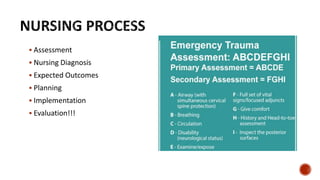
 Assessment
 Nursing Diagnosis
 Expected Outcomes
 Planning
 Implementation
 Evaluation!!!
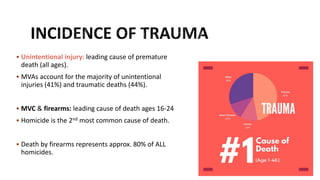
 Unintentional injury: leading cause of premature
death (all ages).
 MVAs account for the majority of unintentional
injuries (41%) and traumatic deaths (44%).
 MVC & firearms: leading cause of death ages 16-24
 Homicide is the 2nd most common cause of death.
 Death by firearms represents approx. 80% of ALL
homicides.
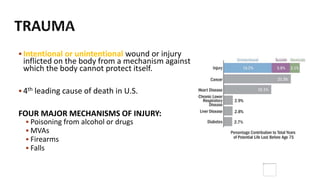
 Intentional or unintentional wound or injury
inflicted on the body from a mechanism against
which the body cannot protect itself.
 4th leading cause of death in U.S.
FOUR MAJOR MECHANISMS OF INJURY:
 Poisoning from alcohol or drugs
 MVAs
 Firearms
 Falls
PREVENTION:
Overarching goal in trauma care.
 Education
 Legislation
 Automatic protection
However, once a traumatic injury
occurs, the priority is early &
aggressive intervention.
PRIMARY PREVENTION: prevents the event
from occurring.
• Driving safety classes
• Speed limits
• Drug awareness campaigns
• Domestic violence campaigns
• Fall prevention
SECONDARY PREVENTION: strategies to
minimize the impact of the traumatic event.
• Seat belt use
• Car seats
• Air bags
• Helmets
• Antibullying hotlines
TERTIARY PREVENTION: interventions to
maximize pt outcomes after a traumatic
event.
• Emergency response systems
• Medical care
• Rehabilitation
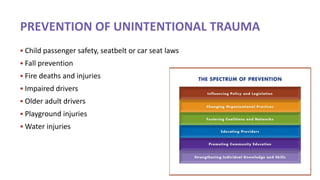
PREVENTION OF UNINTENTIONAL TRAUMA
 Child passenger safety, seatbelt or car seat laws
 Fall prevention
 Fire deaths and injuries
 Impaired drivers
 Older adult drivers
 Playground injuries
 Water injuries
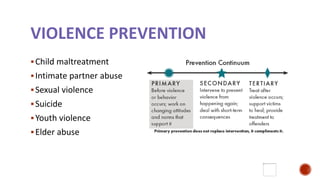
VIOLENCE PREVENTION
Child maltreatment
Intimate partner abuse
Sexual violence
Suicide
Youth violence
Elder abuse
Age: a leading cause of death under age 44.
Socioeconomic status and race
Firearms
Alcohol and drug use
Geography: rural (farm accidents) vs. urban (lead pipes, crime)
Temporal: pattern & timing
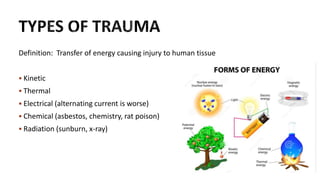
Definition: Transfer of energy causing injury to human tissue
 Kinetic
 Thermal
 Electrical (alternating current is worse)
 Chemical (asbestos, chemistry, rat poison)
 Radiation (sunburn, x-ray)
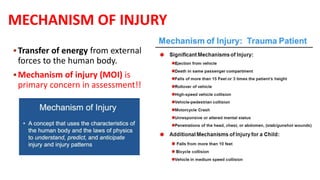
MECHANISM OF INJURY
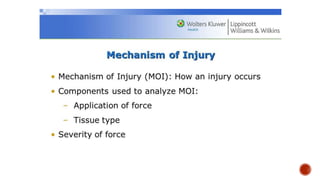
Transfer of energy from external
forces to the human body.
Mechanism of injury (MOI) is
primary concern in assessment!!
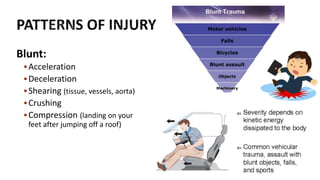
Blunt:
Acceleration
Deceleration
Shearing (tissue, vessels, aorta)
Crushing
Compression (landing on your
feet after jumping off a roof)
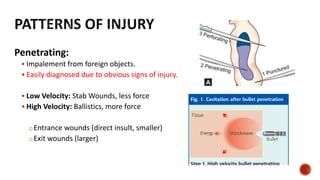
Penetrating:
 Impalement from foreign objects.
 Easily diagnosed due to obvious signs of injury.
 Low Velocity: Stab Wounds, less force
 High Velocity: Ballistics, more force
oEntrance wounds (direct insult, smaller)
oExit wounds (larger)
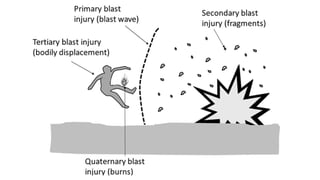
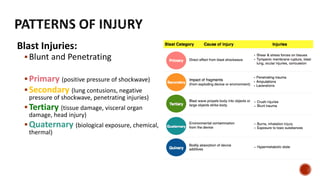
Blast Injuries:
Blunt and Penetrating
Primary (positive pressure of shockwave)
Secondary (lung contusions, negative
pressure of shockwave, penetrating injuries)
Tertiary (tissue damage, visceral organ
damage, head injury)
Quaternary (biological exposure, chemical,
thermal)
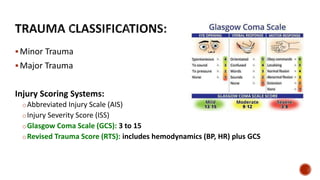
Minor Trauma
Major Trauma
Injury Scoring Systems:
oAbbreviated Injury Scale (AIS)
oInjury Severity Score (ISS)
oGlasgow Coma Scale (GCS): 3 to 15
oRevised Trauma Score (RTS): includes hemodynamics (BP, HR) plus GCS
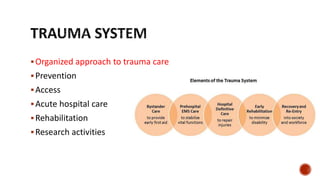
Organized approach to trauma care
Prevention
Access
Acute hospital care
Rehabilitation
Research activities
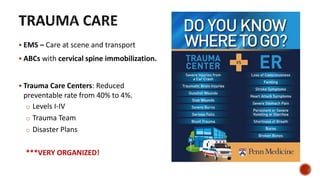
 EMS – Care at scene and transport
 ABCs with cervical spine immobilization.
 Trauma Care Centers: Reduced
preventable rate from 40% to 4%.
o Levels I-IV
o Trauma Team
o Disaster Plans
***VERY ORGANIZED!
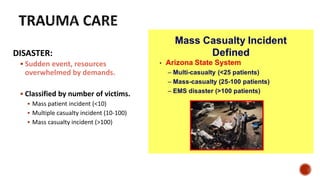
DISASTER:
 Sudden event, resources
overwhelmed by demands.
 Classified by number of victims.
 Mass patient incident (<10)
 Multiple casualty incident (10-100)
 Mass casualty incident (>100)
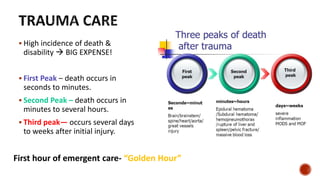
 High incidence of death &
disability  BIG EXPENSE!
 First Peak – death occurs in
seconds to minutes.
 Second Peak – death occurs in
minutes to several hours.
 Third peak— occurs several days
to weeks after initial injury.
First hour of emergent care- “Golden Hour”
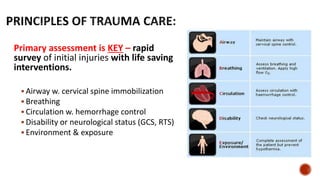
Primary assessment is KEY – rapid
survey of initial injuries with life saving
interventions.
 Airway w. cervical spine immobilization
 Breathing
 Circulation w. hemorrhage control
 Disability or neurological status (GCS, RTS)
 Environment & exposure
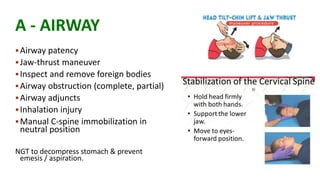
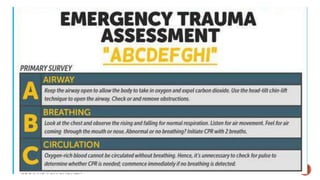
A - AIRWAY
Airway patency
Jaw-thrust maneuver
Inspect and remove foreign bodies
Airway obstruction (complete, partial)
Airway adjuncts
Inhalation injury
Manual C-spine immobilization in
neutral position
NGT to decompress stomach & prevent
emesis / aspiration.
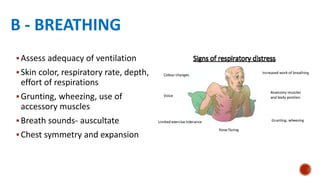
B - BREATHING
Assess adequacy of ventilation
Skin color, respiratory rate, depth,
effort of respirations
Grunting, wheezing, use of
accessory muscles
Breath sounds- auscultate
Chest symmetry and expansion
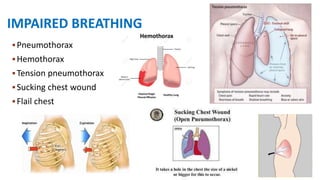
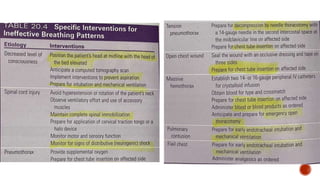
IMPAIRED BREATHING
Pneumothorax
Hemothorax
Tension pneumothorax
Sucking chest wound
Flail chest
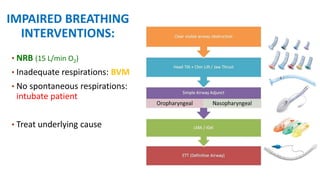
IMPAIRED BREATHING
INTERVENTIONS:
• NRB (15 L/min O2)
• Inadequate respirations: BVM
• No spontaneous respirations:
intubate patient
• Treat underlying cause
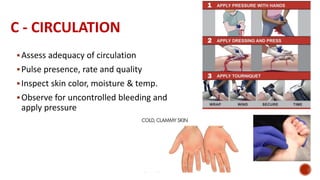
C - CIRCULATION
Assess adequacy of circulation
Pulse presence, rate and quality
Inspect skin color, moisture & temp.
Observe for uncontrolled bleeding and
apply pressure
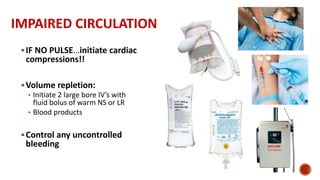
IMPAIRED CIRCULATION
IF NO PULSE…initiate cardiac
compressions!!
Volume repletion:
• Initiate 2 large bore IV’s with
fluid bolus of warm NS or LR
• Blood products
Control any uncontrolled
bleeding
HYPOVOLEMIC & HEMORRHAGIC SHOCK:
 External or internal hemorrhage
 Pneumatic anti-shock garment- (rare)
 Identify & treat the cause
 Fluid replacement with crystalloids:
o3:1 RULE  3mL IV crystalloid for
every 1mL estimated blood loss
 Blood products
 Tachycardia, narrow pulse pressure,
tachypnea, decreased urine output.
o ↓ CO
o ↑ HR, ↑ RR
o ↓ U/O
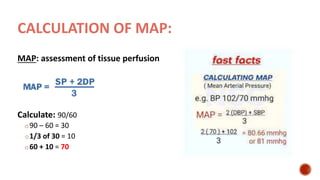
CALCULATION OF MAP:
MAP: assessment of tissue perfusion
Calculate: 90/60
o90 – 60 = 30
o1/3 of 30 = 10
o60 + 10 = 70
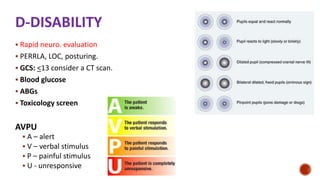
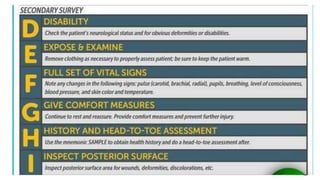
D-DISABILITY
 Rapid neuro. evaluation
 PERRLA, LOC, posturing.
 GCS: <13 consider a CT scan.
 Blood glucose
 ABGs
 Toxicology screen
AVPU
 A – alert
 V – verbal stimulus
 P – painful stimulus
 U - unresponsive
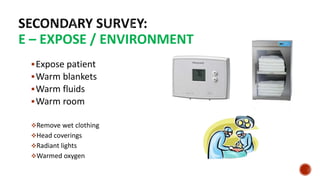
E – EXPOSE / ENVIRONMENT
Expose patient
Warm blankets
Warm fluids
Warm room
Remove wet clothing
Head coverings
Radiant lights
Warmed oxygen
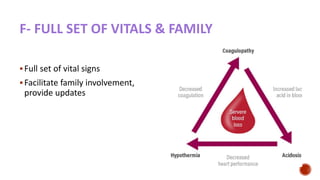
F- FULL SET OF VITALS & FAMILY
Full set of vital signs
Facilitate family involvement,
provide updates
G – GIVE COMFORT MEASURES
Verbal reassurances
Explanation of procedures
Reassurance of care
Touch
Pain management
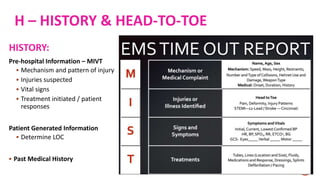
H – HISTORY & HEAD-TO-TOE
HISTORY:
Pre-hospital Information – MIVT
 Mechanism and pattern of injury
 Injuries suspected
 Vital signs
 Treatment initiated / patient
responses
Patient Generated Information
 Determine LOC
 Past Medical History
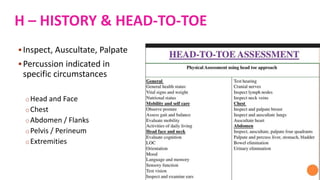
Inspect, Auscultate, Palpate
Percussion indicated in
specific circumstances
oHead and Face
oChest
oAbdomen / Flanks
oPelvis / Perineum
oExtremities
H – HISTORY & HEAD-TO-TOE
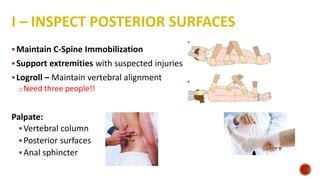
I – INSPECT POSTERIOR SURFACES
Maintain C-Spine Immobilization
Support extremities with suspected injuries
Logroll – Maintain vertebral alignment
oNeed three people!!
Palpate:
Vertebral column
Posterior surfaces
Anal sphincter
Radiological studies per trauma protocol
CT Scan
Tetanus toxoid vaccination
Risk for infection
Hypothermia
Respiratory complications
AKI: hypoperfusion or trauma, pre-renal and intra-
renal causes.
Nutritional support: started within 24-48 hrs to
assist with healing & meeting metabolic demands.
MODS
Effects of aging: Falls are the most frequent causes of injury in the elderly.
• Falls are the leading cause of injury-related deaths in ppl. >65 y.o.
• Physiological changes predispose elderly pts to serious injuries, prolonged recovery,
and higher mortality rates.
• Have worse outcomes after trauma r/t poor functional status and comorbidities.
Alcohol and drug use: contributing factor to many traumas/injuries.
 Assess pt hourly for S&S of withdrawal (tachycardia, HTN, N/V/D, diaphoresis, seizures,
agitation, confusion, hallucinations)
Family and Patient Coping: traumatic event often creates a crisis within the family.
• Promote consistent communication btwn. HC members & the family.
• Involve the social work early on to assist the pt / family with coping & decision making.

Intro. to trauma

  • 1.
    Linda H. Warren EdDRN MSN CCRN NUR 335
  • 2.
     Identify commonmechanisms of injury (MOI)***** (MVA, drowning, blunt injury, adult vs child, size of vehicle & size of person, etc).  Describe primary & secondary assessments of trauma patients.  Identify appropriate nursing diagnosis and expected outcomes based on assessment of the trauma victim.  Identify priorities for nursing interventions based on assessment data.  Describe appropriate interventions for trauma patients.  Evaluate the effectiveness of nursing interventions for trauma patients.
  • 3.
     Assessment  NursingDiagnosis  Expected Outcomes  Planning  Implementation  Evaluation!!!
  • 4.
     Unintentional injury:leading cause of premature death (all ages).  MVAs account for the majority of unintentional injuries (41%) and traumatic deaths (44%).  MVC & firearms: leading cause of death ages 16-24  Homicide is the 2nd most common cause of death.  Death by firearms represents approx. 80% of ALL homicides.
  • 5.
     Intentional orunintentional wound or injury inflicted on the body from a mechanism against which the body cannot protect itself.  4th leading cause of death in U.S. FOUR MAJOR MECHANISMS OF INJURY:  Poisoning from alcohol or drugs  MVAs  Firearms  Falls
  • 6.
    PREVENTION: Overarching goal intrauma care.  Education  Legislation  Automatic protection However, once a traumatic injury occurs, the priority is early & aggressive intervention. PRIMARY PREVENTION: prevents the event from occurring. • Driving safety classes • Speed limits • Drug awareness campaigns • Domestic violence campaigns • Fall prevention SECONDARY PREVENTION: strategies to minimize the impact of the traumatic event. • Seat belt use • Car seats • Air bags • Helmets • Antibullying hotlines TERTIARY PREVENTION: interventions to maximize pt outcomes after a traumatic event. • Emergency response systems • Medical care • Rehabilitation
  • 7.
    PREVENTION OF UNINTENTIONALTRAUMA  Child passenger safety, seatbelt or car seat laws  Fall prevention  Fire deaths and injuries  Impaired drivers  Older adult drivers  Playground injuries  Water injuries
  • 8.
    VIOLENCE PREVENTION Child maltreatment Intimatepartner abuse Sexual violence Suicide Youth violence Elder abuse
  • 9.
    Age: a leadingcause of death under age 44. Socioeconomic status and race Firearms Alcohol and drug use Geography: rural (farm accidents) vs. urban (lead pipes, crime) Temporal: pattern & timing
  • 10.
    Definition: Transfer ofenergy causing injury to human tissue  Kinetic  Thermal  Electrical (alternating current is worse)  Chemical (asbestos, chemistry, rat poison)  Radiation (sunburn, x-ray)
  • 11.
    MECHANISM OF INJURY Transferof energy from external forces to the human body. Mechanism of injury (MOI) is primary concern in assessment!!
  • 13.
    Blunt: Acceleration Deceleration Shearing (tissue, vessels,aorta) Crushing Compression (landing on your feet after jumping off a roof)
  • 14.
    Penetrating:  Impalement fromforeign objects.  Easily diagnosed due to obvious signs of injury.  Low Velocity: Stab Wounds, less force  High Velocity: Ballistics, more force oEntrance wounds (direct insult, smaller) oExit wounds (larger)
  • 15.
    Blast Injuries: Blunt andPenetrating Primary (positive pressure of shockwave) Secondary (lung contusions, negative pressure of shockwave, penetrating injuries) Tertiary (tissue damage, visceral organ damage, head injury) Quaternary (biological exposure, chemical, thermal)
  • 17.
    Minor Trauma Major Trauma InjuryScoring Systems: oAbbreviated Injury Scale (AIS) oInjury Severity Score (ISS) oGlasgow Coma Scale (GCS): 3 to 15 oRevised Trauma Score (RTS): includes hemodynamics (BP, HR) plus GCS
  • 18.
    Organized approach totrauma care Prevention Access Acute hospital care Rehabilitation Research activities
  • 19.
     EMS –Care at scene and transport  ABCs with cervical spine immobilization.  Trauma Care Centers: Reduced preventable rate from 40% to 4%. o Levels I-IV o Trauma Team o Disaster Plans ***VERY ORGANIZED!
  • 20.
    DISASTER:  Sudden event,resources overwhelmed by demands.  Classified by number of victims.  Mass patient incident (<10)  Multiple casualty incident (10-100)  Mass casualty incident (>100)
  • 21.
     High incidenceof death & disability  BIG EXPENSE!  First Peak – death occurs in seconds to minutes.  Second Peak – death occurs in minutes to several hours.  Third peak— occurs several days to weeks after initial injury. First hour of emergent care- “Golden Hour”
  • 22.
    Primary assessment isKEY – rapid survey of initial injuries with life saving interventions.  Airway w. cervical spine immobilization  Breathing  Circulation w. hemorrhage control  Disability or neurological status (GCS, RTS)  Environment & exposure
  • 23.
    A - AIRWAY Airwaypatency Jaw-thrust maneuver Inspect and remove foreign bodies Airway obstruction (complete, partial) Airway adjuncts Inhalation injury Manual C-spine immobilization in neutral position NGT to decompress stomach & prevent emesis / aspiration.
  • 24.
    B - BREATHING Assessadequacy of ventilation Skin color, respiratory rate, depth, effort of respirations Grunting, wheezing, use of accessory muscles Breath sounds- auscultate Chest symmetry and expansion
  • 25.
  • 26.
    IMPAIRED BREATHING INTERVENTIONS: • NRB(15 L/min O2) • Inadequate respirations: BVM • No spontaneous respirations: intubate patient • Treat underlying cause
  • 28.
    C - CIRCULATION Assessadequacy of circulation Pulse presence, rate and quality Inspect skin color, moisture & temp. Observe for uncontrolled bleeding and apply pressure
  • 29.
    IMPAIRED CIRCULATION IF NOPULSE…initiate cardiac compressions!! Volume repletion: • Initiate 2 large bore IV’s with fluid bolus of warm NS or LR • Blood products Control any uncontrolled bleeding
  • 30.
    HYPOVOLEMIC & HEMORRHAGICSHOCK:  External or internal hemorrhage  Pneumatic anti-shock garment- (rare)  Identify & treat the cause  Fluid replacement with crystalloids: o3:1 RULE  3mL IV crystalloid for every 1mL estimated blood loss  Blood products  Tachycardia, narrow pulse pressure, tachypnea, decreased urine output. o ↓ CO o ↑ HR, ↑ RR o ↓ U/O
  • 31.
    CALCULATION OF MAP: MAP:assessment of tissue perfusion Calculate: 90/60 o90 – 60 = 30 o1/3 of 30 = 10 o60 + 10 = 70
  • 32.
    D-DISABILITY  Rapid neuro.evaluation  PERRLA, LOC, posturing.  GCS: <13 consider a CT scan.  Blood glucose  ABGs  Toxicology screen AVPU  A – alert  V – verbal stimulus  P – painful stimulus  U - unresponsive
  • 33.
    E – EXPOSE/ ENVIRONMENT Expose patient Warm blankets Warm fluids Warm room Remove wet clothing Head coverings Radiant lights Warmed oxygen
  • 34.
    F- FULL SETOF VITALS & FAMILY Full set of vital signs Facilitate family involvement, provide updates
  • 35.
    G – GIVECOMFORT MEASURES Verbal reassurances Explanation of procedures Reassurance of care Touch Pain management
  • 36.
    H – HISTORY& HEAD-TO-TOE HISTORY: Pre-hospital Information – MIVT  Mechanism and pattern of injury  Injuries suspected  Vital signs  Treatment initiated / patient responses Patient Generated Information  Determine LOC  Past Medical History
  • 38.
    Inspect, Auscultate, Palpate Percussionindicated in specific circumstances oHead and Face oChest oAbdomen / Flanks oPelvis / Perineum oExtremities H – HISTORY & HEAD-TO-TOE
  • 39.
    I – INSPECTPOSTERIOR SURFACES Maintain C-Spine Immobilization Support extremities with suspected injuries Logroll – Maintain vertebral alignment oNeed three people!! Palpate: Vertebral column Posterior surfaces Anal sphincter
  • 42.
    Radiological studies pertrauma protocol CT Scan Tetanus toxoid vaccination Risk for infection Hypothermia Respiratory complications
  • 43.
    AKI: hypoperfusion ortrauma, pre-renal and intra- renal causes. Nutritional support: started within 24-48 hrs to assist with healing & meeting metabolic demands. MODS
  • 44.
    Effects of aging:Falls are the most frequent causes of injury in the elderly. • Falls are the leading cause of injury-related deaths in ppl. >65 y.o. • Physiological changes predispose elderly pts to serious injuries, prolonged recovery, and higher mortality rates. • Have worse outcomes after trauma r/t poor functional status and comorbidities. Alcohol and drug use: contributing factor to many traumas/injuries.  Assess pt hourly for S&S of withdrawal (tachycardia, HTN, N/V/D, diaphoresis, seizures, agitation, confusion, hallucinations) Family and Patient Coping: traumatic event often creates a crisis within the family. • Promote consistent communication btwn. HC members & the family. • Involve the social work early on to assist the pt / family with coping & decision making.