OCULAR TRAUMA AND BASIC
MANAGEMENT PRINCIPLES
By Dr. Amreen Deshmukh
Under Guidance of Dr. K. G.Choudhary Sir
Outline
 Introduction
 Epidemiology
 Classification
 Evaluation
 General principles
 Management of individual conditions
 Complications
 Prevention
 Conclusion
Introduction
 It is said that “ Eyes are window to the soul
and to the outer world.”
 Ocular trauma is a major cause of
preventable monocular blindness and visual
impairment in the world, especially in the
developing countries
 Ocular trauma and resultant loss of vision
leads to psychological, economical and
professional crippling of the patient.
Epidemiology
 Bimodal age distribution: children and young
adults;>70 yrs of age
 M/F: 3-5x
 Lifetime prevalence 20%: 3x recurrence risk
 workplace, sports, falls(elderly)
 PUBLIC HEALTH ISSUE
 TheWHO Programme for the Prevention of
Blindness, suggests that annually
 55 million eye injuries restricting activities more
than one day
 750,000 cases will require hospitalization
 200,000 open-globe injuries
 approximately 1.6 million blind from injuries
 2.3 million people with bilateral low vision
 19 million with unilateral blindness or low vision.
Classification of Ocular Trauma
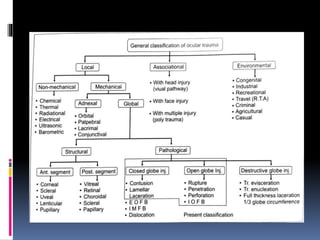
 The Birmingham EyeTraumaTerminology
System (BETTS) devised a classification for
ocular trauma which is accepted worldwide.
 It is unambiguous, consistent and simple.
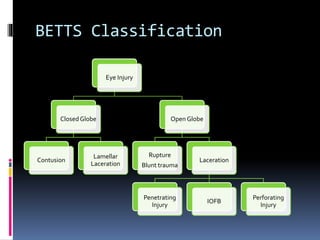
Eye Injury
ClosedGlobe
Contusion
Lamellar
Laceration
Open Globe
Rupture
Blunt trauma
Laceration
Penetrating
Injury
IOFB
Perforating
Injury
BETTS Classification
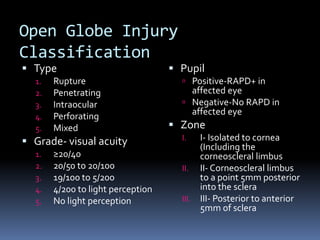
Open Globe Injury
Classification
 Type
1. Rupture
2. Penetrating
3. Intraocular
4. Perforating
5. Mixed
 Grade- visual acuity
1. ≥20/40
2. 20/50 to 20/100
3. 19/100 to 5/200
4. 4/200 to light perception
5. No light perception
 Pupil
 Positive-RAPD+ in
affected eye
 Negative-No RAPD in
affected eye
 Zone
I. I- Isolated to cornea
(Including the
corneoscleral limbus
II. II- Corneoscleral limbus
to a point 5mm posterior
into the sclera
III. III- Posterior to anterior
5mm of sclera
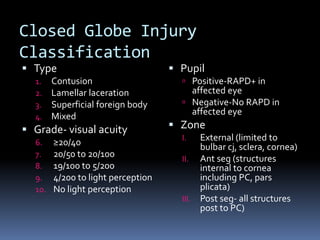
Closed Globe Injury
Classification
 Type
1. Contusion
2. Lamellar laceration
3. Superficial foreign body
4. Mixed
 Grade- visual acuity
6. ≥20/40
7. 20/50 to 20/100
8. 19/100 to 5/200
9. 4/200 to light perception
10. No light perception
 Pupil
 Positive-RAPD+ in
affected eye
 Negative-No RAPD in
affected eye
 Zone
I. External (limited to
bulbar cj, sclera, cornea)
II. Ant seg (structures
internal to cornea
including PC, pars
plicata)
III. Post seg- all structures
post to PC)
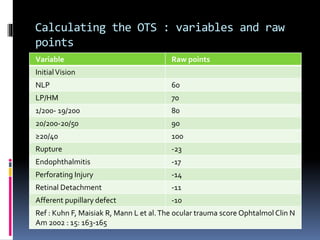
Calculating the OTS : variables and raw
points
Variable Raw points
InitialVision
NLP 60
LP/HM 70
1/200- 19/200 80
20/200-20/50 90
≥20/40 100
Rupture -23
Endophthalmitis -17
Perforating Injury -14
Retinal Detachment -11
Afferent pupillary defect -10
Ref : Kuhn F, Maisiak R, Mann L et al.The ocular trauma score Ophtalmol Clin N
Am 2002 : 15: 163-165
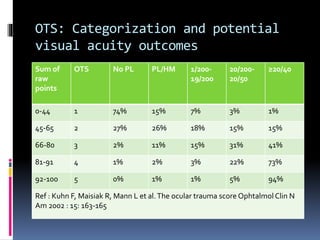
OTS: Categorization and potential
visual acuity outcomes
Sum of
raw
points
OTS No PL PL/HM 1/200-
19/200
20/200-
20/50
≥20/40
0-44 1 74% 15% 7% 3% 1%
45-65 2 27% 26% 18% 15% 15%
66-80 3 2% 11% 15% 31% 41%
81-91 4 1% 2% 3% 22% 73%
92-100 5 0% 1% 1% 5% 94%
Ref : Kuhn F, Maisiak R, Mann L et al.The ocular trauma score Ophtalmol Clin N
Am 2002 : 15: 163-165
EVALUATION OF THE PATIENT
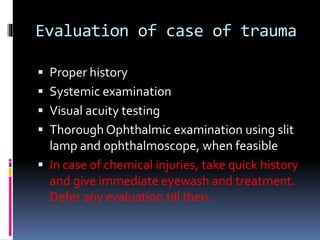
Evaluation of case of trauma
 Proper history
 Systemic examination
 Visual acuity testing
 Thorough Ophthalmic examination using slit
lamp and ophthalmoscope, when feasible
 In case of chemical injuries, take quick history
and give immediate eyewash and treatment.
Defer any evaluation till then.
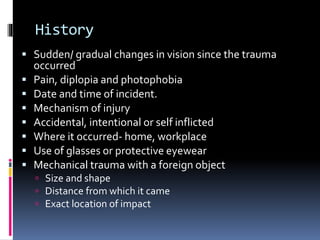
History
 Sudden/ gradual changes in vision since the trauma
occurred
 Pain, diplopia and photophobia
 Date and time of incident.
 Mechanism of injury
 Accidental, intentional or self inflicted
 Where it occurred- home, workplace
 Use of glasses or protective eyewear
 Mechanical trauma with a foreign object
 Size and shape
 Distance from which it came
 Exact location of impact
 Cases of foreign bodies
 Composition of FB, contamination
 Origin and exact mechanism of impact
 Single/multiple
 Injuries from animals
 Type of animal and nature of injury
 Try to locate the animal to test for transmissible
diseases
 Chemical Injuries
 Nature of chemical
 Check pH if sample available
 Past ocular history
 Pre-existing ocular diseases
 Previous ocular surgeries
 Visual acuity prior to incidence
 Intraocular or periocular appliances
 IOL
 Scleral buckle
 Glaucoma drainage implant
 Tetanus immunization
 Any treatment taken for the injury in detail
 Systemic Examination
 General Condition of patient
 Associated head injury, fractures
 Any systemic conditions that may need urgent
intervention
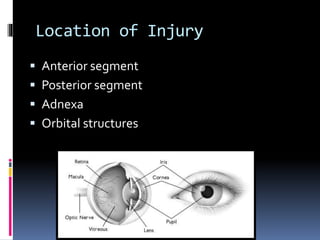
Location of Injury
 Anterior segment
 Posterior segment
 Adnexa
 Orbital structures
Ophthalmic Examination
 Record visual acuity on Snellen’s chart
 Test each eye individually
 Vn with spects
 If not available,Vn with pinhole
 Near vision
 In case of no PL, check with brightest light available (e. g. IDO)
 Keep a record
 Colour vision
 Ophthalmoscopic examination- direct and indirect
 Slit lamp examination
 Photography
 Proper documentation and medico-legal case
registration
 Visual field by confrontation test
 IOP recording
 Deferred until nature of injury is established- open
globe/closed
 Can be done by Schiotz, Applanation or hand
held devices
 Head Posture
 Facial Symmetry
 Eye alignment
 Orbital Fractures- crepitus, infraorbital hypesthesia,
restricted EOM
 Extra-ocular movements- cranial nerve involvement,
entrapment of muscle
 Eyebrows, eyelids and eyelashes-
 Abrasions, CLWs, marginal and canthal tears including
canalicular tears- probing
 Ecchymosis, edema
 Ptosis, FB, enophthalmos/exophthalmos
 Conjunctiva-
 Chemosis, sub-conj. Haemorrhage
 Examine fornices for any FB by double eversion
 conj FB, abrasions (fluorescein staining), lacerations ,
emphysema
 Cornea-
 abrasion- superficial/deep (Fluorescein staining)
 Corneal FB- metallic burr/ vegetative matter
 Chemical burns, ulceration
 Corneal, Corneoscleral tear with/without iris prolapse
 Seidel’s test
• Anterior Chamber-
 Depth
 Gonioscopy- iridodialysis, FB, angle recession
 Cells, flare- iritis
 Hyphaema , hypopyon
 Cortical matter or dislocated lens in AC
 Vitreous, FB
• Iris- examine before dilating the pupil
 Iridodonesis, Iridodialysis
 Iris prolapse
 Sphincter tears
 Traumatic iritis
 Pupil-size, shape and Pupillary Reaction
 Traumatic mydriasis
 RAPD
 D shaped
 Lens-
 Position- Subluxation/ dislocation of lens
 Stability
 Clarity- traumatic cataract- rosette shaped cataract
 PSC, ant subcapsular cat, Sectoral cataracts
 Vossius ring
 Capsular integrity
 Vitreous
 Pigment (tobacco dusting)
 Haemorrhage, IOFB
 Weiss ring- indicates PVD
 Choroid- choroidal rupture, detachment
 Optic Nerve-
 Edema, haemorrhage
 Note c:d ratio
 Avulsion- partial/complete
 optic neuritis
 Retina- scleral depression is important
 Berlin’s edema (commotio retinae)
 IOFB
 Retinal tears, holes
 Retinal dialysis and detachment
INVESTIGATIONS
 Routine haematological investigations
 Radiological Imaging-
 Plain Radiography- if CT and MRI not available
 X-ray orbit AP and Lateral view, PNS
 Orbital fractures
 IOFB and intraorbital FB
Computed Tomography
 Indicated if bone involvement is suspected
 Plain/contrast
 Axial sections- Globe, MR and LR, medial and lat
walls of orbit
 Coronal Sections- SR and IR, roof and floor of orbit
 Indications
 Open globe injuries-
 Post seg visualization
 Suspected Intraocular and intraorbital FB and
haemorrhage
 Orbital fractures
Magnetic Resonance Imaging
 Indications- soft tissue lesions
 To visualise periocular soft tissues
 Suspected vascular lesios, intracranial pathology,
optic nerve lesions
 Non magnetic intraocular or intraorbital FB
 Contraindicated in metallic FB, pacemakers and
implants
Ultrasonography
 Best resolution of post seg (0.1 to 0.01mm)
 Extreme caution in c/o open globe injuries-
preferably avoided
 Indications
 Vitreous haemorrhage, PVD
 Retinal tears and detachment
 Choroidal rupture, suprachoroidal Haemorrhage
 Scleral rupture
 To visualize Lacrimal gland, EOM, soft tissues, FB
MANAGEMENT
First- Aid
 Thorough eyewash- FB , chemical injuries
 Cleaning and dressing of the wounds
 Do Not give pressure on the eyeball in cases
of globe rupture
 Apply a shield in case of open globe injuries
 Tetanus immunisation
 Systemic Analgesics and antibiotics
 Closed globe Injuries
 Eyelid injuries
 Anterior segment
 Posterior segment
 Orbital trauma
 Open globe injuries
 Globe rupture
 Lacerations
 IOFB
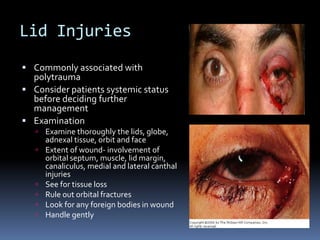
Black Eye
 Blunt truma to eye
 Massive lid edema,
ecchymosis
 marked chemosis
 Fundus- may show Berlin’s
edema
 USG B scan
 X-ray orbit AP lat view
 M/t-
 analgesics-anti-
inflammatory,
 localAntibiotic e/d
 Close follow up
Lid Injuries
 Commonly associated with
polytrauma
 Consider patients systemic status
before deciding further
management
 Examination
 Examine thoroughly the lids, globe,
adnexal tissue, orbit and face
 Extent of wound- involvement of
orbital septum, muscle, lid margin,
canaliculus, medial and lateral canthal
injuries
 See for tissue loss
 Rule out orbital fractures
 Look for any foreign bodies in wound
 Handle gently
 Principles ofWound Repair
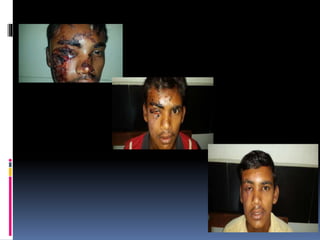
 Re-establish the integrity of basic lid parts- ant.
Lamella, post lamella, levator, canaliculi and canthal
tendons
 Identify landmarks and reattach them- wound angles,
apex of skin flaps, brow hairline
 Do not incorporate orbital septum in the repair
 Can be usually done under LA
 Sutures-
 6-0 polyprolene, nylon , silk
 Can use 6-0 polyglycolic acid in young pts
 Skin sutures removed after 5-7 days
 Major lid reconstructive procedures to be done after
3-6 months
 Non- marginal Lid Lacerations
 Subcutaneous closure
 Use 6- 0/5-0 Polyglactic acid (vicryl) suture
 For suturing of deeper tissue and to anchor it to the
periosteum
 Not necessary to suture the orbital septum
 Tissue loss- consider skin grafts/ flaps
 Marginal Eyelid Lacerations
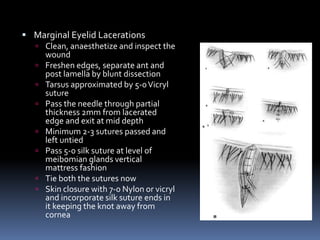
 Clean, anaesthetize and inspect the
wound
 Freshen edges, separate ant and
post lamella by blunt dissection
 Tarsus approximated by 5-0Vicryl
suture
 Pass the needle through partial
thickness 2mm from lacerated
edge and exit at mid depth
 Minimum 2-3 sutures passed and
left untied
 Pass 5-0 silk suture at level of
meibomian glands vertical
mattress fashion
 Tie both the sutures now
 Skin closure with 7-0 Nylon or vicryl
and incorporate silk suture ends in
it keeping the knot away from
cornea
 Canalicular Lacerations-
 Lacerations near medial canthus- do probing and
check if any part is exposed
 Management-
 Monocanalicular stent- for external 2/3rds of one
canaliculus
 Donut stent-silicone bicanalicular stent wih a
pigtail probe
 Crawford stent
 Post-operative Care
 Keep wound clean and dry
 Ice packs to reduce edema
 Pressure patching- upto 1
week- avoid in children, open
globe injury repair, one eyed
pts
 Antibiotic eye ointment,TDS
for 1 week and systemic
antibiotics
 Skin sutures removed on
days 5-7
 Margin sutures left for 2
weeks, stents for 3-6 months
 Complications
 Scarring
 Cicatricial
entropion/ectropion
 Watering
 Exposure keratopathy
 Traumatic ptosis
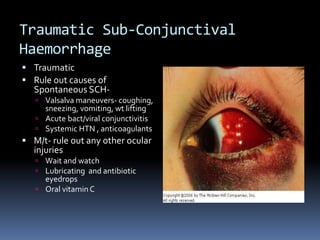
Traumatic Sub-Conjunctival
Haemorrhage
 Traumatic
 Rule out causes of
Spontaneous SCH-
 Valsalva maneuvers- coughing,
sneezing, vomiting, wt lifting
 Acute bact/viral conjunctivitis
 Systemic HTN , anticoagulants
 M/t- rule out any other ocular
injuries
 Wait and watch
 Lubricating and antibiotic
eyedrops
 Oral vitaminC
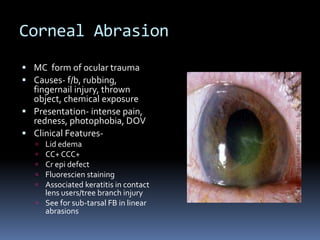
Corneal Abrasion
 MC form of ocular trauma
 Causes- f/b, rubbing,
fingernail injury, thrown
object, chemical exposure
 Presentation- intense pain,
redness, photophobia, DOV
 Clinical Features-
 Lid edema
 CC+ CCC+
 Cr epi defect
 Fluorescien staining
 Associated keratitis in contact
lens users/tree branch injury
 See for sub-tarsal FB in linear
abrasions
 Treatment-
 Debride any loose epithelium with a wet cotton
swab/ sharp blade
 Removal of any FB in fornices and over cornea
 Broad spectrum antibiotics, tear substitutes,
cycloplegics
 Patching of eye- controversial
 Avoid in cases of vegetative trauma, associated
keratitis
 Re-examine patient after 24 hours
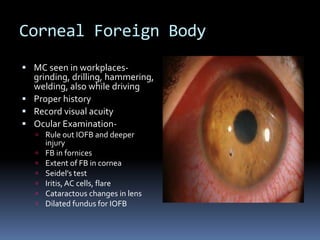
Corneal Foreign Body
 MC seen in workplaces-
grinding, drilling, hammering,
welding, also while driving
 Proper history
 Record visual acuity
 Ocular Examination-
 Rule out IOFB and deeper
injury
 FB in fornices
 Extent of FB in cornea
 Seidel’s test
 Iritis,AC cells, flare
 Cataractous changes in lens
 Dilated fundus for IOFB
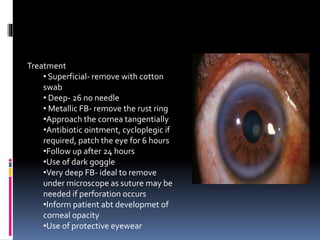
Treatment
• Superficial- remove with cotton
swab
• Deep- 26 no needle
• Metallic FB- remove the rust ring
•Approach the cornea tangentially
•Antibiotic ointment, cycloplegic if
required, patch the eye for 6 hours
•Follow up after 24 hours
•Use of dark goggle
•Very deep FB- ideal to remove
under microscope as suture may be
needed if perforation occurs
•Inform patient abt developmet of
corneal opacity
•Use of protective eyewear
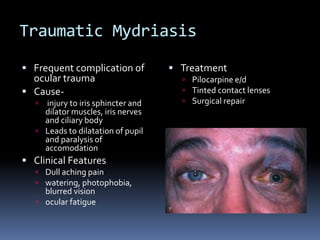
Traumatic Mydriasis
 Frequent complication of
ocular trauma
 Cause-
 injury to iris sphincter and
dilator muscles, iris nerves
and ciliary body
 Leads to dilatation of pupil
and paralysis of
accomodation
 Clinical Features
 Dull aching pain
 watering, photophobia,
blurred vision
 ocular fatigue
 Treatment
 Pilocarpine e/d
 Tinted contact lenses
 Surgical repair
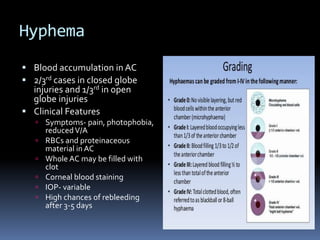
Hyphema
 Blood accumulation in AC
 2/3rd cases in closed globe
injuries and 1/3rd in open
globe injuries
 Clinical Features
 Symptoms- pain, photophobia,
reducedV/A
 RBCs and proteinaceous
material in AC
 Whole AC may be filled with
clot
 Corneal blood staining
 IOP- variable
 High chances of rebleeding
after 3-5 days
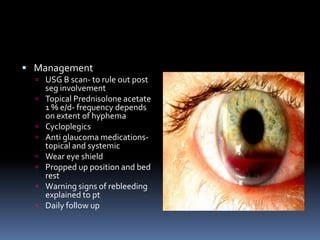
 Management
 USG B scan- to rule out post
seg involvement
 Topical Prednisolone acetate
1 % e/d- frequency depends
on extent of hyphema
 Cycloplegics
 Anti glaucoma medications-
topical and systemic
 Wear eye shield
 Propped up position and bed
rest
 Warning signs of rebleeding
explained to pt
 Daily follow up
 Surgical Intervention
 AC wash with/ without trabeculectomy
 Small gauge bimanual vitrectomy
 Avoid forceful and vigorous manipulation
 Indications
 Corneal blood staining
 Total hyphema with IOP> 50mm Hg > 5days
 Unresolved after 9 days of t/t
 Complications
 Corneal blood staining
 Peripheral anterior synechiae
 Ischemic optic neuropathy
 Optic atrophy, Decreased vision and visual field
defects
 Amblyopia in children d/t corneal blood staining
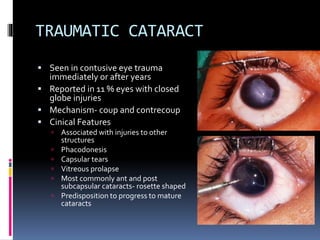
TRAUMATIC CATARACT
 Seen in contusive eye trauma
immediately or after years
 Reported in 11 % eyes with closed
globe injuries
 Mechanism- coup and contrecoup
 Cinical Features
 Associated with injuries to other
structures
 Phacodonesis
 Capsular tears
 Vitreous prolapse
 Most commonly ant and post
subcapsular cataracts- rosette shaped
 Predisposition to progress to mature
cataracts
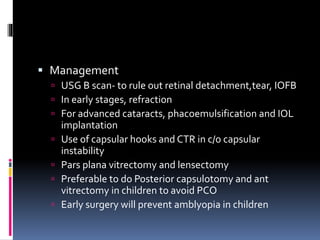
 Management
 USG B scan- to rule out retinal detachment,tear, IOFB
 In early stages, refraction
 For advanced cataracts, phacoemulsification and IOL
implantation
 Use of capsular hooks and CTR in c/o capsular
instability
 Pars plana vitrectomy and lensectomy
 Preferable to do Posterior capsulotomy and ant
vitrectomy in children to avoid PCO
 Early surgery will prevent amblyopia in children
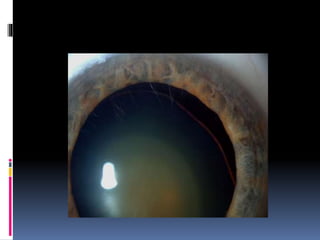
Traumatic Luxation of Lens
 Lens drawn away from
the site of zonular
rupture
 AC- asymmetric
 Lens may dislocate in
AC, posterorly or
extruded
 Symptoms- diminution
of vision, monocular
diplopia,
 Management
 Spectacles/contact lenses
 Miotics
 Mild- Capsular hooks/CTR
with phacoemulsification
and PCIOL
 Severe- ICCE with ACIOL
 Severe with vitreous
prolapse- PPV +
lensectomy
 Lens in AC- anti-
inflammatory, anti-
glaucoma, DO NOT
DILATE- lens extraction
with ACIOL or SFIOL
 Lens in vitreous cavity-
PPV with
phacofragmentation
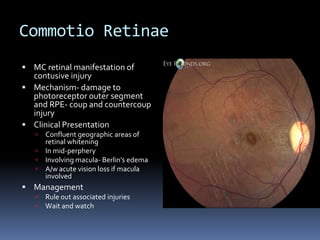
Commotio Retinae
 MC retinal manifestation of
contusive injury
 Mechanism- damage to
photoreceptor outer segment
and RPE- coup and countercoup
injury
 Clinical Presentation
 Confluent geographic areas of
retinal whitening
 In mid-perphery
 Involving macula- Berlin’s edema
 A/w acute vision loss if macula
involved
 Management
 Rule out associated injuries
 Wait and watch
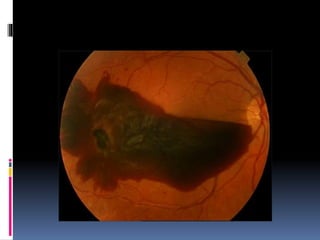
Traumatic Vitreous Haemorrhage
 Clinical Features
 sudden, punctate or web like
floaters
 Decreased visual acuity
 Seeing red
 Diagnosis
 Ophthalmoscopic examination
 USG B scan-
 Mild to moderateVH-mobile
opacities
 MarkedVH- dense echoes
 Positional shifting of
Haemorrhage differentiates from
RD
 Management
 Closed globe injury withVH, no
RD/break-
 bed rest, head elevation
 Re-examination within 2 weeks
for resolution/RD
 Non-resolvingVH- Persisting
for 2-3 months-Vitrectomy
 Associated with RD- early
vitrectony
 Complications
 Secondary open angle
glaucoma
 Hemosiderosis
 PVR,Tractional RD
 Synchysis scintillans
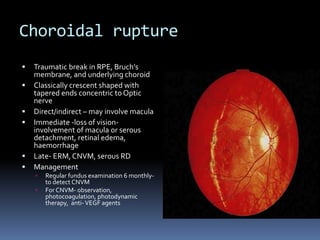
Choroidal rupture
 Traumatic break in RPE, Bruch’s
membrane, and underlying choroid
 Classically crescent shaped with
tapered ends concentric to Optic
nerve
 Direct/indirect – may involve macula
 Immediate -loss of vision-
involvement of macula or serous
detachment, retinal edema,
haemorrhage
 Late- ERM, CNVM, serous RD
 Management
 Regular fundus examination 6 monthly-
to detect CNVM
 For CNVM- observation,
photocoagulation, photodynamic
therapy, anti-VEGF agents
Suprachoroidal Haemorrhage
 Haemorrhgic choroidal detachment a/w accumulation of
blood in potential space between choroid and sclera
 Rupture of long/short post ciliary arteries r ciliary body
vessels
 a/w penetrating ocular injuries
 Presentation-
 Shallow/flatAC, with/without expulsion of intraocular contents
 Pain, raised IOP
 Fundus- dark, dome shped elevation of retina, choroid- loss of red
reflex, apex towards post pole
 USG- non- mobile, flat/dome shaped echo dense opacities in
suprachoroidal space
 Management
 A/w closed globe injury- observe
 Drainage, if indicated- on day 7-14
 A/ w open globe- early surgical intervention
Traumatic Retinal Detachment
Various predisposing conditions which have a
common final outcome i. e. retinal detachment
are
 Retinal Dialysis
 Giant RetinalTears
 Horseshoe tears
 Necrotic Retinal Breaks
 Vitreous base avulsion
 Traumatic posterior vitreous detachment
 Pars plana tears
Retinal Dialysis
 Disinsertion of the retina
from non-pigmented pars
plana epithelium at the ora
serrata
 Retina remains attached to
vitreous base
 MC location
Inferotemporal quadrant
and in traumatic cases-
superonasal
 May remain undiagnosed
for long periods d/t
minimal symptoms
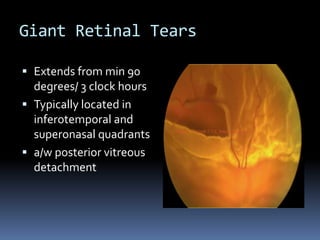
Giant Retinal Tears
 Extends from min 90
degrees/ 3 clock hours
 Typically located in
inferotemporal and
superonasal quadrants
 a/w posterior vitreous
detachment
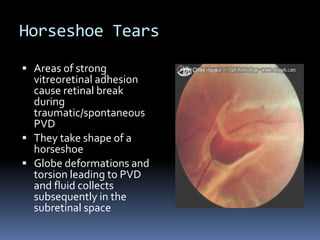
Horseshoe Tears
 Areas of strong
vitreoretinal adhesion
cause retinal break
during
traumatic/spontaneous
PVD
 They take shape of a
horseshoe
 Globe deformations and
torsion leading to PVD
and fluid collects
subsequently in the
subretinal space
Necrotic Retinal Breaks
 Seen posterior to ora serrata
 Direct contusive damage, retinal vascular
damage and retinal capillary necrosis leads to
weakened retina and irregularly shaped
retinal breaks
 Detachment tends to form within 24 hours
Vitreous Base Avulsion
 Occurs commonly after blunt trauma
 Associated with pars plana tears, retinal
dialysis, retinal tears
 Bucket handle appearance- stripe of
translucent vitreous over the retina
 May be asymptomatic, but should search for
associated conditions
Treatment
 Wait and watch
 Prophylactic laser retinopexy/ trans-scleral
cryopexy- peripheral retinal breaks
 Aim of surgery- close all retinal breaks and
relieve vitreoretinal traction
 Surgical techniques- pneumatic retinopexy,
scleral buckling and/or PPV
 Giant retinal tears- PFC stabilization,
lensectomy, , silicon oil tamponade
 RD with pars plana tears/ retinal dialysis- scleral
buckling with trans-scleral cryotherapy or PPV,
air-fluid exchange, internal drainage of SRF and
endolaser photocoagulation
Traumatic Optic Neuropathy
 Intracanalicular part is
most vulnerable
 Mechanism of damage to
optic nerve
 Direct deformation of skull
and optic canal
 Shearing of ON
microvasculature
 Tearing of nerve axons
 Contusion against optic canal
 Presentation
 Profound visual loss, loss of
centralVA
 Visual field defects
 RAPD
 Colour vision defects
 Management
 CT gold standard
 Observation
 High dose corticosteroids -IV
methylprednisolone 30
mg/kg f/b 15 mg/kg 6 hourly
 Optic canal decompression
Orbital Trauma
 Orbital injury can be contusive/ penetrating
 Evaluation-
 Periorbital oedema, lacerations, FB
 Ptosis- edema, haemorrhage, neurogenic
 Crepitus/bony discontinuity- orbital fractures
 Enophthalmos-large orbital #
 Exophthalmos- edema, haemorrhage, bony
fragments, air
 EOM- muscle entrapment, IR mostly involved
 Check Sensations- infraorbital nerve distribution
 Nasal passages- epistaxis, CSF rhinorrhea
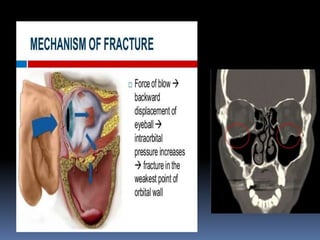
 Blowout Fractures
 Expansion of orbital volume due to fracture of the thin
orbital walls into adjacent paranasal sinuses
 ‘Hydraulic theory’ and ‘buckling theory’
 Axial and Coronal CT scan
 Management
 Systemic oral antibiotics, nasal decongestants, ice packs
 Surgery indicated-
 Entrapment of IR or perimuscular tissue with diplopia
 Significant enophthalmos upto 7-10 days
 High risk injuries for enophthalmos
 Large floor/medial wall #
 Combined medial wall and floor #
 Surgery-
 MedialWall-Floor / transcaruncular incision
 Orbital floor
 approached through transconjunctival/ sunciliary
incision
 Entrapped tissues are released
 Orbital implant- nylon sheets, polyethylene, teflon,
bone
Open Globe Injuries
 Globe rupture- full thickness eyewall injury
caused by blunt trauma
 Laceration- full thickness eyewall wound
caused by sharp object
 Corneal laceration
 Corneoscleral laceration
 Scleral laceration
 Ophthalmic Examination
 360 degreee sub-conjunctival haemorrhage
 ‘Jelly Roll’ chemosis
 Relative asymmetry in AC depth-
 shallow in injuries ant to ciliary body
 deep – post seg involvement
 Transillumination defects in iris- path of projectile
injuries
 Violation of ant capsule, focal cataract
 Seidel test
 Rule outVH, IOFB, RD by dilated examination
Management
 Avoid manipulation of eye, put a protective
shield over the injured eye
 Timing of the surgery depends upon systemic
condition of the patient
 Repair can be performed under Peribulbar
anaesthesia in adults and under GA in
children
 Start systemic antibiotics- IV
aminoglycosides and 3rd generation
cephalosporins
Surgery
 Examination of eye under microscope and
devise a surgical strategy
 Goals
 Close the globe with minimal manipulation
 Reposit/ excise exposed intraocular contents
 Explore the globe for unrecognized injuries
 Decrease the risk of endophthalmitis and
maximize chances of functional recovery by
restoring ocular integrity
Corneal Lacerations
 Small, self-sealing clean
corneal lacerations without iris
incarceration- cyanoacrylate
glue application
 Large lacerations
 Limbal paracentesis site
created
 Injection of viscoelastic
substance in AC
 Iris repositioned, if necrotic
abscission required
 Thorough wash with BSS
 Sutures taken with 10-0
nylon, start with central
suture
 Wound divided in two halves
at the pass of each suture
 75% and 90% depth of suture
pass optimal for healing
 Depth equal on either side,
adequate tension
 Longer passes- less
astigmatism
 Adequate sutures in
periphery, less near visual axis
 Sutures rotated and buried
once the wound is stabilized
 Subconj inj antibiotic and
steroid is given, eye patched
and shield placed
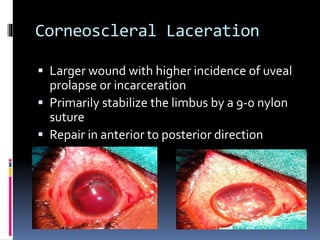
Corneoscleral Laceration
 Larger wound with higher incidence of uveal
prolapse or incarceration
 Primarily stabilize the limbus by a 9-0 nylon
suture
 Repair in anterior to posterior direction
Scleral Laceration
 Identify the posterior extent of the laceration
 Dissect overlying conjunctiva andTenon’s
capsule
 Sutures taken with 8-0 or 9-0 nylon
 Initially place one or two central sutures for
easier repositioning of uveal tissue
 Suture pass should be atleast 50% depth, full
thickness passes avoided
 Interrupted sutures preferred, ends are cut and
rotated if possible
 Rectus muscle laceration- muscle is secured with
double armed 6-0 vicryl, disinserted from globe,
and resutured after wound closure to its original
attachment
 Posterior scleral lacerations
 360 degree conjuctival peritomy
 Isolate all recti on muscle hhoks and secure with loop
of 2-0 braided polyester suture
 Suturing performed, most post part may be leftto heal
by secondary intention
 Tissue loss- scleral or corneal patch graft
 Conjunctiva closed with 6-0 vicryl
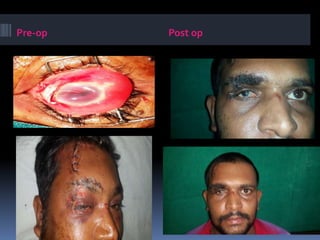
Pre-op Post op
Ruptured Globe Repair
 Exploratory surgery
 360 degree conjunctival peritomy
 Bipolar cautery for haemostasis
 Wound closure performed as described
earlier
Post-operative Management
 Thourough clinical examination
 Topical antibiotics, steroids, cycloplegics, tear substitutes
 IOP lowering agents in case it is elevated
 Eye shielded, avoid strenuous activities
 Continue systemic antibiotics, shift to oral
 Use of soft bandaged contact lenses
 VR consultation in cases of
 IOFB
 Endophthalmitis
 RD,VH
 Posterior scleral rupture/ laceration
 Choroidal detachment, dislocated lens
 Frequent follow-ups
 Suture removal after 4-6 weeks
Complications and Outcomes
 Poor prognostic signs-
 Initial visual acuity at presentation
 Length and width of laceration
 Lacerations of recti
 Involvement of lens
 VH, RD
 Endophthalmitis, sympathetic ophthalmia
 Irregular astigmatism- Rigid gas permeable
contact lenses can be used
Intraocular Foreign Bodies
 Penetrating ocular trauma with IOFB is a
challenging situation for an ophthalmologist
 Diagnosis requires thorough history,
examination and proper imaging
 Ophthalmic examination
 Subconj haemorrhage, iris transillumination defects
 Hyphema, focal lens opacity
 Corneal/scleral laceration
 Violation of ant or post lens capsule
 VH, intra/ sub-retinal haemorrhage
 Relative hypotony
 Visible FB
 Gonioscopy- FB in angle
 Mainstay in imaging- USG and CT, preferably
helical CT with 1mm cuts
Management
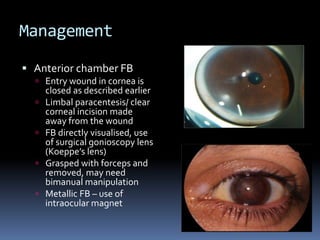
 Anterior chamber FB
 Entry wound in cornea is
closed as described earlier
 Limbal paracentesis/ clear
corneal incision made
away from the wound
 FB directly visualised, use
of surgical gonioscopy lens
(Koeppe’s lens)
 Grasped with forceps and
removed, may need
bimanual manipulation
 Metallic FB – use of
intraocular magnet
 Intralenticular FB-
 can be managed by lens extraction by phacomulsification
and forceps extracion of FB
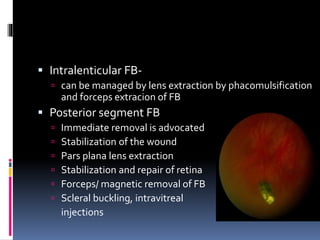
 Posterior segment FB
 Immediate removal is advocated
 Stabilization of the wound
 Pars plana lens extraction
 Stabilization and repair of retina
 Forceps/ magnetic removal of FB
 Scleral buckling, intravitreal
injections
Delayed Complications of ocular
injury
 Traumatic Iritis
 Traumatic cataract
 Delayed trauma-related glaucoma
 Angle recession glaucoma
 Vitreous haemorrhage- induced glaucoma
 Lens- induced glaucoma
 Retinal Detachment
 Metallosis bulbi- siderosis bulbi, chalcosis
 Sympathetic ophthalmia
 Choroidal Neovascularization
 Traumatic endophthalmitis
Sympathetic Ophthalmia
 Bilateral granulomatous uveitis
 MC following open globe injury (incidence 0.2 to
0.5%), may also occur after intraocular surgery
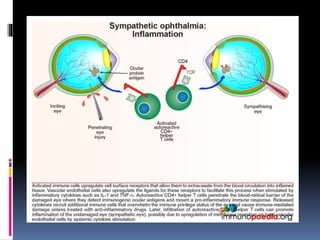
 Pathophysiology-
 Traumatic injury- uveal antigens are exposed-
autoimmune response
 Exciting/injured eye and sympathizing/ normal eye
both become inflamed
 A/w HLA-A 11 is shown
 Onset- 2 weeks to 6 months after injury, mostly within
3 months
 Clinical Features
 Mild pain, photophobia, DOV
 Mutton fat keratic precipitates
 Granulomatous panuveitis with prominent vitritis
 Choroidal lesions- multifocal, placoid, cream colored-
Dalen Fuch’s nodules
 Optic nerve hyperemia, swelling
 FA- multiple hyperfluorescent sites leak in late phase
 Management
 Prevention- enucleation of severely injured eye
 T/t-
 High dose steroids with tapering
 Cyclosporine, azathioprine, chlorambucil, methotrexate
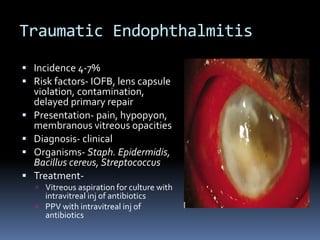
Traumatic Endophthalmitis
 Incidence 4-7%
 Risk factors- IOFB, lens capsule
violation, contamination,
delayed primary repair
 Presentation- pain, hypopyon,
membranous vitreous opacities
 Diagnosis- clinical
 Organisms- Staph. Epidermidis,
Bacillus cereus, Streptococcus
 Treatment-
 Vitreous aspiration for culture with
intravitreal inj of antibiotics
 PPV with intravitreal inj of
antibiotics
Non- Mechanical Eye Injuries
 Chemical Injuries
 Thermal Injuries
 Ultrasonic Injuries
 Electrical Injuries
 Radiational Injuries
Chemical Injuries
 True ocular emergencies, every second
counts
 Immediate irrigation is vital
 Check pH in cul de sac if possible.
 Type of chemical
 Alkali- most severe damage- rapid penetration-
saponification of cell membranes, denaturation of
collagen
 Acids- less damage- hydrogen ion precipitates
proteins and prevents penetration
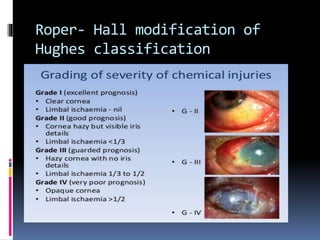
Roper- Hall modification of
Hughes classification
 After thorough irrigation, record visual acuity,
IOP
 Lids ,lashes- crystallized chemicals
 Upper and lower fornix- swipe with cotton
swab
 Size of corneal epi defect, limbal ischemia in
clock hours
 AC reaction
 Management
 Copious irrigation underTA with liter bags of saline with
monitoring of pH till pH neutralizes
 Perform in a lying down position
 Use retractors
 Antibiotic eye ointments, cycloplegic, tear substitutes
 Topical steroids with tapering
 10 % ascorbate and 10% citrate e/d 2hrly
 OralVit C 500mg
 Oral Doxycycline 50-100mg BD- collagenase inhibitor
 Control of raised IOP- topical beta blockers, alpha agonists,CA
inhibitors
 Monitor daily
 SurgicalT/t- temporary tarsorrhaphy, corneal glue, patch graft
Thermal Injuries
 Hyperthermal Injuries
 Flame burns, contact burns
 Clinical Presentations
 Conj hyperemia, chemosis
 Corneal superficial /deep burns- corneal
opacification, sloughing
 Healing- leucoma formation
 Bullous keratitis, ectasia, staphyloma,
symblepharon
 Scleral involvement- uveal prolapse, uveitis,
panophthalmitis
 Treatment
 Clean with saline
 Antibiotic cream
 Full thickness burns of lid- grafting
 Topical – atropine, antibiotics, lubricating e/d, steroids
 Glass rod passed in fornices
 Conj transposition flap, amniotic membrane graft,
limbal cell transplant
 PK or LK for leucomatous corneal opacity later stage
 Hypothermal Injuries
 Surgical Hypothermia-Cardiovascular/
neurosurgery
 Accidental hypothermia
 Cryosurgery
 Clinical lesions
 Conj congestion, edema
 Muscle, tendons- edema and haemorrhage
 Ciliary body- reduced aqueous formation
 Adhesive chorioretinal traction, vitreous iceballs
Electrical Injuries
 Point of entry and exit
 Clinical Features-
 Lid burns- entry wound
 Corneal interstitial opacities
 Iritis, miosis, spasm of accomodation
 Electric cataract
 Retinal edema, papilloedema, RD , chorioretinitis
 Optic neuritis
Radiational Injuries
 Ionizing radiations- X rays, beta rays
 Loss of lashes, entropion, ectropion
 Conj scarring
 Cataract
 UV radiations
 Damage to corneal epithelium
 Cataract formation
 Visible radiation
 Thermal injuries
 Sun gazing l/t damage to macula
 Infrared radiation- Glassblower’s cataract
 Welding arc injuries
Prevention
 Patient education
 Use of protective eyewear at workplaces and
in sports activities
 Use of helmet while riding two wheelers
 Parent education to avoid eye injuries with
household items in children
 Safety norms should be introduced in
workplaces regarding protection of eyes
Take Home Message…
 Immediate treatment is directed at preventing
further injury or vision loss
 Never think of the eye in isolation, always compare
both eyes
 Always record visual acuity as it has important
medicolegal implications
 A visual acuity of 6/6 does not necessarily exclude a
serious eye injury
 Beware of the unilateral red eye as it is rarely ‘just’
conjunctivitis
 Documentation
 Use of protective eyewear
References
 Indian J Ophthalmol. 2013 Oct; 61(10):
539–540 PMCID: PMC3853447 Ocular trauma,
an evolving sub specialty Sundaram
Natarajan
 Ngrel AD, Thylefors B. The global impact
of eye injuries [J] Ophthalmic Epidemiol.
1998;5:143–69. PubMed
 Ocular trauma by James T. Banta
 Clinical Diagnosis and management of
ocular trauma by Garg, Moreno, Shukla et
al
Ocular trauma

Ocular trauma

  • 1.
    OCULAR TRAUMA ANDBASIC MANAGEMENT PRINCIPLES By Dr. Amreen Deshmukh Under Guidance of Dr. K. G.Choudhary Sir
  • 2.
    Outline  Introduction  Epidemiology Classification  Evaluation  General principles  Management of individual conditions  Complications  Prevention  Conclusion
  • 3.
    Introduction  It issaid that “ Eyes are window to the soul and to the outer world.”  Ocular trauma is a major cause of preventable monocular blindness and visual impairment in the world, especially in the developing countries  Ocular trauma and resultant loss of vision leads to psychological, economical and professional crippling of the patient.
  • 4.
    Epidemiology  Bimodal agedistribution: children and young adults;>70 yrs of age  M/F: 3-5x  Lifetime prevalence 20%: 3x recurrence risk  workplace, sports, falls(elderly)  PUBLIC HEALTH ISSUE
  • 5.
     TheWHO Programmefor the Prevention of Blindness, suggests that annually  55 million eye injuries restricting activities more than one day  750,000 cases will require hospitalization  200,000 open-globe injuries  approximately 1.6 million blind from injuries  2.3 million people with bilateral low vision  19 million with unilateral blindness or low vision.
  • 6.
    Classification of OcularTrauma  The Birmingham EyeTraumaTerminology System (BETTS) devised a classification for ocular trauma which is accepted worldwide.  It is unambiguous, consistent and simple.
  • 7.
    Eye Injury ClosedGlobe Contusion Lamellar Laceration Open Globe Rupture Blunttrauma Laceration Penetrating Injury IOFB Perforating Injury BETTS Classification
  • 10.
    Open Globe Injury Classification Type 1. Rupture 2. Penetrating 3. Intraocular 4. Perforating 5. Mixed  Grade- visual acuity 1. ≥20/40 2. 20/50 to 20/100 3. 19/100 to 5/200 4. 4/200 to light perception 5. No light perception  Pupil  Positive-RAPD+ in affected eye  Negative-No RAPD in affected eye  Zone I. I- Isolated to cornea (Including the corneoscleral limbus II. II- Corneoscleral limbus to a point 5mm posterior into the sclera III. III- Posterior to anterior 5mm of sclera
  • 11.
    Closed Globe Injury Classification Type 1. Contusion 2. Lamellar laceration 3. Superficial foreign body 4. Mixed  Grade- visual acuity 6. ≥20/40 7. 20/50 to 20/100 8. 19/100 to 5/200 9. 4/200 to light perception 10. No light perception  Pupil  Positive-RAPD+ in affected eye  Negative-No RAPD in affected eye  Zone I. External (limited to bulbar cj, sclera, cornea) II. Ant seg (structures internal to cornea including PC, pars plicata) III. Post seg- all structures post to PC)
  • 12.
    Calculating the OTS: variables and raw points Variable Raw points InitialVision NLP 60 LP/HM 70 1/200- 19/200 80 20/200-20/50 90 ≥20/40 100 Rupture -23 Endophthalmitis -17 Perforating Injury -14 Retinal Detachment -11 Afferent pupillary defect -10 Ref : Kuhn F, Maisiak R, Mann L et al.The ocular trauma score Ophtalmol Clin N Am 2002 : 15: 163-165
  • 13.
    OTS: Categorization andpotential visual acuity outcomes Sum of raw points OTS No PL PL/HM 1/200- 19/200 20/200- 20/50 ≥20/40 0-44 1 74% 15% 7% 3% 1% 45-65 2 27% 26% 18% 15% 15% 66-80 3 2% 11% 15% 31% 41% 81-91 4 1% 2% 3% 22% 73% 92-100 5 0% 1% 1% 5% 94% Ref : Kuhn F, Maisiak R, Mann L et al.The ocular trauma score Ophtalmol Clin N Am 2002 : 15: 163-165
  • 14.
  • 15.
    Evaluation of caseof trauma  Proper history  Systemic examination  Visual acuity testing  Thorough Ophthalmic examination using slit lamp and ophthalmoscope, when feasible  In case of chemical injuries, take quick history and give immediate eyewash and treatment. Defer any evaluation till then.
  • 16.
    History  Sudden/ gradualchanges in vision since the trauma occurred  Pain, diplopia and photophobia  Date and time of incident.  Mechanism of injury  Accidental, intentional or self inflicted  Where it occurred- home, workplace  Use of glasses or protective eyewear  Mechanical trauma with a foreign object  Size and shape  Distance from which it came  Exact location of impact
  • 17.
     Cases offoreign bodies  Composition of FB, contamination  Origin and exact mechanism of impact  Single/multiple  Injuries from animals  Type of animal and nature of injury  Try to locate the animal to test for transmissible diseases  Chemical Injuries  Nature of chemical  Check pH if sample available
  • 18.
     Past ocularhistory  Pre-existing ocular diseases  Previous ocular surgeries  Visual acuity prior to incidence  Intraocular or periocular appliances  IOL  Scleral buckle  Glaucoma drainage implant  Tetanus immunization  Any treatment taken for the injury in detail
  • 19.
     Systemic Examination General Condition of patient  Associated head injury, fractures  Any systemic conditions that may need urgent intervention
  • 20.
    Location of Injury Anterior segment  Posterior segment  Adnexa  Orbital structures
  • 21.
    Ophthalmic Examination  Recordvisual acuity on Snellen’s chart  Test each eye individually  Vn with spects  If not available,Vn with pinhole  Near vision  In case of no PL, check with brightest light available (e. g. IDO)  Keep a record  Colour vision  Ophthalmoscopic examination- direct and indirect  Slit lamp examination  Photography  Proper documentation and medico-legal case registration
  • 22.
     Visual fieldby confrontation test  IOP recording  Deferred until nature of injury is established- open globe/closed  Can be done by Schiotz, Applanation or hand held devices
  • 23.
     Head Posture Facial Symmetry  Eye alignment  Orbital Fractures- crepitus, infraorbital hypesthesia, restricted EOM  Extra-ocular movements- cranial nerve involvement, entrapment of muscle  Eyebrows, eyelids and eyelashes-  Abrasions, CLWs, marginal and canthal tears including canalicular tears- probing  Ecchymosis, edema  Ptosis, FB, enophthalmos/exophthalmos
  • 24.
     Conjunctiva-  Chemosis,sub-conj. Haemorrhage  Examine fornices for any FB by double eversion  conj FB, abrasions (fluorescein staining), lacerations , emphysema  Cornea-  abrasion- superficial/deep (Fluorescein staining)  Corneal FB- metallic burr/ vegetative matter  Chemical burns, ulceration  Corneal, Corneoscleral tear with/without iris prolapse  Seidel’s test
  • 25.
    • Anterior Chamber- Depth  Gonioscopy- iridodialysis, FB, angle recession  Cells, flare- iritis  Hyphaema , hypopyon  Cortical matter or dislocated lens in AC  Vitreous, FB • Iris- examine before dilating the pupil  Iridodonesis, Iridodialysis  Iris prolapse  Sphincter tears  Traumatic iritis
  • 26.
     Pupil-size, shapeand Pupillary Reaction  Traumatic mydriasis  RAPD  D shaped  Lens-  Position- Subluxation/ dislocation of lens  Stability  Clarity- traumatic cataract- rosette shaped cataract  PSC, ant subcapsular cat, Sectoral cataracts  Vossius ring  Capsular integrity
  • 27.
     Vitreous  Pigment(tobacco dusting)  Haemorrhage, IOFB  Weiss ring- indicates PVD  Choroid- choroidal rupture, detachment  Optic Nerve-  Edema, haemorrhage  Note c:d ratio  Avulsion- partial/complete  optic neuritis  Retina- scleral depression is important  Berlin’s edema (commotio retinae)  IOFB  Retinal tears, holes  Retinal dialysis and detachment
  • 28.
  • 29.
     Routine haematologicalinvestigations  Radiological Imaging-  Plain Radiography- if CT and MRI not available  X-ray orbit AP and Lateral view, PNS  Orbital fractures  IOFB and intraorbital FB
  • 30.
    Computed Tomography  Indicatedif bone involvement is suspected  Plain/contrast  Axial sections- Globe, MR and LR, medial and lat walls of orbit  Coronal Sections- SR and IR, roof and floor of orbit  Indications  Open globe injuries-  Post seg visualization  Suspected Intraocular and intraorbital FB and haemorrhage  Orbital fractures
  • 31.
    Magnetic Resonance Imaging Indications- soft tissue lesions  To visualise periocular soft tissues  Suspected vascular lesios, intracranial pathology, optic nerve lesions  Non magnetic intraocular or intraorbital FB  Contraindicated in metallic FB, pacemakers and implants
  • 32.
    Ultrasonography  Best resolutionof post seg (0.1 to 0.01mm)  Extreme caution in c/o open globe injuries- preferably avoided  Indications  Vitreous haemorrhage, PVD  Retinal tears and detachment  Choroidal rupture, suprachoroidal Haemorrhage  Scleral rupture  To visualize Lacrimal gland, EOM, soft tissues, FB
  • 33.
  • 34.
    First- Aid  Thorougheyewash- FB , chemical injuries  Cleaning and dressing of the wounds  Do Not give pressure on the eyeball in cases of globe rupture  Apply a shield in case of open globe injuries  Tetanus immunisation  Systemic Analgesics and antibiotics
  • 35.
     Closed globeInjuries  Eyelid injuries  Anterior segment  Posterior segment  Orbital trauma  Open globe injuries  Globe rupture  Lacerations  IOFB
  • 36.
    Black Eye  Blunttruma to eye  Massive lid edema, ecchymosis  marked chemosis  Fundus- may show Berlin’s edema  USG B scan  X-ray orbit AP lat view  M/t-  analgesics-anti- inflammatory,  localAntibiotic e/d  Close follow up
  • 37.
    Lid Injuries  Commonlyassociated with polytrauma  Consider patients systemic status before deciding further management  Examination  Examine thoroughly the lids, globe, adnexal tissue, orbit and face  Extent of wound- involvement of orbital septum, muscle, lid margin, canaliculus, medial and lateral canthal injuries  See for tissue loss  Rule out orbital fractures  Look for any foreign bodies in wound  Handle gently
  • 38.
     Principles ofWoundRepair  Re-establish the integrity of basic lid parts- ant. Lamella, post lamella, levator, canaliculi and canthal tendons  Identify landmarks and reattach them- wound angles, apex of skin flaps, brow hairline  Do not incorporate orbital septum in the repair  Can be usually done under LA  Sutures-  6-0 polyprolene, nylon , silk  Can use 6-0 polyglycolic acid in young pts  Skin sutures removed after 5-7 days  Major lid reconstructive procedures to be done after 3-6 months
  • 39.
     Non- marginalLid Lacerations  Subcutaneous closure  Use 6- 0/5-0 Polyglactic acid (vicryl) suture  For suturing of deeper tissue and to anchor it to the periosteum  Not necessary to suture the orbital septum  Tissue loss- consider skin grafts/ flaps
  • 40.
     Marginal EyelidLacerations  Clean, anaesthetize and inspect the wound  Freshen edges, separate ant and post lamella by blunt dissection  Tarsus approximated by 5-0Vicryl suture  Pass the needle through partial thickness 2mm from lacerated edge and exit at mid depth  Minimum 2-3 sutures passed and left untied  Pass 5-0 silk suture at level of meibomian glands vertical mattress fashion  Tie both the sutures now  Skin closure with 7-0 Nylon or vicryl and incorporate silk suture ends in it keeping the knot away from cornea
  • 41.
     Canalicular Lacerations- Lacerations near medial canthus- do probing and check if any part is exposed  Management-  Monocanalicular stent- for external 2/3rds of one canaliculus  Donut stent-silicone bicanalicular stent wih a pigtail probe  Crawford stent
  • 42.
     Post-operative Care Keep wound clean and dry  Ice packs to reduce edema  Pressure patching- upto 1 week- avoid in children, open globe injury repair, one eyed pts  Antibiotic eye ointment,TDS for 1 week and systemic antibiotics  Skin sutures removed on days 5-7  Margin sutures left for 2 weeks, stents for 3-6 months  Complications  Scarring  Cicatricial entropion/ectropion  Watering  Exposure keratopathy  Traumatic ptosis
  • 44.
    Traumatic Sub-Conjunctival Haemorrhage  Traumatic Rule out causes of Spontaneous SCH-  Valsalva maneuvers- coughing, sneezing, vomiting, wt lifting  Acute bact/viral conjunctivitis  Systemic HTN , anticoagulants  M/t- rule out any other ocular injuries  Wait and watch  Lubricating and antibiotic eyedrops  Oral vitaminC
  • 45.
    Corneal Abrasion  MCform of ocular trauma  Causes- f/b, rubbing, fingernail injury, thrown object, chemical exposure  Presentation- intense pain, redness, photophobia, DOV  Clinical Features-  Lid edema  CC+ CCC+  Cr epi defect  Fluorescien staining  Associated keratitis in contact lens users/tree branch injury  See for sub-tarsal FB in linear abrasions
  • 46.
     Treatment-  Debrideany loose epithelium with a wet cotton swab/ sharp blade  Removal of any FB in fornices and over cornea  Broad spectrum antibiotics, tear substitutes, cycloplegics  Patching of eye- controversial  Avoid in cases of vegetative trauma, associated keratitis  Re-examine patient after 24 hours
  • 47.
    Corneal Foreign Body MC seen in workplaces- grinding, drilling, hammering, welding, also while driving  Proper history  Record visual acuity  Ocular Examination-  Rule out IOFB and deeper injury  FB in fornices  Extent of FB in cornea  Seidel’s test  Iritis,AC cells, flare  Cataractous changes in lens  Dilated fundus for IOFB
  • 48.
    Treatment • Superficial- removewith cotton swab • Deep- 26 no needle • Metallic FB- remove the rust ring •Approach the cornea tangentially •Antibiotic ointment, cycloplegic if required, patch the eye for 6 hours •Follow up after 24 hours •Use of dark goggle •Very deep FB- ideal to remove under microscope as suture may be needed if perforation occurs •Inform patient abt developmet of corneal opacity •Use of protective eyewear
  • 49.
    Traumatic Mydriasis  Frequentcomplication of ocular trauma  Cause-  injury to iris sphincter and dilator muscles, iris nerves and ciliary body  Leads to dilatation of pupil and paralysis of accomodation  Clinical Features  Dull aching pain  watering, photophobia, blurred vision  ocular fatigue  Treatment  Pilocarpine e/d  Tinted contact lenses  Surgical repair
  • 50.
    Hyphema  Blood accumulationin AC  2/3rd cases in closed globe injuries and 1/3rd in open globe injuries  Clinical Features  Symptoms- pain, photophobia, reducedV/A  RBCs and proteinaceous material in AC  Whole AC may be filled with clot  Corneal blood staining  IOP- variable  High chances of rebleeding after 3-5 days
  • 51.
     Management  USGB scan- to rule out post seg involvement  Topical Prednisolone acetate 1 % e/d- frequency depends on extent of hyphema  Cycloplegics  Anti glaucoma medications- topical and systemic  Wear eye shield  Propped up position and bed rest  Warning signs of rebleeding explained to pt  Daily follow up
  • 52.
     Surgical Intervention AC wash with/ without trabeculectomy  Small gauge bimanual vitrectomy  Avoid forceful and vigorous manipulation  Indications  Corneal blood staining  Total hyphema with IOP> 50mm Hg > 5days  Unresolved after 9 days of t/t
  • 53.
     Complications  Cornealblood staining  Peripheral anterior synechiae  Ischemic optic neuropathy  Optic atrophy, Decreased vision and visual field defects  Amblyopia in children d/t corneal blood staining
  • 54.
    TRAUMATIC CATARACT  Seenin contusive eye trauma immediately or after years  Reported in 11 % eyes with closed globe injuries  Mechanism- coup and contrecoup  Cinical Features  Associated with injuries to other structures  Phacodonesis  Capsular tears  Vitreous prolapse  Most commonly ant and post subcapsular cataracts- rosette shaped  Predisposition to progress to mature cataracts
  • 55.
     Management  USGB scan- to rule out retinal detachment,tear, IOFB  In early stages, refraction  For advanced cataracts, phacoemulsification and IOL implantation  Use of capsular hooks and CTR in c/o capsular instability  Pars plana vitrectomy and lensectomy  Preferable to do Posterior capsulotomy and ant vitrectomy in children to avoid PCO  Early surgery will prevent amblyopia in children
  • 56.
    Traumatic Luxation ofLens  Lens drawn away from the site of zonular rupture  AC- asymmetric  Lens may dislocate in AC, posterorly or extruded  Symptoms- diminution of vision, monocular diplopia,  Management  Spectacles/contact lenses  Miotics  Mild- Capsular hooks/CTR with phacoemulsification and PCIOL  Severe- ICCE with ACIOL  Severe with vitreous prolapse- PPV + lensectomy  Lens in AC- anti- inflammatory, anti- glaucoma, DO NOT DILATE- lens extraction with ACIOL or SFIOL  Lens in vitreous cavity- PPV with phacofragmentation
  • 58.
    Commotio Retinae  MCretinal manifestation of contusive injury  Mechanism- damage to photoreceptor outer segment and RPE- coup and countercoup injury  Clinical Presentation  Confluent geographic areas of retinal whitening  In mid-perphery  Involving macula- Berlin’s edema  A/w acute vision loss if macula involved  Management  Rule out associated injuries  Wait and watch
  • 59.
    Traumatic Vitreous Haemorrhage Clinical Features  sudden, punctate or web like floaters  Decreased visual acuity  Seeing red  Diagnosis  Ophthalmoscopic examination  USG B scan-  Mild to moderateVH-mobile opacities  MarkedVH- dense echoes  Positional shifting of Haemorrhage differentiates from RD  Management  Closed globe injury withVH, no RD/break-  bed rest, head elevation  Re-examination within 2 weeks for resolution/RD  Non-resolvingVH- Persisting for 2-3 months-Vitrectomy  Associated with RD- early vitrectony  Complications  Secondary open angle glaucoma  Hemosiderosis  PVR,Tractional RD  Synchysis scintillans
  • 61.
    Choroidal rupture  Traumaticbreak in RPE, Bruch’s membrane, and underlying choroid  Classically crescent shaped with tapered ends concentric to Optic nerve  Direct/indirect – may involve macula  Immediate -loss of vision- involvement of macula or serous detachment, retinal edema, haemorrhage  Late- ERM, CNVM, serous RD  Management  Regular fundus examination 6 monthly- to detect CNVM  For CNVM- observation, photocoagulation, photodynamic therapy, anti-VEGF agents
  • 62.
    Suprachoroidal Haemorrhage  Haemorrhgicchoroidal detachment a/w accumulation of blood in potential space between choroid and sclera  Rupture of long/short post ciliary arteries r ciliary body vessels  a/w penetrating ocular injuries  Presentation-  Shallow/flatAC, with/without expulsion of intraocular contents  Pain, raised IOP  Fundus- dark, dome shped elevation of retina, choroid- loss of red reflex, apex towards post pole  USG- non- mobile, flat/dome shaped echo dense opacities in suprachoroidal space  Management  A/w closed globe injury- observe  Drainage, if indicated- on day 7-14  A/ w open globe- early surgical intervention
  • 63.
    Traumatic Retinal Detachment Variouspredisposing conditions which have a common final outcome i. e. retinal detachment are  Retinal Dialysis  Giant RetinalTears  Horseshoe tears  Necrotic Retinal Breaks  Vitreous base avulsion  Traumatic posterior vitreous detachment  Pars plana tears
  • 64.
    Retinal Dialysis  Disinsertionof the retina from non-pigmented pars plana epithelium at the ora serrata  Retina remains attached to vitreous base  MC location Inferotemporal quadrant and in traumatic cases- superonasal  May remain undiagnosed for long periods d/t minimal symptoms
  • 65.
    Giant Retinal Tears Extends from min 90 degrees/ 3 clock hours  Typically located in inferotemporal and superonasal quadrants  a/w posterior vitreous detachment
  • 66.
    Horseshoe Tears  Areasof strong vitreoretinal adhesion cause retinal break during traumatic/spontaneous PVD  They take shape of a horseshoe  Globe deformations and torsion leading to PVD and fluid collects subsequently in the subretinal space
  • 67.
    Necrotic Retinal Breaks Seen posterior to ora serrata  Direct contusive damage, retinal vascular damage and retinal capillary necrosis leads to weakened retina and irregularly shaped retinal breaks  Detachment tends to form within 24 hours
  • 68.
    Vitreous Base Avulsion Occurs commonly after blunt trauma  Associated with pars plana tears, retinal dialysis, retinal tears  Bucket handle appearance- stripe of translucent vitreous over the retina  May be asymptomatic, but should search for associated conditions
  • 69.
    Treatment  Wait andwatch  Prophylactic laser retinopexy/ trans-scleral cryopexy- peripheral retinal breaks  Aim of surgery- close all retinal breaks and relieve vitreoretinal traction  Surgical techniques- pneumatic retinopexy, scleral buckling and/or PPV  Giant retinal tears- PFC stabilization, lensectomy, , silicon oil tamponade  RD with pars plana tears/ retinal dialysis- scleral buckling with trans-scleral cryotherapy or PPV, air-fluid exchange, internal drainage of SRF and endolaser photocoagulation
  • 70.
    Traumatic Optic Neuropathy Intracanalicular part is most vulnerable  Mechanism of damage to optic nerve  Direct deformation of skull and optic canal  Shearing of ON microvasculature  Tearing of nerve axons  Contusion against optic canal  Presentation  Profound visual loss, loss of centralVA  Visual field defects  RAPD  Colour vision defects  Management  CT gold standard  Observation  High dose corticosteroids -IV methylprednisolone 30 mg/kg f/b 15 mg/kg 6 hourly  Optic canal decompression
  • 71.
    Orbital Trauma  Orbitalinjury can be contusive/ penetrating  Evaluation-  Periorbital oedema, lacerations, FB  Ptosis- edema, haemorrhage, neurogenic  Crepitus/bony discontinuity- orbital fractures  Enophthalmos-large orbital #  Exophthalmos- edema, haemorrhage, bony fragments, air  EOM- muscle entrapment, IR mostly involved  Check Sensations- infraorbital nerve distribution  Nasal passages- epistaxis, CSF rhinorrhea
  • 73.
     Blowout Fractures Expansion of orbital volume due to fracture of the thin orbital walls into adjacent paranasal sinuses  ‘Hydraulic theory’ and ‘buckling theory’  Axial and Coronal CT scan  Management  Systemic oral antibiotics, nasal decongestants, ice packs  Surgery indicated-  Entrapment of IR or perimuscular tissue with diplopia  Significant enophthalmos upto 7-10 days  High risk injuries for enophthalmos  Large floor/medial wall #  Combined medial wall and floor #
  • 74.
     Surgery-  MedialWall-Floor/ transcaruncular incision  Orbital floor  approached through transconjunctival/ sunciliary incision  Entrapped tissues are released  Orbital implant- nylon sheets, polyethylene, teflon, bone
  • 75.
    Open Globe Injuries Globe rupture- full thickness eyewall injury caused by blunt trauma  Laceration- full thickness eyewall wound caused by sharp object  Corneal laceration  Corneoscleral laceration  Scleral laceration
  • 76.
     Ophthalmic Examination 360 degreee sub-conjunctival haemorrhage  ‘Jelly Roll’ chemosis  Relative asymmetry in AC depth-  shallow in injuries ant to ciliary body  deep – post seg involvement  Transillumination defects in iris- path of projectile injuries  Violation of ant capsule, focal cataract  Seidel test  Rule outVH, IOFB, RD by dilated examination
  • 77.
    Management  Avoid manipulationof eye, put a protective shield over the injured eye  Timing of the surgery depends upon systemic condition of the patient  Repair can be performed under Peribulbar anaesthesia in adults and under GA in children  Start systemic antibiotics- IV aminoglycosides and 3rd generation cephalosporins
  • 78.
    Surgery  Examination ofeye under microscope and devise a surgical strategy  Goals  Close the globe with minimal manipulation  Reposit/ excise exposed intraocular contents  Explore the globe for unrecognized injuries  Decrease the risk of endophthalmitis and maximize chances of functional recovery by restoring ocular integrity
  • 79.
    Corneal Lacerations  Small,self-sealing clean corneal lacerations without iris incarceration- cyanoacrylate glue application  Large lacerations  Limbal paracentesis site created  Injection of viscoelastic substance in AC  Iris repositioned, if necrotic abscission required  Thorough wash with BSS  Sutures taken with 10-0 nylon, start with central suture  Wound divided in two halves at the pass of each suture  75% and 90% depth of suture pass optimal for healing  Depth equal on either side, adequate tension  Longer passes- less astigmatism  Adequate sutures in periphery, less near visual axis  Sutures rotated and buried once the wound is stabilized  Subconj inj antibiotic and steroid is given, eye patched and shield placed
  • 80.
    Corneoscleral Laceration  Largerwound with higher incidence of uveal prolapse or incarceration  Primarily stabilize the limbus by a 9-0 nylon suture  Repair in anterior to posterior direction
  • 81.
    Scleral Laceration  Identifythe posterior extent of the laceration  Dissect overlying conjunctiva andTenon’s capsule  Sutures taken with 8-0 or 9-0 nylon  Initially place one or two central sutures for easier repositioning of uveal tissue  Suture pass should be atleast 50% depth, full thickness passes avoided  Interrupted sutures preferred, ends are cut and rotated if possible
  • 82.
     Rectus musclelaceration- muscle is secured with double armed 6-0 vicryl, disinserted from globe, and resutured after wound closure to its original attachment  Posterior scleral lacerations  360 degree conjuctival peritomy  Isolate all recti on muscle hhoks and secure with loop of 2-0 braided polyester suture  Suturing performed, most post part may be leftto heal by secondary intention  Tissue loss- scleral or corneal patch graft  Conjunctiva closed with 6-0 vicryl
  • 83.
  • 84.
    Ruptured Globe Repair Exploratory surgery  360 degree conjunctival peritomy  Bipolar cautery for haemostasis  Wound closure performed as described earlier
  • 85.
    Post-operative Management  Thouroughclinical examination  Topical antibiotics, steroids, cycloplegics, tear substitutes  IOP lowering agents in case it is elevated  Eye shielded, avoid strenuous activities  Continue systemic antibiotics, shift to oral  Use of soft bandaged contact lenses  VR consultation in cases of  IOFB  Endophthalmitis  RD,VH  Posterior scleral rupture/ laceration  Choroidal detachment, dislocated lens  Frequent follow-ups  Suture removal after 4-6 weeks
  • 86.
    Complications and Outcomes Poor prognostic signs-  Initial visual acuity at presentation  Length and width of laceration  Lacerations of recti  Involvement of lens  VH, RD  Endophthalmitis, sympathetic ophthalmia  Irregular astigmatism- Rigid gas permeable contact lenses can be used
  • 87.
    Intraocular Foreign Bodies Penetrating ocular trauma with IOFB is a challenging situation for an ophthalmologist  Diagnosis requires thorough history, examination and proper imaging
  • 88.
     Ophthalmic examination Subconj haemorrhage, iris transillumination defects  Hyphema, focal lens opacity  Corneal/scleral laceration  Violation of ant or post lens capsule  VH, intra/ sub-retinal haemorrhage  Relative hypotony  Visible FB  Gonioscopy- FB in angle  Mainstay in imaging- USG and CT, preferably helical CT with 1mm cuts
  • 89.
    Management  Anterior chamberFB  Entry wound in cornea is closed as described earlier  Limbal paracentesis/ clear corneal incision made away from the wound  FB directly visualised, use of surgical gonioscopy lens (Koeppe’s lens)  Grasped with forceps and removed, may need bimanual manipulation  Metallic FB – use of intraocular magnet
  • 90.
     Intralenticular FB- can be managed by lens extraction by phacomulsification and forceps extracion of FB  Posterior segment FB  Immediate removal is advocated  Stabilization of the wound  Pars plana lens extraction  Stabilization and repair of retina  Forceps/ magnetic removal of FB  Scleral buckling, intravitreal injections
  • 91.
    Delayed Complications ofocular injury  Traumatic Iritis  Traumatic cataract  Delayed trauma-related glaucoma  Angle recession glaucoma  Vitreous haemorrhage- induced glaucoma  Lens- induced glaucoma  Retinal Detachment  Metallosis bulbi- siderosis bulbi, chalcosis  Sympathetic ophthalmia  Choroidal Neovascularization  Traumatic endophthalmitis
  • 92.
    Sympathetic Ophthalmia  Bilateralgranulomatous uveitis  MC following open globe injury (incidence 0.2 to 0.5%), may also occur after intraocular surgery  Pathophysiology-  Traumatic injury- uveal antigens are exposed- autoimmune response  Exciting/injured eye and sympathizing/ normal eye both become inflamed  A/w HLA-A 11 is shown  Onset- 2 weeks to 6 months after injury, mostly within 3 months
  • 94.
     Clinical Features Mild pain, photophobia, DOV  Mutton fat keratic precipitates  Granulomatous panuveitis with prominent vitritis  Choroidal lesions- multifocal, placoid, cream colored- Dalen Fuch’s nodules  Optic nerve hyperemia, swelling  FA- multiple hyperfluorescent sites leak in late phase  Management  Prevention- enucleation of severely injured eye  T/t-  High dose steroids with tapering  Cyclosporine, azathioprine, chlorambucil, methotrexate
  • 95.
    Traumatic Endophthalmitis  Incidence4-7%  Risk factors- IOFB, lens capsule violation, contamination, delayed primary repair  Presentation- pain, hypopyon, membranous vitreous opacities  Diagnosis- clinical  Organisms- Staph. Epidermidis, Bacillus cereus, Streptococcus  Treatment-  Vitreous aspiration for culture with intravitreal inj of antibiotics  PPV with intravitreal inj of antibiotics
  • 96.
    Non- Mechanical EyeInjuries  Chemical Injuries  Thermal Injuries  Ultrasonic Injuries  Electrical Injuries  Radiational Injuries
  • 97.
    Chemical Injuries  Trueocular emergencies, every second counts  Immediate irrigation is vital  Check pH in cul de sac if possible.  Type of chemical  Alkali- most severe damage- rapid penetration- saponification of cell membranes, denaturation of collagen  Acids- less damage- hydrogen ion precipitates proteins and prevents penetration
  • 98.
    Roper- Hall modificationof Hughes classification
  • 99.
     After thoroughirrigation, record visual acuity, IOP  Lids ,lashes- crystallized chemicals  Upper and lower fornix- swipe with cotton swab  Size of corneal epi defect, limbal ischemia in clock hours  AC reaction
  • 100.
     Management  Copiousirrigation underTA with liter bags of saline with monitoring of pH till pH neutralizes  Perform in a lying down position  Use retractors  Antibiotic eye ointments, cycloplegic, tear substitutes  Topical steroids with tapering  10 % ascorbate and 10% citrate e/d 2hrly  OralVit C 500mg  Oral Doxycycline 50-100mg BD- collagenase inhibitor  Control of raised IOP- topical beta blockers, alpha agonists,CA inhibitors  Monitor daily  SurgicalT/t- temporary tarsorrhaphy, corneal glue, patch graft
  • 101.
    Thermal Injuries  HyperthermalInjuries  Flame burns, contact burns  Clinical Presentations  Conj hyperemia, chemosis  Corneal superficial /deep burns- corneal opacification, sloughing  Healing- leucoma formation  Bullous keratitis, ectasia, staphyloma, symblepharon  Scleral involvement- uveal prolapse, uveitis, panophthalmitis
  • 102.
     Treatment  Cleanwith saline  Antibiotic cream  Full thickness burns of lid- grafting  Topical – atropine, antibiotics, lubricating e/d, steroids  Glass rod passed in fornices  Conj transposition flap, amniotic membrane graft, limbal cell transplant  PK or LK for leucomatous corneal opacity later stage
  • 103.
     Hypothermal Injuries Surgical Hypothermia-Cardiovascular/ neurosurgery  Accidental hypothermia  Cryosurgery  Clinical lesions  Conj congestion, edema  Muscle, tendons- edema and haemorrhage  Ciliary body- reduced aqueous formation  Adhesive chorioretinal traction, vitreous iceballs
  • 104.
    Electrical Injuries  Pointof entry and exit  Clinical Features-  Lid burns- entry wound  Corneal interstitial opacities  Iritis, miosis, spasm of accomodation  Electric cataract  Retinal edema, papilloedema, RD , chorioretinitis  Optic neuritis
  • 105.
    Radiational Injuries  Ionizingradiations- X rays, beta rays  Loss of lashes, entropion, ectropion  Conj scarring  Cataract  UV radiations  Damage to corneal epithelium  Cataract formation  Visible radiation  Thermal injuries  Sun gazing l/t damage to macula  Infrared radiation- Glassblower’s cataract  Welding arc injuries
  • 106.
    Prevention  Patient education Use of protective eyewear at workplaces and in sports activities  Use of helmet while riding two wheelers  Parent education to avoid eye injuries with household items in children  Safety norms should be introduced in workplaces regarding protection of eyes
  • 107.
    Take Home Message… Immediate treatment is directed at preventing further injury or vision loss  Never think of the eye in isolation, always compare both eyes  Always record visual acuity as it has important medicolegal implications  A visual acuity of 6/6 does not necessarily exclude a serious eye injury  Beware of the unilateral red eye as it is rarely ‘just’ conjunctivitis  Documentation  Use of protective eyewear
  • 108.
    References  Indian JOphthalmol. 2013 Oct; 61(10): 539–540 PMCID: PMC3853447 Ocular trauma, an evolving sub specialty Sundaram Natarajan  Ngrel AD, Thylefors B. The global impact of eye injuries [J] Ophthalmic Epidemiol. 1998;5:143–69. PubMed  Ocular trauma by James T. Banta  Clinical Diagnosis and management of ocular trauma by Garg, Moreno, Shukla et al