• Introduction to vacuum forming-
Prasanna Gunasekaran
Definition
It is one of the type of the Thermoforming Process in
which vacuum is used to get the desired shape.
Vacuum Forming
The process involves heating a plastic sheet until soft and then
draping it over a mould. A vacuum is applied sucking the sheet
into the mould. The sheet is then ejected from the mould.
Process
http://www.bpf.co.uk/downloads/files/vacuumform1.swf
Process in Detail
Clamping
The clamp frame ensures the plastic sheet is held firmly in
place during the forming process.
Heating
Radiant heaters are normally used to heat the sheet which
has been positioned over the aperture of the vacuum forming
machine. For thicker sheet both surfaces may need to be
heated and more sophisticated machines allow this. Heaters
move into position both above and below the sheet.
Pre-stretch
Is used to achieve "even" wall thickness. Air is introduced to
blow a small "bubble" and the mould is then raised into the
pre-stretched sheet.
Vacuum
A vacuum is applied, the sheet is drawn into intimate contact
with the mould and the mould detail is picked up.
Plug Assist
Where a deep draw is required a top "plug" may be used to
push material into the mould during the forming process.
Cooling and Release
The material is allowed to cool. The cooling
process may be shortened with blown air or
even a fine water spray. The molding may then
be released from the mould by introducing a
small air pressure.
Finishing
After molding, any mould finishing may be
performed, trimming, cutting, drilling, polishing,
decorating etc.
http://www.bpf.co.uk/bpfindustry/process_plastics_vacuum_forming.cfm
IMPORTANT CONCERNS IN VACUUM FORMING
A.PART DESIGN
B.TOOLING DESIGN
C.MATERIAL SELECTION
D.PROCESSING TECHNIQUES.
A. PART DESIGN
This is probably the most important consideration in
getting a good part that will perform the function
you want it to.
Size - is definitely a consideration. If a part is too large for
your equipment, that is a problem.
Shape - There are certain shapes that do not lend
themselves to vacuum forming because the draw ratio
in certain spots and sometimes the entire part become
too great. Varying the wall thickness as in injection
molding is impractical too.
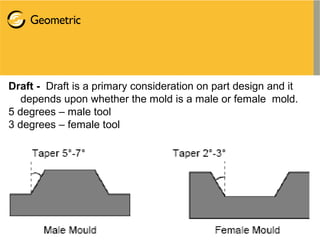
Draft - Draft is a primary consideration on part design and it
depends upon whether the mold is a male or female mold.
5 degrees – male tool
3 degrees – female tool
Undercuts- Should be avoided as far as possible. If
required should be given for small dept and at proper
location of the mold. It makes the mold design very
complicated.
Radii- Generally speaking, the amount of radius is related
to the size of the part. It also depends the type of the mold
And thickness of the sheet.
Texture- Generally textured sheet is used. Regular pattern
is generally avoided as it gets distorted after forming. Fine
graining is generally used. Increase in grain height will
affect the change in thickness.
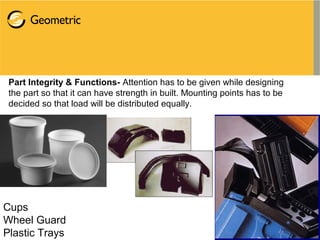
Part Integrity & Functions- Attention has to be given while designing
the part so that it can have strength in built. Mounting points has to be
decided so that load will be distributed equally.
Cups
Wheel Guard
Plastic Trays
Tolerances- Tolerances has to be given on the part
depending upon
-Type of Mold
-Type of material
-Type of cooling
-Method of trimming
B. TOOL DESIGN
The first thing we have to determine is what type of material are
we going to use and what tolerances are expected.
Type of Molds – Male & Female
Decided depending upon which side of the part is important.
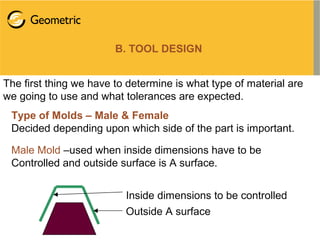
Male Mold –used when inside dimensions have to be
Controlled and outside surface is A surface.
Inside dimensions to be controlled
Outside A surface
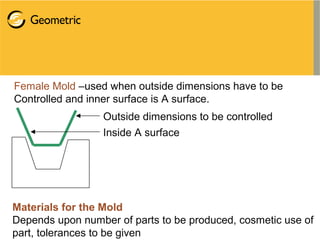
Outside dimensions to be controlled
Inside A surface
Female Mold –used when outside dimensions have to be
Controlled and inner surface is A surface.
Materials for the Mold
Depends upon number of parts to be produced, cosmetic use of
part, tolerances to be given
Wood
Wood is the simplest type of material used in vacuum forming. The
number one benefit is the cost. It is cheap! It can also be milled or
fabricated into a shape pretty easily and it is very readily available.
Most patterns to make a thermoforming tool are made from wood.
•Wood is an insulator and cooling the part on a wooden tool will dramatically
lengthen the cooling cycle,
•The cooling will be uneven depending on the finished thickness throughout the
part. This can cause stress in the part and in some serious cases, warping.
•Sometimes the grain in the wooden tool will transfer onto the plastic and if the
material is thin and the grain in the tool is heavy, it will even transfer through to
the cosmetic surface. wood has moisture in it. If you run these molds in
production, they will need a good deal of maintenance because they will dry out
and crack.
•There are a limited number of parts you can pull on a wooden tool.
POLYESTER or FIBERGLASS
This type of tooling is considered permanent tooling for lower
volume projects. Whenever, you have a job that requires less than
2000 parts per year, you should consider it as a viable alternative. It
too has limitations but it also has advantages. Again, the first
advantage is price.
EPOXY TOOLING
This is also a very popular way to make tooling and it also has some
advantages and limitations. It too is considered permanent tooling but the
volume of parts you could
expect to form off of this type of tooling is quite high, that is, in the
thousands.
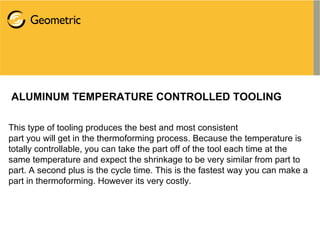
ALUMINUM TEMPERATURE CONTROLLED TOOLING
This type of tooling produces the best and most consistent
part you will get in the thermoforming process. Because the temperature is
totally controllable, you can take the part off of the tool each time at the
same temperature and expect the shrinkage to be very similar from part to
part. A second plus is the cycle time. This is the fastest way you can make a
part in thermoforming. However its very costly.
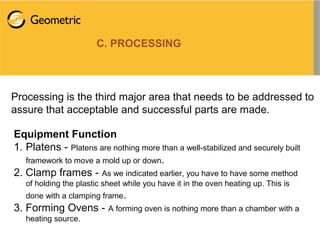
C. PROCESSING
Processing is the third major area that needs to be addressed to
assure that acceptable and successful parts are made.
Equipment Function
1. Platens - Platens are nothing more than a well-stabilized and securely built
framework to move a mold up or down.
2. Clamp frames - As we indicated earlier, you have to have some method
of holding the plastic sheet while you have it in the oven heating up. This is
done with a clamping frame.
3. Forming Ovens - A forming oven is nothing more than a chamber with a
heating source.
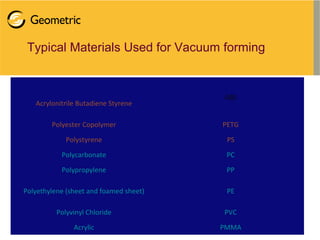
Acrylonitrile Butadiene Styrene
ABS
Polyester Copolymer PETG
Polystyrene PS
Polycarbonate PC
Polypropylene PP
Polyethylene (sheet and foamed sheet) PE
Polyvinyl Chloride PVC
Acrylic PMMA
Typical Materials Used for Vacuum forming
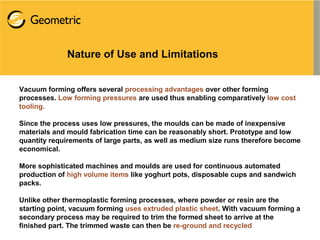
Vacuum forming offers several processing advantages over other forming
processes. Low forming pressures are used thus enabling comparatively low cost
tooling.
Since the process uses low pressures, the moulds can be made of inexpensive
materials and mould fabrication time can be reasonably short. Prototype and low
quantity requirements of large parts, as well as medium size runs therefore become
economical.
More sophisticated machines and moulds are used for continuous automated
production of high volume items like yoghurt pots, disposable cups and sandwich
packs.
Unlike other thermoplastic forming processes, where powder or resin are the
starting point, vacuum forming uses extruded plastic sheet. With vacuum forming a
secondary process may be required to trim the formed sheet to arrive at the
finished part. The trimmed waste can then be re-ground and recycled
Nature of Use and Limitations
Applications of vacuum formed parts
Typical Products Produced
Baths & Shower Trays Yoghurt Pots
Ski-Boxes Boat Hulls
Machinery Guards Vehicle Door Liners
Refrigerator Liners Sandwich Boxes
Parts of vehicle cabs Exterior Shop Signs
Advantages & Limitations
Advantages – Low tooling cost
Less lead-time
Clean process as sheets are directly used
different thermoplastic materials can be used
Good for prototyping
Pre-colored sheets can be used.
Limitations – Design flexibility
Thickness of the sheet
Thickness variation within a part is not possible
Difficult to control the A surface
Small radii are problems
Difficult to maintain the grain structure
Only thermoplastic materials can be used
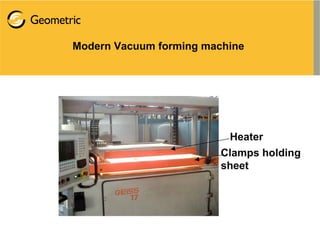
Modern Vacuum forming machine
Heater
Clamps holding
sheet
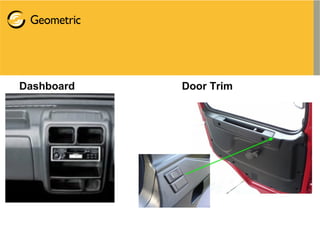
Dashboard Door Trim
Thank You

Vacuum forming

  • 1.
    • Introduction tovacuum forming- Prasanna Gunasekaran
  • 2.
    Definition It is oneof the type of the Thermoforming Process in which vacuum is used to get the desired shape. Vacuum Forming
  • 3.
    The process involvesheating a plastic sheet until soft and then draping it over a mould. A vacuum is applied sucking the sheet into the mould. The sheet is then ejected from the mould. Process http://www.bpf.co.uk/downloads/files/vacuumform1.swf
  • 4.
    Process in Detail Clamping Theclamp frame ensures the plastic sheet is held firmly in place during the forming process. Heating Radiant heaters are normally used to heat the sheet which has been positioned over the aperture of the vacuum forming machine. For thicker sheet both surfaces may need to be heated and more sophisticated machines allow this. Heaters move into position both above and below the sheet.
  • 5.
    Pre-stretch Is used toachieve "even" wall thickness. Air is introduced to blow a small "bubble" and the mould is then raised into the pre-stretched sheet. Vacuum A vacuum is applied, the sheet is drawn into intimate contact with the mould and the mould detail is picked up. Plug Assist Where a deep draw is required a top "plug" may be used to push material into the mould during the forming process.
  • 6.
    Cooling and Release Thematerial is allowed to cool. The cooling process may be shortened with blown air or even a fine water spray. The molding may then be released from the mould by introducing a small air pressure. Finishing After molding, any mould finishing may be performed, trimming, cutting, drilling, polishing, decorating etc. http://www.bpf.co.uk/bpfindustry/process_plastics_vacuum_forming.cfm
  • 7.
    IMPORTANT CONCERNS INVACUUM FORMING A.PART DESIGN B.TOOLING DESIGN C.MATERIAL SELECTION D.PROCESSING TECHNIQUES.
  • 8.
    A. PART DESIGN Thisis probably the most important consideration in getting a good part that will perform the function you want it to. Size - is definitely a consideration. If a part is too large for your equipment, that is a problem. Shape - There are certain shapes that do not lend themselves to vacuum forming because the draw ratio in certain spots and sometimes the entire part become too great. Varying the wall thickness as in injection molding is impractical too.
  • 9.
    Draft - Draftis a primary consideration on part design and it depends upon whether the mold is a male or female mold. 5 degrees – male tool 3 degrees – female tool
  • 10.
    Undercuts- Should beavoided as far as possible. If required should be given for small dept and at proper location of the mold. It makes the mold design very complicated. Radii- Generally speaking, the amount of radius is related to the size of the part. It also depends the type of the mold And thickness of the sheet. Texture- Generally textured sheet is used. Regular pattern is generally avoided as it gets distorted after forming. Fine graining is generally used. Increase in grain height will affect the change in thickness.
  • 11.
    Part Integrity &Functions- Attention has to be given while designing the part so that it can have strength in built. Mounting points has to be decided so that load will be distributed equally. Cups Wheel Guard Plastic Trays
  • 12.
    Tolerances- Tolerances hasto be given on the part depending upon -Type of Mold -Type of material -Type of cooling -Method of trimming
  • 13.
    B. TOOL DESIGN Thefirst thing we have to determine is what type of material are we going to use and what tolerances are expected. Type of Molds – Male & Female Decided depending upon which side of the part is important. Male Mold –used when inside dimensions have to be Controlled and outside surface is A surface. Inside dimensions to be controlled Outside A surface
  • 14.
    Outside dimensions tobe controlled Inside A surface Female Mold –used when outside dimensions have to be Controlled and inner surface is A surface. Materials for the Mold Depends upon number of parts to be produced, cosmetic use of part, tolerances to be given
  • 15.
    Wood Wood is thesimplest type of material used in vacuum forming. The number one benefit is the cost. It is cheap! It can also be milled or fabricated into a shape pretty easily and it is very readily available. Most patterns to make a thermoforming tool are made from wood. •Wood is an insulator and cooling the part on a wooden tool will dramatically lengthen the cooling cycle, •The cooling will be uneven depending on the finished thickness throughout the part. This can cause stress in the part and in some serious cases, warping. •Sometimes the grain in the wooden tool will transfer onto the plastic and if the material is thin and the grain in the tool is heavy, it will even transfer through to the cosmetic surface. wood has moisture in it. If you run these molds in production, they will need a good deal of maintenance because they will dry out and crack. •There are a limited number of parts you can pull on a wooden tool.
  • 16.
    POLYESTER or FIBERGLASS Thistype of tooling is considered permanent tooling for lower volume projects. Whenever, you have a job that requires less than 2000 parts per year, you should consider it as a viable alternative. It too has limitations but it also has advantages. Again, the first advantage is price. EPOXY TOOLING This is also a very popular way to make tooling and it also has some advantages and limitations. It too is considered permanent tooling but the volume of parts you could expect to form off of this type of tooling is quite high, that is, in the thousands.
  • 17.
    ALUMINUM TEMPERATURE CONTROLLEDTOOLING This type of tooling produces the best and most consistent part you will get in the thermoforming process. Because the temperature is totally controllable, you can take the part off of the tool each time at the same temperature and expect the shrinkage to be very similar from part to part. A second plus is the cycle time. This is the fastest way you can make a part in thermoforming. However its very costly.
  • 18.
    C. PROCESSING Processing isthe third major area that needs to be addressed to assure that acceptable and successful parts are made. Equipment Function 1. Platens - Platens are nothing more than a well-stabilized and securely built framework to move a mold up or down. 2. Clamp frames - As we indicated earlier, you have to have some method of holding the plastic sheet while you have it in the oven heating up. This is done with a clamping frame. 3. Forming Ovens - A forming oven is nothing more than a chamber with a heating source.
  • 19.
    Acrylonitrile Butadiene Styrene ABS PolyesterCopolymer PETG Polystyrene PS Polycarbonate PC Polypropylene PP Polyethylene (sheet and foamed sheet) PE Polyvinyl Chloride PVC Acrylic PMMA Typical Materials Used for Vacuum forming
  • 20.
    Vacuum forming offersseveral processing advantages over other forming processes. Low forming pressures are used thus enabling comparatively low cost tooling. Since the process uses low pressures, the moulds can be made of inexpensive materials and mould fabrication time can be reasonably short. Prototype and low quantity requirements of large parts, as well as medium size runs therefore become economical. More sophisticated machines and moulds are used for continuous automated production of high volume items like yoghurt pots, disposable cups and sandwich packs. Unlike other thermoplastic forming processes, where powder or resin are the starting point, vacuum forming uses extruded plastic sheet. With vacuum forming a secondary process may be required to trim the formed sheet to arrive at the finished part. The trimmed waste can then be re-ground and recycled Nature of Use and Limitations
  • 21.
    Applications of vacuumformed parts Typical Products Produced Baths & Shower Trays Yoghurt Pots Ski-Boxes Boat Hulls Machinery Guards Vehicle Door Liners Refrigerator Liners Sandwich Boxes Parts of vehicle cabs Exterior Shop Signs
  • 22.
    Advantages & Limitations Advantages– Low tooling cost Less lead-time Clean process as sheets are directly used different thermoplastic materials can be used Good for prototyping Pre-colored sheets can be used. Limitations – Design flexibility Thickness of the sheet Thickness variation within a part is not possible Difficult to control the A surface Small radii are problems Difficult to maintain the grain structure Only thermoplastic materials can be used
  • 23.
    Modern Vacuum formingmachine Heater Clamps holding sheet
  • 24.
  • 26.