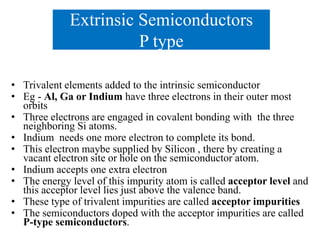
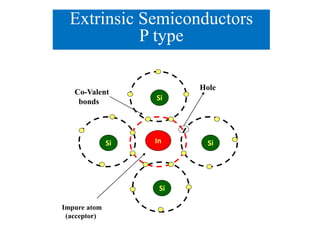
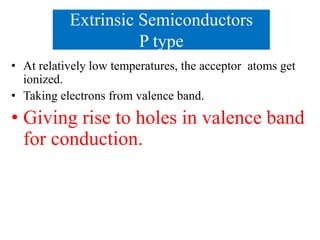
The document discusses p-type semiconductors. Trivalent impurity atoms like indium are added to an intrinsic semiconductor like silicon. These impurity atoms have three outer electrons that bond with silicon atoms, leaving the impurity atom with one less electron than normal. This causes the impurity atom to act as an electron acceptor from the silicon, leaving a hole where the electron was. At low temperatures, the acceptor atoms become ionized by taking electrons from the valence band and creating holes for conduction. As a result, holes become the majority carriers in p-type semiconductors rather than electrons.






![Human Reproduction [ Reproductive System ] Notes @irfanullah_mehar Irfanullah...](https://cdn.slidesharecdn.com/ss_thumbnails/humanreproductionreproductivesystemnotesirfanullahmeharirfanullahmeharjanantantra-260111172350-56e85778-thumbnail.jpg?width=640&height=640&fit=bounds)


