Heat Capacities
(Einstein, Debye 1905-06)
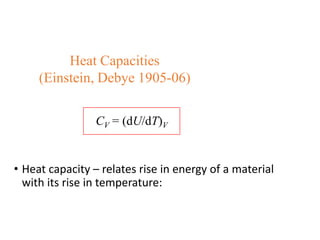
• Heat capacity – relates rise in energy of a material
with its rise in temperature:
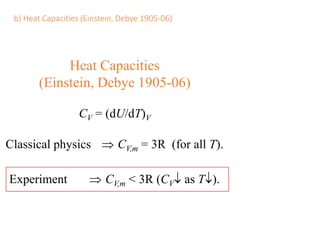
CV = (dU/dT)V
Heat Capacities
(Einstein, Debye 1905-06)
b) Heat Capacities (Einstein, Debye 1905-06)
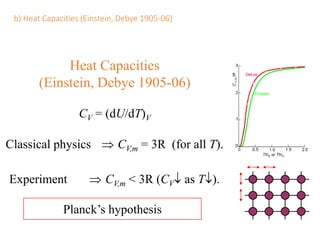
Classical physics  CV,m = 3R (for all T).
Heat Capacities
(Einstein, Debye 1905-06)
CV = (dU/dT)V
b) Heat Capacities (Einstein, Debye 1905-06)
Classical physics  CV,m = 3R (for all T).
Heat Capacities
(Einstein, Debye 1905-06)
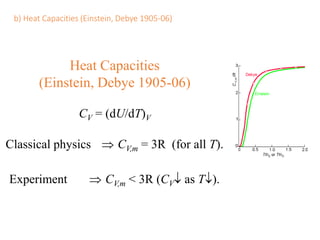
CV = (dU/dT)V
Experiment  CV,m < 3R (CV as T).
b) Heat Capacities (Einstein, Debye 1905-06)
Classical physics  CV,m = 3R (for all T).
Heat Capacities
(Einstein, Debye 1905-06)
CV = (dU/dT)V
Experiment  CV,m < 3R (CV as T).
b) Heat Capacities (Einstein, Debye 1905-06)
Classical physics  CV,m = 3R (for all T).
Heat Capacities
(Einstein, Debye 1905-06)
CV = (dU/dT)V
Experiment  CV,m < 3R (CV as T).
Planck’s hypothesis
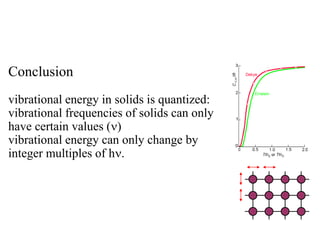
Conclusion
vibrational energy in solids is quantized:
vibrational frequencies of solids can only
have certain values ()
vibrational energy can only change by
integer multiples of h.
c) Photoelectric Effect (Einstein 1905)
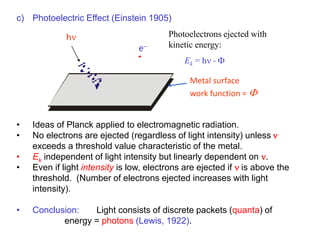
• Ideas of Planck applied to electromagnetic radiation.
• No electrons are ejected (regardless of light intensity) unless 
exceeds a threshold value characteristic of the metal.
• Ek independent of light intensity but linearly dependent on .
• Even if light intensity is low, electrons are ejected if  is above the
threshold. (Number of electrons ejected increases with light
intensity).
• Conclusion: Light consists of discrete packets (quanta) of
energy = photons (Lewis, 1922).
e
P
h
o
t
e
l
e
c
t
r
o
n
s
-
h
Metal surface
work function = F
e
Photoelectrons ejected with
kinetic energy:
Ek = h - F
d) Atomic and Molecular Spectroscopy
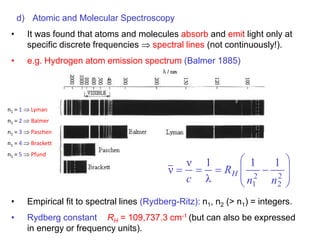
• It was found that atoms and molecules absorb and emit light only at
specific discrete frequencies spectral lines (not continuously!).
• e.g. Hydrogen atom emission spectrum (Balmer 1885)
• Empirical fit to spectral lines (Rydberg-Ritz): n1, n2 (> n1) = integers.
• Rydberg constant RH = 109,737.3 cm-1 (but can also be expressed
in energy or frequency units).











 2
2
2
1
1
1
λ
1
ν
ν
n
n
R
c
H
n1 = 1  Lyman
n1 = 2  Balmer
n1 = 3  Paschen
n1 = 4  Brackett
n1 = 5  Pfund
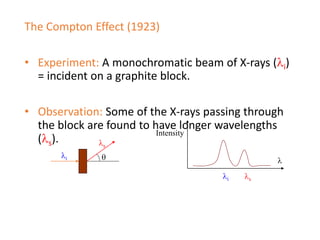
The Compton Effect (1923)
• Experiment: A monochromatic beam of X-rays (i)
= incident on a graphite block.
• Observation: Some of the X-rays passing through
the block are found to have longer wavelengths
(s).

i
s
Intensity

i s
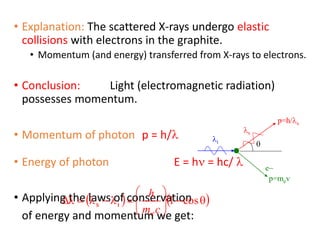
• Explanation: The scattered X-rays undergo elastic
collisions with electrons in the graphite.
• Momentum (and energy) transferred from X-rays to electrons.
• Conclusion: Light (electromagnetic radiation)
possesses momentum.
• Momentum of photon p = h/
• Energy of photon E = h = hc/ 
• Applying the laws of conservation
of energy and momentum we get:
i
s

e
p=h/s
p=mev
   












 cos
1
λ
λ
Δλ i
s
c
m
h
e
Particles Behaving as Waves
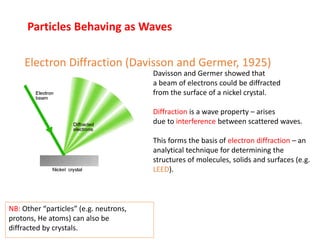
Electron Diffraction (Davisson and Germer, 1925)
Davisson and Germer showed that
a beam of electrons could be diffracted
from the surface of a nickel crystal.
Diffraction is a wave property – arises
due to interference between scattered waves.
This forms the basis of electron diffraction – an
analytical technique for determining the
structures of molecules, solids and surfaces (e.g.
LEED).
NB: Other “particles” (e.g. neutrons,
protons, He atoms) can also be
diffracted by crystals.

heat capacity.ppt

  • 2.
  • 3.
    • Heat capacity– relates rise in energy of a material with its rise in temperature: CV = (dU/dT)V Heat Capacities (Einstein, Debye 1905-06)
  • 4.
    b) Heat Capacities(Einstein, Debye 1905-06) Classical physics  CV,m = 3R (for all T). Heat Capacities (Einstein, Debye 1905-06) CV = (dU/dT)V
  • 5.
    b) Heat Capacities(Einstein, Debye 1905-06) Classical physics  CV,m = 3R (for all T). Heat Capacities (Einstein, Debye 1905-06) CV = (dU/dT)V Experiment  CV,m < 3R (CV as T).
  • 6.
    b) Heat Capacities(Einstein, Debye 1905-06) Classical physics  CV,m = 3R (for all T). Heat Capacities (Einstein, Debye 1905-06) CV = (dU/dT)V Experiment  CV,m < 3R (CV as T).
  • 7.
    b) Heat Capacities(Einstein, Debye 1905-06) Classical physics  CV,m = 3R (for all T). Heat Capacities (Einstein, Debye 1905-06) CV = (dU/dT)V Experiment  CV,m < 3R (CV as T). Planck’s hypothesis
  • 8.
    Conclusion vibrational energy insolids is quantized: vibrational frequencies of solids can only have certain values () vibrational energy can only change by integer multiples of h.
  • 9.
    c) Photoelectric Effect(Einstein 1905) • Ideas of Planck applied to electromagnetic radiation. • No electrons are ejected (regardless of light intensity) unless  exceeds a threshold value characteristic of the metal. • Ek independent of light intensity but linearly dependent on . • Even if light intensity is low, electrons are ejected if  is above the threshold. (Number of electrons ejected increases with light intensity). • Conclusion: Light consists of discrete packets (quanta) of energy = photons (Lewis, 1922). e P h o t e l e c t r o n s - h Metal surface work function = F e Photoelectrons ejected with kinetic energy: Ek = h - F
  • 10.
    d) Atomic andMolecular Spectroscopy • It was found that atoms and molecules absorb and emit light only at specific discrete frequencies spectral lines (not continuously!). • e.g. Hydrogen atom emission spectrum (Balmer 1885) • Empirical fit to spectral lines (Rydberg-Ritz): n1, n2 (> n1) = integers. • Rydberg constant RH = 109,737.3 cm-1 (but can also be expressed in energy or frequency units).             2 2 2 1 1 1 λ 1 ν ν n n R c H n1 = 1  Lyman n1 = 2  Balmer n1 = 3  Paschen n1 = 4  Brackett n1 = 5  Pfund
  • 11.
    The Compton Effect(1923) • Experiment: A monochromatic beam of X-rays (i) = incident on a graphite block. • Observation: Some of the X-rays passing through the block are found to have longer wavelengths (s).  i s Intensity  i s
  • 12.
    • Explanation: Thescattered X-rays undergo elastic collisions with electrons in the graphite. • Momentum (and energy) transferred from X-rays to electrons. • Conclusion: Light (electromagnetic radiation) possesses momentum. • Momentum of photon p = h/ • Energy of photon E = h = hc/  • Applying the laws of conservation of energy and momentum we get: i s  e p=h/s p=mev                  cos 1 λ λ Δλ i s c m h e
  • 13.
    Particles Behaving asWaves Electron Diffraction (Davisson and Germer, 1925) Davisson and Germer showed that a beam of electrons could be diffracted from the surface of a nickel crystal. Diffraction is a wave property – arises due to interference between scattered waves. This forms the basis of electron diffraction – an analytical technique for determining the structures of molecules, solids and surfaces (e.g. LEED). NB: Other “particles” (e.g. neutrons, protons, He atoms) can also be diffracted by crystals.