Electrical Resistance
University High School
Conductors
Possess a great ability of conducting
electricity
Contain free electrons that flow easily
through materials when an electric field
is applied
Examples of conductors:
 metals, some liquids, and plasma
Insulators
Conduct very small currents when a
strong electric field is applied
Electrons are tightly bound and do not
move freely
Examples of insulators:
 wood, plastic, glass, and rubber
Semiconductors
Depending on their form, they can be
either better insulators or conductors.
 In pure form, they are better insulators, but
if an external substance is added, they
become better conductors
Examples of semiconductors:
 Silicon, germanium, gallium, and arsenic
Equation for Electrical
Resistance
Electrical Resistance = voltage drop
current
 R – Electrical Resistance
 V – Voltage Drop
 I – Current
Unit of Measurement
Unit of measure for electrical resistance
is the ohm.
If:
 Potential difference is equal to 1, and;
 Flow of current is 1, then;
 Resistance is equal to 1.
Resistance Example
A small stereo draws a current of 0.80 A
when the power supply produces a
potential difference of 110 V. What is
the resistance of the stereo?
 R = ?
 V = 110 volts
 I = 0.80 amps
Resistivity Defined
Measure of the capacity of a material to
resist electrical charge
Resistivity
Factors affecting resistance on a wire:
 Length
 Longer wire, greater resistance
 Cross-sectional area
 Smaller area, less resistance
 Material
 Higher resistivity, greater resistance
Calculating Resistivity
R = p * L
A
R – Resistivity
p – Rho (given constant for each material)
L – Length
A – Cross-sectional area
Ohm’s Law
This law was devised to aid in
simplifying electrical resistance
Is true when the following criteria are
met:
 Resistance is constant
 Resistance is independent of both potential
difference and current
Series Circuits
Contain only one path
for current flow.
Charge flows from
power supply into a
switch, and then each
light. Returns to power
supply.
Current is equal in all
parts of the circuit.
Any break will stop
current throughout the
entire circuit
Calculating Series
Circuits
R total = R1 + R2 + ……
I total = I1 = I2 = ……
V total = V1 + V2 + …..
V1 = R1 * I1
V2 = R2 * I2
Series Circuit Example
There are two lamps in your home office that
are supplied power through a series
connection. The power supply produces 120
volts. One lamp has a resistance of 90 ohms,
and the other a resistance of 70 ohms.
Calculate:
 The current through the circuit.
 The voltage drop across each lamp.
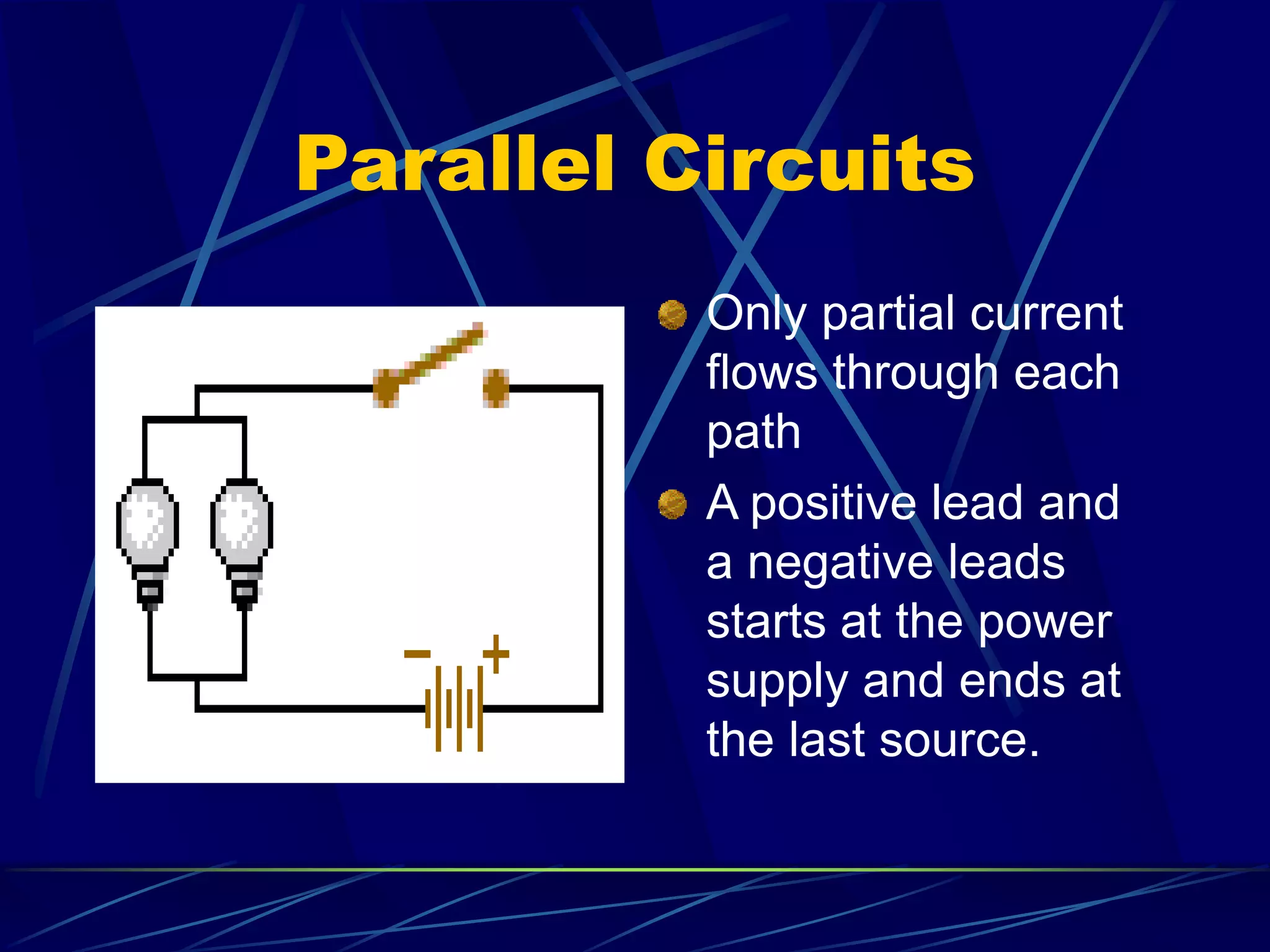
Parallel Circuits
Only partial current
flows through each
path
A positive lead and
a negative leads
starts at the power
supply and ends at
the last source.
Calculating Parallel
Circuits
V total = V1 = V2 = …..
I total = I1 + I2 + …..
I1 = (V1 / R1)
I2 = (V2 / R2)
R total = R1 + R2
R1 * R2
Parallel Circuit Example
You have two lamps in your living room that
are supplied power through a parallel
connection. The power supply produces 120
volts. One lamp has a resistance of 90 ohms,
and the other a resistance of 70 ohms.
Calculate:
 The total current in the circuit.
 The voltage drop across each lamp.
 The current in each lamp
Resistors
An electrical device that has a specific
resistance
Added into a circuit in order to provide
additional resistance that is needed in a
circuit.
Value is shown on the outside of the
resistor by a color coding system.
Resistor Values
Has four separate colored bands; with
each color representing a given value.
Band 1 – 1st significant digit
Band 2 – 2nd significant digit
Band 3 – multiplier; number of zeros
added
Band 4 – tolerance of resistor
Determining Resistor
Values
Band 1 – Green
Band 2 – Red
Band 3 – Black
Band 4 - Gold
Band 1 – Brown
Band 2 – Orange
Band 3 – Blue
Band 4 - Silver

Electrical-Resist1.ppt

  • 1.
  • 2.
    Conductors Possess a greatability of conducting electricity Contain free electrons that flow easily through materials when an electric field is applied Examples of conductors:  metals, some liquids, and plasma
  • 3.
    Insulators Conduct very smallcurrents when a strong electric field is applied Electrons are tightly bound and do not move freely Examples of insulators:  wood, plastic, glass, and rubber
  • 4.
    Semiconductors Depending on theirform, they can be either better insulators or conductors.  In pure form, they are better insulators, but if an external substance is added, they become better conductors Examples of semiconductors:  Silicon, germanium, gallium, and arsenic
  • 5.
    Equation for Electrical Resistance ElectricalResistance = voltage drop current  R – Electrical Resistance  V – Voltage Drop  I – Current
  • 6.
    Unit of Measurement Unitof measure for electrical resistance is the ohm. If:  Potential difference is equal to 1, and;  Flow of current is 1, then;  Resistance is equal to 1.
  • 7.
    Resistance Example A smallstereo draws a current of 0.80 A when the power supply produces a potential difference of 110 V. What is the resistance of the stereo?  R = ?  V = 110 volts  I = 0.80 amps
  • 8.
    Resistivity Defined Measure ofthe capacity of a material to resist electrical charge
  • 9.
    Resistivity Factors affecting resistanceon a wire:  Length  Longer wire, greater resistance  Cross-sectional area  Smaller area, less resistance  Material  Higher resistivity, greater resistance
  • 10.
    Calculating Resistivity R =p * L A R – Resistivity p – Rho (given constant for each material) L – Length A – Cross-sectional area
  • 11.
    Ohm’s Law This lawwas devised to aid in simplifying electrical resistance Is true when the following criteria are met:  Resistance is constant  Resistance is independent of both potential difference and current
  • 12.
    Series Circuits Contain onlyone path for current flow. Charge flows from power supply into a switch, and then each light. Returns to power supply. Current is equal in all parts of the circuit. Any break will stop current throughout the entire circuit
  • 13.
    Calculating Series Circuits R total= R1 + R2 + …… I total = I1 = I2 = …… V total = V1 + V2 + ….. V1 = R1 * I1 V2 = R2 * I2
  • 14.
    Series Circuit Example Thereare two lamps in your home office that are supplied power through a series connection. The power supply produces 120 volts. One lamp has a resistance of 90 ohms, and the other a resistance of 70 ohms. Calculate:  The current through the circuit.  The voltage drop across each lamp.
  • 15.
    Parallel Circuits Only partialcurrent flows through each path A positive lead and a negative leads starts at the power supply and ends at the last source.
  • 16.
    Calculating Parallel Circuits V total= V1 = V2 = ….. I total = I1 + I2 + ….. I1 = (V1 / R1) I2 = (V2 / R2) R total = R1 + R2 R1 * R2
  • 17.
    Parallel Circuit Example Youhave two lamps in your living room that are supplied power through a parallel connection. The power supply produces 120 volts. One lamp has a resistance of 90 ohms, and the other a resistance of 70 ohms. Calculate:  The total current in the circuit.  The voltage drop across each lamp.  The current in each lamp
  • 18.
    Resistors An electrical devicethat has a specific resistance Added into a circuit in order to provide additional resistance that is needed in a circuit. Value is shown on the outside of the resistor by a color coding system.
  • 19.
    Resistor Values Has fourseparate colored bands; with each color representing a given value. Band 1 – 1st significant digit Band 2 – 2nd significant digit Band 3 – multiplier; number of zeros added Band 4 – tolerance of resistor
  • 20.
    Determining Resistor Values Band 1– Green Band 2 – Red Band 3 – Black Band 4 - Gold Band 1 – Brown Band 2 – Orange Band 3 – Blue Band 4 - Silver