Extern conferenceExtern conference
Ext.Ext. PiyatatPiyatat WisitkamthornWisitkamthorn
Ramathibodi Hospital
Mahidol University
case
ผู้ป่วยชายไทยอายุ 18 ปี อาชีพ นักเรียนมัธยมศึกษาปี
ที่6
ภูมิลำเนา จังหวัดนครราชสีมา
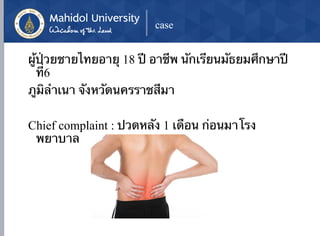
Chief complaint : ปวดหลัง 1 เดือน ก่อนมาโรง
พยาบาล
Present Illness
1 เดือนก่อนมา รพ. ขณะผู้ป่วยเล่น
บาสเกตบอล ถูกเพื่อนกระแทกล้ม สะโพก
กระแทกพื้น หลังกระแทกผู้ป่วยมีอาการ ปวด
หลังบริเวณสะโพก ร้าวลงต้นขาข้างขวา ปวด
แปล๊บๆ ไปพบแพทย์ที่คลินิกใกล้บ้าน ได้รับยา
แก้ปวดแล้วยาคลายกล้ามเนื้อ กลับบ้านมารับ
ประทานอาการปวดไม่ดีขึ้น
1 สัปดาห์ก่อนมา รพ. อาการปวดหลังเป็นถี่
มากขึ้นเรื่อยๆ เป็นตลอดเกือบทั้งวัน ผู้ป่วยไม่
สามารถ ก้มหยิบของหรือนั่งนานๆได้ เนื่องจาก
อาการปวดจะเพิ่มขึ้น ขาขวาเริ่มไม่มีแรง แต่ยัง
พอเดินได้ มีอากาชาปลายเท้าและขาขวาร่วม
ด้วยเป็นช่วงๆ
Present Illness
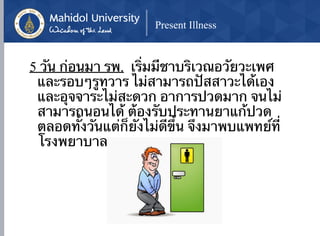
5 วัน ก่อนมา รพ. เริ่มมีชาบริเวณอวัยวะเพศ
และรอบๆรูทวาร ไม่สามารถปัสสาวะได้เอง
และอุจจาระไม่สะดวก อาการปวดมาก จนไม่
สามารถนอนได้ ต้องรับประทานยาแก้ปวด
ตลอดทั้งวันแต่ก็ยังไม่ดีขึ้น จึงมาพบแพทย์ที่
โรงพยาบาล
Past History
•มีประวัติล้มกระแทกบริเวณหลัง 1 เดือนก่อนมา
รพ.
•ปฏิเสธโรคประจำตัว
•ปฏิเสธประวัติการผ่าตัด
•ปฏิเสธประวัติแพ้ยา/แพ้อาหาร
•ปฏิเสธประวัติสูบบุหรี่/ดื่มสุรา
Physical examination
• Vital signs: BP 121/72 mmHg PR 84 bpm
• T 36.8 c RR 20 bpm
• GA: a Thai teen-aged man, good consciousness, no
pallor, no jaundice, anthalgic gait
• HEENT : not pale conjunctivae, anicteric sclerae, no
thyroid gland enlargement ,no cervical LN palpable
• CVS : full regular symmetrical pulse all extremities
, normal S1 S2 no murmur
• Lungs: normal breath sound, equal both lung, no
adventitious sound
• Abdomen : soft, normoactive bowel sound, not
tender, no palpable mass, no hepatosplenomegaly
• Extremities : no deformities, no pitting edema
: left side antalgic gait,
: no Trenderlenburg gait
• Back: loss of lumbar lordosis , no scoliosis
: no mark pain on percussion, no trigger point
: Limitation of flexion due to pain
: SLR test positive at 40 degree Rt, 30 degree
Lt
: Laseque’s test positive
• Neuro : good consciousness , alert
• CN : intact all
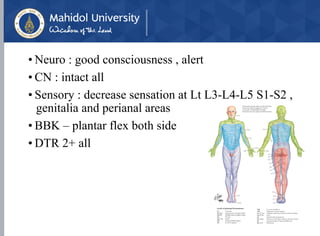
• Sensory : decrease sensation at Lt L3-L4-L5 S1-S2 ,
genitalia and perianal areas
• BBK – plantar flex both side
• DTR 2+ all
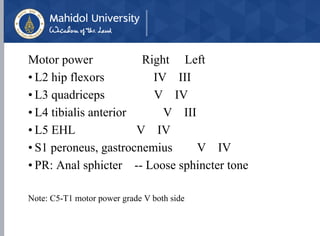
Motor power Right Left
• L2 hip flexors IV III
• L3 quadriceps V IV
• L4 tibialis anterior V III
• L5 EHL V IV
• S1 peroneus, gastrocnemius V IV
• PR: Anal sphicter -- Loose sphincter tone
Note: C5-T1 motor power grade V both side
Investigation
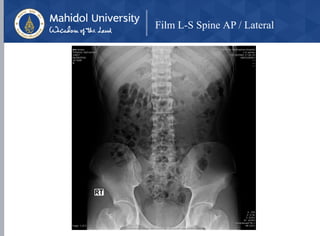
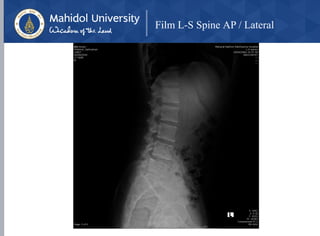
Film L-S Spine AP / Lateral
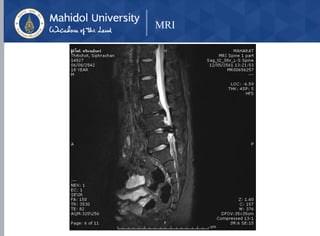
MRI
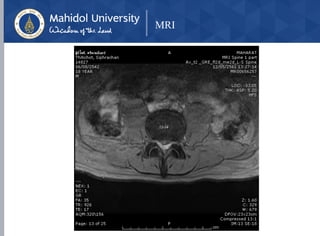
MRI
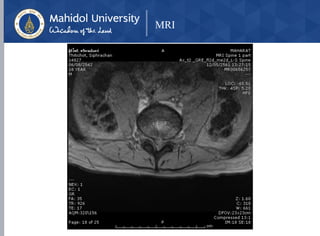
MRI
Diagnosis
Diagnosis
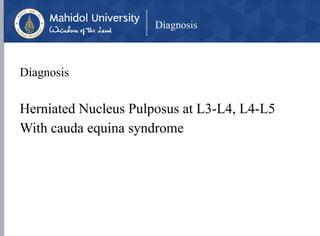
Herniated Nucleus Pulposus at L3-L4, L4-L5
With cauda equina syndrome
Management
• Admit ward ortho 5
• เนื่องจาก ในผู้ป่วยรายนี้ มีภาวะ Cauda equina
syndrome ร่วมด้วยจึงทำการ ผ่าตัด discetomy วันที่
14 พ.ค. 2561
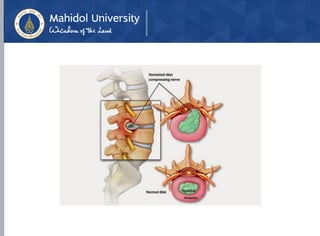
HNP
Herniated Nucleus Pulposus
Epidemiology
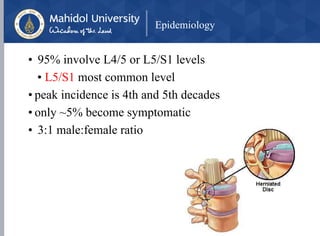
• 95% involve L4/5 or L5/S1 levels
• L5/S1 most common level
• peak incidence is 4th and 5th decades
• only ~5% become symptomatic
• 3:1 male:female ratio
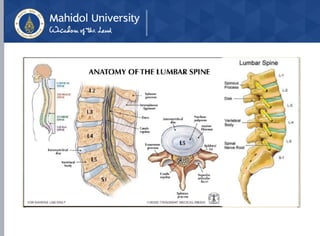
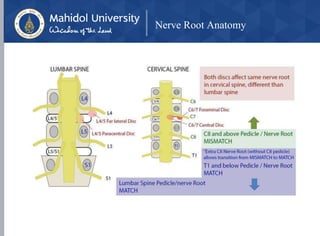
Nerve Root Anatomy
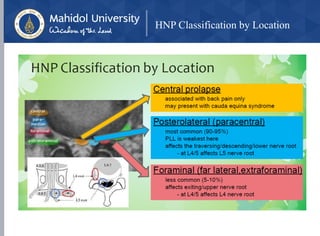
HNP Classification by Location
Symptoms
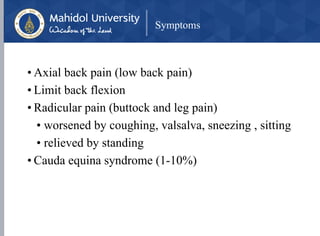
• Axial back pain (low back pain)
• Limit back flexion
• Radicular pain (buttock and leg pain)
• worsened by coughing, valsalva, sneezing , sitting
• relieved by standing
• Cauda equina syndrome (1-10%)
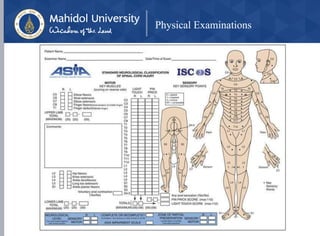
Physical Examinations
Neuro
• Motor
• L2 – hip flexion
• L3 – knee extension
• L4 – ankle dorsiflexion
• L5 – great toe extension
• S1 – plantar flexion
• Sensory – Along dermatomes L2-S1
Physical Examinations
Special Tests
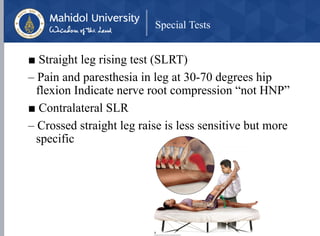
■ Straight leg rising test (SLRT)
– Pain and paresthesia in leg at 30-70 degrees hip
flexion Indicate nerve root compression “not HNP”
■ Contralateral SLR
– Crossed straight leg raise is less sensitive but more
specific
Special Tests
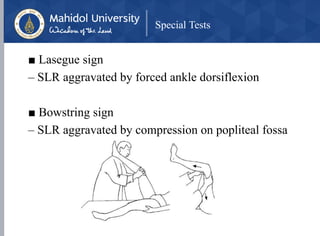
■ Lasegue sign
– SLR aggravated by forced ankle dorsiflexion
■ Bowstring sign
– SLR aggravated by compression on popliteal fossa
Diagnostic Imaging
• X-Ray : L-S spine AP, lateral
• loss of lordosis (spasm)
• loss of disc height
• lumbar spondylosis
• (deg
• MRI
• Modality of choice
• Indications for obtaining an MRI
• pain lasting > 1 month and not responding to
nonoperative management
• Red flags are presentenerative changes
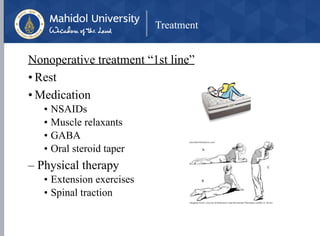
Treatment
Nonoperative treatment “1st line”
• Rest
• Medication
• NSAIDs
• Muscle relaxants
• GABA
• Oral steroid taper
– Physical therapy
• Extension exercises
• Spinal traction
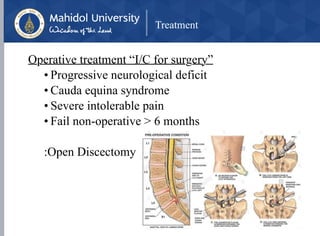
Treatment
Operative treatment “I/C for surgery”
• Progressive neurological deficit
• Cauda equina syndrome
• Severe intolerable pain
• Fail non-operative > 6 months
:Open Discectomy
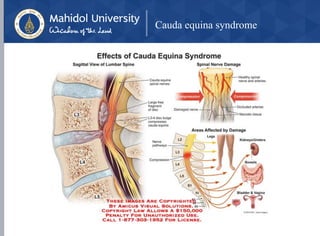
Cauda equina syndrome
• Cauda equina syndrome is defined by a constellation
of symptoms that result from terminal spinal nerve
root compression in the lumbosacral region
considered one of the few true medical emergencies
in orthopaedics
• key features
• bilateral leg pain
• bowel and bladder dysfunction
• saddle anesthesia
• lower extremity sensorimotor changes
Cauda equina syndrome
• Epidemiology 1-6% of lumbar disc herniations
• Pathophysiology space-occupying lesion within
lumbosacral canal, including
• disc herniation (most common)
• spinal stenosis
• tumors
• trauma (retropulsion of fracture fragment, dislocation or
collapse)
• spinal epidural hematoma
• epidural abscess
Cauda equina syndrome
• Operative urgent surgical decompression within
48 hours
• indications
• significant suspicion for CES
• severity of symptoms will increase the urgency of surgical
decompression
• techniques
• diskectomy
• laminectomy
• outcomes
• studies have shown improved outcomes in bowel and bladder
function and resolution of motor and sensory deficits when
decompression performed within 48 hours of the onset of
symptoms
Thank you
Extern conference-orthopedic

Extern conference-orthopedic

  • 1.
    Extern conferenceExtern conference Ext.Ext.PiyatatPiyatat WisitkamthornWisitkamthorn Ramathibodi Hospital Mahidol University
  • 2.
    case ผู้ป่วยชายไทยอายุ 18 ปีอาชีพ นักเรียนมัธยมศึกษาปี ที่6 ภูมิลำเนา จังหวัดนครราชสีมา Chief complaint : ปวดหลัง 1 เดือน ก่อนมาโรง พยาบาล
  • 3.
    Present Illness 1 เดือนก่อนมารพ. ขณะผู้ป่วยเล่น บาสเกตบอล ถูกเพื่อนกระแทกล้ม สะโพก กระแทกพื้น หลังกระแทกผู้ป่วยมีอาการ ปวด หลังบริเวณสะโพก ร้าวลงต้นขาข้างขวา ปวด แปล๊บๆ ไปพบแพทย์ที่คลินิกใกล้บ้าน ได้รับยา แก้ปวดแล้วยาคลายกล้ามเนื้อ กลับบ้านมารับ ประทานอาการปวดไม่ดีขึ้น 1 สัปดาห์ก่อนมา รพ. อาการปวดหลังเป็นถี่ มากขึ้นเรื่อยๆ เป็นตลอดเกือบทั้งวัน ผู้ป่วยไม่ สามารถ ก้มหยิบของหรือนั่งนานๆได้ เนื่องจาก อาการปวดจะเพิ่มขึ้น ขาขวาเริ่มไม่มีแรง แต่ยัง พอเดินได้ มีอากาชาปลายเท้าและขาขวาร่วม
  • 4.
    ด้วยเป็นช่วงๆ Present Illness 5 วันก่อนมา รพ. เริ่มมีชาบริเวณอวัยวะเพศ และรอบๆรูทวาร ไม่สามารถปัสสาวะได้เอง และอุจจาระไม่สะดวก อาการปวดมาก จนไม่ สามารถนอนได้ ต้องรับประทานยาแก้ปวด ตลอดทั้งวันแต่ก็ยังไม่ดีขึ้น จึงมาพบแพทย์ที่ โรงพยาบาล
  • 5.
    Past History •มีประวัติล้มกระแทกบริเวณหลัง 1เดือนก่อนมา รพ. •ปฏิเสธโรคประจำตัว •ปฏิเสธประวัติการผ่าตัด •ปฏิเสธประวัติแพ้ยา/แพ้อาหาร •ปฏิเสธประวัติสูบบุหรี่/ดื่มสุรา
  • 6.
    Physical examination • Vitalsigns: BP 121/72 mmHg PR 84 bpm • T 36.8 c RR 20 bpm • GA: a Thai teen-aged man, good consciousness, no pallor, no jaundice, anthalgic gait • HEENT : not pale conjunctivae, anicteric sclerae, no thyroid gland enlargement ,no cervical LN palpable • CVS : full regular symmetrical pulse all extremities , normal S1 S2 no murmur
  • 7.
    • Lungs: normalbreath sound, equal both lung, no adventitious sound • Abdomen : soft, normoactive bowel sound, not tender, no palpable mass, no hepatosplenomegaly • Extremities : no deformities, no pitting edema : left side antalgic gait, : no Trenderlenburg gait
  • 8.
    • Back: lossof lumbar lordosis , no scoliosis : no mark pain on percussion, no trigger point : Limitation of flexion due to pain : SLR test positive at 40 degree Rt, 30 degree Lt : Laseque’s test positive
  • 9.
    • Neuro :good consciousness , alert • CN : intact all • Sensory : decrease sensation at Lt L3-L4-L5 S1-S2 , genitalia and perianal areas • BBK – plantar flex both side • DTR 2+ all
  • 10.
    Motor power RightLeft • L2 hip flexors IV III • L3 quadriceps V IV • L4 tibialis anterior V III • L5 EHL V IV • S1 peroneus, gastrocnemius V IV • PR: Anal sphicter -- Loose sphincter tone Note: C5-T1 motor power grade V both side
  • 11.
  • 12.
    Film L-S SpineAP / Lateral
  • 13.
    Film L-S SpineAP / Lateral
  • 14.
  • 15.
  • 16.
  • 17.
    Diagnosis Diagnosis Herniated Nucleus Pulposusat L3-L4, L4-L5 With cauda equina syndrome
  • 18.
    Management • Admit wardortho 5 • เนื่องจาก ในผู้ป่วยรายนี้ มีภาวะ Cauda equina syndrome ร่วมด้วยจึงทำการ ผ่าตัด discetomy วันที่ 14 พ.ค. 2561
  • 19.
  • 22.
    Epidemiology • 95% involveL4/5 or L5/S1 levels • L5/S1 most common level • peak incidence is 4th and 5th decades • only ~5% become symptomatic • 3:1 male:female ratio
  • 23.
  • 24.
  • 25.
    Symptoms • Axial backpain (low back pain) • Limit back flexion • Radicular pain (buttock and leg pain) • worsened by coughing, valsalva, sneezing , sitting • relieved by standing • Cauda equina syndrome (1-10%)
  • 26.
    Physical Examinations Neuro • Motor •L2 – hip flexion • L3 – knee extension • L4 – ankle dorsiflexion • L5 – great toe extension • S1 – plantar flexion • Sensory – Along dermatomes L2-S1
  • 27.
  • 28.
    Special Tests ■ Straightleg rising test (SLRT) – Pain and paresthesia in leg at 30-70 degrees hip flexion Indicate nerve root compression “not HNP” ■ Contralateral SLR – Crossed straight leg raise is less sensitive but more specific
  • 29.
    Special Tests ■ Laseguesign – SLR aggravated by forced ankle dorsiflexion ■ Bowstring sign – SLR aggravated by compression on popliteal fossa
  • 30.
    Diagnostic Imaging • X-Ray: L-S spine AP, lateral • loss of lordosis (spasm) • loss of disc height • lumbar spondylosis • (deg • MRI • Modality of choice • Indications for obtaining an MRI • pain lasting > 1 month and not responding to nonoperative management • Red flags are presentenerative changes
  • 32.
    Treatment Nonoperative treatment “1stline” • Rest • Medication • NSAIDs • Muscle relaxants • GABA • Oral steroid taper – Physical therapy • Extension exercises • Spinal traction
  • 33.
    Treatment Operative treatment “I/Cfor surgery” • Progressive neurological deficit • Cauda equina syndrome • Severe intolerable pain • Fail non-operative > 6 months :Open Discectomy
  • 34.
  • 35.
    Cauda equina syndrome •Cauda equina syndrome is defined by a constellation of symptoms that result from terminal spinal nerve root compression in the lumbosacral region considered one of the few true medical emergencies in orthopaedics • key features • bilateral leg pain • bowel and bladder dysfunction • saddle anesthesia • lower extremity sensorimotor changes
  • 36.
    Cauda equina syndrome •Epidemiology 1-6% of lumbar disc herniations • Pathophysiology space-occupying lesion within lumbosacral canal, including • disc herniation (most common) • spinal stenosis • tumors • trauma (retropulsion of fracture fragment, dislocation or collapse) • spinal epidural hematoma • epidural abscess
  • 37.
    Cauda equina syndrome •Operative urgent surgical decompression within 48 hours • indications • significant suspicion for CES • severity of symptoms will increase the urgency of surgical decompression • techniques • diskectomy • laminectomy • outcomes • studies have shown improved outcomes in bowel and bladder function and resolution of motor and sensory deficits when decompression performed within 48 hours of the onset of symptoms
  • 38.