2022/2023
Fifth Stage
First Semester/Industrial Pharmacy II
Dr. Ahmed Najim Abood
Assistant Professor in Pharmaceutics
ahmed.abood@uobasrah.edu.iq
Extended-Release Dosage Forms and
Drug Delivery Systems
Lecture 23
Thursday 12/1/2023
University of Basrah – College of Pharmacy –Department of Pharmaceutics 1
2.
Outlines
Introduction andsome terms
Extended-release oral dosage forms
Types
Some USP requirements and FDA
Guidance
2
3.
Extended-release tabletsand capsules
are commonly taken only once or twice
daily, compared with counterpart
conventional forms that may have to be
taken three or four times daily to
achieve the same therapeutic effect.
3
4.
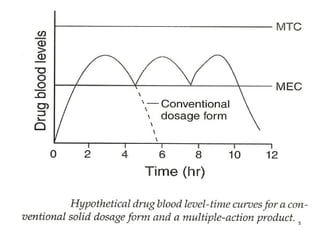
Typically, extended-releaseproducts
provide an immediate release of drug
that promptly produces the desired
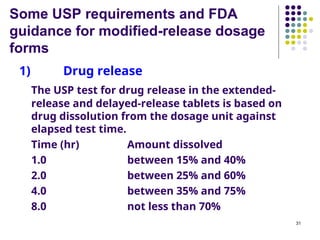
therapeutic effect, followed by gradual
release of additional amounts of drug
to maintain this effect over a
predetermined period.
What is the meaning of (Dose dumping)?
4
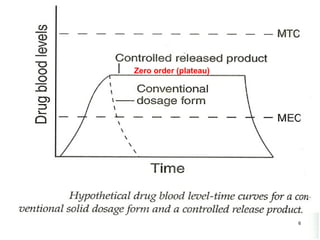
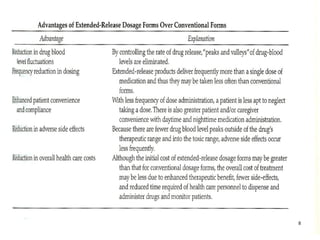
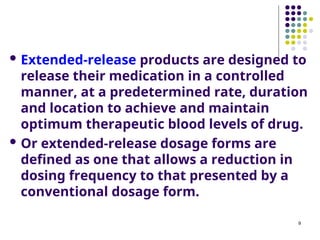
Extended-release productsare designed to
release their medication in a controlled
manner, at a predetermined rate, duration
and location to achieve and maintain
optimum therapeutic blood levels of drug.
Or extended-release dosage forms are
defined as one that allows a reduction in
dosing frequency to that presented by a
conventional dosage form.
9
10.
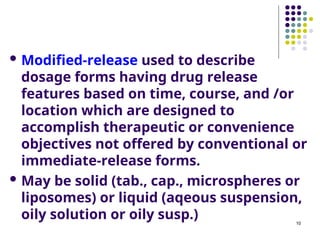
Modified-release usedto describe
dosage forms having drug release
features based on time, course, and /or
location which are designed to
accomplish therapeutic or convenience
objectives not offered by conventional or
immediate-release forms.
May be solid (tab., cap., microspheres or
liposomes) or liquid (aqeous suspension,
oily solution or oily susp.) 10
11.
A Delayed-release dosageform is
designed to release the drug from
the dosage form at a time other
than promptly after administration.
The delay may be time-based or
based on the influence of
environmental conditions, as
gastrointestinal pH.
11
12.
Repeat-action formsusually contain two
single doses of medication, one for
immediate release and the second for
delayed release.
Targeted release describes drug release
directed toward isolating or concentrating
a drug in a body region, or site for
absorption or for drug action.
12
13.
Extended-release oral dosage
forms
Drug-candidates for extended-release
products:
The drugs best suited for incorporation
into an extended-release product have
the following characteristics:
- They exhibit neither very slow nor very
fast rates of absorption and excretion.
13
14.
- They areuniformly absorbed from
the gastrointestinal tract.
- They are administered in relatively
small doses.
- They possess a good margin of safety.
- They are used in the treatment of
chronic rather than acute conditions.
14
15.
The rate ofdrug release from solid
dosage forms may be modified by the
technologies described below:
- Modifying drug dissolution by
controlling access of biologic fluids to
the drug through the use of barrier
coatings.
Extended-release technology for
oral dosage forms
15
16.
- Controlling drugdiffusion rates from
dosage forms.
- Chemically reacting or interacting
between the drug substance or its
pharmaceutical barrier and site-
specific biologic fluids.
16
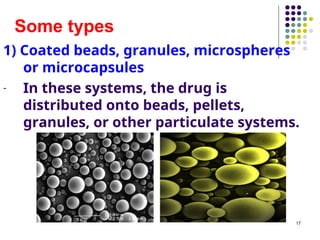
17.
1) Coated beads,granules, microspheres
or microcapsules
- In these systems, the drug is
distributed onto beads, pellets,
granules, or other particulate systems.
Some types
17
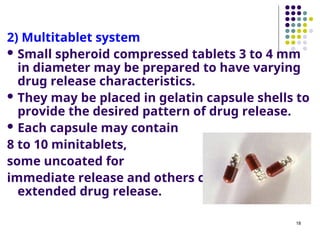
18.
2) Multitablet system
Small spheroid compressed tablets 3 to 4 mm
in diameter may be prepared to have varying
drug release characteristics.
They may be placed in gelatin capsule shells to
provide the desired pattern of drug release.
Each capsule may contain
8 to 10 minitablets,
some uncoated for
immediate release and others coated for
extended drug release.
18
19.
By this process,the drug substance
is combined and made into granules
with an excipient material that
slowly erodes in body fluids,
progressively releasing the drug for
absorption.
3) Embedding drug in slowly
eroding or hydrophilic matrix
system
19
20.
When these granulesare mixed with
granules of drug prepared without
the excipient, the uncombined
granules provide the immediate
drug effect whereas the drug-
excipient granules provide extended
drug action.
20
21.
4) Embedding drugin inert plastic
matrix
By this method, the drug is granulated
with an inert plastic material such as
polyethylene, polyvinyl acetate, or
polymethacrylate, and the granules are
compressed into tablets.
The drug is slowly released from the
inert plastic matrix by diffusion.
The inert tablet matrix, expended of
drug, is excreted out without digestion
or absorption.
21
22.
5) Chemical complexformation
When some drug substances combined
with other chemical agents forming
chemical complexes that may be only
slowly soluble in body fluids,
depending upon the pH of the
environment.
22
23.
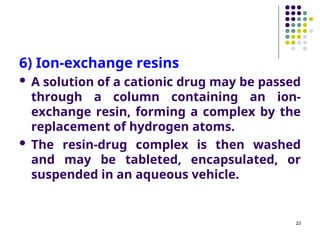
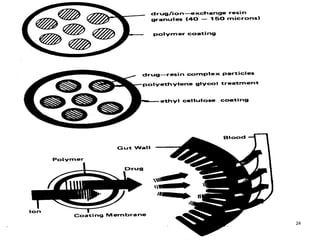
6) Ion-exchange resins
A solution of a cationic drug may be passed
through a column containing an ion-
exchange resin, forming a complex by the
replacement of hydrogen atoms.
The resin-drug complex is then washed
and may be tableted, encapsulated, or
suspended in an aqueous vehicle.
23
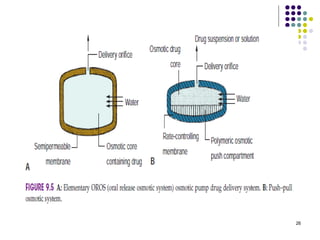
7) Osmotic pump
The pioneer oral osmotic pump drug
delivery system is the Oros system.
The system is composed of a core
tablet surrounded by a
semipermeable membrane coating
have a 0.4 mm diameter hole
produced by laser beam.
25
The systemis designed such that only a
few drops of water are drawn into the
tablet each hour.
The rate of inflow of water and the function
of the tablet depends upon the existence
of an osmotic gradient between the
contents of the bi-layer core and the fluid
in the GI tract.
Drug delivery is essentially constant as
long as the osmotic gradient remains
constant. 27
28.
The drug releaserate may be altered by
Changing the surface area,
The thickness or composition of the
membrane,
Changing the diameter of the drug release
orifice.
The drug-release rate is not affected by
gastrointestinal acidity, alkalinity, fed
conditions, or GI motility.
28
29.
8) Repeat actiontablets
Repeat action tablets are prepared so that an
initial dose of drug is released immediately
followed later by a second dose.
The tablets may be prepared with the
immediate-release dose in the tablet’s outer
shell or coating with the second dose in the
tablet’s inner core, separated by a slowly
permeable barrier coating.
29
30.
Repeat actiondosage forms are best suited
for the treatment of chronic conditions
requiring repeated dosing.
The drugs utilized should have low dosage
and fairly rapid rates of absorption and
excretion.
30
31.
Some USP requirementsand FDA
guidance for modified-release dosage
forms
1) Drug release
The USP test for drug release in the extended-
release and delayed-release tablets is based on
drug dissolution from the dosage unit against
elapsed test time.
Time (hr) Amount dissolved
1.0 between 15% and 40%
2.0 between 25% and 60%
4.0 between 35% and 75%
8.0 not less than 70%
31
32.
2) Uniformity ofdosage units
Uniformity of dosage units may be
demonstrated by either of two methods,
weight variation or content uniformity.
3) In vitro/in vivo correlations (IVIVCs)
IVIVCs is critical to the development of oral
extended-release products. Assessing IVIVCs
is important throughout the periods of
product development, clinical evaluation,
submission of an application for FDA-
approval for marketing, and during
postapproval for any formulation or
manufacturing changes which are proposed.
32
33.
Three categories ofIVIVCs are
included:
- Level A
A predictive mathematical model for the
relationship between the entire in vitro
dissolution/release - time course, e.g., the
time course of plasma drug concentration
or amount of drug absorbed.
33
34.
- Level B
Apredictive mathematical model of the
relationship between summary parameters
(e.g. Cmax or AUC) that characterize the in
vitro and in vivo, time courses.
- Level C
A predictive mathematical model of the
relationship between the amount dissolved
in vitro at a particular time (or T50%) and a
summary parameter that characterizes the
in vivo time course.
34
35.
The end ofindustrial
pharmacy story
Best wishes
35









![SELF MICRO EMULSIFYING DRUG DELIVERY SYSTEM [SMEDDS]](https://cdn.slidesharecdn.com/ss_thumbnails/sagarsavalepaper-150914074813-lva1-app6891-thumbnail.jpg?width=640&height=640&fit=bounds)


![industerial 11[r5575677676756767671].pptx](https://cdn.slidesharecdn.com/ss_thumbnails/industerial111-250310082558-cc51ed29-thumbnail.jpg?width=640&height=640&fit=bounds)


![CTEV [ clubfoot] DR ARUN LAL ,DR MOHAMED ASHRAF travancore medical college k...](https://cdn.slidesharecdn.com/ss_thumbnails/ctevclubfootdrarunlaldrmohamedashraftravancoremedicalcollegekollamkeralaindia-260208063247-18fc466c-thumbnail.jpg?width=640&height=640&fit=bounds)


![PERI-PROSTHETIC FRACTURE NAIL-PLATE CONSTRUCT [NPC].pptx](https://cdn.slidesharecdn.com/ss_thumbnails/drarunkumardrmohamedashrafperiprostheticfrasturenail-plateconstructnpc-260209164459-7e9d15a1-thumbnail.jpg?width=640&height=640&fit=bounds)


