1 | P a g e
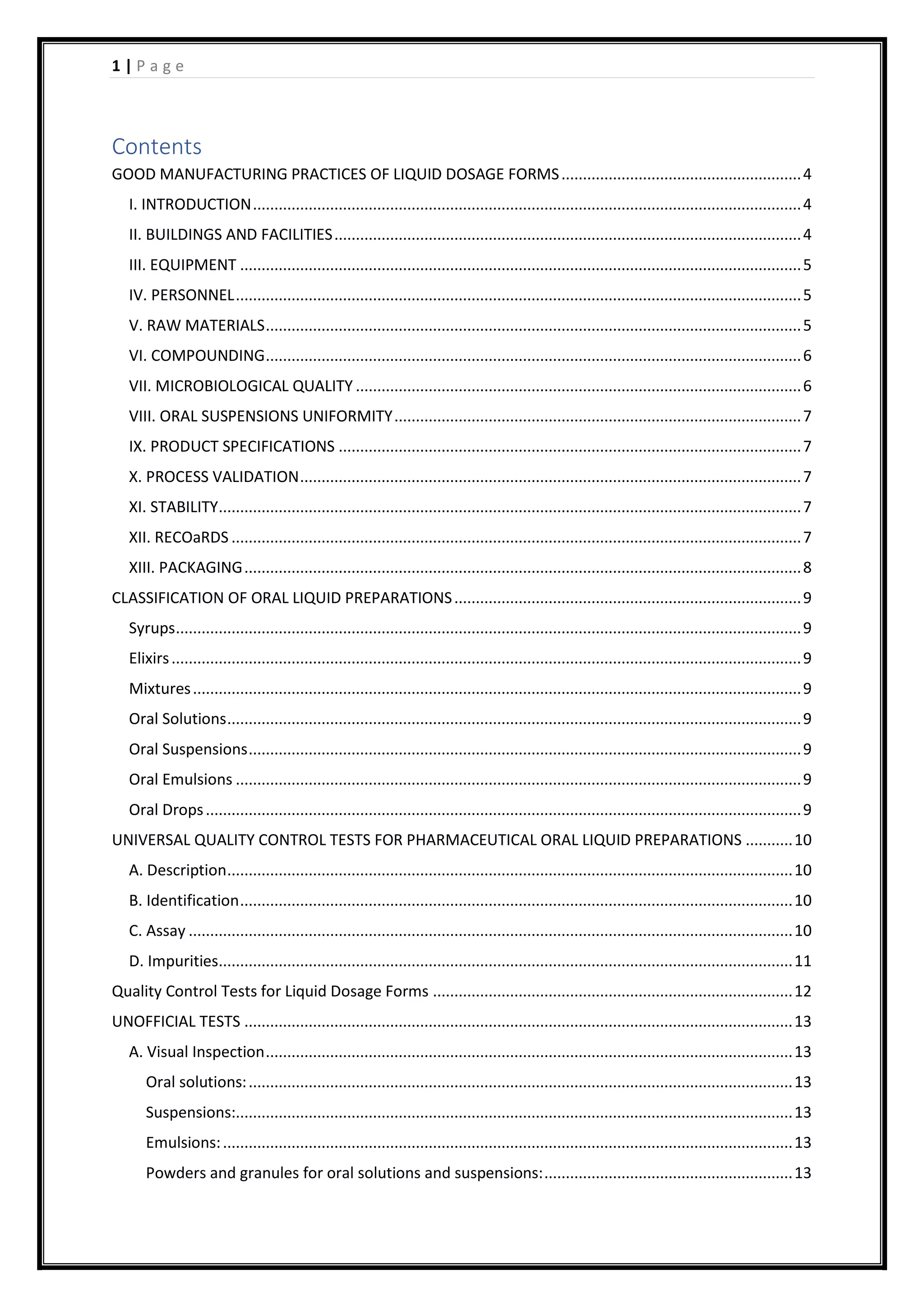
Contents
GOOD MANUFACTURING PRACTICES OF LIQUID DOSAGE FORMS........................................................4
I. INTRODUCTION................................................................................................................................4
II. BUILDINGS AND FACILITIES.............................................................................................................4
III. EQUIPMENT ...................................................................................................................................5
IV. PERSONNEL....................................................................................................................................5
V. RAW MATERIALS.............................................................................................................................5
VI. COMPOUNDING.............................................................................................................................6
VII. MICROBIOLOGICAL QUALITY ........................................................................................................6
VIII. ORAL SUSPENSIONS UNIFORMITY...............................................................................................7
IX. PRODUCT SPECIFICATIONS ............................................................................................................7
X. PROCESS VALIDATION.....................................................................................................................7
XI. STABILITY........................................................................................................................................7
XII. RECOaRDS .....................................................................................................................................7
XIII. PACKAGING..................................................................................................................................8
CLASSIFICATION OF ORAL LIQUID PREPARATIONS.................................................................................9
Syrups..................................................................................................................................................9
Elixirs...................................................................................................................................................9
Mixtures..............................................................................................................................................9
Oral Solutions......................................................................................................................................9
Oral Suspensions.................................................................................................................................9
Oral Emulsions ....................................................................................................................................9
Oral Drops...........................................................................................................................................9
UNIVERSAL QUALITY CONTROL TESTS FOR PHARMACEUTICAL ORAL LIQUID PREPARATIONS ...........10
A. Description....................................................................................................................................10
B. Identification.................................................................................................................................10
C. Assay .............................................................................................................................................10
D. Impurities......................................................................................................................................11
Quality Control Tests for Liquid Dosage Forms ....................................................................................12
UNOFFICIAL TESTS ................................................................................................................................13
A. Visual Inspection...........................................................................................................................13
Oral solutions:...............................................................................................................................13
Suspensions:..................................................................................................................................13
Emulsions:.....................................................................................................................................13
Powders and granules for oral solutions and suspensions:..........................................................13
2 | P a g e
B. Phase Separation ..........................................................................................................................13
Measurement: ..............................................................................................................................13
C. Droplet Size...................................................................................................................................13
Measurement: ..............................................................................................................................14
D. Thermal Stress..............................................................................................................................14
Measurement: ..............................................................................................................................14
E. Sedimentation Volume .................................................................................................................14
F. Degree of Flocculation .................................................................................................................15
G. Redispersibility .............................................................................................................................15
Redispersibilty test:.......................................................................................................................15
H. Zeta Potential ...............................................................................................................................15
Determination:..............................................................................................................................16
OFFICIAL TESTS......................................................................................................................................17
A. Uniformity of Content...................................................................................................................17
Official textbooks reference: ........................................................................................................18
B. Uniformity of Mass .......................................................................................................................18
Official textbooks reference: ........................................................................................................18
C. Mass Variation ..............................................................................................................................18
Official textbooks reference: ........................................................................................................19
D. Uniformity of Volume...................................................................................................................20
E. Uniformity of Weight ....................................................................................................................20
F. Dose and Uniformity of Dose........................................................................................................21
Official textbooks reference: ........................................................................................................21
G. Uniformity of Mass of Delivered Doses........................................................................................21
Official textbooks reference: ........................................................................................................21
H. Microbiological Test .....................................................................................................................21
Official textbooks reference: ........................................................................................................22
I. Antimicrobial Effectiveness Testing...............................................................................................22
Official textbooks reference: ........................................................................................................23
J. Specific Gravity ..............................................................................................................................23
Official textbooks reference: ........................................................................................................23
K. Weight per Millilitre, Density, Relative Density and Apparent Density........................................24
The weight per millilitre................................................................................................................24
Density ..........................................................................................................................................24
Relative density.............................................................................................................................24
Apparent density...........................................................................................................................24
3 | P a g e
Official textbooks reference: ........................................................................................................25
L. Viscosity.........................................................................................................................................25
Official textbooks reference: ........................................................................................................25
M. pH.................................................................................................................................................25
Measurement: ..............................................................................................................................25
N. Deliverable volume.......................................................................................................................25
Official textbooks reference: ........................................................................................................25
References: .......................................................................................................................................26
Official Monographs
4 | P a g e
M. Arshad Mueen
28
GOOD MANUFACTURING PRACTICES OF LIQUID DOSAGE FORMS
I. INTRODUCTION
The manufacture and control of Liquid dosage forms has presented some problems to the
industry. While bioequivalency concerns are minimal (except for the antiseptic products such as
phenytoin suspension), there are other issues which have led to recalls. These include
microbiological, potency and stability problems. Additionally, because the population using oral
dosage forms includes newborns, pediatrics and geriatrics who may not be able to take oral solid
dosage forms and may be compromised, defective dosage forms can pose a greater risk
because of the population being dosed.
So there is a need to establish Good Manufacturing Practices to avoid these problems.
II. BUILDINGS AND FACILITIES
The design of the facilities are largely dependent upon the type of products manufactured and
the potential for cross-contamination and microbiological contamination.
• Review the products manufactured and the procedures used by the firm for the isolation
of processes to minimize contamination.
• Observe the addition of drug substance and powdered excipients to manufacturing
vessels to determine if operations generate dust.
• Observe the systems and the efficiency of the dust removal system.
• The firm's HVAC (Heating Ventilation and Air Conditioning) system may also warrant
coverage particularly where potent or highly sensitizing drugs are processed. Some
manufacturers recirculate air without adequate filtration. Where air is recirculated, review
the firm's data which demonstrates the efficiency of air filtration such should include
surface and/or air sampling.
• Buildings used in the manufacture are of suitable size, design and construction to permit
unobstructed placement of equipment, orderly storage of materials, sanitary operation,
and proper cleaning and maintenance.
• Floors, walls and ceilings are constructed of smooth, easily cleanable surfaces and are
kept clean and in good repair.
• Fixtures, ducts and pipes are installed in such a manner that drip or condensate does not
contaminate cosmetic materials, utensils, cosmetic contact surfaces of equipment, or
finished products in bulk.
• Lighting and ventilation are sufficient for the intended operation and comfort of personnel.
• Water supply, washing and toilet facilities, floor drainage and sewage system are
adequate for sanitary operation and cleaning of facilities, equipment and utensils, as well
as to satisfy employee needs and facilitate personal cleanliness.
5 | P a g e
III. EQUIPMENT
a. Equipment and utensils used in processing, holding, transferring and filling are of
appropriate design, material and workmanship to prevent
• corrosion,
• buildup of material, or adulteration with lubricants,
• dirt or sanitizing agent.
b. Cleaned and sanitized portable equipment and utensils are stored and located, and contact
surfaces of equipment are covered, in a manner that protects them from splash, dust or
other contamination.
Equipment should be of sanitary design. This includes
• sanitary pumps,
• valves,
• flow meters and
• other equipment which can be easily sanitized.
Ball valves, packing in pumps and pockets in flow meters have been identified as sources of
contamination.
In order to facilitate cleaning and sanitization, manufacturing and filling lines should be
identified and detailed in drawings and SOPs. In some cases, long delivery lines between
manufacturing areas and filling areas have been a source of contamination. Also, SOPs,
particularly with regard to time limitations between batches and for cleaning have been found
deficient in many manufacturers. Review cleaning SOPs, including drawings and validation data
with regard to cleaning and sanitization.
The design of the batching tank with regard to the location of the bottom discharge valve has
also presented problems. Ideally, the bottom discharge valve is flush with the bottom of the tank.
With regard to transfer lines, they are generally hard piped and easily cleaned and sanitized.
Another common problem occurs when a manifold or common connections are used, especially
in water supply, premix or raw material supply tanks. Such common connections have been
shown to be a source of contamination.
IV. PERSONNEL
Check whether:
a. The personnel supervising or performing the manufacture or control has the education,
training and/or experience to perform the assigned functions.
b. Persons coming into direct contact with materials, finished products in bulk or contact
surfaces, to the extent necessary to prevent adulteration of products, wear appropriate
outer garments, gloves, hair restraints etc., and maintain adequate personal cleanliness.
c. Consumption of food or drink, or use of tobacco is restricted to appropriately designated
areas.
V. RAW MATERIALS
Check whether:
6 | P a g e
a. Raw materials and primary packaging materials are stored and handled in a manner which
prevents their mix-up, contamination with microorganisms or other chemicals, or
decomposition from exposure to excessive heat, cold, sunlight or moisture.
b. Containers of materials are closed, and bagged or boxed materials are stored off the floor.
c. Containers of materials are labelled with respect to identity, lot identification and control
status.
d. Materials are sampled and tested or examined in conformance with procedures assuring
the absence of contamination with filth, microorganisms or other extraneous substances to
the extent necessary to prevent adulteration of finished products.
e. Materials not meeting acceptance specifications are properly identified and controlled to
prevent their use in cosmetics.
VI. COMPOUNDING
In addition to a determination of the final volume (Q.S.) as previously discussed, there are
microbiological concerns. For oral suspensions, there is the additional concern with uniformity,
particularly because of the potential for segregation during manufacture and storage of the bulk
suspension, during transfer to the filling line and during filling. Review the firm's data that support
storage times and transfer operations. There should be established procedures and time limits
for such operations to address the potential for segregation or settling as well as other
unexpected effects that may be caused by extended holding or stirring.
For oral solutions and suspensions, the amount and control of temperature is important from a
microbiological as well as a potency aspect. For those products in which temperature is identified
as a critical part of the operation, the firm's documentation of temperature, such as by control
charts, should be reviewed.
There are some manufacturers that rely on heat during compounding to control the
microbiological levels in product. For such products, the addition of purified water to final Q.S.,
the batch, and the temperatures during processing should be reviewed.
In addition to drug substances, some additives, such as the parabens are difficult to dissolve and
require heat. The control and assurance of their dissolution during the compounding stage
should be reviewed. From a potency aspect, the storage of product at high temperatures may
increase the level of degradants. Storage limitations (time and temperature) should be justified
by the firm and evaluated during your inspection.
There are also some oral liquids which are sensitive to oxygen and have been known to undergo
degradation. This is particularly true of the phenothiazine class of drugs, such as perphenazine
and chlorpromazine. The manufacture of such products might require the removal of oxygen
such as by nitrogen purging. Additionally, such products might also require storage in sealed
tanks, rather than those with loose lids. Manufacturing directions for these products should be
reviewed.
VII. MICROBIOLOGICAL QUALITY
There are some oral liquids in which microbiological contamination can present significant health
hazards.
Review the microbiological testing of raw materials, including purified water, as well as the
microbiological testing of finished products. Since FDA laboratories typically utilize more
sensitive test methods than industry, consider sampling any oral liquids in which manufacturers
have found microbiological counts, no matter how low. Submit samples for testing for
objectionable microorganisms.
7 | P a g e
VIII. ORAL SUSPENSIONS UNIFORMITY
Those liquid products in which the drug is suspended (and not in solution) present manufacturer
and control problems.
Those liquid products in which the drug is suspended (and not in solution) present manufacture
and control problems. Depending upon the viscosity, many suspensions require continuous or
periodic agitation during the filling process. If delivery lines are used between the bulk storage
tank and the filling equipment, some segregation may occur, particularly if the product is not
viscous. Review the firm's procedures for filling and diagrams for line set-up prior to the filling
equipment.
Good manufacturing practice would warrant testing bottles from the beginning, middle and end to
assure that segregation has not occurred. Such samples should not be composited.
In-process testing for suspensions might also include an assay of a sample from the bulk tank.
More important, however, may be testing for viscosity.
IX. PRODUCT SPECIFICATIONS
Important specifications for the manufacture of all solutions include assay and microbial limits.
Additional important specifications for suspensions include particle size of the suspended drug,
viscosity, pH, and in some cases dissolution.
X. PROCESS VALIDATION
As with other products, the amount of data needed to support the manufacturing process will
vary from product to product. Development (data) should have identified critical phases of the
operation, including the predetermined specifications, that should be monitored during process
validation.
Review the firm's protocol and process validation report and, if appropriate, compare data for full
scale batches to biobatch, data and manufacturing processes.
XI. STABILITY
One area that has presented a number of problems includes the assurance of stability of oral
liquid products throughout their expiry period. Good practice for this class of drug products would
include quantitation of both the active and primary degradant. Dosage form manufacturers
should know and have specifications for the primary degradant. Review the firm's data and
validation data for methods used to quantitate both the active drug and degradant.
Because interactions of products with closure systems are possible, liquids and suspensions
undergoing stability studies should be stored on their side or inverted in order to determine
whether contact of the drug product with the closure system affects product integrity.
Moisture loss which can cause the remaining contents to become super potent and
microbiological contamination are other problems associated with inadequate closure systems.
XII. RECOaRDS
Check whether control records are maintained of:
a. Raw materials and primary packaging materials, documenting disposition of rejected
materials.
b. Manufacturing of batches, documenting the:
8 | P a g e
i. Kinds, lots and quantities of material used.
ii. Processing, handling, transferring, holding and filling.
iii. Sampling, controlling, adjusting and reworking.
iv. Code marks of batches and finished products.
c. Finished products, documenting sampling, individual laboratory controls, test results
and control status.
d. Distribution, documenting initial interstate shipment, code marks and consignees.
XIII. PACKAGING
Problems in the packaging of oral liquids have included potency (fill) of unit dose products,
accurate calibration of measuring devices such as droppers that are often provided. The USP
does not provide for dose uniformity testing for oral solutions. Thus, for unit dose solution
products, they should deliver the label claim within the limits described in the USP. Review the
firm's data to assure uniformity of fill and test procedures to assure that unit dose samples are
being tested.
Another problem in the packaging of Oral Liquids is the lack of cleanliness of containers prior to
filling. Fibers and even insects have been identified as debris in containers, and particularly
plastic containers used for these products. Many manufacturers receive containers shrink-
wrapped in plastic to minimize contamination from fiberboard cartons. Many manufacturers utilize
compressed air to clean containers. Vapors, such as oil vapors, from the compressed air have
occasionally been found to present problems. Review the firm's systems for the cleaning of
containers.
9 | P a g e
Hiba Arif
20
CLASSIFICATION OF ORAL LIQUID PREPARATIONS
Syrups
Syrups are viscous oral liquids that may contain one or more active ingredients in solution. The
vehicle usually contains large amounts of sucrose or other sugars to which certain polyhydric
alcohols may be added to inhibit crystallization or to modify solubilisation, taste and other vehicle
properties. Sugarless syrups may contain sweetening agents and thickening agents. Syrups may
contain ethanol (95%) as a preservative or as a solvent to incorporate flavoring agents.
Antimicrobial agents may also be added to syrups.
Elixirs
Elixirs are clear, flavored oral liquids containing one or more active ingredients dissolved in a
vehicle that usually contains a high proportion of sucrose or a suitable polyhydric alcohol or
alcohols and may also contain ethanol (95 percent) or a dilute ethanol.
Mixtures
Mixtures are oral liquids containing one or more active ingredients dissolved, suspended or
dispersed in a suitable vehicle. Suspended solids may separate slowly on keeping but are easily
redispersed on shaking.
Oral Solutions
Oral solutions are oral liquids containing one or more active ingredients and excipients dissolved
in a suitable vehicle. Water is the most common solvent, although organic solvents are used in
combination with water or on their own. All the components of a solution are dispersed as
molecules or ions, and the solution is optically clear.
Oral Suspensions
Oral suspensions are oral liquids containing one or more active ingredients suspended in a
suitable vehicle. Suspended solids may slowly separate on keeping but are easily redispersed. In
the manufacture of oral suspensions containing dispersed particles, measures shall be taken to
ensure a suitable and controlled particle size with regard to the intended use of the product.
Oral Emulsions
Oral emulsions are dispersions of at least two immiscible or partially miscible liquids. They are
oral liquids containing one or more active ingredients and are stabilized oil-in-water dispersions,
either or both phases of which may contain dissolved solids. Solids may also be suspended in
oral emulsions. Emulsions may exhibit phase separation but are easily reformed on shaking. The
preparation remains sufficiently stable to permit a homogeneous dose to be withdrawn.
Oral Drops
Oral drops are oral liquids that are intended to be administered in small volumes with the aid of a
suitable measuring device such as a dropper.
10 | P a g e
UNIVERSAL QUALITY CONTROL TESTS FOR PHARMACEUTICAL ORAL
LIQUID PREPARATIONS
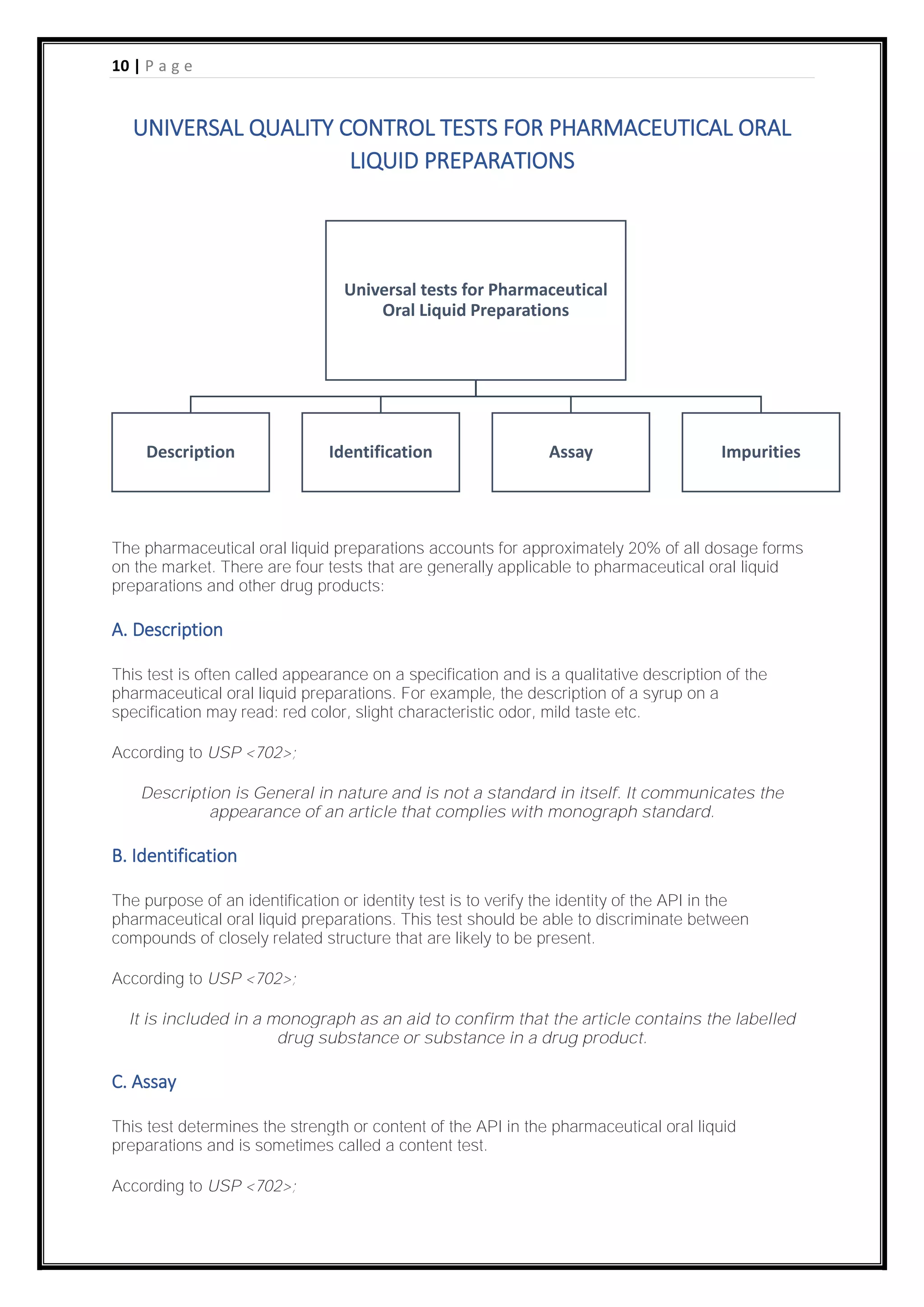
The pharmaceutical oral liquid preparations accounts for approximately 20% of all dosage forms
on the market. There are four tests that are generally applicable to pharmaceutical oral liquid
preparations and other drug products:
A. Description
This test is often called appearance on a specification and is a qualitative description of the
pharmaceutical oral liquid preparations. For example, the description of a syrup on a
specification may read: red color, slight characteristic odor, mild taste etc.
According to USP <702>;
Description is General in nature and is not a standard in itself. It communicates the
appearance of an article that complies with monograph standard.
B. Identification
The purpose of an identification or identity test is to verify the identity of the API in the
pharmaceutical oral liquid preparations. This test should be able to discriminate between
compounds of closely related structure that are likely to be present.
According to USP <702>;
It is included in a monograph as an aid to confirm that the article contains the labelled
drug substance or substance in a drug product.
C. Assay
This test determines the strength or content of the API in the pharmaceutical oral liquid
preparations and is sometimes called a content test.
According to USP <702>;
Universal tests for Pharmaceutical
Oral Liquid Preparations
Description Identification Assay Impurities
11 | P a g e
The Assay is a specific stability indicating test to determine potency of the drug product.
D. Impurities
This test determines the presence of any component that is not the API or an excipient of
pharmaceutical oral liquid preparations. The most common type of impurities that are measured
is related substances, which are process impurities from the new drug substance synthesis,
degradation products of the API, or both.
According to USP <702>;
Process impurities, synthetic by-products, and other inorganic and organic impurities
may be present in the drug substance and in the excipients used in the manufacture of
the drug product. These impurities are limited by drug substance and excipients
monograph.
12 | P a g e
Rimsha Khan
41
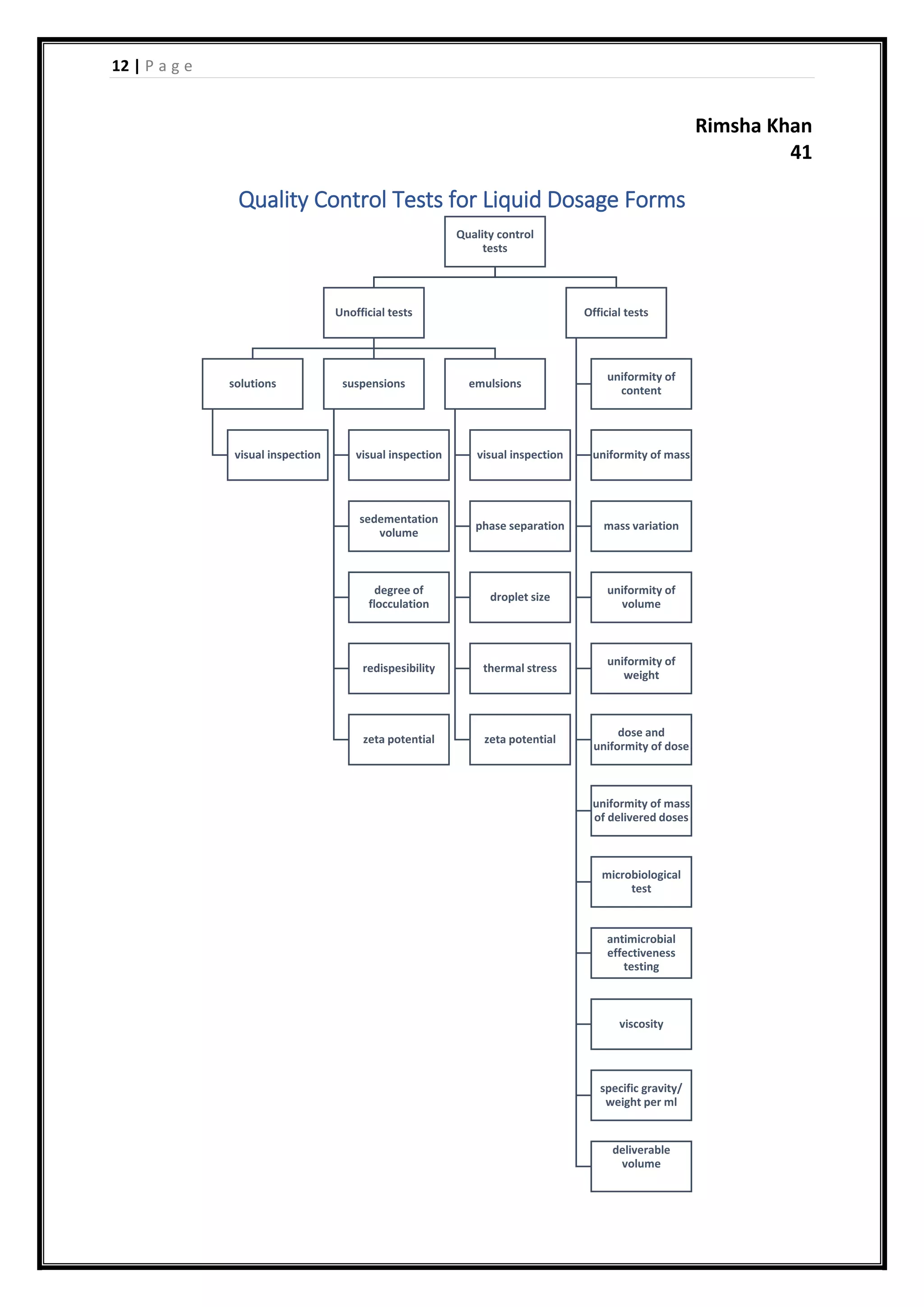
Quality Control Tests for Liquid Dosage Forms
Quality control
tests
Unofficial tests
solutions
visual inspection
suspensions
visual inspection
sedementation
volume
degree of
flocculation
redispesibility
zeta potential
emulsions
visual inspection
phase separation
droplet size
thermal stress
zeta potential
Official tests
uniformity of
content
uniformity of mass
mass variation
uniformity of
volume
uniformity of
weight
dose and
uniformity of dose
uniformity of mass
of delivered doses
microbiological
test
antimicrobial
effectiveness
testing
viscosity
specific gravity/
weight per ml
deliverable
volume
13 | P a g e
UNOFFICIAL TESTS
A. Visual Inspection
Oral solutions:
Oral solution and oral drops should be clear and free from any precipitate. Discoloration or
cloudiness of solutions may indicate
• chemical degradation or
• microbial contamination.
Suspensions:
Evidence of physical instability of oral suspension and oral drops that are suspensions is
demonstrated by the formation of flocculants or sediments that do not readily disperse on gentle
shaking.
Emulsions:
In case of oral emulsion and oral drops that are emulsions evidence of physical instability is
demonstrated by phase separation that is not readily reversed on gentle shaking.
Powders and granules for oral solutions and suspensions:
Evidence of physical instability of powders and granules for oral solutions or oral suspensions
and powders for oral drops is demonstrated by noticeable changes in physical appearance,
including texture for example, clumping.
Discoloration may indicate chemical degradation or microbial contamination of the oral
suspension, oral emulsion, powders and granules for oral solutions or oral suspensions and
powders for oral drops.
B. Phase Separation
This test is applicable for pharmaceutical emulsion.
An approximate estimation of phase separation may be obtained visually. In general, creaming,
flocculation, and coalescence have occurred before phase separation is visible, thus sometimes
making quantitative evaluations more difficult.
Measurement:
The rate and degree of phase separation in an emulsion can be easily determined by keeping a
certain amount in a graduated cylinder and measuring the volume of separated phase after
definite time intervals. The phase separation may result from creaming or coalescence of
globules. The phase separation test can be accelerated by centrifugation at low or mild rate
speeds.
C. Droplet Size
This test is applicable for pharmaceutical emulsion.
14 | P a g e
Growth in the droplet size after the preparation of an emulsion is an indication of its physical
instability.
Measurement:
The droplet size is measured by microscopic methods or by electronic devices such as coulter
counter.
In emulsions containing droplets greater than 1 µm, optical microscopy is particularly useful
because it provides a direct and reassuring measurement of individual droplet sizes. The tedium
of counting droplets to obtain size distributions is reduced by the use of image analysis.
Indirect methods generally involve laser light scattering techniques are used extensively with
emulsions containing submicrometre droplets. In either of these techniques often the original
products has to be suitable diluted before estimation. The dilution may introduce errors because
of incomplete de-flocculation or new pattern of flocculation.
D. Thermal Stress
This test is applicable for pharmaceutical emulsion.
Measurement:
It is usual to evaluate the stability of an emulsion by subjecting it too high and low temperatures
in alternating cycles. The samples are first exposed to 60°C for a few hours and then to 40°C.
Such exposures are repeated a number of times and emulsion stability assessed after each
cycle.
E. Sedimentation Volume
This test is applicable for pharmaceutical suspension.
Sedimentation volume, F of a suspension is expressed by the ratio of the equilibrium volume of
the sediment, Vu to the total volume, Vo of the suspension.
The following formula is used:
F = Vu/Vo
The value of F normally lies between less than 1 to 1 or it may exceed 1 for any pharmaceutical
suspension. The larger the value, the better is the suspendability.
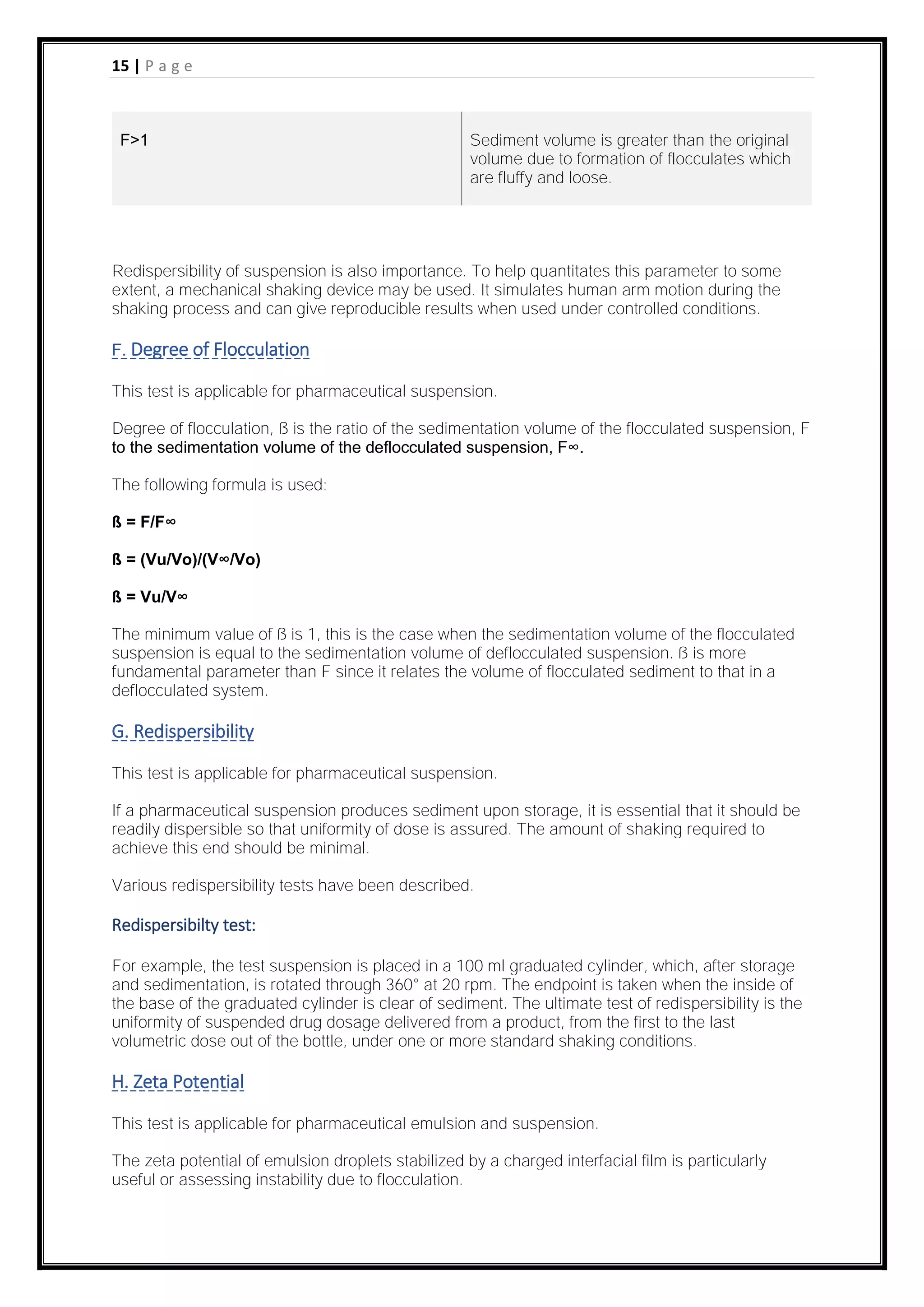
Physical stability of suspension based on F values
F VALUES COMMENTS
F=1 No sedimentation, no clear supernatant.
F=0.5 50% of the volume is occupied by sediment.
15 | P a g e
F>1 Sediment volume is greater than the original
volume due to formation of flocculates which
are fluffy and loose.
Redispersibility of suspension is also importance. To help quantitates this parameter to some
extent, a mechanical shaking device may be used. It simulates human arm motion during the
shaking process and can give reproducible results when used under controlled conditions.
F. Degree of Flocculation
This test is applicable for pharmaceutical suspension.
Degree of flocculation, ß is the ratio of the sedimentation volume of the flocculated suspension, F
to the sedimentation volume of the deflocculated suspension, F∞.
The following formula is used:
ß = F/F∞
ß = (Vu/Vo)/(V∞/Vo)
ß = Vu/V∞
The minimum value of ß is 1, this is the case when the sedimentation volume of the flocculated
suspension is equal to the sedimentation volume of deflocculated suspension. ß is more
fundamental parameter than F since it relates the volume of flocculated sediment to that in a
deflocculated system.
G. Redispersibility
This test is applicable for pharmaceutical suspension.
If a pharmaceutical suspension produces sediment upon storage, it is essential that it should be
readily dispersible so that uniformity of dose is assured. The amount of shaking required to
achieve this end should be minimal.
Various redispersibility tests have been described.
Redispersibilty test:
For example, the test suspension is placed in a 100 ml graduated cylinder, which, after storage
and sedimentation, is rotated through 360° at 20 rpm. The endpoint is taken when the inside of
the base of the graduated cylinder is clear of sediment. The ultimate test of redispersibility is the
uniformity of suspended drug dosage delivered from a product, from the first to the last
volumetric dose out of the bottle, under one or more standard shaking conditions.
H. Zeta Potential
This test is applicable for pharmaceutical emulsion and suspension.
The zeta potential of emulsion droplets stabilized by a charged interfacial film is particularly
useful or assessing instability due to flocculation.
16 | P a g e
Determination:
It can be determined by observing the movement of droplets under the influence of an electric
current (electrophoretic mobility measurements), often in conjunction with photon correlation
spectroscopy.
17 | P a g e
OFFICIAL TESTS
A. Uniformity of Content
Unless otherwise prescribed or justified and authorized, according to BP this test is applicable for
single-dose preparations that are suspensions. T
his test is also applicable for single-dose powders and granules for syrups, oral solutions, oral
suspensions and single-dose powders for oral drops, with a content of active substance less than
2 mg or less than 2 percent of the total mass.
Except single-dose preparations that are suspensions if the preparation has more than one
active substance, the requirement applies only to those substances that correspond to the above
conditions.
According to IP unless otherwise specified, single dose liquids in suspension form or powders or
granules presented in single dose containers and that contain less than 10 mg or less than 10
percent of active ingredient also comply with this test.
For this test as per BP assay 10 units individually using an appropriate analytical method. Carry
out the assay on the amount of well-mixed material that is removed from an individual container
in conditions of normal use. Express the results as delivered dose.
Calculate the acceptance value using the following formula:
│M – X │ + KS
Where,
M = Reference value,
X = Mean of individual content (x1, x2,..., xn) expressed as percentage of the label claim,
K = Acceptability constant,
S = Sample standard deviation.
According to IP, BP the preparation complies with the test if not more than one individual content
is outside the limits of 85 percent to 115 percent of the average content and none is outside the
limits of 75 percent to 125 percent of the average content.
The preparation fails to comply with the test if more than 3 individual contents are outside the
limits of 85 percent to 115 percent of the average content or if one or more individual contents
are outside the limits of 75 percent to 125 percent of the average content.
If 2 or 3 individual contents are outside the limits of 85 percent to 115 percent but within the limits
of 75 percent to 125 percent, determine the individual contents of another 20 dosage units taken
at random.
• The preparation complies with the test if not more than 3 individual contents of the 30
dosage units are outside the limits of 85 percent to 115 percent of the average content
and none is outside the limits of 75 percent to 125 percent of the average content.
18 | P a g e
BP and USP-NF limits for content uniformity (CU) and mass variation (MV) tests
Official textbooks reference:
✓ Appendix XII C. Consistency of Formulated preparations (BP)
✓ <905> Uniformity of dosage units (USP)
B. Uniformity of Mass
According to BP this test is applicable for single dose preparations that are solutions or
emulsions; single-dose powders and granules for syrups, oral solutions, oral suspensions; and
single-dose powders for oral drops.
For this test weigh individually the contents of 20 dosage units taken at random, emptied as
completely as possible, and determine the average mass.
As stated by BP for single-dose preparations that are solutions or emulsions not more than 2 of
the individual masses deviate by more than 10 percent from the average mass and none deviate
by more than 20 percent.
For single-dose powders and granules for syrups, oral solutions, oral suspensions and single-
dose powders for oral drops according to BP not more than 2 of the individual masses deviate
from the average mass by more than the percentage deviation shown in Table and none
deviates by more than twice that percentage.
BP limits for uniformity of mass
Official textbooks reference:
✓ Appendix XII C. Consistency of Formulated preparations (BP)
C. Mass Variation
According to BP accurately weigh the amount of liquid that is removed from each of 10 individual
containers in conditions of normal use. If necessary, compute the equivalent volume after
determining the density.
Calculate the active substance content in each container from the mass of product removed from
the individual containers and the result of the assay.
Calculate the acceptance value using the following formula:
19 | P a g e
│M – X │ + KS
Xi = Wi × A/W
Where,
x1, x2,..., xn = Individual estimated contents of the dosage units tested,
w1, w2,..., wn = Individual masses of the dosage units tested,
A = Content of active substance (percentage of label claim) obtained using an appropriate
analytical method (assay),
W = Mean of individual weights (w1, w2,..., wn).
Unless otherwise specified, consistent with BP, the requirement is met if the acceptance value of
10 dosage units is less than or equal to 15 percent.
If acceptance value is greater than 15 percent, test the next 20 dosage units and calculate the
acceptance value.
The requirements are met if the final acceptance value of the 30 dosage units is less than or
equal to 15 percent and no individual content of the dosage units is less than (1 – 25 × 0.01)M or
more than (1 + 25 × 0.01)M in calculation of acceptance value under mass variation or content
uniformity.
Official textbooks reference:
✓ Appendix XII C. Consistency of Formulated preparations (BP)
20 | P a g e
Naila Jabeen
37
D. Uniformity of Volume
According to IP this test is suitable for oral liquids and oral suspensions of viscous preparations.
For this test select a sample of 10 filled containers and determine the weight of the contents of
each container. Determine the weight per ml and calculate the net volume of the contents of
each container.
For non-viscous and free-flowing liquids pour completely the contents of each container into
calibrated volume measures of the appropriate size and determine the net volume of the
contents of the 10 containers.
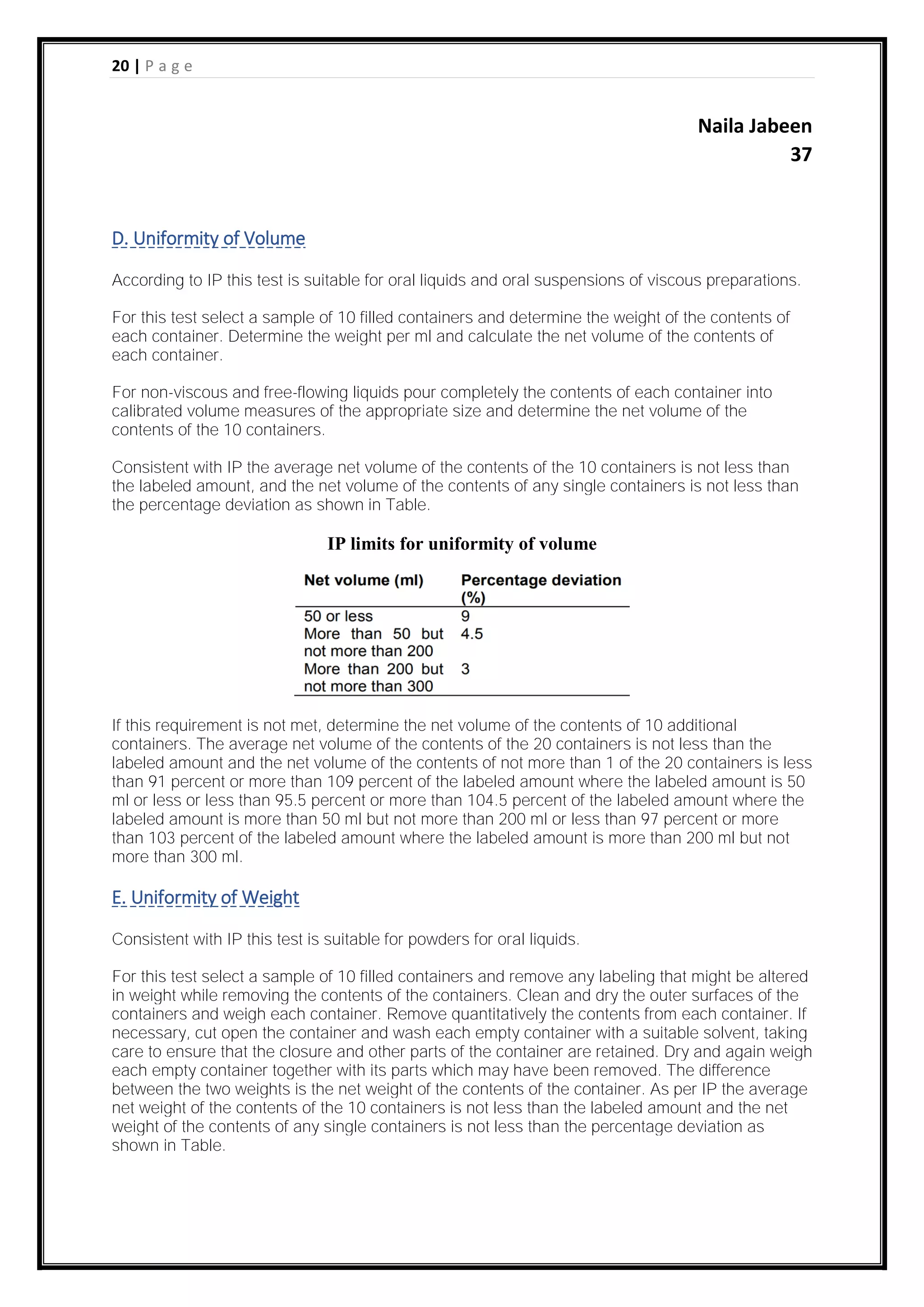
Consistent with IP the average net volume of the contents of the 10 containers is not less than
the labeled amount, and the net volume of the contents of any single containers is not less than
the percentage deviation as shown in Table.
IP limits for uniformity of volume
If this requirement is not met, determine the net volume of the contents of 10 additional
containers. The average net volume of the contents of the 20 containers is not less than the
labeled amount and the net volume of the contents of not more than 1 of the 20 containers is less
than 91 percent or more than 109 percent of the labeled amount where the labeled amount is 50
ml or less or less than 95.5 percent or more than 104.5 percent of the labeled amount where the
labeled amount is more than 50 ml but not more than 200 ml or less than 97 percent or more
than 103 percent of the labeled amount where the labeled amount is more than 200 ml but not
more than 300 ml.
E. Uniformity of Weight
Consistent with IP this test is suitable for powders for oral liquids.
For this test select a sample of 10 filled containers and remove any labeling that might be altered
in weight while removing the contents of the containers. Clean and dry the outer surfaces of the
containers and weigh each container. Remove quantitatively the contents from each container. If
necessary, cut open the container and wash each empty container with a suitable solvent, taking
care to ensure that the closure and other parts of the container are retained. Dry and again weigh
each empty container together with its parts which may have been removed. The difference
between the two weights is the net weight of the contents of the container. As per IP the average
net weight of the contents of the 10 containers is not less than the labeled amount and the net
weight of the contents of any single containers is not less than the percentage deviation as
shown in Table.
21 | P a g e
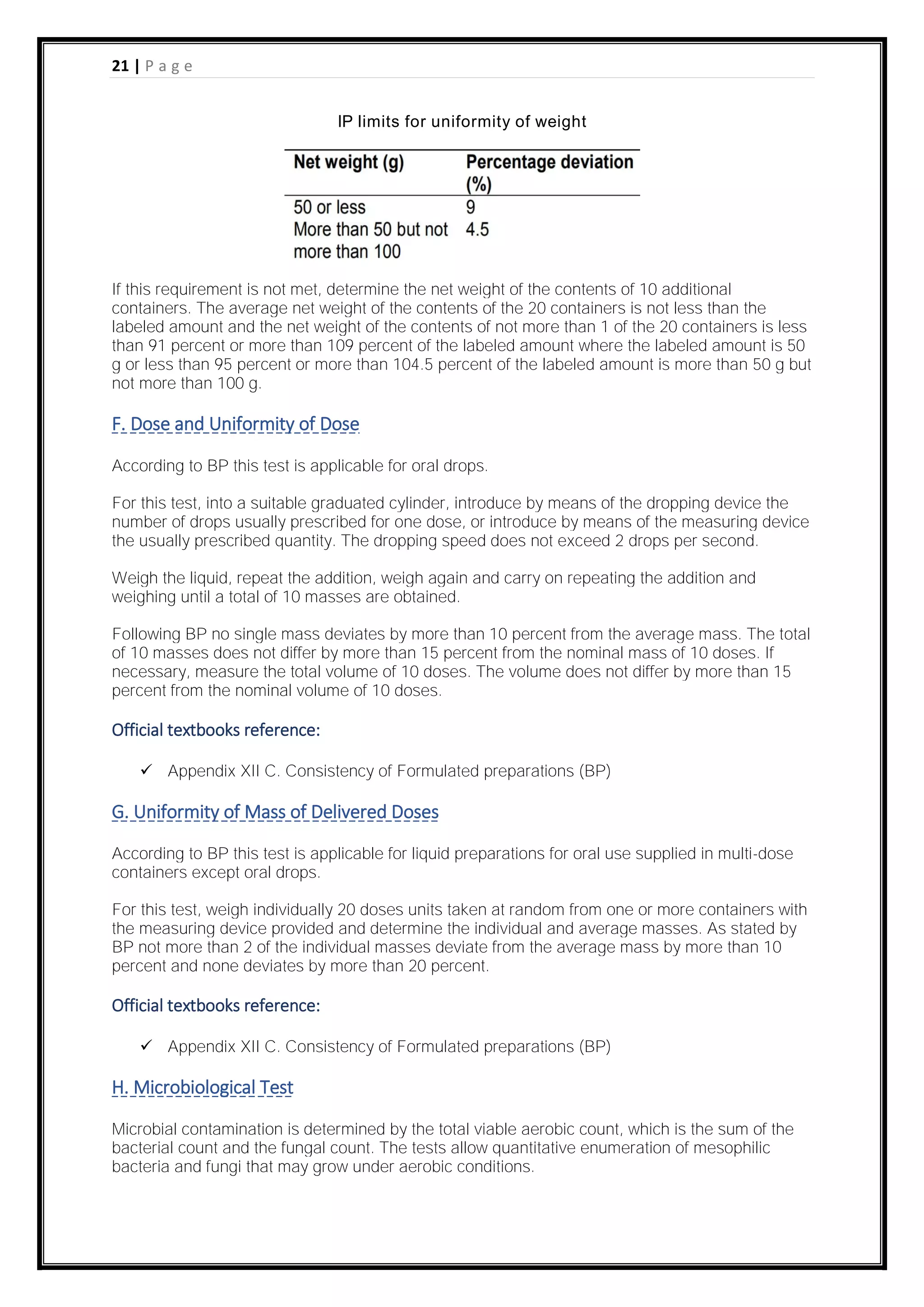
IP limits for uniformity of weight
If this requirement is not met, determine the net weight of the contents of 10 additional
containers. The average net weight of the contents of the 20 containers is not less than the
labeled amount and the net weight of the contents of not more than 1 of the 20 containers is less
than 91 percent or more than 109 percent of the labeled amount where the labeled amount is 50
g or less than 95 percent or more than 104.5 percent of the labeled amount is more than 50 g but
not more than 100 g.
F. Dose and Uniformity of Dose
According to BP this test is applicable for oral drops.
For this test, into a suitable graduated cylinder, introduce by means of the dropping device the
number of drops usually prescribed for one dose, or introduce by means of the measuring device
the usually prescribed quantity. The dropping speed does not exceed 2 drops per second.
Weigh the liquid, repeat the addition, weigh again and carry on repeating the addition and
weighing until a total of 10 masses are obtained.
Following BP no single mass deviates by more than 10 percent from the average mass. The total
of 10 masses does not differ by more than 15 percent from the nominal mass of 10 doses. If
necessary, measure the total volume of 10 doses. The volume does not differ by more than 15
percent from the nominal volume of 10 doses.
Official textbooks reference:
✓ Appendix XII C. Consistency of Formulated preparations (BP)
G. Uniformity of Mass of Delivered Doses
According to BP this test is applicable for liquid preparations for oral use supplied in multi-dose
containers except oral drops.
For this test, weigh individually 20 doses units taken at random from one or more containers with
the measuring device provided and determine the individual and average masses. As stated by
BP not more than 2 of the individual masses deviate from the average mass by more than 10
percent and none deviates by more than 20 percent.
Official textbooks reference:
✓ Appendix XII C. Consistency of Formulated preparations (BP)
H. Microbiological Test
Microbial contamination is determined by the total viable aerobic count, which is the sum of the
bacterial count and the fungal count. The tests allow quantitative enumeration of mesophilic
bacteria and fungi that may grow under aerobic conditions.
22 | P a g e
Membrane filtration, plate count methods and mostprobable-number method are used for
determination of total viable aerobic count.
According to USP-NF the product complies with the test if no colonies are present or if the
identification tests are negative.
Official textbooks reference:
✓ <61> Microbiological examination of nonsterile products: microbial enumeration tests
(USP)
I. Antimicrobial Effectiveness Testing
According to USP-NF the test can be conducted either in 5 original containers if sufficient volume
of product is available in each container. Inoculate each container with one of the prepared and
standardized inoculum, and mix.
The volume of the suspension inoculum used is between 0.5 percent and 1.0 percent of the
volume of the product.
For oral products other than antacids, made with aqueous bases or vehicles, the concentration of
test microorganisms that is added to the product are such that the final concentration of the test
preparation after inoculation is between 1 × 10⁵ and 1 × 10⁶ CFU per ml of the product.
For antacids made with an aqueous base the final concentration of the test preparation after
inoculation is between 1 × 10³ and 1 × 10⁴ CFU per ml of the product. The initial concentration
of viable microorganisms in each test preparation is estimated based on the concentration of
microorganisms in each of the standardized inoculum as determined by the plate-count method.
Incubate the inoculated containers at 22.5±2.5°C. Sample each container at the appropriate
intervals specified in Table B.
Record any changes observed in appearance at these intervals. Determine by the plate-count
procedure the number of CFU present in each test preparation for the applicable intervals.
Incorporate an inactivator (neutralizer) of the specific antimicrobial in the plate count or in the
appropriate dilution prepared for plating. These conditions are determined in the validation study
for that sample based upon the conditions of media and microbial recovery incubation times
listed in Table A. Using the calculated concentrations of CFU per ml present at the start of the
test, calculate the change in log10 values of the concentration of CFU per ml for each
microorganism at the applicable test intervals, and express the changes in terms of log
reductions.
According to USP-NF the requirements for antimicrobial effectiveness are met if the criteria
specified under Table B are met. No increase is defined as not more than 0.5 log10 unit higher
than the previous value measured.
23 | P a g e
Table A. Culture conditions for inoculum preparation
Table B. Criteria for tested microorganisms
Official textbooks reference:
✓ <51> antimicrobial effectiveness testing (USP)
J. Specific Gravity
According to USP, Unless otherwise stated in the individual monograph, the specific gravity
determination is applicable only to liquids, and unless otherwise stated, is based on the ratio of
the weight of a liquid in air at 25° to that of an equal volume of water at the same temperature.
Where a temperature is specified in the individual monograph, the specific gravity is the ratio of
the weight of the liquid in air at the specified temperature to that of an equal volume of water at
the same temperature. When the substance is a solid at 25°, determine the specific gravity of the
melted material at the temperature directed in the individual monograph, and refer to water at
25°. Unless otherwise stated in the individual monograph, the density is defined as the mass of a
unit volume of the substance at 25°, expressed in kilograms per cubic meter or grams per cubic
centimeter (1kg/m3 = 10–3 g/cm3). Where the density is known, mass can be converted to
volume, or volume converted to mass, by the formula: volume = mass/density
Official textbooks reference:
✓ <841> Specific Gravity (USP)
24 | P a g e
K. Weight per Millilitre, Density, Relative Density and Apparent Density
The weight per millilitre
of a liquid is the weight in g of 1 ml of a liquid when weighed in air at 20°, unless otherwise
specified in the monograph.
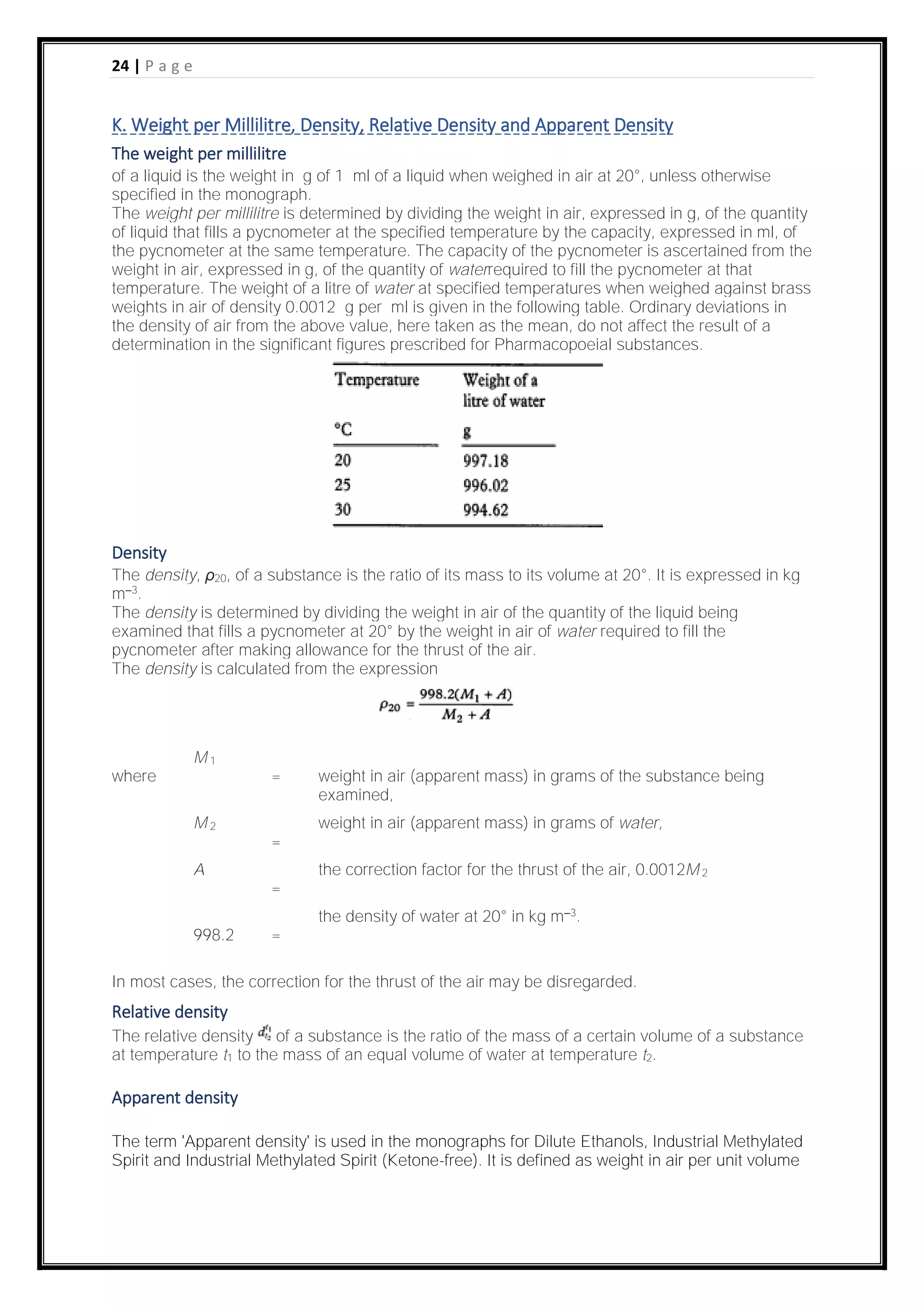
The weight per millilitre is determined by dividing the weight in air, expressed in g, of the quantity
of liquid that fills a pycnometer at the specified temperature by the capacity, expressed in ml, of
the pycnometer at the same temperature. The capacity of the pycnometer is ascertained from the
weight in air, expressed in g, of the quantity of waterrequired to fill the pycnometer at that
temperature. The weight of a litre of water at specified temperatures when weighed against brass
weights in air of density 0.0012 g per ml is given in the following table. Ordinary deviations in
the density of air from the above value, here taken as the mean, do not affect the result of a
determination in the significant figures prescribed for Pharmacopoeial substances.
Density
The density, ρ20, of a substance is the ratio of its mass to its volume at 20°. It is expressed in kg
m–3
.
The density is determined by dividing the weight in air of the quantity of the liquid being
examined that fills a pycnometer at 20° by the weight in air of water required to fill the
pycnometer after making allowance for the thrust of the air.
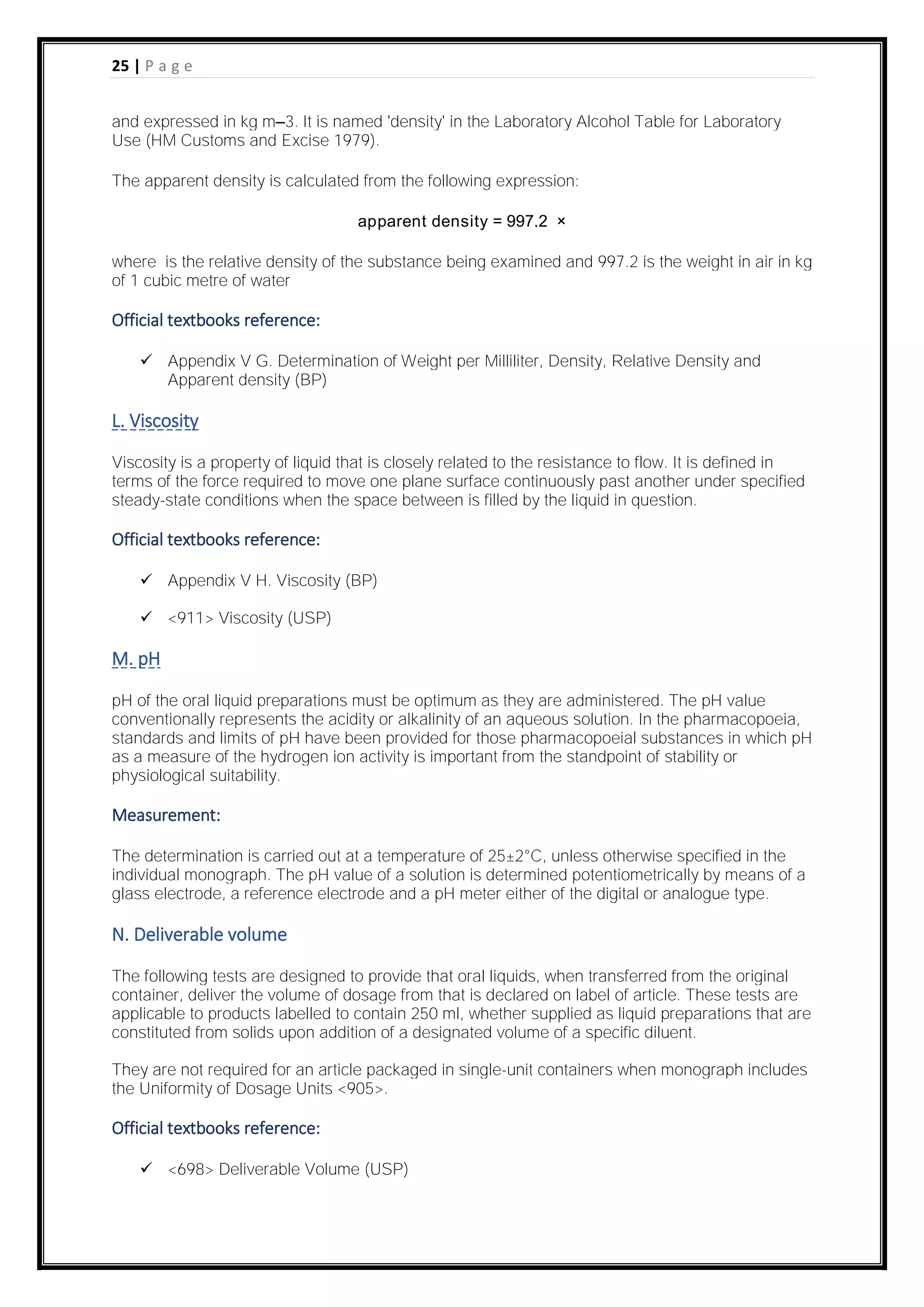
The density is calculated from the expression
where
M 1
= weight in air (apparent mass) in grams of the substance being
examined,
M 2
=
weight in air (apparent mass) in grams of water,
A
=
the correction factor for the thrust of the air, 0.0012M 2
998.2 =
the density of water at 20° in kg m–3
.
In most cases, the correction for the thrust of the air may be disregarded.
Relative density
The relative density of a substance is the ratio of the mass of a certain volume of a substance
at temperature t1 to the mass of an equal volume of water at temperature t2.
Apparent density
The term 'Apparent density' is used in the monographs for Dilute Ethanols, Industrial Methylated
Spirit and Industrial Methylated Spirit (Ketone-free). It is defined as weight in air per unit volume
25 | P a g e
and expressed in kg m–3. It is named 'density' in the Laboratory Alcohol Table for Laboratory
Use (HM Customs and Excise 1979).
The apparent density is calculated from the following expression:
apparent density = 997.2 ×
where is the relative density of the substance being examined and 997.2 is the weight in air in kg
of 1 cubic metre of water
Official textbooks reference:
✓ Appendix V G. Determination of Weight per Milliliter, Density, Relative Density and
Apparent density (BP)
L. Viscosity
Viscosity is a property of liquid that is closely related to the resistance to flow. It is defined in
terms of the force required to move one plane surface continuously past another under specified
steady-state conditions when the space between is filled by the liquid in question.
Official textbooks reference:
✓ Appendix V H. Viscosity (BP)
✓ <911> Viscosity (USP)
M. pH
pH of the oral liquid preparations must be optimum as they are administered. The pH value
conventionally represents the acidity or alkalinity of an aqueous solution. In the pharmacopoeia,
standards and limits of pH have been provided for those pharmacopoeial substances in which pH
as a measure of the hydrogen ion activity is important from the standpoint of stability or
physiological suitability.
Measurement:
The determination is carried out at a temperature of 25±2°C, unless otherwise specified in the
individual monograph. The pH value of a solution is determined potentiometrically by means of a
glass electrode, a reference electrode and a pH meter either of the digital or analogue type.
N. Deliverable volume
The following tests are designed to provide that oral liquids, when transferred from the original
container, deliver the volume of dosage from that is declared on label of article. These tests are
applicable to products labelled to contain 250 ml, whether supplied as liquid preparations that are
constituted from solids upon addition of a designated volume of a specific diluent.
They are not required for an article packaged in single-unit containers when monograph includes
the Uniformity of Dosage Units <905>.
Official textbooks reference:
✓ <698> Deliverable Volume (USP)
26 | P a g e
References:
I. https://www.fda.gov/ICECI/Inspections/InspectionGuides/ucm074935.htm
II. Article: Pharmacopoeial Standards and Specifications for Pharmaceutical Oral
Liquid Preparations (https://www.researchgate.net/publication/292130182)

GMPs and quality control tests of liquid dosage forms

  • 1.
    1 | Pa g e Contents GOOD MANUFACTURING PRACTICES OF LIQUID DOSAGE FORMS........................................................4 I. INTRODUCTION................................................................................................................................4 II. BUILDINGS AND FACILITIES.............................................................................................................4 III. EQUIPMENT ...................................................................................................................................5 IV. PERSONNEL....................................................................................................................................5 V. RAW MATERIALS.............................................................................................................................5 VI. COMPOUNDING.............................................................................................................................6 VII. MICROBIOLOGICAL QUALITY ........................................................................................................6 VIII. ORAL SUSPENSIONS UNIFORMITY...............................................................................................7 IX. PRODUCT SPECIFICATIONS ............................................................................................................7 X. PROCESS VALIDATION.....................................................................................................................7 XI. STABILITY........................................................................................................................................7 XII. RECOaRDS .....................................................................................................................................7 XIII. PACKAGING..................................................................................................................................8 CLASSIFICATION OF ORAL LIQUID PREPARATIONS.................................................................................9 Syrups..................................................................................................................................................9 Elixirs...................................................................................................................................................9 Mixtures..............................................................................................................................................9 Oral Solutions......................................................................................................................................9 Oral Suspensions.................................................................................................................................9 Oral Emulsions ....................................................................................................................................9 Oral Drops...........................................................................................................................................9 UNIVERSAL QUALITY CONTROL TESTS FOR PHARMACEUTICAL ORAL LIQUID PREPARATIONS ...........10 A. Description....................................................................................................................................10 B. Identification.................................................................................................................................10 C. Assay .............................................................................................................................................10 D. Impurities......................................................................................................................................11 Quality Control Tests for Liquid Dosage Forms ....................................................................................12 UNOFFICIAL TESTS ................................................................................................................................13 A. Visual Inspection...........................................................................................................................13 Oral solutions:...............................................................................................................................13 Suspensions:..................................................................................................................................13 Emulsions:.....................................................................................................................................13 Powders and granules for oral solutions and suspensions:..........................................................13
  • 2.
    2 | Pa g e B. Phase Separation ..........................................................................................................................13 Measurement: ..............................................................................................................................13 C. Droplet Size...................................................................................................................................13 Measurement: ..............................................................................................................................14 D. Thermal Stress..............................................................................................................................14 Measurement: ..............................................................................................................................14 E. Sedimentation Volume .................................................................................................................14 F. Degree of Flocculation .................................................................................................................15 G. Redispersibility .............................................................................................................................15 Redispersibilty test:.......................................................................................................................15 H. Zeta Potential ...............................................................................................................................15 Determination:..............................................................................................................................16 OFFICIAL TESTS......................................................................................................................................17 A. Uniformity of Content...................................................................................................................17 Official textbooks reference: ........................................................................................................18 B. Uniformity of Mass .......................................................................................................................18 Official textbooks reference: ........................................................................................................18 C. Mass Variation ..............................................................................................................................18 Official textbooks reference: ........................................................................................................19 D. Uniformity of Volume...................................................................................................................20 E. Uniformity of Weight ....................................................................................................................20 F. Dose and Uniformity of Dose........................................................................................................21 Official textbooks reference: ........................................................................................................21 G. Uniformity of Mass of Delivered Doses........................................................................................21 Official textbooks reference: ........................................................................................................21 H. Microbiological Test .....................................................................................................................21 Official textbooks reference: ........................................................................................................22 I. Antimicrobial Effectiveness Testing...............................................................................................22 Official textbooks reference: ........................................................................................................23 J. Specific Gravity ..............................................................................................................................23 Official textbooks reference: ........................................................................................................23 K. Weight per Millilitre, Density, Relative Density and Apparent Density........................................24 The weight per millilitre................................................................................................................24 Density ..........................................................................................................................................24 Relative density.............................................................................................................................24 Apparent density...........................................................................................................................24
  • 3.
    3 | Pa g e Official textbooks reference: ........................................................................................................25 L. Viscosity.........................................................................................................................................25 Official textbooks reference: ........................................................................................................25 M. pH.................................................................................................................................................25 Measurement: ..............................................................................................................................25 N. Deliverable volume.......................................................................................................................25 Official textbooks reference: ........................................................................................................25 References: .......................................................................................................................................26 Official Monographs
  • 4.
    4 | Pa g e M. Arshad Mueen 28 GOOD MANUFACTURING PRACTICES OF LIQUID DOSAGE FORMS I. INTRODUCTION The manufacture and control of Liquid dosage forms has presented some problems to the industry. While bioequivalency concerns are minimal (except for the antiseptic products such as phenytoin suspension), there are other issues which have led to recalls. These include microbiological, potency and stability problems. Additionally, because the population using oral dosage forms includes newborns, pediatrics and geriatrics who may not be able to take oral solid dosage forms and may be compromised, defective dosage forms can pose a greater risk because of the population being dosed. So there is a need to establish Good Manufacturing Practices to avoid these problems. II. BUILDINGS AND FACILITIES The design of the facilities are largely dependent upon the type of products manufactured and the potential for cross-contamination and microbiological contamination. • Review the products manufactured and the procedures used by the firm for the isolation of processes to minimize contamination. • Observe the addition of drug substance and powdered excipients to manufacturing vessels to determine if operations generate dust. • Observe the systems and the efficiency of the dust removal system. • The firm's HVAC (Heating Ventilation and Air Conditioning) system may also warrant coverage particularly where potent or highly sensitizing drugs are processed. Some manufacturers recirculate air without adequate filtration. Where air is recirculated, review the firm's data which demonstrates the efficiency of air filtration such should include surface and/or air sampling. • Buildings used in the manufacture are of suitable size, design and construction to permit unobstructed placement of equipment, orderly storage of materials, sanitary operation, and proper cleaning and maintenance. • Floors, walls and ceilings are constructed of smooth, easily cleanable surfaces and are kept clean and in good repair. • Fixtures, ducts and pipes are installed in such a manner that drip or condensate does not contaminate cosmetic materials, utensils, cosmetic contact surfaces of equipment, or finished products in bulk. • Lighting and ventilation are sufficient for the intended operation and comfort of personnel. • Water supply, washing and toilet facilities, floor drainage and sewage system are adequate for sanitary operation and cleaning of facilities, equipment and utensils, as well as to satisfy employee needs and facilitate personal cleanliness.
  • 5.
    5 | Pa g e III. EQUIPMENT a. Equipment and utensils used in processing, holding, transferring and filling are of appropriate design, material and workmanship to prevent • corrosion, • buildup of material, or adulteration with lubricants, • dirt or sanitizing agent. b. Cleaned and sanitized portable equipment and utensils are stored and located, and contact surfaces of equipment are covered, in a manner that protects them from splash, dust or other contamination. Equipment should be of sanitary design. This includes • sanitary pumps, • valves, • flow meters and • other equipment which can be easily sanitized. Ball valves, packing in pumps and pockets in flow meters have been identified as sources of contamination. In order to facilitate cleaning and sanitization, manufacturing and filling lines should be identified and detailed in drawings and SOPs. In some cases, long delivery lines between manufacturing areas and filling areas have been a source of contamination. Also, SOPs, particularly with regard to time limitations between batches and for cleaning have been found deficient in many manufacturers. Review cleaning SOPs, including drawings and validation data with regard to cleaning and sanitization. The design of the batching tank with regard to the location of the bottom discharge valve has also presented problems. Ideally, the bottom discharge valve is flush with the bottom of the tank. With regard to transfer lines, they are generally hard piped and easily cleaned and sanitized. Another common problem occurs when a manifold or common connections are used, especially in water supply, premix or raw material supply tanks. Such common connections have been shown to be a source of contamination. IV. PERSONNEL Check whether: a. The personnel supervising or performing the manufacture or control has the education, training and/or experience to perform the assigned functions. b. Persons coming into direct contact with materials, finished products in bulk or contact surfaces, to the extent necessary to prevent adulteration of products, wear appropriate outer garments, gloves, hair restraints etc., and maintain adequate personal cleanliness. c. Consumption of food or drink, or use of tobacco is restricted to appropriately designated areas. V. RAW MATERIALS Check whether:
  • 6.
    6 | Pa g e a. Raw materials and primary packaging materials are stored and handled in a manner which prevents their mix-up, contamination with microorganisms or other chemicals, or decomposition from exposure to excessive heat, cold, sunlight or moisture. b. Containers of materials are closed, and bagged or boxed materials are stored off the floor. c. Containers of materials are labelled with respect to identity, lot identification and control status. d. Materials are sampled and tested or examined in conformance with procedures assuring the absence of contamination with filth, microorganisms or other extraneous substances to the extent necessary to prevent adulteration of finished products. e. Materials not meeting acceptance specifications are properly identified and controlled to prevent their use in cosmetics. VI. COMPOUNDING In addition to a determination of the final volume (Q.S.) as previously discussed, there are microbiological concerns. For oral suspensions, there is the additional concern with uniformity, particularly because of the potential for segregation during manufacture and storage of the bulk suspension, during transfer to the filling line and during filling. Review the firm's data that support storage times and transfer operations. There should be established procedures and time limits for such operations to address the potential for segregation or settling as well as other unexpected effects that may be caused by extended holding or stirring. For oral solutions and suspensions, the amount and control of temperature is important from a microbiological as well as a potency aspect. For those products in which temperature is identified as a critical part of the operation, the firm's documentation of temperature, such as by control charts, should be reviewed. There are some manufacturers that rely on heat during compounding to control the microbiological levels in product. For such products, the addition of purified water to final Q.S., the batch, and the temperatures during processing should be reviewed. In addition to drug substances, some additives, such as the parabens are difficult to dissolve and require heat. The control and assurance of their dissolution during the compounding stage should be reviewed. From a potency aspect, the storage of product at high temperatures may increase the level of degradants. Storage limitations (time and temperature) should be justified by the firm and evaluated during your inspection. There are also some oral liquids which are sensitive to oxygen and have been known to undergo degradation. This is particularly true of the phenothiazine class of drugs, such as perphenazine and chlorpromazine. The manufacture of such products might require the removal of oxygen such as by nitrogen purging. Additionally, such products might also require storage in sealed tanks, rather than those with loose lids. Manufacturing directions for these products should be reviewed. VII. MICROBIOLOGICAL QUALITY There are some oral liquids in which microbiological contamination can present significant health hazards. Review the microbiological testing of raw materials, including purified water, as well as the microbiological testing of finished products. Since FDA laboratories typically utilize more sensitive test methods than industry, consider sampling any oral liquids in which manufacturers have found microbiological counts, no matter how low. Submit samples for testing for objectionable microorganisms.
  • 7.
    7 | Pa g e VIII. ORAL SUSPENSIONS UNIFORMITY Those liquid products in which the drug is suspended (and not in solution) present manufacturer and control problems. Those liquid products in which the drug is suspended (and not in solution) present manufacture and control problems. Depending upon the viscosity, many suspensions require continuous or periodic agitation during the filling process. If delivery lines are used between the bulk storage tank and the filling equipment, some segregation may occur, particularly if the product is not viscous. Review the firm's procedures for filling and diagrams for line set-up prior to the filling equipment. Good manufacturing practice would warrant testing bottles from the beginning, middle and end to assure that segregation has not occurred. Such samples should not be composited. In-process testing for suspensions might also include an assay of a sample from the bulk tank. More important, however, may be testing for viscosity. IX. PRODUCT SPECIFICATIONS Important specifications for the manufacture of all solutions include assay and microbial limits. Additional important specifications for suspensions include particle size of the suspended drug, viscosity, pH, and in some cases dissolution. X. PROCESS VALIDATION As with other products, the amount of data needed to support the manufacturing process will vary from product to product. Development (data) should have identified critical phases of the operation, including the predetermined specifications, that should be monitored during process validation. Review the firm's protocol and process validation report and, if appropriate, compare data for full scale batches to biobatch, data and manufacturing processes. XI. STABILITY One area that has presented a number of problems includes the assurance of stability of oral liquid products throughout their expiry period. Good practice for this class of drug products would include quantitation of both the active and primary degradant. Dosage form manufacturers should know and have specifications for the primary degradant. Review the firm's data and validation data for methods used to quantitate both the active drug and degradant. Because interactions of products with closure systems are possible, liquids and suspensions undergoing stability studies should be stored on their side or inverted in order to determine whether contact of the drug product with the closure system affects product integrity. Moisture loss which can cause the remaining contents to become super potent and microbiological contamination are other problems associated with inadequate closure systems. XII. RECOaRDS Check whether control records are maintained of: a. Raw materials and primary packaging materials, documenting disposition of rejected materials. b. Manufacturing of batches, documenting the:
  • 8.
    8 | Pa g e i. Kinds, lots and quantities of material used. ii. Processing, handling, transferring, holding and filling. iii. Sampling, controlling, adjusting and reworking. iv. Code marks of batches and finished products. c. Finished products, documenting sampling, individual laboratory controls, test results and control status. d. Distribution, documenting initial interstate shipment, code marks and consignees. XIII. PACKAGING Problems in the packaging of oral liquids have included potency (fill) of unit dose products, accurate calibration of measuring devices such as droppers that are often provided. The USP does not provide for dose uniformity testing for oral solutions. Thus, for unit dose solution products, they should deliver the label claim within the limits described in the USP. Review the firm's data to assure uniformity of fill and test procedures to assure that unit dose samples are being tested. Another problem in the packaging of Oral Liquids is the lack of cleanliness of containers prior to filling. Fibers and even insects have been identified as debris in containers, and particularly plastic containers used for these products. Many manufacturers receive containers shrink- wrapped in plastic to minimize contamination from fiberboard cartons. Many manufacturers utilize compressed air to clean containers. Vapors, such as oil vapors, from the compressed air have occasionally been found to present problems. Review the firm's systems for the cleaning of containers.
  • 9.
    9 | Pa g e Hiba Arif 20 CLASSIFICATION OF ORAL LIQUID PREPARATIONS Syrups Syrups are viscous oral liquids that may contain one or more active ingredients in solution. The vehicle usually contains large amounts of sucrose or other sugars to which certain polyhydric alcohols may be added to inhibit crystallization or to modify solubilisation, taste and other vehicle properties. Sugarless syrups may contain sweetening agents and thickening agents. Syrups may contain ethanol (95%) as a preservative or as a solvent to incorporate flavoring agents. Antimicrobial agents may also be added to syrups. Elixirs Elixirs are clear, flavored oral liquids containing one or more active ingredients dissolved in a vehicle that usually contains a high proportion of sucrose or a suitable polyhydric alcohol or alcohols and may also contain ethanol (95 percent) or a dilute ethanol. Mixtures Mixtures are oral liquids containing one or more active ingredients dissolved, suspended or dispersed in a suitable vehicle. Suspended solids may separate slowly on keeping but are easily redispersed on shaking. Oral Solutions Oral solutions are oral liquids containing one or more active ingredients and excipients dissolved in a suitable vehicle. Water is the most common solvent, although organic solvents are used in combination with water or on their own. All the components of a solution are dispersed as molecules or ions, and the solution is optically clear. Oral Suspensions Oral suspensions are oral liquids containing one or more active ingredients suspended in a suitable vehicle. Suspended solids may slowly separate on keeping but are easily redispersed. In the manufacture of oral suspensions containing dispersed particles, measures shall be taken to ensure a suitable and controlled particle size with regard to the intended use of the product. Oral Emulsions Oral emulsions are dispersions of at least two immiscible or partially miscible liquids. They are oral liquids containing one or more active ingredients and are stabilized oil-in-water dispersions, either or both phases of which may contain dissolved solids. Solids may also be suspended in oral emulsions. Emulsions may exhibit phase separation but are easily reformed on shaking. The preparation remains sufficiently stable to permit a homogeneous dose to be withdrawn. Oral Drops Oral drops are oral liquids that are intended to be administered in small volumes with the aid of a suitable measuring device such as a dropper.
  • 10.
    10 | Pa g e UNIVERSAL QUALITY CONTROL TESTS FOR PHARMACEUTICAL ORAL LIQUID PREPARATIONS The pharmaceutical oral liquid preparations accounts for approximately 20% of all dosage forms on the market. There are four tests that are generally applicable to pharmaceutical oral liquid preparations and other drug products: A. Description This test is often called appearance on a specification and is a qualitative description of the pharmaceutical oral liquid preparations. For example, the description of a syrup on a specification may read: red color, slight characteristic odor, mild taste etc. According to USP <702>; Description is General in nature and is not a standard in itself. It communicates the appearance of an article that complies with monograph standard. B. Identification The purpose of an identification or identity test is to verify the identity of the API in the pharmaceutical oral liquid preparations. This test should be able to discriminate between compounds of closely related structure that are likely to be present. According to USP <702>; It is included in a monograph as an aid to confirm that the article contains the labelled drug substance or substance in a drug product. C. Assay This test determines the strength or content of the API in the pharmaceutical oral liquid preparations and is sometimes called a content test. According to USP <702>; Universal tests for Pharmaceutical Oral Liquid Preparations Description Identification Assay Impurities
  • 11.
    11 | Pa g e The Assay is a specific stability indicating test to determine potency of the drug product. D. Impurities This test determines the presence of any component that is not the API or an excipient of pharmaceutical oral liquid preparations. The most common type of impurities that are measured is related substances, which are process impurities from the new drug substance synthesis, degradation products of the API, or both. According to USP <702>; Process impurities, synthetic by-products, and other inorganic and organic impurities may be present in the drug substance and in the excipients used in the manufacture of the drug product. These impurities are limited by drug substance and excipients monograph.
  • 12.
    12 | Pa g e Rimsha Khan 41 Quality Control Tests for Liquid Dosage Forms Quality control tests Unofficial tests solutions visual inspection suspensions visual inspection sedementation volume degree of flocculation redispesibility zeta potential emulsions visual inspection phase separation droplet size thermal stress zeta potential Official tests uniformity of content uniformity of mass mass variation uniformity of volume uniformity of weight dose and uniformity of dose uniformity of mass of delivered doses microbiological test antimicrobial effectiveness testing viscosity specific gravity/ weight per ml deliverable volume
  • 13.
    13 | Pa g e UNOFFICIAL TESTS A. Visual Inspection Oral solutions: Oral solution and oral drops should be clear and free from any precipitate. Discoloration or cloudiness of solutions may indicate • chemical degradation or • microbial contamination. Suspensions: Evidence of physical instability of oral suspension and oral drops that are suspensions is demonstrated by the formation of flocculants or sediments that do not readily disperse on gentle shaking. Emulsions: In case of oral emulsion and oral drops that are emulsions evidence of physical instability is demonstrated by phase separation that is not readily reversed on gentle shaking. Powders and granules for oral solutions and suspensions: Evidence of physical instability of powders and granules for oral solutions or oral suspensions and powders for oral drops is demonstrated by noticeable changes in physical appearance, including texture for example, clumping. Discoloration may indicate chemical degradation or microbial contamination of the oral suspension, oral emulsion, powders and granules for oral solutions or oral suspensions and powders for oral drops. B. Phase Separation This test is applicable for pharmaceutical emulsion. An approximate estimation of phase separation may be obtained visually. In general, creaming, flocculation, and coalescence have occurred before phase separation is visible, thus sometimes making quantitative evaluations more difficult. Measurement: The rate and degree of phase separation in an emulsion can be easily determined by keeping a certain amount in a graduated cylinder and measuring the volume of separated phase after definite time intervals. The phase separation may result from creaming or coalescence of globules. The phase separation test can be accelerated by centrifugation at low or mild rate speeds. C. Droplet Size This test is applicable for pharmaceutical emulsion.
  • 14.
    14 | Pa g e Growth in the droplet size after the preparation of an emulsion is an indication of its physical instability. Measurement: The droplet size is measured by microscopic methods or by electronic devices such as coulter counter. In emulsions containing droplets greater than 1 µm, optical microscopy is particularly useful because it provides a direct and reassuring measurement of individual droplet sizes. The tedium of counting droplets to obtain size distributions is reduced by the use of image analysis. Indirect methods generally involve laser light scattering techniques are used extensively with emulsions containing submicrometre droplets. In either of these techniques often the original products has to be suitable diluted before estimation. The dilution may introduce errors because of incomplete de-flocculation or new pattern of flocculation. D. Thermal Stress This test is applicable for pharmaceutical emulsion. Measurement: It is usual to evaluate the stability of an emulsion by subjecting it too high and low temperatures in alternating cycles. The samples are first exposed to 60°C for a few hours and then to 40°C. Such exposures are repeated a number of times and emulsion stability assessed after each cycle. E. Sedimentation Volume This test is applicable for pharmaceutical suspension. Sedimentation volume, F of a suspension is expressed by the ratio of the equilibrium volume of the sediment, Vu to the total volume, Vo of the suspension. The following formula is used: F = Vu/Vo The value of F normally lies between less than 1 to 1 or it may exceed 1 for any pharmaceutical suspension. The larger the value, the better is the suspendability. Physical stability of suspension based on F values F VALUES COMMENTS F=1 No sedimentation, no clear supernatant. F=0.5 50% of the volume is occupied by sediment.
  • 15.
    15 | Pa g e F>1 Sediment volume is greater than the original volume due to formation of flocculates which are fluffy and loose. Redispersibility of suspension is also importance. To help quantitates this parameter to some extent, a mechanical shaking device may be used. It simulates human arm motion during the shaking process and can give reproducible results when used under controlled conditions. F. Degree of Flocculation This test is applicable for pharmaceutical suspension. Degree of flocculation, ß is the ratio of the sedimentation volume of the flocculated suspension, F to the sedimentation volume of the deflocculated suspension, F∞. The following formula is used: ß = F/F∞ ß = (Vu/Vo)/(V∞/Vo) ß = Vu/V∞ The minimum value of ß is 1, this is the case when the sedimentation volume of the flocculated suspension is equal to the sedimentation volume of deflocculated suspension. ß is more fundamental parameter than F since it relates the volume of flocculated sediment to that in a deflocculated system. G. Redispersibility This test is applicable for pharmaceutical suspension. If a pharmaceutical suspension produces sediment upon storage, it is essential that it should be readily dispersible so that uniformity of dose is assured. The amount of shaking required to achieve this end should be minimal. Various redispersibility tests have been described. Redispersibilty test: For example, the test suspension is placed in a 100 ml graduated cylinder, which, after storage and sedimentation, is rotated through 360° at 20 rpm. The endpoint is taken when the inside of the base of the graduated cylinder is clear of sediment. The ultimate test of redispersibility is the uniformity of suspended drug dosage delivered from a product, from the first to the last volumetric dose out of the bottle, under one or more standard shaking conditions. H. Zeta Potential This test is applicable for pharmaceutical emulsion and suspension. The zeta potential of emulsion droplets stabilized by a charged interfacial film is particularly useful or assessing instability due to flocculation.
  • 16.
    16 | Pa g e Determination: It can be determined by observing the movement of droplets under the influence of an electric current (electrophoretic mobility measurements), often in conjunction with photon correlation spectroscopy.
  • 17.
    17 | Pa g e OFFICIAL TESTS A. Uniformity of Content Unless otherwise prescribed or justified and authorized, according to BP this test is applicable for single-dose preparations that are suspensions. T his test is also applicable for single-dose powders and granules for syrups, oral solutions, oral suspensions and single-dose powders for oral drops, with a content of active substance less than 2 mg or less than 2 percent of the total mass. Except single-dose preparations that are suspensions if the preparation has more than one active substance, the requirement applies only to those substances that correspond to the above conditions. According to IP unless otherwise specified, single dose liquids in suspension form or powders or granules presented in single dose containers and that contain less than 10 mg or less than 10 percent of active ingredient also comply with this test. For this test as per BP assay 10 units individually using an appropriate analytical method. Carry out the assay on the amount of well-mixed material that is removed from an individual container in conditions of normal use. Express the results as delivered dose. Calculate the acceptance value using the following formula: │M – X │ + KS Where, M = Reference value, X = Mean of individual content (x1, x2,..., xn) expressed as percentage of the label claim, K = Acceptability constant, S = Sample standard deviation. According to IP, BP the preparation complies with the test if not more than one individual content is outside the limits of 85 percent to 115 percent of the average content and none is outside the limits of 75 percent to 125 percent of the average content. The preparation fails to comply with the test if more than 3 individual contents are outside the limits of 85 percent to 115 percent of the average content or if one or more individual contents are outside the limits of 75 percent to 125 percent of the average content. If 2 or 3 individual contents are outside the limits of 85 percent to 115 percent but within the limits of 75 percent to 125 percent, determine the individual contents of another 20 dosage units taken at random. • The preparation complies with the test if not more than 3 individual contents of the 30 dosage units are outside the limits of 85 percent to 115 percent of the average content and none is outside the limits of 75 percent to 125 percent of the average content.
  • 18.
    18 | Pa g e BP and USP-NF limits for content uniformity (CU) and mass variation (MV) tests Official textbooks reference: ✓ Appendix XII C. Consistency of Formulated preparations (BP) ✓ <905> Uniformity of dosage units (USP) B. Uniformity of Mass According to BP this test is applicable for single dose preparations that are solutions or emulsions; single-dose powders and granules for syrups, oral solutions, oral suspensions; and single-dose powders for oral drops. For this test weigh individually the contents of 20 dosage units taken at random, emptied as completely as possible, and determine the average mass. As stated by BP for single-dose preparations that are solutions or emulsions not more than 2 of the individual masses deviate by more than 10 percent from the average mass and none deviate by more than 20 percent. For single-dose powders and granules for syrups, oral solutions, oral suspensions and single- dose powders for oral drops according to BP not more than 2 of the individual masses deviate from the average mass by more than the percentage deviation shown in Table and none deviates by more than twice that percentage. BP limits for uniformity of mass Official textbooks reference: ✓ Appendix XII C. Consistency of Formulated preparations (BP) C. Mass Variation According to BP accurately weigh the amount of liquid that is removed from each of 10 individual containers in conditions of normal use. If necessary, compute the equivalent volume after determining the density. Calculate the active substance content in each container from the mass of product removed from the individual containers and the result of the assay. Calculate the acceptance value using the following formula:
  • 19.
    19 | Pa g e │M – X │ + KS Xi = Wi × A/W Where, x1, x2,..., xn = Individual estimated contents of the dosage units tested, w1, w2,..., wn = Individual masses of the dosage units tested, A = Content of active substance (percentage of label claim) obtained using an appropriate analytical method (assay), W = Mean of individual weights (w1, w2,..., wn). Unless otherwise specified, consistent with BP, the requirement is met if the acceptance value of 10 dosage units is less than or equal to 15 percent. If acceptance value is greater than 15 percent, test the next 20 dosage units and calculate the acceptance value. The requirements are met if the final acceptance value of the 30 dosage units is less than or equal to 15 percent and no individual content of the dosage units is less than (1 – 25 × 0.01)M or more than (1 + 25 × 0.01)M in calculation of acceptance value under mass variation or content uniformity. Official textbooks reference: ✓ Appendix XII C. Consistency of Formulated preparations (BP)
  • 20.
    20 | Pa g e Naila Jabeen 37 D. Uniformity of Volume According to IP this test is suitable for oral liquids and oral suspensions of viscous preparations. For this test select a sample of 10 filled containers and determine the weight of the contents of each container. Determine the weight per ml and calculate the net volume of the contents of each container. For non-viscous and free-flowing liquids pour completely the contents of each container into calibrated volume measures of the appropriate size and determine the net volume of the contents of the 10 containers. Consistent with IP the average net volume of the contents of the 10 containers is not less than the labeled amount, and the net volume of the contents of any single containers is not less than the percentage deviation as shown in Table. IP limits for uniformity of volume If this requirement is not met, determine the net volume of the contents of 10 additional containers. The average net volume of the contents of the 20 containers is not less than the labeled amount and the net volume of the contents of not more than 1 of the 20 containers is less than 91 percent or more than 109 percent of the labeled amount where the labeled amount is 50 ml or less or less than 95.5 percent or more than 104.5 percent of the labeled amount where the labeled amount is more than 50 ml but not more than 200 ml or less than 97 percent or more than 103 percent of the labeled amount where the labeled amount is more than 200 ml but not more than 300 ml. E. Uniformity of Weight Consistent with IP this test is suitable for powders for oral liquids. For this test select a sample of 10 filled containers and remove any labeling that might be altered in weight while removing the contents of the containers. Clean and dry the outer surfaces of the containers and weigh each container. Remove quantitatively the contents from each container. If necessary, cut open the container and wash each empty container with a suitable solvent, taking care to ensure that the closure and other parts of the container are retained. Dry and again weigh each empty container together with its parts which may have been removed. The difference between the two weights is the net weight of the contents of the container. As per IP the average net weight of the contents of the 10 containers is not less than the labeled amount and the net weight of the contents of any single containers is not less than the percentage deviation as shown in Table.
  • 21.
    21 | Pa g e IP limits for uniformity of weight If this requirement is not met, determine the net weight of the contents of 10 additional containers. The average net weight of the contents of the 20 containers is not less than the labeled amount and the net weight of the contents of not more than 1 of the 20 containers is less than 91 percent or more than 109 percent of the labeled amount where the labeled amount is 50 g or less than 95 percent or more than 104.5 percent of the labeled amount is more than 50 g but not more than 100 g. F. Dose and Uniformity of Dose According to BP this test is applicable for oral drops. For this test, into a suitable graduated cylinder, introduce by means of the dropping device the number of drops usually prescribed for one dose, or introduce by means of the measuring device the usually prescribed quantity. The dropping speed does not exceed 2 drops per second. Weigh the liquid, repeat the addition, weigh again and carry on repeating the addition and weighing until a total of 10 masses are obtained. Following BP no single mass deviates by more than 10 percent from the average mass. The total of 10 masses does not differ by more than 15 percent from the nominal mass of 10 doses. If necessary, measure the total volume of 10 doses. The volume does not differ by more than 15 percent from the nominal volume of 10 doses. Official textbooks reference: ✓ Appendix XII C. Consistency of Formulated preparations (BP) G. Uniformity of Mass of Delivered Doses According to BP this test is applicable for liquid preparations for oral use supplied in multi-dose containers except oral drops. For this test, weigh individually 20 doses units taken at random from one or more containers with the measuring device provided and determine the individual and average masses. As stated by BP not more than 2 of the individual masses deviate from the average mass by more than 10 percent and none deviates by more than 20 percent. Official textbooks reference: ✓ Appendix XII C. Consistency of Formulated preparations (BP) H. Microbiological Test Microbial contamination is determined by the total viable aerobic count, which is the sum of the bacterial count and the fungal count. The tests allow quantitative enumeration of mesophilic bacteria and fungi that may grow under aerobic conditions.
  • 22.
    22 | Pa g e Membrane filtration, plate count methods and mostprobable-number method are used for determination of total viable aerobic count. According to USP-NF the product complies with the test if no colonies are present or if the identification tests are negative. Official textbooks reference: ✓ <61> Microbiological examination of nonsterile products: microbial enumeration tests (USP) I. Antimicrobial Effectiveness Testing According to USP-NF the test can be conducted either in 5 original containers if sufficient volume of product is available in each container. Inoculate each container with one of the prepared and standardized inoculum, and mix. The volume of the suspension inoculum used is between 0.5 percent and 1.0 percent of the volume of the product. For oral products other than antacids, made with aqueous bases or vehicles, the concentration of test microorganisms that is added to the product are such that the final concentration of the test preparation after inoculation is between 1 × 10⁵ and 1 × 10⁶ CFU per ml of the product. For antacids made with an aqueous base the final concentration of the test preparation after inoculation is between 1 × 10³ and 1 × 10⁴ CFU per ml of the product. The initial concentration of viable microorganisms in each test preparation is estimated based on the concentration of microorganisms in each of the standardized inoculum as determined by the plate-count method. Incubate the inoculated containers at 22.5±2.5°C. Sample each container at the appropriate intervals specified in Table B. Record any changes observed in appearance at these intervals. Determine by the plate-count procedure the number of CFU present in each test preparation for the applicable intervals. Incorporate an inactivator (neutralizer) of the specific antimicrobial in the plate count or in the appropriate dilution prepared for plating. These conditions are determined in the validation study for that sample based upon the conditions of media and microbial recovery incubation times listed in Table A. Using the calculated concentrations of CFU per ml present at the start of the test, calculate the change in log10 values of the concentration of CFU per ml for each microorganism at the applicable test intervals, and express the changes in terms of log reductions. According to USP-NF the requirements for antimicrobial effectiveness are met if the criteria specified under Table B are met. No increase is defined as not more than 0.5 log10 unit higher than the previous value measured.
  • 23.
    23 | Pa g e Table A. Culture conditions for inoculum preparation Table B. Criteria for tested microorganisms Official textbooks reference: ✓ <51> antimicrobial effectiveness testing (USP) J. Specific Gravity According to USP, Unless otherwise stated in the individual monograph, the specific gravity determination is applicable only to liquids, and unless otherwise stated, is based on the ratio of the weight of a liquid in air at 25° to that of an equal volume of water at the same temperature. Where a temperature is specified in the individual monograph, the specific gravity is the ratio of the weight of the liquid in air at the specified temperature to that of an equal volume of water at the same temperature. When the substance is a solid at 25°, determine the specific gravity of the melted material at the temperature directed in the individual monograph, and refer to water at 25°. Unless otherwise stated in the individual monograph, the density is defined as the mass of a unit volume of the substance at 25°, expressed in kilograms per cubic meter or grams per cubic centimeter (1kg/m3 = 10–3 g/cm3). Where the density is known, mass can be converted to volume, or volume converted to mass, by the formula: volume = mass/density Official textbooks reference: ✓ <841> Specific Gravity (USP)
  • 24.
    24 | Pa g e K. Weight per Millilitre, Density, Relative Density and Apparent Density The weight per millilitre of a liquid is the weight in g of 1 ml of a liquid when weighed in air at 20°, unless otherwise specified in the monograph. The weight per millilitre is determined by dividing the weight in air, expressed in g, of the quantity of liquid that fills a pycnometer at the specified temperature by the capacity, expressed in ml, of the pycnometer at the same temperature. The capacity of the pycnometer is ascertained from the weight in air, expressed in g, of the quantity of waterrequired to fill the pycnometer at that temperature. The weight of a litre of water at specified temperatures when weighed against brass weights in air of density 0.0012 g per ml is given in the following table. Ordinary deviations in the density of air from the above value, here taken as the mean, do not affect the result of a determination in the significant figures prescribed for Pharmacopoeial substances. Density The density, ρ20, of a substance is the ratio of its mass to its volume at 20°. It is expressed in kg m–3 . The density is determined by dividing the weight in air of the quantity of the liquid being examined that fills a pycnometer at 20° by the weight in air of water required to fill the pycnometer after making allowance for the thrust of the air. The density is calculated from the expression where M 1 = weight in air (apparent mass) in grams of the substance being examined, M 2 = weight in air (apparent mass) in grams of water, A = the correction factor for the thrust of the air, 0.0012M 2 998.2 = the density of water at 20° in kg m–3 . In most cases, the correction for the thrust of the air may be disregarded. Relative density The relative density of a substance is the ratio of the mass of a certain volume of a substance at temperature t1 to the mass of an equal volume of water at temperature t2. Apparent density The term 'Apparent density' is used in the monographs for Dilute Ethanols, Industrial Methylated Spirit and Industrial Methylated Spirit (Ketone-free). It is defined as weight in air per unit volume
  • 25.
    25 | Pa g e and expressed in kg m–3. It is named 'density' in the Laboratory Alcohol Table for Laboratory Use (HM Customs and Excise 1979). The apparent density is calculated from the following expression: apparent density = 997.2 × where is the relative density of the substance being examined and 997.2 is the weight in air in kg of 1 cubic metre of water Official textbooks reference: ✓ Appendix V G. Determination of Weight per Milliliter, Density, Relative Density and Apparent density (BP) L. Viscosity Viscosity is a property of liquid that is closely related to the resistance to flow. It is defined in terms of the force required to move one plane surface continuously past another under specified steady-state conditions when the space between is filled by the liquid in question. Official textbooks reference: ✓ Appendix V H. Viscosity (BP) ✓ <911> Viscosity (USP) M. pH pH of the oral liquid preparations must be optimum as they are administered. The pH value conventionally represents the acidity or alkalinity of an aqueous solution. In the pharmacopoeia, standards and limits of pH have been provided for those pharmacopoeial substances in which pH as a measure of the hydrogen ion activity is important from the standpoint of stability or physiological suitability. Measurement: The determination is carried out at a temperature of 25±2°C, unless otherwise specified in the individual monograph. The pH value of a solution is determined potentiometrically by means of a glass electrode, a reference electrode and a pH meter either of the digital or analogue type. N. Deliverable volume The following tests are designed to provide that oral liquids, when transferred from the original container, deliver the volume of dosage from that is declared on label of article. These tests are applicable to products labelled to contain 250 ml, whether supplied as liquid preparations that are constituted from solids upon addition of a designated volume of a specific diluent. They are not required for an article packaged in single-unit containers when monograph includes the Uniformity of Dosage Units <905>. Official textbooks reference: ✓ <698> Deliverable Volume (USP)
  • 26.
    26 | Pa g e References: I. https://www.fda.gov/ICECI/Inspections/InspectionGuides/ucm074935.htm II. Article: Pharmacopoeial Standards and Specifications for Pharmaceutical Oral Liquid Preparations (https://www.researchgate.net/publication/292130182)