EVALUATION AND STABILITY
STUDIES OF TABLET
RAJENDRA D.MAHAJAN
M-Pharm 2nd Sem.
U.D.P.S. Nagpur
1
CONTENTS
 Evaluation
 STABILTY STUDIES OF TABLETS
2
Evaluation of
Tablet
3
LIST OF TEST PERFORMED :-
 GENERAL APPERANCE
1)Size & Shape
2)Unique identification marking
3)Organoleptic properties
 HARDNESS
 FRIABILITY TEST
 WEIGHT VARIATION
 DISINTEGRATION TEST
 DISSOLUTION TEST
4
1.GENERALAPPEARANCE:
The general appearance of a tablet, its identity and general
elegance is essential for consumer acceptance. The control
of general appearance involves the measurement of size,
shape, colour, presence or absence of odour, taste etc
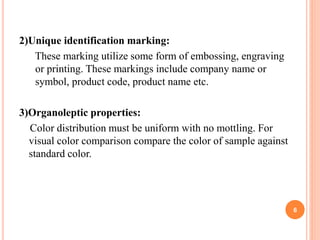
1)Size & Shape:
Tablet thickness can be measured by micrometer or by
other device. Tablet thickness should be controlled within
a ± 5% variation of standard value
5
2)Unique identification marking:
These marking utilize some form of embossing, engraving
or printing. These markings include company name or
symbol, product code, product name etc.
3)Organoleptic properties:
Color distribution must be uniform with no mottling. For
visual color comparison compare the color of sample against
standard color.
6
2)HARDNESS
 It is defined as the force required to break a tablet in a diametric
compression test.
 Hardness is an unofficial test.
 Hardness is measured by
1)Monsanto tester.
2)Pfizer.
3) Strong-Cobb tester
4)erweka
5)scheuniger
Conventional tablets hardness : 2.5- 5 kg/cm2
Dispersible/ chewable tablets hardness: 2.25- 2.5 kg/cm2
Extended release tablets hardness : 5- 7.5 kg/cm2 7
Pfizer (Capacity 0 to 20 kg
Monsanto (Capacity 0 to 20 kg)
ERWEKA (capacity 0 to 500 N) 8
3) FRIABILITY TEST:
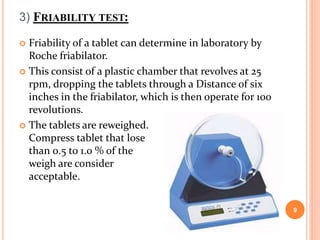
 Friability of a tablet can determine in laboratory by
Roche friabilator.
 This consist of a plastic chamber that revolves at 25
rpm, dropping the tablets through a Distance of six
inches in the friabilator, which is then operate for 100
revolutions.
 The tablets are reweighed.
Compress tablet that lose less
than 0.5 to 1.0 % of the Tablet
weigh are consider
acceptable.
9
4)WEIGHT VERIATION
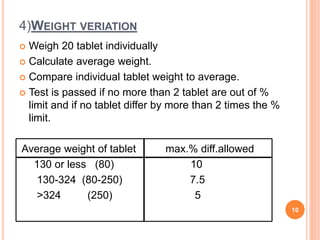
 Weigh 20 tablet individually
 Calculate average weight.
 Compare individual tablet weight to average.
 Test is passed if no more than 2 tablet are out of %
limit and if no tablet differ by more than 2 times the %
limit.
Average weight of tablet max.% diff.allowed
130 or less (80) 10
130-324 (80-250) 7.5
>324 (250) 5
10
5)DISINTEGRATION TEST
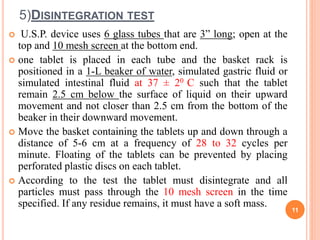
 U.S.P. device uses 6 glass tubes that are 3” long; open at the
top and 10 mesh screen at the bottom end.
 one tablet is placed in each tube and the basket rack is
positioned in a 1-L beaker of water, simulated gastric fluid or
simulated intestinal fluid at 37 ± 20 C such that the tablet
remain 2.5 cm below the surface of liquid on their upward
movement and not closer than 2.5 cm from the bottom of the
beaker in their downward movement.
 Move the basket containing the tablets up and down through a
distance of 5-6 cm at a frequency of 28 to 32 cycles per
minute. Floating of the tablets can be prevented by placing
perforated plastic discs on each tablet.
 According to the test the tablet must disintegrate and all
particles must pass through the 10 mesh screen in the time
specified. If any residue remains, it must have a soft mass.
11
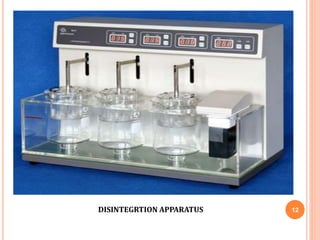
DISINTEGRTION APPARATUS 12
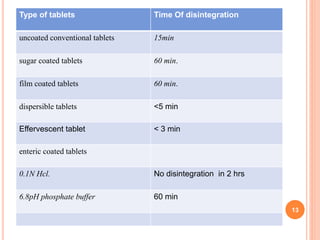
Type of tablets Time Of disintegration
uncoated conventional tablets 15min
sugar coated tablets 60 min.
film coated tablets 60 min.
dispersible tablets <5 min
Effervescent tablet < 3 min
enteric coated tablets
0.1N Hcl. No disintegration in 2 hrs
6.8pH phosphate buffer 60 min
13
6)DISSOLUTION TEST
Different types of dissolution apparatus:-
Apparatus -I-Rotating Basket type.
Apparatus -II- Rotating Paddle type.
Apparatus-3-Reciprocating cylindrical type.
Apparatus-4-Flow through cell.
Apparatus-5-Paddle over disk.
Apparatus-6-Cylindrical apparatus.
Apparatus-7-Reciprocating disc apparatus.
14
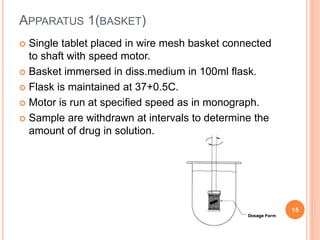
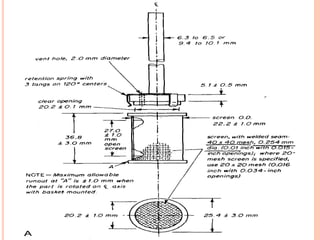
APPARATUS 1(BASKET)
 Single tablet placed in wire mesh basket connected
to shaft with speed motor.
 Basket immersed in diss.medium in 100ml flask.
 Flask is maintained at 37+0.5C.
 Motor is run at specified speed as in monograph.
 Sample are withdrawn at intervals to determine the
amount of drug in solution.
15
16
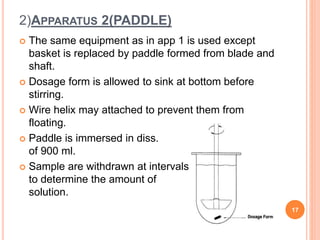
2)APPARATUS 2(PADDLE)
 The same equipment as in app 1 is used except
basket is replaced by paddle formed from blade and
shaft.
 Dosage form is allowed to sink at bottom before
stirring.
 Wire helix may attached to prevent them from
floating.
 Paddle is immersed in diss. medium
of 900 ml.
 Sample are withdrawn at intervals to determine also
to determine the amount of drug in
solution.
17
18
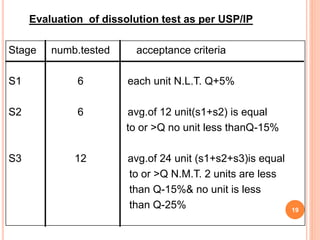
Evaluation of dissolution test as per USP/IP
Stage numb.tested acceptance criteria
S1 6 each unit N.L.T. Q+5%
S2 6 avg.of 12 unit(s1+s2) is equal
to or >Q no unit less thanQ-15%
S3 12 avg.of 24 unit (s1+s2+s3)is equal
to or >Q N.M.T. 2 units are less
than Q-15%& no unit is less
than Q-25% 19
20
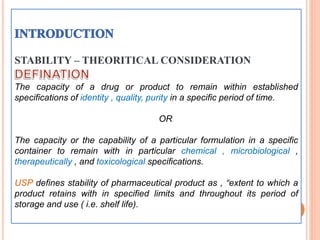
STABILITY – THEORITICAL CONSIDERATION
The capacity of a drug or product to remain within established
specifications of identity , quality, purity in a specific period of time.
OR
The capacity or the capability of a particular formulation in a specific
container to remain with in particular chemical , microbiological ,
therapeutically , and toxicological specifications.
USP defines stability of pharmaceutical product as , “extent to which a
product retains with in specified limits and throughout its period of
storage and use ( i.e. shelf life).
21
It is defined as the time required for the concentration of the reactant to
reduce to 90% of its initial concentration .Represented as t90 and the
units of time /conc.
t90 = (a-0.9a) = 0.1 a
ko ko
Where , a = initial concentration .
ko = specific rate constant for zero order reaction.
(the time from the date of manufacture and packaging of the
formulation until its chemical or therapeutic activity is maintained to a
predetermined level of labeled potency and ,
its physical characteristic have not changed appreciably or deleteriously
).
22
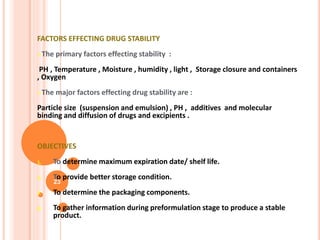
FACTORS EFFECTING DRUG STABILITY
The primary factors effecting stability :
PH , Temperature , Moisture , humidity , light , Storage closure and containers
, Oxygen
The major factors effecting drug stability are :
Particle size (suspension and emulsion) , PH , additives and molecular
binding and diffusion of drugs and excipients .
OBJECTIVES
1. To determine maximum expiration date/ shelf life.
2. To provide better storage condition.
3. To determine the packaging components.
4. To gather information during preformulation stage to produce a stable
product.
23
THEARAPEUTICAL
STABILITY
PHYSICAL
STABILITY
TOXICOLOGIC
STABILITY
MICROBIOLOGIC
AL
STABILITY
CHEMICAL
STABILITY
I
AM
STABLE
24
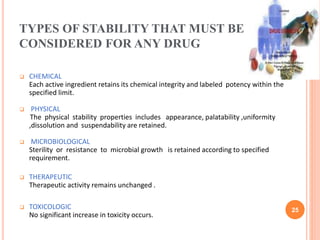
TYPES OF STABILITY THAT MUST BE
CONSIDERED FOR ANY DRUG
 CHEMICAL
Each active ingredient retains its chemical integrity and labeled potency within the
specified limit.
 PHYSICAL
The physical stability properties includes appearance, palatability ,uniformity
,dissolution and suspendability are retained.
 MICROBIOLOGICAL
Sterility or resistance to microbial growth is retained according to specified
requirement.
 THERAPEUTIC
Therapeutic activity remains unchanged .
 TOXICOLOGIC
No significant increase in toxicity occurs.
25
Stability study requirement and expiration dates are
covered in the current GMP , USP and FDA
 GMP (Good Manufacturing Practice) states that there
will be written testing program design to access the
stability characteristics of drug products . And result of
such stability testing will be used to determine
appropriate storage condition and expiration dates
26
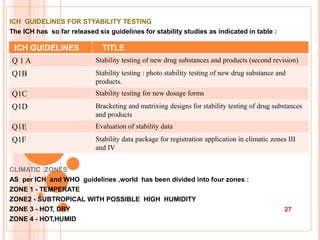
ICH GUIDELINES FOR STYABILITY TESTING
The ICH has so far released six guidelines for stability studies as indicated in table :
CLIMATIC ZONES
AS per ICH and WHO guidelines ,world has been divided into four zones :
ZONE 1 - TEMPERATE
ZONE2 - SUBTROPICAL WITH POSSIBLE HIGH HUMIDITY
ZONE 3 - HOT, DRY
ZONE 4 - HOT,HUMID
ICH GUIDELINES TITLE
Q 1 A Stability testing of new drug substances and products (second revision)
Q1B Stability testing : photo stability testing of new drug substance and
products.
Q1C Stability testing for new dosage forms
Q1D Bracketing and matrixing designs for stability testing of drug substances
and products
Q1E Evaluation of stability data
Q1F Stability data package for registration application in climatic zones III
and IV
27
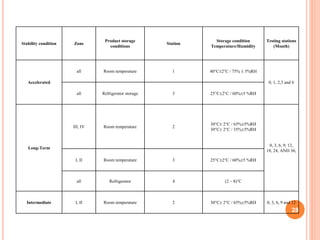
Stability condition Zone
Product storage
conditions
Station
Storage condition
Temperature/Humidity
Testing stations
(Month)
Accelerated
all Room temperature 1 40°C2°C / 75%  5%RH
0, 1, 2,3 and 6
all Refrigerator storage 3 25°C2°C / 60%5 %RH
Long-Term
III, IV Room temperature 2
30°C 2°C / 65%5%RH
30°C 2°C / 35%5%RH
0, 3, 6, 9, 12,
18, 24, AND 36,
I, II Room temperature 3 25°C2°C / 60%5 %RH
all Refrigerator 4 (2 – 8)°C
Intermediate I, II Room temperature 2 30°C 2°C / 65%5%RH 0, 3, 6, 9 and 12
28
Station 1: (40
°C  2 & 75 %
RH  5).
Station 2: (30 °C
 2 & 65 % RH 
5).
Station 5: (30 °C
 2 & 35 % RH 
5).
Station 4: (2 - 8) °C.
Station 3: (25 °C
 2 & 60 % RH 
5).
Storage Conditions
29
RELATIVE HUMIDITY
 Relative humidity is the ratio of the partial
pressure of water vapor in an air water
mixture to the saturated vapor pressure of
water at prescribed temperature.
 Relative humidity depends on temperature
and pressure.
30
TESTING FREQUENCY
For long term studies, frequency of testing
should be sufficient to establish the stability
profile of the active dosage form.
For active dosage form with a proposed re-test
period of at least 12 months, the frequency of
testing at the long term storage condition
should normally be every 3 months over the
first year, every 6 months over the second
year, and annually there after through the
proposed re-test period. 31
TESTING FREQUENCY
At the accelerated storage condition, a minimum of
3 time points, including the initial and final time
points (e.g. 0, 3, and 6 months), from a 6-month
study is recommended.
Where an expectation (based on development
experience) exists that results from accelerated
studies are likely to approach significant change
criteria, increased testing should be conducted
either by adding samples at the final time point or
by including a fourth time point in the study
design. 32
TABLET
 Stable tablets retain their original size ,shape , weight ,roughness ,colour variation ,
cracking under normal handling and storage conditions throughout their shelf life.
• FRIABILITY TEST : studies revel the physical instability if any in tablet.
Maximum weight loss should not be more than 1%.
• HARDNESS TEST : shows resistance to crushing.
• COLOR STABILITY : by colorimeter , reflectometer with heat , sunlight and intense
artificial light.
 Uniformity of weight , odor , texture , drug and moisture content , humidity effects are
also Studied during a tablet test.
33
Tests Method
SOP#
Specification
(Low/High)
Time (Months)
appearance 0 3 6 9 etc.
Color
Degradation
Assay
Dissolution
Clarity
Product Name/Strength Study Number Purpose of Study
Batch Number Batch Size Date Study Started
Date Manufactured Manufacturer/Site Container/Size/Supplier
Date Packaged Packager/Site Closure Supplier
Storage Condition Storage Orientation Seal Supplier
Drug Substance Manufacturer/Site/Batch Number
Approved/Proposed Expiration Dating Period
34
WHEN RE-TEST IS DONE??
In general, “significant change” for a pharmaceutical
product is defined as:
1. A 5% change in assay from its initial value; or failure to
meet the acceptance criteria for potency when using
biological or immunological procedures;
2. Any degradation product exceeding its acceptance
criterion;
3. Failure to meet the acceptance criteria for appearance,
physical attributes, and functionality test (e.g., colour,
phase separation, resuspendibility, caking, hardness,
dose delivery per actuation); however, some changes in
physical attributes (e.g.,
softening of suppositories, melting of creams, partial loss
of adhesion for transdermal products
35
WHEN RE-TEST IS DONE?
4. Failure to meet the acceptance criterion for
pH; or
5. Failure to meet the acceptance criteria for
dissolution for 12 dosage units.
36
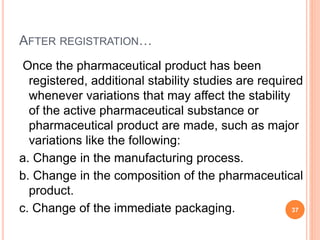
AFTER REGISTRATION…
Once the pharmaceutical product has been
registered, additional stability studies are required
whenever variations that may affect the stability
of the active pharmaceutical substance or
pharmaceutical product are made, such as major
variations like the following:
a. Change in the manufacturing process.
b. Change in the composition of the pharmaceutical
product.
c. Change of the immediate packaging. 37
9
38

Tablet evaluation and stability studies for tablet

  • 1.
    EVALUATION AND STABILITY STUDIESOF TABLET RAJENDRA D.MAHAJAN M-Pharm 2nd Sem. U.D.P.S. Nagpur 1
  • 2.
  • 3.
  • 4.
    LIST OF TESTPERFORMED :-  GENERAL APPERANCE 1)Size & Shape 2)Unique identification marking 3)Organoleptic properties  HARDNESS  FRIABILITY TEST  WEIGHT VARIATION  DISINTEGRATION TEST  DISSOLUTION TEST 4
  • 5.
    1.GENERALAPPEARANCE: The general appearanceof a tablet, its identity and general elegance is essential for consumer acceptance. The control of general appearance involves the measurement of size, shape, colour, presence or absence of odour, taste etc 1)Size & Shape: Tablet thickness can be measured by micrometer or by other device. Tablet thickness should be controlled within a ± 5% variation of standard value 5
  • 6.
    2)Unique identification marking: Thesemarking utilize some form of embossing, engraving or printing. These markings include company name or symbol, product code, product name etc. 3)Organoleptic properties: Color distribution must be uniform with no mottling. For visual color comparison compare the color of sample against standard color. 6
  • 7.
    2)HARDNESS  It isdefined as the force required to break a tablet in a diametric compression test.  Hardness is an unofficial test.  Hardness is measured by 1)Monsanto tester. 2)Pfizer. 3) Strong-Cobb tester 4)erweka 5)scheuniger Conventional tablets hardness : 2.5- 5 kg/cm2 Dispersible/ chewable tablets hardness: 2.25- 2.5 kg/cm2 Extended release tablets hardness : 5- 7.5 kg/cm2 7
  • 8.
    Pfizer (Capacity 0to 20 kg Monsanto (Capacity 0 to 20 kg) ERWEKA (capacity 0 to 500 N) 8
  • 9.
    3) FRIABILITY TEST: Friability of a tablet can determine in laboratory by Roche friabilator.  This consist of a plastic chamber that revolves at 25 rpm, dropping the tablets through a Distance of six inches in the friabilator, which is then operate for 100 revolutions.  The tablets are reweighed. Compress tablet that lose less than 0.5 to 1.0 % of the Tablet weigh are consider acceptable. 9
  • 10.
    4)WEIGHT VERIATION  Weigh20 tablet individually  Calculate average weight.  Compare individual tablet weight to average.  Test is passed if no more than 2 tablet are out of % limit and if no tablet differ by more than 2 times the % limit. Average weight of tablet max.% diff.allowed 130 or less (80) 10 130-324 (80-250) 7.5 >324 (250) 5 10
  • 11.
    5)DISINTEGRATION TEST  U.S.P.device uses 6 glass tubes that are 3” long; open at the top and 10 mesh screen at the bottom end.  one tablet is placed in each tube and the basket rack is positioned in a 1-L beaker of water, simulated gastric fluid or simulated intestinal fluid at 37 ± 20 C such that the tablet remain 2.5 cm below the surface of liquid on their upward movement and not closer than 2.5 cm from the bottom of the beaker in their downward movement.  Move the basket containing the tablets up and down through a distance of 5-6 cm at a frequency of 28 to 32 cycles per minute. Floating of the tablets can be prevented by placing perforated plastic discs on each tablet.  According to the test the tablet must disintegrate and all particles must pass through the 10 mesh screen in the time specified. If any residue remains, it must have a soft mass. 11
  • 12.
  • 13.
    Type of tabletsTime Of disintegration uncoated conventional tablets 15min sugar coated tablets 60 min. film coated tablets 60 min. dispersible tablets <5 min Effervescent tablet < 3 min enteric coated tablets 0.1N Hcl. No disintegration in 2 hrs 6.8pH phosphate buffer 60 min 13
  • 14.
    6)DISSOLUTION TEST Different typesof dissolution apparatus:- Apparatus -I-Rotating Basket type. Apparatus -II- Rotating Paddle type. Apparatus-3-Reciprocating cylindrical type. Apparatus-4-Flow through cell. Apparatus-5-Paddle over disk. Apparatus-6-Cylindrical apparatus. Apparatus-7-Reciprocating disc apparatus. 14
  • 15.
    APPARATUS 1(BASKET)  Singletablet placed in wire mesh basket connected to shaft with speed motor.  Basket immersed in diss.medium in 100ml flask.  Flask is maintained at 37+0.5C.  Motor is run at specified speed as in monograph.  Sample are withdrawn at intervals to determine the amount of drug in solution. 15
  • 16.
  • 17.
    2)APPARATUS 2(PADDLE)  Thesame equipment as in app 1 is used except basket is replaced by paddle formed from blade and shaft.  Dosage form is allowed to sink at bottom before stirring.  Wire helix may attached to prevent them from floating.  Paddle is immersed in diss. medium of 900 ml.  Sample are withdrawn at intervals to determine also to determine the amount of drug in solution. 17
  • 18.
  • 19.
    Evaluation of dissolutiontest as per USP/IP Stage numb.tested acceptance criteria S1 6 each unit N.L.T. Q+5% S2 6 avg.of 12 unit(s1+s2) is equal to or >Q no unit less thanQ-15% S3 12 avg.of 24 unit (s1+s2+s3)is equal to or >Q N.M.T. 2 units are less than Q-15%& no unit is less than Q-25% 19
  • 20.
  • 21.
    STABILITY – THEORITICALCONSIDERATION The capacity of a drug or product to remain within established specifications of identity , quality, purity in a specific period of time. OR The capacity or the capability of a particular formulation in a specific container to remain with in particular chemical , microbiological , therapeutically , and toxicological specifications. USP defines stability of pharmaceutical product as , “extent to which a product retains with in specified limits and throughout its period of storage and use ( i.e. shelf life). 21
  • 22.
    It is definedas the time required for the concentration of the reactant to reduce to 90% of its initial concentration .Represented as t90 and the units of time /conc. t90 = (a-0.9a) = 0.1 a ko ko Where , a = initial concentration . ko = specific rate constant for zero order reaction. (the time from the date of manufacture and packaging of the formulation until its chemical or therapeutic activity is maintained to a predetermined level of labeled potency and , its physical characteristic have not changed appreciably or deleteriously ). 22
  • 23.
    FACTORS EFFECTING DRUGSTABILITY The primary factors effecting stability : PH , Temperature , Moisture , humidity , light , Storage closure and containers , Oxygen The major factors effecting drug stability are : Particle size (suspension and emulsion) , PH , additives and molecular binding and diffusion of drugs and excipients . OBJECTIVES 1. To determine maximum expiration date/ shelf life. 2. To provide better storage condition. 3. To determine the packaging components. 4. To gather information during preformulation stage to produce a stable product. 23
  • 24.
  • 25.
    TYPES OF STABILITYTHAT MUST BE CONSIDERED FOR ANY DRUG  CHEMICAL Each active ingredient retains its chemical integrity and labeled potency within the specified limit.  PHYSICAL The physical stability properties includes appearance, palatability ,uniformity ,dissolution and suspendability are retained.  MICROBIOLOGICAL Sterility or resistance to microbial growth is retained according to specified requirement.  THERAPEUTIC Therapeutic activity remains unchanged .  TOXICOLOGIC No significant increase in toxicity occurs. 25
  • 26.
    Stability study requirementand expiration dates are covered in the current GMP , USP and FDA  GMP (Good Manufacturing Practice) states that there will be written testing program design to access the stability characteristics of drug products . And result of such stability testing will be used to determine appropriate storage condition and expiration dates 26
  • 27.
    ICH GUIDELINES FORSTYABILITY TESTING The ICH has so far released six guidelines for stability studies as indicated in table : CLIMATIC ZONES AS per ICH and WHO guidelines ,world has been divided into four zones : ZONE 1 - TEMPERATE ZONE2 - SUBTROPICAL WITH POSSIBLE HIGH HUMIDITY ZONE 3 - HOT, DRY ZONE 4 - HOT,HUMID ICH GUIDELINES TITLE Q 1 A Stability testing of new drug substances and products (second revision) Q1B Stability testing : photo stability testing of new drug substance and products. Q1C Stability testing for new dosage forms Q1D Bracketing and matrixing designs for stability testing of drug substances and products Q1E Evaluation of stability data Q1F Stability data package for registration application in climatic zones III and IV 27
  • 28.
    Stability condition Zone Productstorage conditions Station Storage condition Temperature/Humidity Testing stations (Month) Accelerated all Room temperature 1 40°C2°C / 75%  5%RH 0, 1, 2,3 and 6 all Refrigerator storage 3 25°C2°C / 60%5 %RH Long-Term III, IV Room temperature 2 30°C 2°C / 65%5%RH 30°C 2°C / 35%5%RH 0, 3, 6, 9, 12, 18, 24, AND 36, I, II Room temperature 3 25°C2°C / 60%5 %RH all Refrigerator 4 (2 – 8)°C Intermediate I, II Room temperature 2 30°C 2°C / 65%5%RH 0, 3, 6, 9 and 12 28
  • 29.
    Station 1: (40 °C 2 & 75 % RH  5). Station 2: (30 °C  2 & 65 % RH  5). Station 5: (30 °C  2 & 35 % RH  5). Station 4: (2 - 8) °C. Station 3: (25 °C  2 & 60 % RH  5). Storage Conditions 29
  • 30.
    RELATIVE HUMIDITY  Relativehumidity is the ratio of the partial pressure of water vapor in an air water mixture to the saturated vapor pressure of water at prescribed temperature.  Relative humidity depends on temperature and pressure. 30
  • 31.
    TESTING FREQUENCY For longterm studies, frequency of testing should be sufficient to establish the stability profile of the active dosage form. For active dosage form with a proposed re-test period of at least 12 months, the frequency of testing at the long term storage condition should normally be every 3 months over the first year, every 6 months over the second year, and annually there after through the proposed re-test period. 31
  • 32.
    TESTING FREQUENCY At theaccelerated storage condition, a minimum of 3 time points, including the initial and final time points (e.g. 0, 3, and 6 months), from a 6-month study is recommended. Where an expectation (based on development experience) exists that results from accelerated studies are likely to approach significant change criteria, increased testing should be conducted either by adding samples at the final time point or by including a fourth time point in the study design. 32
  • 33.
    TABLET  Stable tabletsretain their original size ,shape , weight ,roughness ,colour variation , cracking under normal handling and storage conditions throughout their shelf life. • FRIABILITY TEST : studies revel the physical instability if any in tablet. Maximum weight loss should not be more than 1%. • HARDNESS TEST : shows resistance to crushing. • COLOR STABILITY : by colorimeter , reflectometer with heat , sunlight and intense artificial light.  Uniformity of weight , odor , texture , drug and moisture content , humidity effects are also Studied during a tablet test. 33
  • 34.
    Tests Method SOP# Specification (Low/High) Time (Months) appearance0 3 6 9 etc. Color Degradation Assay Dissolution Clarity Product Name/Strength Study Number Purpose of Study Batch Number Batch Size Date Study Started Date Manufactured Manufacturer/Site Container/Size/Supplier Date Packaged Packager/Site Closure Supplier Storage Condition Storage Orientation Seal Supplier Drug Substance Manufacturer/Site/Batch Number Approved/Proposed Expiration Dating Period 34
  • 35.
    WHEN RE-TEST ISDONE?? In general, “significant change” for a pharmaceutical product is defined as: 1. A 5% change in assay from its initial value; or failure to meet the acceptance criteria for potency when using biological or immunological procedures; 2. Any degradation product exceeding its acceptance criterion; 3. Failure to meet the acceptance criteria for appearance, physical attributes, and functionality test (e.g., colour, phase separation, resuspendibility, caking, hardness, dose delivery per actuation); however, some changes in physical attributes (e.g., softening of suppositories, melting of creams, partial loss of adhesion for transdermal products 35
  • 36.
    WHEN RE-TEST ISDONE? 4. Failure to meet the acceptance criterion for pH; or 5. Failure to meet the acceptance criteria for dissolution for 12 dosage units. 36
  • 37.
    AFTER REGISTRATION… Once thepharmaceutical product has been registered, additional stability studies are required whenever variations that may affect the stability of the active pharmaceutical substance or pharmaceutical product are made, such as major variations like the following: a. Change in the manufacturing process. b. Change in the composition of the pharmaceutical product. c. Change of the immediate packaging. 37
  • 38.