How To Get Information For Next
To Nothing

A White Paper By B2B International Market Research
By Paul Hague and Conor Wilcock
Why Reinvent The Wheel?
Desk research is the collection
of secondary data
• Often, it is quite difficult to
locate relevant information in
exactly the way that we need or
want it
• Information available in the
public domain can be
extremely useful as it has been
subject to scrutiny; the
researcher may be able
therefore to judge its accuracy

2
Sources Used In Desk Research
Sources of Sources & Industry Experts
•

General guides to sources of information are
useful to desk researchers, such as books,
websites, directories and CDs. These
include:
–

4

•

Encyclopaedias such as Encyclopaedia
Britannica (www.britannica.com) are useful
storehouses of information

European Directory of Marketing Information
Sources

–

•

Croner’s A-Z Business Information Sources
(www.croner.cch.co.uk)

–

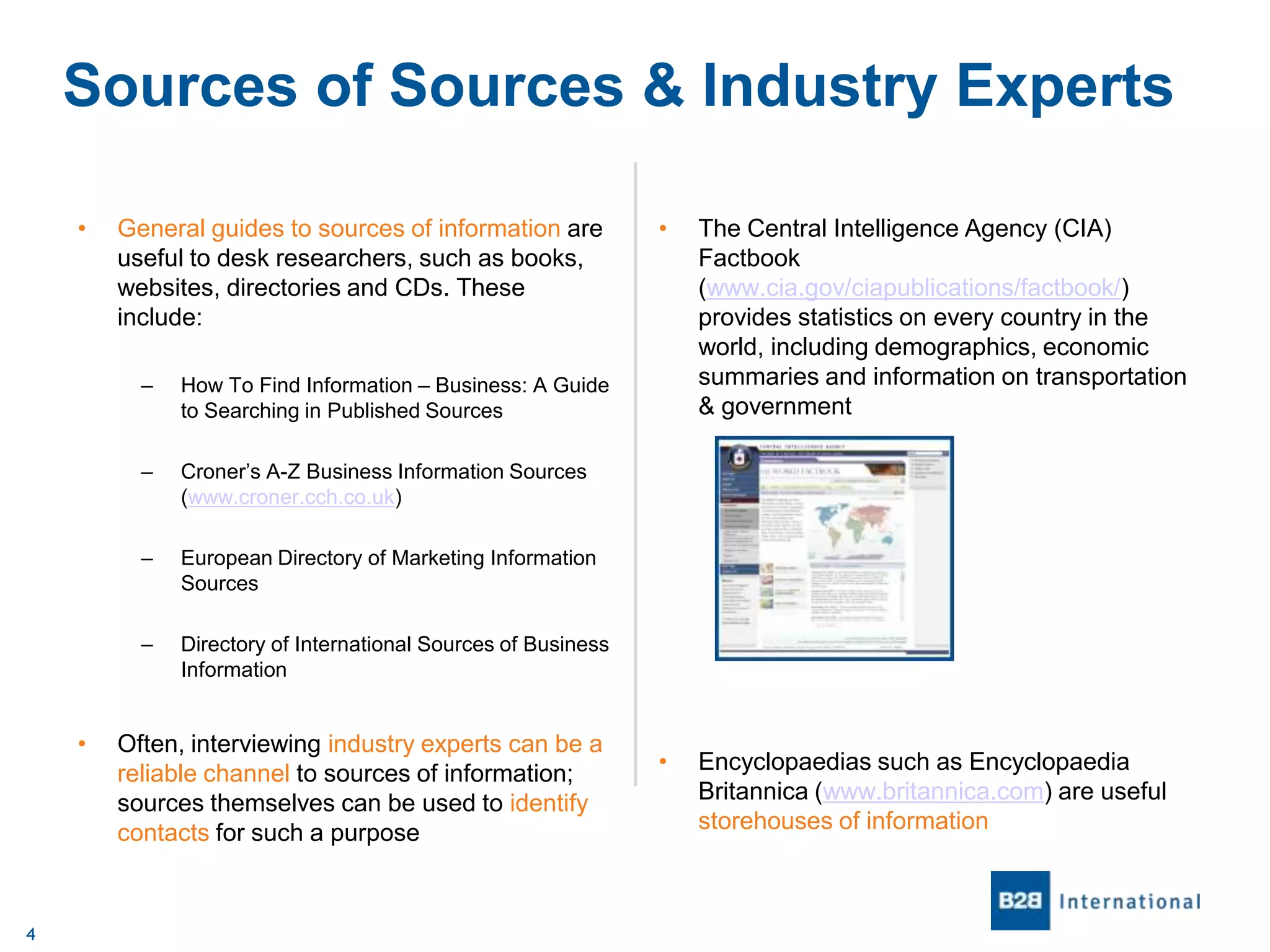
The Central Intelligence Agency (CIA)
Factbook
(www.cia.gov/ciapublications/factbook/)
provides statistics on every country in the
world, including demographics, economic
summaries and information on transportation
& government

How To Find Information – Business: A Guide
to Searching in Published Sources

–

•

Directory of International Sources of Business
Information

Often, interviewing industry experts can be a
reliable channel to sources of information;
sources themselves can be used to identify
contacts for such a purpose
The Internet
Market researchers can use the Internet for desk research by visiting
websites with publicly available information, or online communities and
social media
•

Due to the constant evolution of the Internet, the
problem for researchers is finding information,
rather than the amount of information available.
Despite the advances in search engine
intelligence, it is often difficult to sift through vast
amounts of information to find the most relevant
and reliable source

•

Common problems with online desk research
include:

– Search strings
– Semantics
•

5

Often, the answer to the specific question a
researcher may be asking will not obtainable.
There is usually data, however, that can lead in
a series of logical steps to the desired outcome

•

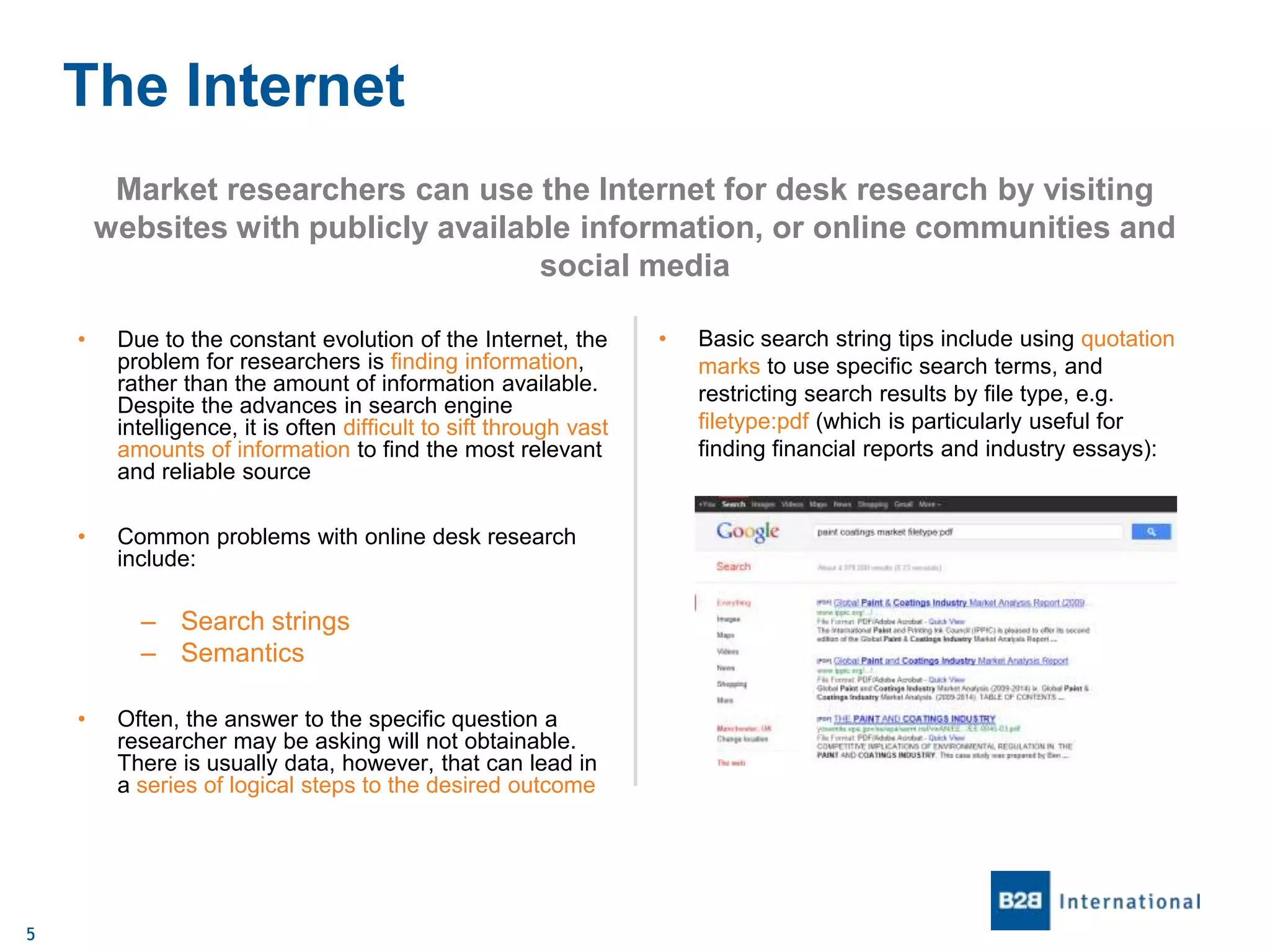
Basic search string tips include using quotation
marks to use specific search terms, and
restricting search results by file type, e.g.
filetype:pdf (which is particularly useful for
finding financial reports and industry essays):
Market & Company Data
Online databases and industry
reports

Company data

6

Obtaining company data is a central part
of desk research, especially in cases
where competitive intelligence or market
assessment information is required

Companies House (link), Hoovers, a
subsidiary of Dun & Bradstreet (link), and
the US Securities & Exchange
Commission (link) are good starting points
for basic company details

•

•

Detailed reports for almost every industry
you can think of are available, but most
come at a price (a report could cost
anything between £500 and £5,000)

•

•

•

Data that are typically available free of
charge include company address, date of
incorporation, company type, revenue and
number of employees

www.marketresearch.com is a gateway to
over 300,000 reports from 700 research
agencies
Government & Industry Sources
Government Statistics
•

•

7

Government data is as “official” as a
researcher is likely to encounter during
desk research, though information
should be looked upon with the same
scrutiny as from other sources
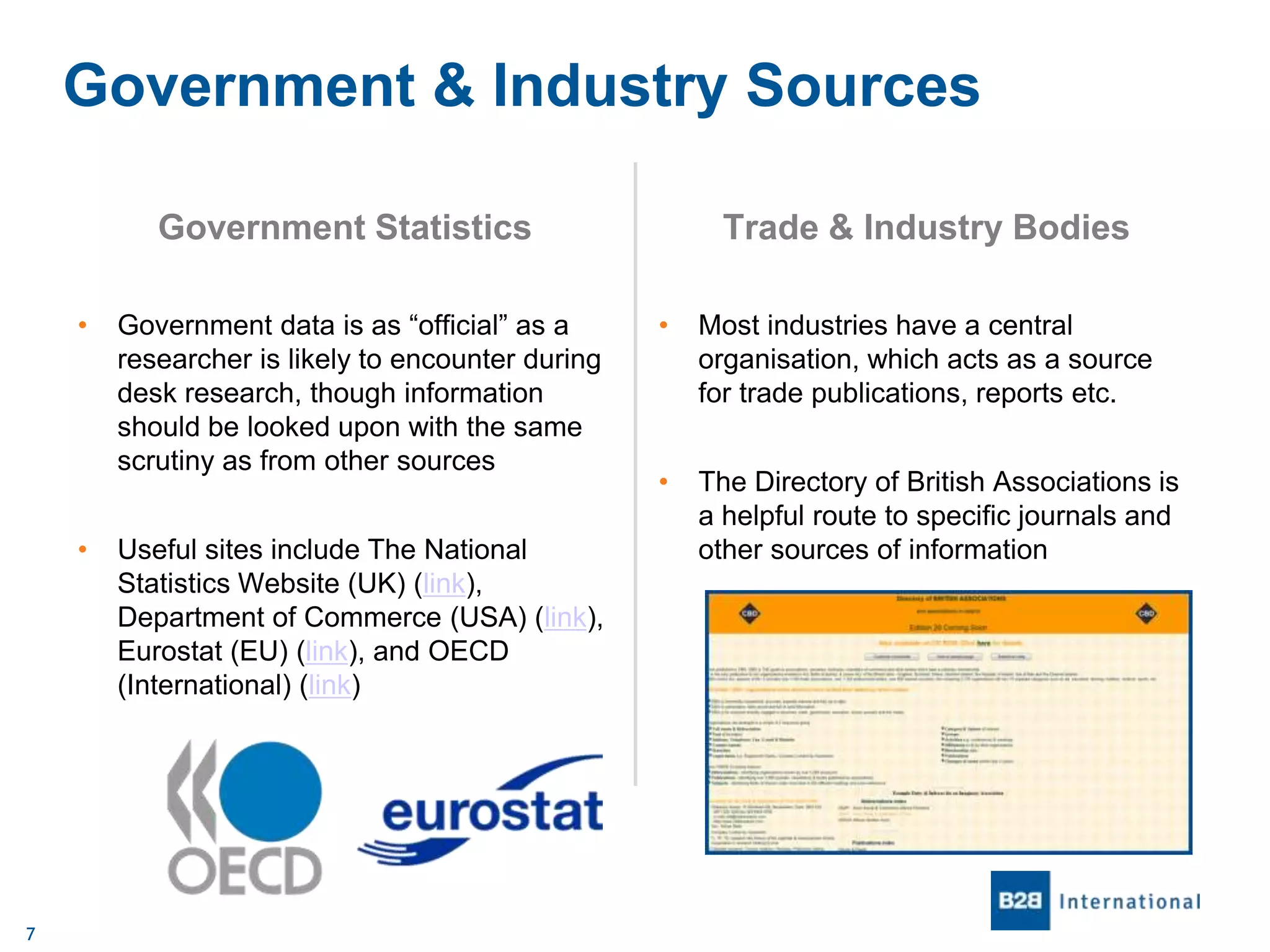
Useful sites include The National
Statistics Website (UK) (link),
Department of Commerce (USA) (link),
Eurostat (EU) (link), and OECD
(International) (link)

Trade & Industry Bodies
•

Most industries have a central
organisation, which acts as a source
for trade publications, reports etc.

•

The Directory of British Associations is
a helpful route to specific journals and
other sources of information
General Directories & The Press
The Press

General Directories

•

•

Directories are a fundamental tool for
market researchers. They are usually
the first port of call for sample building
and also provide company details

•

In addition to the general and business
press, most trades have official
journals

•

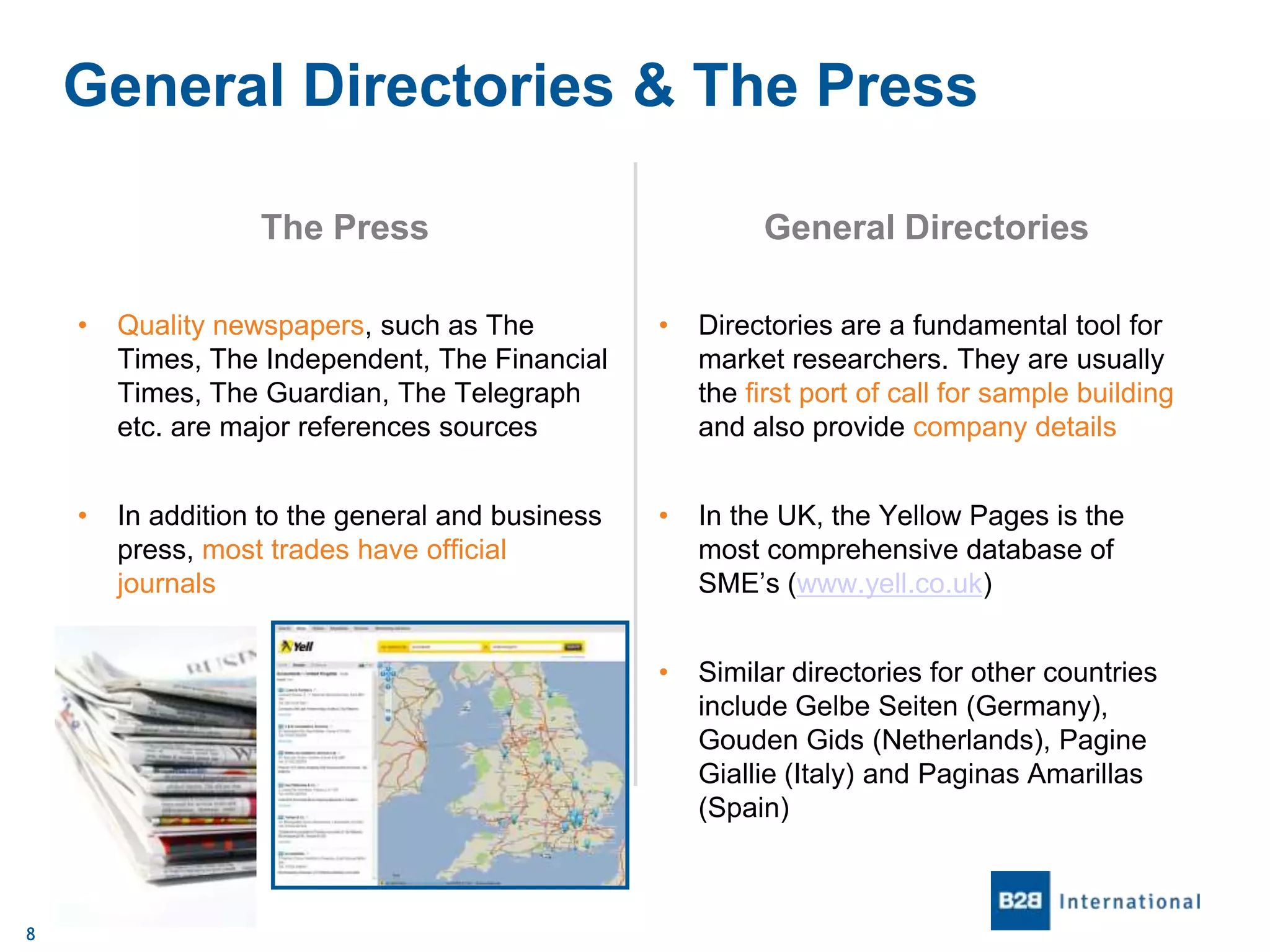
In the UK, the Yellow Pages is the
most comprehensive database of
SME’s (www.yell.co.uk)

•

8

Quality newspapers, such as The
Times, The Independent, The Financial
Times, The Guardian, The Telegraph
etc. are major references sources

Similar directories for other countries
include Gelbe Seiten (Germany),
Gouden Gids (Netherlands), Pagine
Giallie (Italy) and Paginas Amarillas
(Spain)
Applications Of Desk Research
What Can Desk Research Be Used For?
The Marketing Environment

Market Structure & Size

• Businesses constantly look to
better understand the markets in
which they operate and those into
which they are considering
expanding
• Exploratory research such as this
can not be done without desk
research (be it as due diligence or
otherwise) though primary
research is often used to
supplement the secondary work

10

• Market size estimates are hard to
come by, but extensive desk
research using a variety of
methods can lead to reasonable
approximations about the size of
almost any market
• Market sizing can be researched
using the top-down (by calculating
the size of a wider market which is
the target market) or bottom-up
(calculating the size of subsegments within the target market)
approaches
What Can Desk Research Be Used For?
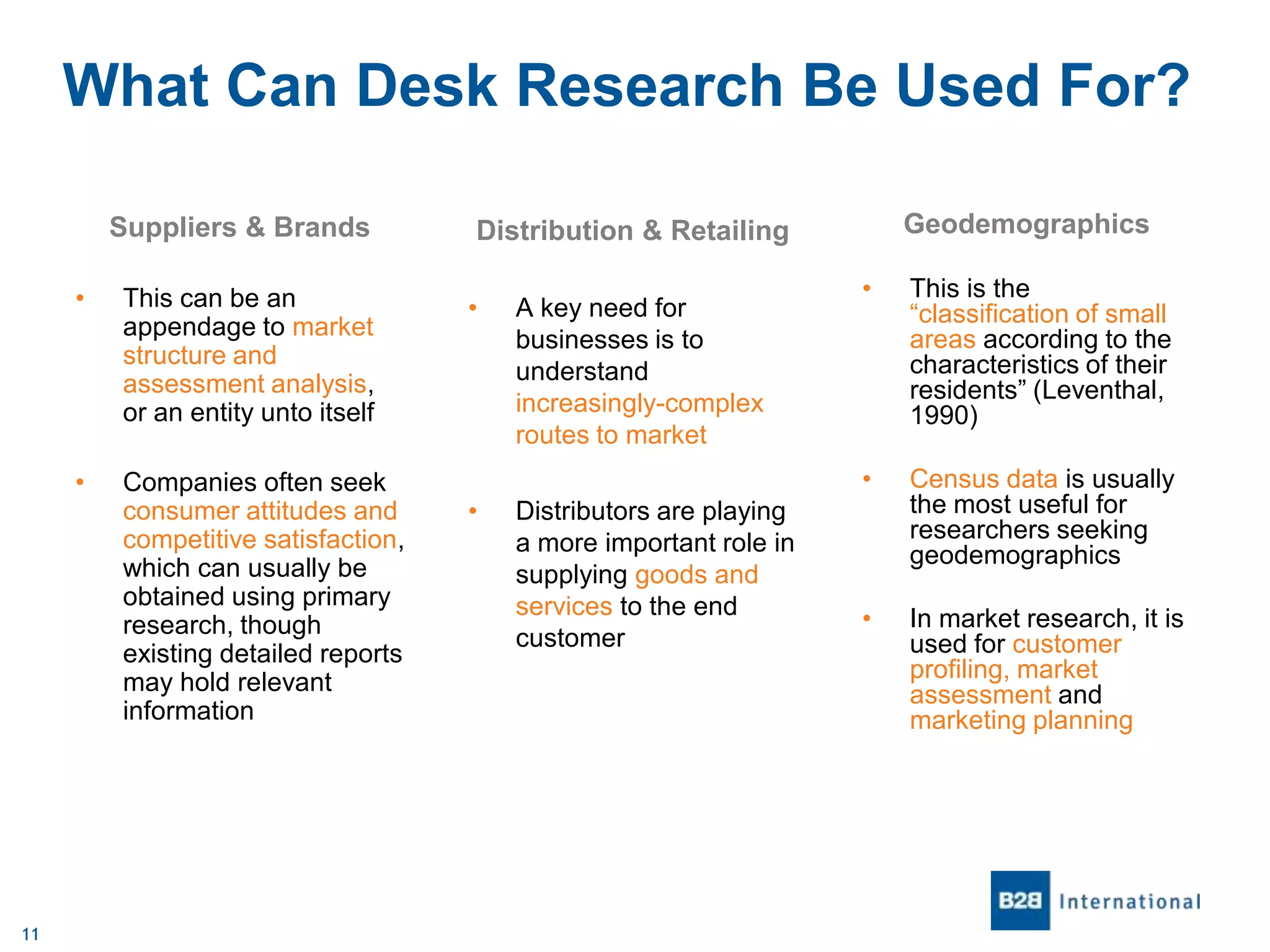
Suppliers & Brands
•

•

11

This can be an
appendage to market
structure and
assessment analysis,
or an entity unto itself
Companies often seek
consumer attitudes and
competitive satisfaction,
which can usually be
obtained using primary
research, though
existing detailed reports
may hold relevant
information

Geodemographics

Distribution & Retailing

•

A key need for
businesses is to
understand
increasingly-complex
routes to market
Distributors are playing
a more important role in
supplying goods and
services to the end
customer

•

This is the
“classification of small
areas according to the
characteristics of their
residents” (Leventhal,
1990)

•

•

Census data is usually
the most useful for
researchers seeking
geodemographics

•

In market research, it is
used for customer
profiling, market
assessment and
marketing planning
What Can Desk Research Be Used For?
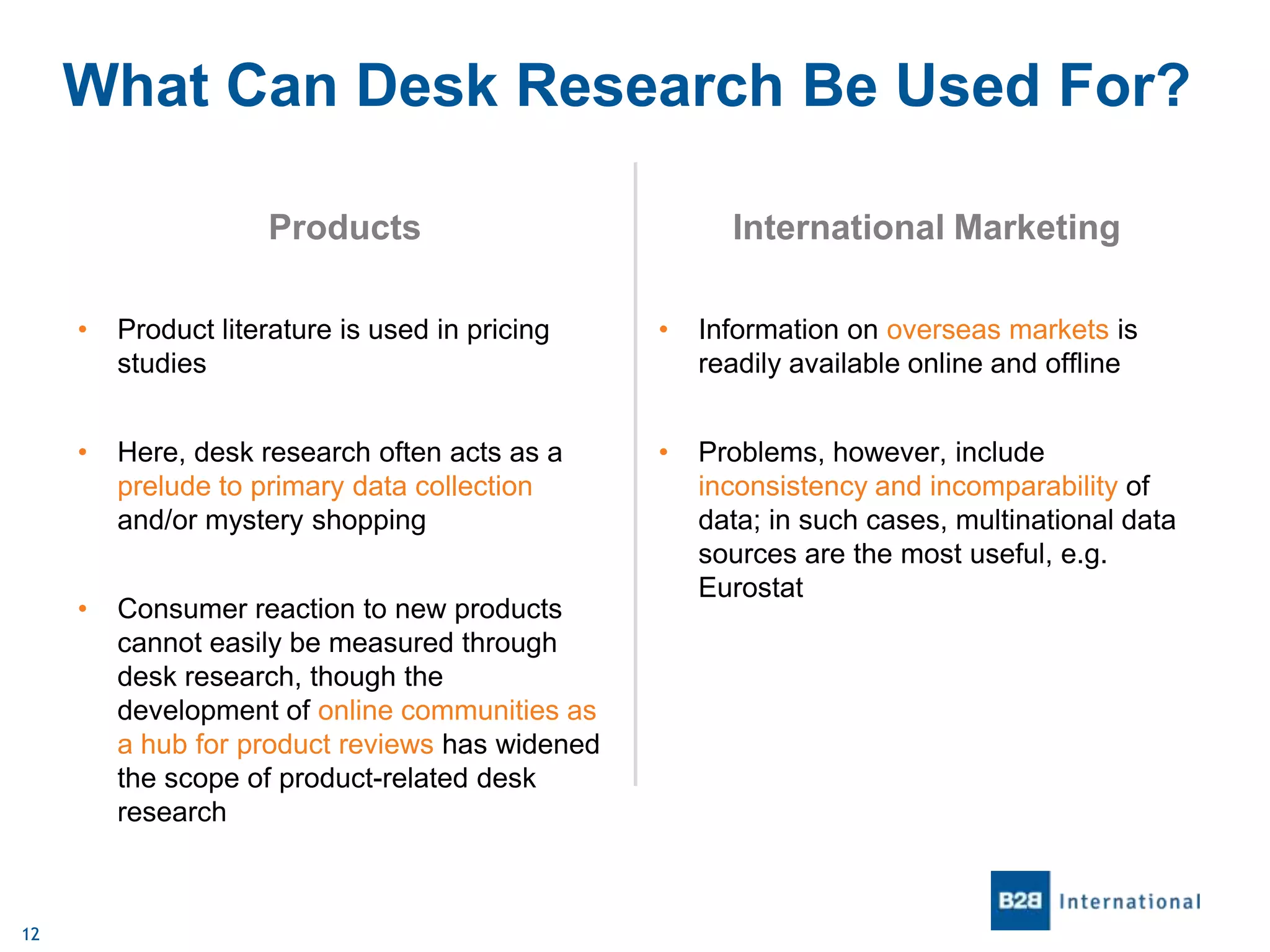
Products

International Marketing

•

•

Information on overseas markets is
readily available online and offline

•

Here, desk research often acts as a
prelude to primary data collection
and/or mystery shopping

•

•

12

Product literature is used in pricing
studies

Consumer reaction to new products
cannot easily be measured through
desk research, though the
development of online communities as
a hub for product reviews has widened
the scope of product-related desk
research

Problems, however, include
inconsistency and incomparability of
data; in such cases, multinational data
sources are the most useful, e.g.
Eurostat
Best Practices & Limitations
Best Practices For Desk Research
•

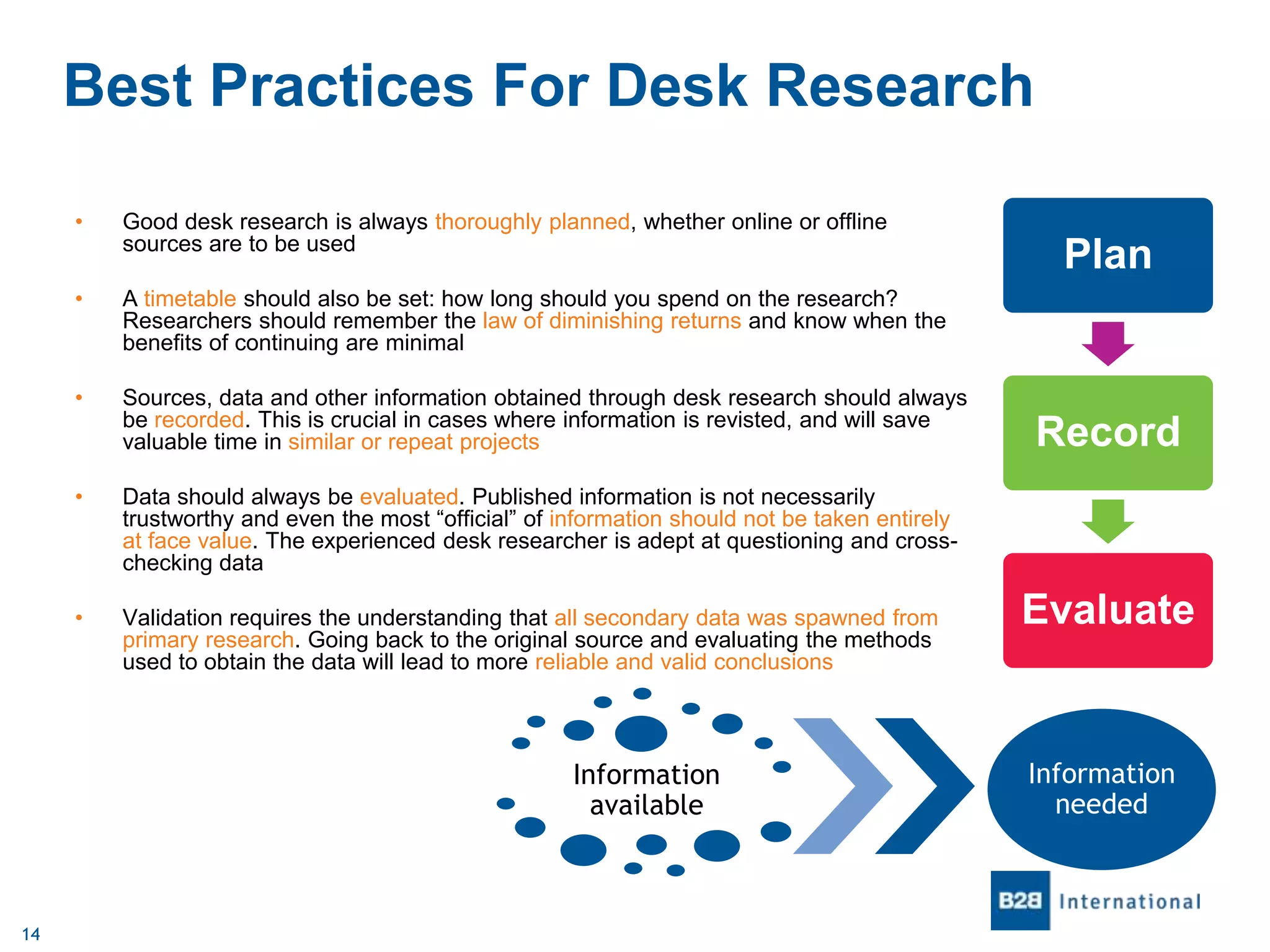
Good desk research is always thoroughly planned, whether online or offline
sources are to be used

•

A timetable should also be set: how long should you spend on the research?
Researchers should remember the law of diminishing returns and know when the
benefits of continuing are minimal

•

Sources, data and other information obtained through desk research should always
be recorded. This is crucial in cases where information is revisted, and will save
valuable time in similar or repeat projects

•

Validation requires the understanding that all secondary data was spawned from
primary research. Going back to the original source and evaluating the methods
used to obtain the data will lead to more reliable and valid conclusions

Record

Data should always be evaluated. Published information is not necessarily
trustworthy and even the most “official” of information should not be taken entirely
at face value. The experienced desk researcher is adept at questioning and crosschecking data

•

Information
available

14

Plan

Evaluate

Information
needed
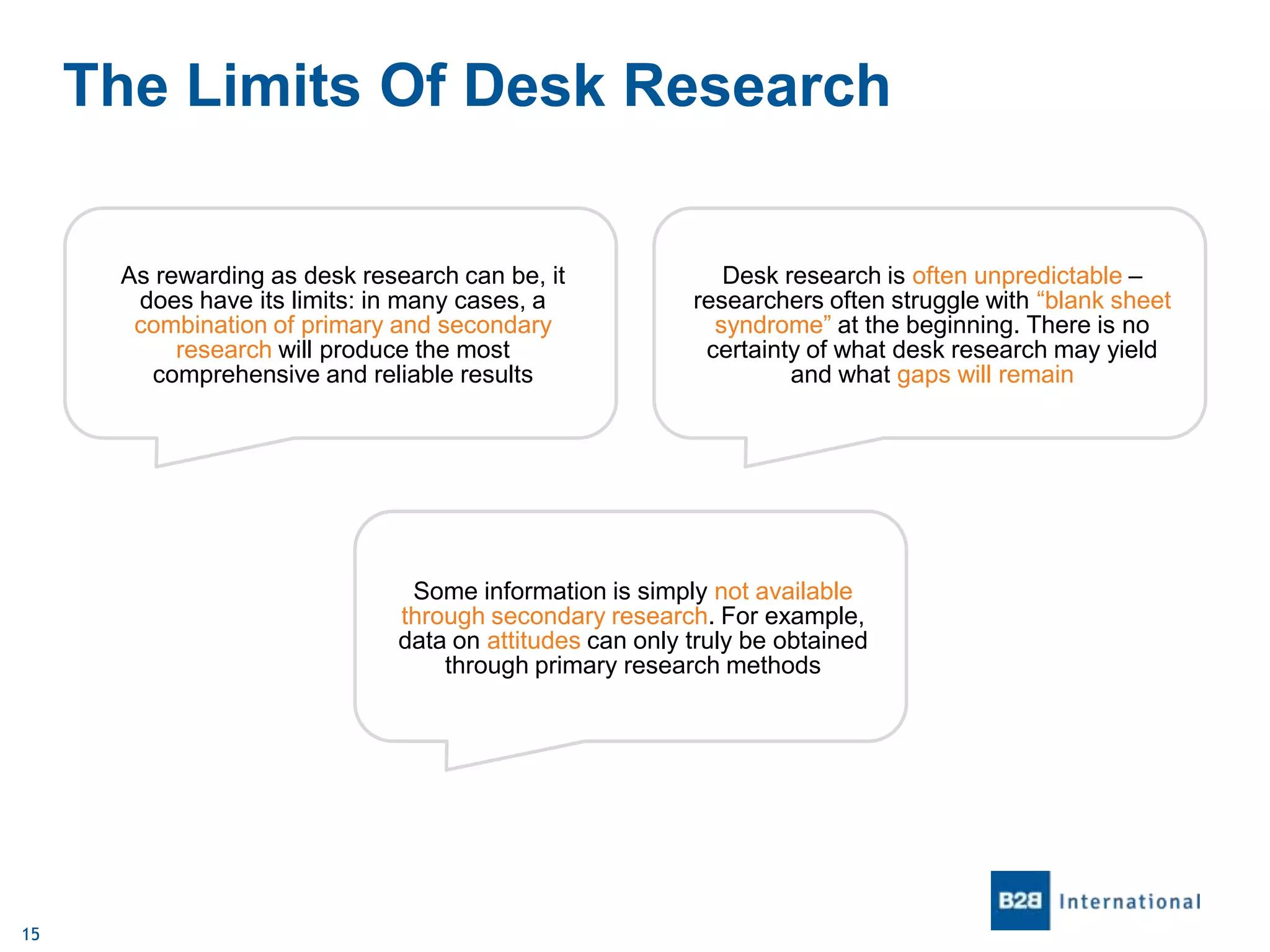
The Limits Of Desk Research
As rewarding as desk research can be, it
does have its limits: in many cases, a
combination of primary and secondary
research will produce the most
comprehensive and reliable results

Desk research is often unpredictable –
researchers often struggle with “blank sheet
syndrome” at the beginning. There is no
certainty of what desk research may yield
and what gaps will remain

Some information is simply not available
through secondary research. For example,
data on attitudes can only truly be obtained
through primary research methods

15
Thank You For Reading

Thank you for reading our White Paper on Scoping Market Research Projects.
To access further white papers and publications by B2B International, please visit:
http://www.b2binternational.com/publications/
Keep up-to-date with industry developments and news by following our blog:
http://www.b2binternational.com/b2b-blog/
Find out what’s going on at B2B International by following us on Twitter:
@B2B_Insight

16
MANCHESTER

LONDON

NEW YORK

B2B International
Bramhall House, 14 Ack Lane East,
Bramhall, Stockport, Manchester SK7 2BY
Tel:
Fax:
E-mail:
Website:

+44 (0)161 440 6000
+44 (0)161 440 6006
info@b2binternational.com
www.b2binternational.com

CHICAGO

BRUSSELS

BEIJING

SHANGHAI

An Introduction To Desk Research

  • 1.
    How To GetInformation For Next To Nothing A White Paper By B2B International Market Research By Paul Hague and Conor Wilcock
  • 2.
    Why Reinvent TheWheel? Desk research is the collection of secondary data • Often, it is quite difficult to locate relevant information in exactly the way that we need or want it • Information available in the public domain can be extremely useful as it has been subject to scrutiny; the researcher may be able therefore to judge its accuracy 2
  • 3.
    Sources Used InDesk Research
  • 4.
    Sources of Sources& Industry Experts • General guides to sources of information are useful to desk researchers, such as books, websites, directories and CDs. These include: – 4 • Encyclopaedias such as Encyclopaedia Britannica (www.britannica.com) are useful storehouses of information European Directory of Marketing Information Sources – • Croner’s A-Z Business Information Sources (www.croner.cch.co.uk) – The Central Intelligence Agency (CIA) Factbook (www.cia.gov/ciapublications/factbook/) provides statistics on every country in the world, including demographics, economic summaries and information on transportation & government How To Find Information – Business: A Guide to Searching in Published Sources – • Directory of International Sources of Business Information Often, interviewing industry experts can be a reliable channel to sources of information; sources themselves can be used to identify contacts for such a purpose
  • 5.
    The Internet Market researcherscan use the Internet for desk research by visiting websites with publicly available information, or online communities and social media • Due to the constant evolution of the Internet, the problem for researchers is finding information, rather than the amount of information available. Despite the advances in search engine intelligence, it is often difficult to sift through vast amounts of information to find the most relevant and reliable source • Common problems with online desk research include: – Search strings – Semantics • 5 Often, the answer to the specific question a researcher may be asking will not obtainable. There is usually data, however, that can lead in a series of logical steps to the desired outcome • Basic search string tips include using quotation marks to use specific search terms, and restricting search results by file type, e.g. filetype:pdf (which is particularly useful for finding financial reports and industry essays):
  • 6.
    Market & CompanyData Online databases and industry reports Company data 6 Obtaining company data is a central part of desk research, especially in cases where competitive intelligence or market assessment information is required Companies House (link), Hoovers, a subsidiary of Dun & Bradstreet (link), and the US Securities & Exchange Commission (link) are good starting points for basic company details • • Detailed reports for almost every industry you can think of are available, but most come at a price (a report could cost anything between £500 and £5,000) • • • Data that are typically available free of charge include company address, date of incorporation, company type, revenue and number of employees www.marketresearch.com is a gateway to over 300,000 reports from 700 research agencies
  • 7.
    Government & IndustrySources Government Statistics • • 7 Government data is as “official” as a researcher is likely to encounter during desk research, though information should be looked upon with the same scrutiny as from other sources Useful sites include The National Statistics Website (UK) (link), Department of Commerce (USA) (link), Eurostat (EU) (link), and OECD (International) (link) Trade & Industry Bodies • Most industries have a central organisation, which acts as a source for trade publications, reports etc. • The Directory of British Associations is a helpful route to specific journals and other sources of information
  • 8.
    General Directories &The Press The Press General Directories • • Directories are a fundamental tool for market researchers. They are usually the first port of call for sample building and also provide company details • In addition to the general and business press, most trades have official journals • In the UK, the Yellow Pages is the most comprehensive database of SME’s (www.yell.co.uk) • 8 Quality newspapers, such as The Times, The Independent, The Financial Times, The Guardian, The Telegraph etc. are major references sources Similar directories for other countries include Gelbe Seiten (Germany), Gouden Gids (Netherlands), Pagine Giallie (Italy) and Paginas Amarillas (Spain)
  • 9.
  • 10.
    What Can DeskResearch Be Used For? The Marketing Environment Market Structure & Size • Businesses constantly look to better understand the markets in which they operate and those into which they are considering expanding • Exploratory research such as this can not be done without desk research (be it as due diligence or otherwise) though primary research is often used to supplement the secondary work 10 • Market size estimates are hard to come by, but extensive desk research using a variety of methods can lead to reasonable approximations about the size of almost any market • Market sizing can be researched using the top-down (by calculating the size of a wider market which is the target market) or bottom-up (calculating the size of subsegments within the target market) approaches
  • 11.
    What Can DeskResearch Be Used For? Suppliers & Brands • • 11 This can be an appendage to market structure and assessment analysis, or an entity unto itself Companies often seek consumer attitudes and competitive satisfaction, which can usually be obtained using primary research, though existing detailed reports may hold relevant information Geodemographics Distribution & Retailing • A key need for businesses is to understand increasingly-complex routes to market Distributors are playing a more important role in supplying goods and services to the end customer • This is the “classification of small areas according to the characteristics of their residents” (Leventhal, 1990) • • Census data is usually the most useful for researchers seeking geodemographics • In market research, it is used for customer profiling, market assessment and marketing planning
  • 12.
    What Can DeskResearch Be Used For? Products International Marketing • • Information on overseas markets is readily available online and offline • Here, desk research often acts as a prelude to primary data collection and/or mystery shopping • • 12 Product literature is used in pricing studies Consumer reaction to new products cannot easily be measured through desk research, though the development of online communities as a hub for product reviews has widened the scope of product-related desk research Problems, however, include inconsistency and incomparability of data; in such cases, multinational data sources are the most useful, e.g. Eurostat
  • 13.
    Best Practices &Limitations
  • 14.
    Best Practices ForDesk Research • Good desk research is always thoroughly planned, whether online or offline sources are to be used • A timetable should also be set: how long should you spend on the research? Researchers should remember the law of diminishing returns and know when the benefits of continuing are minimal • Sources, data and other information obtained through desk research should always be recorded. This is crucial in cases where information is revisted, and will save valuable time in similar or repeat projects • Validation requires the understanding that all secondary data was spawned from primary research. Going back to the original source and evaluating the methods used to obtain the data will lead to more reliable and valid conclusions Record Data should always be evaluated. Published information is not necessarily trustworthy and even the most “official” of information should not be taken entirely at face value. The experienced desk researcher is adept at questioning and crosschecking data • Information available 14 Plan Evaluate Information needed
  • 15.
    The Limits OfDesk Research As rewarding as desk research can be, it does have its limits: in many cases, a combination of primary and secondary research will produce the most comprehensive and reliable results Desk research is often unpredictable – researchers often struggle with “blank sheet syndrome” at the beginning. There is no certainty of what desk research may yield and what gaps will remain Some information is simply not available through secondary research. For example, data on attitudes can only truly be obtained through primary research methods 15
  • 16.
    Thank You ForReading Thank you for reading our White Paper on Scoping Market Research Projects. To access further white papers and publications by B2B International, please visit: http://www.b2binternational.com/publications/ Keep up-to-date with industry developments and news by following our blog: http://www.b2binternational.com/b2b-blog/ Find out what’s going on at B2B International by following us on Twitter: @B2B_Insight 16
  • 17.
    MANCHESTER LONDON NEW YORK B2B International BramhallHouse, 14 Ack Lane East, Bramhall, Stockport, Manchester SK7 2BY Tel: Fax: E-mail: Website: +44 (0)161 440 6000 +44 (0)161 440 6006 info@b2binternational.com www.b2binternational.com CHICAGO BRUSSELS BEIJING SHANGHAI