SECONDARY DATA COLLECTIONPresented By:Amit Kadam		10
Amit Kamble		11
SameetaKhambe	12
PoojaKulkarni	13Defining Research Systematic : well organised and plannedObjectivity : unbiased and unemotionalThe information is used to identify and define opportunities and problems, and make recommendations on solutionsMarket Research links consumer, customer and the public to the marketers through information.Generate, refine and evaluate marketing actions, performance and the marketing process.
Defining Market ResearchResearch is the systematic and objective approach to investigate a specific problem that needs a solution.Research is a process by which a series of well thought out and carefully executed activities enable one to enquire, investigate or examine a problem to discover new facts to deal with the problem.
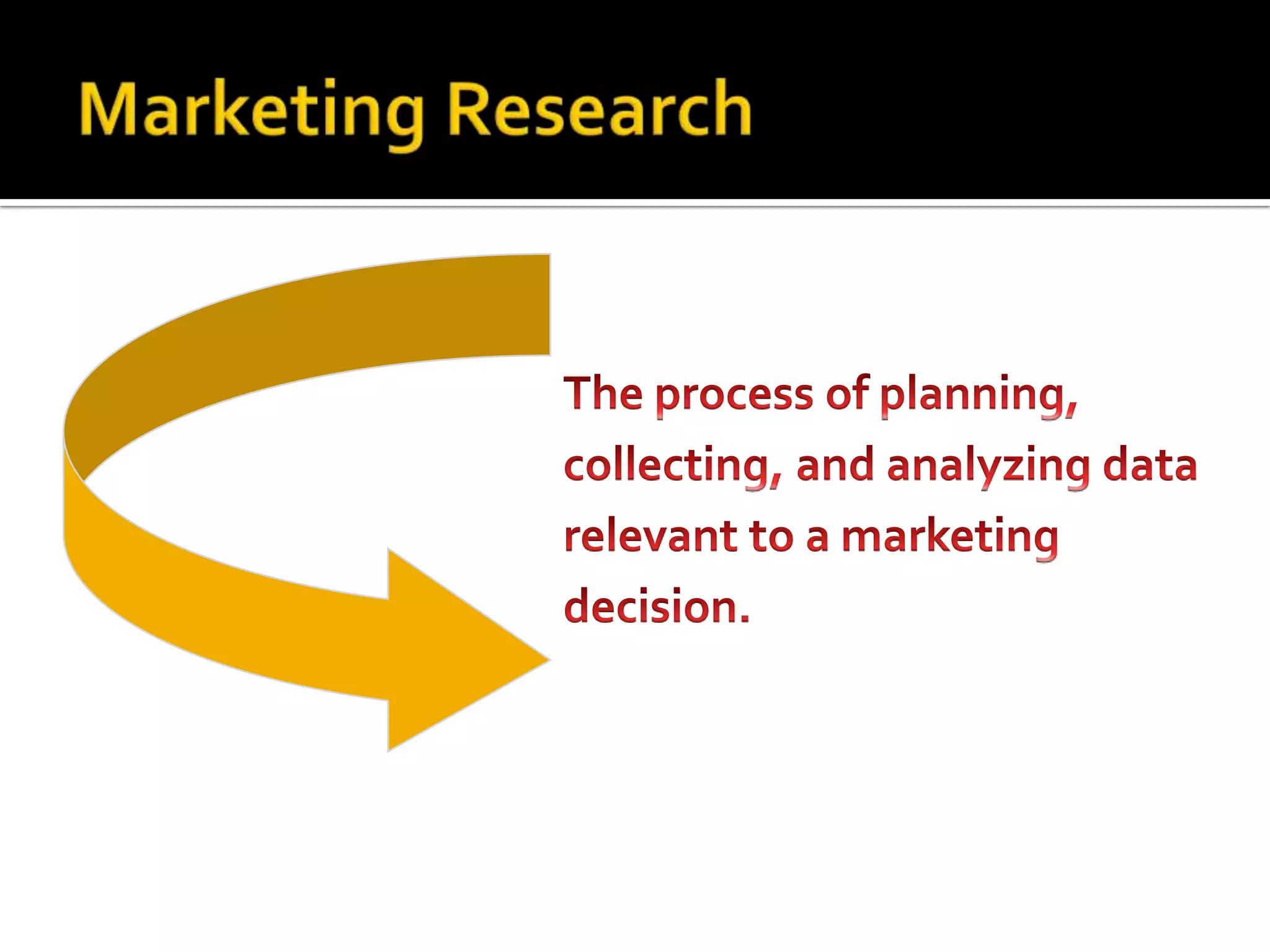
Marketing ResearchThe process of planning, collecting, and analyzing data relevant to a marketing decision.
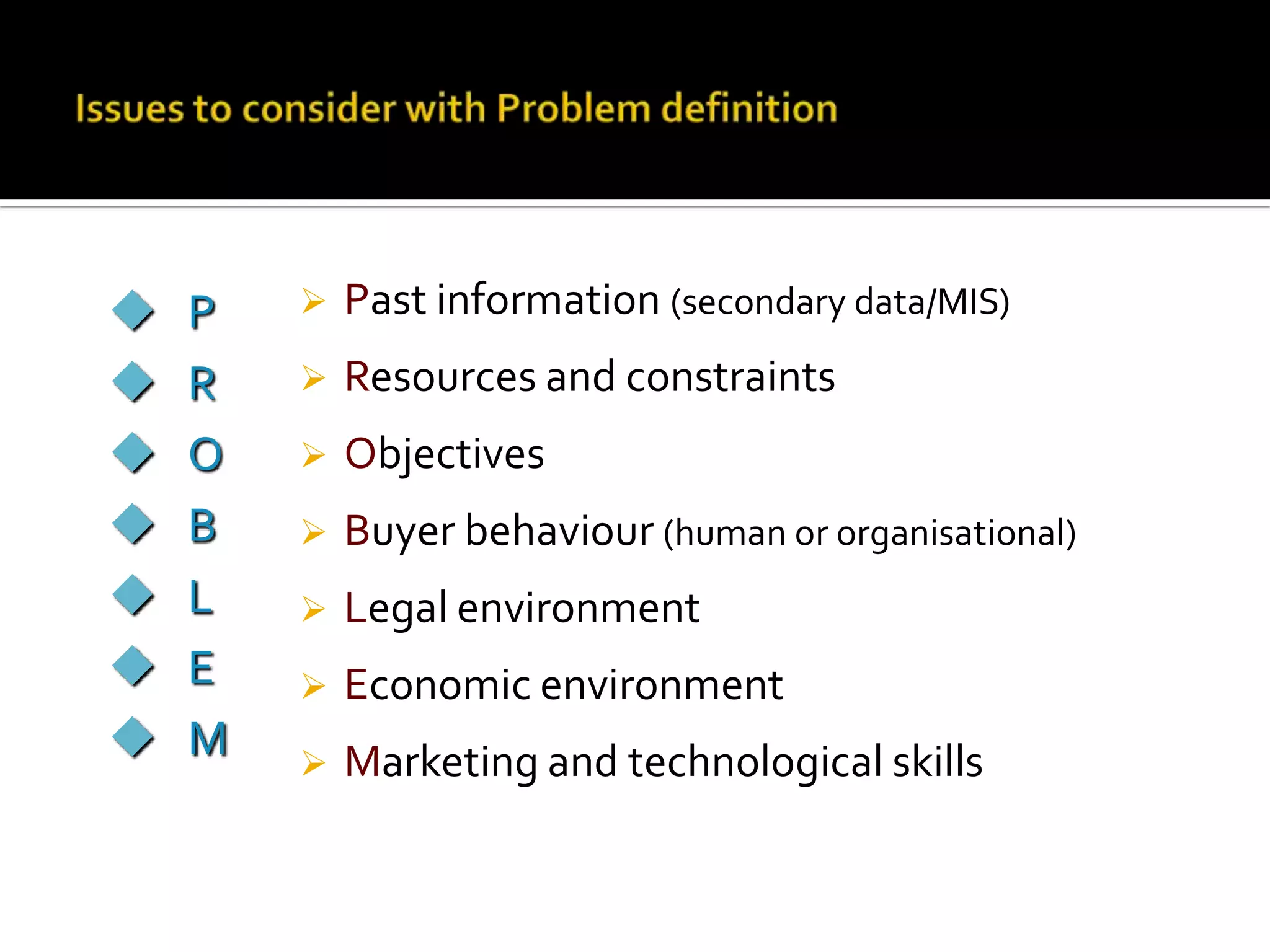
Issues to consider with Problem definitionPast information(secondary data/MIS)
Resources and constraints
Objectives
Buyerbehaviour(human or organisational)
Legal environment
Economic environment
Marketing and technological skills
P
R
O
B
L
E
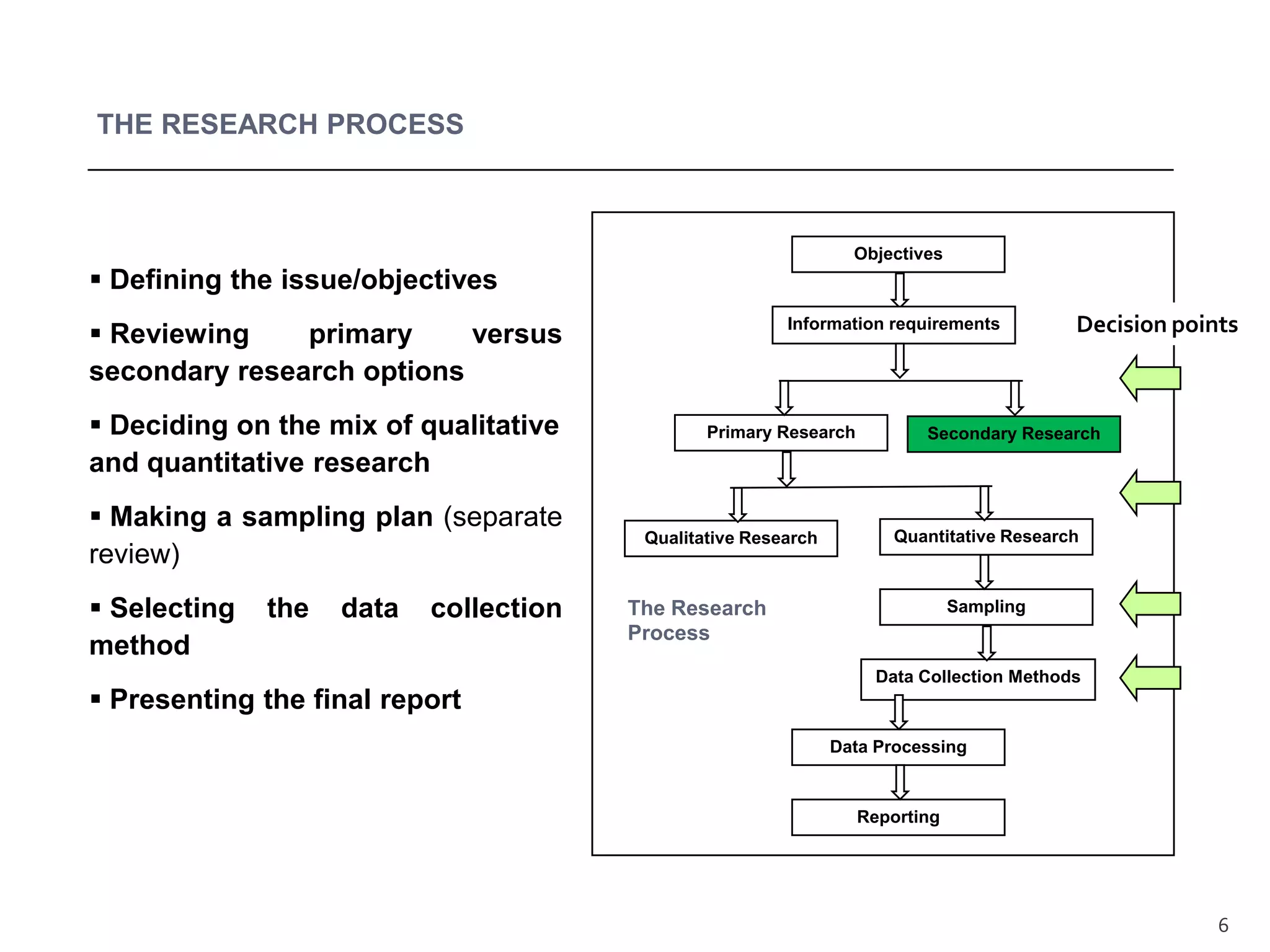
M6ObjectivesInformation requirementsPrimary ResearchSecondary ResearchQuantitative ResearchQualitative ResearchSamplingData Collection MethodsData ProcessingReportingTHE RESEARCH PROCESS Defining the issue/objectives
 Reviewing primary versus secondary research options
 Deciding on the mix of qualitative and quantitative research
 Making a sampling plan (separate review)
 Selecting the data collection method
 Presenting the final report Decision pointsThe Research Process
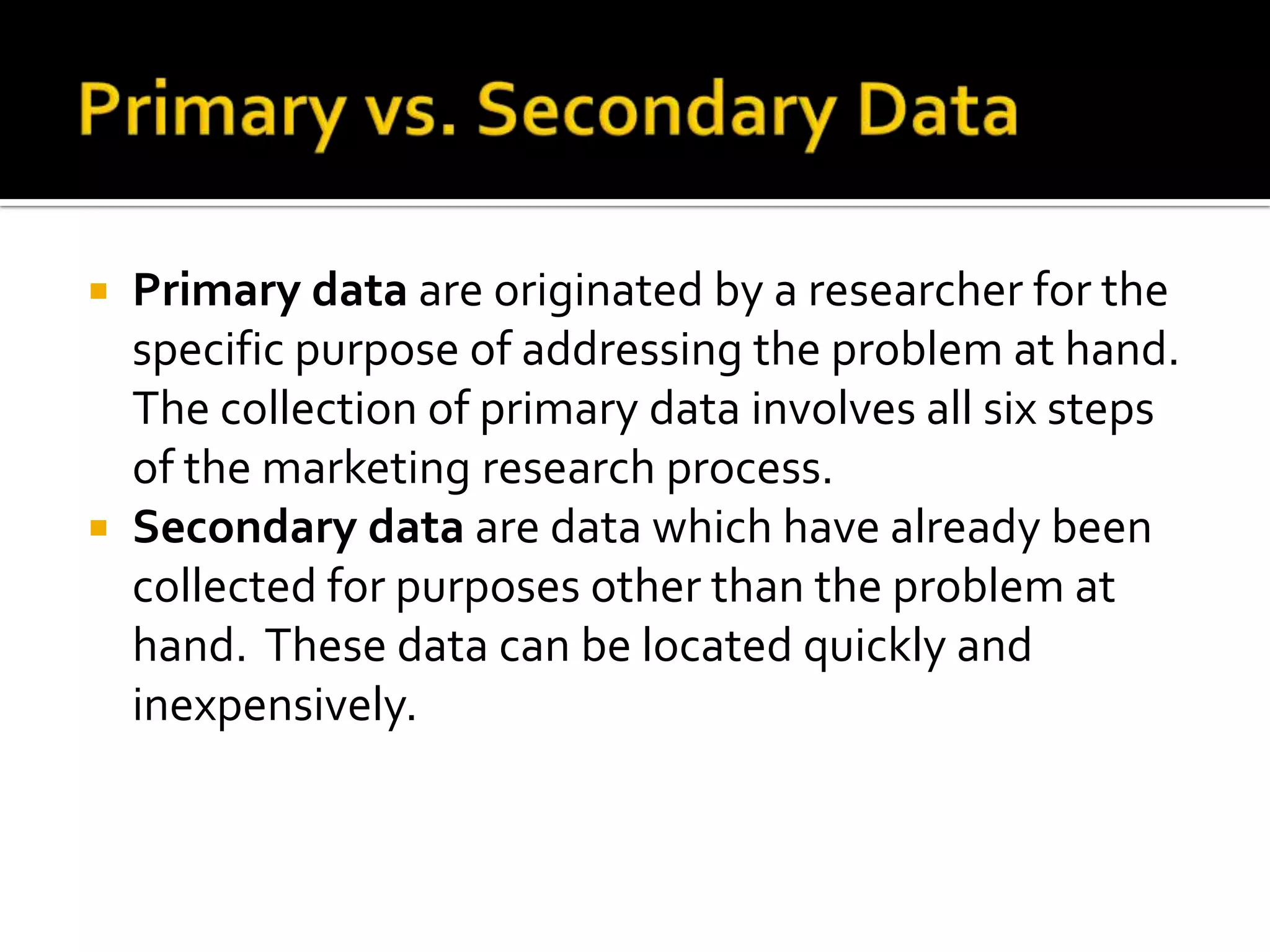
Primary vs. Secondary DataPrimary data are originated by a researcher for the specific purpose of addressing the problem at hand.  The collection of primary data involves all six steps of the marketing research process.  Secondary data are data which have already been collected for purposes other than the problem at hand.  These data can be located quickly and inexpensively.
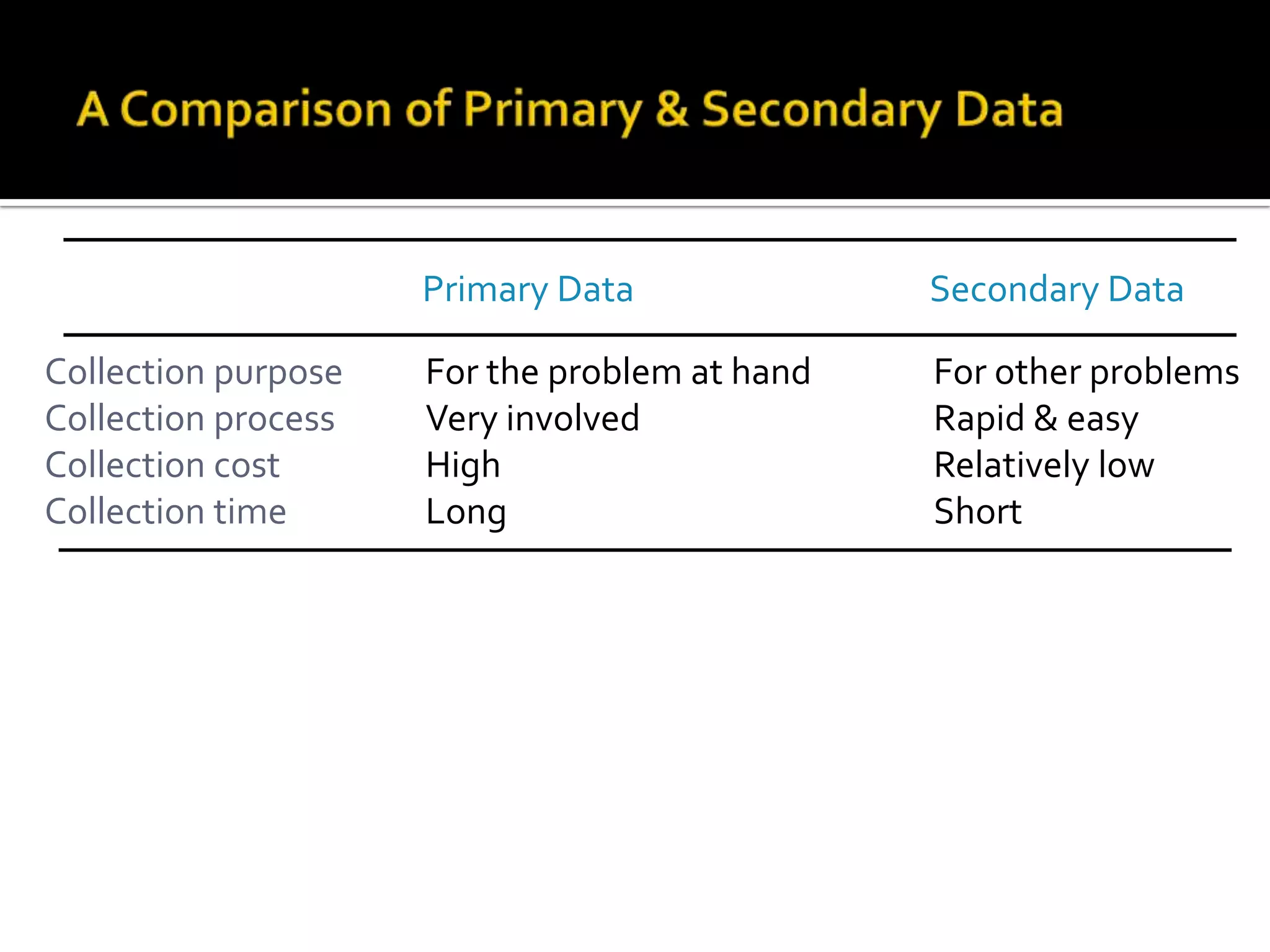
A Comparison of Primary & Secondary DataPrimary DataSecondary DataCollection purpose	For the problem at hand	For other problemsCollection process	Very involved			Rapid & easyCollection cost		High				Relatively lowCollection time		Long				Short
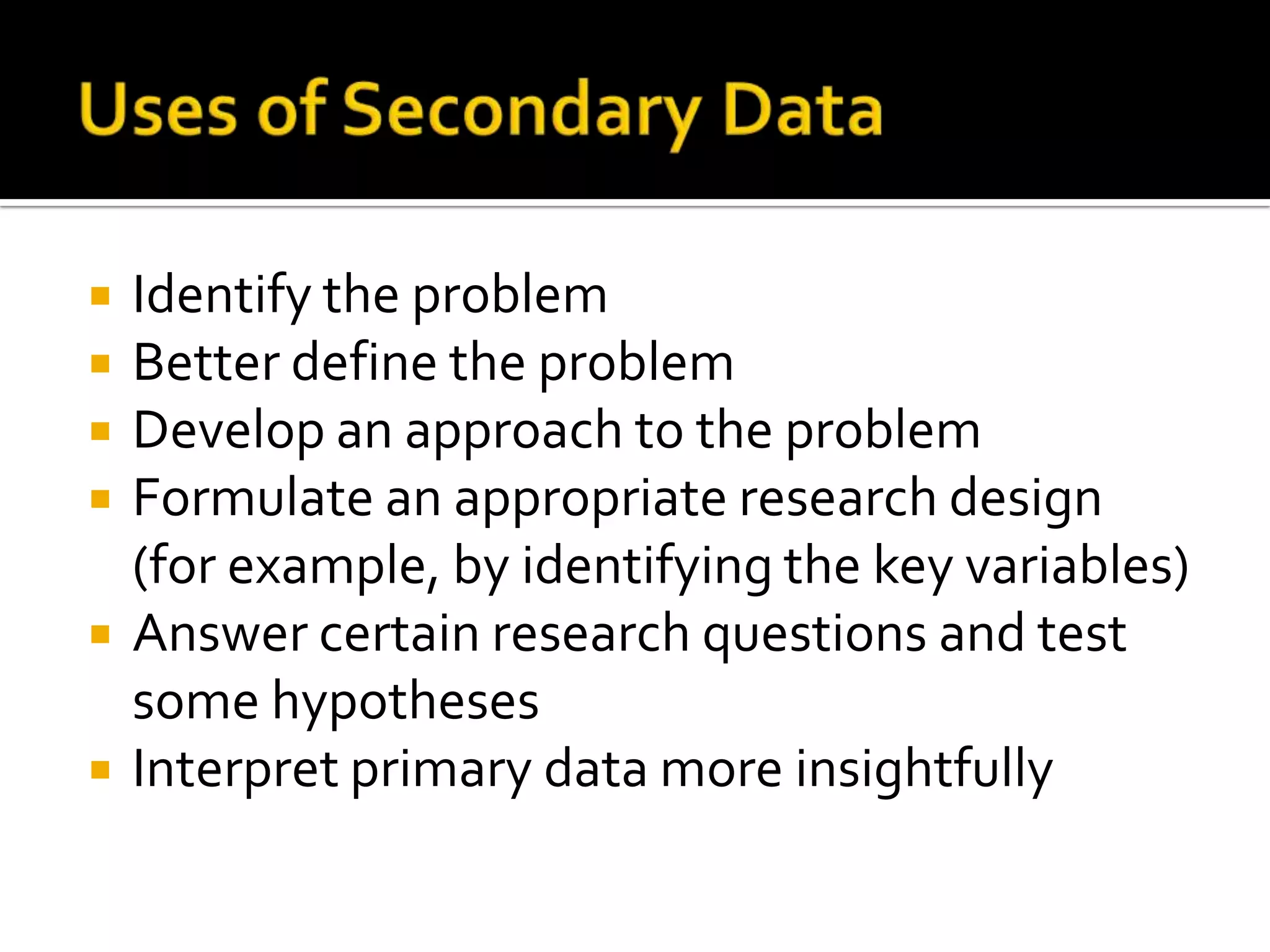
Uses of Secondary DataIdentify the problemBetter define the problemDevelop an approach to the problemFormulate an appropriate research design (for example, by identifying the key variables)Answer certain research questions and test some hypothesesInterpret primary data more insightfully
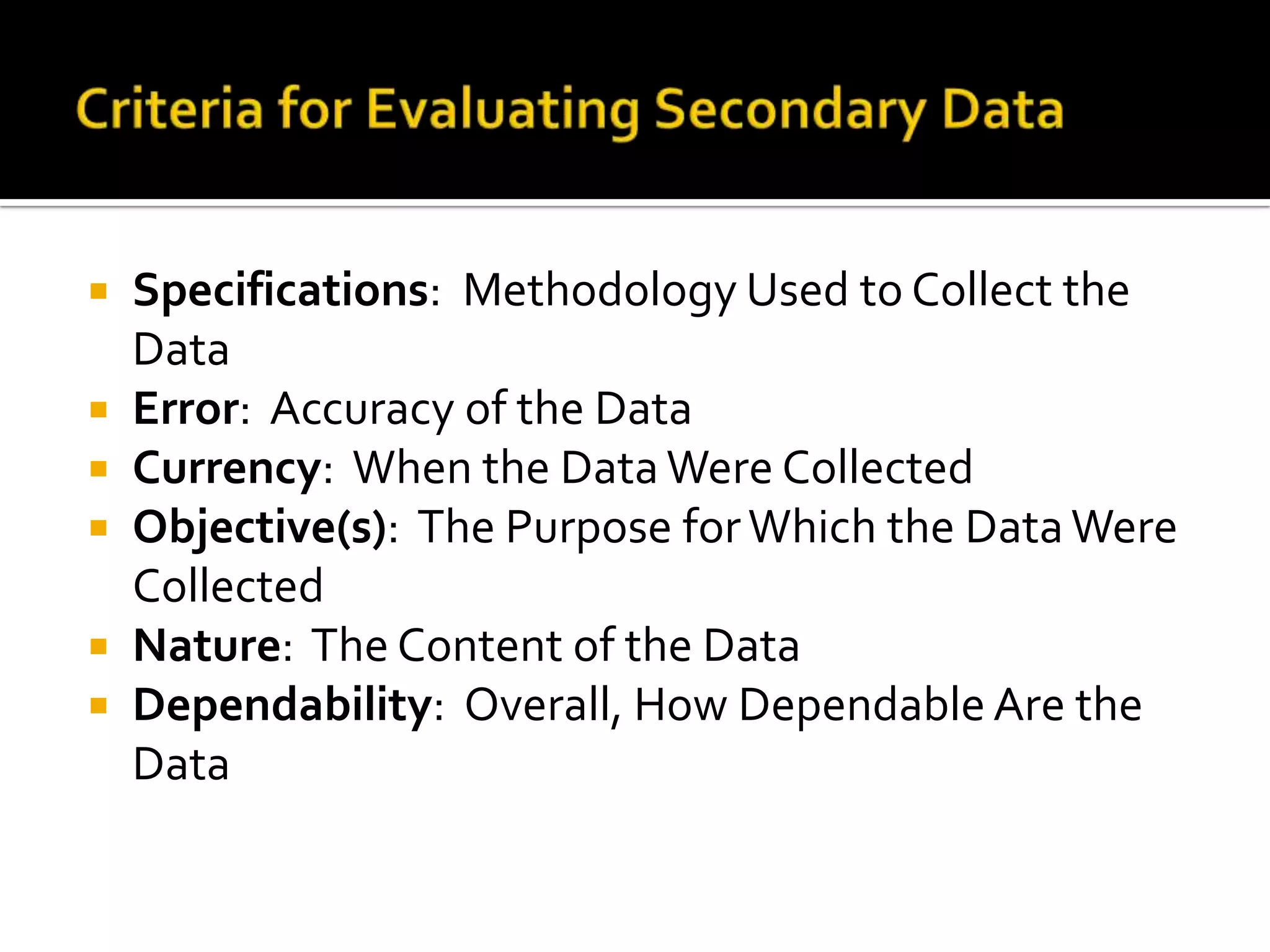
Criteria for Evaluating Secondary DataSpecifications:  Methodology Used to Collect the DataError:  Accuracy of the DataCurrency:  When the Data Were CollectedObjective(s):  The Purpose for Which the Data Were CollectedNature:  The Content of the DataDependability:  Overall, How Dependable Are the Data
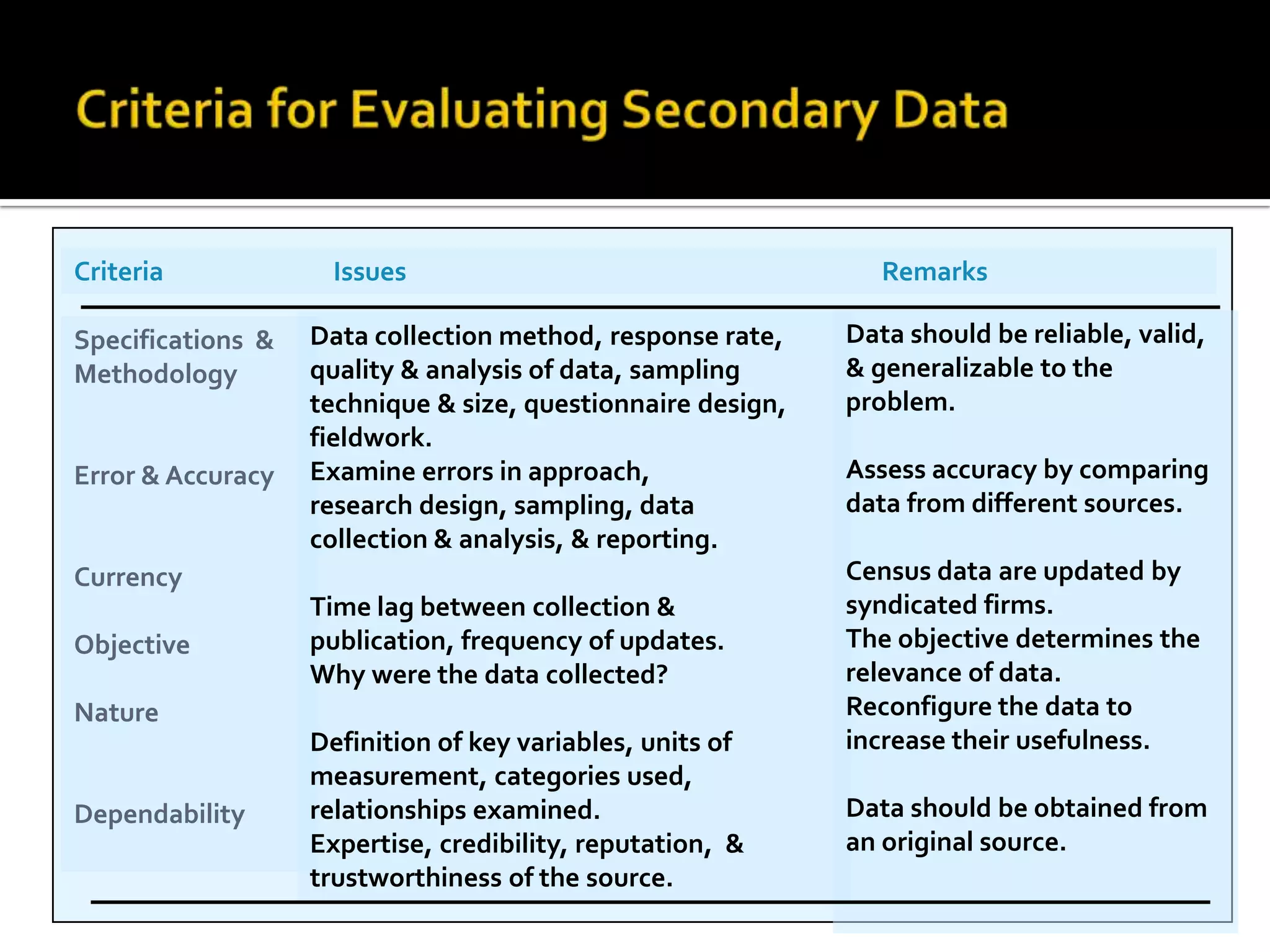
Criteria for Evaluating Secondary DataTable 4.2Criteria	    	 Issues				        RemarksData should be reliable, valid, & generalizable to the problem.Assess accuracy by comparing data from different sources.Census data are updated by syndicated firms.The objective determines the relevance of data.Reconfigure the data to increase their usefulness. Data should be obtained from an original source.Data collection method, response rate, quality & analysis of data, sampling technique & size, questionnaire design, fieldwork.Examine errors in approach,research design, sampling, datacollection & analysis, & reporting.Time lag between collection &publication, frequency of updates.Why were the data collected?Definition of key variables, units of measurement, categories used, relationships examined.Expertise, credibility, reputation,  & trustworthiness of the source.Specifications  & MethodologyError & AccuracyCurrencyObjectiveNatureDependability
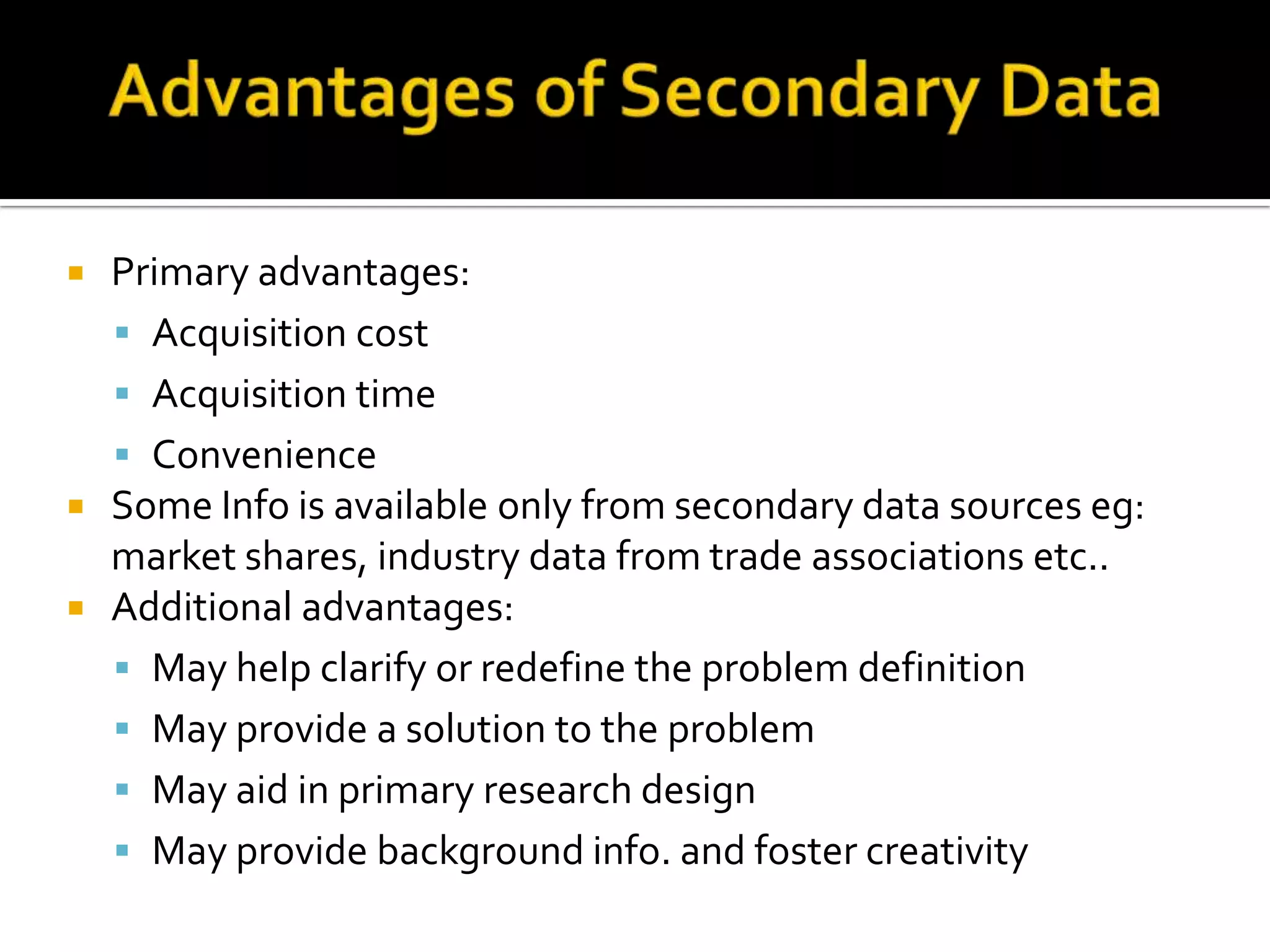
Advantages of Secondary DataPrimary advantages:Acquisition costAcquisition timeConvenienceSome Info is available only from secondary data sources eg: market shares, industry data from trade associations etc..Additional advantages:May help clarify or redefine the problem definitionMay provide a solution to the problemMay aid in primary research designMay provide background info. and foster creativity
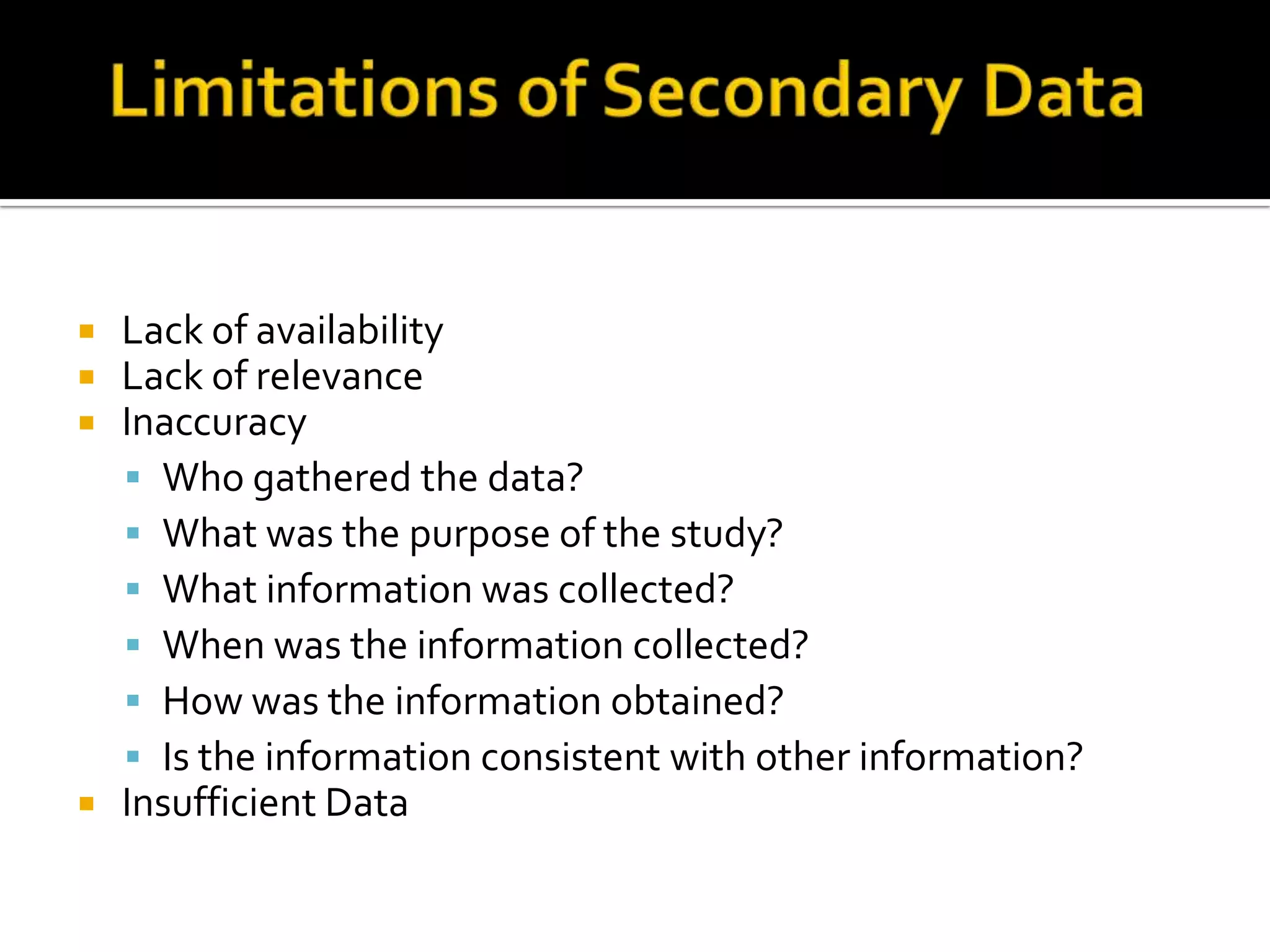
Limitations of Secondary DataLack of availabilityLack of relevanceInaccuracyWho gathered the data?What was the purpose of the study?What information was collected?When was the information collected?How was the information obtained?Is the information consistent with other information?Insufficient Data

Final ppt sec.data.coll

  • 1.
  • 2.
  • 3.
  • 4.
    PoojaKulkarni 13Defining Research Systematic: well organised and plannedObjectivity : unbiased and unemotionalThe information is used to identify and define opportunities and problems, and make recommendations on solutionsMarket Research links consumer, customer and the public to the marketers through information.Generate, refine and evaluate marketing actions, performance and the marketing process.
  • 5.
    Defining Market ResearchResearchis the systematic and objective approach to investigate a specific problem that needs a solution.Research is a process by which a series of well thought out and carefully executed activities enable one to enquire, investigate or examine a problem to discover new facts to deal with the problem.
  • 6.
    Marketing ResearchThe processof planning, collecting, and analyzing data relevant to a marketing decision.
  • 7.
    Issues to considerwith Problem definitionPast information(secondary data/MIS)
  • 8.
  • 9.
  • 10.
  • 11.
  • 12.
  • 13.
  • 14.
  • 15.
  • 16.
  • 17.
  • 18.
  • 19.
  • 20.
    M6ObjectivesInformation requirementsPrimary ResearchSecondaryResearchQuantitative ResearchQualitative ResearchSamplingData Collection MethodsData ProcessingReportingTHE RESEARCH PROCESS Defining the issue/objectives
  • 21.
    Reviewing primaryversus secondary research options
  • 22.
    Deciding onthe mix of qualitative and quantitative research
  • 23.
    Making asampling plan (separate review)
  • 24.
    Selecting thedata collection method
  • 25.
    Presenting thefinal report Decision pointsThe Research Process
  • 26.
    Primary vs. SecondaryDataPrimary data are originated by a researcher for the specific purpose of addressing the problem at hand. The collection of primary data involves all six steps of the marketing research process. Secondary data are data which have already been collected for purposes other than the problem at hand. These data can be located quickly and inexpensively.
  • 27.
    A Comparison ofPrimary & Secondary DataPrimary DataSecondary DataCollection purpose For the problem at hand For other problemsCollection process Very involved Rapid & easyCollection cost High Relatively lowCollection time Long Short
  • 28.
    Uses of SecondaryDataIdentify the problemBetter define the problemDevelop an approach to the problemFormulate an appropriate research design (for example, by identifying the key variables)Answer certain research questions and test some hypothesesInterpret primary data more insightfully
  • 29.
    Criteria for EvaluatingSecondary DataSpecifications: Methodology Used to Collect the DataError: Accuracy of the DataCurrency: When the Data Were CollectedObjective(s): The Purpose for Which the Data Were CollectedNature: The Content of the DataDependability: Overall, How Dependable Are the Data
  • 30.
    Criteria for EvaluatingSecondary DataTable 4.2Criteria Issues RemarksData should be reliable, valid, & generalizable to the problem.Assess accuracy by comparing data from different sources.Census data are updated by syndicated firms.The objective determines the relevance of data.Reconfigure the data to increase their usefulness. Data should be obtained from an original source.Data collection method, response rate, quality & analysis of data, sampling technique & size, questionnaire design, fieldwork.Examine errors in approach,research design, sampling, datacollection & analysis, & reporting.Time lag between collection &publication, frequency of updates.Why were the data collected?Definition of key variables, units of measurement, categories used, relationships examined.Expertise, credibility, reputation, & trustworthiness of the source.Specifications & MethodologyError & AccuracyCurrencyObjectiveNatureDependability
  • 31.
    Advantages of SecondaryDataPrimary advantages:Acquisition costAcquisition timeConvenienceSome Info is available only from secondary data sources eg: market shares, industry data from trade associations etc..Additional advantages:May help clarify or redefine the problem definitionMay provide a solution to the problemMay aid in primary research designMay provide background info. and foster creativity
  • 32.
    Limitations of SecondaryDataLack of availabilityLack of relevanceInaccuracyWho gathered the data?What was the purpose of the study?What information was collected?When was the information collected?How was the information obtained?Is the information consistent with other information?Insufficient Data
  • 33.
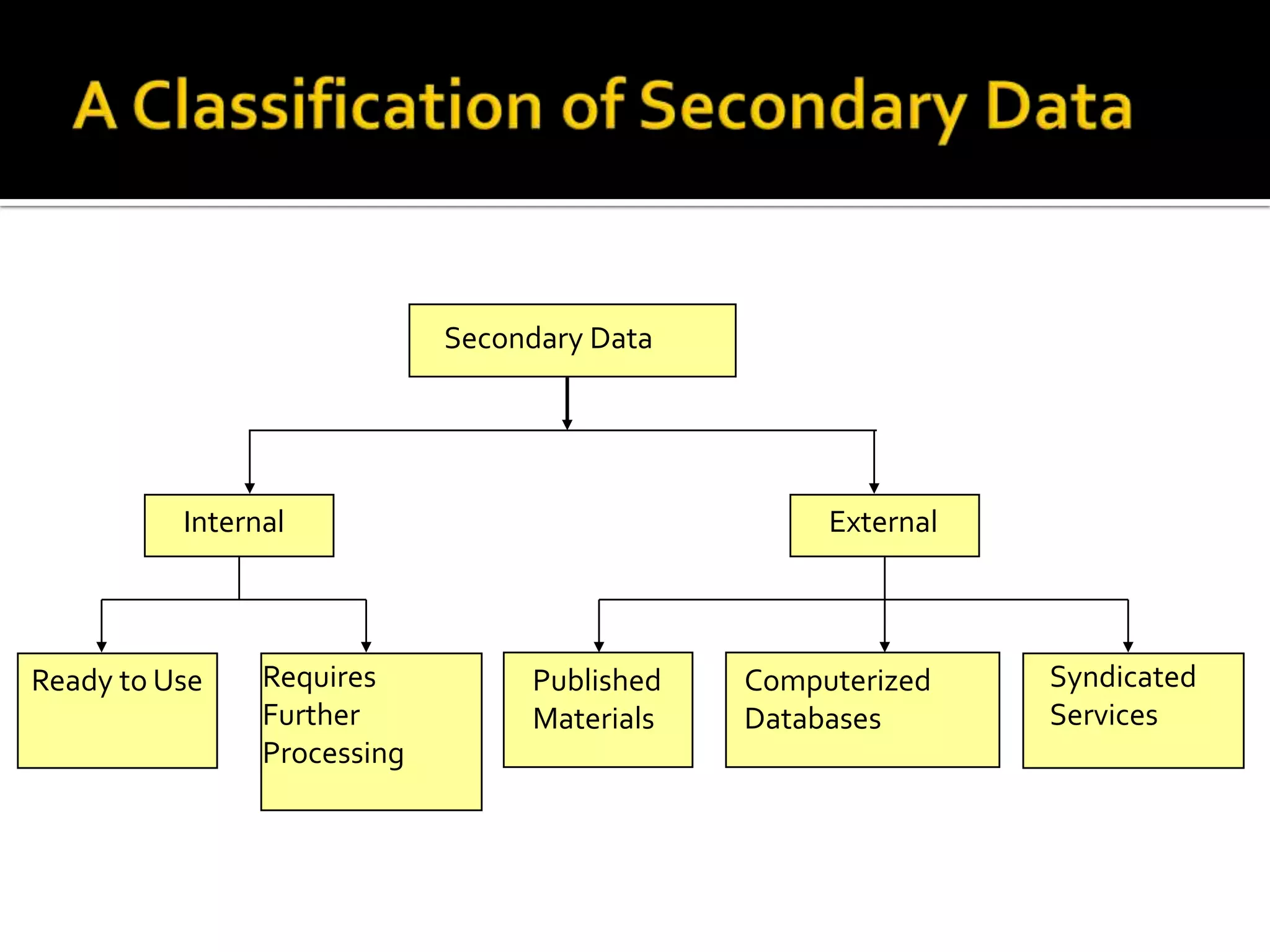
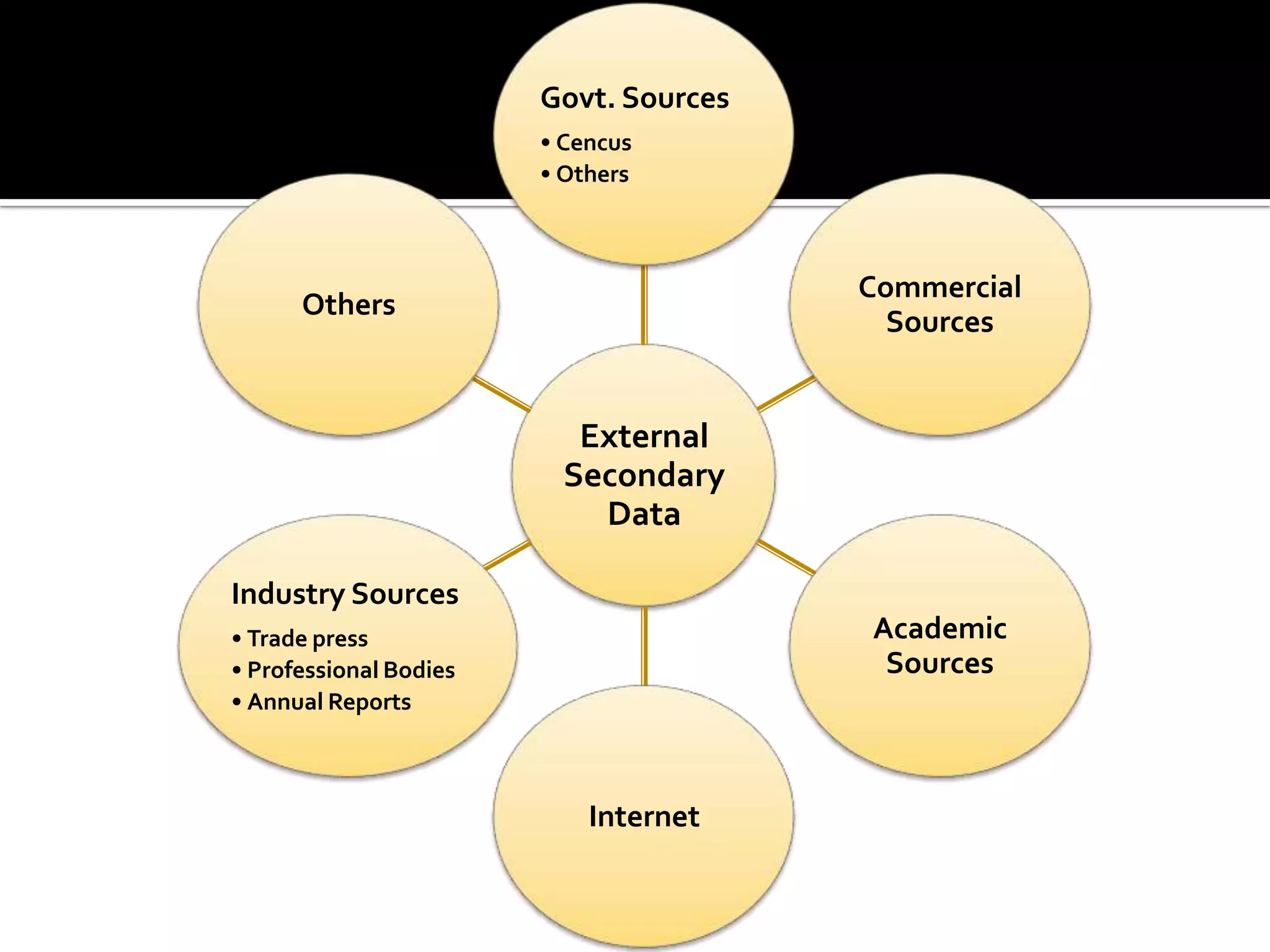
    Secondary DataInternalExternalRequires FurtherProcessingSyndicated ServicesReady to UsePublishedMaterialsComputerized DatabasesA Classification of Secondary Data
  • 35.
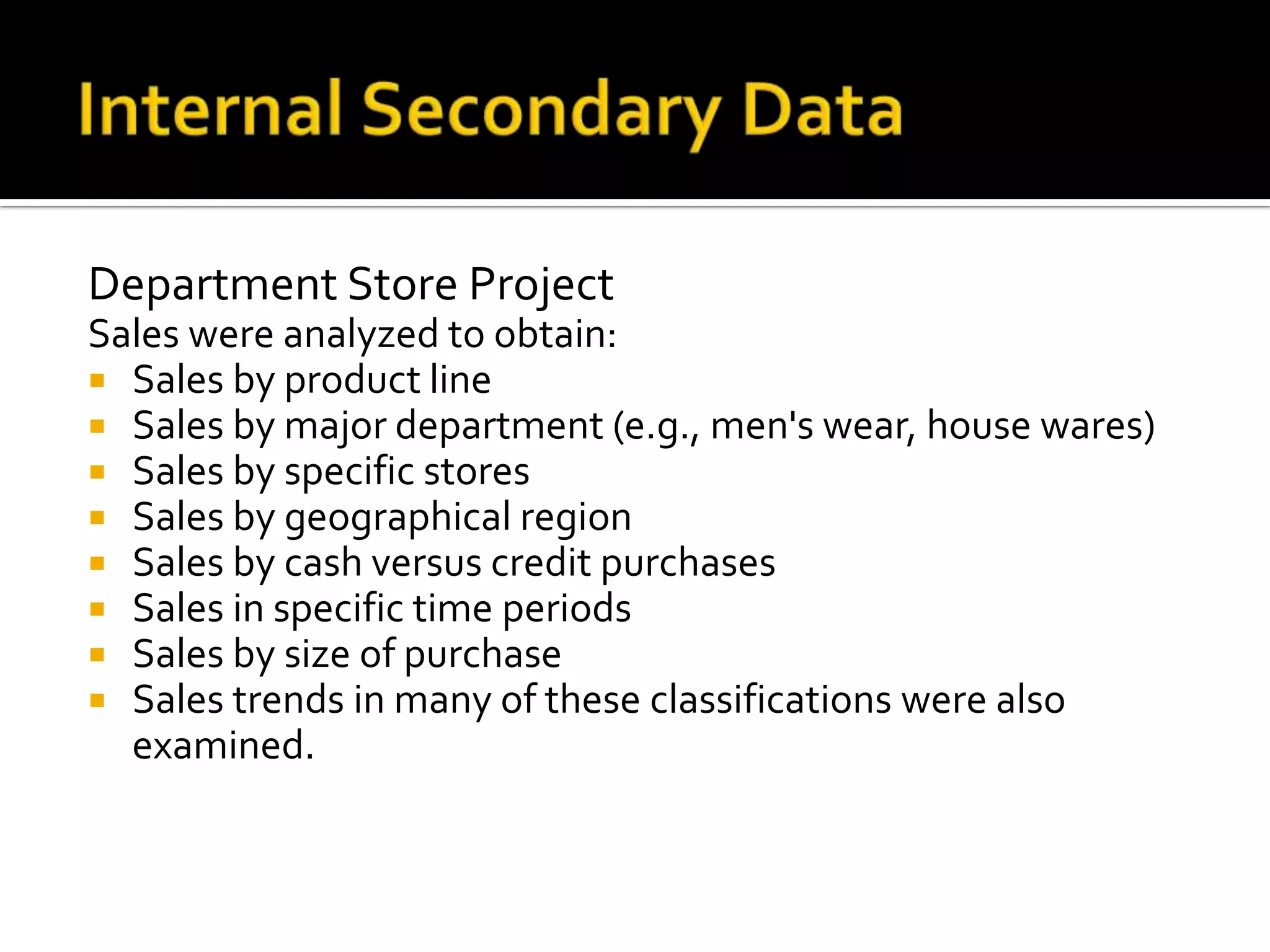
    Internal Secondary DataDepartmentStore ProjectSales were analyzed to obtain:Sales by product lineSales by major department (e.g., men's wear, house wares)Sales by specific storesSales by geographical regionSales by cash versus credit purchasesSales in specific time periodsSales by size of purchaseSales trends in many of these classifications were also examined.
  • 37.
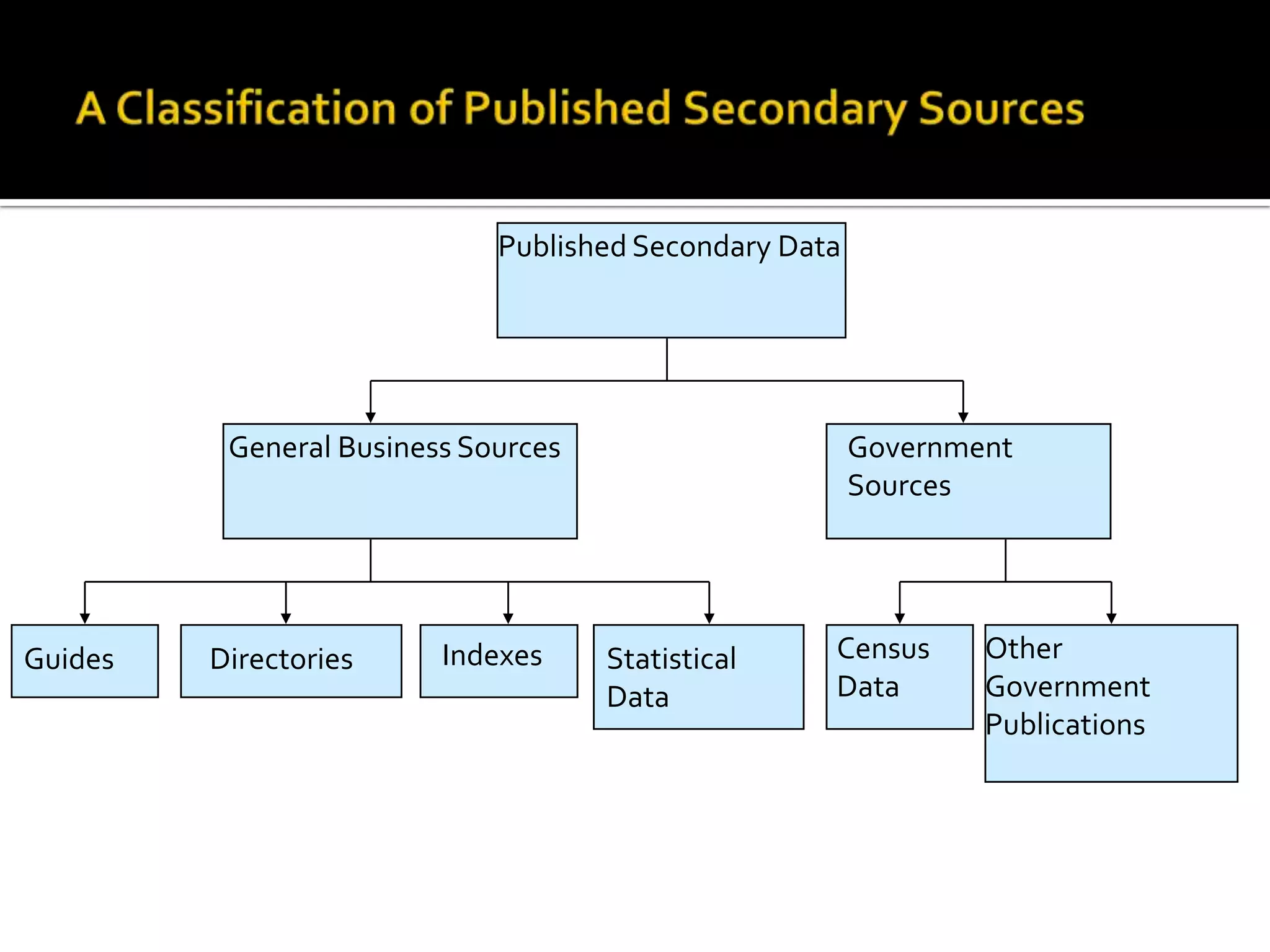
    A Classification ofPublished Secondary SourcesCensus DataOther Government PublicationsStatisticalDataIndexesGuidesDirectoriesPublished Secondary DataGeneral Business SourcesGovernment Sources
  • 38.
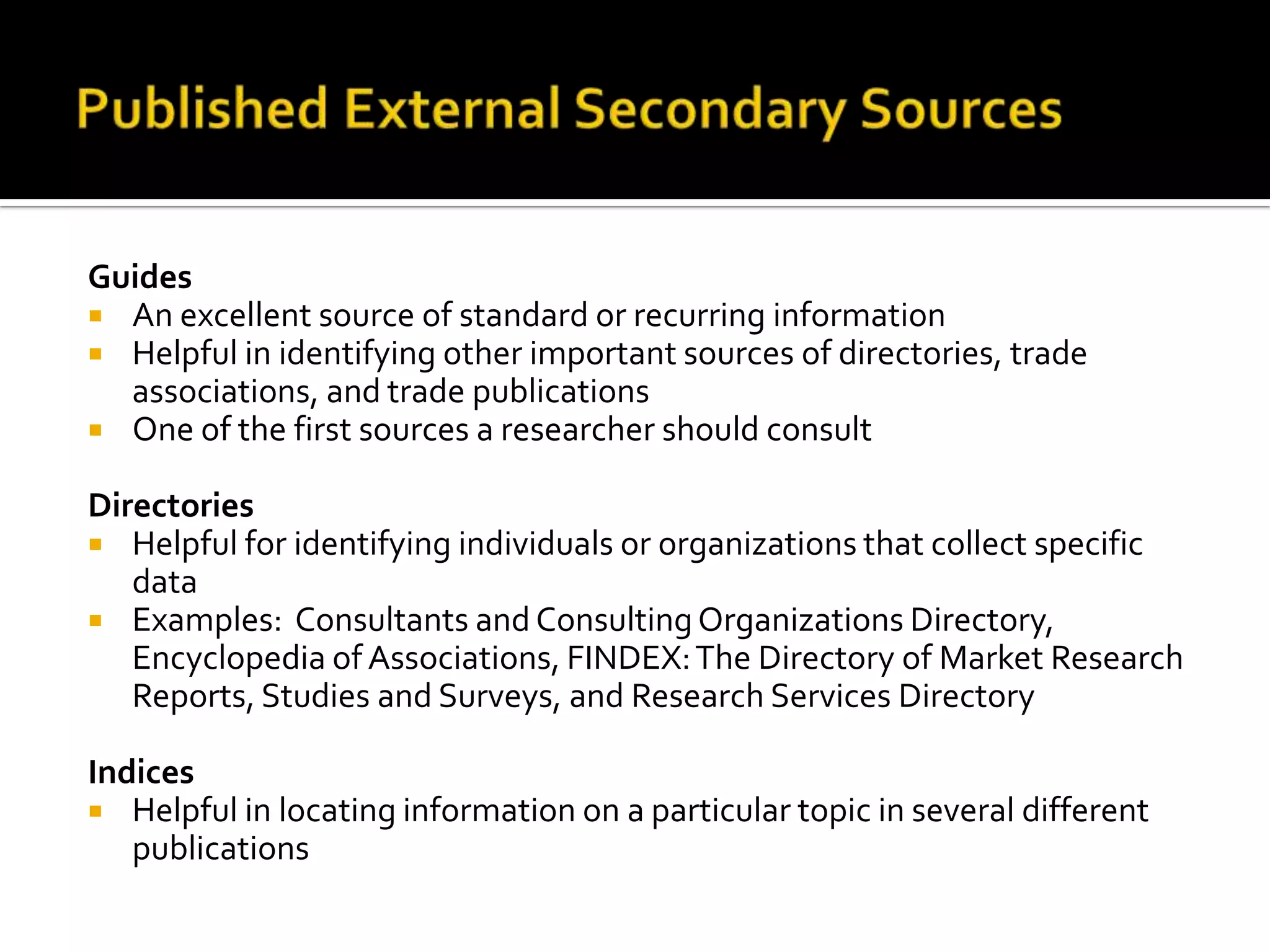
    Published External SecondarySourcesGuidesAn excellent source of standard or recurring informationHelpful in identifying other important sources of directories, trade associations, and trade publicationsOne of the first sources a researcher should consultDirectoriesHelpful for identifying individuals or organizations that collect specific dataExamples: Consultants and Consulting Organizations Directory, Encyclopedia of Associations, FINDEX: The Directory of Market Research Reports, Studies and Surveys, and Research Services DirectoryIndicesHelpful in locating information on a particular topic in several different publications
  • 39.
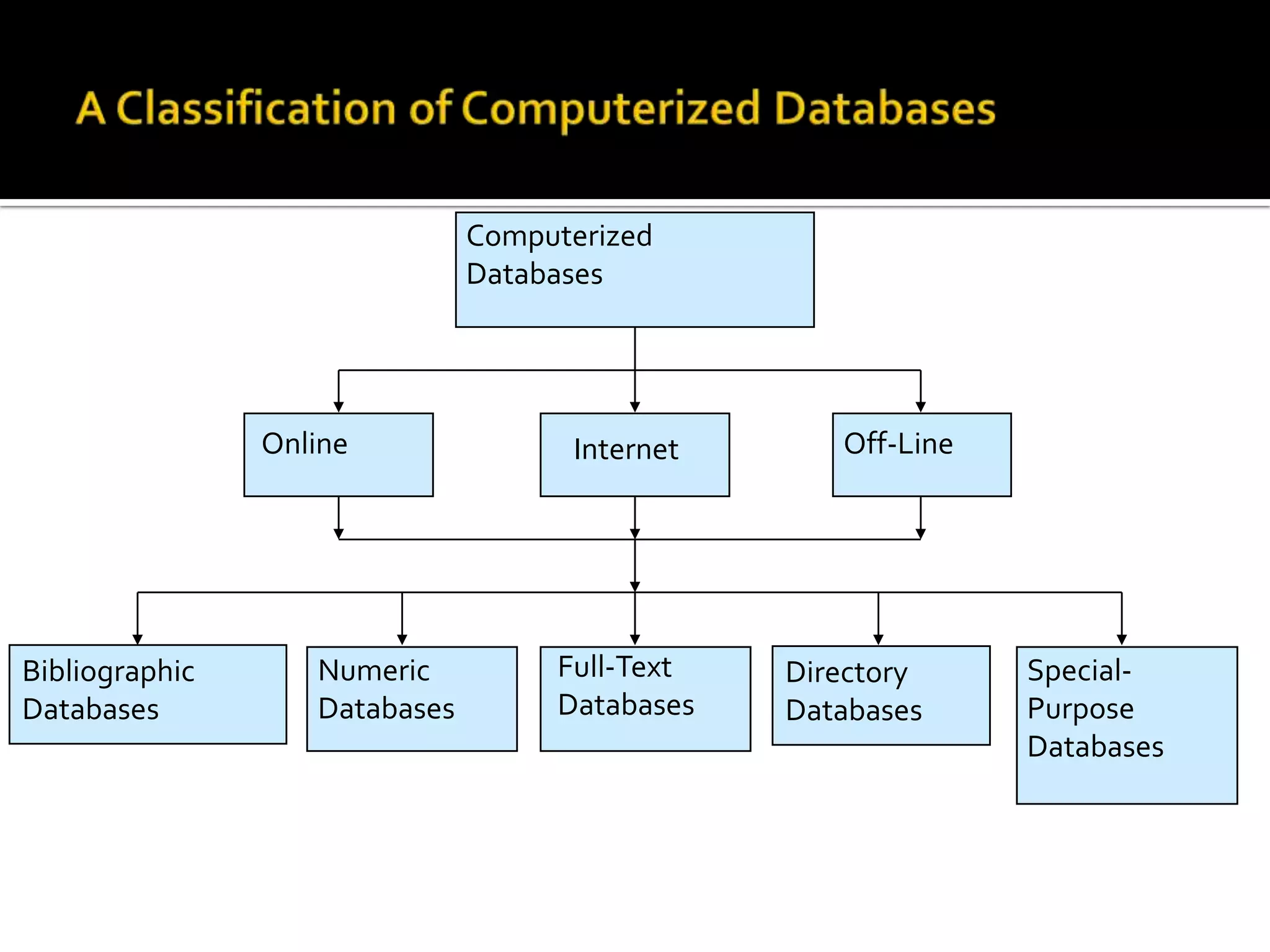
    A Classification ofComputerized DatabasesComputerized DatabasesOnlineOff-LineInternetFull-Text DatabasesNumeric DatabasesSpecial-Purpose DatabasesBibliographic DatabasesDirectory Databases
  • 40.
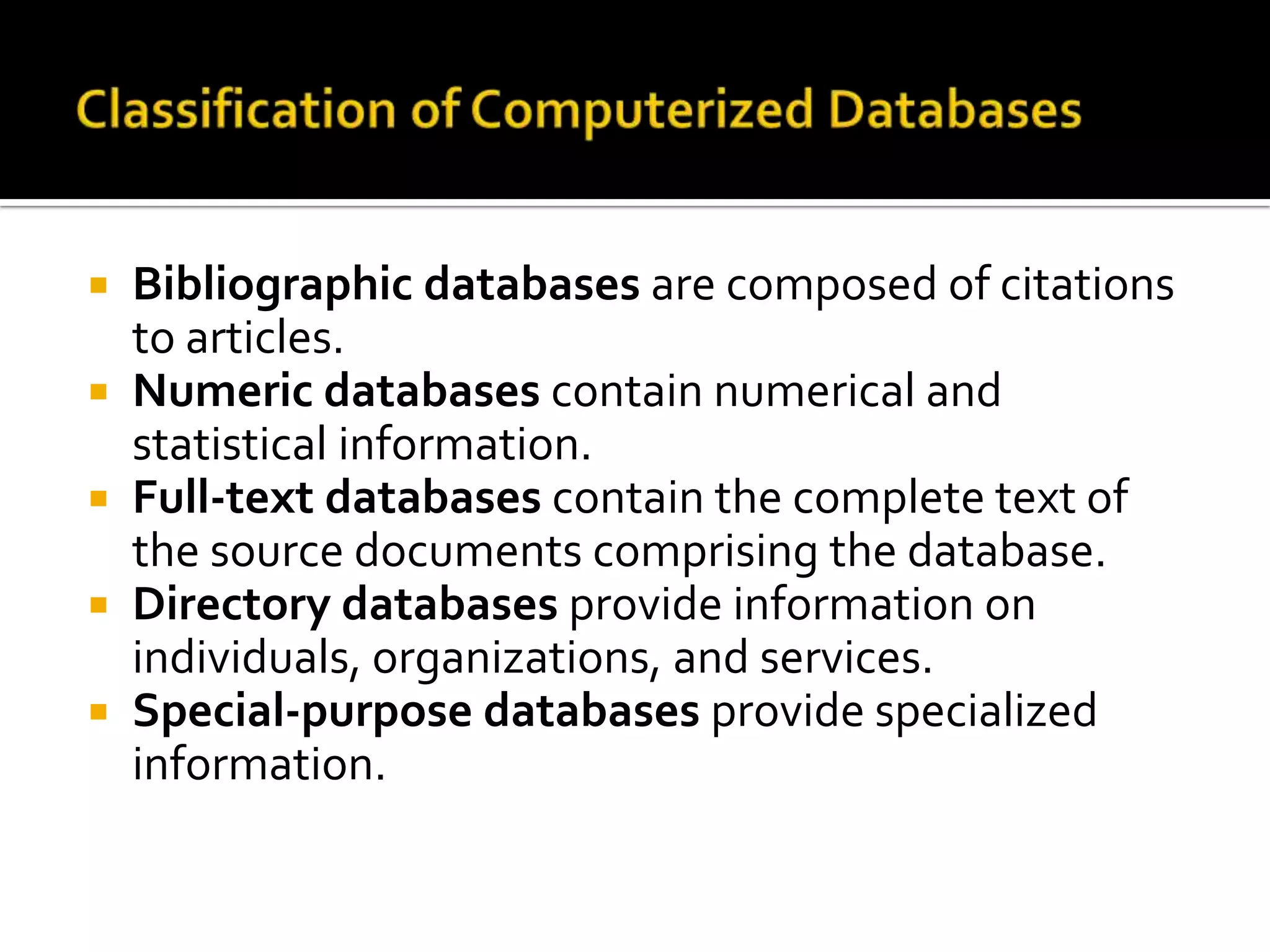
    Classification of ComputerizedDatabasesBibliographic databases are composed of citations to articles.Numeric databases contain numerical and statistical information. Full-text databases contain the complete text of the source documents comprising the database. Directory databases provide information on individuals, organizations, and services. Special-purpose databases provide specialized information.
  • 41.
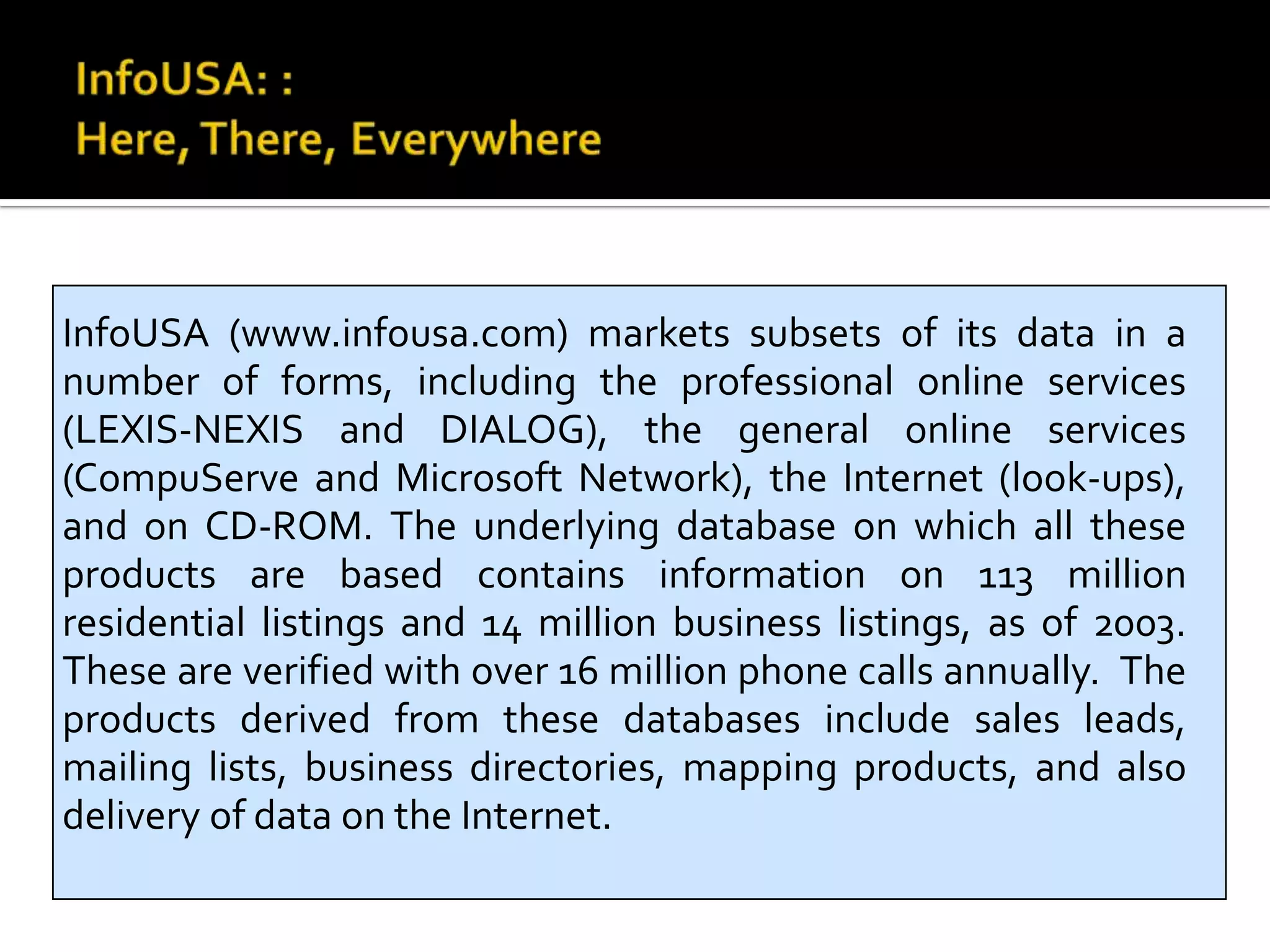
    InfoUSA: : Here,There, EverywhereInfoUSA (www.infousa.com) markets subsets of its data in a number of forms, including the professional online services (LEXIS-NEXIS and DIALOG), the general online services (CompuServe and Microsoft Network), the Internet (look-ups), and on CD-ROM. The underlying database on which all these products are based contains information on 113 million residential listings and 14 million business listings, as of 2003. These are verified with over 16 million phone calls annually. The products derived from these databases include sales leads, mailing lists, business directories, mapping products, and also delivery of data on the Internet.
  • 42.
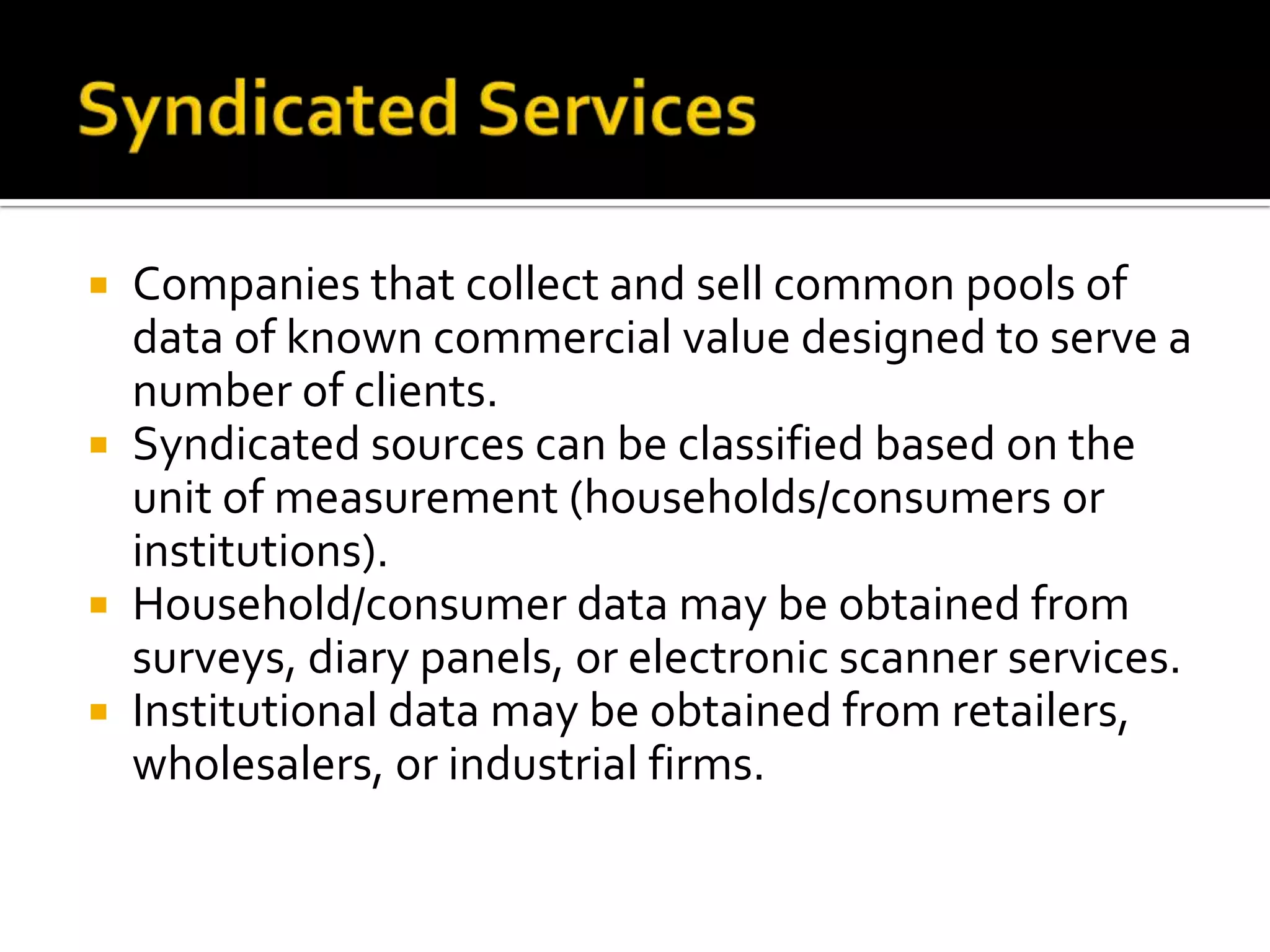
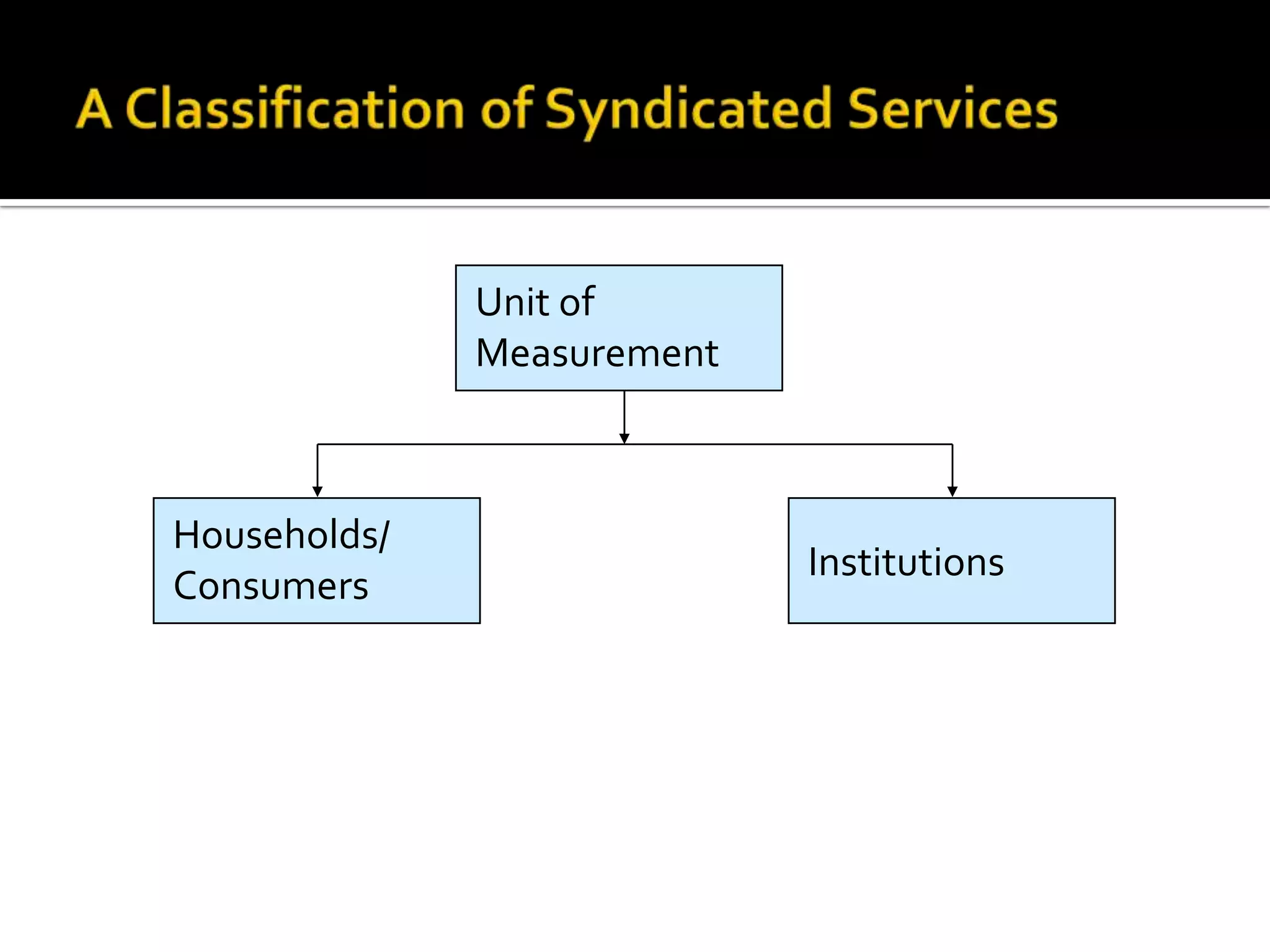
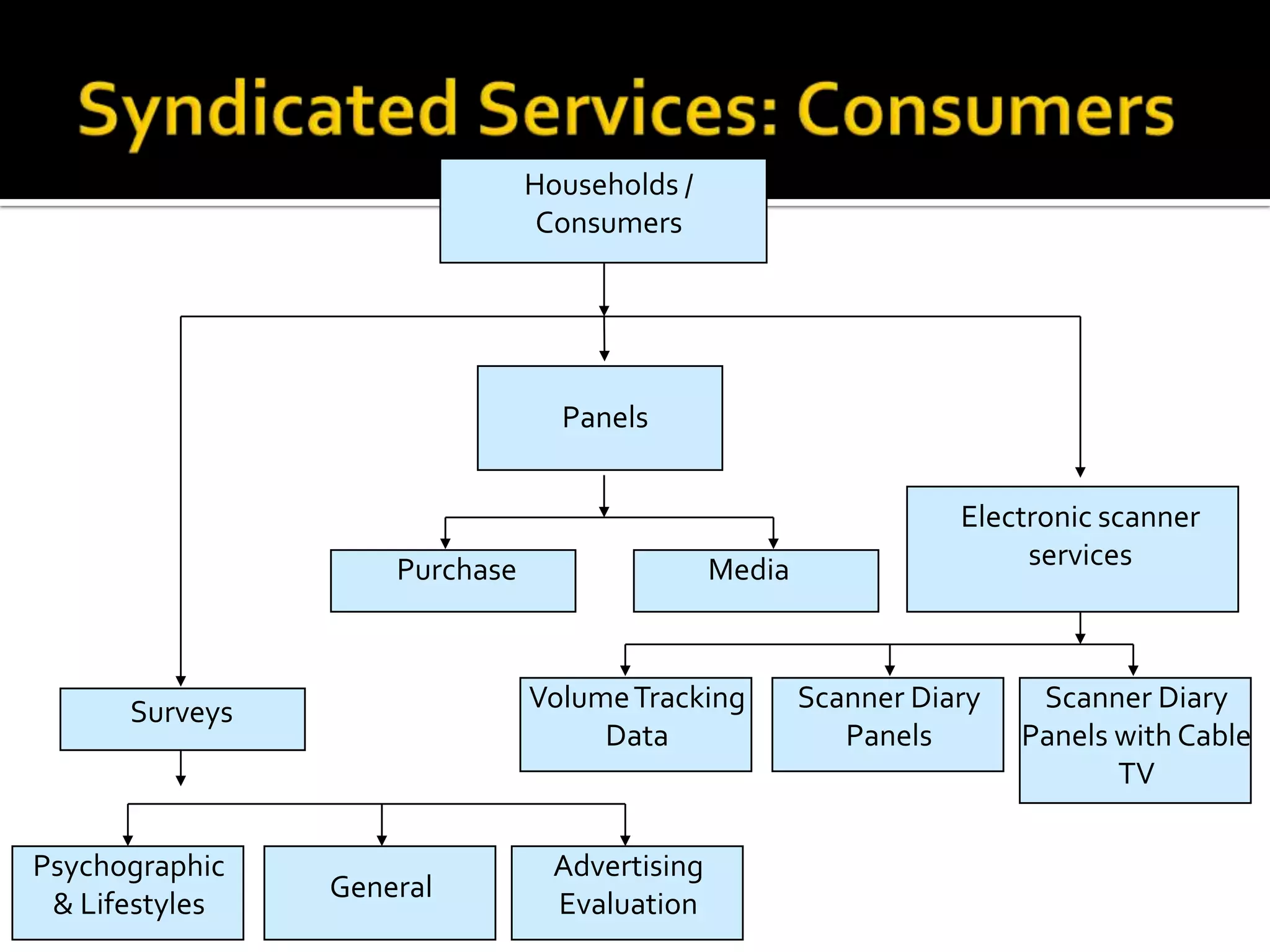
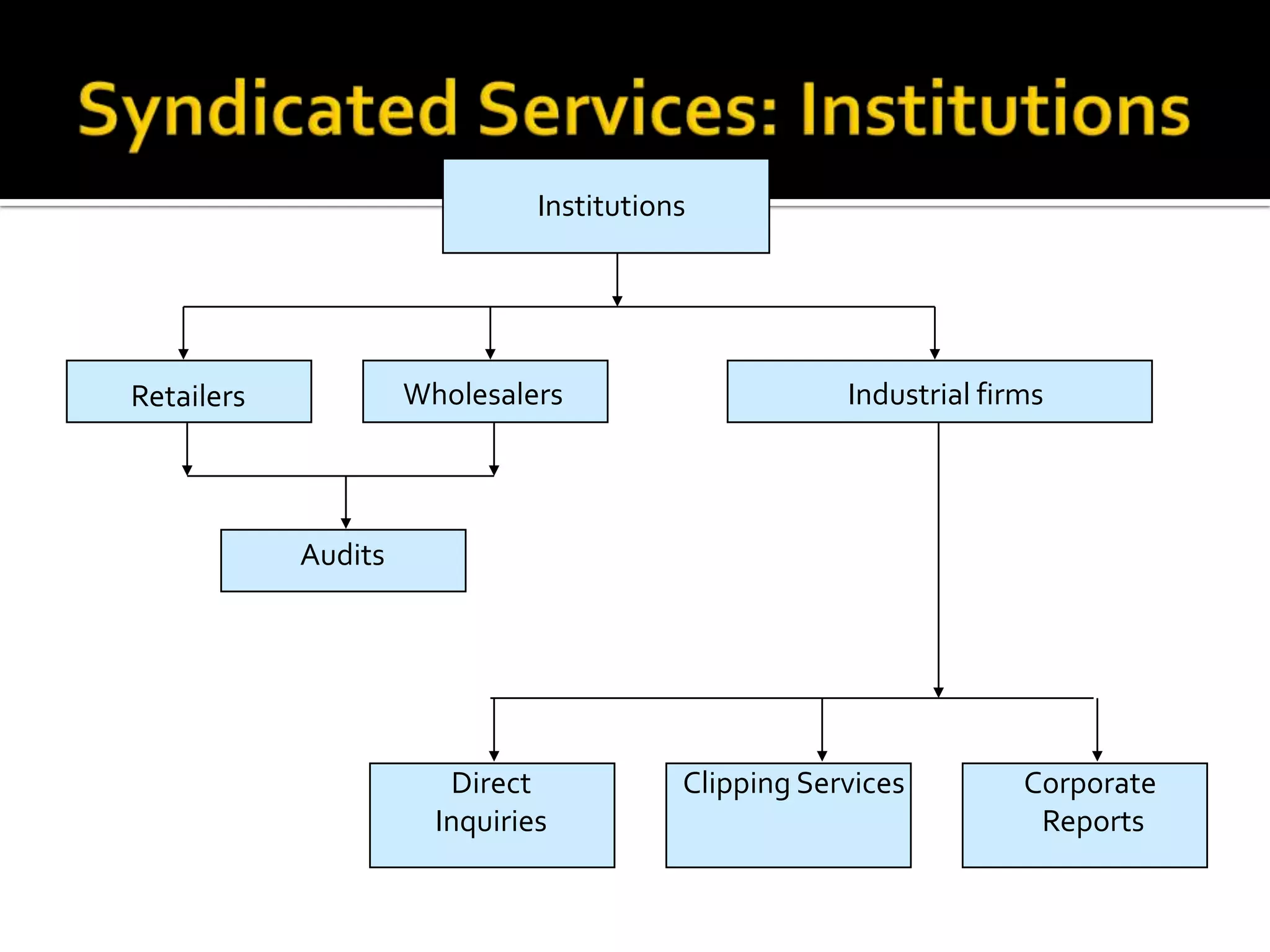
    Syndicated ServicesCompanies thatcollect and sell common pools of data of known commercial value designed to serve a number of clients.Syndicated sources can be classified based on the unit of measurement (households/consumers or institutions). Household/consumer data may be obtained from surveys, diary panels, or electronic scanner services. Institutional data may be obtained from retailers, wholesalers, or industrial firms.
  • 43.
    A Classification ofSyndicated ServicesUnit ofMeasurementHouseholds/ConsumersInstitutions
  • 44.
    Syndicated Services: ConsumersHouseholds/ ConsumersPanelsElectronic scanner servicesPurchaseMediaScanner Diary Panels with Cable TVVolume Tracking DataScanner Diary PanelsSurveysPsychographic& LifestylesAdvertisingEvaluationGeneral
  • 45.
    Syndicated Services: InstitutionsInstitutionsWholesalersIndustrialfirmsRetailersAuditsDirect InquiriesClipping ServicesCorporateReports
  • 46.
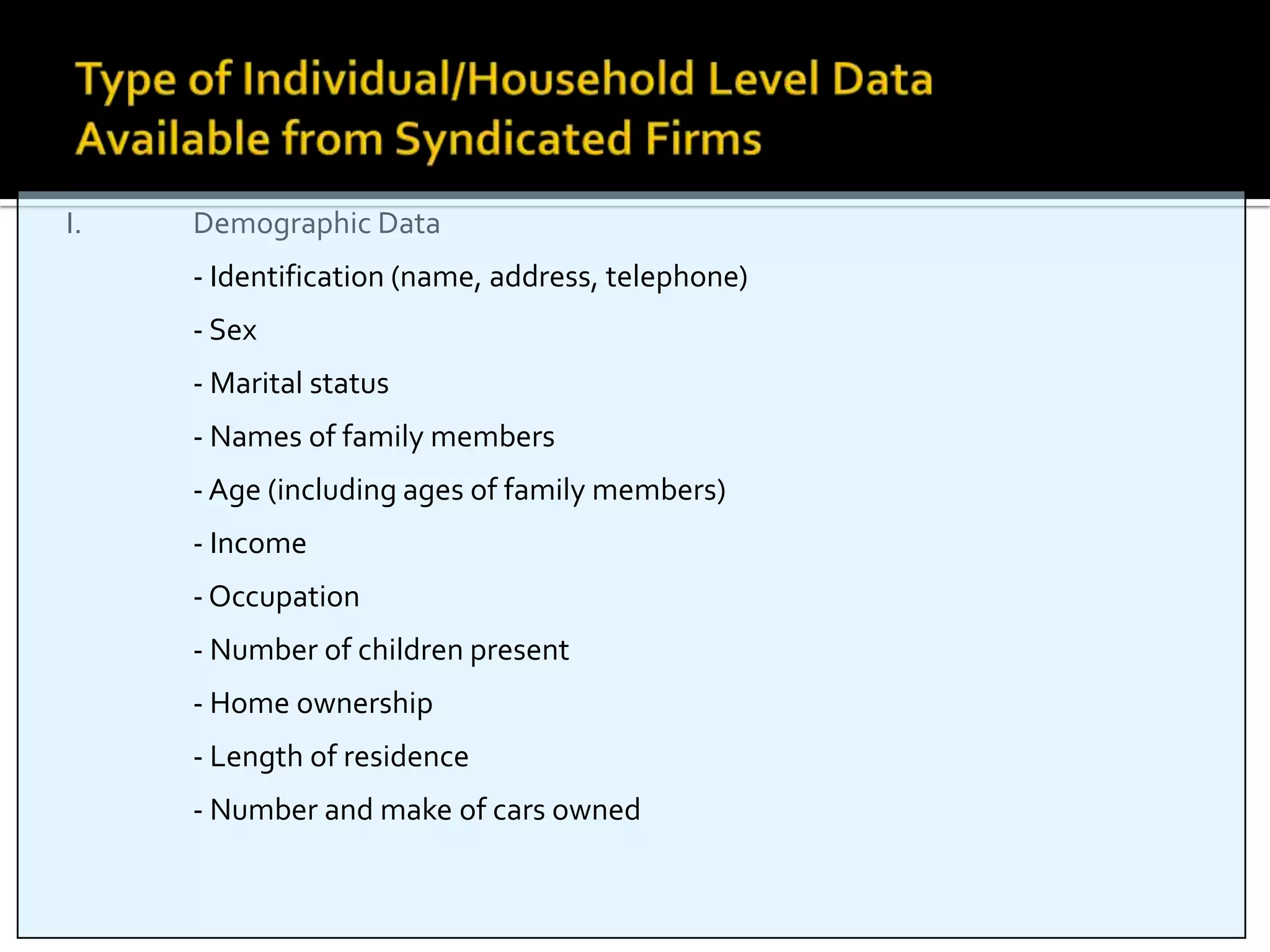
    Type of Individual/HouseholdLevel DataAvailable from Syndicated FirmsI. Demographic Data - Identification (name, address, telephone) - Sex - Marital status - Names of family members - Age (including ages of family members) - Income - Occupation - Number of children present - Home ownership - Length of residence - Number and make of cars owned
  • 47.
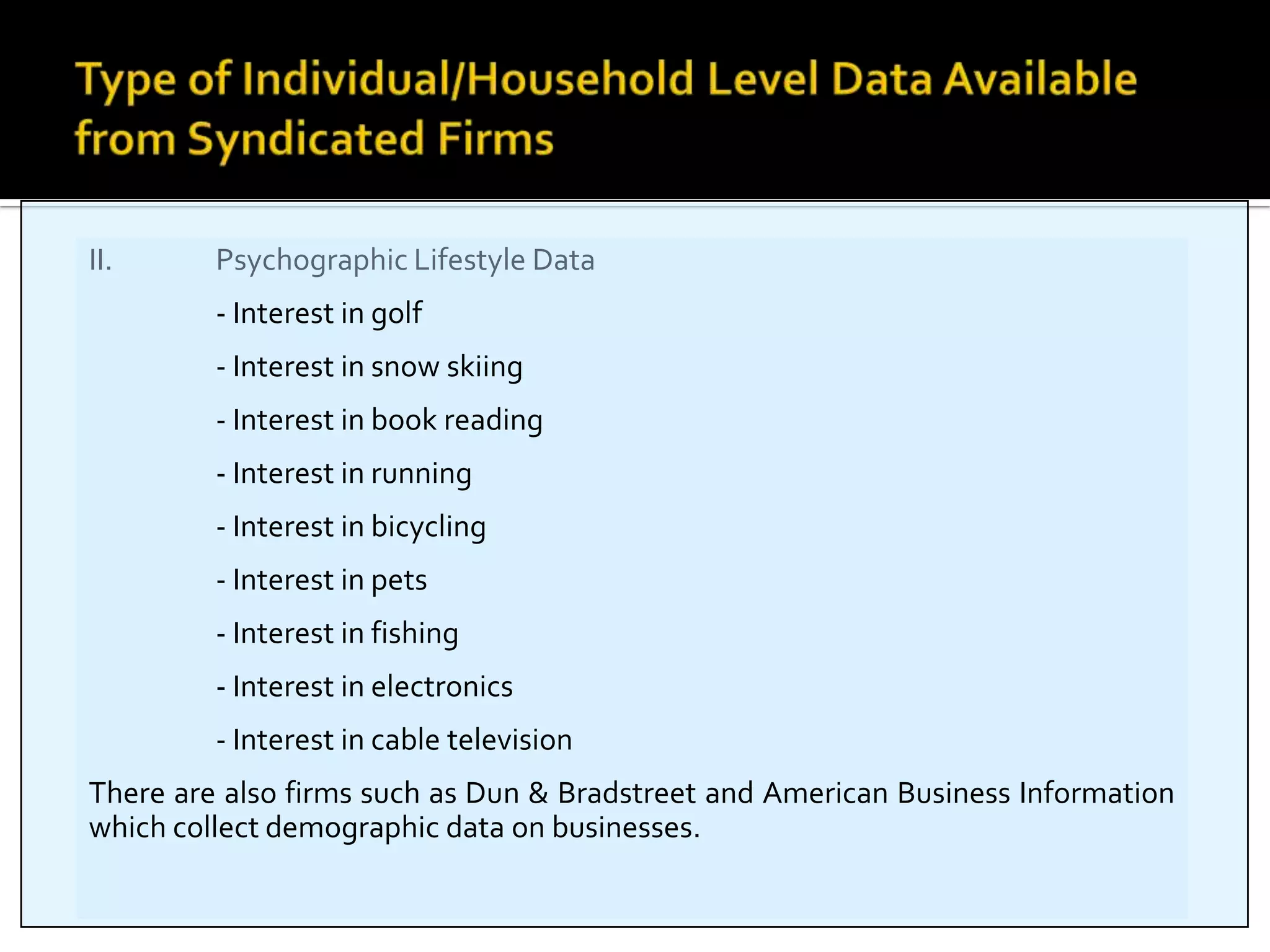
    Type of Individual/HouseholdLevel Data Available from Syndicated FirmsII. Psychographic Lifestyle Data - Interest in golf - Interest in snow skiing - Interest in book reading - Interest in running - Interest in bicycling - Interest in pets - Interest in fishing - Interest in electronics - Interest in cable televisionThere are also firms such as Dun & Bradstreet and American Business Information which collect demographic data on businesses.
  • 48.
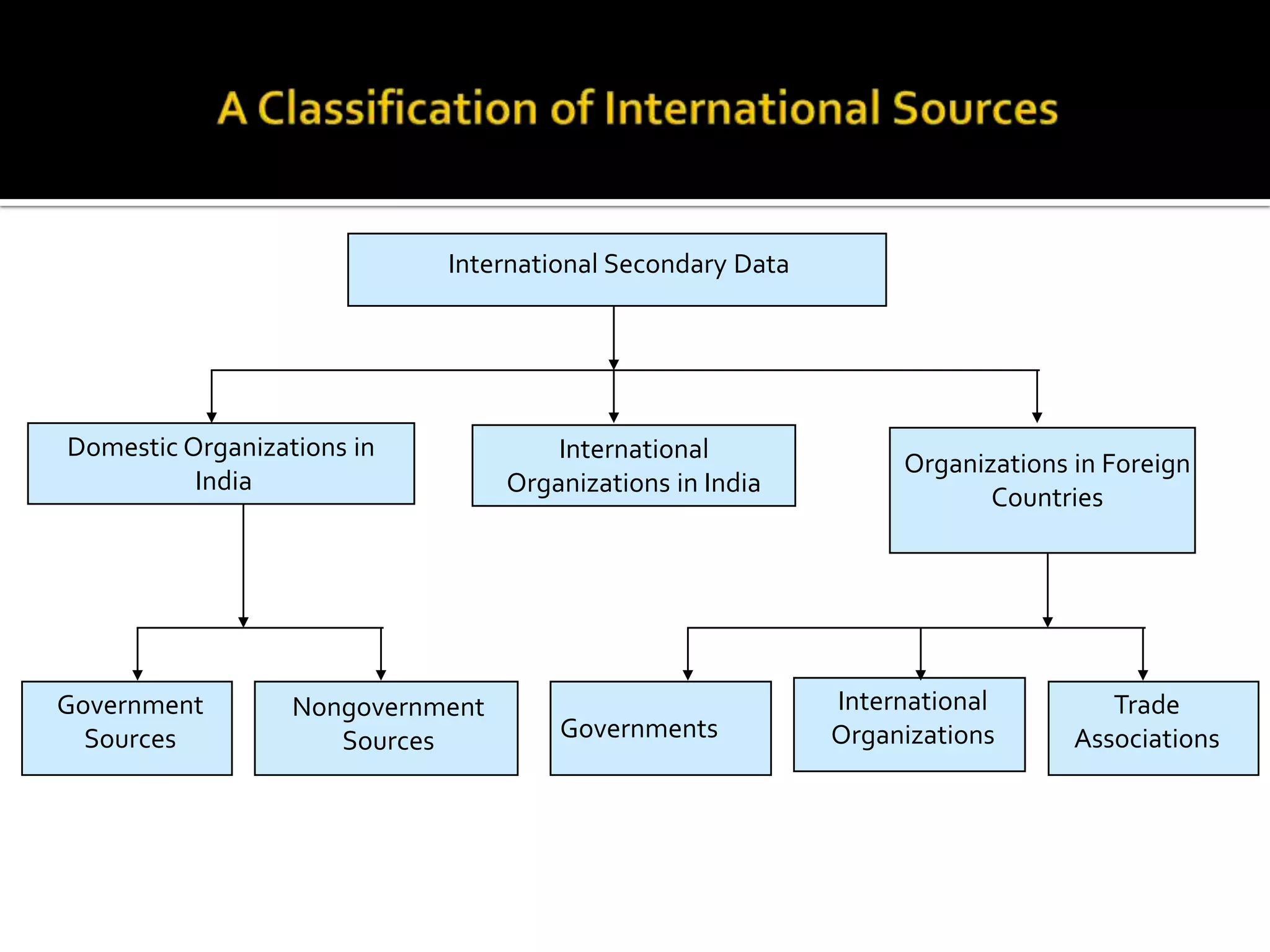
    A Classification ofInternational SourcesInternational Secondary DataFig. 4.5Domestic Organizations in IndiaInternational Organizations in IndiaOrganizations in Foreign CountriesInternational OrganizationsTrade AssociationsGovernment SourcesNongovernment SourcesGovernments
  • 49.
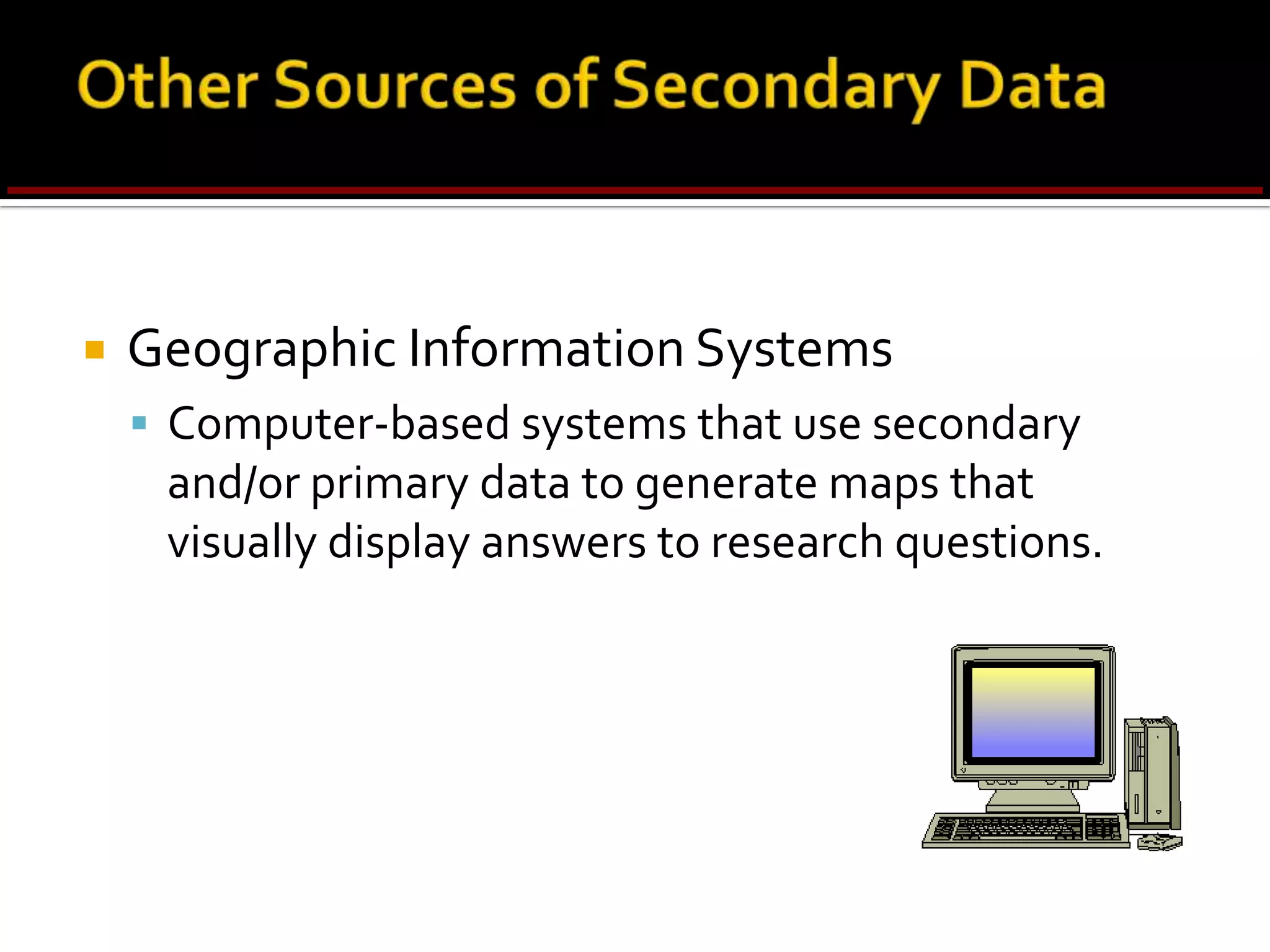
    Other Sources ofSecondary DataGeographic Information SystemsComputer-based systems that use secondary and/or primary data to generate maps that visually display answers to research questions.
  • 50.
    Summary of KeyPointsSecondary data are information previously gathered for a different purpose that may be relevant to the problem at hand.Secondary data can come from sources internal to the organization or external.The internet and syndicated firms have, in many ways, enabled the gathering of secondary data.Secondary data are generally useful, low-cost, rapidly available sources of information. Always look for secondary data first
  • 51.