









Shakehand with Life


     Research Methodology
     Systematized effort to gain new knowledge
     Notes for MBA III Sem. Maharishi Dayanand University, Rohtak, (DDE)

     Prepared By

     Narender Sharma
     Quality Professional in a leading Container Glass Manufacturing Organization

     HNG Industries Ltd , Bahadurgarh


                                                                                  Prepared By
                                                                              Narender Sharma
                   Quality Professional in a leading Container Glass Manufacturing Organization
Few words
To All Management and Engineering Professionals………………
                                                                                                                       Course Journey
All   of you have studied about the Software and Hardware as these                                                 Research Methodology
understand as a heavy source of earning but I believe in Humanware and in                                       (MBA , Sem. III, M.D. University, Rohtak)
my view “Nothing costly than a human mind as it has unlimited capabilities.”
                                                                                          Unit I :                 Page 3 - 8
so my Mission statement is
                                                                                          Introduction
                        “Shakehand with Life”                                                      Meaning and nature of research.
                                                                                                   Significance of research in business decision making.
The   notes are strictly according to the syllabus of Maharishi Dayanand                           Identification and formulation of research problems , Setting
University, Rohtak under distance education mode for MBA ,Sem. III.                                objectives and formulation of hypothesis.
                                                                                          Unit II :           Page 9 - 22
As a quality professional It is my effort to give the quality in my work which            Research designs and data collection
will give the maximum output through minimum input from the user end so                            Research designs – Exploratory , descriptive, diagnostic, and
that he can get maximum marks in his examination.                                                  experimental data collection.
                                                                                                   Universe , survey population , and sampling designs.
I always seeking the feedback from your side so that, I can continuously
                                                                                                   Data collection tools –Schedule, questionnaire, interview and
make improvement in my work.
                                                                                                   observation, use of SPSS
With Regards                                                                              Unit III :         Page 23 - 34
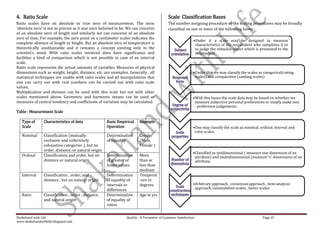
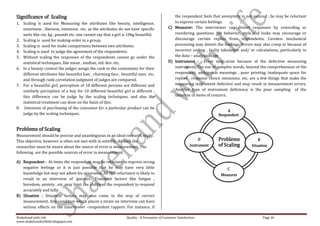
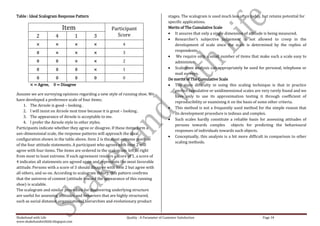
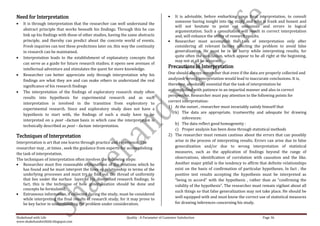
                                                                                          Scaling Techniques
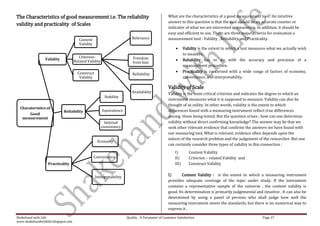
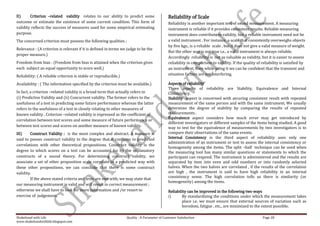
                                                                                                   Need for scaling, problems of scaling , reliability and validity of scales.
                                                                                                   Scale construction techniques- Arbitrary approach , consensus scale
Narender Sharma                                                                                    approach     ( Thurston), Item analysis approach (Likert) and
                                                                                                   cumulative scales ( Gut man’s Scalogram)
        Working As A Quality Professional In A Leading Container Glass
        Manufacturing Organization Since July 2001 To Till Date.                          Unit IV:             Page 35 - 44
        Visiting Faculty in Leading Management Institutes in Delhi.                       Interpretation and Report writing
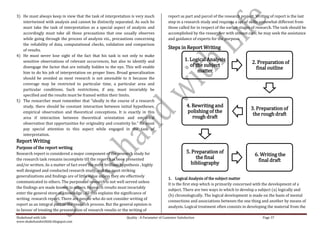
        Six –Sigma Green Belt.                                                                     Introduction , meaning of interpretation
        Group Member “Benchmark Six Sigma” , “Leaders Think Tank” on Linkedin.                     Techniques and precautions in interpretation and generalization.
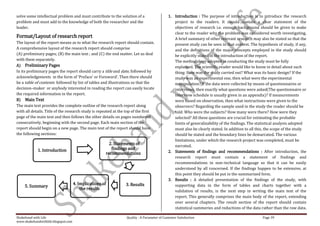
        M.B.A. (Production And Operation Management).                                              Report writing – purpose, steps and format of research report and
        B.Sc. (Electronics, Physics, Mathematics).                                                 final presentation of the research report


Shakehand with Life                                           Quality : A Parameter of Customer Satisfaction                                       Page 1
www.shakehandwithlife.blogspot.com
Few Motivational words                                                                                   Train-ed To be a Leader
        “ I know you are going                                                      People are often like a Train, Some are like its Engine
        to make it ………..                                                            Leading the train forward,
        It may take time                                                            Some are like bogies chugging along, following the leader
        and hard work                                                               While few others are likes the brakes, putting a stop to its motion
        You may become frustrated and                                               Therefore the leader is like the Engine of this train
        at times you will feel                                                      A man who will lead with trust and honesty,
        like giving up                                                              with speed and also ensure that there are no accidents.
        Sometimes you may even
        wonder if it’s really worth it
                                                                                                                   Narender Sharma
        But I have confidence in you
                                                                                                                   Lead India MAILBOX, My Times, My Voice
        and I know you’ll make it,                                                                                 Times of India, New Delhi,
        If you try.”                                                                                               Aug24, 2007, p. 2


                                 ……………..Ananda Pierce


Shakehand with Life                                     Quality : A Parameter of Customer Satisfaction                                   Page 2
www.shakehandwithlife.blogspot.com
Santa’s Research Story on a Frog
                                                                    Mr. Santa has got a chance to become a researcher and he went to America
                                                                    and did a interesting research on a Frog.


                                                                    Here is the research story of the Santa
                                                                    Mr. Santa caught a Frog and put the Frog on a table and asked to the Frog,
                                                                    “Daddu, my son, jump!”


Unit I : Introduction
        Meaning and nature of research.
        Significance of research in business                        Frog jumped about six feet.
        decision making.                                            Then Mr. Santa cut one rear leg of the Frog and then put the Frog again on the
                                                                    table and asked to the Frog, “Daddu, my son, jump!”
        Identification and formulation of research                  Frog used the force of all three legs and jumped about three feet.
                                                                    Then Mr. Santa cut one more leg of the Frog , that was his right front leg.
        problems,      Setting  objectives     and                  Now Mr. Santa put the Frog on the table and again asked the Frog , “Daddu,
        formulation of hypothesis.                                  my son, jump!”
                                                                    Frog used the force of his two legs and jumped about one feet.
                                                                    Now Mr. Santa cut one more leg of the Frog , that was the second rear leg of
                                                                    the Frog.
                                                                     Then put the Frog again on the table and asked the Frog , “Daddu, my son,
                                                                    jump!”
                                                                    Frog somehow using the force of his remaining last leg and try to jump but
                                                                    managed to scrawl himself just about two inches.
                                                                    Now at last Mr. Santa cut the last leg of the Frog and put the Frog on the table
                                                                    and asked him again, “Daddu, my son, jump!”
                                                                    But this time the Frog even collecting the whole inner strength of his body
                                                                    failed to even scrawl himself.
                                                                    Now Mr. Santa find the result from his study and made a generalization that

Shakehand with Life                     Quality : A Parameter of Customer Satisfaction                                    Page 3
www.shakehandwithlife.blogspot.com
“ If all four Legs of the Frog are cut down then Frog stops listening.”                      Types of Researches
This was the research done by Mr. Santa.                                                     Descriptive vs Analytical
But Actually, What is Research?                                                                  Descriptive research includes surveys and fact finding enquiries of
What is the significance of the research?                                                        different kind. The major purpose of descriptive research is description
How the research progress?                                                                       of the state of affairs as it exists at present.
How do we identify and formulate the research problem?                                           Analytical research on the other hand , the researcher has to use facts or
All these are discussed in this subject named as                                                 information already available , and analyze these to make a critical
Research Methodology                                                                             evaluation of the material.
Meaning and Nature of Research                                                               Applied vs Fundamental
We all possess the vital instinct of inquisitiveness for, when the unknown                       Applied research aims at finding a solution for an immediate problem
confronts us , we wonder and our inquisitiveness makes us probe and attain                       facing a society or an industrial/ business organization.
full and fuller understanding of the unknown. This inquisitiveness is the                        Fundamental research is mainly concerned with generalization and with
mother of all knowledge and the method , which man employs for obtaining                         the formulation of theory.
the knowledge of whatever the unknown , can be termed as research.                           Quantitative vs Qualitative
                                                                                                 Quantitative research is based in the measurement of quantity or
    Research is an art of scientific investigation.
                                                                                                 amount.
    Systematized effort to gain new knowledge –Redman and Morry
                                                                                                 Qualitative research , is concerned with qualitative involving quality or
    Research is movement of known to unknown.                                                    kind. For instance , when we are interested in investigating the reasons
    It is actually a voyage of discovery.                                                        for human behavior.
    Research comprises defining and redefining problems , formulating                        Conceptual vs Emperical
    hypothesis or suggested solutions ; collecting , organizing and evaluating
                                                                                                 Conceptual research is that related to some abstract idea or theory. It is
    data; making deductions and reaching conclusions ; and at last carefully
                                                                                                 generally used by philosophers and thinkers to develop new concepts or
    testing the conclusions to determine whether they fit the formulating
                                                                                                 to reinterpret existing ones.
    hypothesis.
                                                                                                 Empirical research relies on the experience or observation alone, often
    The manipulation of things, concepts or symbols for the purpose of
                                                                                                 without due regard for system and theory. It is data based research,
    generalization to extend , correct or verify knowledge, whether that
                                                                                                 coming up with conclusions which are capable of being verified by
    knowledge, aids in construction of theory or in the practice of art.- D.
                                                                                                 observation or experiment.
    Slesinger and M. Stephenson
                                                                                             Some Other types of Researches
Conclusion : Research as such terms refers to the systematic method                              One time or longitudinal research
consisting of enunciating the problem, formulating a hypothesis, collecting the                  Laboratory or simulation research
facts or data, analyzing the facts and reaching certain conclusions either in the                Clinical or diagnostic research
form of solutions towards the concerned problem or in certain generalizations                    Historical research
for some theoretical formulation.


Shakehand with Life                                              Quality : A Parameter of Customer Satisfaction                                   Page 4
www.shakehandwithlife.blogspot.com
Significance of Research in Business decisions making                                       Research, thus, replaces intuitive business decisions by more logical and
“ All progress is born of inquiry. Doubt is often better than overconfidence,               scientific decisions.
for it leads to inquiry, and inquiry leads to invention.”- Hudson Maxim in                  Types of research problems.
context of significance of research.                                                        There are two types if research problems, viz.,
    Research inculcates scientific and inductive thinking and it promotes the               1. Those which relate to states of nature.
    development of logical habits of thinking and organization.                             2. Those which relate to relationships between variables.
    Research provides the basis for nearly all government policies in our                   Process of Identification and formulation of research
    economic system.
                                                                                            problems.
    Decision- making may not be a part of research, but research certainly
                                                                                                Single out the problem : At the very outset the researcher must single
    facilitates the decision of the policy maker.
                                                                                                out the problem he wants to study, i.e., he must decide the general area of
    Research has its special significance in solving various operational and
                                                                                                interest or aspect of a subject –matter that he would like to inquire into.
    planning problems of business and industry.
                                                                                                Initially the problem may be stated in a broad general way and then the
    Market research is the investigation of the structure and development of
                                                                                                ambiguities, if any, relating to the problem be resolved.
    a market for the purpose of formulating efficient policies for purchasing,
                                                                                                Feasibility of a particular solution : The feasibility of a particular
    production and sales.
                                                                                                solution has to be considered before a working formulation of the
    Operational research refers to the application of mathematical, logical
                                                                                                problem can be set up. The formulation of a general topic into a specific
    and analytical techniques to the solution of business problems of cost
                                                                                                research problem, viz., understanding the problem thoroughly, and
    minimization or of profit maximization or what can be termed as
                                                                                                rephrasing the same into meaningful terms from an analytical point of
    optimization problems.
                                                                                                view.
    Motivational research of determining why people behave as they do is
                                                                                                Understanding the problem : The best way of understanding the
    mainly concerned with market characteristics. In other words, it is
                                                                                                problem is to discuss it with one’s own colleagues or with those having
    concerned with the determination of motivations underlying the
                                                                                                some expertise in the matter. In private business units or in
    consumer (market) behaviour.
                                                                                                governmental organizations, the problem is usually earmarked by the
    Research with regard to demand and market factors has great utility in
                                                                                                administrative agencies with whom the researcher can discusses as to
    business. Given knowledge of future demand, it is generally not difficult
                                                                                                how the problem originally came about and what considerations are
    for a firm, or for an industry to adjust its supply schedule within the limit
                                                                                                involved in its possible solutions.
    of its projected capacity.
                                                                                                Study the available literature related to the problem : The researcher
    Market analysis has become an integral tool of business policy these days.
                                                                                                must at the same time examine all available literature to get himself
    Business budgeting , which ultimately results in a projected profit and
                                                                                                acquainted with the selected problem. He may review two types of
    loss account , is based mainly on sales estimates which in turn depends
                                                                                                literature – the conceptual literature concerning the concepts and
    on business research. Once sales forecasting is done, efficient production
                                                                                                theories, and the empirical literature consisting of studies made earlier
    and investment programmes can be set up around which are grouped the
                                                                                                which are similar to the one proposed. The basic outcome of this review
    purchasing and financing plans.
                                                                                                will be the knowledge as to what data and other materials are available


Shakehand with Life                                             Quality : A Parameter of Customer Satisfaction                                    Page 5
www.shakehandwithlife.blogspot.com
for operational purposes which will enable the researcher to specify his               Quite often a research hypothesis is a predictive statement, capable of being
    own research problem in a meaningful context.                                          tested by scientific methods, that relates an independent variable to some
    Rephrases the problem into analytical or operational terms : After                     dependent variable.
    this the researcher rephrases the problem into analytical or operational               For example consider the statements like the following ones:
    terms i.e., to put the problem in as specific terms as possible.                       “Students who receive counseling will show a greater increase in creativity
This task of formulating, or defining , a research problem is a step of greatest           than students not receiving counseling”
importance in the entire research process. The problem to be investigated                  Or “A girl and a boy lead their married life successfully if they allowed to
must be defined unambiguously for that will help discriminating relevant                   talk before their marriage for better understanding in comparison to those
data from irrelevant ones. Care must, however, be taken to verify the                      who are not to be allowed to do so.”
objectivity and validity of the background facts concerning the problem. In                “The automobile A is performing as well as automobile B.”
fact, formulation of the problem often follows a sequential pattern where a                These are hypothesis capable of being objectively verified and tested. Thus,
number of formulations are set up, each formulation more specific than the                 we may conclude that a hypothesis states what we are looking for and it is a
preceding one, each one phrased in more analytical terms, and each more                    proposition which can be put to test to determine its validity.
realistic in terms of the available data and resources.                                    Basic concept of hypothesis testing
                                                                                           Develop the hypothesis of population and make statistical decision by
Setting of Objectives                                                                      determining the acceptance of hypothesis using sample data.
        To gain familiarity with a phenomenon or to achieve new insights                   Null hypothesis (H0): Argument made so far, or hypothesis saying that there
        into it (Exploratory or Formulative research studies).                             is no change or difference
         To portray accurately the characteristics of a particular individual,             Alternative Hypothesis (H1): New argument, that is a hypothesis that you
        situation or a group (Descriptive research studies)                                want to prove with solid ground obtained from sample
        To determine the frequency with which something occurs or with                     Example : Medicine B for headache that is newly developed by a
        which it is associated with something else ( Diagnostic research                   pharmaceutical company has 30 minutes longer effects than existing
        studies)                                                                           Medicine A.
        To test a hypothesis of a casual relationship between variables                    H0 =Medicine A and B has same effect.
        (Hypothesis testing research studies)                                              H1= Medicine B has 30 minutes longer effects than medicine A.
Formulation of Hypothesis                                                                  Example : The following is data on yield of old process and improved process.
What is Hypothesis?                                                                        Process B is improved process.
Ordinarily, when one talks about hypothesis, one simply means a mere                       Process before improvement
assumption or some supposition to be proved or disapproved. But for                         Process
                                                                                                    89.7        81.4   84.5   84.8   87.3   79.7   85.1   81.7   83.7   84.5
researcher hypothesis is a formal question that he intends to resolve.                         A
Thus a hypothesis may be defined as a proposition or a set of proposition set              Process after improvement
forth an explanation for the occurrence of some specified group of phenomena
either asserted merely as a provisional conjecture to guide some investigation               Process
                                                                                                     84.7 86.1 83.2 91.9 86.3 79.3 82.6 89.1 83.7 88.5
                                                                                                B
or accepted as highly probable in the light of established facts.
                                                                                           Is there real difference between Process A and Process B ?

Shakehand with Life                                            Quality : A Parameter of Customer Satisfaction                                       Page 6
www.shakehandwithlife.blogspot.com
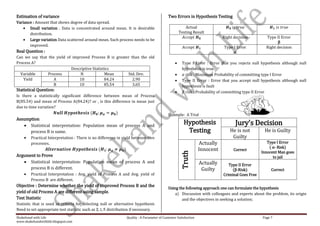
Estimation of variance                                                                      Two Errors in Hypothesis Testing
Variance : Amount that shows degree of data spread.
       Small variation . Data is concentrated around mean. It is desirable                             Actual
       distribution.                                                                               Testing Result
                                                                                                                            Right decision         Type II Error
       Large variation Data scattered around mean. Such process needs to be
                                                                                                                                                         β
       improved.                                                                                                            Type I Error           Right decision
Real Question :                                                                                                                  α
Can we say that the yield of improved Process B is greater than the old
Process A?                                                                                           Type I Error : Error that you rejects null hypothesis although null
                            Descriptive Statistics                                                   hypothesis is true.
  Variable      Process          N             Mean      Std. Dev.                                     risk : Maximum Probability of committing type I Error
   Yield           A            10             84.24        2.90                                     Type II Error : Error that you accept null hypothesis although null
                   B            10             85.54        3.65                                     hypothesis is fault
Statistical Question:                                                                                  risk : Probability of committing type II Error
Is there a statistically significant difference between mean of Process
B(85.54) and mean of Process A(84.24)? or , is this difference in mean just
due to time variation?
                                                                                            Example: A Trial
Assumption
      Statistical interpretation: Population mean of process A and
                                                                                                      Hypothesis                   Jury’s Decision
      process B is same.                                                                               Testing                  He is not         He is Guilty
        Practical Interpretation : There is no difference in yield between two                                                   Guilty
        processes.                                                                                               Actually                           Type I Error
                                                                                                                                                     ( α- Risk)
                                                                                                                 Innocent         Correct
                                                                                                                                                 Innocent Man goes


                                                                                                    Truth
Argument to Prove                                                                                                                                      to jail
      Statistical interpretation: Population mean of process A and                                               Actually      Type II Error
      process B is different.                                                                                     Guilty         (β-Risk)             Correct
        Practical Interpretation : Avg. yield of Process A and Avg. yield of                                                Criminal Goes Free
        Process B are different.
Objective : Determine whether the yield of improved Process B and the
                                                                                            Using the following approach one can formulate the hypothesis
yield of old Process A are different using sample.                                              a) Discussion with colleagues and experts about the problem, its origin
Test Statistic                                                                                      and the objectives in seeking a solution;
Statistic that is used as criteria for selecting null or alternative hypothesis
Need to set appropriate test statistic such as Z, t, F distribution if necessary.
Shakehand with Life                                             Quality : A Parameter of Customer Satisfaction                                   Page 7
www.shakehandwithlife.blogspot.com
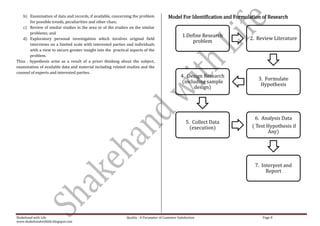
b) Examination of data and records, if available, concerning the problem               Model For Identification and Formulation of Research
       for possible trends, peculiarities and other clues;
   c) Review of similar studies in the area or of the studies on the similar
       problems; and
                                                                                                   1.Define Research
   d) Exploratory personal investigation which involves original field                                                       2. Review Literature
                                                                                                       problem
       interviews on a limited scale with interested parties and individuals
       with a view to secure greater insight into the practical aspects of the
       problem.
Thus , hypothesis arise as a result of a priori thinking about the subject,
examination of available data and material including related studies and the
counsel of experts and interested parties.
                                                                                                  4. Design Research
                                                                                                                                 3. Formulate
                                                                                                  (including sample
                                                                                                                                  Hypothesis
                                                                                                       design)


                                                                                                                                6. Analysis Data
                                                                                                      5. Collect Data
                                                                                                        (execution)           ( Test Hypothesis if
                                                                                                                                     Any)


                                                                                                                               7. Interpret and
                                                                                                                                    Report


Shakehand with Life                                           Quality : A Parameter of Customer Satisfaction                       Page 8
www.shakehandwithlife.blogspot.com
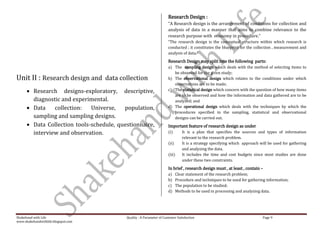
Research Design :
                                                                         “A Research design is the arrangement of conditions for collection and
                                                                         analysis of data in a manner that aims to combine relevance to the
                                                                         research purpose with economy in procedure.”
                                                                         “The research design is the conceptual structure within which research is
                                                                         conducted ; it constitutes the blueprint for the collection , measurement and
                                                                         analysis of data.”
                                                                         Research Design may split into the following parts:
                                                                         a) The sampling design which deals with the method of selecting items to
                                                                            be observed for the given study;
Unit II : Research design and data collection                            b) The observational design which relates to the conditions under which
                                                                            observations are to be made;
          Research designs-exploratory, descriptive,                     c) The statistical design which concern with the question of how many items
                                                                            are to be observed and how the information and data gathered are to be
          diagnostic and experimental.                                      analyzed; and
          Data    collection:   Universe,   population,                  d) The operational design which deals with the techniques by which the
                                                                            procedures specified in the sampling, statistical and observational
          sampling and sampling designs.                                    designs can be carried out.
          Data Collection tools-schedule, questionnaire,                 Important feature of research design as under
          interview and observation.                                     (i)       It is a plan that specifies the sources and types of information
                                                                                   relevant to the research problem.
                                                                         (ii)      It is a strategy specifying which approach will be used for gathering
                                                                                   and analyzing the data.
                                                                         (iii)     It includes the time and cost budgets since most studies are done
                                                                                   under these two constraints.
                                                                         In brief , research design must , at least , contain –
                                                                         a)     Clear statement of the research problem;
                                                                         b)     Procedure and techniques to be used for gathering information;
                                                                         c)     The population to be studied;
                                                                         d)     Methods to be used in processing and analyzing data.


Shakehand with Life                          Quality : A Parameter of Customer Satisfaction                                    Page 9
www.shakehandwithlife.blogspot.com
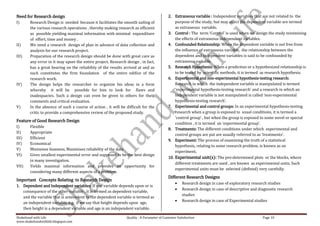
Need for Research design                                                                   2. Extraneous variable : Independent variables that are not related to the
I)      Research Design is needed because it facilitates the smooth sailing of                 purpose of the study, but may affect the dependent variable are termed
        the various research operations , thereby making research as efficient                 as extraneous variable.
        as possible yielding maximal information with minimal expenditure                  3. Control : The term ‘Control’ is used when we design the study minimizing
        of effort, time and money .                                                            the effects of extraneous independent variables.
II)     We need a research design of plan in advance of data collection and                4. Confounded Relationship: When the dependent variable is not free from
        analysis for our research project.                                                     the influence of extraneous variable, the relationship between the
III)    Preparation of the research design should be done with great care as                   dependent and independent variables is said to be confounded by
        any error in it may upset the entire project. Research design , in fact,               extraneous variable.
        has a great bearing on the reliability of the results arrived at and as            5. Research Hypothesis: When a prediction or a hypothesized relationship is
        such constitutes the firm foundation of the entire edifice of the                      to be tested by scientific methods, it is termed as research hypothesis.
        research work.                                                                     6. Experimental and non-experimental hypothesis-testing research:
IV)     The design helps the researcher to organize his ideas in a form                        Research in which the independent variable is manipulated is termed
        whereby it will be possible for him to look for flaws and                              ‘experimental hypothesis-testing research’ and a research in which an
        inadequacies. Such a design can even be given to others for their                      independent variable is not manipulated is called ‘non-experimental
        comments and critical evaluation.                                                      hypothesis-testing research’.
V)      In the absence of such a course of action , it will be difficult for the           7. Experimental and control groups: In an experimental hypothesis-testing
        critic to provide a comprehensive review of the proposed study.                        research when a group is exposed to usual conditions, it is termed a
                                                                                               ‘control group’ , but when the group is exposed to some novel or special
Feature of Good Research Design
                                                                                               condition , it is termed an ‘experimental group’.
I)      Flexible
                                                                                           8. Treatments: The different conditions under which experimental and
II)     Appropriate
                                                                                               control groups are put are usually referred to as ‘treatments’.
III)    Efficient
                                                                                           9. Experiment: The process of examining the truth of a statistical
IV)     Economical
                                                                                               hypothesis, relating to some research problem, is known as an
V)      Minimises biasness, Maximises reliability of the data
                                                                                               experiment.
VI)     Gives smallest experimental error and supposed to be the best design
                                                                                           10. Experimental unit(s): The pre-determined plots or the blocks, where
        in many investigation.
                                                                                               different treatments are used , are known as experimental units. Such
VII)    Yields maximal information and provides an opportunity for
                                                                                               experimental units must be selected (defined) very carefully.
        considering many different aspects of a problem.
                                                                                           Different Research Designs
Important Concepts Relating to Research Design
                                                                                                    Research design in case of exploratory research studies
1. Dependent and Independent variables: If one variable depends upon or is
                                                                                                    Research design in case of descriptive and diagnostic research
   consequence of the other variable , it is termed as dependent variable,
                                                                                                    studies
   and the variable that is antecedent to the dependent variable is termed as
   an independent variable. e.g. if we say that height depends upon age,                            Research design in case of Experimental studies
   then height is a dependent variable and age is an independent variable.

Shakehand with Life                                            Quality : A Parameter of Customer Satisfaction                                    Page 10
www.shakehandwithlife.blogspot.com
Research design in case of exploratory research studies                                    transition from one stage to another, the reactions of individuals from
        Exploratory research studies are also termed as formulative research               different social strata and the like.
studies. The main purpose of such studies is that of formulating a problem for             Research design in case of descriptive and diagnostic research studies:
more precise investigation or of developing the working hypotheses from an
                                                                                           Descriptive research studies are those studies which are concerned with
operational point of view. The major emphasis in such studies is on the
                                                                                           describing the characteristics of a particular individual, or of a group. The
discovery of ideas and insights.
                                                                                           studies concerned with specific predictions, with narration of facts and
Generally, the following three methods in the context of research design for               characteristics concerning individual, group or situation all are examples of
such studies are talked about:                                                             descriptive research studies. Most of the social research comes under this
                                                                                           category.
a) The survey of concerning literature: It happens to be the most simple and
                                                                                            Diagnostics research     studies determine the frequency with which
   fruitful method of formulating precisely the research problem or
                                                                                           something occurs or its association with something else. The studies
   developing hypothesis. Hypothesis stated by earlier workers may be
                                                                                           concerning whether certain variables are associated are examples of
   reviewed and their usefulness be evaluated as a basis for further
                                                                                           diagnostic research studies.
   research. It may also be considered whether the already stated
                                                                                           From the point of view of the research design, the descriptive as well as
   hypothesis suggest new hypothesis. In this way the researcher should
                                                                                           diagnostic studies share common requirements and as such we may group
   review and build upon the work already done by others, but in cases
                                                                                           together these two types of research studies. In descriptive as well as in
   where hypotheses have not yet been formulated , his task is to review the
                                                                                           diagnostic studies, the researcher must be able to define clearly, what he
   available material for deriving the relevant hypothesis from it.
                                                                                           wants to measure and find adequate methods for measuring it along with a
b) Experience Survey : Experience survey means the survey of people who
                                                                                           clear cut definition of ‘population’ he wants to study. Since the aim is to
   have had practical experience with the problem to be studied. The object
                                                                                           obtain complete and accurate information in the said studies, the procedure
   of such a survey is to obtain insight into the relationships between
                                                                                           to be used must be carefully planned. The research design must make
   variables and new ideas relating to the research problem. For such a
                                                                                           enough provision for protection against bias and must maximize reliability,
   survey people who are competent and can contribute new ideas may be
                                                                                           with due concern for the economical completion of the research study. The
   carefully selected as respondents to ensure a representation of different
                                                                                           design in such studies must be rigid and not flexible and must focus attention
   types of experience. The respondents so selected may then be
                                                                                           on the following :
   interviewed by the investigator.
                                                                                               a) Formulating the objective of the study (what the study is about and
Analysis of Insight stimulating examples: It is also a fruitful method for                        why is it being made?)
suggesting method consists of the intensive study of selected instances of the                 b) Designing the methods of data collection (what techniques of
phenomenon in which one is interested. For this purpose the existing                              gathering data will be adopted?)
records, if any, may be examined, the unstructured interviewing may take                       c) Selecting the sample (how much material will be needed?)
place , or some other approach may be adopted. One can mention few                             d) Collecting the data (where can the required data be found and with
examples of ‘insight- stimulating’ cases such as the reactions of strangers, the                  what time period should the data be related?)
reactions of marginal individuals, the study of individuals who are in                         e) Processing and analyzing the data.
                                                                                               f) Reporting the findings.
Shakehand with Life                                            Quality : A Parameter of Customer Satisfaction                                   Page 11
www.shakehandwithlife.blogspot.com
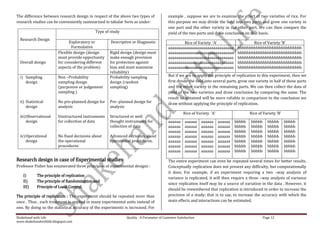
The difference between research design in respect of the above two types of               example , suppose we are to examine the effect of two varieties of rice. For
research studies can be conveniently summarized in tabular form as under:                 this purpose we may divide the field into two parts and grow one variety in
                                                                                          one part and the other variety in the other part. We can then compare the
                                             Type of study                                yield of the two parts and draw conclusion on that basis.
  Research Design
                               Exploratory or        Descriptive or Diagnostic                    Rice of Variety ‘A’                      Rice of Variety ‘B’
                                Formulative                                               aaaaaaaaaaaaaaaaaaaaaaaaaaaaaaaa          bbbbbbbbbbbbbbbbbbbbbbbbbbbb
                         Flexible design (design     Rigid design (design must            aaaaaaaaaaaaaaaaaaaaaaaaaaaaaaaa          bbbbbbbbbbbbbbbbbbbbbbbbbbbb
                         must provide opportunity    make enough provision                aaaaaaaaaaaaaaaaaaaaaaaaaaaaaaaa          bbbbbbbbbbbbbbbbbbbbbbbbbbbb
  Overall design         for considering different   for protection against               aaaaaaaaaaaaaaaaaaaaaaaaaaaaaaaa          bbbbbbbbbbbbbbbbbbbbbbbbbbbb
                         aspects of the problem)     bias and must maximize               aaaaaaaaaaaaaaaaaaaaaaaaaaaaaaaa          bbbbbbbbbbbbbbbbbbbbbbbbbbbb
                                                     reliability)
  i) Sampling            Non –Probability            Probability sampling                 But if we are to apply the principle of replication to this experiment, then we
     design              sampling design             design (random                       first divide the field into several parts, grow one variety in half of these parts
                         (purposive or judgement     sampling)                            and the other variety in the remaining parts. We can then collect the data of
                         sampling )                                                       yield of the two varieties and draw conclusion by comparing the same. The
                                                                                          result so obtained will be more reliable in comparison to the conclusion we
  ii) Statistical        No pre-planned design for   Pre- planned design for              draw without applying the principle of replication.
      design             analysis                    analysis
                                                                                                    Rice of Variety ‘A’                    Rice of Variety ‘B’
  iii) Observational     Unstructured instruments    Structured or well
       design            for collection of data      thought instruments for              aaaaaa     aaaaaa    aaaaaa     aaaaaa   bbbbb   bbbbb     bbbbb       bbbbb
                                                     collection of data                   aaaaaa     aaaaaa    aaaaaa     aaaaaa   bbbbb   bbbbb     bbbbb       bbbbb
                                                                                          aaaaaa     aaaaaa    aaaaaa     aaaaaa   bbbbb   bbbbb     bbbbb       bbbbb
  iv) Operational        No fixed decisions about    Advanced decisions about             aaaaaa     aaaaaa    aaaaaa     aaaaaa   bbbbb   bbbbb     bbbbb       bbbbb
      design             the operational             operational procedures.              aaaaaa     aaaaaa    aaaaaa     aaaaaa   bbbbb   bbbbb     bbbbb       bbbbb
                         procedures                                                       aaaaaa     aaaaaa    aaaaaa     aaaaaa   bbbbb   bbbbb     bbbbb       bbbbb
                                                                                          aaaaaa     aaaaaa    aaaaaa     aaaaaa   bbbbb   bbbbb     bbbbb       bbbbb

Research design in case of Experimental studies                                           The entire experiment can even be repeated several times for better results.
Professor Fisher has enumerated three principles of experimental designs :                Conceptually replication does not present any difficulty, but computationally
                                                                                          it does. For example, if an experiment requiring a two –way analysis of
    I)      The principle of replication
                                                                                          variance is replicated, it will then require a three –way analysis of variance
    II)     The principle of Randomization and
                                                                                          since replication itself may be a source of variation in the data . However, it
    III)    Principle of Local Control.
                                                                                          should be remembered that replication is introduced in order to increase the
The principle of replication : The experiment should be repeated more than                precision of a study; that is to say, to increase the accuracy with which the
once . Thus , each treatment is applied in many experimental units instead of             main effects and interactions can be estimated.
one. By doing so the statistical accuracy of the experiments is increased. For

Shakehand with Life                                           Quality : A Parameter of Customer Satisfaction                                       Page 12
www.shakehandwithlife.blogspot.com
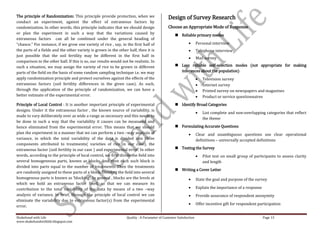
The principle of Randomization: This principle provide protection, when we                    Design of Survey Research
conduct an experiment, against the effect of extraneous factors by
randomization. In other words, this principle indicates that we should design                 Choose an Appropriate Mode of Response
or plan the experiment in such a way that the variations caused by                                 Reliable primary modes
extraneous factors can all be combined under the general heading of
“chance.” For instance, if we grow one variety of rice , say, in the first half of                                 Personal interview
the parts of a fields and the other variety is grown in the other half, then it is                                 Telephone interview
just possible that the soil fertility may be different in the first half in
                                                                                                                   Mail survey
comparison to the other half. If this is so, our results would not be realistic. In
such a situation, we may assign the variety of rice to be grown in different                       Less reliable self-selection modes (not appropriate for making
parts of the field on the basis of some random sampling technique i.e. we may                       inferences about the population)
apply randomization principle and protect ourselves against the effects of the                                        Television survey
extraneous factors (soil fertility differences in the given case). As such,                                           Internet survey
through the application of the principle of randomization, we can have a                                              Printed survey on newspapers and magazines
better estimate of the experimental error.                                                                            Product or service questionnaires
Principle of Local Control : It is another important principle of experimental                     Identify Broad Categories
designs. Under it the extraneous factor , the known source of variability, is
                                                                                                                      List complete and non-overlapping categories that reflect
made to vary deliberately over as wide a range as necessary and this needs to
                                                                                                                      the theme
be done in such a way that the variability it causes can be measured and
hence eliminated from the experimental error. This means that we should                            Formulating Accurate Questions
plan the experiment in a manner that we can perform a two –way analysis of                                         Clear and unambiguous questions use clear operational
variance, in which the total variability of the data is divided into three                                         definitions – universally accepted definitions
components attributed to treatments( varieties of rice in our case), the
extraneous factor (soil fertility in our case ) and experimental error. In other                   Testing the Survey
words, according to the principle of local control, we first divide the field into                                    Pilot test on small group of participants to assess clarity
several homogeneous parts, known as blocks, and then each such block is                                               and length
divided into parts equal to the number of treatments. Then the treatments
                                                                                                   Writing a Cover Letter
are randomly assigned to these parts of a block. Dividing the field into several
homogenous parts is known as ‘blocking’. In general , blocks are the levels at                                     State the goal and purpose of the survey
which we hold an extraneous factor fixed, so that we can measure its
contribution to the total variability of the data by means of a two –way                                           Explain the importance of a response
analysis of variance. In brief, through the principle of local control we can                                      Provide assurance of respondent anonymity
eliminate the variability due to extraneous factor(s) from the experimental
                                                                                                                   Offer incentive gift for respondent participation
error.

Shakehand with Life                                               Quality : A Parameter of Customer Satisfaction                                          Page 13
www.shakehandwithlife.blogspot.com
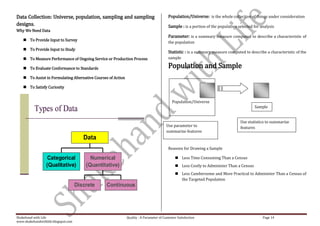
Data Collection: Universe, population, sampling and sampling                               Population/Universe: is the whole collection of things under consideration
designs.                                                                                   Sample : is a portion of the population selected for analysis
Why We Need Data
                                                                                           Parameter: is a summary measure computed to describe a characteristic of
     To Provide Input to Survey
                                                                                           the population
     To Provide Input to Study
                                                                                           Statistic : is a summary measure computed to describe a characteristic of the
     To Measure Performance of Ongoing Service or Production Process                      sample

     To Evaluate Conformance to Standards                                                 Population and Sample
     To Assist in Formulating Alternative Courses of Action

     To Satisfy Curiosity


                                                                                             Population/Universe
                                                                                                                                            Sample
          Types of Data
                                                                                                                                    Use statistics to summarize
                                                                                         Use parameter to                           features
                                                                                         summarize features
                                        Data
                                                                                           Reasons for Drawing a Sample

                   Categorical             Numerical                                            Less Time Consuming Than a Census
                  (Qualitative)          (Quantitative)                                         Less Costly to Administer Than a Census
                                                                                                Less Cumbersome and More Practical to Administer Than a Census of
                                                                                                 the Targeted Population
                                     Discrete    Continuous


Shakehand with Life                                            Quality : A Parameter of Customer Satisfaction                                    Page 14
www.shakehandwithlife.blogspot.com
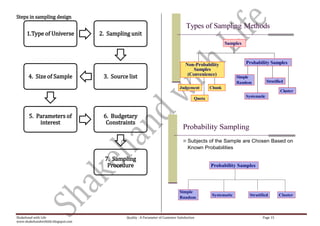
Steps in sampling design
                                                                                       Types of Sampling Methods
      1.Type of Universe             2. Sampling unit
                                                                                                            Samples


                                                                                      Non-Probability                 Probability Samples
                                                                                          Samples
                                                                                       (Convenience)
       4. Size of Sample              3. Source list                                                             Simple
                                                                                                                 Random            Stratified
                                                                                   Judgement        Chunk
                                                                                                                                           Cluster
                                                                                                                      Systematic
                                                                                            Quota


       5. Parameters of               6. Budgetary
           interest                    Constraints
                                                                                     Probability Sampling
                                                                                      Subjects of the Sample are Chosen Based on
                                                                                        Known Probabilities

                                       7. Sampling
                                        Procedure                                                   Probability Samples


                                                                                  Simple
                                                                                                    Systematic         Stratified         Cluster
                                                                                  Random


Shakehand with Life                            Quality : A Parameter of Customer Satisfaction                                 Page 15
www.shakehandwithlife.blogspot.com
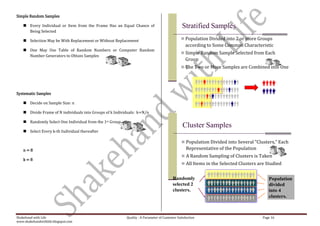
Simple Random Samples

     Every Individual or Item from the Frame Has an Equal Chance of                            Stratified Samples
      Being Selected

     Selection May be With Replacement or Without Replacement                                  Population Divided into 2 or more Groups
                                                                                                  according to Some Common Characteristic
     One May Use Table of Random Numbers or Computer Random
                                                                                                Simple Random Sample Selected from Each
      Number Generators to Obtain Samples
                                                                                                  Group
                                                                                                The Two or More Samples are Combined into One


Systematic Samples

     Decide on Sample Size: n

     Divide Frame of N individuals into Groups of k Individuals: k=N/n

     Randomly Select One Individual from the 1st Group
                                                                                                Cluster Samples
     Select Every k-th Individual thereafter

                                                                                                 Population Divided into Several “Clusters,” Each
    n=8                                                                                            Representative of the Population
                                                                                                 A Random Sampling of Clusters is Taken
    k=8
                                                                                                 All Items in the Selected Clusters are Studied


                                                                                          Randomly                                        Population
                                                                                          selected 2                                      divided
                                                                                          clusters.                                       into 4
                                                                                                                                          clusters.


Shakehand with Life                                        Quality : A Parameter of Customer Satisfaction                              Page 16
www.shakehandwithlife.blogspot.com
Advantages and Disadvantages

     Simple Random Sample & Systematic Sample
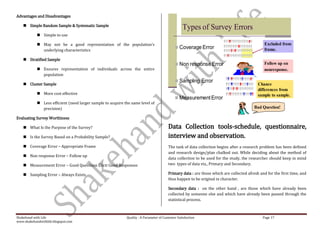
                                                                                                  Types of Survey Errors
             Simple to use

             May not be a good representation of the population’s                                                                              Excluded from
              underlying characteristics
                                                                                              Coverage Error                                   frame.

     Stratified Sample
                                                                                              Non response Error                              Follow up on
             Ensures representation of individuals across the entire                                                                          nonresponse.
              population
                                                                                              Sampling Error
     Cluster Sample                                                                                                                        Chance
                                                                                                                                            differences from
             More cost effective                                                                                                           sample to sample.
                                                                                              Measurement Error
             Less efficient (need larger sample to acquire the same level of
              precision)                                                                                                                  Bad Question!

Evaluating Survey Worthiness

     What Is the Purpose of the Survey?                                                 Data Collection tools-schedule, questionnaire,
     Is the Survey Based on a Probability Sample?                                       interview and observation.
     Coverage Error – Appropriate Frame                                                 The task of data collection begins after a research problem has been defined
                                                                                         and research design/plan chalked out. While deciding about the method of
     Non response Error – Follow up
                                                                                         data collection to be used for the study, the researcher should keep in mind
     Measurement Error – Good Questions Elicit Good Responses                           two types of data viz., Primary and Secondary.

     Sampling Error – Always Exists                                                     Primary data : are those which are collected afresh and for the first time, and
                                                                                         thus happen to be original in character.

                                                                                         Secondary data : on the other hand , are those which have already been
                                                                                         collected by someone else and which have already been passed through the
                                                                                         statistical process.


Shakehand with Life                                          Quality : A Parameter of Customer Satisfaction                                    Page 17
www.shakehandwithlife.blogspot.com
The methods of collecting primary and secondary data differ since primary                  Merits of observation Method
data are to be originally collected , while in case of secondary data the nature               1. Subjective biasness is eliminated by using this method if observation
of data collection work is merely that of compilation.                                            is done accurately.
                                                                                               2. The information obtained under this method relates to what is
We below try to understand the tools of data collection with merits and
                                                                                                  currently happening; it is not complicated by either the past behavior
demerits of each tool.
                                                                                                  or future intentions or attitudes.
                                                                                               3. This method is independent of respondents’ willingness to respond
Observation Method                                                                                and as such is relatively less demanding of active cooperation on the
Under observation method, the information is sought by way of investigator’s                      part of respondents as happens to be the case in the interview or the
own direct observation without asking from the respondent. For instance, in                       questionnaire method.
a study relating to consumer behavior, the investigator instead of asking the                  4. This method is particularly suitable in studies which deal with
brand of wrist watch used by the respondent, may himself look at the watch.                       subjects (i.e. respondents) who are not capable of giving verbal
                                                                                                  reports of their feeling for one reason or the other.
Types of Observation
      Structured observation : In case the observation is characterized by a               Demerits of observation Method
      careful definition of the units to be observed, the style of recording the               1. It is an expensive method.
      observed information , standardized conditions of observation and the
                                                                                               2. The information provided by this method is very limited.
      selection of pertinent data of observation, then the observation is called
      as structured observation.                                                               3. Sometime unforeseen factors may interfere with the observational
      Unstructured observation : When observation is to take place without                        task.
      these characteristics to be thought of in advance, the same is termed as                 4. Sometimes , some people are rarely accessible to direct observation
      unstructured observation.                                                                   creates obstacle for this method to collect data effectively.
      Participant observation : If the observer observes by making himself,
      more or less, a member of the group he is observing so that he can                   Interview Method
      experience what the members of the group experience , the observation
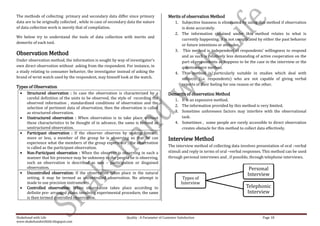
      is called as the participant observation.                                            The interview method of collecting data involves presentation of oral –verbal
      Non-Participant observation : When the observer is observing in such a               stimuli and reply in terms of oral –verbal responses. This method can be used
      manner that his presence may be unknown to the people he is observing,               through personal interviews and , if possible, through telephone interviews.
      such an observation is described as non – participation or disguised
      observation.                                                                                                                      Personal
      Uncontrolled observation: If the observation takes place in the natural                                                          Interview
      setting, it may be termed as uncontrolled observation. No attempt is                          Types of
      made to use precision instruments.                                                           Interview
      Controlled observation: When observation takes place according to                                                               Telephonic
      definite pre- arranged plans, involving experimental procedure, the same                                                         Interview
      is then termed controlled observation.


Shakehand with Life                                            Quality : A Parameter of Customer Satisfaction                                  Page 18
www.shakehandwithlife.blogspot.com
Personal Interview                                                                            beliefs and of the frame of reference within which such feelings and
Personal interview method requires a person known as the interviewer                          beliefs take on personal significance.
asking questions generally in a face to face contact to the other person or               Major Advantages of Personal interview
persons.( At times the interviewee may also ask certain questions and the                 1) More information and that too in greater depth can be obtained.
interviewer responds to these, but usually the interviewer initiates then                 2) Interviewer by his own skill can overcome the resistance, if any, of the
interview and collects the information.)                                                     respondents.
Types of personal Interview                                                               3) Greater flexibility.
a) Structured Interview : Such interviews involve the use of a set of                     4) Observation method can as well be applied to recording verbal answers
   predetermined questions and of highly standardized techniques of                          to various questions.
   recording . Thus, the interviewer in a structured interview follows a rigid            5) Personal information can as well be obtained easily under this method.
   procedure laid down, asking questions in a form and order prescribed.                  6) Samples can be controlled more effectively as there arises no difficulty of
b) Unstructured Interview: are characterized by a flexibility of approach to                 the missing returns; non –response generally remains very low.
   questioning. Unstructured interviews do not follow a system of pre –                   7) Group discussions may also be held.
   determined      questions and standardized techniques of recording                     8) The language of the interview can be adopted to the ability or educational
   information. In a non –structured interview, the interviewer is allowed                   level of the person interviewed.
   much greater freedom to ask, in case of need, supplementary questions                  9) The interviewer can collect supplementary information about the
   or at times he may omit certain questions if the situation so requires. He                respondent’s personal characteristics and environment which is often of
   may even change the sequence of questions. He has relatively greater                      great value in interpreting results.
   freedom while recording the responses to include some aspects and
                                                                                          Weaknesses of Personal Interview
   exclude others.
                                                                                          1) It is very expensive method, especially when large and widely spread
c) Focused Interview: is meant to focus attention on the given experience of
                                                                                             geographical sample is taken.
   the respondent and its effects. The main task of the interviewer in case of
                                                                                          2) There remains the possibility of the bias of interviewer as well as that of
   a focused interview is to confine the respondent to a discussion of issues
                                                                                             the respondent; there also remains the headache of supervision and
   with which he seeks conversance. Such interviews are used generally in
                                                                                             control of interviewers.
   the development of hypothesis and constitute a major type of
                                                                                          3) Certain types of respondents such as important officials or executives or
   unstructured interviews.
                                                                                             people in high income groups may not be easily approachable under this
d) Clinical Interview: is concerned with broad underlying feelings or
                                                                                             method and to that extent the data may prove inadequate.
   motivations or with the course of individual’s life experience. The method
                                                                                          4) This method is relatively more –time –consuming, especially when the
   of eliciting information under it is generally left to the interviewer‘s
                                                                                             sample is large and recalls upon the respondents are necessary.
   discretion.
                                                                                          5) The presence of the interviewer on the spot may over stimulate the
e) Non –directive Interview: In this case, the interviewer’s function is
                                                                                             respondent, sometimes even to the extent that he may give imaginary
   simply to encourage the respondent to talk about the given topic with a
                                                                                             information just to make the interview interesting.
   bare minimum of direct questioning. The interviewer often acts as a
   catalyst to a comprehensive expression of the respondents’ feelings and

Shakehand with Life                                           Quality : A Parameter of Customer Satisfaction                                   Page 19
www.shakehandwithlife.blogspot.com
6) Under the interview method the organization required for selecting ,                    Questionnaire Method
   training and supervising the field –staff is more complex with formidable               This method of data collection is quite popular , particularly in case of big
   problems.                                                                               enquiries. It is being adopted by private individuals , research workers ,
7) Interviewing at times may also introduce systematic errors.                             private and public organizations and even by governments . In this method a
8) Effective interview presupposes proper rapport with respondents that                    questionnaire is sent (usually by post) to the persons concerned with a
   would facilitate free and frank responses. This is often a very difficult               request to answer the questions and return the questionnaire. A
   requirement.                                                                            questionnaire consists of a number of questions printed or typed in a definite
Telephonic Interview                                                                       order on a form or set or forms . The questionnaire is mailed to respondents
This method of collecting information consists in containing respondents on                who are expected to read and understand the questions and write down the
telephone itself. It is not a very widely used method, but plays important part            reply in the space meant for the purpose in the questionnaire itself. The
in industrial surveys, particularly in developed regions.                                  respondents have to answer the questions on their own.
Chief merits of this method
                                                                                           Three main aspects of a questionnaire
1) More flexible than mailing method.
2) Faster than other methods.                                                              1. General form
3) Cheaper than personal interviewing method                                               2. Question Sequence
4) Recall is easy; callbacks are simple and economical.                                    3. Question formulation and wording
5) There is a higher rate of response than what we have in mailing method;                 General form:
6) Replies can be recorded without causing embarrassment to respondents.                   It can either be structured or unstructured questionnaire. Structured
7) Interviewer can explain requirements more easily.                                       questionnaire are those questionnaire in which there are definite, concrete
8) At times, access can be gained to respondents who otherwise cannot be                   and pre –determined questions. The questions are presented with exactly the
     contacted for one reason or the other.                                                same wording and in the same order to all respondents. Resorts is taken to
9) No field staff is required.                                                             this sort of standardization to ensure that all respondents reply to the same
10) Representative and wider distribution of sample is possible.                           set of questions. The form of the questions may be either closed (i.e. of the
Drawbacks of this method                                                                   type ‘yes’ or ‘no’ ) or open (i.e. inviting free response) but should be stated in
1) Little time is given to respondents for considered answers; interview                   advance and not constructed during questioning. When these characteristics
     period is not likely to exceed five minutes in most cases.                            are not present in a questionnaire , it can be termed as unstructured
2) Surveys are restricted to respondents who have telephone facilities.                    questionnaire. More specifically, we can say that in an unstructured
3) Extensive geographical coverage may get restricted by cost                              questionnaire, the interviewer is provided with a general guide on the type of
     considerations.                                                                       information to be obtained , but the exact question formulation is largely his
4) It is not suitable for intensive surveys where comprehensive answers are                own responsibility and the replies are to be taken down in the respondent’s
     required to various questions.                                                        own words to the extent possible; in some situations tape recorders may be
5) Possibility of the bias of the interviewer is relatively more.                          used to achieve this goal.
6) Questions have to be short and to the point ; probes are difficult to
     handle.

Shakehand with Life                                            Quality : A Parameter of Customer Satisfaction                                      Page 20
www.shakehandwithlife.blogspot.com
Question Sequence                                                                         Wording of the questions:
The question –sequence must be clear and smoothly –moving , meaning                           Researcher must pay proper attention to the wordings of questions since
thereby that the relation of one question to another should be readily                        reliable and meaningful returns depend on it to a large extent.
apparent to the respondent, questions that are easiest to answer being put in                 Since words are likely to affect responses, they should be properly
the beginning. The first few questions are particularly important because                     chosen.
they are likely to influence the attitude of the respondent and in seeking his                Simple words, which are familiar to all respondents should be employed.
desired cooperation. The opening question should be such as to arouse                         Words with ambiguous meaning must be avoided.
human interest. The following type of questions should generally be avoided                   Similarly, danger words, catch –words or words with emotional
as opening question in a questionnaire ;                                                      connotations should be avoided.
1. Question that put too great a strain on the memory or intellect of the                     Caution must also be exercised in the use if phrases which reflects upon
    respondent;                                                                               the prestige of the respondent.
2. Question of a personal character;                                                          Question wording no case , should bias the answer. In fact, question
3. Question related to personal wealth, etc.                                                  wording and formulation is an art and can only be learnt by practice.
Question sequence should usually go from the general to the more specific
and the researcher must always remember that the answer to a given                        Essentials of a good Questionnaire:
question is a function not only of the question itself, but of all previous
                                                                                              Size of the questionnaire should be kept to the minimum.
questions as well. For instance, if one question deals with the price usually
paid for coffee and the next with reason for preferring that particular brand,                Questions should proceed in logical sequence moving from easy to more
the answer to this latter question may be couched largely in terms of price                   difficult questions.
differences.                                                                                  Personal and intimate questions should be left to the end.
Question formulation and wording:                                                             Technical terms and vague expressions capable of different
With regard to this aspect of questionnaire, the researcher should note that                  interpretations should be avoided in a questionnaire.
all questions should meet the following standards –                                           Questions may be dichotomous (yes or no answers), multiple choice
a) Should be easily understood                                                                (alternative answers listed) or open –ended. The latter type of questions
b) Should be simple i.e. should convey only one thought at a time;                            are often difficult to analyze and hence should be avoided in a
c) Should be concrete and conform as much as possible to the respondent’s                     questionnaire to the extent possible.
     way of thinking ( for instance , instead of asking, “How many pens do you                There should be some control questions into questionnaire which
     use annually?” The more realistic question would be to ask, “How many                    indicate the reliability of the respondent.
     pens did you use last week?”)                                                            Questions affecting the sentiments of respondents should be avoided.
Concerning the form of questions, we can talk about two principal forms viz.,                 Adequate space for answers should be provide in the questionnaire to
     Multiple choice questions: respondents selects one of the alternative                    help editing and tabulation.
     possible answers put to him.                                                             Finally, the physical appearance of the questionnaire affects the
     Open ended questions: Respondents supply the answer in his own words .                   cooperation the researcher receives from the recipient and as such an
The question with only two possible answers (usually ‘Yes’ or ‘No’) can be                    attractive looking questionnaire, particularly in mail surveys, is plus
taken as a special case of the multiple choice question, or can be named as a                 point for enlisting cooperation.
‘closed question’.                                                                            The quality of paper, along with its color must be good so that it may
                                                                                              attract the attention of recipients.

Shakehand with Life                                           Quality : A Parameter of Customer Satisfaction                                  Page 21
www.shakehandwithlife.blogspot.com
“It is better to know some of the questions than all of the answer.”                     big organizations. Population census all over the world is conducted through
                                                                                           this method.
   Session improve participants’
                                                                                           Difference Between Questionnaire and Schedules
           Ability to put a good Questions.                                                From the technical point of view there is considerable difference between
           Ability of public speaking.                                                     the two. The important point of difference are as under:
           Ability To find out a root cause of a problem.                                  1. The questionnaire is generally sent through mail to informants to be
           Ability of Group discussion.                                                        answered as specified in a covering letter. The schedule is generally filled
           Ability to work as team member.                                                     out by the research worker or the enumerator.
Collection of data through Schedules                                                       2. To collect data through questionnaire is relatively cheap and economical
This method of data collection is very much like the collection of data                        in comparison of schedules. Considerable amount of money has to be
                                                                                               spent in appointing enumerator and in importing training to them.
through questionnaire, with little difference which lies in the fact that
                                                                                               Money is also spent in preparing schedules.
schedules (proforma containing a set of questions) are being filled in by the              3. Non- response is usually high in case of questionnaire method. Bias due
enumerators who are specially appointed for the purpose. These                                 to non-response often remains indeterminate. Non response is generally
enumerators along with schedules, go to respondents, put to them the                           very low in case of schedules. But there remains the danger of
questions from the proforma in the order the questions are listed and record                   interviewer bias and cheating.
the replies in the space meant for the same in the proforma. In certain                    4. Identity of respondent is not clear in case of questionnaire.
situations, schedules may be handed over to respondents and enumerators                    5. Questionnaire method is likely to be very slow in comparison of
                                                                                               schedules as they are filled in by enumerators.
may help them in recording their answers to various questions in the said
                                                                                           6. Personal contact is not possible in case of questionnaire method. But in
schedules. Enumerators explain the aims and objects of the investigation and                   case of schedules direct personal contact is established with respondents.
also remove the difficulties which any respondent may feel in understanding                7. Questionnaire method can be used only when respondents are literate
the implications of a particular question of the definition or concept of                      and cooperative. But in case of schedules the information can be gathered
difficult terms.                                                                               even when the respondents happen to be illiterate.
This method requires the selection of enumerators for filling up schedules or              8. Wider and more representative distribution of sample is possible under
assisting respondents to fill up schedules and as such enumerators should be                   the questionnaire method. But in respect of schedules there usually
                                                                                               remains the difficulty in sending enumerators over a relatively wide area.
very carefully selected. The enumerators should be trained to perform their
                                                                                           9. The information collected through schedules is relatively more accurate
job well and the nature and scope of the investigation should be explained to                  than that obtained through questionnaires, as enumerators can remove
them thoroughly so that they may well understand the implications of                           the difficulties, if any, faced by respondents and help in correctly
different questions put in schedule . Enumerators should be intelligent and                    understanding the questions.
must possess the capacity of cross examination in order to find out the truth.             10. The success of questionnaire method lies more on the quality of the
Above all, they should be honest, sincere , hardworking and should have                        questionnaire itself, but in the case of schedules much depends upon the
                                                                                               honesty and competence of enumerators.
patience and perseverance.
                                                                                           11. In order to attract the attention of respondents, the physical appearance
This method of data collection is very useful in extensive enquiries and can                   of questionnaire must be quite attractive, but this may not be so in case of
lead to fairly reliable results, It is , however, very expensive and is usually                schedules as they are to be filled in by enumerators and not by
adopted in investigations conducted by governmental agencies of by some                        respondents.
                                                                                           12. Along with schedules, observation method can also be used but such a
                                                                                               thing is not possible while collecting data through questionnaires.
Shakehand with Life                                            Quality : A Parameter of Customer Satisfaction                                    Page 22
www.shakehandwithlife.blogspot.com
Technically speaking ,(measurement is a process of mapping aspects of a
                                                                 domain onto other aspects of a range according to some rule of
                                                                 correspondence . In measuring, we devise some form of scale in the range (in
                                                                 terms of set theory ,range may refer to some set) and then transform or ,map
                                                                 the properties of objects from the domain (in terms of set theory , domain
                                                                 may refer to some other set)onto this scale. For example , in case we are to
                                                                 find the male to female attendance ratio while conducting a study of persons

Unit III : Scaling Techniques                                    who attend some show , then we may tabulate those who come to the show
                                                                 according to sex. In terms of set theory, this process is one of mapping the
                                                                 observed physical properties of those coming to the show (the domain) on to
        Need for scaling, problems of                            a sex classification (the range ).The rule of correspondence is: if the object in
                                                                 the domain appears to be male m assign to “0”and if female assign to “1”.
        scaling, reliability and validity of                     Similarly , we record a person’s marital status as 1, 2, 3 or 4, depending on
                                                                 whether the person is single, married , widowed or divorced.
        scales.                                                  Scaling :
        Scale construction techniques-                           Scaling describes the procedure of assigning numbers to various degrees of
                                                                 opinion, attitude and other concepts this can be done in two ways

        Arbitrary approach, consensus                            i)      Making a judgment about some characteristics of an individual and
                                                                         then placing him directly on a scale that has been defined in terms of
                                                                         that characteristics
        scale approach ( Thurston), Item                         ii)     Constructing questionnaires in such a way that the score of
                                                                         individual’s response assigns him place on a scale.
        analysis approach (Likert) and                           Or
                                                                 Scaling is defined as “procedure for the assignment of numbers ( or that
        cumulative scales ( Gut man’s                            other symbols ) to a property of objects in order to impart some of the
                                                                 characteristics of numbers to the properties in question”
        Scalogram)


Shakehand with Life                  Quality : A Parameter of Customer Satisfaction                                     Page 23
www.shakehandwithlife.blogspot.com
Measurement Scales                                                                       2. Ordinal Scale
The most widely used classification of measurement scales are                            The ordinal scale places event in order, but there is no attempt to make the
                                                                                         intervals of the scale equal in terms of rule. Ordinal scales only permit the
                                                                                         ranking of items from highest to lowest median is used for measure. For
                                                                                         instance , if Ram’s position in his class is 10 and Mohan’s position is 40, it
                                                                                         cannot be said that Ram’s position is four times as good as that of Mohan. The
                                       1.Nominal
                                         Scale                                           statement would make no sense at all. The use of an ordinal scale implies a
                                                                                         statement of ‘greater than’ or ‘less than’ (an equality statement is also
                                                                                         acceptable ) without our being able to state how much greater or less. The
                                                                                         real difference between ranks 1 and 2 may be more or less than the
                                                                                         difference between ranks 5 and 6. Since the numbers of this scale have only a
                          4.Ratio    Measurement        2.Ordinal
                                        Scale                                            rank meaning , the appropriate measure of central tendency is the median.
                           Scale                          Scale

                                                                                         3. Interval Scale
                                                                                         The intervals are adjusted in terms of some rule that has been established as
                                                                                         a basis for making the units equal. The units are equal only in so far as one
                                       3.Interval                                        accepts the assumptions on which the rule is based. Interval scale can have
                                          Scale                                          an arbitrary zero, but it is not possible to determine for them what may be
                                                                                         called an absolute zero or the unique origin. The primary limitation of the
                                                                                         interval scale is the lack of true Zero ; it does not have the capacity to
                                                                                         measure the complete absence of a trait or characteristic. The Fahrenheit
1. Nominal Scale:
                                                                                         scale is an example of an interval scale and shows similarities in what one
Nominal scale is simply a system of assigning number symbols to events in
                                                                                         can and cannot do with it. One can say that an increase in temperature from
order to label them. The usual example of this is the assignment of numbers
of basketball players in order to identify them . Nominal scales provide                 300 to 400 involves the same increase in temperature as an increase from 600
convenient ways of keeping track of people, objects and events. One cannot               to 700 but one cannot say that the temperature of 600 is twice as warm as the
do much with the numbers involved . Nominal scale is the least powerful                  temperature of 300 because both numbers are dependent on the fact that the
level of measurement . It indicates no order or distance relationship and has            zero on the scale is set arbitrary at the temperature of the freezing point of
no arithmetic origin. A nominal scale simply describes differences between               water. The ratio of the two temperature , 300 and 600, means nothing because
things by assigning them to categories. The counting of numbers of in each               zero is an arbitrary point.
group is the only possible arithmetic operation when a nominal scale is
employed. Accordingly, we are restricted to use mode as the measure of                   Interval scales provides more powerful measurement than ordinal scales for
central tendency.                                                                        interval scale also incorporates the concept of equality of interval. As such
                                                                                         more powerful statistical measures can be used with interval scales. Mean is
                                                                                         the appropriate measure of central tendency, while standard deviation is the
                                                                                         most widely used measure of dispersion.

Shakehand with Life                                          Quality : A Parameter of Customer Satisfaction                                   Page 24
www.shakehandwithlife.blogspot.com
4. Ratio Scale                                                                              Scale Classification Bases
Ratio scales have an absolute or true zero of measurement. The term                         The number assigning procedure or the scaling procedures may be broadly
‘absolute zero’ is not as precise as it was once believed to be. We can conceive            classified on one or more of the following bases :
of an absolute zero of length and similarly we can conceive of an absolute
zero of time. For example, the zero point on a centimeter scales indicates the
                                                                                                             •Under it a scale may be designed to measure
complete absence of length or height. But an absolute zero of temperature is                                  characteristics of the respondent who completes it or
theoretically unobtainable and it remains a concept existing only in the                                      to judge the stimulus object which is presented to the
scientist’s mind. With ratio scales involved does have significance and                                       respondent
facilities a kind of comparison which is not possible in case of an interval
scale.
Ratio scale represents the actual amounts of variables. Measures of physical
dimensions such as weight, height, distance, etc. are examples. Generally , all                              •Under this we may classify the scales as categorical(rating
statistical techniques are usable with ratio scales and all manipulations that                                scales) and comparative (ranking scales)
one can carry out with real numbers can be carried out with ratio scale
values.
Multiplication and division can be used with this scale but not with other
scales mentioned above. Geometric and harmonic means can be used as                                          •With this bases the scale data may be based on whether we
measures of central tendency and coefficients of variation may be calculated.                                 measure subjective personal preferences or simply make non
                                                                                                              - preference judgements.
Table : Measurement Scale

   Type of      Characteristics of data              Basic Empirical    Example
   Scale                                             Operation                                               •One may classify the scale as nominal, ordinal, interval and
                                                                                                              ratio scales.
   Nominal      Classification (mutually             Determination      Gender
                exclusive and collectively           of equality        (Male,
                exhaustive categories ), but no                         Female )
                order, distance, or natural origin
                                                                                                             •Classified as unidimensional ( measure one dimension of an
   Ordinal      Classification and order, but no     Determination      More                                  attribute) and multidimensional (measure 'n' dimensions of an
                distance or natural origin           of greater or      than or                               attribute.
                                                     lesser values      less than
                                                                        medium
   Interval     Classification , order, and          Determination      Temperat
                distance , but no natural origin     of equality of     -ure in
                                                     intervals or       degrees                              •Arbitrary approach , consensus approach , item analysis
                                                     differences                                              approach, cummulative scales , factor scales
   Ratio        Classification , order , distance,   Determination      Age in yrs
                and natural origin                   of equality of
                                                     ratios


Shakehand with Life                                             Quality : A Parameter of Customer Satisfaction                                        Page 25
www.shakehandwithlife.blogspot.com
Significance of Scaling                                                                        the respondent feels that anonymity is not assured , he may be reluctant
1. Scaling is used for Measuring the attributes like beauty, intelligence,                     to express certain feelings.
   smartness , likeness, intension etc. as the attributes do not have specific              C) Measurer: The interviewer can distort responses by rewording or
   units like cm, kg , pounds etc. one cannot say that a girl is 10kg beautiful.               reordering questions. His behavior, style and looks may encourage or
2. Scaling is used for making order in a group.                                                discourage certain replies from respondents. Careless mechanical
3. Scaling is used for make comparisons between two attributes.                                processing may distort the findings. Errors may also creep in because of
4. Scaling is used to judge the agreement of the respondents.                                  incorrect coding , faulty tabulation and/ or calculations, particularly in
5. Without scaling the responses of the respondents cannot go under the                        the data – analysis stage
   statistical techniques, like mean , median, std. dev. etc.                               D) Instrument : Error may arise because of the defective measuring
6. In a beauty contest the judges assign the rank to the contestants for their                 instrument. The use of complex words, beyond the comprehension of the
   different attributes like beautiful hair , charming face , beautiful eyes etc.              respondent, ambiguous meanings , poor printing, inadequate space for
   and through rank correlation judgment of judges are compared.                               replies , response choice omissions, etc, are a few things that make the
7. For a beautiful girl, perception of 10 different persons are different and                  measuring instrument defective and may result in measurement errors.
   similarly perception of a boy for 10 different beautiful girl is different ,                Another type of instrument deficiency is the poor sampling of the
   this difference can be judge by the scaling techniques, and also the                        universe of items of concern.
   statistical treatment can done on the basis of this.
8. Intension of purchasing of the consumer for a particular product can be
                                                                                                                            A
   judge by the scaling techniques.                                                                                     Respondent


Problems of Scaling
Measurement should be precise and unambiguous in an ideal research study.
This objective, however is often not met with in entirely. As such the                                         D       Problems               B
researcher must be aware about the source of error is measurement. The                                    Instrument   of Scaling         Situation
following are the possible sources of error in measurement.

A) Respondent : At times the respondent may be reluctant to express strong
   negative feelings or it is just possible that he may have very little                                                    C
   knowledge but may not admit his ignorance. All this reluctance is likely to                                           Measurer
   result in an interview of ‘guesses’. Transient factors like fatigue ,
   boredom, anxiety , etc. may limit the ability of the respondent to respond
   accurately and fully.
B) Situation : Situation factors may also come in the way of correct
   measurement. Any condition which places a strain on interview can have
   serious effects on the interviewer –respondent rapport. For instance, if

Shakehand with Life                                             Quality : A Parameter of Customer Satisfaction                                  Page 26
www.shakehandwithlife.blogspot.com
The Characteristics of good measurement i.e. The reliability                                      What are the characteristics of a good measurement tool? An intuitive
                                                                                                  answer to this question is that the tool should be an accurate counter or
validity and practicality of Scales
                                                                                                  indicator of what we are interested in measuring. In addition, it should be
                                                                                                  easy and efficient to use. There are three major criteria for evaluation a
                                        Content                          Relevance                measurement tool : Validity , Reliability and Practicality.
                                        Validity
                                                                                                             Validity is the extent to which a test measures what we actually wish
                                                                                                             to measure.
                                        Criterion-                        Freedom
                 Validity                                                                                    Reliability has to do with the accuracy and precision of a
                                     Related Validity                     from bias
                                                                                                             measurement procedure.
                                       Construct                                                             Practicality is concerned with a wide range of factors of economy,
                                                                         Reliability
                                        Validity                                                             convenience, and interpretability.

                                                                                                  Validity of Scale
                                                                         Availability             Validity is the most critical criterion and indicates the degree to which an
                                                         Stability
                                                                                                  instrument measures what it is supposed to measure. Validity can also be
                                                                                                  thought of as utility. In other words, validity is the extent to which
  Charateristics of
                            Reliability                 Equivalence                               differences found with a measuring instrument reflect true differences
       Good
   measurement                                                                                    among those being tested. But the question arises ; how can one determine
                                                          Internal                                validity without direct confirming knowledge? The answer may be that we
                                                        consistancy                               seek other relevant evidence that confirms the answers we have found with
                                                                                                  our measuring tool. What is relevant, evidence often depends upon the
                                                                                                  nature of the research problem and the judgement of the researcher. But one
                                                    Economy
                                                                                                  can certainly consider three types of validity in this connection :
                                                                                                      I)        Content Validity
                                                   Convenience                                        II)       Criterion – related Validity and
                   Practicality                                                                       III)      Construct Validity


                                                   Interpretability                               I)      Content Validity : is the extent to which a measuring instrument
                                                                                                  provides adequate coverage of the topic under study. If the instrument
                                                                                                  contains a representative sample of the universe , the content validity is
                                                                                                  good. Its determination is primarily judgemental and intuitive . It can also be
                                                                                                  determined by using a panel of persons who shall judge how well the
                                                                                                  measuring instrument meets the standards, but there is no numerical way to
                                                                                                  express it .

Shakehand with Life                                                   Quality : A Parameter of Customer Satisfaction                                     Page 27
www.shakehandwithlife.blogspot.com
II)     Criterion –related validity relates to our ability to predict some                    Reliability of Scale
outcome or estimate the existence of some current condition. This form of                     Reliability is another important test of sound measurement. A measuring
validity reflects the success of measures used for some empirical estimating                  instrument is reliable if it provides consistent results. Reliable measuring
purpose.                                                                                      instrument does contribute to validity, but a reliable instrument need not be
The concerned criterion must possess the following qualities ;                                a valid instrument . For instance, a scale that consistently overweighs objects
                                                                                              by five kgs., is a reliable scale , but it does not give a valid measure of weight.
Relevance : (A criterion is relevant if it is defined in terms we judge to be the
                                                                                              But the other way is not true i.e., a valid instrument is always reliable.
proper measure.)
                                                                                              Accordingly reliability is not as valuable as validity, but it is easier to assess
Freedom from bias : (Freedom from bias is attained when the criterion gives                   reliability in comparison to validity. If the quality of reliability is satisfied by
each subject an equal opportunity to score well.)                                             an instrument, then while using it we can be confident that the transient and
Reliability: ( A reliable criterion is stable or reproducible.)                               situation factors are not interfering.

Availability : ( The information specified by the criterion must be available.)               Aspects of reliability
                                                                                              Three aspects of reliability are Stability, Equivalence and Internal
In fact, a criterion –related validity is a broad term that actually refers to                Consistency.
(i) Predictive Validity and (ii) Concurrent validity. The former refers to the                Stability aspect is concerned with securing consistent result with repeated
usefulness of a test in predicting some future performance whereas the latter                 measurement of the same person and with the same instrument. We usually
refers to the usefulness of a test in closely relating to other measures of                   determine the degree of stability by comparing the results of repeated
known validity . Criterion –related validity is expressed as the coefficient of               measurements .
                                                                                              Equivalence aspect considers how much error may get introduced by
correlation between test scores and some measure of future performance or
                                                                                              different investigators or different samples of the items being studied. A good
between test scores and scores on another measure of known validity.                          way to test for the equivalence of measurements by two investigators is to
III)    Construct Validity : is the most complex and abstract. A measure is                   compare their observations of the same events.
said to posses construct validity to the degree that it confirms to predicted                 Internal Consistency is the third aspect of reliability uses only one
                                                                                              administration of an instrument or test to assess the internal consistency or
correlations with other theoretical propositions. Construct validity is the
                                                                                              homogeneity among the items. The split –half technique can be used when
degree to which scores on a test can be accounted for by the explanatory                      the measuring tool has many similar questions or statements to which the
constructs of a sound theory. For determining construct validity, we                          participant can respond. The instrument is administered and the results are
associate a set of other proposition scale correlate in a predicted way with                  separated by item into even and odd numbers or into randomly selected
these other propositions, we can conclude that there is some construct                        halves. When the two halves are correlated , if the results of the correlation
validity.                                                                                     are high , the instrument is said to have high reliability in an internal
        If the above stated criteria and tests are met with, we may state that                consistency sense. The high correlation tells us there is similarity (or
                                                                                              homogeneity) among the items.
our measuring instrument is valid and will result in correct measurement ;
otherwise we shall have to look for more information and /or resort to                        Reliability can be improved in the following two ways
exercise of judgement.                                                                        i)      By standardizing the conditions under which the measurement takes
                                                                                                      place i.e. we must ensure that external sources of variation such as
                                                                                                      boredom, fatigue , etc., are minimized to the extent possible.

Shakehand with Life                                               Quality : A Parameter of Customer Satisfaction                                        Page 28
www.shakehandwithlife.blogspot.com
ii)     By carefully designed directions for measurement with no variation                  interest of limiting the interview or observation time, we have to take only
        from group to group, by using trained and motivated persons to                      few items for our study purpose. Similarly, data –collection methods to be
        conduct the research and also by broadening the sample of items                     used are also dependent at times upon economic factors.
        used.
                                                                                            Convenience test suggests that the measuring instrument should be easy to
An archer’s bow and target as an analogy for understanding
                                                                                            administer. For this purpose one should give due attention to the proper
the Validity and Reliability.                                                               layout of the measuring instrument. For instance , a questionnaire, with clear
       Understanding                                                                        instructions (illustration by examples ), is certainly more effective and easier
                                            Validity                                        to complete than one which lacks these features.
           Validity and
                                     High                 Low                               Interpretability consideration is specially important when persons other
             Reliability                                                                    than the designer of the test are to interpret the results. The measuring
                                                                                            instrument, in order to be interpretable, must be supplemented by (a)
                                                                                            detailed instructions for administering the test; (b) Scoring keys ; (c)
                                                                                            evidence about the reliability and (d) guides for using the test and for
                     High


                                                                                            interpreting results.
       Reliability


                                                                                            Scale construction techniques
                                                                                            In social science studies, while measuring attitudes of the people we
                                                                                            generally follow the technique of preparing the opinionnaire/or attitude scale
                                                                                            (An information form that attempts to measure the attitude or belief of an
                     Low


                                                                                            individual is known as opinionnaire.) in such a way that the score of the
                                                                                            individual responses assigns him a place on a scale . Under this approach , the
                                                                                            respondent expresses his agreement or disagreement with a number of
                                                                                            statements relevant to the issue. While developing such statements, the
                                                                                            researcher must note the following two points;
Practicality of Scale
The practicality characteristic of a measuring instrument can be judged in                  I)       That the statements must elicit responses which are psychologically
terms of economy, convenience and interpretability. From the operational                             related to the attitude being measured ;
point of view , the measuring instrument ought to be practical i.e. It should be            II)      That the statements need be such that they discriminate not merely
economical, convenient and interpretable.                                                            between extremes of attitude but also among individuals who differ
                                                                                                     slightly.
Economy consideration suggests that some trade-off is needed between the
ideal research project and that which the budget can afford. The length of                  Researchers must as well be aware that inferring attitude from what has
measuring is and important area where economic pressures are quickly felt.                  been recorded in opinionnaire has several limitations . People may conceal
Although more items give greater reliability as stated earlier, but in the                  their attitudes and express socially acceptable opinions. They may not really
                                                                                            know how they feel about a social issue. People may be unaware of their
Shakehand with Life                                             Quality : A Parameter of Customer Satisfaction                                     Page 29
www.shakehandwithlife.blogspot.com
attitude about an abstract situation ; until confronted with a real situation,             Merit of the scale
they may be unable to predict their reaction. Even behavior itself is at times                They can be developed very easily, quickly and with relatively less
not a true indication of attitude. For instance, when politicians kiss babies,                expense.
their behavior may not be a true expression of affection toward infants. Thus,                They can also be designed to be highly specific and adequate. Because of
there is no sure method of measuring attitude; we only try to measure the                     these benefits, such scales are widely used in practice.
expressed opinion and then draw inferences from it about people’s real                     Limitations
feelings or attitudes.                                                                        We don’t have objective evidence that such scales measure the concepts
With all these limitations in mind , psychologists and sociologists have                      for which they have been developed.
developed several scale construction techniques for the purpose. The                          We have simply to rely on researcher’s insight and competence.
researcher should know these techniques so as to develop an appropriate
scale for his own study.                                                                   Consensus Scales approach (Differential /Thurston –Type
Some of the important approaches, along with the corresponding scales                      Scale)
developed under each approach to measure attitude are as follows:                          The name of L.L. Thurstone is associated with differential scales which have
                                                                                           been developed using consensus scale approach. Under such an approach the
Different Scales for Measuring Attitudes of People
                                                                                           selection of items is made by a panel of judges who evaluate the items in
    S.No. Name of the Scale                 Name of the Scale Developed
                                                                                           terms of whether they are relevant to the topic area and unambiguous in
          construction Approach
                                                                                           implication. The detailed procedure is as under ;
    1.      Arbitrary Approach              Arbitrary Scales                               a) The researcher gathers large number of statements, usually twenty or
                                                                                               more , that express various points of view toward a group, institution,
    2.      Consensus Scale approach        Differential scales ( such as                      idea, or practice (i.e. statements belonging to the topic area.)
                                            Thurstone differential scale)                  b) These statements are then submitted to a panel of judges, each of whom
                                                                                               arranges them in eleven groups or piles ranging from one extreme to
    3.      Item analysis approach          Summated scales ( Such as
                                                                                               another in position. Each of the judges is requested to place generally in
                                            Likert scale)
                                                                                               the first pile the statements which he thinks are most unfavourable to the
    4.      Cumulative Scale approach       Cumulative scales (such as                         issue, in the second pile to place those statements which he thinks are
                                            Guttman’s Scalogram)                               next most unfavourable and he goes on doing so in this manner till in the
                                                                                               eleventh pile he puts the statements which he considers to be the most
Arbitrary Scales                                                                               favourable.
         Arbitrary scales are developed in ad hoc basis and are designed                   c) This sorting by each judge yields a composite position for each of the
         largely through the researcher’s own subjective selection of items.                   items. In case of marked disagreement between the judges in assigning a
         The researcher first collects few statements or items which he                        position to an item, that item is discarded.
         believes are unambiguous and appropriate to a given topic.                        d) For items that are retained , each is given its median scale value between
         Some of these are selected for inclusion in the measuring instrument                  one and eleven as established by the panel. In other words , the scale
         and then people are asked check in a list the statements with which                   value of any one statement is computed as the ‘median’ position to which
         they agree.                                                                           it is assigned by the group of judges.

Shakehand with Life                                            Quality : A Parameter of Customer Satisfaction                                   Page 30
www.shakehandwithlife.blogspot.com
e) A final selection is made. For this purpose a sample of statements, whose                Item analysis approach ( Summated Scales or Likert –type
    median scores are spread evenly from one extreme to the other is taken.
                                                                                            Scales)
    The statements so selected, constitute the final scale to be administered
                                                                                            Summated scales (or likert –type scales )are developed by utilizing the item
    to respondents. The position of each statement on the scale is the same as
                                                                                            analysis approach wherein a particular item is evaluated on the basis of how
    determined by the judges
                                                                                            well it discriminates between those persons whose total score is high and
After developing the scale as stated above, the respondents are asked during
                                                                                            those whose score is low. Those items or statements that best meet this sort
the administration of the scale to check the statements with which they
                                                                                            of discrimination test are included in the final instrument.
agree. The median value of the statements that they check is worked out and
this establishes their score or quantifies their opinion. It may be noted that in           Thus, summated scales consist of a number of statements which express
the actual instrument the statements are arranged in order of scale value. If               either a favourable or unfavourable attitude towards the given object to
the values are valid and if the opinionnaire deals with only one attitude                   which the respondent is asked to react. The respondent indicates his
dimension, the typical respondent will choose one or several contiguous                     agreement or disagreement with each statement in the instrument. Each
items (in terms of scale values ) to reflect his views. However, at times                   response is given a numerical score, indicating its favourableness or
divergence may occur when a statement appears to tap a different attitude                   unfavourableness, and the scores are totaled to measure the respondent’s
dimension.                                                                                  attitude. In other words , the overall score represents the respondent’s
Merits of The Scale                                                                         position on the continuum of favourable –unfavourableness towards an
    The thurstone method has been developed widely used for developing                      issue.
    differential scales which are utilized to measured attitudes towards
    varied issues like, war, religion, etc. Such scales are considered most                 Procedure for developing a likert –type scale is as follows
    appropriate and reliable when used for measuring a single attitude.                     1. As a first step, the researcher collects a large number of statements which
Demerits of Scale                                                                              are relevant to the attitude being studied and each of the statements
    Heavy cost and effort required to develop them.                                            expresses definite favourableness or unfavourableness to a particular
                                                                                               point of view or the attitude and that the number of favourable and
    Values assigned to various statements by the judges may reflect their
                                                                                               unfavourable statements is approximately equal.
    own attitudes.
                                                                                            2. After the statement have been gathered, a trial test should be
    The method is not completely objective; it involves ultimately subjective
                                                                                               administered to a number of subjects. In other words, a small group of
    decision process.
                                                                                               people, from those who are going to be studied finally, are asked to
    Critics of this method also opine that some other scale designs give more
                                                                                               indicate their response to each statement by checking one of the
    information about the respondent’s attitude in comparison to differential
                                                                                               categories of agreement or disagreement using a five point scale as stated
    scales.
                                                                                               above.
                                                                                            3. The response to various statements are scored in such a way that a
                                                                                               response indicative of the most favourable attitude is given the highest
                                                                                               score of 5 and that with the most unfavourable attitude is given the
                                                                                               lowest score, say, of 1. We may illustrate as under:


Shakehand with Life                                             Quality : A Parameter of Customer Satisfaction                                   Page 31
www.shakehandwithlife.blogspot.com
Feedback Form
                                                                                                               Motivation Training Programme
  (5)                (4)                 (3)          (2)              (1)                  Dated:……………………….Venue…………………………………………………………………
                                                                                            Respondent’s Name:…………………………………………Contact ……………………….
 Strongly         Agree              Undecided   Disagree      Strongly
 agree                                                         disagree                     Email:……………………………………………………………………………………………………
                                                                                            Organization……………………………………………Designation:…………………………..
                                                                                                                            “Rating Scale”
4. Then the total score of each respondent is obtained by adding his scores
                                                                                               Strongly                                                       Strongly
   that he received for separate statements.                                                            Agree=4 Undecided=3 Disagree=2
                                                                                               Agree=5                                                       disagree=1
5. The next step is to array these total scores and find out those statements
   which have a high discriminatory power. For this purpose, the researcher                      S.No.                           Question                             Score
   may select some part of the highest and the lowest total scores, say the
   top 25 percent and the bottom 25 percent. These two extreme groups are                          1       Trainer’s Programme objectives were clear
   interpreted to represent the most favourable and the least favourable                                   Trainer time management skills are effective and
   attitudes and are used as criterion groups by which to evaluate individual                      2
                                                                                                           efficient
   statements. This way we determine which statements consistently
   correlate with low favourablility and which with high favourability.                            3       Trainer encourages group discussion activity
6. Only those statements that correlate with the total test be retained in the
   final instrument and all other must be discarded from it.                                       4       Trainer shows enthusiasm during the training

Example of Likert – type Scale                                                                     5       Trainer is very effective in presenting the material

Attitude of the participants during a Motivation training programme can be                         6       Examples and activities are remarkable
calculate by likert scale as shown below in a feedback form
                                                                                                           Boredom was not enter at any point in the
                                                                                                   7
                                                                                                           programme
                                                                                                           This programme helped me to become a critical
                                                                                                   8
                                                                                                           thinker

                                                                                                   9       This programme challenged me intellectually

                                                                                                           I recommend this programme in my organization or
                                                                                                  10
                                                                                                           in other institution

                                                                                                                                                              Total


Shakehand with Life                                           Quality : A Parameter of Customer Satisfaction                                       Page 32
www.shakehandwithlife.blogspot.com
Merits of the Likert –Scale                                                                    There remains a possibility that people may answer according to what
   It is relatively easy to construct the Likert –type scale in comparison to                  they think they should feel rather than how they do feel. This particular
   Thurston –type scale because Likert –type scale can be performed                            weakness of the Likert –type scale is met by using a cumulative scale
   without a panel of judges.                                                                  which we shall discuss next.
   Likert –type scale is considered more reliable because under it                        In spite of all the limitations, the Likert –type summated scales are regarded
   respondents answer each statement included in the instrument. As such                  as the most useful in a situation wherein it is possible to compare the
   it also provides more information and data than does the Thurston – type               respondent’s score with a distribution of scores from some well defined
   scale.                                                                                 group. They are equally useful when we are concerned with a programme of
   Each statement, included in the Likert –type scale, is given an empirical              change or improvement in which case we can use the scales to measure
   test for discriminating ability and as such, unlike Thurstone –type scale,             attitudes before and after the programme of change or improvement in order
   the Likert –type scale permits the use of statements that are not                      to assess whether our efforts have had the desired effects. We can as well
   manifestly related (to have a direct relationship) to the attitude being               correlate scores on the scale to other measures without any concern for the
   studied.                                                                               absolute value of what is favourable and what is unfavourable. All this
   Likert –type scale can easily be used in respondent –central and stimulus              account for the popularity of Likert –type scales in social studies relating to
   –centred studies i.e. through it we can study how responses differ                     measuring of attitudes.
   between people and how responses differ between stimuli.
                                                                                          Cumulative scales (such as Guttman’s Scalogram)
   Likert –type scale takes much less time to construct, it is frequently used
                                                                                          Cumulative scales or Louis Guttman’s scalogram analysis , Like other scales,
   by the students of opinion research. Moreover, it has reported in various
                                                                                          consist of series of statements to which a respondent expresses his
   research studies that there is high degree of correlation between Likert –
                                                                                          agreement or disagreement. The special feature of this type of scale is that
   type scale and Thurstone –type scale.
                                                                                          statements in it form a cumulative series. This, in other words, means that
Demerits of the Likert –Scale
                                                                                          the statements are related to one another in such a way that an individual,
   With this scale, we can simply examine whether respondents are more or
                                                                                          who replies favourably to say item No.3, also replies favourably to items No.
   less favourable to a topic, but we cannot tell how much more or less they
                                                                                          2 and 1, and one who replies favourably to item No. 4 also replies favourably
   are.
                                                                                          to items No.3, 2, and 1, and so on. This being so an individual whose attitude
   There is no basis for belief that the five positions indicated on the scale
                                                                                          is at a certain point in a cumulative scale will answer favourably all the items
   are equally spaced. The interval between ‘strongly agree’ and ‘agree’, may
                                                                                          on one side of this point, and answer unfavourably all the items on the other
   not be equal to the interval between “agree” and “undecided”. This means
                                                                                          side of this point. The individual’s score is worked out by counting the
   that Likert –scale does not rise to a stature more than that of an ordinal
                                                                                          number of points concerning the number of statements he answers
   scale, whereas the designers of Thurstone scale claim the Thurstone scale
                                                                                          favourably. If one knows this total score, one can estimate as to how a
   to be an interval scale.
                                                                                          respondent has answered individual statements constituting cumulative
   Total score of an individual respondent has little clear meaning since a
                                                                                          scales. The major scale of this type of cumulative scales is the Guttman’s
   given total score can be secured by a variety of answers patterns. It is
                                                                                          scalogram. Brief description is given below
   unlikely that the respondent can validly react to a short statement on a
   printed form in the absence of real –life qualifying situations.


Shakehand with Life                                           Quality : A Parameter of Customer Satisfaction                                     Page 33
www.shakehandwithlife.blogspot.com
Table : Ideal Scalogram Response Pattern                                                    stages. The scalogram is used much less often today, but retains potential for
                                                                                            specific applications.
                            Item                     Participant                            Merits of The Cumulative Scale
                                                       Score                                    It assures that only a single dimension of attitude is being measured.
            2          4             1     3
                                                                                                Researcher’s subjective judgement is not allowed to creep in the
            ×          ×             ×     ×                4                                   development of scale since the scale is determined by the replies of
                                                                                                respondents.
            0          ×             ×     ×                3
                                                                                                 We require only a small number of items that make such a scale easy to
            0           0            ×     ×                2                                   administer.
            0           0            0     ×                1                                   Scalogram analysis can appropriately be used for personal, telephone or
                                                                                                mail surveys.
            0           0            0      0               0                               De merits of The Cumulative Scale
        × = Agree,    0 = Disagree                                                              The main difficulty in using this scaling technique is that in practice
                                                                                                perfect cumulative or unidimensional scales are very rarely found and we
Assume we are surveying opinions regarding a new style of running shoe. We
                                                                                                have only to use its approximation testing it through coefficient of
have developed a preference scale of four items;
                                                                                                reproducibility or examining it on the basis of some other criteria.
     1. The Airsole is good – looking .
                                                                                                This method is not a frequently used method for the simple reason that
     2. I will insist on Airsole next time because it is great – looking .
                                                                                                its development procedure is tedious and complex.
     3. The appearance of Airsole is acceptable to me.
                                                                                                Such scales hardly constitute a reliable basis for assessing attitudes of
     4. I prefer the Airsole style to other styles.
                                                                                                persons towards complex objects for predicting the behavioural
Participants indicate whether they agree or disagree. If these items form a
                                                                                                responses of individuals towards such objects.
uni–dimensional scale, the response patterns will approach the ideal
                                                                                                Conceptually, this analysis is a bit more difficult in comparison to other
configuration shown in the table above. Item 2 is the most extreme position
                                                                                                scaling methods.
of the four attitude statements. A participant who agrees with item 2 will
agree with four items. The items are ordered in the scalogram left to right
from most to least extreme. If each agreement renders a score of 1, a score of
4 indicates all statements are agreed upon and represents the most favorable
attitude. Persons with a score of 3 should disagree with item 2 but agree with
all others, and so on. According to scalogram theory, this pattern confirms
that the universe of content (attitude toward the appearance of this running
shoe) is scalable.
The scalogram and similar procedure for discovering underlying structure
are useful for assessing attitudes and behaviors that are highly structured,
such as social distance, organizational hierarchies and evolutionary product


Shakehand with Life                                             Quality : A Parameter of Customer Satisfaction                                   Page 34
www.shakehandwithlife.blogspot.com
After collecting and analyzing the data, the researcher has to accomplish the
                                                                 task of drawing inferences followed by report writing. This has to be done
                                                                 very carefully, otherwise misleading conclusions may be drawn and the
                                                                 whole purpose of doing research may get vitiated. It is only through
Unit IV: Interpretation and                                      interpretation that the researcher can expose relations and processes that
                                                                 underlie his findings. In case of hypotheses testing studies, if hypotheses are

Report writing                                                   tested and upheld several times, the researcher may arrive at
                                                                 generalizations. But in case the researcher had no hypothesis to start with, he

        Introduction, meaning of                                 would try to explain his findings on the basis of some theory. This may at
                                                                 times result in new questions , leading to further researches. All this

        interpretation                                           analytical information and consequential and inference(s) may well be
                                                                 communicated, preferably through research report, to the consumers of
                                                                 research results who may be either an individual or a group of individuals or
        Techniques and precautions in                            some public/private organization.

        interpretation and generalization.                       Meaning of Interpretation
                                                                     Interpretation refers to the task of drawing inferences from the collected
        Report writing–purpose, steps and                            facts after an analytical and/or experimental study. In fact, it is a search
                                                                     for broader meaning of research findings.
        format of research report and final                          The task of interpretation has two major aspects viz., (i) the effort to
                                                                     establish continuity in research through linking the results of a given
        presentation of the research                                 study with those of another, and (ii) the establishment of some
                                                                     explanatory concepts.
        report.                                                      “In one sense, interpretation is concerned with relationships within the
                                                                     collected data , partially overlapping analysis. Interpretation also extends
                                                                     beyond the data of the study to include the results of other research,
                                                                     theory and hypotheses .”
                                                                 Thus interpretation is the device through which the factors that seem to
                                                                 explain what has been observed by researcher in the course of the study can
                                                                 be better understand and it also provides a theoretical conception which can
                                                                 serve as a guide for further researches.


Shakehand with Life                  Quality : A Parameter of Customer Satisfaction                                    Page 35
www.shakehandwithlife.blogspot.com
Need for Interpretation                                                                        It is advisable, before embarking upon final interpretation, to consult
                                                                                               someone having insight into the study and who is frank and honest and
    It is through interpretation that the researcher can well understand the
                                                                                               will not hesitate to point out omissions and errors in logical
    abstract principle that works beneath his findings. Through this he can                    argumentation. Such a consultation will result in correct interpretation
    link up his findings with those of other studies, having the same abstracts                and, will enhance the utility of research results.
    principle, and thereby can predict about the concrete world of events.                     Researcher must accomplish the task of interpretation only after
    Fresh inquiries can test these predictions later on. this way the continuity               considering all relevant factors affecting the problem to avoid false
    in research can be maintained.                                                             generalization. He must be in no hurry while interpreting results, for
    Interpretation leads to the establishment of explanatory concepts that                     quite often the conclusion, which appear to be all right at the beginning,
                                                                                               may not at all be accurate.
    can serve as a guide for future research studies; it opens new avenues of
    intellectual adventure and stimulates the quest for more knowledge.
                                                                                           Precautions in Interpretation
    Researcher can better appreciate only through interpretation why his                   One should always remember that even if the data are properly collected and
    findings are what they are and can make others to understand the real                  analyzed, wrong interpretation would lead to inaccurate conclusions. It is,
    significance of his research findings                                                  therefore, absolutely essential that the task of interpretation be
                                                                                           accomplished with patience in an impartial manner and also in correct
    The interpretation of the findings of exploratory research study often
                                                                                           perspective. Researcher must pay attention to the following points for
    results into hypothesis for experimental research and as such
                                                                                           correct interpretation:
    interpretation is involved in the transition from exploratory to
                                                                                           1) At the outset , researcher must invariably satisfy himself that
    experimental research. Since and exploratory study does not have a
                                                                                               a) The data are appropriate, trustworthy and adequate for drawing
    hypothesis to start with, the findings of such a study have to be
                                                                                                   inferences:
    interpreted on a post –factum basis in which case the interpretation is
                                                                                               b) The data reflect good homogeneity :
    technically described as post – factum interpretation.
                                                                                               c) Proper analysis has been done through statistical methods
Techniques of Interpretation                                                               2) The researcher must remain cautious about the errors that can possibly
Interpretation is art that one learns through practice and experience. The                     arise in the process of interpreting results. Errors can arise due to false
researcher may , at times , seek the guidance from experts for accomplishing                   generalization and/or due to wrong interpretation of statistical
the task of interpretation.                                                                    measures, such as the application of findings beyond the range of
The techniques of interpretation often involves the following steps:                           observations, identification of correlation with causation and the like.
    Researcher must five reasonable explanations of the relations which he                     Another major pitfall is the tendency to affirm that definite relationships
    has found and he must interpret the lines or relationship in terms of the                  exist on the basis of confirmation of particular hypotheses. In fact , the
    underlying processes and must try to find out the thread of uniformity                     positive test results accepting the hypothesis must be interpreted as
    that lies under the surface layer of his diversified research findings. In                 “being in accord” with the hypothesis , rather than as “confirming the
    fact, this is the technique of how generalization should be done and                       validity of the hypothesis”. The researcher must remain vigilant about all
    concepts be formulated.
                                                                                               such things so that false generalization may not take place. He should be
    Extraneous information, if collected during the study, must be considered
                                                                                               well equipped with and must know the correct use of statistical measures
    while interpreting the final results of research study, for it may prove to
    be key factor in understanding the problem under consideration.                            for drawing inferences concerning his study.


Shakehand with Life                                            Quality : A Parameter of Customer Satisfaction                                    Page 36
www.shakehandwithlife.blogspot.com
3) He must always keep in view that the task of interpretation is very much                report as part and parcel of the research project. Writing of report is the last
   intertwined with analysis and cannot be distinctly separated. As such he                step in a research study and requires a set of skills somewhat different from
   must take the task of interpretation as a special aspect of analysis and                those called for in respect of the earlier stages of research. The task should be
   accordingly must take all those precautions that one usually observes                   accomplished by the researcher with utmost care; he may seek the assistance
   while going through the process of analysis viz., precautions concerning                and guidance of experts for the purpose.
   the reliability of data, computational checks, validation and comparison
   of results.
                                                                                           Steps in Report Writing
4) He must never lose sight of the fact that his task is not only to make
   sensitive observations of relevant occurrences, but also to identify and                           1. Logical Analysis
                                                                                                                                            2. Preparation of
   disengage the factor that are initially hidden to the eye. This will enable                           of the subject
                                                                                                                                              final outline
   him to do his job of interpretation on proper lines. Broad generalization                                 matter
   should be avoided as most research is not amenable to it because the
   coverage may be restricted to particular time, a particular area and
   particular conditions. Such restrictions, if any, must invariably be
   specified and the results must be framed within their limits.
5) The researcher must remember that “ideally in the course of a research
   study, there should be constant interaction between initial hypotheses,                             4. Rewriting and
                                                                                                                                           3. Preparation of
   empirical observation and theoretical conceptions. It is exactly in this                            polishing of the
                                                                                                                                            the rough draft
   area if interaction between theoretical orientation and empirical                                      rough draft
   observation that opportunities for originality and creativity lie.” He must
   pay special attention to this aspect while engaged in the task of
   interpretation.
Report Writing
Purpose of the report writing
Research report is considered a major component of the research study for                              5. Preparation of
                                                                                                                                             6. Writing the
the research task remains incomplete till the report has been presented                                     the final
                                                                                                                                               final draft
and/or written. As a matter of fact even the most brilliant hypothesis , highly                          bibliography
well designed and conducted research study, and the most striking
generalizations and findings are of little value unless they ate effectively
                                                                                           1. Logical Analysis of the subject matter
communicated to others. The purpose of research is not well served unless
                                                                                           It is the first step which is primarily concerned with the development of a
the findings are made known to others. Research results must invariably
                                                                                           subject. There are two ways in which to develop a subject (a) logically and
enter the general store of knowledge . All this explains the significance of
                                                                                           (b) chronologically. The logical development is made on the basis of mental
writing research report. There are people who do not consider writing of
                                                                                           connections and associations between the one thing and another by means of
report as an integral part or the research process. But the general opinion is
                                                                                           analysis. Logical treatment often consists in developing the material from the
in favour of treating the presentation of research results or the writing of
Shakehand with Life                                            Quality : A Parameter of Customer Satisfaction                                     Page 37
www.shakehandwithlife.blogspot.com
simple possible to the most complex structure. Chronological development is                 the names of magazine and newspaper articles. Generally, this pattern of
based on a connection or sequence in time or occurrence. The directions for                 bibliography is considered convenient and satisfactory from the point of view
doing or making something usually follow the chronological order.                           of reader, through it is not the only way of presenting bibliography. The
2. Preparation of final outline                                                             entries in bibliography should be made adopting the following order:
It is next step in writing the research report “outlines are the framework                  For book and pamphlets the order may be as under
upon which long written works are constructed. They are an aid to the logical                    1. Name of the author, last name first.
organization of the material and a reminder of the points to be stressed in the                  2. Title , underlined to indicate italics.
report.”                                                                                         3. Place , publisher , and date of publication.
3. Preparation of the rough draft                                                                4. Number of volumes.
This follows the logical analysis of the subject and the preparation of the final           Example: Sharma Narender, Quantitative Techniques, New Delhi, XYZ
outline. Such a step is of utmost importance for the researcher now sits to                 Publication House Pvt. Ltd., 2009
write down what he has done in the context of his research study. He will                   For magazines and newspapers the order may be as under:
write down the procedure adopted by him in collecting the material for his                       1. Name of the author, last name first.
study along with various limitations faced by him, the technique of analysis                     2. Title of article, in quotation marks.
adopted by him, the broad findings and generalizations and the various                           3. Name of periodical, underlined to indicate italics.
suggestions he wants to offer regarding the problem concerned.                                   4. The volume or volume and number.
4. Rewriting and polishing of the rough draft                                                    5. The date of issue.
This step happens to be the most difficult part of all formal writing. Usually                   6. The pagination.
this step requires more time than the writing of the rough draft. The careful               Example: Sharma Narender , “Train–ed to be a Leader”, Lead India MAILBOX,
revision makes the difference between a mediocre and a good piece of                        My times, My Voice , The Times of India, New Delhi, India, August 24, 2007,
writing. While rewriting and polishing, one should check the report for                     p.2.
weakness in logical development or presentation. The researcher should also                 The above examples are just the samples for bibliography entries and may be
“see whether or not the material, as it is presented, has unity and cohesion;               used but one should also remember that they are not the only acceptable
does the report stand upright and firm and exhibit a definite pattern, like a               forms. The only thing important is that, whatever method one selects, it must
marble arch? Or does it resemble an old wall of moldering cement and loose                  remain consistent.
brick “. In addition the researcher should give due attention to the fact that in           6. Writing the final draft
his rough draft he has been consistent or not. He should check the mechanics                This constitutes the last step. The final draft should be written in a concise
of writing –grammar, spelling and usage.                                                    and objective style and in simple language, avoiding vague expressions such
5. Preparation of the final bibliography                                                    as “it seems”, “ There may be”, and the like ones . While writing the final draft,
Next in order comes the task of the preparation of the final bibliography,                  the researcher must avoid abstract terminology and technical jargon.
which is generally appended to the research report, is a list of books in some              Illustrations and examples based on common experiences must be
way pertinent to the research which has been done. It should contain all                    incorporated in the final draft as they happen to be most effective in
those works which the researcher has consulted. The bibliography should be                  communicating the research findings to others. A research report should not
arranged alphabetically and may be divided into two parts; the first part may               be dull, but must enthuse people and maintain interest and must show
contain the names of books and pamphlets, and the second part may contain                   originality. It must be remembered that every report should be an attempt to

Shakehand with Life                                             Quality : A Parameter of Customer Satisfaction                                      Page 38
www.shakehandwithlife.blogspot.com
solve some intellectual problem and must contribute to the solution of a                    1. Introduction : The purpose of introduction is to introduce the research
problem and must add to the knowledge of both the researcher and the                           project to the readers. It should contain a clear statement of the
leader.                                                                                        objectives of research i.e. enough background should be given to make
                                                                                               clear to the reader why the problem was considered worth investigating.
Format/Layout of research report                                                               A brief summary of other relevant research may also be stated so that the
The layout of the report means as to what the research report should contain.                  present study can be seen in that context. The hypothesis of study, if any,
A comprehensive layout of the research report should comprise                                  and the definitions of the major concepts employed in the study should
(A) preliminary pages; (B) the main text ; and (C) the end matter. Let us deal                 be explicitly stated in the introduction of the report.
with them separately.                                                                          The methodology adopted in conducting the study must be fully
A) Preliminary Pages                                                                           explained. The scientific reader would like to know in detail about such
In its preliminary pages the report should carry a title and date, followed by                 thing: How was the study carried out? What was its basic design? If the
acknowledgements in the form of ‘Preface’ or Foreword’. Then there should                      study was an experimental one, then what were the experimental
be a table of contents followed by list of tables and illustrations so that the                manipulation? If the data were collected by means of questionnaires or
decision–maker or anybody interested in reading the report can easily locate                   interviews, then exactly what questions were asked(The questionnaire or
the required information in the report.                                                        interview schedule is usually given in an appendix)? If measurements
B) Main Text                                                                                   were based on observation, then what instructions were given to the
The main text provides the complete outline of the research report along                       observers? Regarding the sample used in the study the reader should be
with all details. Title of the research study is repeated at the top of the first              told: Who were the subjects? How many were there? How were they
page of the main text and then follows the other details on pages numbered                     selected? All these questions are crucial for estimating the probable
consecutively, beginning with the second page. Each main section of the                        limits of generalizability of the findings. The statistical analysis adopted
report should begin on a new page. The main text of the report should have                     must also be clearly stated. In addition to all this, the scope of the study
the following sections:                                                                        should be stated and the boundary lines be demarcated. The various
                                                                                               limitations, under which the research project was completed, must be
                                                        2. Statements of                       narrated.
            1. Introduction                              findings and
                                                      recommendations                       2. Statements of findings and recommendations : After introduction, the
                                                                                               research report must contain a statement of findings and
                                                                                               recommendations in non–technical language so that it can be easily
                                                                                               understood by all concerned. If the findings happen to be extensive, at
                                                                                               this point they should be put in the summarized form.
                                                                                            3. Results : A detailed presentation of the findings of the study, with
                                     4. Implications of         3. Results                     supporting data in the form of tables and charts together with a
     5. Summary
                                         the results
                                                                                               validation of results, is the next step in writing the main text of the
                                                                                               report. This generally comprises the main body of the report, extending
                                                                                               over several chapters. The result section of the report should contain
                                                                                               statistical summeries and reductions of the data rather than the raw data.

Shakehand with Life                                             Quality : A Parameter of Customer Satisfaction                                    Page 39
www.shakehandwithlife.blogspot.com
All the results should be presented in logical sequence and splitted into                Final Presentation of a research report
   readily indentifiable sections. All relevent results must find a place in the            There are very definite and set rules which should be followed in the actual
   report.                                                                                  presentation of the research report or paper. Once the techniques are finally
4. Implications of the results : Towards the end of the main text, the                      decided, they should be scrupulously adhered to, and no deviation permitted.
   researcher should again put down the results of his research clearly and                 The criteria of format should be decided as soon as the materials for the
   precisely. He should, state the implications that flow from the results of               research paper have been assembled. The following points deserve mention
   the study, for the general reader is interested in the implications for                  so far as the mechanics of writing a report are concerned:
   understanding the human behavior. Such implications may have three                       1. Size and physical design
   aspects as stated below:                                                                 The manuscript should be written on unruled paper 8 ½”×11” in size. If it is
   a) A statement of the inferences drawn from the present study which                      to be written by hand, then black or blue–black ink should be used. A margin
       may be expected to apply in similar circumstances.                                   of at least one and one–half inches should be allowed at the left hand and of
   b) The conditions of the present study which may limit the extent of                     at least half an inch at the right hand of the paper. There should also be one–
       legitimate generalizations of the inferences drawn from the study.                   inch margins, top and bottom. The paper should be neat and legible. If the
   c) The relevant questions that still remain unanswered or new                            manuscript is to be typed, then all typing should be double–spaced on one
       questions raised by the study along with suggestions for the kind of                 side of the page only except for the insertion of the long quotations.
       research that would provide answers for them.
                                                                                            2. Procedure
It is considered a good practice to finish the report with a short conclusion               Various steps in writing the report should be strictly adhered (All such steps
which summarizes and recapitulates the main points of the study.                            have already been explained earlier in this chapter).
                                                                                            3. Layout
5. Summary : It has become customary to conclude the research report                        Keeping in view the objective and nature of the problem, the layout of the
   with a very brief summary, resting in brief the research problem, the                    report should be thought of and decided and accordingly adopted ( The
   methodology, the major findings and the conclusions drawn from the                       layout of the research report has been described in this unit earlier which
   research results.                                                                        should be taken as a guide for report– writing in case of a particular problem.
C) End Matter                                                                               4. Treatment of Quotations
                                                                                            Quotations should be placed in quotation marks and double spaced, forming
At the end of the report, appendices should be enlisted in respect of all
                                                                                            an immediate part of the text. But if a quotation is of a considerable length
technical data such as questionnaires, sample information, mathematical
                                                                                            (more than four or five type written lines) then it should be single–spaced
derivations and the like ones. Bibliography of sources consulted should also
                                                                                            and indented at least half an inch to the right of the normal text margin.
be given. Index( an alphabetical listing of names, places and topics along with
                                                                                            5. The footnotes
the numbers of the pages in a book or report on which they are mentioned or
                                                                                            Regarding the footnotes one should keep in view the followings :
discussed) should invariably be given at the end of the report. The value of
index lies in the fact that it works as a guide to the reader for the contents in              The footnotes serve two purposes viz., the identification of materials
the report.                                                                                    used in quotations in the report and the notice of materials not
                                                                                               immediately necessary to the body of the research text but still of
                                                                                               supplemental value. In other words, footnotes are meant for cross

Shakehand with Life                                             Quality : A Parameter of Customer Satisfaction                                    Page 40
www.shakehandwithlife.blogspot.com
references, citation of authorities and sources, acknowledgement and                       3. Place and date of publication ;
    elucidation or explanation of a point or view. It should always be kept in                 4. Number of volume;
    view that footnote is not an end nor a means of the display of                             5. Pagination references( The page number).
    scholarship. The modern tendency is to make the minimum use of                        III) Regarding works arranged alphabetically
    footnotes for scholarship does not need to be displayed.                              For works arranged alphabetically such as encyclopedias and dictionaries, no
    Footnotes are placed at the bottom of the page on which the reference or              pagination references is usually needed. In such cases the order is illustrated
    quotation which they identify or supplement ends. Footnotes are                       as under;
    customarily separated from the textual material by a space of half an inch            Example1: “Salamanca,” Encyclopedia Britannica, 14th Edition.
    and a line about one and a half inches long.                                          Example2: “Mary Wollstonecraft Godwin,” Dictionary of national biography.
    Footnotes should be numbered consecutively, usually beginning with 1 in               But if there should be a detailed reference to long encyclopedia article,
    each chapter separately. The number should be put slightly above the                  volume and pagination reference may be found necessary.
    line, say at the end of a quotation. At the foot of the page, again, the              IV) Regarding periodicals reference
    footnote number should be indented and typed a little above line. Thus,                   1.   Name of the author in normal order;
    consecutive numbers must be used to correlate the reference in the text                   2.   Title of article, in quotation marks;
    with its corresponding note at the bottom of the page, except in case of
                                                                                              3.   Name of periodical, underlined to indicate italics;
    statistical tables and other numerical material, where symbols such as
    the asterisk(*) or the like one may be used to prevent confusion.                         4.   Volume number;
    Footnotes are always typed in single space though they are divided from                   5.   Date of issuance;
    one another by double space.                                                              6.    Pagination.
6. Documentation Style                                                                    V) Regarding anthologies and collections reference
Regarding documentation, the first footnote reference to any given work                   Quotations from anthologies or collections of literary works must be
should be complete in its documentation, given all the essential facts about              acknowledged not only by author, but also by the name of the collector.
the edition used. Such documentary footnotes follow a general sequence. The               VI) Regarding second –hand quotations reference
common order may be described as under:                                                   In such cases the documentation should be handled as follows;
I) Regarding the single –volume reference                                                      1. Original author and title;
    1. Author’s name in normal order (and not beginning with the last name                     2. “quoted or cited in,”;
        as in a bibliography)                                                                  3. Second author and work.
    2. Title of work , underlined to indicate italics;                                    Example: J. F. Jones, Life in Ploynesia, p. 16, quoted in History of the Pacific
    3. Place and date of publication ;                                                    Ocean area, by R. B. Abel, p. 191
    4. Pagination references( The page number).                                           VII) Case of multiple authorship
Example: John Gassner, Master of the Drama, New York: Dover Publication,                  If there are more than two authors or editors, then in the documentation the
Inc, 1954, p. 315                                                                         name of only the first is given and the multiple authorship is indicated by
II) Regarding multivolumed reference                                                      “et al.” or “and others”.
    1. Author’s name in normal order;                                                     Subsequent reference to the same work need not be so detailed as stated
    2. Title of work , underlined to indicate italics;                                    above. If the work is cited again without any other work intervening, it may

Shakehand with Life                                           Quality : A Parameter of Customer Satisfaction                                      Page 41
www.shakehandwithlife.blogspot.com
be indicated as ibid , followed by a comma and the page number. A single                       researcher should learn to recognize them as well as he should learn to use
page should be referred to as p., but more than one page be referred to as pp.                 them);
If there are several pages referred to at a stretch, the practice is to use often              Abbreviations                        Meaning
the page number, for example , pp. 190ff , which means page number 190 and                     anon.,                               anonymous
the following pages; but only for page 190 and the following page ‘190f’.                      ante.,                               before
Roman numerical is generally used to indicate the number of the volume of a                    art.,                                article
book. Op. cit.( opera citato, in the work cited ) or Loc. cit. ( loco citato, in the           aug.,                                augmented
place cited ) are two of the very convenient abbreviations used in the                         bk.,                                 book
footnotes. Op. cit. or Loc. cit. after the writer’s name would suggest that the                bull.,                               bulletin
reference is to work by the writer has been cited in detail in an earlier                      cf.,                                 compare
footnote but intervened by some other references.                                              ch.,                                 chapter
7. Punctuation and abbreviations in footnotes                                                  col.,                                column
The first item after the number in the footnotes is the author’s name, given in                diss.,                               dissertation
the normal signature order. This is followed by a comma. After the comma,                      ed.,                                 editor, edition, edited.
the title of the book is given : the article (such as “A” , “An” , “The” etc. ) is             ed. cit.,                            edition cited
omitted and only the first word and proper nouns and adjective are                             e.g.,                                exempli gratia; for example
capitalized. The title is followed by a comma. Information concerning the                      eng.,                                enlarged
edition is given next. This entry is followed by a comma. The place of                         et. al.,                             and others
publication is then stated; it may be mentioned in an abbreviated form, if the                 et seq.,                             and the following
place happens to be a famous one such as Lond. for London, N.Y. for New                        ex.,                                 example
York, N.D. for New Delhi and so on. This entry is followed by a comma. Then                    f., ff.,                             and the following
the name of the publisher is mentioned and this entry is closed by a comma.                    fig(s).,                             figure(s)
It is followed by the date of publication if the date is given on the title page. If           fn.,                                 footnote
the date appears in the copyright notice on the reverse side of the title page                 ibid., ibidem:                       in the same place (when two or more
or elsewhere in the volume, the comma should be omitted and the date                                                                successive footnotes refer to the same
enclosed in square brackets [ c 1978], [1978]. The entry is followed by a                                                           work, it is not necessary to repeat
comma. Then follow the volume and page references and are separated by a                                                            complete reference for the second
comma if both are given. A period closes the complete documentary                                                                   footnote. ibid. may be used. if different
reference. But one should remember that the documentation regarding                                                                 pages are referred to, pagination must
acknowledgements from magazine articles and periodical literature follow a                                                          be shown).
different form as stated earlier while explaining the entries in the                           id., idem:                           the same
bibliography.                                                                                  ill., illus., or illust(s).          illustrated, illustration(s)
Certain English and Latin abbreviations are quite often used in bibliographies                 Intro., intro.,                      introduction
and footnotes to eliminate tedious repetition. The following is a partial list of              l, or ll,                            line (s)
the most common abbreviations frequently used in report–writing ( the

Shakehand with Life                                                Quality : A Parameter of Customer Satisfaction                                   Page 42
www.shakehandwithlife.blogspot.com
loc. cit., loco citato:               in the place cited; used as op.cit.,(when            9. The final draft
                                      new reference is made to the same                    Revising and rewriting the rough draft of the report should be done with
                                      pagination as cited in the previous                  great care before writing the final draft. For the purpose, the researcher
                                      note)                                                should put to himself questions like: Are the sentences written in the report
MS., MSS.,                            Manuscript or Manuscripts                            clear? Are they grammatically correct? Do the various points incorporated in
N.B., nota bene:                      note well                                            the report fit together logically? “Having at least one colleague read the
n.d.,                                 no date                                              report just before the final revision is extremely helpful. Sentences that seem
n.p.,                                 no place                                             crystal–clear to the writer may prove quite confusing to other people; a
no pub.,                              no publisher                                         connection that had seemed self evident may strike others as non–sequitur. A
no(s).,                               number(s)                                            friendly critic, by pointing out passages that seem unclear or illogical, and
o.p.,                                 out of print                                         perhaps suggesting ways of remedying the difficulties, can be an invaluable
op. cit: opera citato                 in the work cited (if reference has been             aid in achieving the goal of adequate communication.”
                                      made to a work and new reference is to               10. Bibliography:
                                      be made, ibid., may be used, if                      Bibliography should be prepared and appended to the research report as
                                      intervening reference has been made to               discussed earlier.
                                      different works, op.cit. must be used.               11. Preparation of the index:
                                      the name of the author must precede.                 At the end of the report, an index should invariably be given, the value of
p. or pp.,                            page(s)                                              which lies in the fact that it acts as a good guide, to the reader. Index may be
passim:                               here and there                                       prepared both as subject index and as author index. The former gives the
post:                                 after                                                names of the subject–topics or concepts along with the number of pages on
rev.,                                 revised                                              which they have appeared or discussed in the report, whereas the latter gives
tr., transe.,                         translator, translated, translation                  the similar information regarding the names of authors. The index should
vid or vide:                          see, refer to                                        always be arranged alphabetically. Some people prefer to prepare only one
viz.,                                 namely                                               index common for names of authors, subjects–topics, concepts and the like
vol. or vol(s).,                      volume(s)                                            ones.
vs., versus:                          against
                                                                                           Precautions For Writing Research Reports
8. Use of statistics, charts and graphs:
                                                                                           Research report is a channel of communicating the research findings to the
A judicious use of statistics in research reports is often considered a virtue
                                                                                           readers of the report. A good research report is one which does this task
for it contributes a great deal towards the clarification and simplification of
                                                                                           effectively. As such it must be prepared keeping the following precautions in
the material and research results. One may well remember that a good
                                                                                           view:
picture is often worth more than a thousand words. Statistics are usually
                                                                                           1. While determining the length of the report (since research reports vary
presented in the form of tables, charts, bars and line–graphs and pictograms.
                                                                                               greatly in length), one should keep in view the fact that it should be long
Such presentation should be self explanatory and complete in itself. It should
                                                                                               enough to cover the subject but short enough to maintain interest. In fact,
be suitable and appropriate looking to the problem at hand. Finally,
statistical presentation should be neat and attractive.

Shakehand with Life                                            Quality : A Parameter of Customer Satisfaction                                    Page 43
www.shakehandwithlife.blogspot.com
report–writing should not be a means to learning more and more about                   11. Bibliography of sources consulted is a must for a good report and must
      less and less.                                                                             necessarily be given.
2.    A research report should not, if this can be avoided, be dull ; it should be           12. Index is also considered and essential part of a good report and as such
      such as to sustain reader’s interest.                                                      must be prepared and appended at the end.
3.    Abstract terminology and technical jargon should be avoided in a                       13. Report must be attractive in appearance, neat and clean, whether typed
      research report. The report should be able to convey the matter as                         or printed.
      possible. This, in other words, means that report should be written in an              14. Calculated confidence limits must be mentioned and the various
      objective style in simple language, avoiding expressions such as “it                       constraints experienced in conducting the research study may also be
      seems,” there may be “ and the like.                                                       stated in the report.
4.    Readers are often interested in acquiring a quick knowledge of the main                15. Objective of the study, the nature of the problem, the methods employed
      findings and as such the report must provide a ready availability of the                   and the analysis techniques adopted must all be clearly stated in the
      findings. For this purpose, charts, graphs and the statistical tables may be               beginning of the report in the form of introduction.
      used for the various results in the main report in addition to the
      summary of important findings.
5.     The layout of the report should be well thought out and must be
      appropriate and in accordance with the objective of the research
      problem.                                                                               An interesting recent research study cracked the amount of
6.    The report should be free from grammatical mistakes and must be                        time–which apparently runs into years–women spend doing
      prepared strictly in accordance with the techniques of composition of
      report writing such as the use of quotations, footnotes , documentation ,
                                                                                             seemingly trivial stuff.
      proper punctuation and use of abbreviations in footnotes and the like.
7.     The report must present the logical analysis of the subject matter. It
      must reflect a structure wherein the different pieces of analysis relating
      to the research problem fit well.
8.    A research report should show originally and should necessarily be an
      attempt to solve some intellectual problem. It must contribute to the
      solution of a problem and must add to the store of knowledge.
9.    Towards the end, the report must also state the policy implications
      relating to the problem under consideration. It is usually considered
      desirable if the report makes a forecast of the probable future of the
                                                                                             How many women have wished there were more than 24 hours in a day? For,
      subject concerned and indicates the kinds of research still needs to be
                                                                                             going by recent research, a woman has quite a packed life. She might plan her
      done in that particular field.
                                                                                             next meal with delighted precision and then spend the time after it worrying
10.   Appendices should be enlisted in respect of all the technical data in the
                                                                                             about how she’ll lose all the calories! We took some such figures to women,
      report.
                                                                                             who nod in total agreement.

Shakehand with Life                                              Quality : A Parameter of Customer Satisfaction                                  Page 44
www.shakehandwithlife.blogspot.com
The obsession with size zero may be recent, but the desire to have a svelte                Those tresses have to be washed, cut, colored and styled, which takes away
and toned figure is old and time consuming. An average woman goes on two                   two and a half years from one’s lifespan.
diets every year, with each lasting an average of five weeks, equivalent to 104            “I always carry a hair brush with me and use it after every few hours.” Says
diets or 10 yrs in a lifetime!                                                             Pooja Bhalla, an IT executive.
“I prepare a fresh diet chart each week and that’s largely because I fall to
stick to it ,” says Kanika Dev, a business consultant.
                                                                                           Mulling over the next meal takes two years of a woman’s life!
                                                                                           “I start thinking of yum evening snack option during the lunch hour itself.”
Woman love to shop and they indulge in it for a whopping 399 hours and 46                  Confesses Shalini, a call centre executive.
minutes each year, which is nine years of retail therapy over a lifetime .
“ My wife can shop or window shop for hours without feeling tired,” sighs
Navdeep Brar, a business analyst.                                                          Women spend one year, seven months and 15days in washroom in their
                                                                                           entire lives.
                                                                                            “You shower, dry and powder yourself, and moisturize. Each of these things
 A study claims that girls spend four years of their life on the phone. Women              is important. Women are not as dirty as men!” explains Shreya.
make or receive an average of 2,88,000 calls in their lives which last for
42,000 hours or 4.75 yrs!
“I talk on the phone for more than four hours each day,” admits Amrita, who
                                                                                           Trying to decide the perfect outfit consumes a year of a woman’s life.
works in an advertising firm.
                                                                                           “I spent 20 minutes daily deciding what to wear to work. It takes even longer
                                                                                           to pick an outfit for a Saturday night.” Says Aman Khaullar, a bank executive.

Just two minutes more–that’s the most often heard line from the women folk.
Those two minutes actually sum up to three years in a lifetime.
                                                                                           “It’s a basic hygiene need and not a beauty treatment.” Verifies Anjana
“It’s important to have one last look in the mirror before stepping out of
                                                                                           Shukla, a class XI student.
home, but then it doesn’t take that long!” protests Meghna Wadhwa,
                                                                                           Well, going by that women spend 58.4 days in shaving, waxing or using
a budding architect.
                                                                                           creams.
                                                                                           And, if you still think you have some time at hand, then digest this ! You
                                                                                           spend 27 years of your life sleeping, another 2 standing in a queue and if
Your mascara and lipstick might be taking about 603 days of your life. And
                                                                                           nothing at all, 2 years in simply getting bored!
another 170 are spent taking it off!
“What’s wrong with looking good? Don’t men want us to look good too?” asks
Melinda, who works in the hospitality industry.

Shakehand with Life                                            Quality : A Parameter of Customer Satisfaction                                    Page 45
www.shakehandwithlife.blogspot.com
Ref. Books :

Kothari, C.R., Research Methodology , New Age International Publishers.

Coope, Donald R., Schindler, Pamela S., Business Research Methods, Tata
Mcgraw Hill Publication.

Ref. Article :

“IT ALL ADDS UP”, Delhi Times, The Times of India, New Delhi, August 08,
2009, p.1

Ref. notes :
                                                                                       Contact :
My Six – Sigma Green Belt training.


                                                                                           Call me for telephonic support on Wednesday , Thursday , Friday , Saturday
                                                                                           , Sunday at 7:00PM to 9:00PM.
                                                                                           I request for your seriousness and honesty.
                                                                                           Plz have patience if you hear “your call is on wait”.
                                                                                           For home tuition and contact classes student and institute first send a
                                                                                           request on my email id below mentioned.
                                                                                       You can mail me at :
                                                                                       sharma_ndr21@rediffmail.com
                                                                                       narendersharma21@indiatimes.com
                                                                                       You can find me at:

                                                                                       http://www.facebook.com/profile.php?id=100000837976546

                                                                                       http://www.linkedin.com/profile/view?id=68376470&trk=tab_pro

                                                                                       Visit:
                                                                                       www.shakehandwithlife.blogspot.com


Shakehand with Life                                          Quality : A Parameter of Customer Satisfaction                                 Page 46
www.shakehandwithlife.blogspot.com
“Success can never lower its standard, you have to raise
your standard to achieve it.”

I wish for your dreams to be succeed.


All the Best !

MBA Notes Research Methodology

  • 1.
    Shakehand with Life Research Methodology Systematized effort to gain new knowledge Notes for MBA III Sem. Maharishi Dayanand University, Rohtak, (DDE) Prepared By Narender Sharma Quality Professional in a leading Container Glass Manufacturing Organization HNG Industries Ltd , Bahadurgarh Prepared By Narender Sharma Quality Professional in a leading Container Glass Manufacturing Organization
  • 2.
    Few words To AllManagement and Engineering Professionals……………… Course Journey All of you have studied about the Software and Hardware as these Research Methodology understand as a heavy source of earning but I believe in Humanware and in (MBA , Sem. III, M.D. University, Rohtak) my view “Nothing costly than a human mind as it has unlimited capabilities.” Unit I : Page 3 - 8 so my Mission statement is Introduction “Shakehand with Life” Meaning and nature of research. Significance of research in business decision making. The notes are strictly according to the syllabus of Maharishi Dayanand Identification and formulation of research problems , Setting University, Rohtak under distance education mode for MBA ,Sem. III. objectives and formulation of hypothesis. Unit II : Page 9 - 22 As a quality professional It is my effort to give the quality in my work which Research designs and data collection will give the maximum output through minimum input from the user end so Research designs – Exploratory , descriptive, diagnostic, and that he can get maximum marks in his examination. experimental data collection. Universe , survey population , and sampling designs. I always seeking the feedback from your side so that, I can continuously Data collection tools –Schedule, questionnaire, interview and make improvement in my work. observation, use of SPSS With Regards Unit III : Page 23 - 34 Scaling Techniques Need for scaling, problems of scaling , reliability and validity of scales. Scale construction techniques- Arbitrary approach , consensus scale Narender Sharma approach ( Thurston), Item analysis approach (Likert) and cumulative scales ( Gut man’s Scalogram) Working As A Quality Professional In A Leading Container Glass Manufacturing Organization Since July 2001 To Till Date. Unit IV: Page 35 - 44 Visiting Faculty in Leading Management Institutes in Delhi. Interpretation and Report writing Six –Sigma Green Belt. Introduction , meaning of interpretation Group Member “Benchmark Six Sigma” , “Leaders Think Tank” on Linkedin. Techniques and precautions in interpretation and generalization. M.B.A. (Production And Operation Management). Report writing – purpose, steps and format of research report and B.Sc. (Electronics, Physics, Mathematics). final presentation of the research report Shakehand with Life Quality : A Parameter of Customer Satisfaction Page 1 www.shakehandwithlife.blogspot.com
  • 3.
    Few Motivational words Train-ed To be a Leader “ I know you are going People are often like a Train, Some are like its Engine to make it ……….. Leading the train forward, It may take time Some are like bogies chugging along, following the leader and hard work While few others are likes the brakes, putting a stop to its motion You may become frustrated and Therefore the leader is like the Engine of this train at times you will feel A man who will lead with trust and honesty, like giving up with speed and also ensure that there are no accidents. Sometimes you may even wonder if it’s really worth it Narender Sharma But I have confidence in you Lead India MAILBOX, My Times, My Voice and I know you’ll make it, Times of India, New Delhi, If you try.” Aug24, 2007, p. 2 ……………..Ananda Pierce Shakehand with Life Quality : A Parameter of Customer Satisfaction Page 2 www.shakehandwithlife.blogspot.com
  • 4.
    Santa’s Research Storyon a Frog Mr. Santa has got a chance to become a researcher and he went to America and did a interesting research on a Frog. Here is the research story of the Santa Mr. Santa caught a Frog and put the Frog on a table and asked to the Frog, “Daddu, my son, jump!” Unit I : Introduction Meaning and nature of research. Significance of research in business Frog jumped about six feet. decision making. Then Mr. Santa cut one rear leg of the Frog and then put the Frog again on the table and asked to the Frog, “Daddu, my son, jump!” Identification and formulation of research Frog used the force of all three legs and jumped about three feet. Then Mr. Santa cut one more leg of the Frog , that was his right front leg. problems, Setting objectives and Now Mr. Santa put the Frog on the table and again asked the Frog , “Daddu, formulation of hypothesis. my son, jump!” Frog used the force of his two legs and jumped about one feet. Now Mr. Santa cut one more leg of the Frog , that was the second rear leg of the Frog. Then put the Frog again on the table and asked the Frog , “Daddu, my son, jump!” Frog somehow using the force of his remaining last leg and try to jump but managed to scrawl himself just about two inches. Now at last Mr. Santa cut the last leg of the Frog and put the Frog on the table and asked him again, “Daddu, my son, jump!” But this time the Frog even collecting the whole inner strength of his body failed to even scrawl himself. Now Mr. Santa find the result from his study and made a generalization that Shakehand with Life Quality : A Parameter of Customer Satisfaction Page 3 www.shakehandwithlife.blogspot.com
  • 5.
    “ If allfour Legs of the Frog are cut down then Frog stops listening.” Types of Researches This was the research done by Mr. Santa. Descriptive vs Analytical But Actually, What is Research? Descriptive research includes surveys and fact finding enquiries of What is the significance of the research? different kind. The major purpose of descriptive research is description How the research progress? of the state of affairs as it exists at present. How do we identify and formulate the research problem? Analytical research on the other hand , the researcher has to use facts or All these are discussed in this subject named as information already available , and analyze these to make a critical Research Methodology evaluation of the material. Meaning and Nature of Research Applied vs Fundamental We all possess the vital instinct of inquisitiveness for, when the unknown Applied research aims at finding a solution for an immediate problem confronts us , we wonder and our inquisitiveness makes us probe and attain facing a society or an industrial/ business organization. full and fuller understanding of the unknown. This inquisitiveness is the Fundamental research is mainly concerned with generalization and with mother of all knowledge and the method , which man employs for obtaining the formulation of theory. the knowledge of whatever the unknown , can be termed as research. Quantitative vs Qualitative Quantitative research is based in the measurement of quantity or Research is an art of scientific investigation. amount. Systematized effort to gain new knowledge –Redman and Morry Qualitative research , is concerned with qualitative involving quality or Research is movement of known to unknown. kind. For instance , when we are interested in investigating the reasons It is actually a voyage of discovery. for human behavior. Research comprises defining and redefining problems , formulating Conceptual vs Emperical hypothesis or suggested solutions ; collecting , organizing and evaluating Conceptual research is that related to some abstract idea or theory. It is data; making deductions and reaching conclusions ; and at last carefully generally used by philosophers and thinkers to develop new concepts or testing the conclusions to determine whether they fit the formulating to reinterpret existing ones. hypothesis. Empirical research relies on the experience or observation alone, often The manipulation of things, concepts or symbols for the purpose of without due regard for system and theory. It is data based research, generalization to extend , correct or verify knowledge, whether that coming up with conclusions which are capable of being verified by knowledge, aids in construction of theory or in the practice of art.- D. observation or experiment. Slesinger and M. Stephenson Some Other types of Researches Conclusion : Research as such terms refers to the systematic method One time or longitudinal research consisting of enunciating the problem, formulating a hypothesis, collecting the Laboratory or simulation research facts or data, analyzing the facts and reaching certain conclusions either in the Clinical or diagnostic research form of solutions towards the concerned problem or in certain generalizations Historical research for some theoretical formulation. Shakehand with Life Quality : A Parameter of Customer Satisfaction Page 4 www.shakehandwithlife.blogspot.com
  • 6.
    Significance of Researchin Business decisions making Research, thus, replaces intuitive business decisions by more logical and “ All progress is born of inquiry. Doubt is often better than overconfidence, scientific decisions. for it leads to inquiry, and inquiry leads to invention.”- Hudson Maxim in Types of research problems. context of significance of research. There are two types if research problems, viz., Research inculcates scientific and inductive thinking and it promotes the 1. Those which relate to states of nature. development of logical habits of thinking and organization. 2. Those which relate to relationships between variables. Research provides the basis for nearly all government policies in our Process of Identification and formulation of research economic system. problems. Decision- making may not be a part of research, but research certainly Single out the problem : At the very outset the researcher must single facilitates the decision of the policy maker. out the problem he wants to study, i.e., he must decide the general area of Research has its special significance in solving various operational and interest or aspect of a subject –matter that he would like to inquire into. planning problems of business and industry. Initially the problem may be stated in a broad general way and then the Market research is the investigation of the structure and development of ambiguities, if any, relating to the problem be resolved. a market for the purpose of formulating efficient policies for purchasing, Feasibility of a particular solution : The feasibility of a particular production and sales. solution has to be considered before a working formulation of the Operational research refers to the application of mathematical, logical problem can be set up. The formulation of a general topic into a specific and analytical techniques to the solution of business problems of cost research problem, viz., understanding the problem thoroughly, and minimization or of profit maximization or what can be termed as rephrasing the same into meaningful terms from an analytical point of optimization problems. view. Motivational research of determining why people behave as they do is Understanding the problem : The best way of understanding the mainly concerned with market characteristics. In other words, it is problem is to discuss it with one’s own colleagues or with those having concerned with the determination of motivations underlying the some expertise in the matter. In private business units or in consumer (market) behaviour. governmental organizations, the problem is usually earmarked by the Research with regard to demand and market factors has great utility in administrative agencies with whom the researcher can discusses as to business. Given knowledge of future demand, it is generally not difficult how the problem originally came about and what considerations are for a firm, or for an industry to adjust its supply schedule within the limit involved in its possible solutions. of its projected capacity. Study the available literature related to the problem : The researcher Market analysis has become an integral tool of business policy these days. must at the same time examine all available literature to get himself Business budgeting , which ultimately results in a projected profit and acquainted with the selected problem. He may review two types of loss account , is based mainly on sales estimates which in turn depends literature – the conceptual literature concerning the concepts and on business research. Once sales forecasting is done, efficient production theories, and the empirical literature consisting of studies made earlier and investment programmes can be set up around which are grouped the which are similar to the one proposed. The basic outcome of this review purchasing and financing plans. will be the knowledge as to what data and other materials are available Shakehand with Life Quality : A Parameter of Customer Satisfaction Page 5 www.shakehandwithlife.blogspot.com
  • 7.
    for operational purposeswhich will enable the researcher to specify his Quite often a research hypothesis is a predictive statement, capable of being own research problem in a meaningful context. tested by scientific methods, that relates an independent variable to some Rephrases the problem into analytical or operational terms : After dependent variable. this the researcher rephrases the problem into analytical or operational For example consider the statements like the following ones: terms i.e., to put the problem in as specific terms as possible. “Students who receive counseling will show a greater increase in creativity This task of formulating, or defining , a research problem is a step of greatest than students not receiving counseling” importance in the entire research process. The problem to be investigated Or “A girl and a boy lead their married life successfully if they allowed to must be defined unambiguously for that will help discriminating relevant talk before their marriage for better understanding in comparison to those data from irrelevant ones. Care must, however, be taken to verify the who are not to be allowed to do so.” objectivity and validity of the background facts concerning the problem. In “The automobile A is performing as well as automobile B.” fact, formulation of the problem often follows a sequential pattern where a These are hypothesis capable of being objectively verified and tested. Thus, number of formulations are set up, each formulation more specific than the we may conclude that a hypothesis states what we are looking for and it is a preceding one, each one phrased in more analytical terms, and each more proposition which can be put to test to determine its validity. realistic in terms of the available data and resources. Basic concept of hypothesis testing Develop the hypothesis of population and make statistical decision by Setting of Objectives determining the acceptance of hypothesis using sample data. To gain familiarity with a phenomenon or to achieve new insights Null hypothesis (H0): Argument made so far, or hypothesis saying that there into it (Exploratory or Formulative research studies). is no change or difference To portray accurately the characteristics of a particular individual, Alternative Hypothesis (H1): New argument, that is a hypothesis that you situation or a group (Descriptive research studies) want to prove with solid ground obtained from sample To determine the frequency with which something occurs or with Example : Medicine B for headache that is newly developed by a which it is associated with something else ( Diagnostic research pharmaceutical company has 30 minutes longer effects than existing studies) Medicine A. To test a hypothesis of a casual relationship between variables H0 =Medicine A and B has same effect. (Hypothesis testing research studies) H1= Medicine B has 30 minutes longer effects than medicine A. Formulation of Hypothesis Example : The following is data on yield of old process and improved process. What is Hypothesis? Process B is improved process. Ordinarily, when one talks about hypothesis, one simply means a mere Process before improvement assumption or some supposition to be proved or disapproved. But for Process 89.7 81.4 84.5 84.8 87.3 79.7 85.1 81.7 83.7 84.5 researcher hypothesis is a formal question that he intends to resolve. A Thus a hypothesis may be defined as a proposition or a set of proposition set Process after improvement forth an explanation for the occurrence of some specified group of phenomena either asserted merely as a provisional conjecture to guide some investigation Process 84.7 86.1 83.2 91.9 86.3 79.3 82.6 89.1 83.7 88.5 B or accepted as highly probable in the light of established facts. Is there real difference between Process A and Process B ? Shakehand with Life Quality : A Parameter of Customer Satisfaction Page 6 www.shakehandwithlife.blogspot.com
  • 8.
    Estimation of variance Two Errors in Hypothesis Testing Variance : Amount that shows degree of data spread. Small variation . Data is concentrated around mean. It is desirable Actual distribution. Testing Result Right decision Type II Error Large variation Data scattered around mean. Such process needs to be β improved. Type I Error Right decision Real Question : α Can we say that the yield of improved Process B is greater than the old Process A? Type I Error : Error that you rejects null hypothesis although null Descriptive Statistics hypothesis is true. Variable Process N Mean Std. Dev. risk : Maximum Probability of committing type I Error Yield A 10 84.24 2.90 Type II Error : Error that you accept null hypothesis although null B 10 85.54 3.65 hypothesis is fault Statistical Question: risk : Probability of committing type II Error Is there a statistically significant difference between mean of Process B(85.54) and mean of Process A(84.24)? or , is this difference in mean just due to time variation? Example: A Trial Assumption Statistical interpretation: Population mean of process A and Hypothesis Jury’s Decision process B is same. Testing He is not He is Guilty Practical Interpretation : There is no difference in yield between two Guilty processes. Actually Type I Error ( α- Risk) Innocent Correct Innocent Man goes Truth Argument to Prove to jail Statistical interpretation: Population mean of process A and Actually Type II Error process B is different. Guilty (β-Risk) Correct Practical Interpretation : Avg. yield of Process A and Avg. yield of Criminal Goes Free Process B are different. Objective : Determine whether the yield of improved Process B and the Using the following approach one can formulate the hypothesis yield of old Process A are different using sample. a) Discussion with colleagues and experts about the problem, its origin Test Statistic and the objectives in seeking a solution; Statistic that is used as criteria for selecting null or alternative hypothesis Need to set appropriate test statistic such as Z, t, F distribution if necessary. Shakehand with Life Quality : A Parameter of Customer Satisfaction Page 7 www.shakehandwithlife.blogspot.com
  • 9.
    b) Examination ofdata and records, if available, concerning the problem Model For Identification and Formulation of Research for possible trends, peculiarities and other clues; c) Review of similar studies in the area or of the studies on the similar problems; and 1.Define Research d) Exploratory personal investigation which involves original field 2. Review Literature problem interviews on a limited scale with interested parties and individuals with a view to secure greater insight into the practical aspects of the problem. Thus , hypothesis arise as a result of a priori thinking about the subject, examination of available data and material including related studies and the counsel of experts and interested parties. 4. Design Research 3. Formulate (including sample Hypothesis design) 6. Analysis Data 5. Collect Data (execution) ( Test Hypothesis if Any) 7. Interpret and Report Shakehand with Life Quality : A Parameter of Customer Satisfaction Page 8 www.shakehandwithlife.blogspot.com
  • 10.
    Research Design : “A Research design is the arrangement of conditions for collection and analysis of data in a manner that aims to combine relevance to the research purpose with economy in procedure.” “The research design is the conceptual structure within which research is conducted ; it constitutes the blueprint for the collection , measurement and analysis of data.” Research Design may split into the following parts: a) The sampling design which deals with the method of selecting items to be observed for the given study; Unit II : Research design and data collection b) The observational design which relates to the conditions under which observations are to be made; Research designs-exploratory, descriptive, c) The statistical design which concern with the question of how many items are to be observed and how the information and data gathered are to be diagnostic and experimental. analyzed; and Data collection: Universe, population, d) The operational design which deals with the techniques by which the procedures specified in the sampling, statistical and observational sampling and sampling designs. designs can be carried out. Data Collection tools-schedule, questionnaire, Important feature of research design as under interview and observation. (i) It is a plan that specifies the sources and types of information relevant to the research problem. (ii) It is a strategy specifying which approach will be used for gathering and analyzing the data. (iii) It includes the time and cost budgets since most studies are done under these two constraints. In brief , research design must , at least , contain – a) Clear statement of the research problem; b) Procedure and techniques to be used for gathering information; c) The population to be studied; d) Methods to be used in processing and analyzing data. Shakehand with Life Quality : A Parameter of Customer Satisfaction Page 9 www.shakehandwithlife.blogspot.com
  • 11.
    Need for Researchdesign 2. Extraneous variable : Independent variables that are not related to the I) Research Design is needed because it facilitates the smooth sailing of purpose of the study, but may affect the dependent variable are termed the various research operations , thereby making research as efficient as extraneous variable. as possible yielding maximal information with minimal expenditure 3. Control : The term ‘Control’ is used when we design the study minimizing of effort, time and money . the effects of extraneous independent variables. II) We need a research design of plan in advance of data collection and 4. Confounded Relationship: When the dependent variable is not free from analysis for our research project. the influence of extraneous variable, the relationship between the III) Preparation of the research design should be done with great care as dependent and independent variables is said to be confounded by any error in it may upset the entire project. Research design , in fact, extraneous variable. has a great bearing on the reliability of the results arrived at and as 5. Research Hypothesis: When a prediction or a hypothesized relationship is such constitutes the firm foundation of the entire edifice of the to be tested by scientific methods, it is termed as research hypothesis. research work. 6. Experimental and non-experimental hypothesis-testing research: IV) The design helps the researcher to organize his ideas in a form Research in which the independent variable is manipulated is termed whereby it will be possible for him to look for flaws and ‘experimental hypothesis-testing research’ and a research in which an inadequacies. Such a design can even be given to others for their independent variable is not manipulated is called ‘non-experimental comments and critical evaluation. hypothesis-testing research’. V) In the absence of such a course of action , it will be difficult for the 7. Experimental and control groups: In an experimental hypothesis-testing critic to provide a comprehensive review of the proposed study. research when a group is exposed to usual conditions, it is termed a ‘control group’ , but when the group is exposed to some novel or special Feature of Good Research Design condition , it is termed an ‘experimental group’. I) Flexible 8. Treatments: The different conditions under which experimental and II) Appropriate control groups are put are usually referred to as ‘treatments’. III) Efficient 9. Experiment: The process of examining the truth of a statistical IV) Economical hypothesis, relating to some research problem, is known as an V) Minimises biasness, Maximises reliability of the data experiment. VI) Gives smallest experimental error and supposed to be the best design 10. Experimental unit(s): The pre-determined plots or the blocks, where in many investigation. different treatments are used , are known as experimental units. Such VII) Yields maximal information and provides an opportunity for experimental units must be selected (defined) very carefully. considering many different aspects of a problem. Different Research Designs Important Concepts Relating to Research Design Research design in case of exploratory research studies 1. Dependent and Independent variables: If one variable depends upon or is Research design in case of descriptive and diagnostic research consequence of the other variable , it is termed as dependent variable, studies and the variable that is antecedent to the dependent variable is termed as an independent variable. e.g. if we say that height depends upon age, Research design in case of Experimental studies then height is a dependent variable and age is an independent variable. Shakehand with Life Quality : A Parameter of Customer Satisfaction Page 10 www.shakehandwithlife.blogspot.com
  • 12.
    Research design incase of exploratory research studies transition from one stage to another, the reactions of individuals from Exploratory research studies are also termed as formulative research different social strata and the like. studies. The main purpose of such studies is that of formulating a problem for Research design in case of descriptive and diagnostic research studies: more precise investigation or of developing the working hypotheses from an Descriptive research studies are those studies which are concerned with operational point of view. The major emphasis in such studies is on the describing the characteristics of a particular individual, or of a group. The discovery of ideas and insights. studies concerned with specific predictions, with narration of facts and Generally, the following three methods in the context of research design for characteristics concerning individual, group or situation all are examples of such studies are talked about: descriptive research studies. Most of the social research comes under this category. a) The survey of concerning literature: It happens to be the most simple and Diagnostics research studies determine the frequency with which fruitful method of formulating precisely the research problem or something occurs or its association with something else. The studies developing hypothesis. Hypothesis stated by earlier workers may be concerning whether certain variables are associated are examples of reviewed and their usefulness be evaluated as a basis for further diagnostic research studies. research. It may also be considered whether the already stated From the point of view of the research design, the descriptive as well as hypothesis suggest new hypothesis. In this way the researcher should diagnostic studies share common requirements and as such we may group review and build upon the work already done by others, but in cases together these two types of research studies. In descriptive as well as in where hypotheses have not yet been formulated , his task is to review the diagnostic studies, the researcher must be able to define clearly, what he available material for deriving the relevant hypothesis from it. wants to measure and find adequate methods for measuring it along with a b) Experience Survey : Experience survey means the survey of people who clear cut definition of ‘population’ he wants to study. Since the aim is to have had practical experience with the problem to be studied. The object obtain complete and accurate information in the said studies, the procedure of such a survey is to obtain insight into the relationships between to be used must be carefully planned. The research design must make variables and new ideas relating to the research problem. For such a enough provision for protection against bias and must maximize reliability, survey people who are competent and can contribute new ideas may be with due concern for the economical completion of the research study. The carefully selected as respondents to ensure a representation of different design in such studies must be rigid and not flexible and must focus attention types of experience. The respondents so selected may then be on the following : interviewed by the investigator. a) Formulating the objective of the study (what the study is about and Analysis of Insight stimulating examples: It is also a fruitful method for why is it being made?) suggesting method consists of the intensive study of selected instances of the b) Designing the methods of data collection (what techniques of phenomenon in which one is interested. For this purpose the existing gathering data will be adopted?) records, if any, may be examined, the unstructured interviewing may take c) Selecting the sample (how much material will be needed?) place , or some other approach may be adopted. One can mention few d) Collecting the data (where can the required data be found and with examples of ‘insight- stimulating’ cases such as the reactions of strangers, the what time period should the data be related?) reactions of marginal individuals, the study of individuals who are in e) Processing and analyzing the data. f) Reporting the findings. Shakehand with Life Quality : A Parameter of Customer Satisfaction Page 11 www.shakehandwithlife.blogspot.com
  • 13.
    The difference betweenresearch design in respect of the above two types of example , suppose we are to examine the effect of two varieties of rice. For research studies can be conveniently summarized in tabular form as under: this purpose we may divide the field into two parts and grow one variety in one part and the other variety in the other part. We can then compare the Type of study yield of the two parts and draw conclusion on that basis. Research Design Exploratory or Descriptive or Diagnostic Rice of Variety ‘A’ Rice of Variety ‘B’ Formulative aaaaaaaaaaaaaaaaaaaaaaaaaaaaaaaa bbbbbbbbbbbbbbbbbbbbbbbbbbbb Flexible design (design Rigid design (design must aaaaaaaaaaaaaaaaaaaaaaaaaaaaaaaa bbbbbbbbbbbbbbbbbbbbbbbbbbbb must provide opportunity make enough provision aaaaaaaaaaaaaaaaaaaaaaaaaaaaaaaa bbbbbbbbbbbbbbbbbbbbbbbbbbbb Overall design for considering different for protection against aaaaaaaaaaaaaaaaaaaaaaaaaaaaaaaa bbbbbbbbbbbbbbbbbbbbbbbbbbbb aspects of the problem) bias and must maximize aaaaaaaaaaaaaaaaaaaaaaaaaaaaaaaa bbbbbbbbbbbbbbbbbbbbbbbbbbbb reliability) i) Sampling Non –Probability Probability sampling But if we are to apply the principle of replication to this experiment, then we design sampling design design (random first divide the field into several parts, grow one variety in half of these parts (purposive or judgement sampling) and the other variety in the remaining parts. We can then collect the data of sampling ) yield of the two varieties and draw conclusion by comparing the same. The result so obtained will be more reliable in comparison to the conclusion we ii) Statistical No pre-planned design for Pre- planned design for draw without applying the principle of replication. design analysis analysis Rice of Variety ‘A’ Rice of Variety ‘B’ iii) Observational Unstructured instruments Structured or well design for collection of data thought instruments for aaaaaa aaaaaa aaaaaa aaaaaa bbbbb bbbbb bbbbb bbbbb collection of data aaaaaa aaaaaa aaaaaa aaaaaa bbbbb bbbbb bbbbb bbbbb aaaaaa aaaaaa aaaaaa aaaaaa bbbbb bbbbb bbbbb bbbbb iv) Operational No fixed decisions about Advanced decisions about aaaaaa aaaaaa aaaaaa aaaaaa bbbbb bbbbb bbbbb bbbbb design the operational operational procedures. aaaaaa aaaaaa aaaaaa aaaaaa bbbbb bbbbb bbbbb bbbbb procedures aaaaaa aaaaaa aaaaaa aaaaaa bbbbb bbbbb bbbbb bbbbb aaaaaa aaaaaa aaaaaa aaaaaa bbbbb bbbbb bbbbb bbbbb Research design in case of Experimental studies The entire experiment can even be repeated several times for better results. Professor Fisher has enumerated three principles of experimental designs : Conceptually replication does not present any difficulty, but computationally it does. For example, if an experiment requiring a two –way analysis of I) The principle of replication variance is replicated, it will then require a three –way analysis of variance II) The principle of Randomization and since replication itself may be a source of variation in the data . However, it III) Principle of Local Control. should be remembered that replication is introduced in order to increase the The principle of replication : The experiment should be repeated more than precision of a study; that is to say, to increase the accuracy with which the once . Thus , each treatment is applied in many experimental units instead of main effects and interactions can be estimated. one. By doing so the statistical accuracy of the experiments is increased. For Shakehand with Life Quality : A Parameter of Customer Satisfaction Page 12 www.shakehandwithlife.blogspot.com
  • 14.
    The principle ofRandomization: This principle provide protection, when we Design of Survey Research conduct an experiment, against the effect of extraneous factors by randomization. In other words, this principle indicates that we should design Choose an Appropriate Mode of Response or plan the experiment in such a way that the variations caused by  Reliable primary modes extraneous factors can all be combined under the general heading of “chance.” For instance, if we grow one variety of rice , say, in the first half of Personal interview the parts of a fields and the other variety is grown in the other half, then it is Telephone interview just possible that the soil fertility may be different in the first half in Mail survey comparison to the other half. If this is so, our results would not be realistic. In such a situation, we may assign the variety of rice to be grown in different  Less reliable self-selection modes (not appropriate for making parts of the field on the basis of some random sampling technique i.e. we may inferences about the population) apply randomization principle and protect ourselves against the effects of the Television survey extraneous factors (soil fertility differences in the given case). As such, Internet survey through the application of the principle of randomization, we can have a Printed survey on newspapers and magazines better estimate of the experimental error. Product or service questionnaires Principle of Local Control : It is another important principle of experimental  Identify Broad Categories designs. Under it the extraneous factor , the known source of variability, is List complete and non-overlapping categories that reflect made to vary deliberately over as wide a range as necessary and this needs to the theme be done in such a way that the variability it causes can be measured and hence eliminated from the experimental error. This means that we should  Formulating Accurate Questions plan the experiment in a manner that we can perform a two –way analysis of Clear and unambiguous questions use clear operational variance, in which the total variability of the data is divided into three definitions – universally accepted definitions components attributed to treatments( varieties of rice in our case), the extraneous factor (soil fertility in our case ) and experimental error. In other  Testing the Survey words, according to the principle of local control, we first divide the field into Pilot test on small group of participants to assess clarity several homogeneous parts, known as blocks, and then each such block is and length divided into parts equal to the number of treatments. Then the treatments  Writing a Cover Letter are randomly assigned to these parts of a block. Dividing the field into several homogenous parts is known as ‘blocking’. In general , blocks are the levels at State the goal and purpose of the survey which we hold an extraneous factor fixed, so that we can measure its contribution to the total variability of the data by means of a two –way Explain the importance of a response analysis of variance. In brief, through the principle of local control we can Provide assurance of respondent anonymity eliminate the variability due to extraneous factor(s) from the experimental Offer incentive gift for respondent participation error. Shakehand with Life Quality : A Parameter of Customer Satisfaction Page 13 www.shakehandwithlife.blogspot.com
  • 15.
    Data Collection: Universe,population, sampling and sampling Population/Universe: is the whole collection of things under consideration designs. Sample : is a portion of the population selected for analysis Why We Need Data Parameter: is a summary measure computed to describe a characteristic of  To Provide Input to Survey the population  To Provide Input to Study Statistic : is a summary measure computed to describe a characteristic of the  To Measure Performance of Ongoing Service or Production Process sample  To Evaluate Conformance to Standards Population and Sample  To Assist in Formulating Alternative Courses of Action  To Satisfy Curiosity Population/Universe Sample Types of Data Use statistics to summarize Use parameter to features summarize features Data Reasons for Drawing a Sample Categorical Numerical  Less Time Consuming Than a Census (Qualitative) (Quantitative)  Less Costly to Administer Than a Census  Less Cumbersome and More Practical to Administer Than a Census of the Targeted Population Discrete Continuous Shakehand with Life Quality : A Parameter of Customer Satisfaction Page 14 www.shakehandwithlife.blogspot.com
  • 16.
    Steps in samplingdesign Types of Sampling Methods 1.Type of Universe 2. Sampling unit Samples Non-Probability Probability Samples Samples (Convenience) 4. Size of Sample 3. Source list Simple Random Stratified Judgement Chunk Cluster Systematic Quota 5. Parameters of 6. Budgetary interest Constraints Probability Sampling  Subjects of the Sample are Chosen Based on Known Probabilities 7. Sampling Procedure Probability Samples Simple Systematic Stratified Cluster Random Shakehand with Life Quality : A Parameter of Customer Satisfaction Page 15 www.shakehandwithlife.blogspot.com
  • 17.
    Simple Random Samples  Every Individual or Item from the Frame Has an Equal Chance of Stratified Samples Being Selected  Selection May be With Replacement or Without Replacement  Population Divided into 2 or more Groups according to Some Common Characteristic  One May Use Table of Random Numbers or Computer Random  Simple Random Sample Selected from Each Number Generators to Obtain Samples Group  The Two or More Samples are Combined into One Systematic Samples  Decide on Sample Size: n  Divide Frame of N individuals into Groups of k Individuals: k=N/n  Randomly Select One Individual from the 1st Group Cluster Samples  Select Every k-th Individual thereafter  Population Divided into Several “Clusters,” Each n=8 Representative of the Population  A Random Sampling of Clusters is Taken k=8  All Items in the Selected Clusters are Studied Randomly Population selected 2 divided clusters. into 4 clusters. Shakehand with Life Quality : A Parameter of Customer Satisfaction Page 16 www.shakehandwithlife.blogspot.com
  • 18.
    Advantages and Disadvantages  Simple Random Sample & Systematic Sample Types of Survey Errors  Simple to use  May not be a good representation of the population’s Excluded from underlying characteristics  Coverage Error frame.  Stratified Sample  Non response Error Follow up on  Ensures representation of individuals across the entire nonresponse. population  Sampling Error  Cluster Sample Chance differences from  More cost effective sample to sample.  Measurement Error  Less efficient (need larger sample to acquire the same level of precision) Bad Question! Evaluating Survey Worthiness  What Is the Purpose of the Survey? Data Collection tools-schedule, questionnaire,  Is the Survey Based on a Probability Sample? interview and observation.  Coverage Error – Appropriate Frame The task of data collection begins after a research problem has been defined and research design/plan chalked out. While deciding about the method of  Non response Error – Follow up data collection to be used for the study, the researcher should keep in mind  Measurement Error – Good Questions Elicit Good Responses two types of data viz., Primary and Secondary.  Sampling Error – Always Exists Primary data : are those which are collected afresh and for the first time, and thus happen to be original in character. Secondary data : on the other hand , are those which have already been collected by someone else and which have already been passed through the statistical process. Shakehand with Life Quality : A Parameter of Customer Satisfaction Page 17 www.shakehandwithlife.blogspot.com
  • 19.
    The methods ofcollecting primary and secondary data differ since primary Merits of observation Method data are to be originally collected , while in case of secondary data the nature 1. Subjective biasness is eliminated by using this method if observation of data collection work is merely that of compilation. is done accurately. 2. The information obtained under this method relates to what is We below try to understand the tools of data collection with merits and currently happening; it is not complicated by either the past behavior demerits of each tool. or future intentions or attitudes. 3. This method is independent of respondents’ willingness to respond Observation Method and as such is relatively less demanding of active cooperation on the Under observation method, the information is sought by way of investigator’s part of respondents as happens to be the case in the interview or the own direct observation without asking from the respondent. For instance, in questionnaire method. a study relating to consumer behavior, the investigator instead of asking the 4. This method is particularly suitable in studies which deal with brand of wrist watch used by the respondent, may himself look at the watch. subjects (i.e. respondents) who are not capable of giving verbal reports of their feeling for one reason or the other. Types of Observation Structured observation : In case the observation is characterized by a Demerits of observation Method careful definition of the units to be observed, the style of recording the 1. It is an expensive method. observed information , standardized conditions of observation and the 2. The information provided by this method is very limited. selection of pertinent data of observation, then the observation is called as structured observation. 3. Sometime unforeseen factors may interfere with the observational Unstructured observation : When observation is to take place without task. these characteristics to be thought of in advance, the same is termed as 4. Sometimes , some people are rarely accessible to direct observation unstructured observation. creates obstacle for this method to collect data effectively. Participant observation : If the observer observes by making himself, more or less, a member of the group he is observing so that he can Interview Method experience what the members of the group experience , the observation is called as the participant observation. The interview method of collecting data involves presentation of oral –verbal Non-Participant observation : When the observer is observing in such a stimuli and reply in terms of oral –verbal responses. This method can be used manner that his presence may be unknown to the people he is observing, through personal interviews and , if possible, through telephone interviews. such an observation is described as non – participation or disguised observation. Personal Uncontrolled observation: If the observation takes place in the natural Interview setting, it may be termed as uncontrolled observation. No attempt is Types of made to use precision instruments. Interview Controlled observation: When observation takes place according to Telephonic definite pre- arranged plans, involving experimental procedure, the same Interview is then termed controlled observation. Shakehand with Life Quality : A Parameter of Customer Satisfaction Page 18 www.shakehandwithlife.blogspot.com
  • 20.
    Personal Interview beliefs and of the frame of reference within which such feelings and Personal interview method requires a person known as the interviewer beliefs take on personal significance. asking questions generally in a face to face contact to the other person or Major Advantages of Personal interview persons.( At times the interviewee may also ask certain questions and the 1) More information and that too in greater depth can be obtained. interviewer responds to these, but usually the interviewer initiates then 2) Interviewer by his own skill can overcome the resistance, if any, of the interview and collects the information.) respondents. Types of personal Interview 3) Greater flexibility. a) Structured Interview : Such interviews involve the use of a set of 4) Observation method can as well be applied to recording verbal answers predetermined questions and of highly standardized techniques of to various questions. recording . Thus, the interviewer in a structured interview follows a rigid 5) Personal information can as well be obtained easily under this method. procedure laid down, asking questions in a form and order prescribed. 6) Samples can be controlled more effectively as there arises no difficulty of b) Unstructured Interview: are characterized by a flexibility of approach to the missing returns; non –response generally remains very low. questioning. Unstructured interviews do not follow a system of pre – 7) Group discussions may also be held. determined questions and standardized techniques of recording 8) The language of the interview can be adopted to the ability or educational information. In a non –structured interview, the interviewer is allowed level of the person interviewed. much greater freedom to ask, in case of need, supplementary questions 9) The interviewer can collect supplementary information about the or at times he may omit certain questions if the situation so requires. He respondent’s personal characteristics and environment which is often of may even change the sequence of questions. He has relatively greater great value in interpreting results. freedom while recording the responses to include some aspects and Weaknesses of Personal Interview exclude others. 1) It is very expensive method, especially when large and widely spread c) Focused Interview: is meant to focus attention on the given experience of geographical sample is taken. the respondent and its effects. The main task of the interviewer in case of 2) There remains the possibility of the bias of interviewer as well as that of a focused interview is to confine the respondent to a discussion of issues the respondent; there also remains the headache of supervision and with which he seeks conversance. Such interviews are used generally in control of interviewers. the development of hypothesis and constitute a major type of 3) Certain types of respondents such as important officials or executives or unstructured interviews. people in high income groups may not be easily approachable under this d) Clinical Interview: is concerned with broad underlying feelings or method and to that extent the data may prove inadequate. motivations or with the course of individual’s life experience. The method 4) This method is relatively more –time –consuming, especially when the of eliciting information under it is generally left to the interviewer‘s sample is large and recalls upon the respondents are necessary. discretion. 5) The presence of the interviewer on the spot may over stimulate the e) Non –directive Interview: In this case, the interviewer’s function is respondent, sometimes even to the extent that he may give imaginary simply to encourage the respondent to talk about the given topic with a information just to make the interview interesting. bare minimum of direct questioning. The interviewer often acts as a catalyst to a comprehensive expression of the respondents’ feelings and Shakehand with Life Quality : A Parameter of Customer Satisfaction Page 19 www.shakehandwithlife.blogspot.com
  • 21.
    6) Under theinterview method the organization required for selecting , Questionnaire Method training and supervising the field –staff is more complex with formidable This method of data collection is quite popular , particularly in case of big problems. enquiries. It is being adopted by private individuals , research workers , 7) Interviewing at times may also introduce systematic errors. private and public organizations and even by governments . In this method a 8) Effective interview presupposes proper rapport with respondents that questionnaire is sent (usually by post) to the persons concerned with a would facilitate free and frank responses. This is often a very difficult request to answer the questions and return the questionnaire. A requirement. questionnaire consists of a number of questions printed or typed in a definite Telephonic Interview order on a form or set or forms . The questionnaire is mailed to respondents This method of collecting information consists in containing respondents on who are expected to read and understand the questions and write down the telephone itself. It is not a very widely used method, but plays important part reply in the space meant for the purpose in the questionnaire itself. The in industrial surveys, particularly in developed regions. respondents have to answer the questions on their own. Chief merits of this method Three main aspects of a questionnaire 1) More flexible than mailing method. 2) Faster than other methods. 1. General form 3) Cheaper than personal interviewing method 2. Question Sequence 4) Recall is easy; callbacks are simple and economical. 3. Question formulation and wording 5) There is a higher rate of response than what we have in mailing method; General form: 6) Replies can be recorded without causing embarrassment to respondents. It can either be structured or unstructured questionnaire. Structured 7) Interviewer can explain requirements more easily. questionnaire are those questionnaire in which there are definite, concrete 8) At times, access can be gained to respondents who otherwise cannot be and pre –determined questions. The questions are presented with exactly the contacted for one reason or the other. same wording and in the same order to all respondents. Resorts is taken to 9) No field staff is required. this sort of standardization to ensure that all respondents reply to the same 10) Representative and wider distribution of sample is possible. set of questions. The form of the questions may be either closed (i.e. of the Drawbacks of this method type ‘yes’ or ‘no’ ) or open (i.e. inviting free response) but should be stated in 1) Little time is given to respondents for considered answers; interview advance and not constructed during questioning. When these characteristics period is not likely to exceed five minutes in most cases. are not present in a questionnaire , it can be termed as unstructured 2) Surveys are restricted to respondents who have telephone facilities. questionnaire. More specifically, we can say that in an unstructured 3) Extensive geographical coverage may get restricted by cost questionnaire, the interviewer is provided with a general guide on the type of considerations. information to be obtained , but the exact question formulation is largely his 4) It is not suitable for intensive surveys where comprehensive answers are own responsibility and the replies are to be taken down in the respondent’s required to various questions. own words to the extent possible; in some situations tape recorders may be 5) Possibility of the bias of the interviewer is relatively more. used to achieve this goal. 6) Questions have to be short and to the point ; probes are difficult to handle. Shakehand with Life Quality : A Parameter of Customer Satisfaction Page 20 www.shakehandwithlife.blogspot.com
  • 22.
    Question Sequence Wording of the questions: The question –sequence must be clear and smoothly –moving , meaning Researcher must pay proper attention to the wordings of questions since thereby that the relation of one question to another should be readily reliable and meaningful returns depend on it to a large extent. apparent to the respondent, questions that are easiest to answer being put in Since words are likely to affect responses, they should be properly the beginning. The first few questions are particularly important because chosen. they are likely to influence the attitude of the respondent and in seeking his Simple words, which are familiar to all respondents should be employed. desired cooperation. The opening question should be such as to arouse Words with ambiguous meaning must be avoided. human interest. The following type of questions should generally be avoided Similarly, danger words, catch –words or words with emotional as opening question in a questionnaire ; connotations should be avoided. 1. Question that put too great a strain on the memory or intellect of the Caution must also be exercised in the use if phrases which reflects upon respondent; the prestige of the respondent. 2. Question of a personal character; Question wording no case , should bias the answer. In fact, question 3. Question related to personal wealth, etc. wording and formulation is an art and can only be learnt by practice. Question sequence should usually go from the general to the more specific and the researcher must always remember that the answer to a given Essentials of a good Questionnaire: question is a function not only of the question itself, but of all previous Size of the questionnaire should be kept to the minimum. questions as well. For instance, if one question deals with the price usually paid for coffee and the next with reason for preferring that particular brand, Questions should proceed in logical sequence moving from easy to more the answer to this latter question may be couched largely in terms of price difficult questions. differences. Personal and intimate questions should be left to the end. Question formulation and wording: Technical terms and vague expressions capable of different With regard to this aspect of questionnaire, the researcher should note that interpretations should be avoided in a questionnaire. all questions should meet the following standards – Questions may be dichotomous (yes or no answers), multiple choice a) Should be easily understood (alternative answers listed) or open –ended. The latter type of questions b) Should be simple i.e. should convey only one thought at a time; are often difficult to analyze and hence should be avoided in a c) Should be concrete and conform as much as possible to the respondent’s questionnaire to the extent possible. way of thinking ( for instance , instead of asking, “How many pens do you There should be some control questions into questionnaire which use annually?” The more realistic question would be to ask, “How many indicate the reliability of the respondent. pens did you use last week?”) Questions affecting the sentiments of respondents should be avoided. Concerning the form of questions, we can talk about two principal forms viz., Adequate space for answers should be provide in the questionnaire to Multiple choice questions: respondents selects one of the alternative help editing and tabulation. possible answers put to him. Finally, the physical appearance of the questionnaire affects the Open ended questions: Respondents supply the answer in his own words . cooperation the researcher receives from the recipient and as such an The question with only two possible answers (usually ‘Yes’ or ‘No’) can be attractive looking questionnaire, particularly in mail surveys, is plus taken as a special case of the multiple choice question, or can be named as a point for enlisting cooperation. ‘closed question’. The quality of paper, along with its color must be good so that it may attract the attention of recipients. Shakehand with Life Quality : A Parameter of Customer Satisfaction Page 21 www.shakehandwithlife.blogspot.com
  • 23.
    “It is betterto know some of the questions than all of the answer.” big organizations. Population census all over the world is conducted through this method. Session improve participants’ Difference Between Questionnaire and Schedules Ability to put a good Questions. From the technical point of view there is considerable difference between Ability of public speaking. the two. The important point of difference are as under: Ability To find out a root cause of a problem. 1. The questionnaire is generally sent through mail to informants to be Ability of Group discussion. answered as specified in a covering letter. The schedule is generally filled Ability to work as team member. out by the research worker or the enumerator. Collection of data through Schedules 2. To collect data through questionnaire is relatively cheap and economical This method of data collection is very much like the collection of data in comparison of schedules. Considerable amount of money has to be spent in appointing enumerator and in importing training to them. through questionnaire, with little difference which lies in the fact that Money is also spent in preparing schedules. schedules (proforma containing a set of questions) are being filled in by the 3. Non- response is usually high in case of questionnaire method. Bias due enumerators who are specially appointed for the purpose. These to non-response often remains indeterminate. Non response is generally enumerators along with schedules, go to respondents, put to them the very low in case of schedules. But there remains the danger of questions from the proforma in the order the questions are listed and record interviewer bias and cheating. the replies in the space meant for the same in the proforma. In certain 4. Identity of respondent is not clear in case of questionnaire. situations, schedules may be handed over to respondents and enumerators 5. Questionnaire method is likely to be very slow in comparison of schedules as they are filled in by enumerators. may help them in recording their answers to various questions in the said 6. Personal contact is not possible in case of questionnaire method. But in schedules. Enumerators explain the aims and objects of the investigation and case of schedules direct personal contact is established with respondents. also remove the difficulties which any respondent may feel in understanding 7. Questionnaire method can be used only when respondents are literate the implications of a particular question of the definition or concept of and cooperative. But in case of schedules the information can be gathered difficult terms. even when the respondents happen to be illiterate. This method requires the selection of enumerators for filling up schedules or 8. Wider and more representative distribution of sample is possible under assisting respondents to fill up schedules and as such enumerators should be the questionnaire method. But in respect of schedules there usually remains the difficulty in sending enumerators over a relatively wide area. very carefully selected. The enumerators should be trained to perform their 9. The information collected through schedules is relatively more accurate job well and the nature and scope of the investigation should be explained to than that obtained through questionnaires, as enumerators can remove them thoroughly so that they may well understand the implications of the difficulties, if any, faced by respondents and help in correctly different questions put in schedule . Enumerators should be intelligent and understanding the questions. must possess the capacity of cross examination in order to find out the truth. 10. The success of questionnaire method lies more on the quality of the Above all, they should be honest, sincere , hardworking and should have questionnaire itself, but in the case of schedules much depends upon the honesty and competence of enumerators. patience and perseverance. 11. In order to attract the attention of respondents, the physical appearance This method of data collection is very useful in extensive enquiries and can of questionnaire must be quite attractive, but this may not be so in case of lead to fairly reliable results, It is , however, very expensive and is usually schedules as they are to be filled in by enumerators and not by adopted in investigations conducted by governmental agencies of by some respondents. 12. Along with schedules, observation method can also be used but such a thing is not possible while collecting data through questionnaires. Shakehand with Life Quality : A Parameter of Customer Satisfaction Page 22 www.shakehandwithlife.blogspot.com
  • 24.
    Technically speaking ,(measurementis a process of mapping aspects of a domain onto other aspects of a range according to some rule of correspondence . In measuring, we devise some form of scale in the range (in terms of set theory ,range may refer to some set) and then transform or ,map the properties of objects from the domain (in terms of set theory , domain may refer to some other set)onto this scale. For example , in case we are to find the male to female attendance ratio while conducting a study of persons Unit III : Scaling Techniques who attend some show , then we may tabulate those who come to the show according to sex. In terms of set theory, this process is one of mapping the observed physical properties of those coming to the show (the domain) on to Need for scaling, problems of a sex classification (the range ).The rule of correspondence is: if the object in the domain appears to be male m assign to “0”and if female assign to “1”. scaling, reliability and validity of Similarly , we record a person’s marital status as 1, 2, 3 or 4, depending on whether the person is single, married , widowed or divorced. scales. Scaling : Scale construction techniques- Scaling describes the procedure of assigning numbers to various degrees of opinion, attitude and other concepts this can be done in two ways Arbitrary approach, consensus i) Making a judgment about some characteristics of an individual and then placing him directly on a scale that has been defined in terms of that characteristics scale approach ( Thurston), Item ii) Constructing questionnaires in such a way that the score of individual’s response assigns him place on a scale. analysis approach (Likert) and Or Scaling is defined as “procedure for the assignment of numbers ( or that cumulative scales ( Gut man’s other symbols ) to a property of objects in order to impart some of the characteristics of numbers to the properties in question” Scalogram) Shakehand with Life Quality : A Parameter of Customer Satisfaction Page 23 www.shakehandwithlife.blogspot.com
  • 25.
    Measurement Scales 2. Ordinal Scale The most widely used classification of measurement scales are The ordinal scale places event in order, but there is no attempt to make the intervals of the scale equal in terms of rule. Ordinal scales only permit the ranking of items from highest to lowest median is used for measure. For instance , if Ram’s position in his class is 10 and Mohan’s position is 40, it cannot be said that Ram’s position is four times as good as that of Mohan. The 1.Nominal Scale statement would make no sense at all. The use of an ordinal scale implies a statement of ‘greater than’ or ‘less than’ (an equality statement is also acceptable ) without our being able to state how much greater or less. The real difference between ranks 1 and 2 may be more or less than the difference between ranks 5 and 6. Since the numbers of this scale have only a 4.Ratio Measurement 2.Ordinal Scale rank meaning , the appropriate measure of central tendency is the median. Scale Scale 3. Interval Scale The intervals are adjusted in terms of some rule that has been established as a basis for making the units equal. The units are equal only in so far as one 3.Interval accepts the assumptions on which the rule is based. Interval scale can have Scale an arbitrary zero, but it is not possible to determine for them what may be called an absolute zero or the unique origin. The primary limitation of the interval scale is the lack of true Zero ; it does not have the capacity to measure the complete absence of a trait or characteristic. The Fahrenheit 1. Nominal Scale: scale is an example of an interval scale and shows similarities in what one Nominal scale is simply a system of assigning number symbols to events in can and cannot do with it. One can say that an increase in temperature from order to label them. The usual example of this is the assignment of numbers of basketball players in order to identify them . Nominal scales provide 300 to 400 involves the same increase in temperature as an increase from 600 convenient ways of keeping track of people, objects and events. One cannot to 700 but one cannot say that the temperature of 600 is twice as warm as the do much with the numbers involved . Nominal scale is the least powerful temperature of 300 because both numbers are dependent on the fact that the level of measurement . It indicates no order or distance relationship and has zero on the scale is set arbitrary at the temperature of the freezing point of no arithmetic origin. A nominal scale simply describes differences between water. The ratio of the two temperature , 300 and 600, means nothing because things by assigning them to categories. The counting of numbers of in each zero is an arbitrary point. group is the only possible arithmetic operation when a nominal scale is employed. Accordingly, we are restricted to use mode as the measure of Interval scales provides more powerful measurement than ordinal scales for central tendency. interval scale also incorporates the concept of equality of interval. As such more powerful statistical measures can be used with interval scales. Mean is the appropriate measure of central tendency, while standard deviation is the most widely used measure of dispersion. Shakehand with Life Quality : A Parameter of Customer Satisfaction Page 24 www.shakehandwithlife.blogspot.com
  • 26.
    4. Ratio Scale Scale Classification Bases Ratio scales have an absolute or true zero of measurement. The term The number assigning procedure or the scaling procedures may be broadly ‘absolute zero’ is not as precise as it was once believed to be. We can conceive classified on one or more of the following bases : of an absolute zero of length and similarly we can conceive of an absolute zero of time. For example, the zero point on a centimeter scales indicates the •Under it a scale may be designed to measure complete absence of length or height. But an absolute zero of temperature is characteristics of the respondent who completes it or theoretically unobtainable and it remains a concept existing only in the to judge the stimulus object which is presented to the scientist’s mind. With ratio scales involved does have significance and respondent facilities a kind of comparison which is not possible in case of an interval scale. Ratio scale represents the actual amounts of variables. Measures of physical dimensions such as weight, height, distance, etc. are examples. Generally , all •Under this we may classify the scales as categorical(rating statistical techniques are usable with ratio scales and all manipulations that scales) and comparative (ranking scales) one can carry out with real numbers can be carried out with ratio scale values. Multiplication and division can be used with this scale but not with other scales mentioned above. Geometric and harmonic means can be used as •With this bases the scale data may be based on whether we measures of central tendency and coefficients of variation may be calculated. measure subjective personal preferences or simply make non - preference judgements. Table : Measurement Scale Type of Characteristics of data Basic Empirical Example Scale Operation •One may classify the scale as nominal, ordinal, interval and ratio scales. Nominal Classification (mutually Determination Gender exclusive and collectively of equality (Male, exhaustive categories ), but no Female ) order, distance, or natural origin •Classified as unidimensional ( measure one dimension of an Ordinal Classification and order, but no Determination More attribute) and multidimensional (measure 'n' dimensions of an distance or natural origin of greater or than or attribute. lesser values less than medium Interval Classification , order, and Determination Temperat distance , but no natural origin of equality of -ure in intervals or degrees •Arbitrary approach , consensus approach , item analysis differences approach, cummulative scales , factor scales Ratio Classification , order , distance, Determination Age in yrs and natural origin of equality of ratios Shakehand with Life Quality : A Parameter of Customer Satisfaction Page 25 www.shakehandwithlife.blogspot.com
  • 27.
    Significance of Scaling the respondent feels that anonymity is not assured , he may be reluctant 1. Scaling is used for Measuring the attributes like beauty, intelligence, to express certain feelings. smartness , likeness, intension etc. as the attributes do not have specific C) Measurer: The interviewer can distort responses by rewording or units like cm, kg , pounds etc. one cannot say that a girl is 10kg beautiful. reordering questions. His behavior, style and looks may encourage or 2. Scaling is used for making order in a group. discourage certain replies from respondents. Careless mechanical 3. Scaling is used for make comparisons between two attributes. processing may distort the findings. Errors may also creep in because of 4. Scaling is used to judge the agreement of the respondents. incorrect coding , faulty tabulation and/ or calculations, particularly in 5. Without scaling the responses of the respondents cannot go under the the data – analysis stage statistical techniques, like mean , median, std. dev. etc. D) Instrument : Error may arise because of the defective measuring 6. In a beauty contest the judges assign the rank to the contestants for their instrument. The use of complex words, beyond the comprehension of the different attributes like beautiful hair , charming face , beautiful eyes etc. respondent, ambiguous meanings , poor printing, inadequate space for and through rank correlation judgment of judges are compared. replies , response choice omissions, etc, are a few things that make the 7. For a beautiful girl, perception of 10 different persons are different and measuring instrument defective and may result in measurement errors. similarly perception of a boy for 10 different beautiful girl is different , Another type of instrument deficiency is the poor sampling of the this difference can be judge by the scaling techniques, and also the universe of items of concern. statistical treatment can done on the basis of this. 8. Intension of purchasing of the consumer for a particular product can be A judge by the scaling techniques. Respondent Problems of Scaling Measurement should be precise and unambiguous in an ideal research study. This objective, however is often not met with in entirely. As such the D Problems B researcher must be aware about the source of error is measurement. The Instrument of Scaling Situation following are the possible sources of error in measurement. A) Respondent : At times the respondent may be reluctant to express strong negative feelings or it is just possible that he may have very little C knowledge but may not admit his ignorance. All this reluctance is likely to Measurer result in an interview of ‘guesses’. Transient factors like fatigue , boredom, anxiety , etc. may limit the ability of the respondent to respond accurately and fully. B) Situation : Situation factors may also come in the way of correct measurement. Any condition which places a strain on interview can have serious effects on the interviewer –respondent rapport. For instance, if Shakehand with Life Quality : A Parameter of Customer Satisfaction Page 26 www.shakehandwithlife.blogspot.com
  • 28.
    The Characteristics ofgood measurement i.e. The reliability What are the characteristics of a good measurement tool? An intuitive answer to this question is that the tool should be an accurate counter or validity and practicality of Scales indicator of what we are interested in measuring. In addition, it should be easy and efficient to use. There are three major criteria for evaluation a Content Relevance measurement tool : Validity , Reliability and Practicality. Validity Validity is the extent to which a test measures what we actually wish to measure. Criterion- Freedom Validity Reliability has to do with the accuracy and precision of a Related Validity from bias measurement procedure. Construct Practicality is concerned with a wide range of factors of economy, Reliability Validity convenience, and interpretability. Validity of Scale Availability Validity is the most critical criterion and indicates the degree to which an Stability instrument measures what it is supposed to measure. Validity can also be thought of as utility. In other words, validity is the extent to which Charateristics of Reliability Equivalence differences found with a measuring instrument reflect true differences Good measurement among those being tested. But the question arises ; how can one determine Internal validity without direct confirming knowledge? The answer may be that we consistancy seek other relevant evidence that confirms the answers we have found with our measuring tool. What is relevant, evidence often depends upon the nature of the research problem and the judgement of the researcher. But one Economy can certainly consider three types of validity in this connection : I) Content Validity Convenience II) Criterion – related Validity and Practicality III) Construct Validity Interpretability I) Content Validity : is the extent to which a measuring instrument provides adequate coverage of the topic under study. If the instrument contains a representative sample of the universe , the content validity is good. Its determination is primarily judgemental and intuitive . It can also be determined by using a panel of persons who shall judge how well the measuring instrument meets the standards, but there is no numerical way to express it . Shakehand with Life Quality : A Parameter of Customer Satisfaction Page 27 www.shakehandwithlife.blogspot.com
  • 29.
    II) Criterion –related validity relates to our ability to predict some Reliability of Scale outcome or estimate the existence of some current condition. This form of Reliability is another important test of sound measurement. A measuring validity reflects the success of measures used for some empirical estimating instrument is reliable if it provides consistent results. Reliable measuring purpose. instrument does contribute to validity, but a reliable instrument need not be The concerned criterion must possess the following qualities ; a valid instrument . For instance, a scale that consistently overweighs objects by five kgs., is a reliable scale , but it does not give a valid measure of weight. Relevance : (A criterion is relevant if it is defined in terms we judge to be the But the other way is not true i.e., a valid instrument is always reliable. proper measure.) Accordingly reliability is not as valuable as validity, but it is easier to assess Freedom from bias : (Freedom from bias is attained when the criterion gives reliability in comparison to validity. If the quality of reliability is satisfied by each subject an equal opportunity to score well.) an instrument, then while using it we can be confident that the transient and Reliability: ( A reliable criterion is stable or reproducible.) situation factors are not interfering. Availability : ( The information specified by the criterion must be available.) Aspects of reliability Three aspects of reliability are Stability, Equivalence and Internal In fact, a criterion –related validity is a broad term that actually refers to Consistency. (i) Predictive Validity and (ii) Concurrent validity. The former refers to the Stability aspect is concerned with securing consistent result with repeated usefulness of a test in predicting some future performance whereas the latter measurement of the same person and with the same instrument. We usually refers to the usefulness of a test in closely relating to other measures of determine the degree of stability by comparing the results of repeated known validity . Criterion –related validity is expressed as the coefficient of measurements . Equivalence aspect considers how much error may get introduced by correlation between test scores and some measure of future performance or different investigators or different samples of the items being studied. A good between test scores and scores on another measure of known validity. way to test for the equivalence of measurements by two investigators is to III) Construct Validity : is the most complex and abstract. A measure is compare their observations of the same events. said to posses construct validity to the degree that it confirms to predicted Internal Consistency is the third aspect of reliability uses only one administration of an instrument or test to assess the internal consistency or correlations with other theoretical propositions. Construct validity is the homogeneity among the items. The split –half technique can be used when degree to which scores on a test can be accounted for by the explanatory the measuring tool has many similar questions or statements to which the constructs of a sound theory. For determining construct validity, we participant can respond. The instrument is administered and the results are associate a set of other proposition scale correlate in a predicted way with separated by item into even and odd numbers or into randomly selected these other propositions, we can conclude that there is some construct halves. When the two halves are correlated , if the results of the correlation validity. are high , the instrument is said to have high reliability in an internal If the above stated criteria and tests are met with, we may state that consistency sense. The high correlation tells us there is similarity (or homogeneity) among the items. our measuring instrument is valid and will result in correct measurement ; otherwise we shall have to look for more information and /or resort to Reliability can be improved in the following two ways exercise of judgement. i) By standardizing the conditions under which the measurement takes place i.e. we must ensure that external sources of variation such as boredom, fatigue , etc., are minimized to the extent possible. Shakehand with Life Quality : A Parameter of Customer Satisfaction Page 28 www.shakehandwithlife.blogspot.com
  • 30.
    ii) By carefully designed directions for measurement with no variation interest of limiting the interview or observation time, we have to take only from group to group, by using trained and motivated persons to few items for our study purpose. Similarly, data –collection methods to be conduct the research and also by broadening the sample of items used are also dependent at times upon economic factors. used. Convenience test suggests that the measuring instrument should be easy to An archer’s bow and target as an analogy for understanding administer. For this purpose one should give due attention to the proper the Validity and Reliability. layout of the measuring instrument. For instance , a questionnaire, with clear Understanding instructions (illustration by examples ), is certainly more effective and easier Validity to complete than one which lacks these features. Validity and High Low Interpretability consideration is specially important when persons other Reliability than the designer of the test are to interpret the results. The measuring instrument, in order to be interpretable, must be supplemented by (a) detailed instructions for administering the test; (b) Scoring keys ; (c) evidence about the reliability and (d) guides for using the test and for High interpreting results. Reliability Scale construction techniques In social science studies, while measuring attitudes of the people we generally follow the technique of preparing the opinionnaire/or attitude scale (An information form that attempts to measure the attitude or belief of an Low individual is known as opinionnaire.) in such a way that the score of the individual responses assigns him a place on a scale . Under this approach , the respondent expresses his agreement or disagreement with a number of statements relevant to the issue. While developing such statements, the researcher must note the following two points; Practicality of Scale The practicality characteristic of a measuring instrument can be judged in I) That the statements must elicit responses which are psychologically terms of economy, convenience and interpretability. From the operational related to the attitude being measured ; point of view , the measuring instrument ought to be practical i.e. It should be II) That the statements need be such that they discriminate not merely economical, convenient and interpretable. between extremes of attitude but also among individuals who differ slightly. Economy consideration suggests that some trade-off is needed between the ideal research project and that which the budget can afford. The length of Researchers must as well be aware that inferring attitude from what has measuring is and important area where economic pressures are quickly felt. been recorded in opinionnaire has several limitations . People may conceal Although more items give greater reliability as stated earlier, but in the their attitudes and express socially acceptable opinions. They may not really know how they feel about a social issue. People may be unaware of their Shakehand with Life Quality : A Parameter of Customer Satisfaction Page 29 www.shakehandwithlife.blogspot.com
  • 31.
    attitude about anabstract situation ; until confronted with a real situation, Merit of the scale they may be unable to predict their reaction. Even behavior itself is at times They can be developed very easily, quickly and with relatively less not a true indication of attitude. For instance, when politicians kiss babies, expense. their behavior may not be a true expression of affection toward infants. Thus, They can also be designed to be highly specific and adequate. Because of there is no sure method of measuring attitude; we only try to measure the these benefits, such scales are widely used in practice. expressed opinion and then draw inferences from it about people’s real Limitations feelings or attitudes. We don’t have objective evidence that such scales measure the concepts With all these limitations in mind , psychologists and sociologists have for which they have been developed. developed several scale construction techniques for the purpose. The We have simply to rely on researcher’s insight and competence. researcher should know these techniques so as to develop an appropriate scale for his own study. Consensus Scales approach (Differential /Thurston –Type Some of the important approaches, along with the corresponding scales Scale) developed under each approach to measure attitude are as follows: The name of L.L. Thurstone is associated with differential scales which have been developed using consensus scale approach. Under such an approach the Different Scales for Measuring Attitudes of People selection of items is made by a panel of judges who evaluate the items in S.No. Name of the Scale Name of the Scale Developed terms of whether they are relevant to the topic area and unambiguous in construction Approach implication. The detailed procedure is as under ; 1. Arbitrary Approach Arbitrary Scales a) The researcher gathers large number of statements, usually twenty or more , that express various points of view toward a group, institution, 2. Consensus Scale approach Differential scales ( such as idea, or practice (i.e. statements belonging to the topic area.) Thurstone differential scale) b) These statements are then submitted to a panel of judges, each of whom arranges them in eleven groups or piles ranging from one extreme to 3. Item analysis approach Summated scales ( Such as another in position. Each of the judges is requested to place generally in Likert scale) the first pile the statements which he thinks are most unfavourable to the 4. Cumulative Scale approach Cumulative scales (such as issue, in the second pile to place those statements which he thinks are Guttman’s Scalogram) next most unfavourable and he goes on doing so in this manner till in the eleventh pile he puts the statements which he considers to be the most Arbitrary Scales favourable. Arbitrary scales are developed in ad hoc basis and are designed c) This sorting by each judge yields a composite position for each of the largely through the researcher’s own subjective selection of items. items. In case of marked disagreement between the judges in assigning a The researcher first collects few statements or items which he position to an item, that item is discarded. believes are unambiguous and appropriate to a given topic. d) For items that are retained , each is given its median scale value between Some of these are selected for inclusion in the measuring instrument one and eleven as established by the panel. In other words , the scale and then people are asked check in a list the statements with which value of any one statement is computed as the ‘median’ position to which they agree. it is assigned by the group of judges. Shakehand with Life Quality : A Parameter of Customer Satisfaction Page 30 www.shakehandwithlife.blogspot.com
  • 32.
    e) A finalselection is made. For this purpose a sample of statements, whose Item analysis approach ( Summated Scales or Likert –type median scores are spread evenly from one extreme to the other is taken. Scales) The statements so selected, constitute the final scale to be administered Summated scales (or likert –type scales )are developed by utilizing the item to respondents. The position of each statement on the scale is the same as analysis approach wherein a particular item is evaluated on the basis of how determined by the judges well it discriminates between those persons whose total score is high and After developing the scale as stated above, the respondents are asked during those whose score is low. Those items or statements that best meet this sort the administration of the scale to check the statements with which they of discrimination test are included in the final instrument. agree. The median value of the statements that they check is worked out and this establishes their score or quantifies their opinion. It may be noted that in Thus, summated scales consist of a number of statements which express the actual instrument the statements are arranged in order of scale value. If either a favourable or unfavourable attitude towards the given object to the values are valid and if the opinionnaire deals with only one attitude which the respondent is asked to react. The respondent indicates his dimension, the typical respondent will choose one or several contiguous agreement or disagreement with each statement in the instrument. Each items (in terms of scale values ) to reflect his views. However, at times response is given a numerical score, indicating its favourableness or divergence may occur when a statement appears to tap a different attitude unfavourableness, and the scores are totaled to measure the respondent’s dimension. attitude. In other words , the overall score represents the respondent’s Merits of The Scale position on the continuum of favourable –unfavourableness towards an The thurstone method has been developed widely used for developing issue. differential scales which are utilized to measured attitudes towards varied issues like, war, religion, etc. Such scales are considered most Procedure for developing a likert –type scale is as follows appropriate and reliable when used for measuring a single attitude. 1. As a first step, the researcher collects a large number of statements which Demerits of Scale are relevant to the attitude being studied and each of the statements Heavy cost and effort required to develop them. expresses definite favourableness or unfavourableness to a particular point of view or the attitude and that the number of favourable and Values assigned to various statements by the judges may reflect their unfavourable statements is approximately equal. own attitudes. 2. After the statement have been gathered, a trial test should be The method is not completely objective; it involves ultimately subjective administered to a number of subjects. In other words, a small group of decision process. people, from those who are going to be studied finally, are asked to Critics of this method also opine that some other scale designs give more indicate their response to each statement by checking one of the information about the respondent’s attitude in comparison to differential categories of agreement or disagreement using a five point scale as stated scales. above. 3. The response to various statements are scored in such a way that a response indicative of the most favourable attitude is given the highest score of 5 and that with the most unfavourable attitude is given the lowest score, say, of 1. We may illustrate as under: Shakehand with Life Quality : A Parameter of Customer Satisfaction Page 31 www.shakehandwithlife.blogspot.com
  • 33.
    Feedback Form Motivation Training Programme (5) (4) (3) (2) (1) Dated:……………………….Venue………………………………………………………………… Respondent’s Name:…………………………………………Contact ………………………. Strongly Agree Undecided Disagree Strongly agree disagree Email:…………………………………………………………………………………………………… Organization……………………………………………Designation:………………………….. “Rating Scale” 4. Then the total score of each respondent is obtained by adding his scores Strongly Strongly that he received for separate statements. Agree=4 Undecided=3 Disagree=2 Agree=5 disagree=1 5. The next step is to array these total scores and find out those statements which have a high discriminatory power. For this purpose, the researcher S.No. Question Score may select some part of the highest and the lowest total scores, say the top 25 percent and the bottom 25 percent. These two extreme groups are 1 Trainer’s Programme objectives were clear interpreted to represent the most favourable and the least favourable Trainer time management skills are effective and attitudes and are used as criterion groups by which to evaluate individual 2 efficient statements. This way we determine which statements consistently correlate with low favourablility and which with high favourability. 3 Trainer encourages group discussion activity 6. Only those statements that correlate with the total test be retained in the final instrument and all other must be discarded from it. 4 Trainer shows enthusiasm during the training Example of Likert – type Scale 5 Trainer is very effective in presenting the material Attitude of the participants during a Motivation training programme can be 6 Examples and activities are remarkable calculate by likert scale as shown below in a feedback form Boredom was not enter at any point in the 7 programme This programme helped me to become a critical 8 thinker 9 This programme challenged me intellectually I recommend this programme in my organization or 10 in other institution Total Shakehand with Life Quality : A Parameter of Customer Satisfaction Page 32 www.shakehandwithlife.blogspot.com
  • 34.
    Merits of theLikert –Scale There remains a possibility that people may answer according to what It is relatively easy to construct the Likert –type scale in comparison to they think they should feel rather than how they do feel. This particular Thurston –type scale because Likert –type scale can be performed weakness of the Likert –type scale is met by using a cumulative scale without a panel of judges. which we shall discuss next. Likert –type scale is considered more reliable because under it In spite of all the limitations, the Likert –type summated scales are regarded respondents answer each statement included in the instrument. As such as the most useful in a situation wherein it is possible to compare the it also provides more information and data than does the Thurston – type respondent’s score with a distribution of scores from some well defined scale. group. They are equally useful when we are concerned with a programme of Each statement, included in the Likert –type scale, is given an empirical change or improvement in which case we can use the scales to measure test for discriminating ability and as such, unlike Thurstone –type scale, attitudes before and after the programme of change or improvement in order the Likert –type scale permits the use of statements that are not to assess whether our efforts have had the desired effects. We can as well manifestly related (to have a direct relationship) to the attitude being correlate scores on the scale to other measures without any concern for the studied. absolute value of what is favourable and what is unfavourable. All this Likert –type scale can easily be used in respondent –central and stimulus account for the popularity of Likert –type scales in social studies relating to –centred studies i.e. through it we can study how responses differ measuring of attitudes. between people and how responses differ between stimuli. Cumulative scales (such as Guttman’s Scalogram) Likert –type scale takes much less time to construct, it is frequently used Cumulative scales or Louis Guttman’s scalogram analysis , Like other scales, by the students of opinion research. Moreover, it has reported in various consist of series of statements to which a respondent expresses his research studies that there is high degree of correlation between Likert – agreement or disagreement. The special feature of this type of scale is that type scale and Thurstone –type scale. statements in it form a cumulative series. This, in other words, means that Demerits of the Likert –Scale the statements are related to one another in such a way that an individual, With this scale, we can simply examine whether respondents are more or who replies favourably to say item No.3, also replies favourably to items No. less favourable to a topic, but we cannot tell how much more or less they 2 and 1, and one who replies favourably to item No. 4 also replies favourably are. to items No.3, 2, and 1, and so on. This being so an individual whose attitude There is no basis for belief that the five positions indicated on the scale is at a certain point in a cumulative scale will answer favourably all the items are equally spaced. The interval between ‘strongly agree’ and ‘agree’, may on one side of this point, and answer unfavourably all the items on the other not be equal to the interval between “agree” and “undecided”. This means side of this point. The individual’s score is worked out by counting the that Likert –scale does not rise to a stature more than that of an ordinal number of points concerning the number of statements he answers scale, whereas the designers of Thurstone scale claim the Thurstone scale favourably. If one knows this total score, one can estimate as to how a to be an interval scale. respondent has answered individual statements constituting cumulative Total score of an individual respondent has little clear meaning since a scales. The major scale of this type of cumulative scales is the Guttman’s given total score can be secured by a variety of answers patterns. It is scalogram. Brief description is given below unlikely that the respondent can validly react to a short statement on a printed form in the absence of real –life qualifying situations. Shakehand with Life Quality : A Parameter of Customer Satisfaction Page 33 www.shakehandwithlife.blogspot.com
  • 35.
    Table : IdealScalogram Response Pattern stages. The scalogram is used much less often today, but retains potential for specific applications. Item Participant Merits of The Cumulative Scale Score It assures that only a single dimension of attitude is being measured. 2 4 1 3 Researcher’s subjective judgement is not allowed to creep in the × × × × 4 development of scale since the scale is determined by the replies of respondents. 0 × × × 3 We require only a small number of items that make such a scale easy to 0 0 × × 2 administer. 0 0 0 × 1 Scalogram analysis can appropriately be used for personal, telephone or mail surveys. 0 0 0 0 0 De merits of The Cumulative Scale × = Agree, 0 = Disagree The main difficulty in using this scaling technique is that in practice perfect cumulative or unidimensional scales are very rarely found and we Assume we are surveying opinions regarding a new style of running shoe. We have only to use its approximation testing it through coefficient of have developed a preference scale of four items; reproducibility or examining it on the basis of some other criteria. 1. The Airsole is good – looking . This method is not a frequently used method for the simple reason that 2. I will insist on Airsole next time because it is great – looking . its development procedure is tedious and complex. 3. The appearance of Airsole is acceptable to me. Such scales hardly constitute a reliable basis for assessing attitudes of 4. I prefer the Airsole style to other styles. persons towards complex objects for predicting the behavioural Participants indicate whether they agree or disagree. If these items form a responses of individuals towards such objects. uni–dimensional scale, the response patterns will approach the ideal Conceptually, this analysis is a bit more difficult in comparison to other configuration shown in the table above. Item 2 is the most extreme position scaling methods. of the four attitude statements. A participant who agrees with item 2 will agree with four items. The items are ordered in the scalogram left to right from most to least extreme. If each agreement renders a score of 1, a score of 4 indicates all statements are agreed upon and represents the most favorable attitude. Persons with a score of 3 should disagree with item 2 but agree with all others, and so on. According to scalogram theory, this pattern confirms that the universe of content (attitude toward the appearance of this running shoe) is scalable. The scalogram and similar procedure for discovering underlying structure are useful for assessing attitudes and behaviors that are highly structured, such as social distance, organizational hierarchies and evolutionary product Shakehand with Life Quality : A Parameter of Customer Satisfaction Page 34 www.shakehandwithlife.blogspot.com
  • 36.
    After collecting andanalyzing the data, the researcher has to accomplish the task of drawing inferences followed by report writing. This has to be done very carefully, otherwise misleading conclusions may be drawn and the whole purpose of doing research may get vitiated. It is only through Unit IV: Interpretation and interpretation that the researcher can expose relations and processes that underlie his findings. In case of hypotheses testing studies, if hypotheses are Report writing tested and upheld several times, the researcher may arrive at generalizations. But in case the researcher had no hypothesis to start with, he Introduction, meaning of would try to explain his findings on the basis of some theory. This may at times result in new questions , leading to further researches. All this interpretation analytical information and consequential and inference(s) may well be communicated, preferably through research report, to the consumers of research results who may be either an individual or a group of individuals or Techniques and precautions in some public/private organization. interpretation and generalization. Meaning of Interpretation Interpretation refers to the task of drawing inferences from the collected Report writing–purpose, steps and facts after an analytical and/or experimental study. In fact, it is a search for broader meaning of research findings. format of research report and final The task of interpretation has two major aspects viz., (i) the effort to establish continuity in research through linking the results of a given presentation of the research study with those of another, and (ii) the establishment of some explanatory concepts. report. “In one sense, interpretation is concerned with relationships within the collected data , partially overlapping analysis. Interpretation also extends beyond the data of the study to include the results of other research, theory and hypotheses .” Thus interpretation is the device through which the factors that seem to explain what has been observed by researcher in the course of the study can be better understand and it also provides a theoretical conception which can serve as a guide for further researches. Shakehand with Life Quality : A Parameter of Customer Satisfaction Page 35 www.shakehandwithlife.blogspot.com
  • 37.
    Need for Interpretation It is advisable, before embarking upon final interpretation, to consult someone having insight into the study and who is frank and honest and It is through interpretation that the researcher can well understand the will not hesitate to point out omissions and errors in logical abstract principle that works beneath his findings. Through this he can argumentation. Such a consultation will result in correct interpretation link up his findings with those of other studies, having the same abstracts and, will enhance the utility of research results. principle, and thereby can predict about the concrete world of events. Researcher must accomplish the task of interpretation only after Fresh inquiries can test these predictions later on. this way the continuity considering all relevant factors affecting the problem to avoid false in research can be maintained. generalization. He must be in no hurry while interpreting results, for Interpretation leads to the establishment of explanatory concepts that quite often the conclusion, which appear to be all right at the beginning, may not at all be accurate. can serve as a guide for future research studies; it opens new avenues of intellectual adventure and stimulates the quest for more knowledge. Precautions in Interpretation Researcher can better appreciate only through interpretation why his One should always remember that even if the data are properly collected and findings are what they are and can make others to understand the real analyzed, wrong interpretation would lead to inaccurate conclusions. It is, significance of his research findings therefore, absolutely essential that the task of interpretation be accomplished with patience in an impartial manner and also in correct The interpretation of the findings of exploratory research study often perspective. Researcher must pay attention to the following points for results into hypothesis for experimental research and as such correct interpretation: interpretation is involved in the transition from exploratory to 1) At the outset , researcher must invariably satisfy himself that experimental research. Since and exploratory study does not have a a) The data are appropriate, trustworthy and adequate for drawing hypothesis to start with, the findings of such a study have to be inferences: interpreted on a post –factum basis in which case the interpretation is b) The data reflect good homogeneity : technically described as post – factum interpretation. c) Proper analysis has been done through statistical methods Techniques of Interpretation 2) The researcher must remain cautious about the errors that can possibly Interpretation is art that one learns through practice and experience. The arise in the process of interpreting results. Errors can arise due to false researcher may , at times , seek the guidance from experts for accomplishing generalization and/or due to wrong interpretation of statistical the task of interpretation. measures, such as the application of findings beyond the range of The techniques of interpretation often involves the following steps: observations, identification of correlation with causation and the like. Researcher must five reasonable explanations of the relations which he Another major pitfall is the tendency to affirm that definite relationships has found and he must interpret the lines or relationship in terms of the exist on the basis of confirmation of particular hypotheses. In fact , the underlying processes and must try to find out the thread of uniformity positive test results accepting the hypothesis must be interpreted as that lies under the surface layer of his diversified research findings. In “being in accord” with the hypothesis , rather than as “confirming the fact, this is the technique of how generalization should be done and validity of the hypothesis”. The researcher must remain vigilant about all concepts be formulated. such things so that false generalization may not take place. He should be Extraneous information, if collected during the study, must be considered well equipped with and must know the correct use of statistical measures while interpreting the final results of research study, for it may prove to be key factor in understanding the problem under consideration. for drawing inferences concerning his study. Shakehand with Life Quality : A Parameter of Customer Satisfaction Page 36 www.shakehandwithlife.blogspot.com
  • 38.
    3) He mustalways keep in view that the task of interpretation is very much report as part and parcel of the research project. Writing of report is the last intertwined with analysis and cannot be distinctly separated. As such he step in a research study and requires a set of skills somewhat different from must take the task of interpretation as a special aspect of analysis and those called for in respect of the earlier stages of research. The task should be accordingly must take all those precautions that one usually observes accomplished by the researcher with utmost care; he may seek the assistance while going through the process of analysis viz., precautions concerning and guidance of experts for the purpose. the reliability of data, computational checks, validation and comparison of results. Steps in Report Writing 4) He must never lose sight of the fact that his task is not only to make sensitive observations of relevant occurrences, but also to identify and 1. Logical Analysis 2. Preparation of disengage the factor that are initially hidden to the eye. This will enable of the subject final outline him to do his job of interpretation on proper lines. Broad generalization matter should be avoided as most research is not amenable to it because the coverage may be restricted to particular time, a particular area and particular conditions. Such restrictions, if any, must invariably be specified and the results must be framed within their limits. 5) The researcher must remember that “ideally in the course of a research study, there should be constant interaction between initial hypotheses, 4. Rewriting and 3. Preparation of empirical observation and theoretical conceptions. It is exactly in this polishing of the the rough draft area if interaction between theoretical orientation and empirical rough draft observation that opportunities for originality and creativity lie.” He must pay special attention to this aspect while engaged in the task of interpretation. Report Writing Purpose of the report writing Research report is considered a major component of the research study for 5. Preparation of 6. Writing the the research task remains incomplete till the report has been presented the final final draft and/or written. As a matter of fact even the most brilliant hypothesis , highly bibliography well designed and conducted research study, and the most striking generalizations and findings are of little value unless they ate effectively 1. Logical Analysis of the subject matter communicated to others. The purpose of research is not well served unless It is the first step which is primarily concerned with the development of a the findings are made known to others. Research results must invariably subject. There are two ways in which to develop a subject (a) logically and enter the general store of knowledge . All this explains the significance of (b) chronologically. The logical development is made on the basis of mental writing research report. There are people who do not consider writing of connections and associations between the one thing and another by means of report as an integral part or the research process. But the general opinion is analysis. Logical treatment often consists in developing the material from the in favour of treating the presentation of research results or the writing of Shakehand with Life Quality : A Parameter of Customer Satisfaction Page 37 www.shakehandwithlife.blogspot.com
  • 39.
    simple possible tothe most complex structure. Chronological development is the names of magazine and newspaper articles. Generally, this pattern of based on a connection or sequence in time or occurrence. The directions for bibliography is considered convenient and satisfactory from the point of view doing or making something usually follow the chronological order. of reader, through it is not the only way of presenting bibliography. The 2. Preparation of final outline entries in bibliography should be made adopting the following order: It is next step in writing the research report “outlines are the framework For book and pamphlets the order may be as under upon which long written works are constructed. They are an aid to the logical 1. Name of the author, last name first. organization of the material and a reminder of the points to be stressed in the 2. Title , underlined to indicate italics. report.” 3. Place , publisher , and date of publication. 3. Preparation of the rough draft 4. Number of volumes. This follows the logical analysis of the subject and the preparation of the final Example: Sharma Narender, Quantitative Techniques, New Delhi, XYZ outline. Such a step is of utmost importance for the researcher now sits to Publication House Pvt. Ltd., 2009 write down what he has done in the context of his research study. He will For magazines and newspapers the order may be as under: write down the procedure adopted by him in collecting the material for his 1. Name of the author, last name first. study along with various limitations faced by him, the technique of analysis 2. Title of article, in quotation marks. adopted by him, the broad findings and generalizations and the various 3. Name of periodical, underlined to indicate italics. suggestions he wants to offer regarding the problem concerned. 4. The volume or volume and number. 4. Rewriting and polishing of the rough draft 5. The date of issue. This step happens to be the most difficult part of all formal writing. Usually 6. The pagination. this step requires more time than the writing of the rough draft. The careful Example: Sharma Narender , “Train–ed to be a Leader”, Lead India MAILBOX, revision makes the difference between a mediocre and a good piece of My times, My Voice , The Times of India, New Delhi, India, August 24, 2007, writing. While rewriting and polishing, one should check the report for p.2. weakness in logical development or presentation. The researcher should also The above examples are just the samples for bibliography entries and may be “see whether or not the material, as it is presented, has unity and cohesion; used but one should also remember that they are not the only acceptable does the report stand upright and firm and exhibit a definite pattern, like a forms. The only thing important is that, whatever method one selects, it must marble arch? Or does it resemble an old wall of moldering cement and loose remain consistent. brick “. In addition the researcher should give due attention to the fact that in 6. Writing the final draft his rough draft he has been consistent or not. He should check the mechanics This constitutes the last step. The final draft should be written in a concise of writing –grammar, spelling and usage. and objective style and in simple language, avoiding vague expressions such 5. Preparation of the final bibliography as “it seems”, “ There may be”, and the like ones . While writing the final draft, Next in order comes the task of the preparation of the final bibliography, the researcher must avoid abstract terminology and technical jargon. which is generally appended to the research report, is a list of books in some Illustrations and examples based on common experiences must be way pertinent to the research which has been done. It should contain all incorporated in the final draft as they happen to be most effective in those works which the researcher has consulted. The bibliography should be communicating the research findings to others. A research report should not arranged alphabetically and may be divided into two parts; the first part may be dull, but must enthuse people and maintain interest and must show contain the names of books and pamphlets, and the second part may contain originality. It must be remembered that every report should be an attempt to Shakehand with Life Quality : A Parameter of Customer Satisfaction Page 38 www.shakehandwithlife.blogspot.com
  • 40.
    solve some intellectualproblem and must contribute to the solution of a 1. Introduction : The purpose of introduction is to introduce the research problem and must add to the knowledge of both the researcher and the project to the readers. It should contain a clear statement of the leader. objectives of research i.e. enough background should be given to make clear to the reader why the problem was considered worth investigating. Format/Layout of research report A brief summary of other relevant research may also be stated so that the The layout of the report means as to what the research report should contain. present study can be seen in that context. The hypothesis of study, if any, A comprehensive layout of the research report should comprise and the definitions of the major concepts employed in the study should (A) preliminary pages; (B) the main text ; and (C) the end matter. Let us deal be explicitly stated in the introduction of the report. with them separately. The methodology adopted in conducting the study must be fully A) Preliminary Pages explained. The scientific reader would like to know in detail about such In its preliminary pages the report should carry a title and date, followed by thing: How was the study carried out? What was its basic design? If the acknowledgements in the form of ‘Preface’ or Foreword’. Then there should study was an experimental one, then what were the experimental be a table of contents followed by list of tables and illustrations so that the manipulation? If the data were collected by means of questionnaires or decision–maker or anybody interested in reading the report can easily locate interviews, then exactly what questions were asked(The questionnaire or the required information in the report. interview schedule is usually given in an appendix)? If measurements B) Main Text were based on observation, then what instructions were given to the The main text provides the complete outline of the research report along observers? Regarding the sample used in the study the reader should be with all details. Title of the research study is repeated at the top of the first told: Who were the subjects? How many were there? How were they page of the main text and then follows the other details on pages numbered selected? All these questions are crucial for estimating the probable consecutively, beginning with the second page. Each main section of the limits of generalizability of the findings. The statistical analysis adopted report should begin on a new page. The main text of the report should have must also be clearly stated. In addition to all this, the scope of the study the following sections: should be stated and the boundary lines be demarcated. The various limitations, under which the research project was completed, must be 2. Statements of narrated. 1. Introduction findings and recommendations 2. Statements of findings and recommendations : After introduction, the research report must contain a statement of findings and recommendations in non–technical language so that it can be easily understood by all concerned. If the findings happen to be extensive, at this point they should be put in the summarized form. 3. Results : A detailed presentation of the findings of the study, with 4. Implications of 3. Results supporting data in the form of tables and charts together with a 5. Summary the results validation of results, is the next step in writing the main text of the report. This generally comprises the main body of the report, extending over several chapters. The result section of the report should contain statistical summeries and reductions of the data rather than the raw data. Shakehand with Life Quality : A Parameter of Customer Satisfaction Page 39 www.shakehandwithlife.blogspot.com
  • 41.
    All the resultsshould be presented in logical sequence and splitted into Final Presentation of a research report readily indentifiable sections. All relevent results must find a place in the There are very definite and set rules which should be followed in the actual report. presentation of the research report or paper. Once the techniques are finally 4. Implications of the results : Towards the end of the main text, the decided, they should be scrupulously adhered to, and no deviation permitted. researcher should again put down the results of his research clearly and The criteria of format should be decided as soon as the materials for the precisely. He should, state the implications that flow from the results of research paper have been assembled. The following points deserve mention the study, for the general reader is interested in the implications for so far as the mechanics of writing a report are concerned: understanding the human behavior. Such implications may have three 1. Size and physical design aspects as stated below: The manuscript should be written on unruled paper 8 ½”×11” in size. If it is a) A statement of the inferences drawn from the present study which to be written by hand, then black or blue–black ink should be used. A margin may be expected to apply in similar circumstances. of at least one and one–half inches should be allowed at the left hand and of b) The conditions of the present study which may limit the extent of at least half an inch at the right hand of the paper. There should also be one– legitimate generalizations of the inferences drawn from the study. inch margins, top and bottom. The paper should be neat and legible. If the c) The relevant questions that still remain unanswered or new manuscript is to be typed, then all typing should be double–spaced on one questions raised by the study along with suggestions for the kind of side of the page only except for the insertion of the long quotations. research that would provide answers for them. 2. Procedure It is considered a good practice to finish the report with a short conclusion Various steps in writing the report should be strictly adhered (All such steps which summarizes and recapitulates the main points of the study. have already been explained earlier in this chapter). 3. Layout 5. Summary : It has become customary to conclude the research report Keeping in view the objective and nature of the problem, the layout of the with a very brief summary, resting in brief the research problem, the report should be thought of and decided and accordingly adopted ( The methodology, the major findings and the conclusions drawn from the layout of the research report has been described in this unit earlier which research results. should be taken as a guide for report– writing in case of a particular problem. C) End Matter 4. Treatment of Quotations Quotations should be placed in quotation marks and double spaced, forming At the end of the report, appendices should be enlisted in respect of all an immediate part of the text. But if a quotation is of a considerable length technical data such as questionnaires, sample information, mathematical (more than four or five type written lines) then it should be single–spaced derivations and the like ones. Bibliography of sources consulted should also and indented at least half an inch to the right of the normal text margin. be given. Index( an alphabetical listing of names, places and topics along with 5. The footnotes the numbers of the pages in a book or report on which they are mentioned or Regarding the footnotes one should keep in view the followings : discussed) should invariably be given at the end of the report. The value of index lies in the fact that it works as a guide to the reader for the contents in The footnotes serve two purposes viz., the identification of materials the report. used in quotations in the report and the notice of materials not immediately necessary to the body of the research text but still of supplemental value. In other words, footnotes are meant for cross Shakehand with Life Quality : A Parameter of Customer Satisfaction Page 40 www.shakehandwithlife.blogspot.com
  • 42.
    references, citation ofauthorities and sources, acknowledgement and 3. Place and date of publication ; elucidation or explanation of a point or view. It should always be kept in 4. Number of volume; view that footnote is not an end nor a means of the display of 5. Pagination references( The page number). scholarship. The modern tendency is to make the minimum use of III) Regarding works arranged alphabetically footnotes for scholarship does not need to be displayed. For works arranged alphabetically such as encyclopedias and dictionaries, no Footnotes are placed at the bottom of the page on which the reference or pagination references is usually needed. In such cases the order is illustrated quotation which they identify or supplement ends. Footnotes are as under; customarily separated from the textual material by a space of half an inch Example1: “Salamanca,” Encyclopedia Britannica, 14th Edition. and a line about one and a half inches long. Example2: “Mary Wollstonecraft Godwin,” Dictionary of national biography. Footnotes should be numbered consecutively, usually beginning with 1 in But if there should be a detailed reference to long encyclopedia article, each chapter separately. The number should be put slightly above the volume and pagination reference may be found necessary. line, say at the end of a quotation. At the foot of the page, again, the IV) Regarding periodicals reference footnote number should be indented and typed a little above line. Thus, 1. Name of the author in normal order; consecutive numbers must be used to correlate the reference in the text 2. Title of article, in quotation marks; with its corresponding note at the bottom of the page, except in case of 3. Name of periodical, underlined to indicate italics; statistical tables and other numerical material, where symbols such as the asterisk(*) or the like one may be used to prevent confusion. 4. Volume number; Footnotes are always typed in single space though they are divided from 5. Date of issuance; one another by double space. 6. Pagination. 6. Documentation Style V) Regarding anthologies and collections reference Regarding documentation, the first footnote reference to any given work Quotations from anthologies or collections of literary works must be should be complete in its documentation, given all the essential facts about acknowledged not only by author, but also by the name of the collector. the edition used. Such documentary footnotes follow a general sequence. The VI) Regarding second –hand quotations reference common order may be described as under: In such cases the documentation should be handled as follows; I) Regarding the single –volume reference 1. Original author and title; 1. Author’s name in normal order (and not beginning with the last name 2. “quoted or cited in,”; as in a bibliography) 3. Second author and work. 2. Title of work , underlined to indicate italics; Example: J. F. Jones, Life in Ploynesia, p. 16, quoted in History of the Pacific 3. Place and date of publication ; Ocean area, by R. B. Abel, p. 191 4. Pagination references( The page number). VII) Case of multiple authorship Example: John Gassner, Master of the Drama, New York: Dover Publication, If there are more than two authors or editors, then in the documentation the Inc, 1954, p. 315 name of only the first is given and the multiple authorship is indicated by II) Regarding multivolumed reference “et al.” or “and others”. 1. Author’s name in normal order; Subsequent reference to the same work need not be so detailed as stated 2. Title of work , underlined to indicate italics; above. If the work is cited again without any other work intervening, it may Shakehand with Life Quality : A Parameter of Customer Satisfaction Page 41 www.shakehandwithlife.blogspot.com
  • 43.
    be indicated asibid , followed by a comma and the page number. A single researcher should learn to recognize them as well as he should learn to use page should be referred to as p., but more than one page be referred to as pp. them); If there are several pages referred to at a stretch, the practice is to use often Abbreviations Meaning the page number, for example , pp. 190ff , which means page number 190 and anon., anonymous the following pages; but only for page 190 and the following page ‘190f’. ante., before Roman numerical is generally used to indicate the number of the volume of a art., article book. Op. cit.( opera citato, in the work cited ) or Loc. cit. ( loco citato, in the aug., augmented place cited ) are two of the very convenient abbreviations used in the bk., book footnotes. Op. cit. or Loc. cit. after the writer’s name would suggest that the bull., bulletin reference is to work by the writer has been cited in detail in an earlier cf., compare footnote but intervened by some other references. ch., chapter 7. Punctuation and abbreviations in footnotes col., column The first item after the number in the footnotes is the author’s name, given in diss., dissertation the normal signature order. This is followed by a comma. After the comma, ed., editor, edition, edited. the title of the book is given : the article (such as “A” , “An” , “The” etc. ) is ed. cit., edition cited omitted and only the first word and proper nouns and adjective are e.g., exempli gratia; for example capitalized. The title is followed by a comma. Information concerning the eng., enlarged edition is given next. This entry is followed by a comma. The place of et. al., and others publication is then stated; it may be mentioned in an abbreviated form, if the et seq., and the following place happens to be a famous one such as Lond. for London, N.Y. for New ex., example York, N.D. for New Delhi and so on. This entry is followed by a comma. Then f., ff., and the following the name of the publisher is mentioned and this entry is closed by a comma. fig(s)., figure(s) It is followed by the date of publication if the date is given on the title page. If fn., footnote the date appears in the copyright notice on the reverse side of the title page ibid., ibidem: in the same place (when two or more or elsewhere in the volume, the comma should be omitted and the date successive footnotes refer to the same enclosed in square brackets [ c 1978], [1978]. The entry is followed by a work, it is not necessary to repeat comma. Then follow the volume and page references and are separated by a complete reference for the second comma if both are given. A period closes the complete documentary footnote. ibid. may be used. if different reference. But one should remember that the documentation regarding pages are referred to, pagination must acknowledgements from magazine articles and periodical literature follow a be shown). different form as stated earlier while explaining the entries in the id., idem: the same bibliography. ill., illus., or illust(s). illustrated, illustration(s) Certain English and Latin abbreviations are quite often used in bibliographies Intro., intro., introduction and footnotes to eliminate tedious repetition. The following is a partial list of l, or ll, line (s) the most common abbreviations frequently used in report–writing ( the Shakehand with Life Quality : A Parameter of Customer Satisfaction Page 42 www.shakehandwithlife.blogspot.com
  • 44.
    loc. cit., lococitato: in the place cited; used as op.cit.,(when 9. The final draft new reference is made to the same Revising and rewriting the rough draft of the report should be done with pagination as cited in the previous great care before writing the final draft. For the purpose, the researcher note) should put to himself questions like: Are the sentences written in the report MS., MSS., Manuscript or Manuscripts clear? Are they grammatically correct? Do the various points incorporated in N.B., nota bene: note well the report fit together logically? “Having at least one colleague read the n.d., no date report just before the final revision is extremely helpful. Sentences that seem n.p., no place crystal–clear to the writer may prove quite confusing to other people; a no pub., no publisher connection that had seemed self evident may strike others as non–sequitur. A no(s)., number(s) friendly critic, by pointing out passages that seem unclear or illogical, and o.p., out of print perhaps suggesting ways of remedying the difficulties, can be an invaluable op. cit: opera citato in the work cited (if reference has been aid in achieving the goal of adequate communication.” made to a work and new reference is to 10. Bibliography: be made, ibid., may be used, if Bibliography should be prepared and appended to the research report as intervening reference has been made to discussed earlier. different works, op.cit. must be used. 11. Preparation of the index: the name of the author must precede. At the end of the report, an index should invariably be given, the value of p. or pp., page(s) which lies in the fact that it acts as a good guide, to the reader. Index may be passim: here and there prepared both as subject index and as author index. The former gives the post: after names of the subject–topics or concepts along with the number of pages on rev., revised which they have appeared or discussed in the report, whereas the latter gives tr., transe., translator, translated, translation the similar information regarding the names of authors. The index should vid or vide: see, refer to always be arranged alphabetically. Some people prefer to prepare only one viz., namely index common for names of authors, subjects–topics, concepts and the like vol. or vol(s)., volume(s) ones. vs., versus: against Precautions For Writing Research Reports 8. Use of statistics, charts and graphs: Research report is a channel of communicating the research findings to the A judicious use of statistics in research reports is often considered a virtue readers of the report. A good research report is one which does this task for it contributes a great deal towards the clarification and simplification of effectively. As such it must be prepared keeping the following precautions in the material and research results. One may well remember that a good view: picture is often worth more than a thousand words. Statistics are usually 1. While determining the length of the report (since research reports vary presented in the form of tables, charts, bars and line–graphs and pictograms. greatly in length), one should keep in view the fact that it should be long Such presentation should be self explanatory and complete in itself. It should enough to cover the subject but short enough to maintain interest. In fact, be suitable and appropriate looking to the problem at hand. Finally, statistical presentation should be neat and attractive. Shakehand with Life Quality : A Parameter of Customer Satisfaction Page 43 www.shakehandwithlife.blogspot.com
  • 45.
    report–writing should notbe a means to learning more and more about 11. Bibliography of sources consulted is a must for a good report and must less and less. necessarily be given. 2. A research report should not, if this can be avoided, be dull ; it should be 12. Index is also considered and essential part of a good report and as such such as to sustain reader’s interest. must be prepared and appended at the end. 3. Abstract terminology and technical jargon should be avoided in a 13. Report must be attractive in appearance, neat and clean, whether typed research report. The report should be able to convey the matter as or printed. possible. This, in other words, means that report should be written in an 14. Calculated confidence limits must be mentioned and the various objective style in simple language, avoiding expressions such as “it constraints experienced in conducting the research study may also be seems,” there may be “ and the like. stated in the report. 4. Readers are often interested in acquiring a quick knowledge of the main 15. Objective of the study, the nature of the problem, the methods employed findings and as such the report must provide a ready availability of the and the analysis techniques adopted must all be clearly stated in the findings. For this purpose, charts, graphs and the statistical tables may be beginning of the report in the form of introduction. used for the various results in the main report in addition to the summary of important findings. 5. The layout of the report should be well thought out and must be appropriate and in accordance with the objective of the research problem. An interesting recent research study cracked the amount of 6. The report should be free from grammatical mistakes and must be time–which apparently runs into years–women spend doing prepared strictly in accordance with the techniques of composition of report writing such as the use of quotations, footnotes , documentation , seemingly trivial stuff. proper punctuation and use of abbreviations in footnotes and the like. 7. The report must present the logical analysis of the subject matter. It must reflect a structure wherein the different pieces of analysis relating to the research problem fit well. 8. A research report should show originally and should necessarily be an attempt to solve some intellectual problem. It must contribute to the solution of a problem and must add to the store of knowledge. 9. Towards the end, the report must also state the policy implications relating to the problem under consideration. It is usually considered desirable if the report makes a forecast of the probable future of the How many women have wished there were more than 24 hours in a day? For, subject concerned and indicates the kinds of research still needs to be going by recent research, a woman has quite a packed life. She might plan her done in that particular field. next meal with delighted precision and then spend the time after it worrying 10. Appendices should be enlisted in respect of all the technical data in the about how she’ll lose all the calories! We took some such figures to women, report. who nod in total agreement. Shakehand with Life Quality : A Parameter of Customer Satisfaction Page 44 www.shakehandwithlife.blogspot.com
  • 46.
    The obsession withsize zero may be recent, but the desire to have a svelte Those tresses have to be washed, cut, colored and styled, which takes away and toned figure is old and time consuming. An average woman goes on two two and a half years from one’s lifespan. diets every year, with each lasting an average of five weeks, equivalent to 104 “I always carry a hair brush with me and use it after every few hours.” Says diets or 10 yrs in a lifetime! Pooja Bhalla, an IT executive. “I prepare a fresh diet chart each week and that’s largely because I fall to stick to it ,” says Kanika Dev, a business consultant. Mulling over the next meal takes two years of a woman’s life! “I start thinking of yum evening snack option during the lunch hour itself.” Woman love to shop and they indulge in it for a whopping 399 hours and 46 Confesses Shalini, a call centre executive. minutes each year, which is nine years of retail therapy over a lifetime . “ My wife can shop or window shop for hours without feeling tired,” sighs Navdeep Brar, a business analyst. Women spend one year, seven months and 15days in washroom in their entire lives. “You shower, dry and powder yourself, and moisturize. Each of these things A study claims that girls spend four years of their life on the phone. Women is important. Women are not as dirty as men!” explains Shreya. make or receive an average of 2,88,000 calls in their lives which last for 42,000 hours or 4.75 yrs! “I talk on the phone for more than four hours each day,” admits Amrita, who Trying to decide the perfect outfit consumes a year of a woman’s life. works in an advertising firm. “I spent 20 minutes daily deciding what to wear to work. It takes even longer to pick an outfit for a Saturday night.” Says Aman Khaullar, a bank executive. Just two minutes more–that’s the most often heard line from the women folk. Those two minutes actually sum up to three years in a lifetime. “It’s a basic hygiene need and not a beauty treatment.” Verifies Anjana “It’s important to have one last look in the mirror before stepping out of Shukla, a class XI student. home, but then it doesn’t take that long!” protests Meghna Wadhwa, Well, going by that women spend 58.4 days in shaving, waxing or using a budding architect. creams. And, if you still think you have some time at hand, then digest this ! You spend 27 years of your life sleeping, another 2 standing in a queue and if Your mascara and lipstick might be taking about 603 days of your life. And nothing at all, 2 years in simply getting bored! another 170 are spent taking it off! “What’s wrong with looking good? Don’t men want us to look good too?” asks Melinda, who works in the hospitality industry. Shakehand with Life Quality : A Parameter of Customer Satisfaction Page 45 www.shakehandwithlife.blogspot.com
  • 47.
    Ref. Books : Kothari,C.R., Research Methodology , New Age International Publishers. Coope, Donald R., Schindler, Pamela S., Business Research Methods, Tata Mcgraw Hill Publication. Ref. Article : “IT ALL ADDS UP”, Delhi Times, The Times of India, New Delhi, August 08, 2009, p.1 Ref. notes : Contact : My Six – Sigma Green Belt training. Call me for telephonic support on Wednesday , Thursday , Friday , Saturday , Sunday at 7:00PM to 9:00PM. I request for your seriousness and honesty. Plz have patience if you hear “your call is on wait”. For home tuition and contact classes student and institute first send a request on my email id below mentioned. You can mail me at : sharma_ndr21@rediffmail.com narendersharma21@indiatimes.com You can find me at: http://www.facebook.com/profile.php?id=100000837976546 http://www.linkedin.com/profile/view?id=68376470&trk=tab_pro Visit: www.shakehandwithlife.blogspot.com Shakehand with Life Quality : A Parameter of Customer Satisfaction Page 46 www.shakehandwithlife.blogspot.com
  • 48.
    “Success can neverlower its standard, you have to raise your standard to achieve it.” I wish for your dreams to be succeed. All the Best !