What is marketingresearch?
• Marketing research: is the process of designing,
gathering, analyzing, and reporting information
that may be used to solve a specific marketing
problem. (Burns & Bush)
…is the function that links the consumer, customer, and
public to the marketer through information—information
used to identify and define marketing opportunities and
problems; generate, refine, and evaluate marketing actions;
monitor marketing performance; and improve the
understanding of marketing as a process. (AMA)
3.
The Research Process:11 Steps
• Step One: Establishing the Need for Research
• Step Two: Defining the Problem
• Step Three: Establishing Research Objectives
• Step Four: Determining Research Design
• Step Five: Identifying Information Types and
Sources
• Step Six: Determining Methods of Accessing
Data
4.
The Research Process:11 Steps cont…
• Step Seven: Designing Data Collection Forms
• Step Eight: Determining Sample Plan and Size
• Step Nine: Collecting Data
• Step Ten: Analyzing Data
• Step Eleven: Preparing and Presenting the Final
Research Report
5.
The Research Process
StepOne: Establish the Need for Research
• Research is not needed when the:
• required information is already available
• decisions need to be made now
• organization can’t afford the research
• costs outweigh the value of the research
6.
The Research Process
StepTwo: Define the Problem
• The most important step in the Research process
is defining the problem.
7.
The Research Process
StepThree: Establish Research Objectives
• What information is needed in order to solve the
problem?
8.
The Research Process
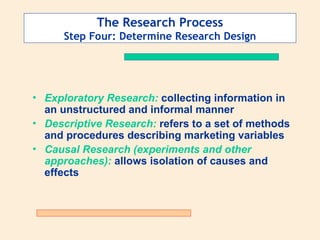
StepFour: Determine Research Design
• Exploratory Research: collecting information in
an unstructured and informal manner
• Descriptive Research: refers to a set of methods
and procedures describing marketing variables
• Causal Research (experiments and other
approaches): allows isolation of causes and
effects
9.
The Research Process
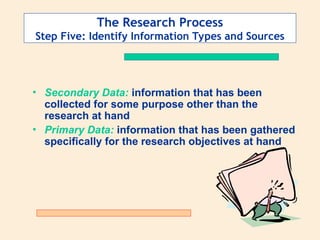
StepFive: Identify Information Types and Sources
• Secondary Data: information that has been
collected for some purpose other than the
research at hand
• Primary Data: information that has been gathered
specifically for the research objectives at hand
10.
The Research Process
StepSix: Determine Methods of Accessing Data
• Secondary Data: accessing data through sources such as
the Internet and library
• Primary Data: collecting data from participants through
methods such as telephone, mail, online, and face-to-face
(quantitative), and observation studies and focus groups
(qualitative)
11.
The Research Process
StepSeven: Design Data Collection Forms
• The design of the data collection form that is
used to ask or observe and record information in
Research projects is critical to the success of the
project.
• It is easy to write a set of questions but very
difficult to construct a questionnaire.
• General types of “instruments” (forms)
• Questionnaires
• Observation Study forms (protocols)
12.
The Research Process
StepEight: Determine Sample Plan and Size
• Sample plan: refers to the process used to select
units from the population to be included in the
sample
• Sample size: refers to determining how many
elements (units) of the population should be
included in the sample
13.
The Research Process
StepNine: Collect Data
• Sound data collection is very important because,
regardless of the data analysis methods used,
data analysis cannot “fix” bad data. 12
• Nonsampling errors may occur during data
collection. These are related to poor design
and/or execution of the data gathering.
• Sampling errors may occur based purely on
chance
14.
The Research Process
StepTen: Analyze Data
• Data analysis: involves entering data into
computer files, inspecting data for errors (data
cleaning), running tabulations (frequencies), and
conducting various statistical tests
15.
The Research Process
StepEleven: Prepare and Present the Final
Research Report
• Findings are presented, often by research
objective, in a clear and concise way.
• The need for a good report cannot be overstated.
It is the report, and/or its presentation, that
properly communicates the results to the client.
16.
Growing Importance ofResearch in India
• Monopolistic Business
• Demand was more than Supply
• Business was local; hence close to customers
17.
Challenges faced inIndia
• Country’s vast size
• Diversity in the population
• Infrastructure problem
• Literacy Issues
• Attitudinal problems
18.
Research Design
• AStatement of Objectives
• Data inputs required on the basis of which the
research problem has to be solved
• Method of Analysis
• Simply a BluePrint!
19.
Exploratory Research Design
•Provides info to enable a more precise problem
definition or hypothesis formulation
• Establishing research priorities
• Gives researched a feel of the problem
• Good start
• Methods Used
– Survey of literature
– Survey of experienced individuals
– Analysis of selected case situations
20.
Descriptive Research Designs
•Most commonly used
• Combination of qualitative and quantitative
• More formal as compared to Exploratory
• Types
– Panel Discussion
– Focus Groups
– Cross Sectional Designs
21.
Casual Research
• Itis the testing of a hypothesis on the cause and effect within a given
market.
• Casual Research explores the effect of one thing on another and more
specifically, the effect of one variable on another. The research is used
to measure what impact a specific change will have on existing norms
and allows market researchers to predict hypothetical scenarios upon
which a company can base its business plan. For example, if a clothing
company currently sells blue denim jeans, casual research can
measure the impact of the company changing the product design to the
colour white. Following the research, company bosses will be able to
decide whether changing the colour of the jeans to white would be
profitable. To summarise, casual research is a way of seeing how
actions now will affect a business in the future
22.
Primary Versus SecondaryData
• Primary data: information that is developed or
gathered by the researcher specifically for the
research project at hand
• Secondary data: information that has previously
been gathered by someone other than the
researcher and/or for some other purpose than
the research project at hand
23.
Classification of SecondaryData
• Internal secondary data: data that have been
collected within the firm
• Internal databases: databases (collection of data
and information describing items of interest)
consisting of information gathered by a company
typically during the normal course of business
transactions
24.
Classification of SecondaryData…cont.
• External secondary data: data obtained from
outside the firm
• Types:
• Published
• Syndicated Services Data
• External Databases
25.
Advantages of SecondaryData
• Obtained quickly (compared to primary data
gathering)
• Inexpensive (compared to primary data
gathering)
• Usually available
• Enhances existing primary data
26.
Disadvantages of SecondaryData
• Mismatch of the units of measurement
Need daily data yet only monthly available, need incomes
of $75,000 and over only available $50,000 and over
• Differing class definitions used – Need users “in
between” heavy, medium or light users
• Timeliness (how current is the secondary data)
• Lack of information needed to assess the
credibility of the reported data (next slide)
27.
Evaluating Secondary Data
•What was the purpose of the study?
• Who collected the information and when was this
done?
• What information was collected (questions,
scales, etc.)?
• How was the information obtained (sampling
frame, method of sample draw, communication
method, resulting sample, etc.)?
• How consistent is the information with other
published information?
28.
Sources of Errorin Data Collection
• Investigator
– Personal Bias
– Misinterpretation
• Respondent
– Ambiguity
– Not true feedback provided
Non-probability Sampling Method
•Convenience:
– 100 stores in one location
– 50 students in a class
– One state in a country
• Judgment: Researcher draws a sample that he thinks
is the representation of the population
• Quota Sampling: Like Stratified sampling but the
difference is that the selection of sample in the quota
is not random (but judgment of researcher) the way it
is with Stratified sampling