Invertebrate Excretory Structures Contractile Vacuole it is an organ of water balance in freshwater protozoa, in which it expels excess water gained by osmosis. As water enters, the protozoan, a vacuole grows and finally collapses, emptying its contents through a pore in the surface. This is common in freshwater protozoa, sponges, and radiated animals.
 
Nephridium it is a tubular structure desinged to maintain appropriate osmotic balance. Fluid enters through the flame cells moves down to the tubules and is excreted through the pores that open at intervals on the body surface.
Human  Kidney
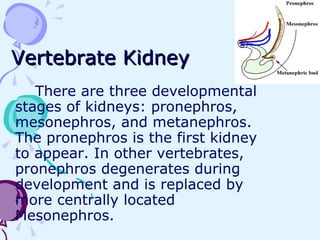
Vertebrate Kidney There are three developmental stages of kidneys: pronephros, mesonephros, and metanephros.  The pronephros is the first kidney to appear. In other vertebrates, pronephros degenerates during development and is replaced by  more centrally located Mesonephros.
The mesonephros is the functional kidney of embryonic amniotes. Opisthonephros is the combination of mesonephros and metanephros. It forms the adult kidney of most fishes and amphibians.
Vertebrate Kidney  Function the vertebrate kidney is a part of many interlocking mechanisms that maintain homeostasis. Excretion, the removal of metabolic wastes is incidental to its regulatory function. The function of the vertebrate kidney, is it excretes water and makes concentrated urine.
Glomerular Filtration The glomerular filtration is where the glomerulus acts as a specialized filter in which an almost protein free filtrate of the plasma is driven by the blood pressure across capillary walls and into the fluid filled space of Bowman’s capsule. Human Kidneys form approximately 180 liters of filtrate each day, a volume many times exceeding the total blood volume. Depletion does not happen because early all of the filtrate is reabsorbed.
 
Tubular Reabsorption the essential function of the kidney is to regulate plasma concentrations of electrolytes, all are individually reabsorbed by ion pumps specific for each electrolyte. Much of this reabsorption.  Active transport, in which cellular energy is used to transport materials from tubular fluid to the surrounding capillary network from which they will reenter the blood circulation.
Tubular secretion this is the reverse of the tubular reabsorption. Tubular secretions enables a kidney to increase the urine concentrations of materials to be excreted. The kidneys of bony marine fishes, reptiles and birds uses the tubular secretion process better than it is in mammalian kidneys.
Water excretion Water excretion is really important. When the fluid intake is high, the kidney excretes dilute urine, saving the salt and excreting water. Most of the water and salts removed from the Loop of Henle are recycled to the circulating blood via countercurrent exchange with the VASA RECTA. This maintains the steep concentration gradient in the renal medulla.
Water is withdrawn from the descending limb osmosis. And last adjustment is, water is withdrawn from the urine. This build up are contributes significantly to high osmotic concentration medulla.
Temperature Regulation Animals capable of temperature regulation within a given range are deemed homeotherms (alternatively homiotherms or homotherms). They have the ability to regulate temperature via negative feedback control. Temperature is controlled in a variety of ways in these animals. The hypothalamus once again acts as a receptor in regulation, by detecting fluctuations in temperature. These receptors are better known as thermoreceptors. Skin also possesses thermoreceptors which can detect the temperature of the external environment. This information is relayed to the hypothalamus which can in turn transmit nerve pulses for corrective mechanisms to occur.

Excretory system 2

  • 1.
    Invertebrate Excretory StructuresContractile Vacuole it is an organ of water balance in freshwater protozoa, in which it expels excess water gained by osmosis. As water enters, the protozoan, a vacuole grows and finally collapses, emptying its contents through a pore in the surface. This is common in freshwater protozoa, sponges, and radiated animals.
  • 2.
  • 3.
    Nephridium it isa tubular structure desinged to maintain appropriate osmotic balance. Fluid enters through the flame cells moves down to the tubules and is excreted through the pores that open at intervals on the body surface.
  • 4.
  • 5.
    Vertebrate Kidney Thereare three developmental stages of kidneys: pronephros, mesonephros, and metanephros. The pronephros is the first kidney to appear. In other vertebrates, pronephros degenerates during development and is replaced by more centrally located Mesonephros.
  • 6.
    The mesonephros isthe functional kidney of embryonic amniotes. Opisthonephros is the combination of mesonephros and metanephros. It forms the adult kidney of most fishes and amphibians.
  • 7.
    Vertebrate Kidney Function the vertebrate kidney is a part of many interlocking mechanisms that maintain homeostasis. Excretion, the removal of metabolic wastes is incidental to its regulatory function. The function of the vertebrate kidney, is it excretes water and makes concentrated urine.
  • 8.
    Glomerular Filtration Theglomerular filtration is where the glomerulus acts as a specialized filter in which an almost protein free filtrate of the plasma is driven by the blood pressure across capillary walls and into the fluid filled space of Bowman’s capsule. Human Kidneys form approximately 180 liters of filtrate each day, a volume many times exceeding the total blood volume. Depletion does not happen because early all of the filtrate is reabsorbed.
  • 9.
  • 10.
    Tubular Reabsorption theessential function of the kidney is to regulate plasma concentrations of electrolytes, all are individually reabsorbed by ion pumps specific for each electrolyte. Much of this reabsorption. Active transport, in which cellular energy is used to transport materials from tubular fluid to the surrounding capillary network from which they will reenter the blood circulation.
  • 11.
    Tubular secretion thisis the reverse of the tubular reabsorption. Tubular secretions enables a kidney to increase the urine concentrations of materials to be excreted. The kidneys of bony marine fishes, reptiles and birds uses the tubular secretion process better than it is in mammalian kidneys.
  • 12.
    Water excretion Waterexcretion is really important. When the fluid intake is high, the kidney excretes dilute urine, saving the salt and excreting water. Most of the water and salts removed from the Loop of Henle are recycled to the circulating blood via countercurrent exchange with the VASA RECTA. This maintains the steep concentration gradient in the renal medulla.
  • 13.
    Water is withdrawnfrom the descending limb osmosis. And last adjustment is, water is withdrawn from the urine. This build up are contributes significantly to high osmotic concentration medulla.
  • 14.
    Temperature Regulation Animalscapable of temperature regulation within a given range are deemed homeotherms (alternatively homiotherms or homotherms). They have the ability to regulate temperature via negative feedback control. Temperature is controlled in a variety of ways in these animals. The hypothalamus once again acts as a receptor in regulation, by detecting fluctuations in temperature. These receptors are better known as thermoreceptors. Skin also possesses thermoreceptors which can detect the temperature of the external environment. This information is relayed to the hypothalamus which can in turn transmit nerve pulses for corrective mechanisms to occur.