Excretory System This system regulates the chemical  composition of body fluids by removing   metabolic wastes and retaining the   proper amounts of water, salts, and   nutrients.
FUNCTIONS: Collects water and filters body fluids Removes and concentrates waste products from body fluids and return other substances to body fluids as necessary for homeostasis Eliminates excretory products from the body
OSMOREGULATION in Animals a system of adaptations to control the water balance in organisms living in hyperosmotic, hypoosmotic or terrestrial environments. involves different processes depending on the animal due to the different environments they all live in. deals with osmosis of water between the internal environments of animals, with the outside environment
OSMOREGULATION in Animals AQUATIC "osmoconformers" don't actively regulate the osmolarity of their body fluids (but they may regulate the concentration of specific ions)  body fluids  ISOSMOTIC  to the surrounding seawater
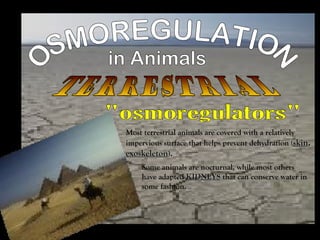
OSMOREGULATION in Animals TERRESTRIAL "osmoregulators" Most terrestrial animals are covered with a relatively impervious surface that helps prevent dehydration  ( skin ,  exoskeleton ).   Some animals are nocturnal, while most others have adapted  KIDNEYS  that can conserve water in some fashion.
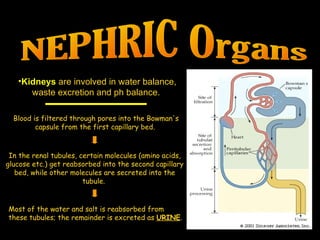
NEPHRIC Organs Kidneys  are involved in water balance, waste excretion and ph balance.  Blood is filtered through pores into the Bowman's capsule from the first capillary bed.  In the renal tubules, certain molecules (amino acids, glucose etc.) get reabsorbed into the second capillary bed, while other molecules are secreted into the tubule.  Most of the water and salt is reabsorbed from these tubules; the remainder is excreted as  URINE .
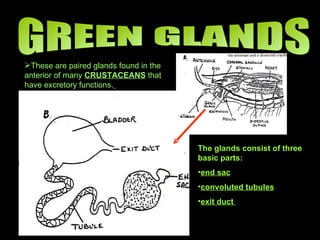
GREEN GLANDS These are paired glands found in the anterior of many  CRUSTACEANS  that have excretory functions.   The glands consist of three basic parts:  end sac convoluted tubules   exit duct
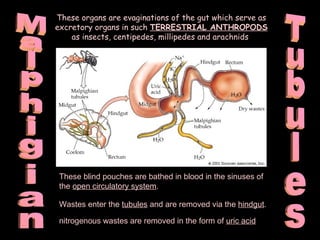
Malphigian Tubules These organs are evaginations of the gut which serve as excretory organs in such  TERRESTRIAL ANTHROPODS  as insects, centipedes, millipedes and arachnids  These blind pouches are bathed in blood in the sinuses of the  open circulatory system .  Wastes enter the  tubules  and are removed via the  hindgut .   nitrogenous wastes are removed in the form of  uric acid

Excretory system

  • 1.
    Excretory System Thissystem regulates the chemical composition of body fluids by removing metabolic wastes and retaining the proper amounts of water, salts, and nutrients.
  • 2.
    FUNCTIONS: Collects waterand filters body fluids Removes and concentrates waste products from body fluids and return other substances to body fluids as necessary for homeostasis Eliminates excretory products from the body
  • 3.
    OSMOREGULATION in Animalsa system of adaptations to control the water balance in organisms living in hyperosmotic, hypoosmotic or terrestrial environments. involves different processes depending on the animal due to the different environments they all live in. deals with osmosis of water between the internal environments of animals, with the outside environment
  • 4.
    OSMOREGULATION in AnimalsAQUATIC "osmoconformers" don't actively regulate the osmolarity of their body fluids (but they may regulate the concentration of specific ions) body fluids ISOSMOTIC to the surrounding seawater
  • 5.
    OSMOREGULATION in AnimalsTERRESTRIAL "osmoregulators" Most terrestrial animals are covered with a relatively impervious surface that helps prevent dehydration ( skin , exoskeleton ).  Some animals are nocturnal, while most others have adapted KIDNEYS that can conserve water in some fashion.
  • 6.
    NEPHRIC Organs Kidneys are involved in water balance, waste excretion and ph balance. Blood is filtered through pores into the Bowman's capsule from the first capillary bed. In the renal tubules, certain molecules (amino acids, glucose etc.) get reabsorbed into the second capillary bed, while other molecules are secreted into the tubule. Most of the water and salt is reabsorbed from these tubules; the remainder is excreted as URINE .
  • 7.
    GREEN GLANDS Theseare paired glands found in the anterior of many CRUSTACEANS that have excretory functions. The glands consist of three basic parts: end sac convoluted tubules exit duct
  • 8.
    Malphigian Tubules Theseorgans are evaginations of the gut which serve as excretory organs in such TERRESTRIAL ANTHROPODS as insects, centipedes, millipedes and arachnids These blind pouches are bathed in blood in the sinuses of the open circulatory system . Wastes enter the tubules and are removed via the hindgut .  nitrogenous wastes are removed in the form of uric acid