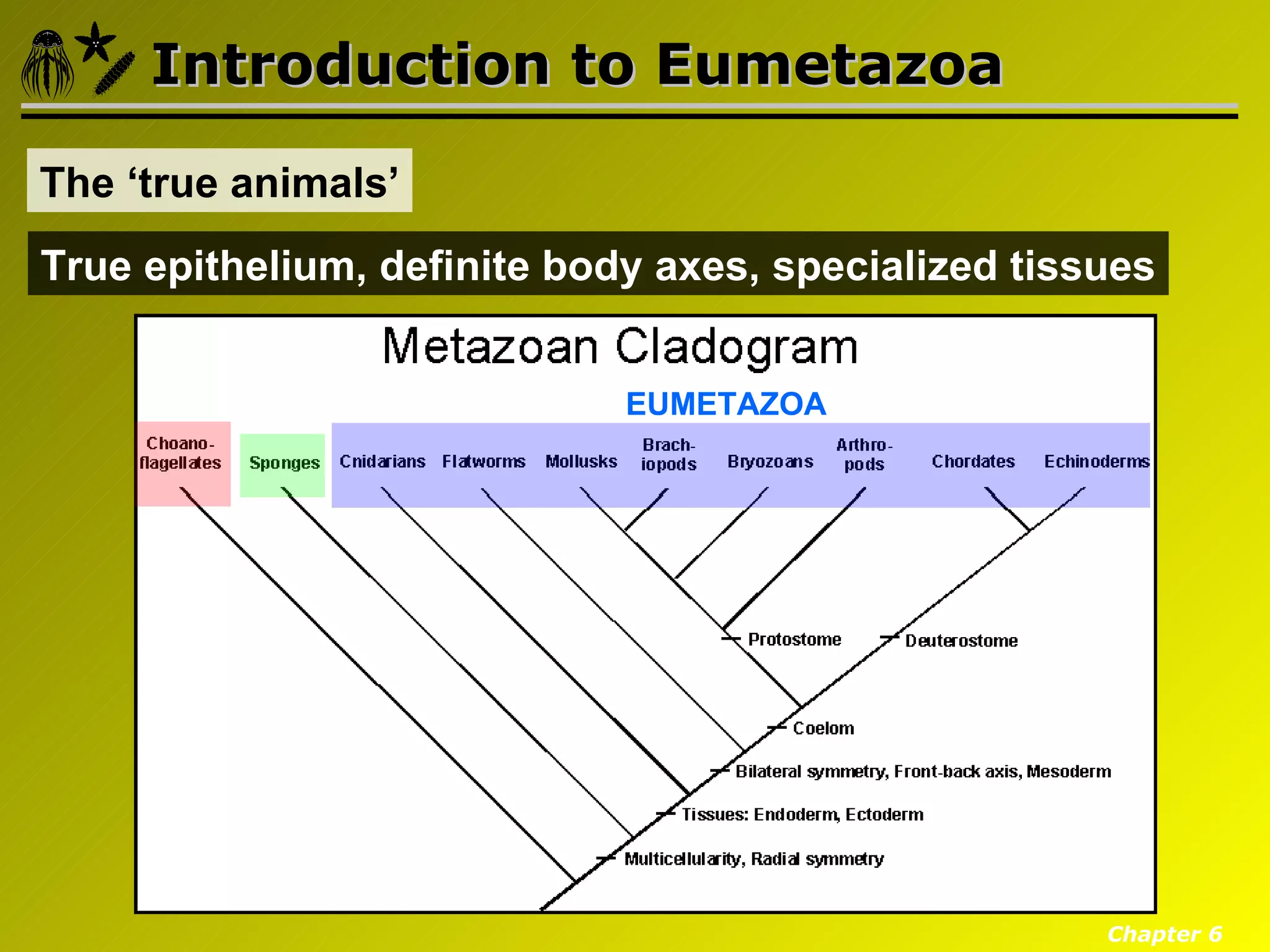
Introduction to Eumetazoa

The ‘true animals’
True epithelium, definite body axes, specialized tissues


                             EUMETAZOA


                                                     Chapter 6
True Epithelia


EPITHELIUM – cell layer that covers surfaces, lines
         internal cavities and spaces

  With basal lamina, apical-basal polarity, cell-cell
                junctions, immobile
Allows for establishment of regulated compartments
     (connective tissue, gut lumen, coelom)
    Epithelial cells control passage of materials
Environment under the epithelium can be chemically
                     controlled


                                                 Chapter 6
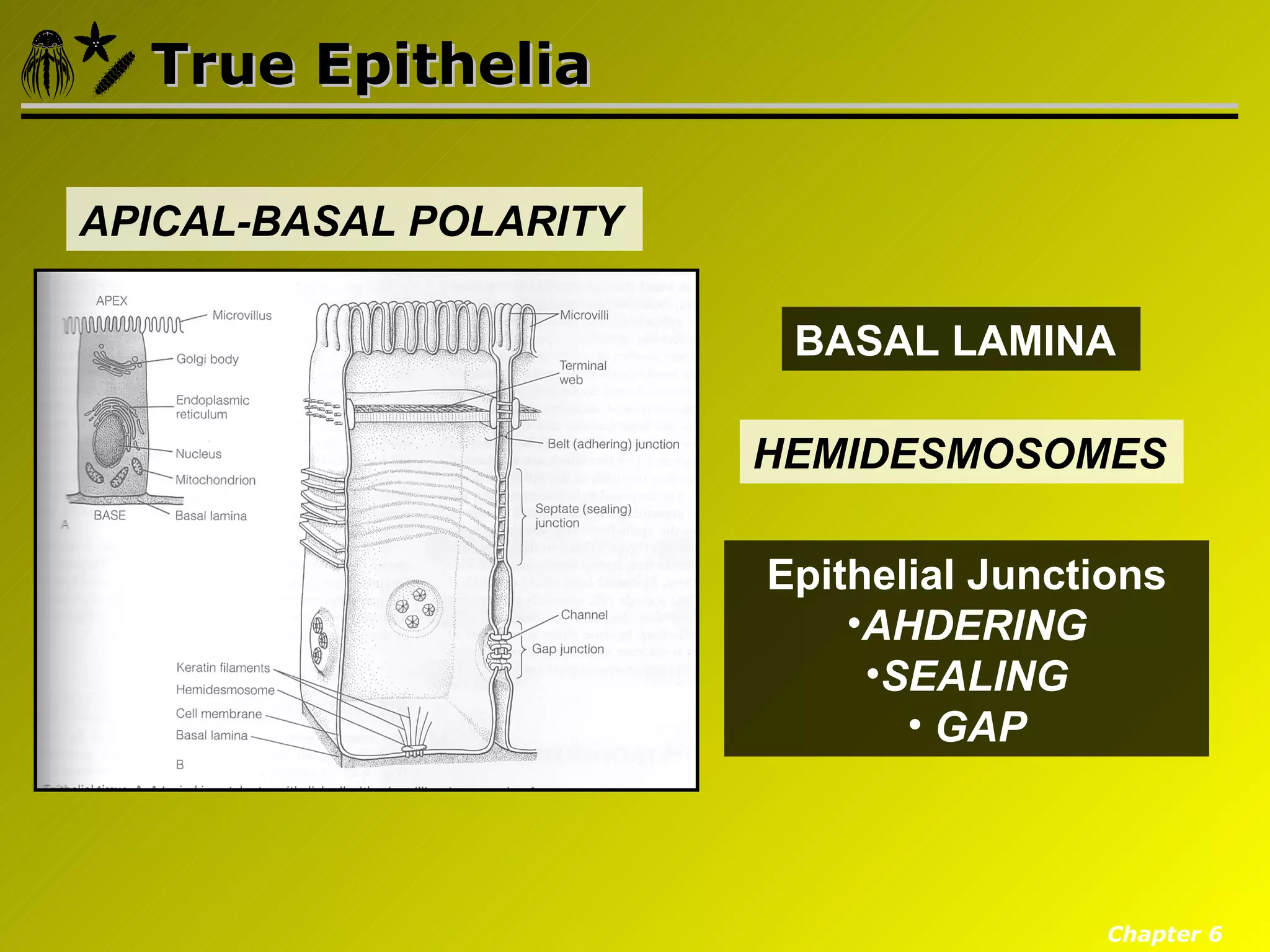
True Epithelia

APICAL-BASAL POLARITY

                         BASAL LAMINA

                        HEMIDESMOSOMES

                        Epithelial Junctions
                            •AHDERING
                             •SEALING
                               • GAP


                                         Chapter 6
Epidermis, Gastrodermis & Gut
EPIDERMIS – the outer skin; covers the surface of the
                eumetazoan body
                       Secretory
                      Absorptive
                     Impermeable
GASTRODERMIS – stomach skin; epithelial layer that
 lines the gut and joins the epidermis at the mouth

GUT – internal, epithelia-lined cavity; it is a regulated
                    compartment
       • GUT LUMEN (CAVITY) – also regulated
                     compartment
        • Allows EXTRACELLULAR DIGESTION
 • Secretes digestive enzymes and absorbs products
                                                      Chapter 6
Connective Tissue
CONNECTIVE-TISSUE COMPARTMENT – lies between
           the epi- and gastrodermis
   May just be the basal lamina of the two epithelia
                  May be very thick


CONNECTIVE TISSUE – consists of ECM and cells; no
      collective term for cells of the ECM

                  Sponges – mesohyl
                Metazoans – blastocoel
                Cnidarians – mesoglea
     Bilateria – simply called ‘connective tissue’


                                                     Chapter 6
Eumetazoan Skeletons
Skeletons can:


                    Maintain body shape
                 Support or protect the body
                  Transmit force of muscle
                       contraction
                   Be internal or external
                 Be mineral, organic or both
                      Be fluid or solid


                                               Chapter 6
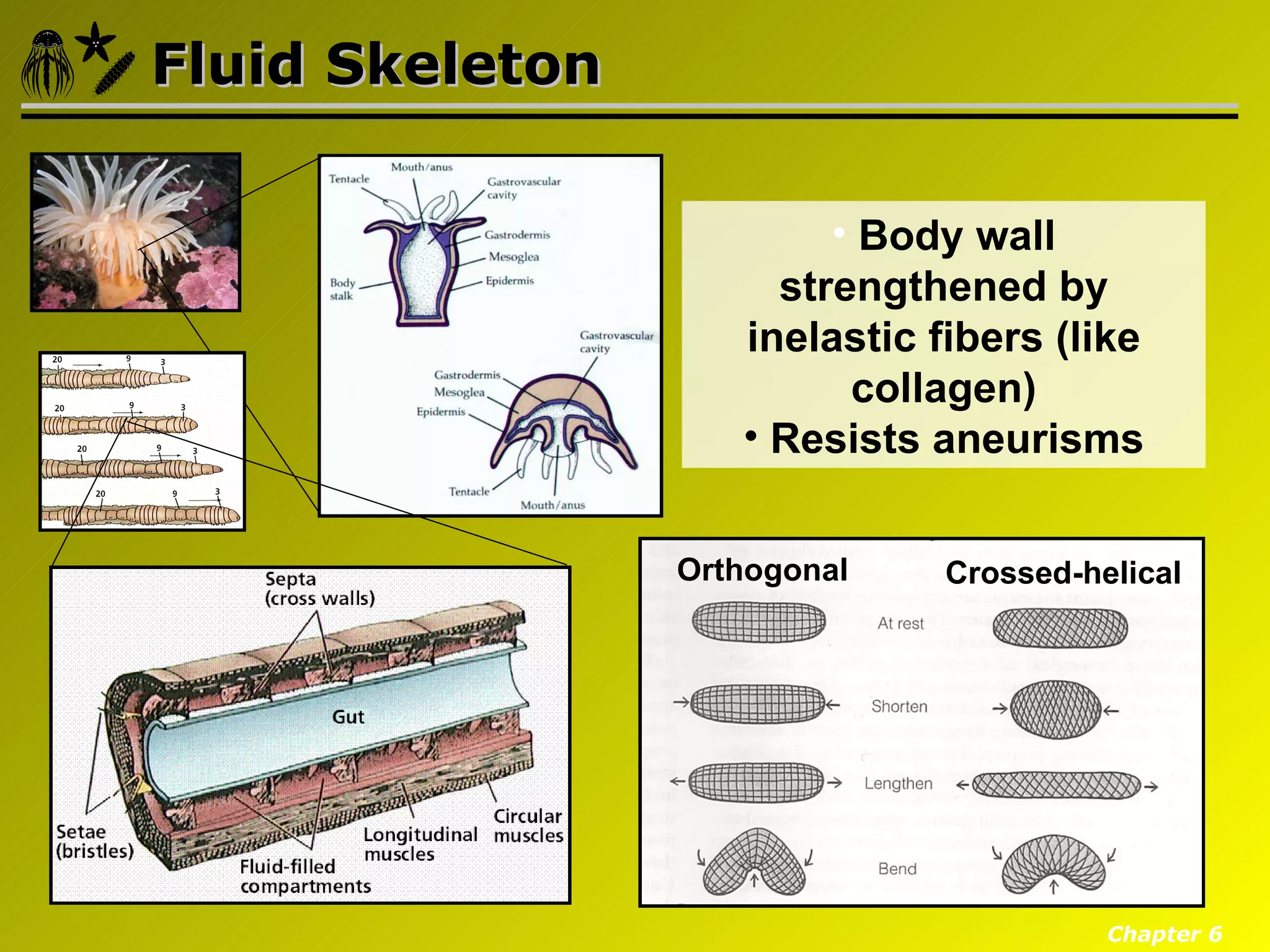
Fluid Skeleton
HYDROSTATIC SKELETON – water-filled skeleton,
a.k.a. a hydrstat; cavity filled with water-based fluid
         **This is a eumetazoan innovation!!**
  • Surrounded by muscles (circular and longitudinal)
       • Muscles contract and pressurize the fluid
               • Water is incompressible
   •CIRCULAR CONTRACTION – lengthens hydrostat
           and stretches longitudinal muscles
      • LONGITUDINAL CONTRACTION – shortens
        hydrostat and stretches circular muscles
Utility  inflate body, extend parts, locomotion, burrowing


                                                          Chapter 6
Fluid Skeleton

                         • Body wall
                      strengthened by
                    inelastic fibers (like
                          collagen)
                    • Resists aneurisms


                 Orthogonal    Crossed-helical


                                         Chapter 6
Solid Skeleton
PLIANT SKELETON – made of materials that
are rubbery and elastic
  • Deform when stretched, spring back to original
                        shape
         • Proteins, polysaccharides, water
  • Use as CT in comb jellies, mesoglea in jellyfish,
                  hinges of bivalves


RIGID SKELETON – made of materials
that resist a change of shape (bone/shell)
Insect framework, terrestrial and flying invertebrates, and
          fast moving crustaceans of the ocean

                                                        Chapter 6
Movement and Body Size

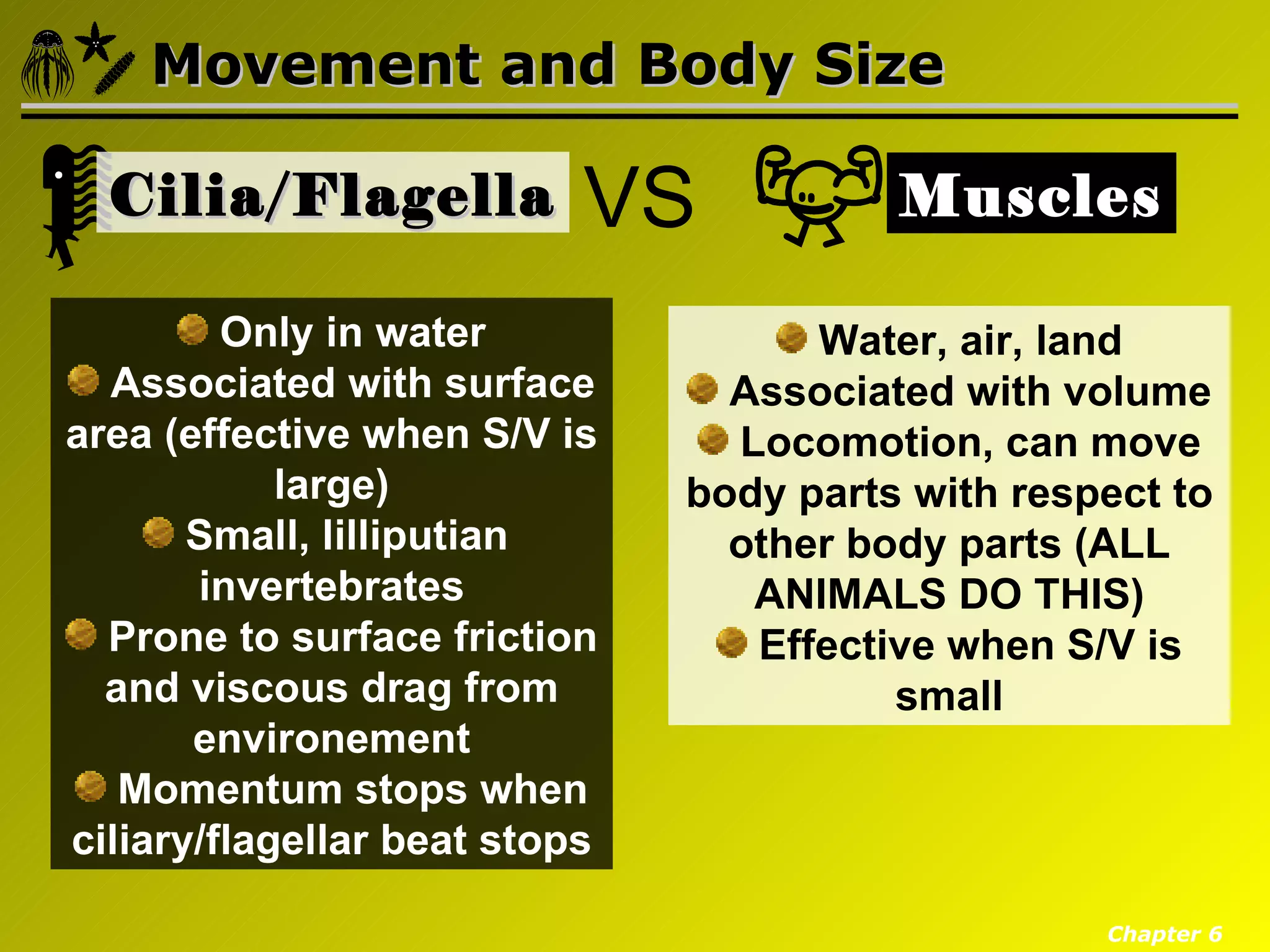
  Cilia/Flagella           VS            Muscles

         Only in water               Water, air, land
  Associated with surface        Associated with volume
area (effective when S/V is      Locomotion, can move
            large)             body parts with respect to
       Small, lilliputian        other body parts (ALL
       invertebrates              ANIMALS DO THIS)
  Prone to surface friction       Effective when S/V is
  and viscous drag from                  small
       environement
   Momentum stops when
ciliary/flagellar beat stops

                                                   Chapter 6
Musculature
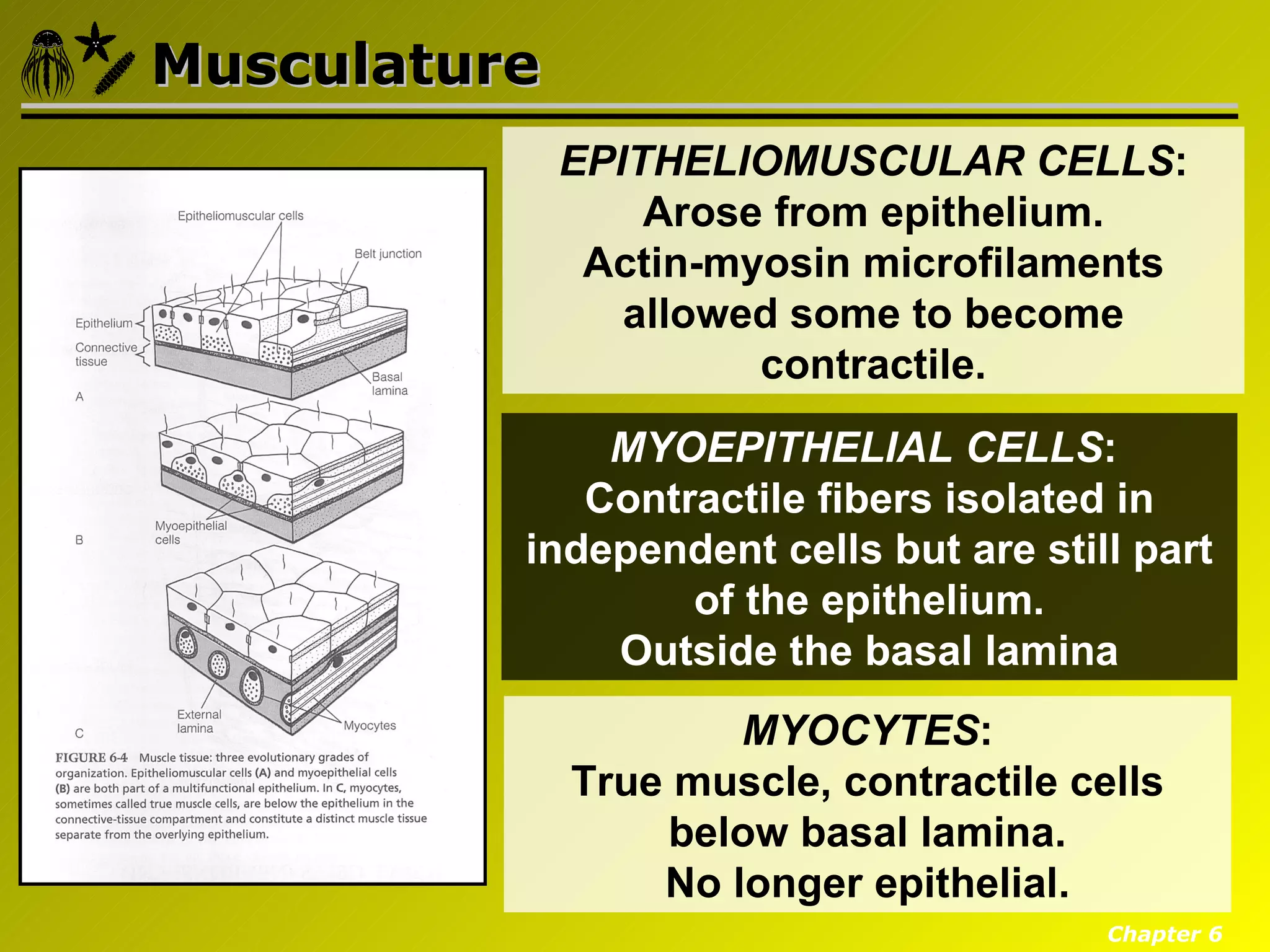
              EPITHELIOMUSCULAR CELLS:
                  Arose from epithelium.
               Actin-myosin microfilaments
                 allowed some to become
                       contractile.
              MYOEPITHELIAL CELLS:
             Contractile fibers isolated in
          independent cells but are still part
                  of the epithelium.
              Outside the basal lamina
                      MYOCYTES:
              True muscle, contractile cells
                   below basal lamina.
                  No longer epithelial.
                                         Chapter 6
Musculature
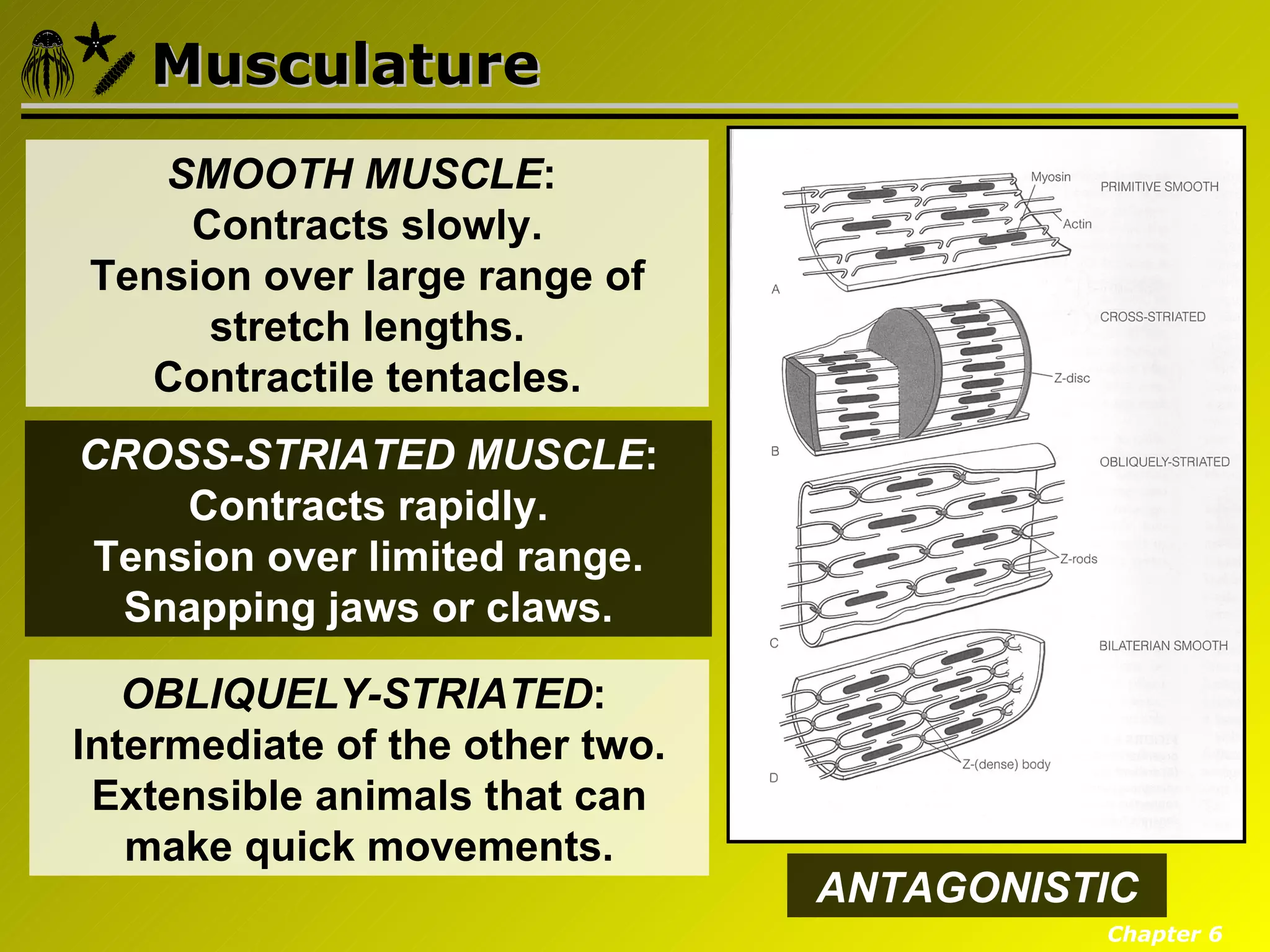
   SMOOTH MUSCLE:
    Contracts slowly.
Tension over large range of
     stretch lengths.
   Contractile tentacles.
CROSS-STRIATED MUSCLE:
    Contracts rapidly.
Tension over limited range.
 Snapping jaws or claws.

   OBLIQUELY-STRIATED:
Intermediate of the other two.
 Extensible animals that can
   make quick movements.
                                 ANTAGONISTIC
                                           Chapter 6
Neurons and Nervous System

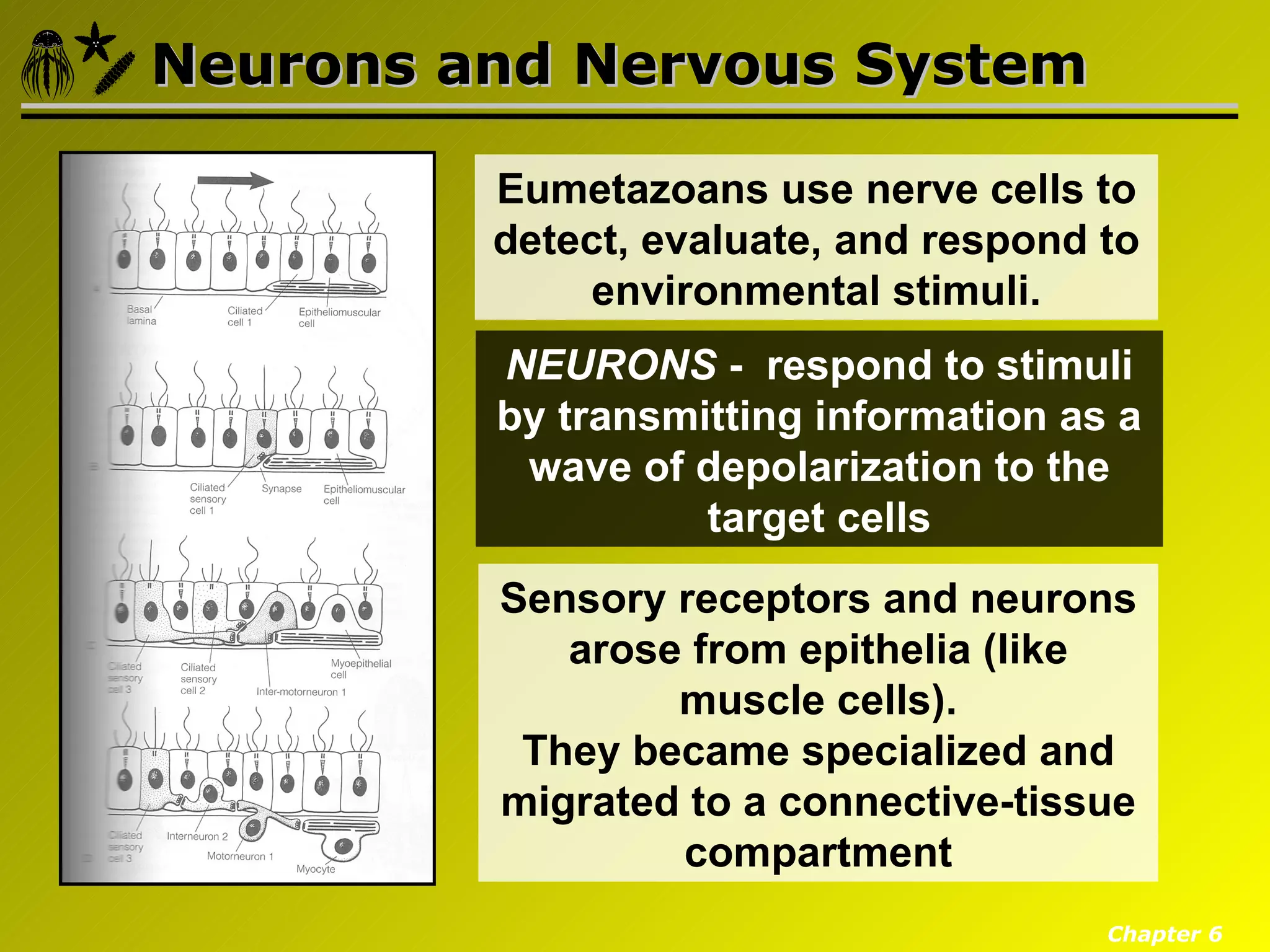
         Eumetazoans use nerve cells to
         detect, evaluate, and respond to
             environmental stimuli.
         NEURONS - respond to stimuli
         by transmitting information as a
          wave of depolarization to the
                   target cells
         Sensory receptors and neurons
            arose from epithelia (like
                 muscle cells).
          They became specialized and
         migrated to a connective-tissue
                 compartment
                                       Chapter 6
Neurons and Nervous System
Transmission of a nerve impulse from neuron to neuron
    or from neuron to effector (muscle) occurs via:


     Electrical junctions – gap junctions that join
    cells so that membrane depolarization (action
         potential) spreads uninterrupted; no
                   organismal control

     SYNAPSE – gap between two cells (synaptic
      cleft) through which the action potential is
        carried by chemical neurotransmitters


                                                      Chapter 6
Sense Cells & Organs
Eumetazoans need to obtain a dynamic picture of their
environment so they can respond appropriately.
Response to different stimuli like:

 Electromagnetic                      Mechanical

   Chemical             Magn                            etic
        Direction and distance to the source of the
        stimuli are so important to each eumtezoan

          Simple: sensory neuron-effector
        Complex: multiple stimuli, whole-body
        response, accessory structures, CNS
                                                      Chapter 6
Gravity Receptors
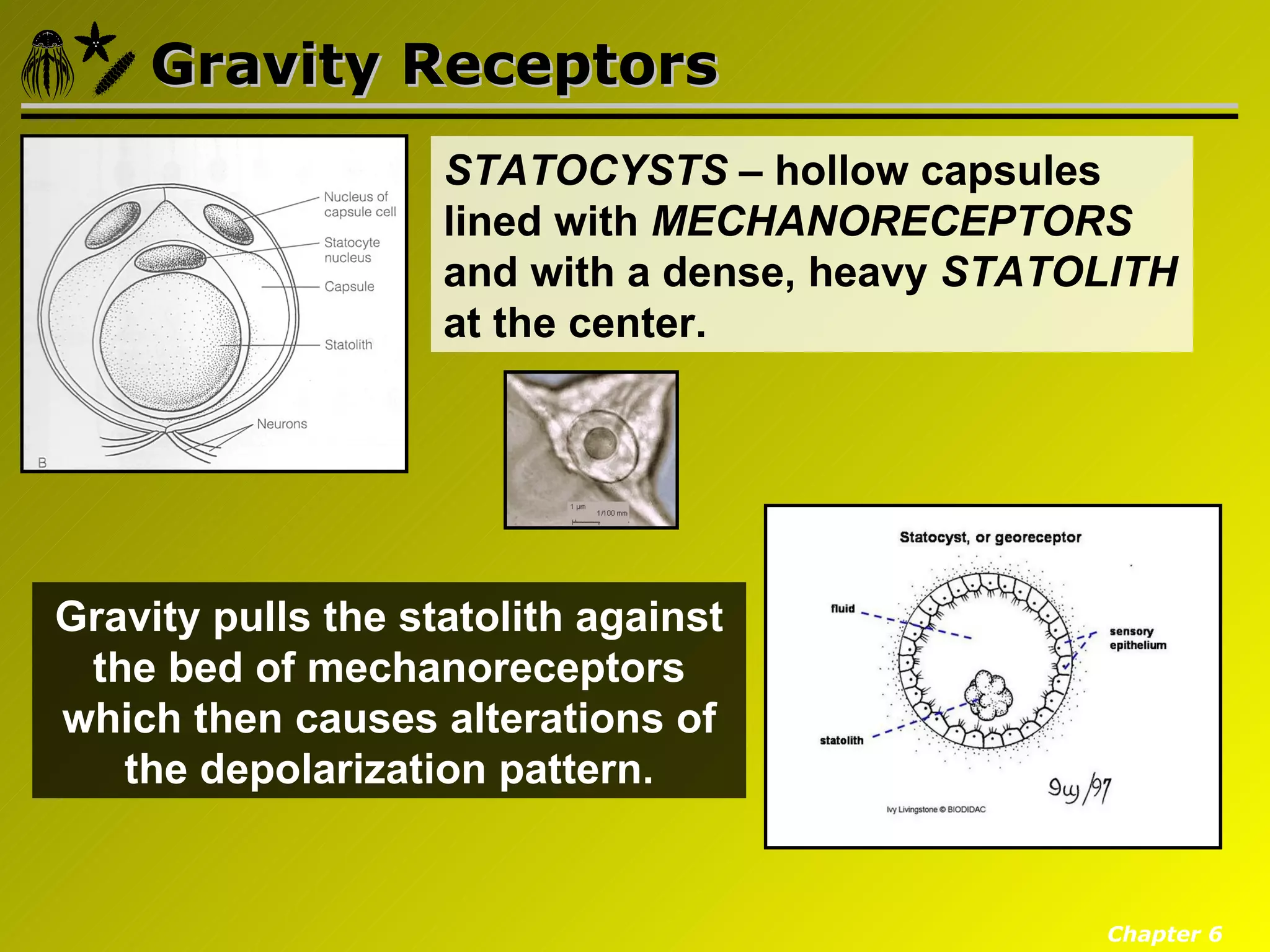
                    STATOCYSTS – hollow capsules
                    lined with MECHANORECEPTORS
                    and with a dense, heavy STATOLITH
                    at the center.


Gravity pulls the statolith against
 the bed of mechanoreceptors
which then causes alterations of
   the depolarization pattern.


                                                 Chapter 6
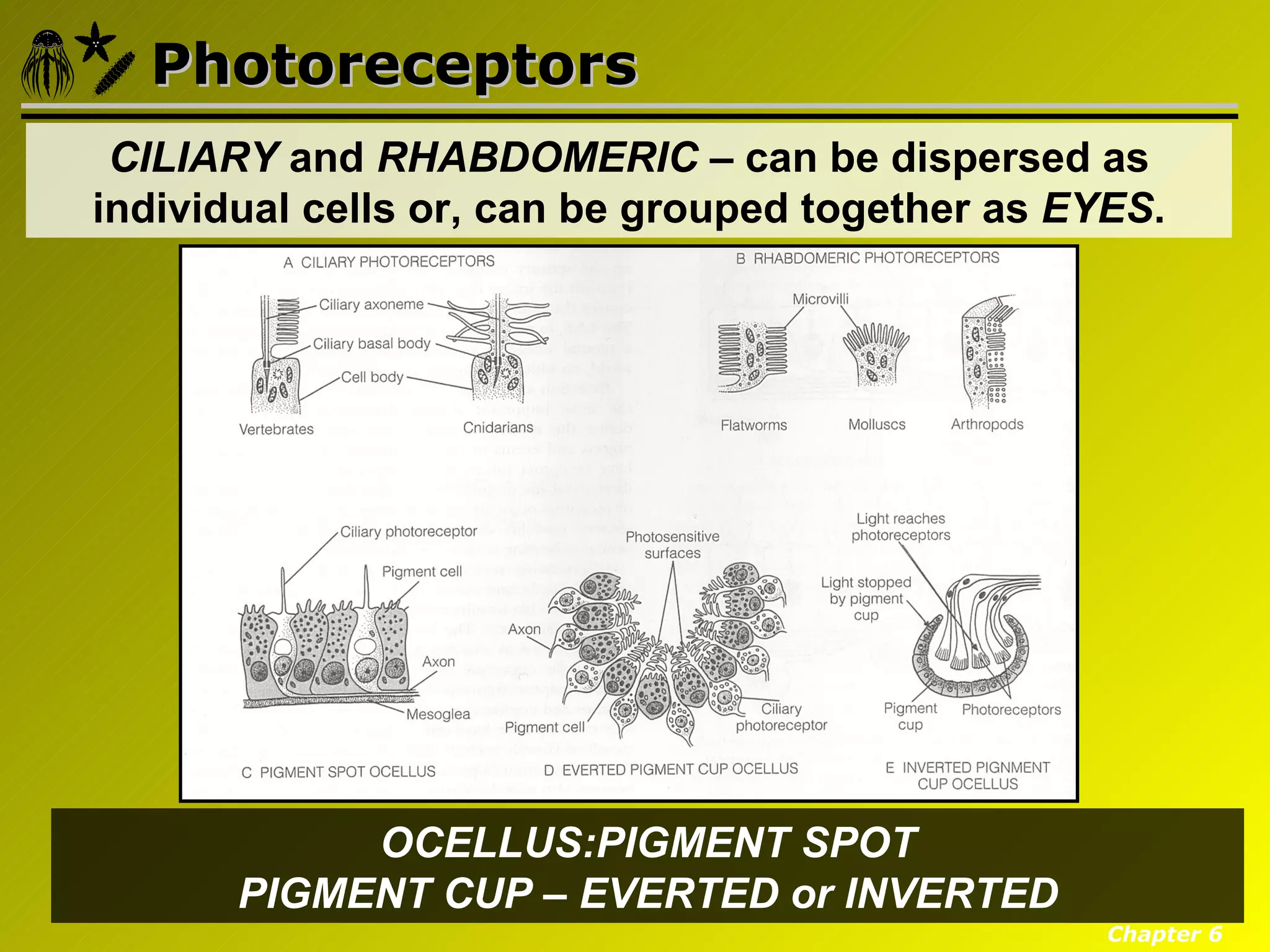
Photoreceptors
 CILIARY and RHABDOMERIC – can be dispersed as
individual cells or, can be grouped together as EYES.


            OCELLUS:PIGMENT SPOT
       PIGMENT CUP – EVERTED or INVERTED
                                                  Chapter 6
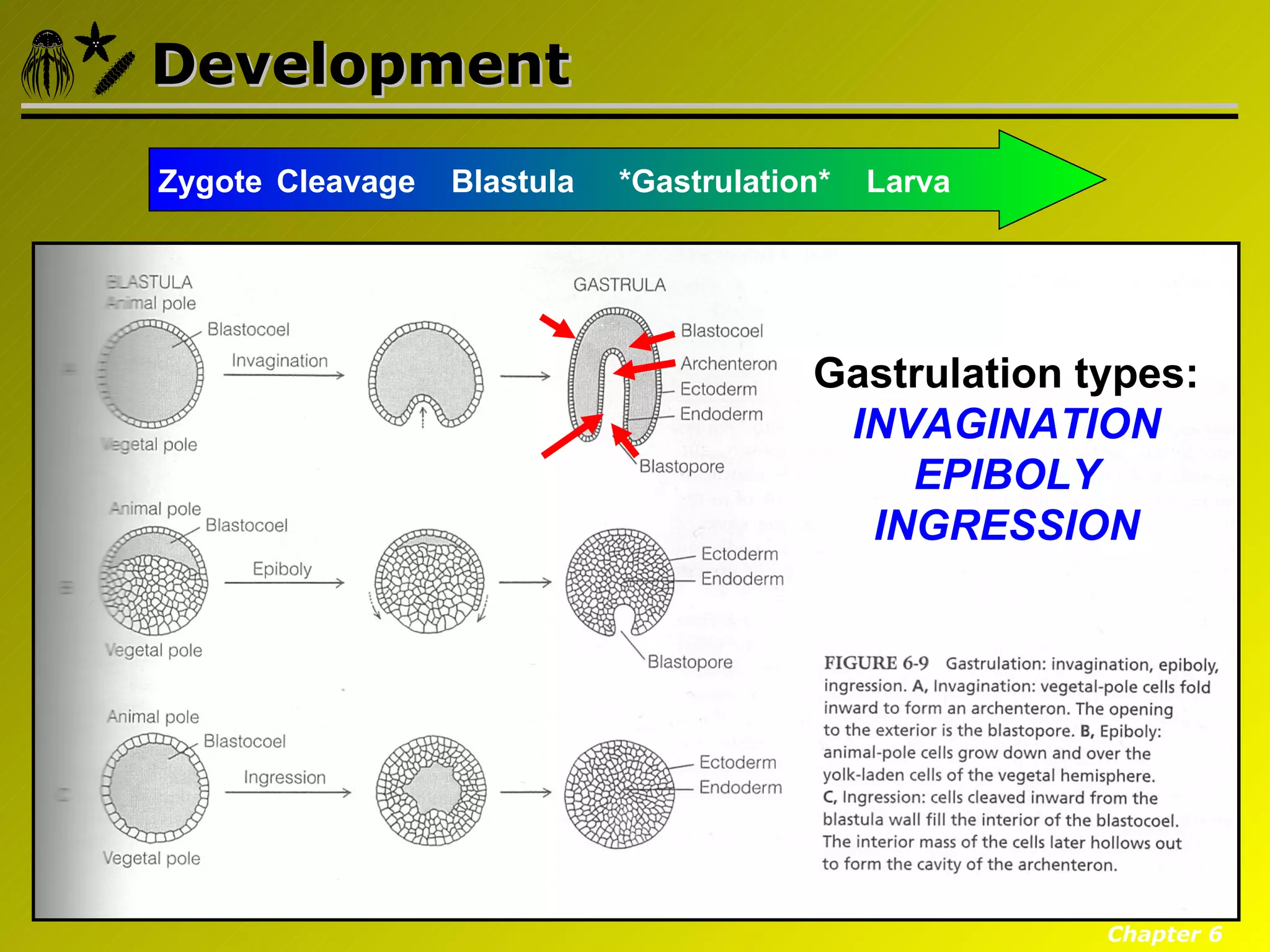
Development
Zygote Cleavage   Blastula   *Gastrulation*   Larva


                                         Gastrulation types:
                                          INVAGINATION
                                             EPIBOLY
                                           INGRESSION


                                                       Chapter 6
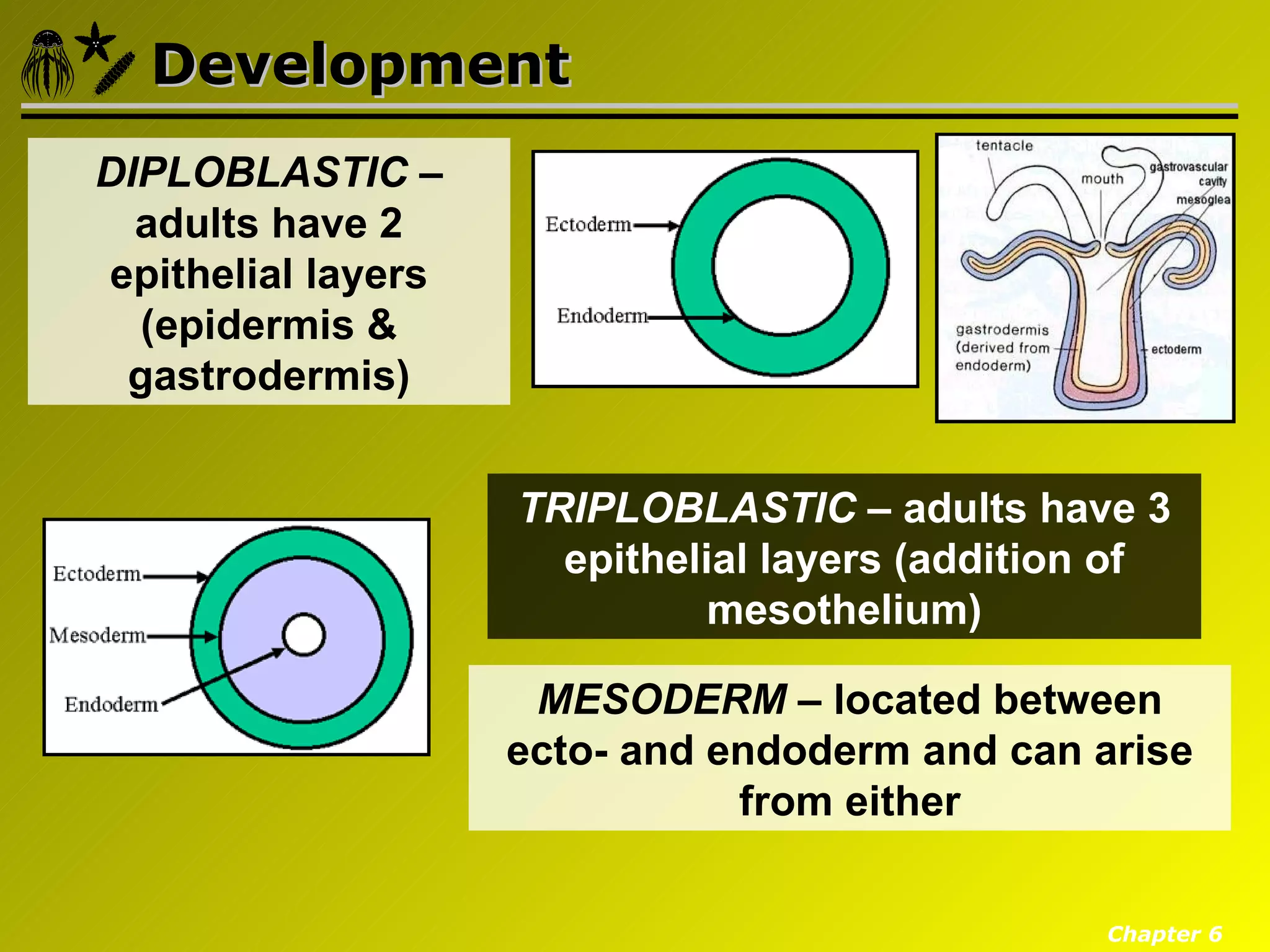
Development
DIPLOBLASTIC –
  adults have 2
epithelial layers
  (epidermis &
 gastrodermis)


                    TRIPLOBLASTIC – adults have 3
                      epithelial layers (addition of
                              mesothelium)

                     MESODERM – located between
                    ecto- and endoderm and can arise
                               from either

                                                Chapter 6
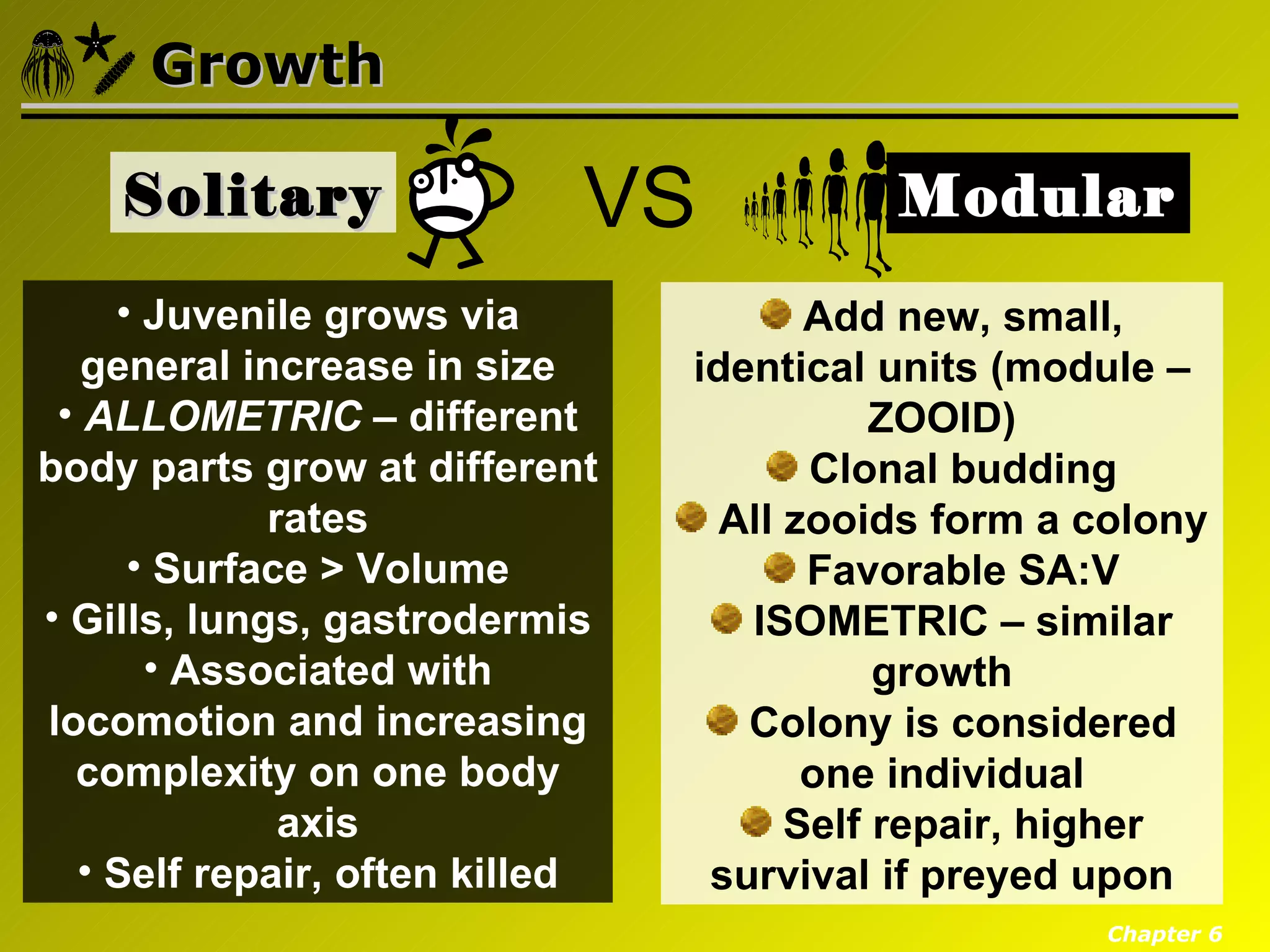
Growth

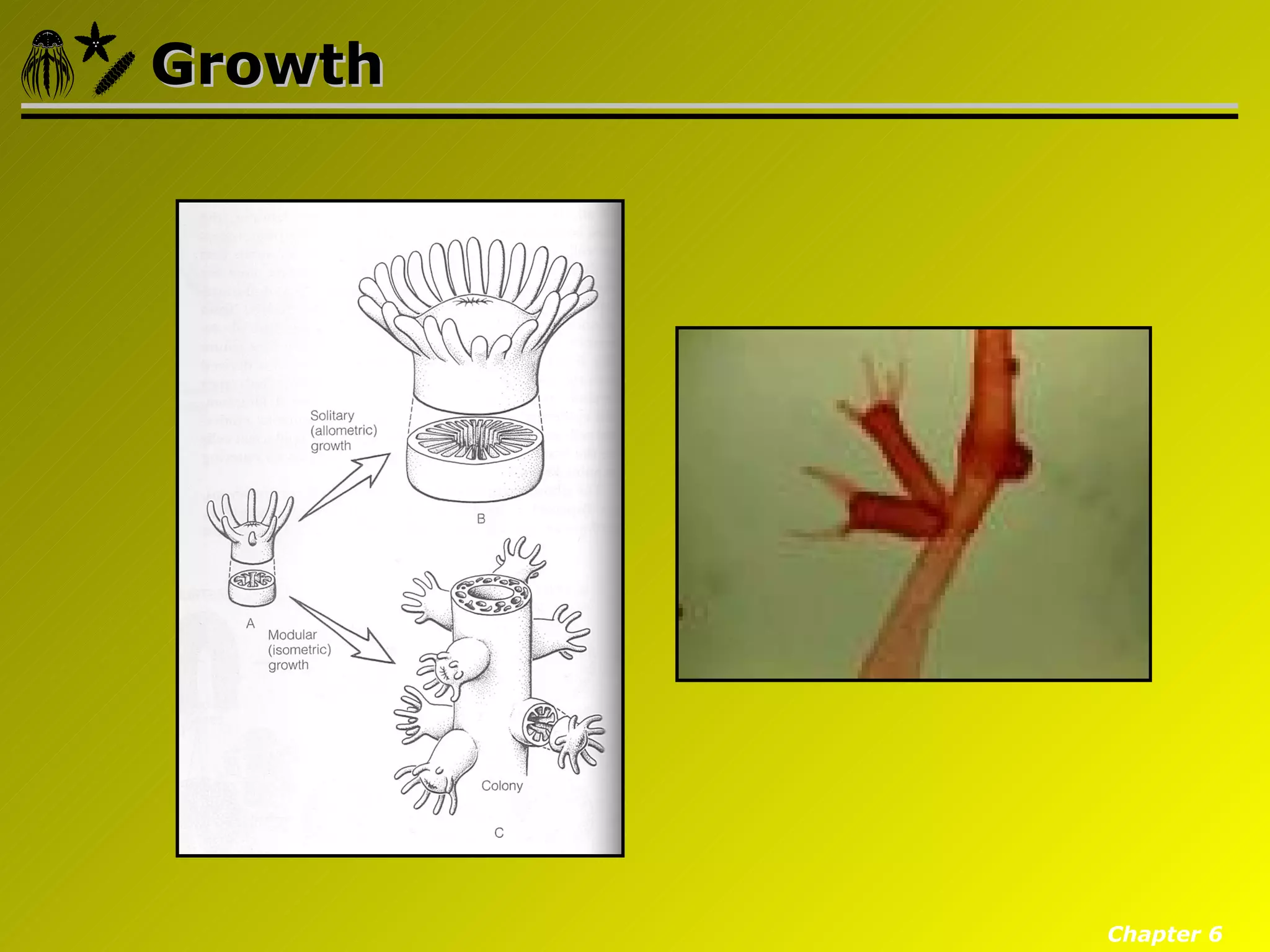
    Solitary                VS            Modular
    • Juvenile grows via               Add new, small,
   general increase in size     identical units (module –
 • ALLOMETRIC – different                  ZOOID)
body parts grow at different           Clonal budding
             rates                All zooids form a colony
     • Surface > Volume                Favorable SA:V
• Gills, lungs, gastrodermis       ISOMETRIC – similar
      • Associated with                    growth
locomotion and increasing          Colony is considered
  complexity on one body               one individual
              axis                    Self repair, higher
  • Self repair, often killed    survival if preyed upon
                                                    Chapter 6
Growth


         Chapter 6
Growth
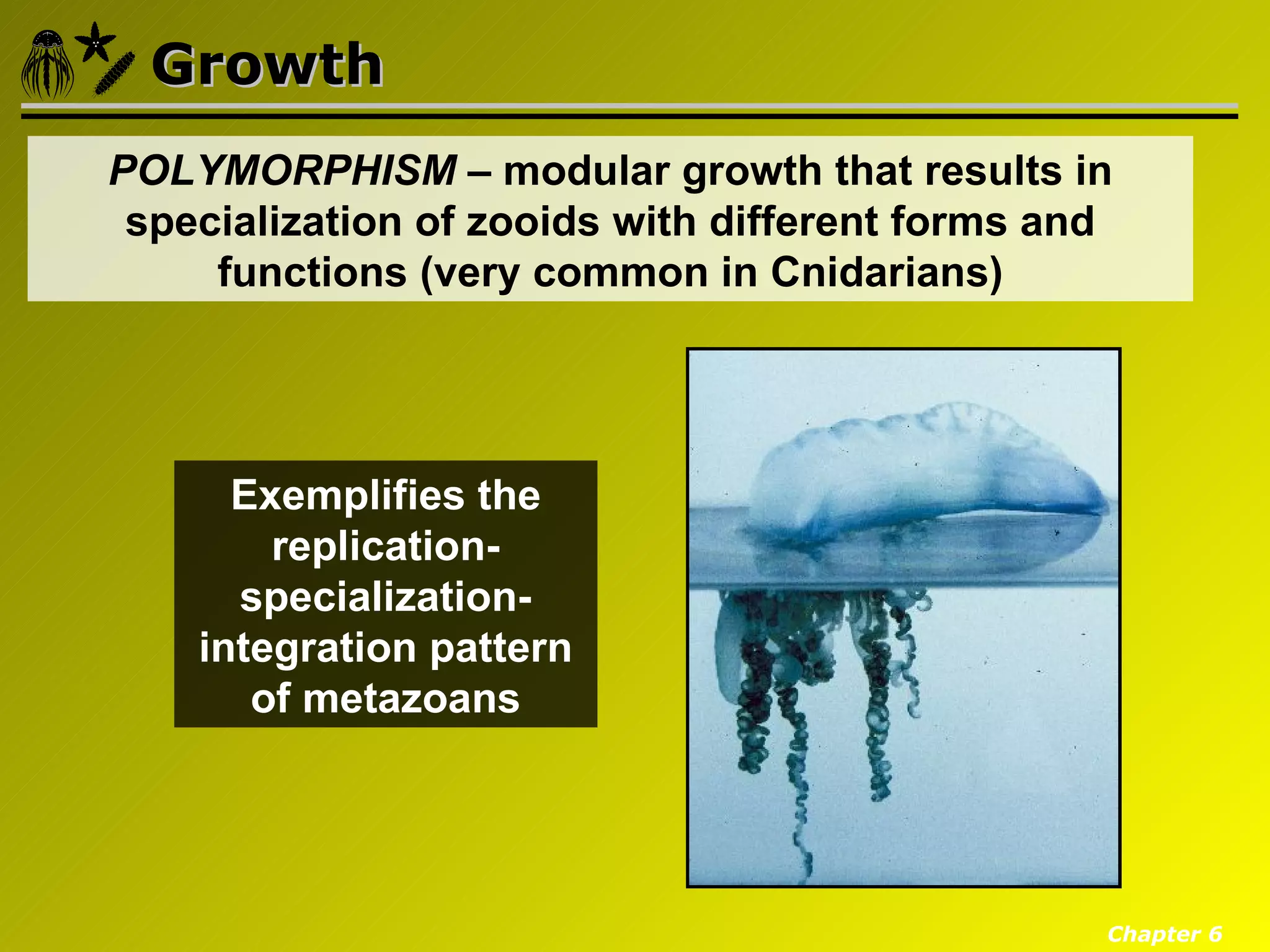
POLYMORPHISM – modular growth that results in
 specialization of zooids with different forms and
     functions (very common in Cnidarians)


      Exemplifies the
        replication-
      specialization-
    integration pattern
       of metazoans


                                                 Chapter 6

Intro to eumetazoa2012

  • 1.
    Introduction to Eumetazoa The‘true animals’ True epithelium, definite body axes, specialized tissues EUMETAZOA Chapter 6
  • 2.
    True Epithelia EPITHELIUM –cell layer that covers surfaces, lines internal cavities and spaces With basal lamina, apical-basal polarity, cell-cell junctions, immobile Allows for establishment of regulated compartments (connective tissue, gut lumen, coelom) Epithelial cells control passage of materials Environment under the epithelium can be chemically controlled Chapter 6
  • 3.
    True Epithelia APICAL-BASAL POLARITY BASAL LAMINA HEMIDESMOSOMES Epithelial Junctions •AHDERING •SEALING • GAP Chapter 6
  • 4.
    Epidermis, Gastrodermis &Gut EPIDERMIS – the outer skin; covers the surface of the eumetazoan body Secretory Absorptive Impermeable GASTRODERMIS – stomach skin; epithelial layer that lines the gut and joins the epidermis at the mouth GUT – internal, epithelia-lined cavity; it is a regulated compartment • GUT LUMEN (CAVITY) – also regulated compartment • Allows EXTRACELLULAR DIGESTION • Secretes digestive enzymes and absorbs products Chapter 6
  • 5.
    Connective Tissue CONNECTIVE-TISSUE COMPARTMENT– lies between the epi- and gastrodermis May just be the basal lamina of the two epithelia May be very thick CONNECTIVE TISSUE – consists of ECM and cells; no collective term for cells of the ECM Sponges – mesohyl Metazoans – blastocoel Cnidarians – mesoglea Bilateria – simply called ‘connective tissue’ Chapter 6
  • 6.
    Eumetazoan Skeletons Skeletons can: Maintain body shape Support or protect the body Transmit force of muscle contraction Be internal or external Be mineral, organic or both Be fluid or solid Chapter 6
  • 7.
    Fluid Skeleton HYDROSTATIC SKELETON– water-filled skeleton, a.k.a. a hydrstat; cavity filled with water-based fluid **This is a eumetazoan innovation!!** • Surrounded by muscles (circular and longitudinal) • Muscles contract and pressurize the fluid • Water is incompressible •CIRCULAR CONTRACTION – lengthens hydrostat and stretches longitudinal muscles • LONGITUDINAL CONTRACTION – shortens hydrostat and stretches circular muscles Utility  inflate body, extend parts, locomotion, burrowing Chapter 6
  • 8.
    Fluid Skeleton • Body wall strengthened by inelastic fibers (like collagen) • Resists aneurisms Orthogonal Crossed-helical Chapter 6
  • 9.
    Solid Skeleton PLIANT SKELETON– made of materials that are rubbery and elastic • Deform when stretched, spring back to original shape • Proteins, polysaccharides, water • Use as CT in comb jellies, mesoglea in jellyfish, hinges of bivalves RIGID SKELETON – made of materials that resist a change of shape (bone/shell) Insect framework, terrestrial and flying invertebrates, and fast moving crustaceans of the ocean Chapter 6
  • 10.
    Movement and BodySize Cilia/Flagella VS Muscles Only in water Water, air, land Associated with surface Associated with volume area (effective when S/V is Locomotion, can move large) body parts with respect to Small, lilliputian other body parts (ALL invertebrates ANIMALS DO THIS) Prone to surface friction Effective when S/V is and viscous drag from small environement Momentum stops when ciliary/flagellar beat stops Chapter 6
  • 11.
    Musculature EPITHELIOMUSCULAR CELLS: Arose from epithelium. Actin-myosin microfilaments allowed some to become contractile. MYOEPITHELIAL CELLS: Contractile fibers isolated in independent cells but are still part of the epithelium. Outside the basal lamina MYOCYTES: True muscle, contractile cells below basal lamina. No longer epithelial. Chapter 6
  • 12.
    Musculature SMOOTH MUSCLE: Contracts slowly. Tension over large range of stretch lengths. Contractile tentacles. CROSS-STRIATED MUSCLE: Contracts rapidly. Tension over limited range. Snapping jaws or claws. OBLIQUELY-STRIATED: Intermediate of the other two. Extensible animals that can make quick movements. ANTAGONISTIC Chapter 6
  • 13.
    Neurons and NervousSystem Eumetazoans use nerve cells to detect, evaluate, and respond to environmental stimuli. NEURONS - respond to stimuli by transmitting information as a wave of depolarization to the target cells Sensory receptors and neurons arose from epithelia (like muscle cells). They became specialized and migrated to a connective-tissue compartment Chapter 6
  • 14.
    Neurons and NervousSystem Transmission of a nerve impulse from neuron to neuron or from neuron to effector (muscle) occurs via: Electrical junctions – gap junctions that join cells so that membrane depolarization (action potential) spreads uninterrupted; no organismal control SYNAPSE – gap between two cells (synaptic cleft) through which the action potential is carried by chemical neurotransmitters Chapter 6
  • 15.
    Sense Cells &Organs Eumetazoans need to obtain a dynamic picture of their environment so they can respond appropriately. Response to different stimuli like: Electromagnetic Mechanical Chemical Magn etic Direction and distance to the source of the stimuli are so important to each eumtezoan Simple: sensory neuron-effector Complex: multiple stimuli, whole-body response, accessory structures, CNS Chapter 6
  • 16.
    Gravity Receptors STATOCYSTS – hollow capsules lined with MECHANORECEPTORS and with a dense, heavy STATOLITH at the center. Gravity pulls the statolith against the bed of mechanoreceptors which then causes alterations of the depolarization pattern. Chapter 6
  • 17.
    Photoreceptors CILIARY andRHABDOMERIC – can be dispersed as individual cells or, can be grouped together as EYES. OCELLUS:PIGMENT SPOT PIGMENT CUP – EVERTED or INVERTED Chapter 6
  • 18.
    Development Zygote Cleavage Blastula *Gastrulation* Larva Gastrulation types: INVAGINATION EPIBOLY INGRESSION Chapter 6
  • 19.
    Development DIPLOBLASTIC – adults have 2 epithelial layers (epidermis & gastrodermis) TRIPLOBLASTIC – adults have 3 epithelial layers (addition of mesothelium) MESODERM – located between ecto- and endoderm and can arise from either Chapter 6
  • 20.
    Growth Solitary VS Modular • Juvenile grows via Add new, small, general increase in size identical units (module – • ALLOMETRIC – different ZOOID) body parts grow at different Clonal budding rates All zooids form a colony • Surface > Volume Favorable SA:V • Gills, lungs, gastrodermis ISOMETRIC – similar • Associated with growth locomotion and increasing Colony is considered complexity on one body one individual axis Self repair, higher • Self repair, often killed survival if preyed upon Chapter 6
  • 21.
    Growth Chapter 6
  • 22.
    Growth POLYMORPHISM – modulargrowth that results in specialization of zooids with different forms and functions (very common in Cnidarians) Exemplifies the replication- specialization- integration pattern of metazoans Chapter 6