MS EXCEL 2013
Presenter Note:
Presenter Notes:
The Word Basics presentation is a
preformatted solution designed to help
familiarize you with the word processing
application’s basic functions.
What is Excel ?
 Excel 2013 is a spreadsheet program that allows you to store, organize,
and analyze information.
 It features calculation, graphing tools, pivot tables, and a macro
programming language called Visual Basic for Applications.
The Excel Cell
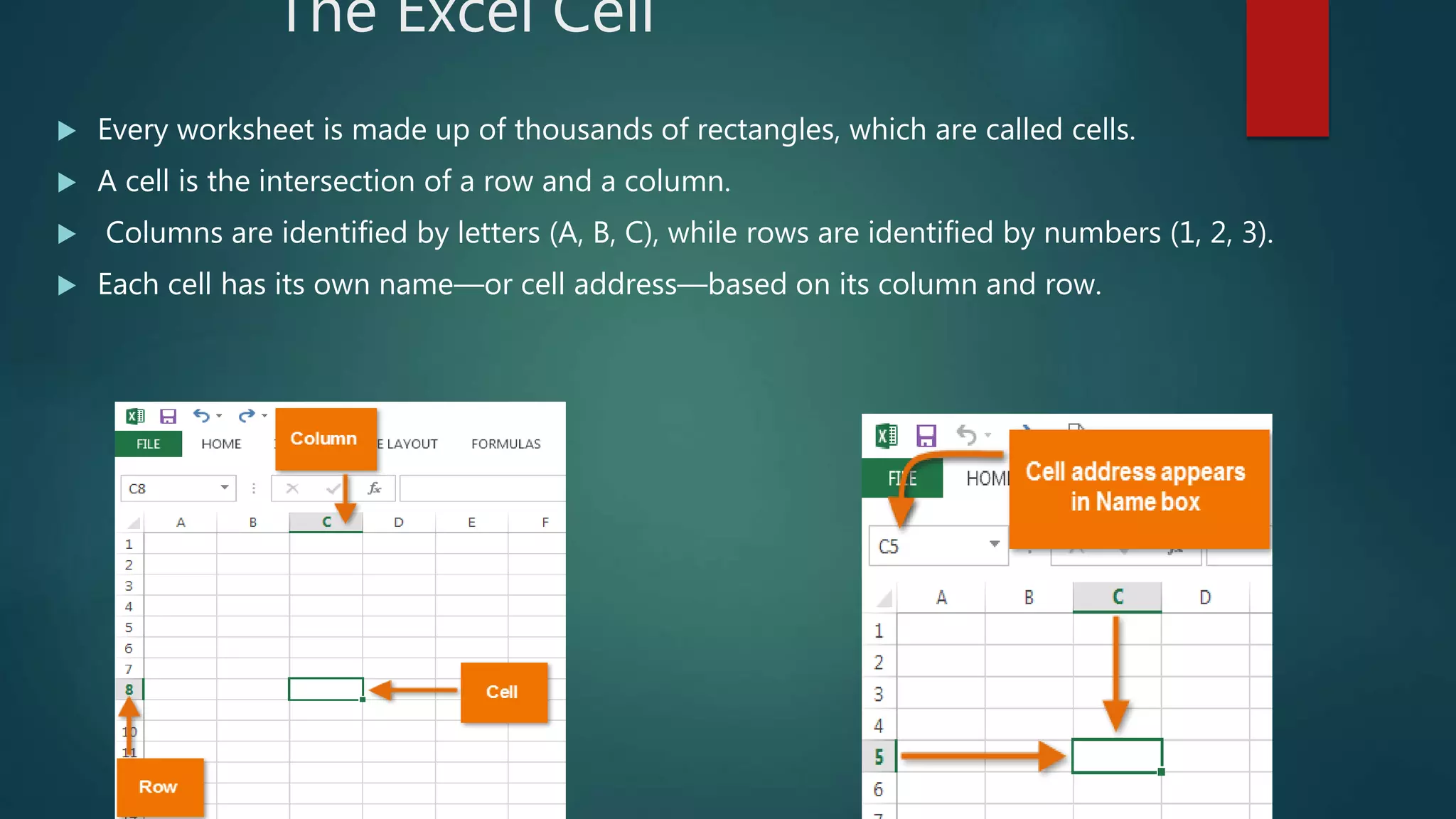
 Every worksheet is made up of thousands of rectangles, which are called cells.
 A cell is the intersection of a row and a column.
 Columns are identified by letters (A, B, C), while rows are identified by numbers (1, 2, 3).
 Each cell has its own name—or cell address—based on its column and row.
Cell Content
 Cell can contain different types of content, including text, formatting,
formulas and functions.
Text: Cells can contain text, such as letters,
numbers, and dates.
Formatting: Formatting attributes can change
the way letters, numbers, and dates are
displayed.
Formulas and Functions: Cells can contain
formulas and functions that calculate cell values.
Worksheet Views
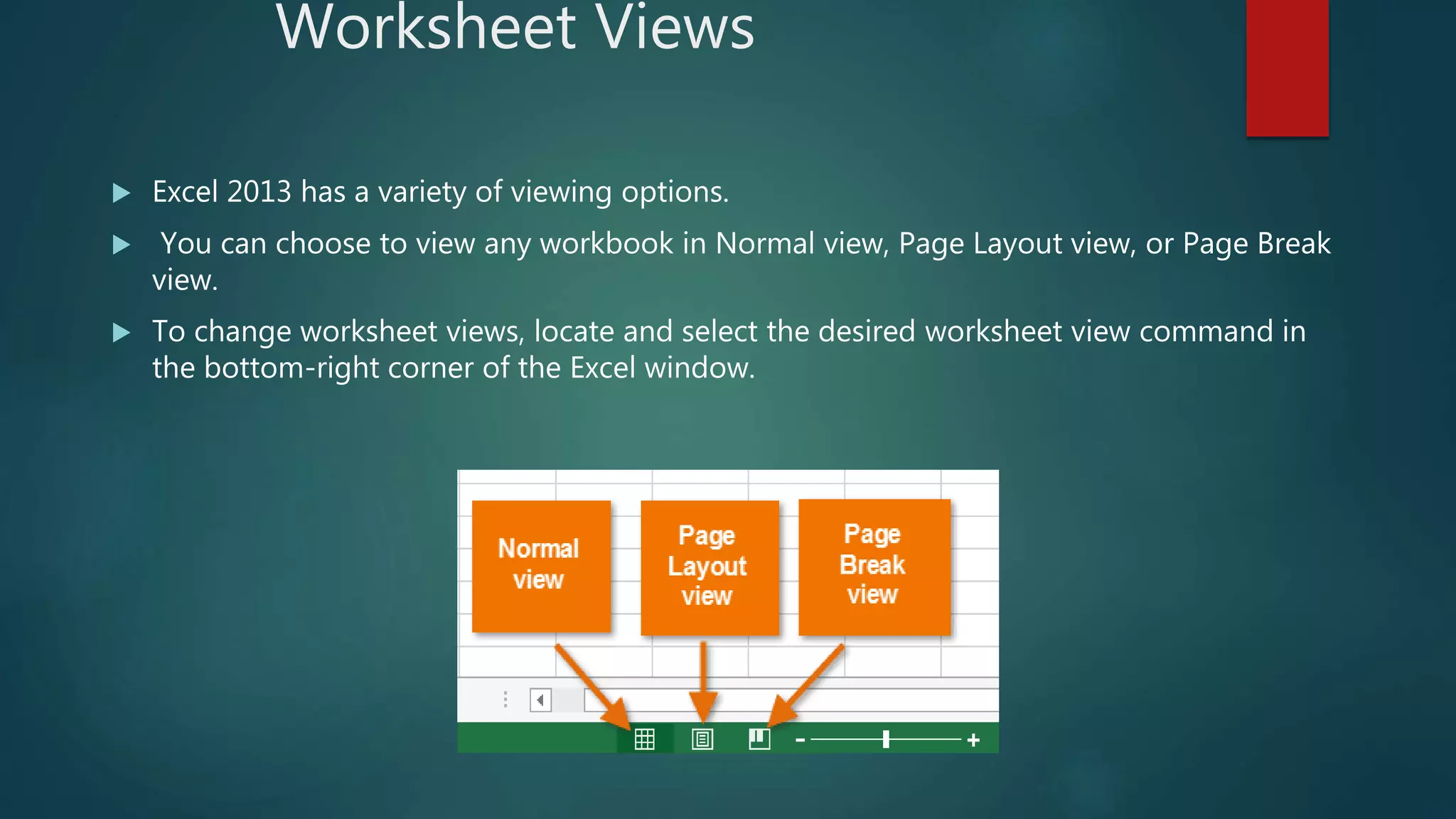
 Excel 2013 has a variety of viewing options.
 You can choose to view any workbook in Normal view, Page Layout view, or Page Break
view.
 To change worksheet views, locate and select the desired worksheet view command in
the bottom-right corner of the Excel window.
Formatting Text and Numbers in Cells
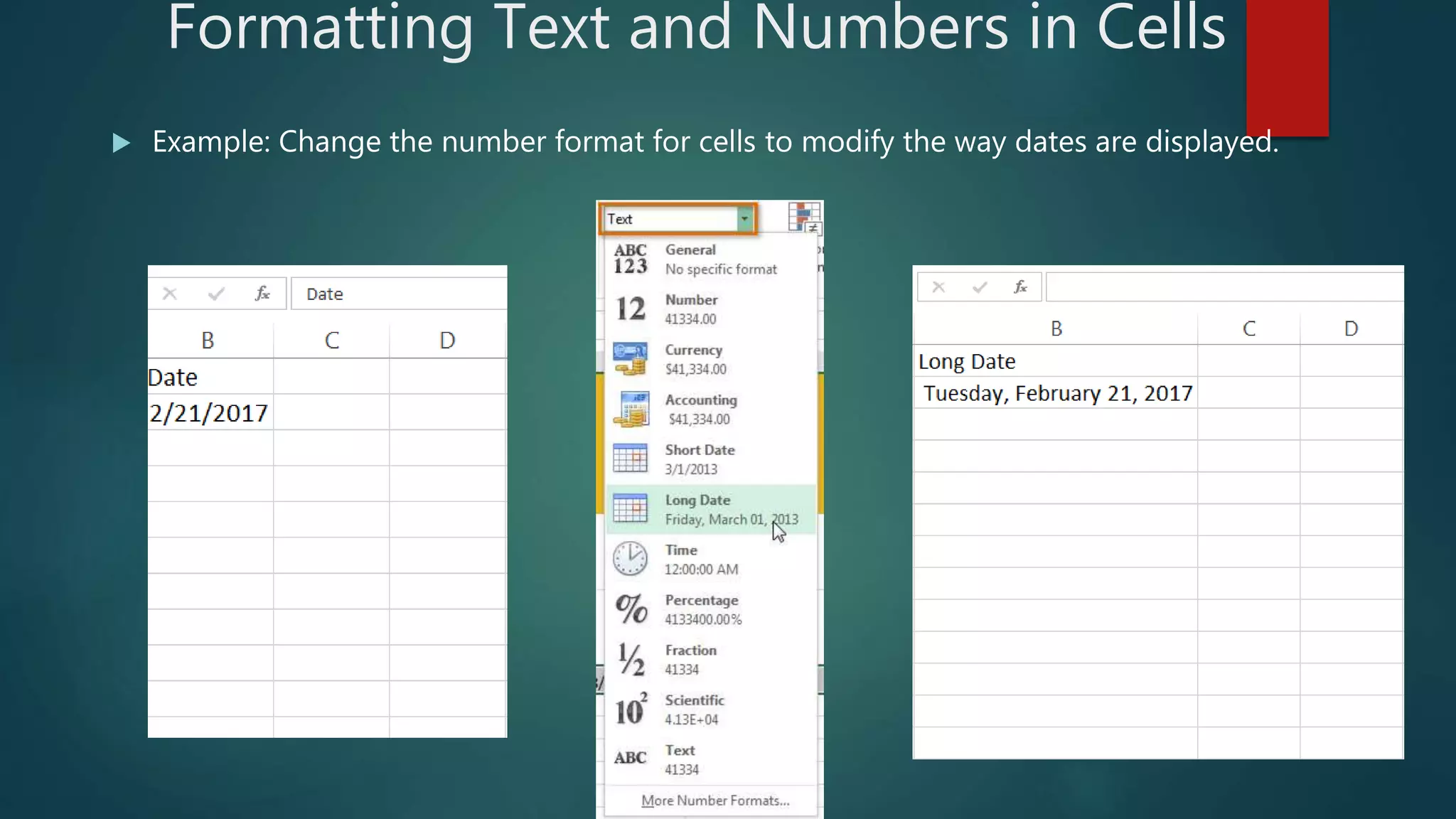
 Example: Change the number format for cells to modify the way dates are displayed.
Simple Formulas
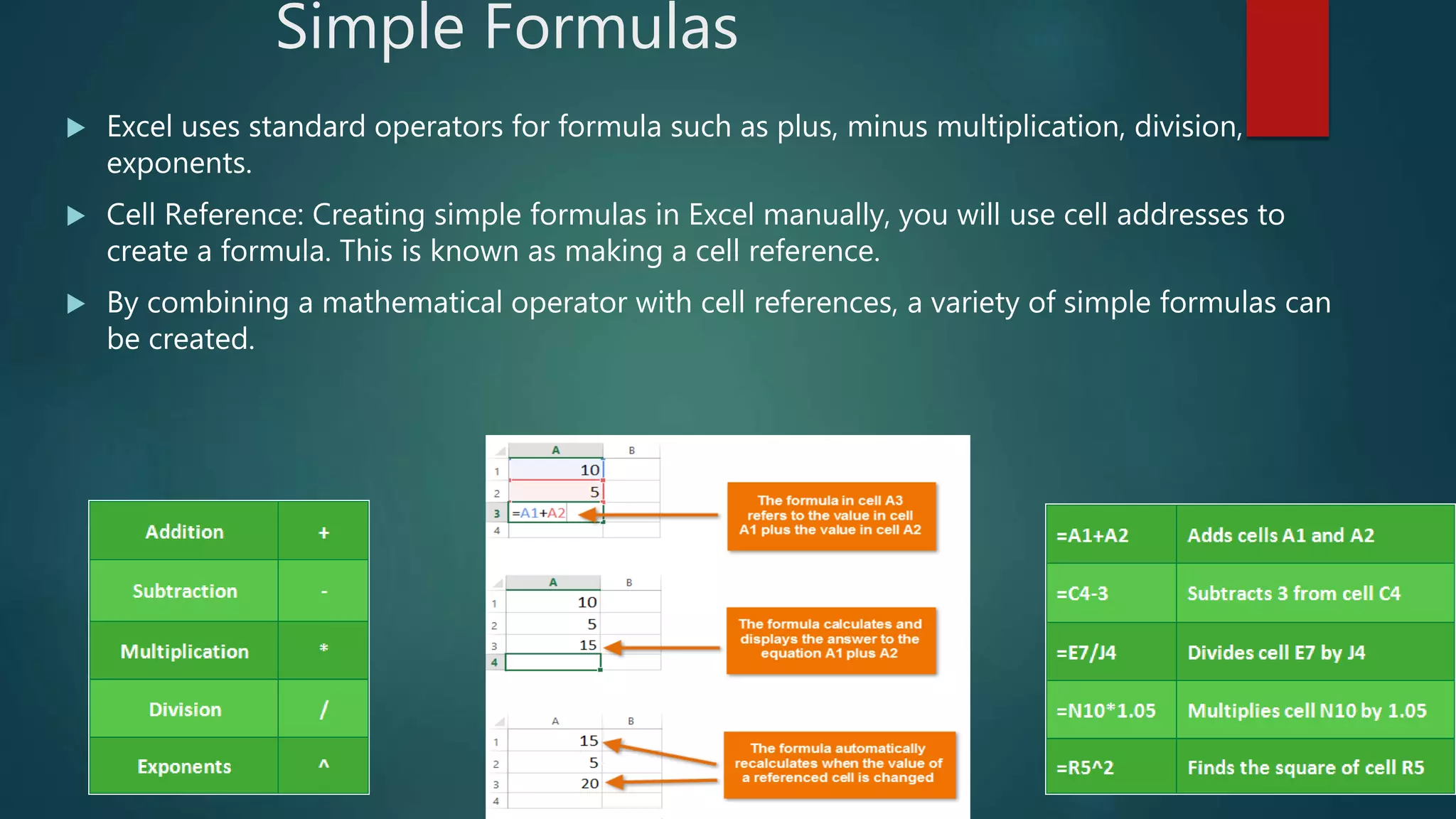
 Excel uses standard operators for formula such as plus, minus multiplication, division,
exponents.
 Cell Reference: Creating simple formulas in Excel manually, you will use cell addresses to
create a formula. This is known as making a cell reference.
 By combining a mathematical operator with cell references, a variety of simple formulas can
be created.
Complex Formula
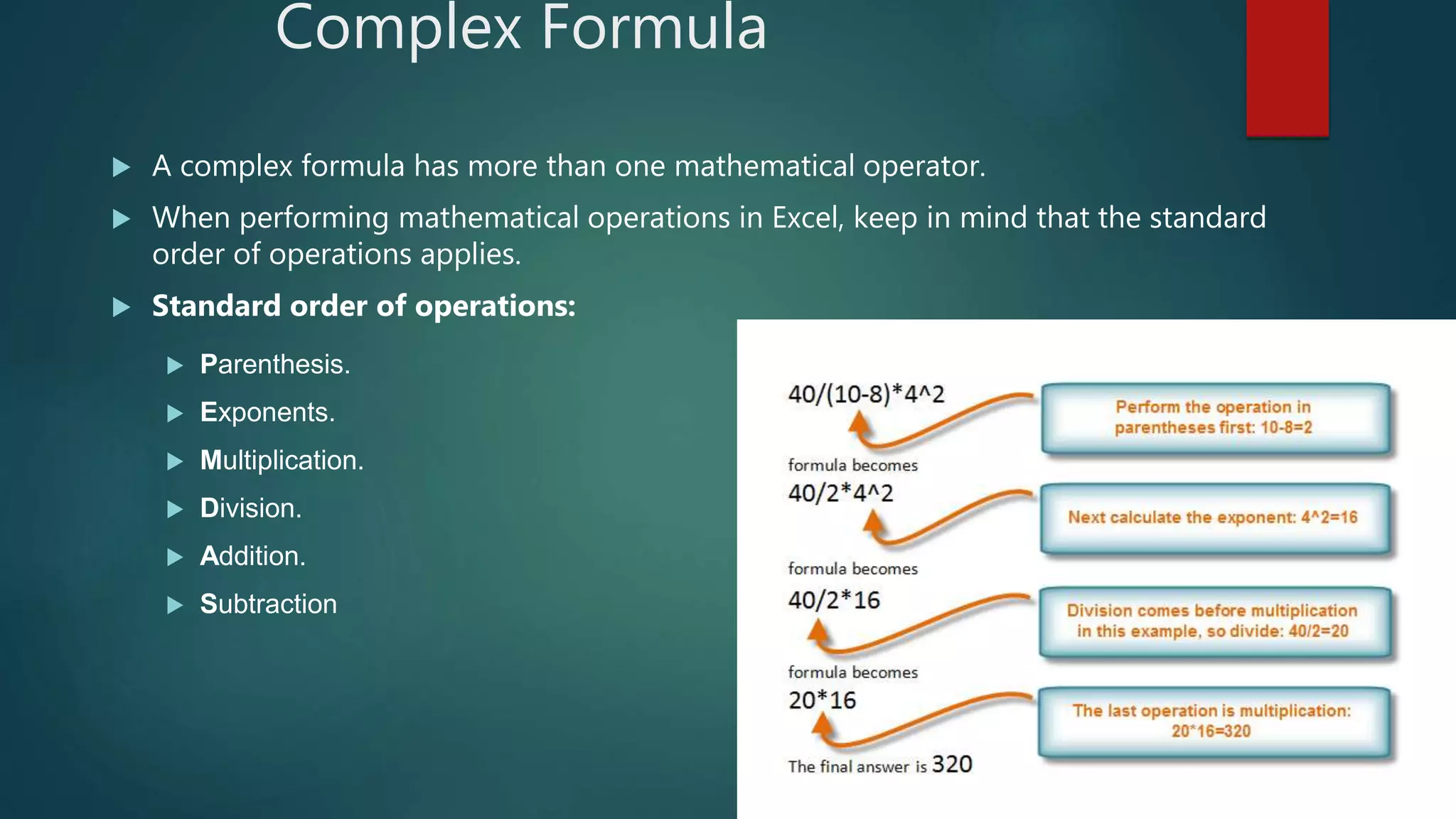
 A complex formula has more than one mathematical operator.
 When performing mathematical operations in Excel, keep in mind that the standard
order of operations applies.
 Standard order of operations:
 Parenthesis.
 Exponents.
 Multiplication.
 Division.
 Addition.
 Subtraction
Insert Function Tool
 Insert function tool is used to ensure a formula is entered with the correct syntax.
 you can select the function that most matches your needs. When the function is highlighted, a
description is shown underneath the function list.
 Select the cell that will contain the function.
 Click the Formulas tab on the Ribbon, then select the Insert Function command.
 The Insert Function dialog box will appear, type a few keywords, then click GO.
 Review the results to find the desired function, then click OK.
 The Function Arguments dialog box will appear, select the field, then enter the desired cell.
 Click OK, the function will be calculated, and the result will appear in the cell.
Creating Formulas
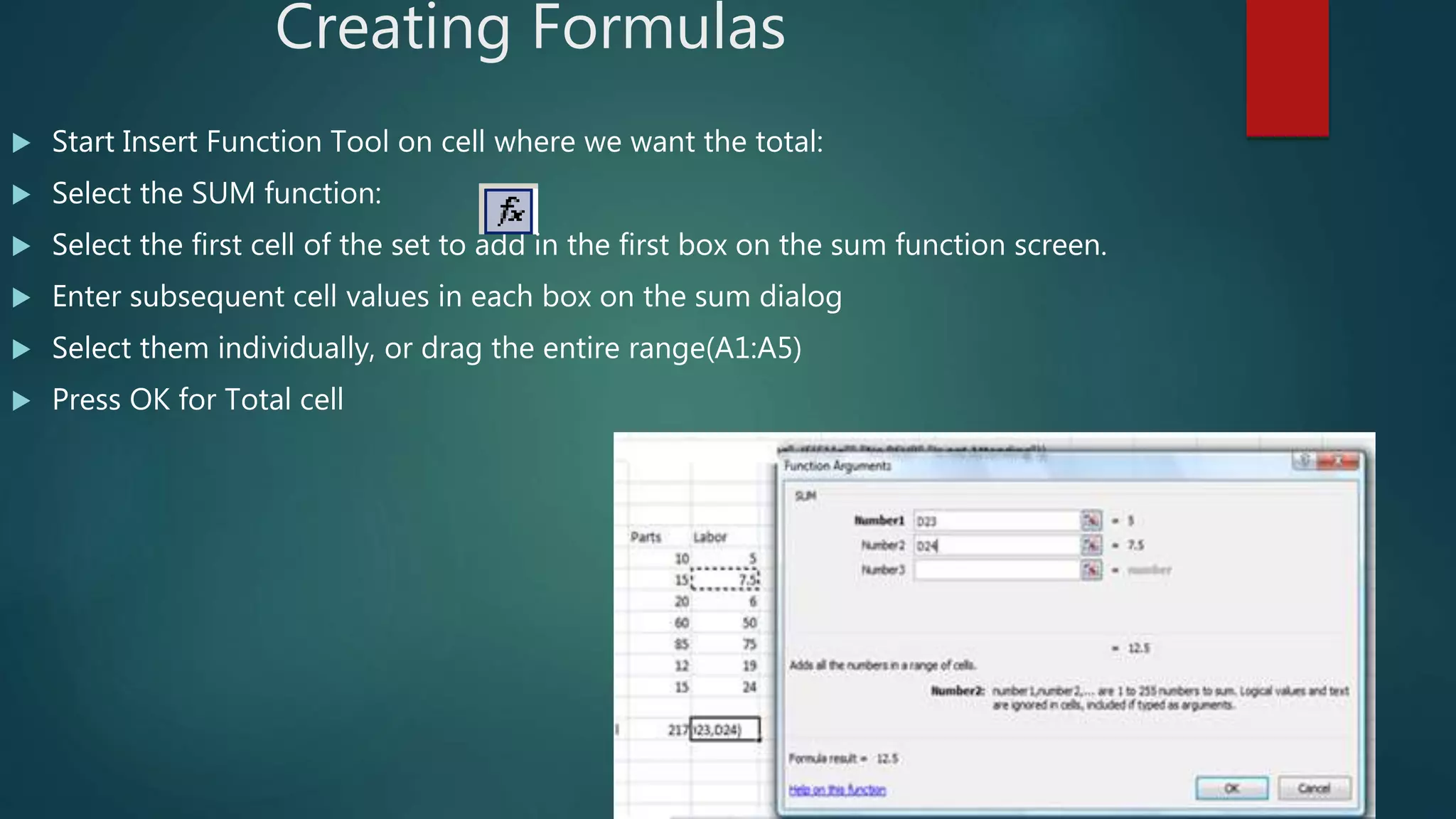
 Start Insert Function Tool on cell where we want the total:
 Select the SUM function:
 Select the first cell of the set to add in the first box on the sum function screen.
 Enter subsequent cell values in each box on the sum dialog
 Select them individually, or drag the entire range(A1:A5)
 Press OK for Total cell
Intermediate
Relative and Absolute Cell References
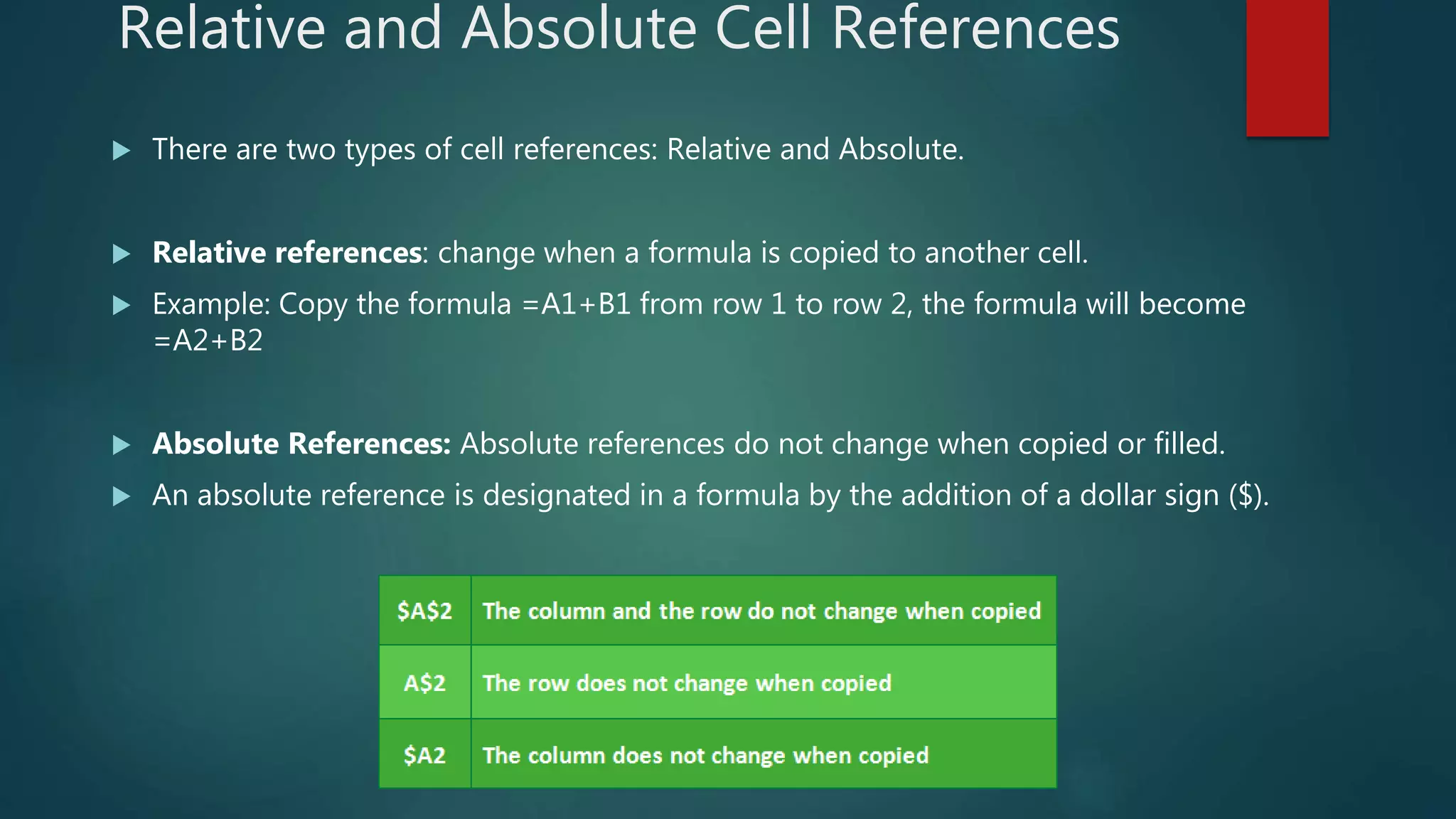
 There are two types of cell references: Relative and Absolute.
 Relative references: change when a formula is copied to another cell.
 Example: Copy the formula =A1+B1 from row 1 to row 2, the formula will become
=A2+B2
 Absolute References: Absolute references do not change when copied or filled.
 An absolute reference is designated in a formula by the addition of a dollar sign ($).
Track Changes
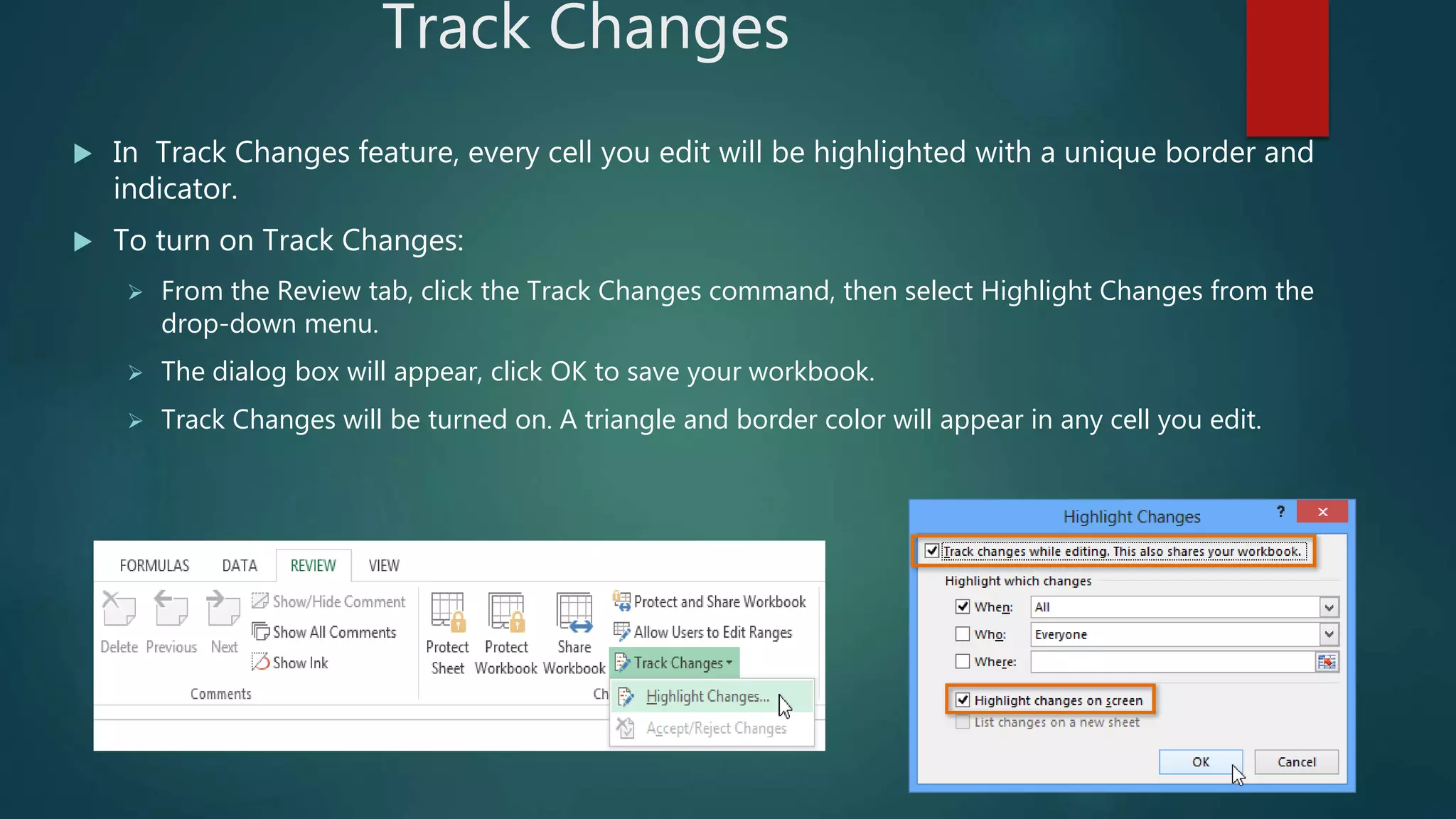
 In Track Changes feature, every cell you edit will be highlighted with a unique border and
indicator.
 To turn on Track Changes:
 From the Review tab, click the Track Changes command, then select Highlight Changes from the
drop-down menu.
 The dialog box will appear, click OK to save your workbook.
 Track Changes will be turned on. A triangle and border color will appear in any cell you edit.
Comments
 Sometimes you may want to add a comment to provide feedback instead of editing the
contents of a cell.
 To add a comment:
 Select the cell where you want the comment to appear
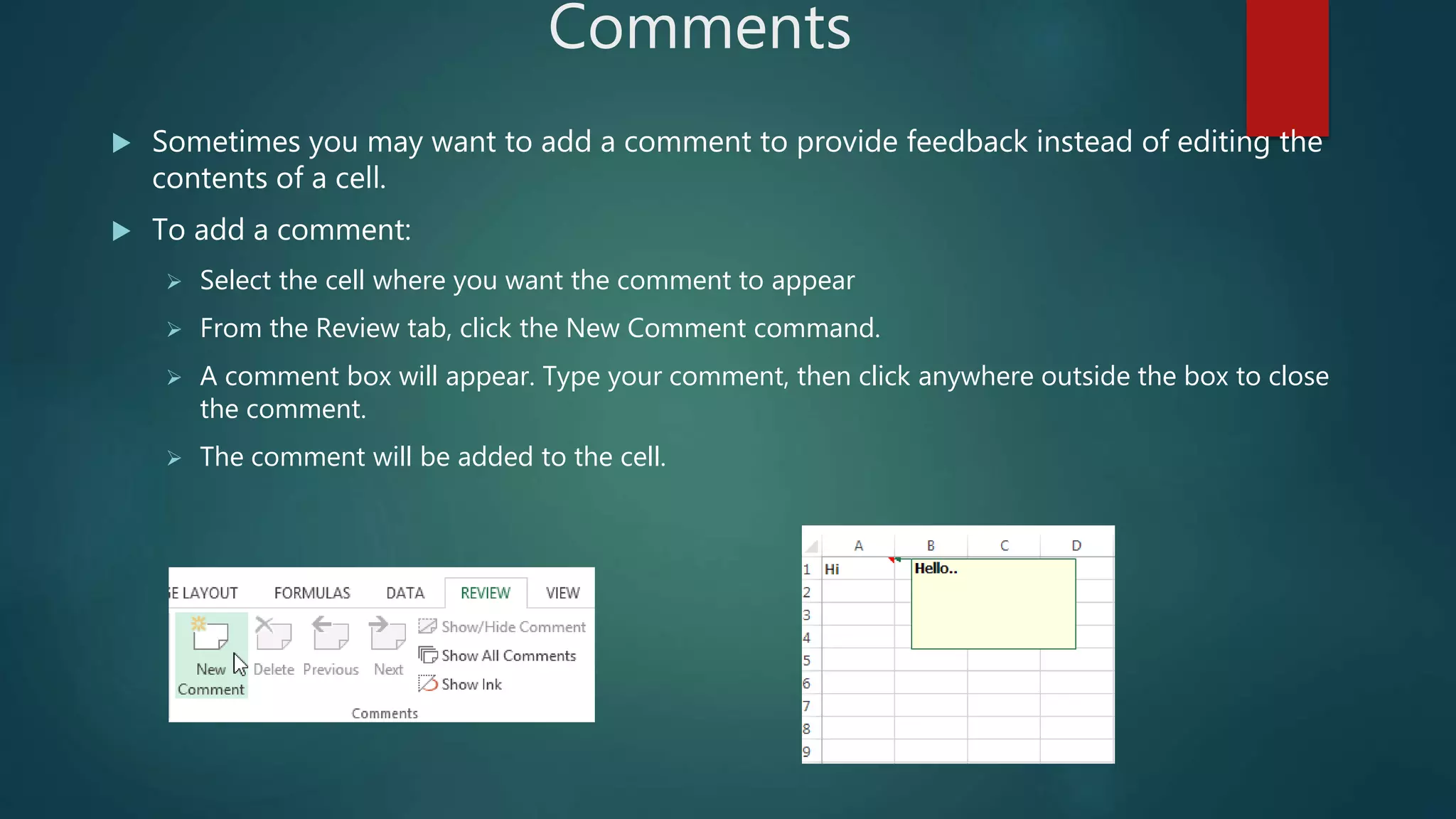
 From the Review tab, click the New Comment command.
 A comment box will appear. Type your comment, then click anywhere outside the box to close
the comment.
 The comment will be added to the cell.
Macro
What is Macro?
A macro is an action or a set of actions that you can run as many times as you
want. If you have tasks in Microsoft Excel that you do repeatedly, you can
record a macro to automate those tasks. When you create a macro, you are
recording your mouse clicks and keystrokes. After you create a macro, you can
edit it to make minor changes to the way it works.
Macro
 Before recording the Macro make sure Developer tab is visible on ribbon.
 By default, the Developer tab is not visible, so do the following:
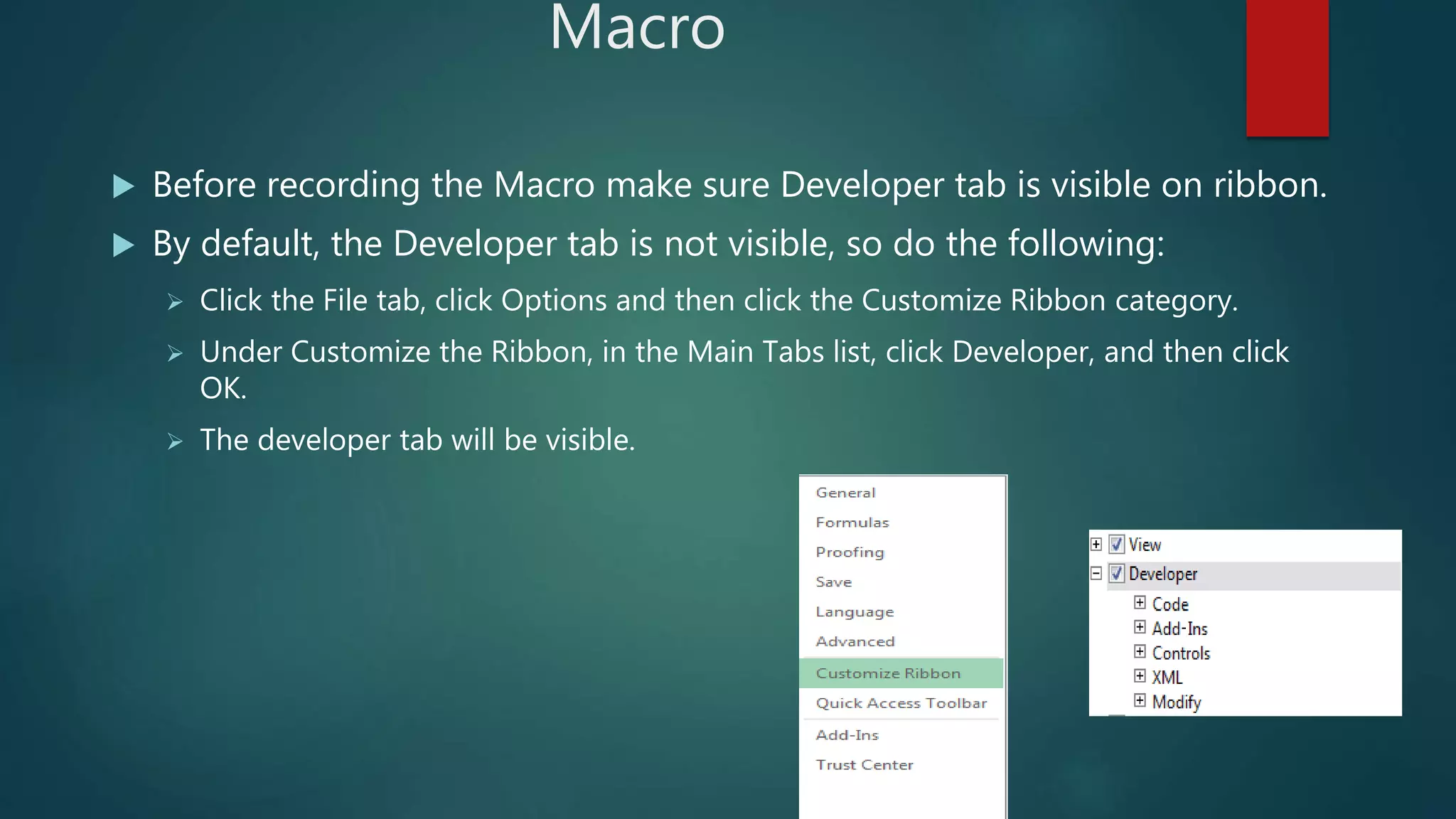
 Click the File tab, click Options and then click the Customize Ribbon category.
 Under Customize the Ribbon, in the Main Tabs list, click Developer, and then click
OK.
 The developer tab will be visible.
Macro
 Record Macro:
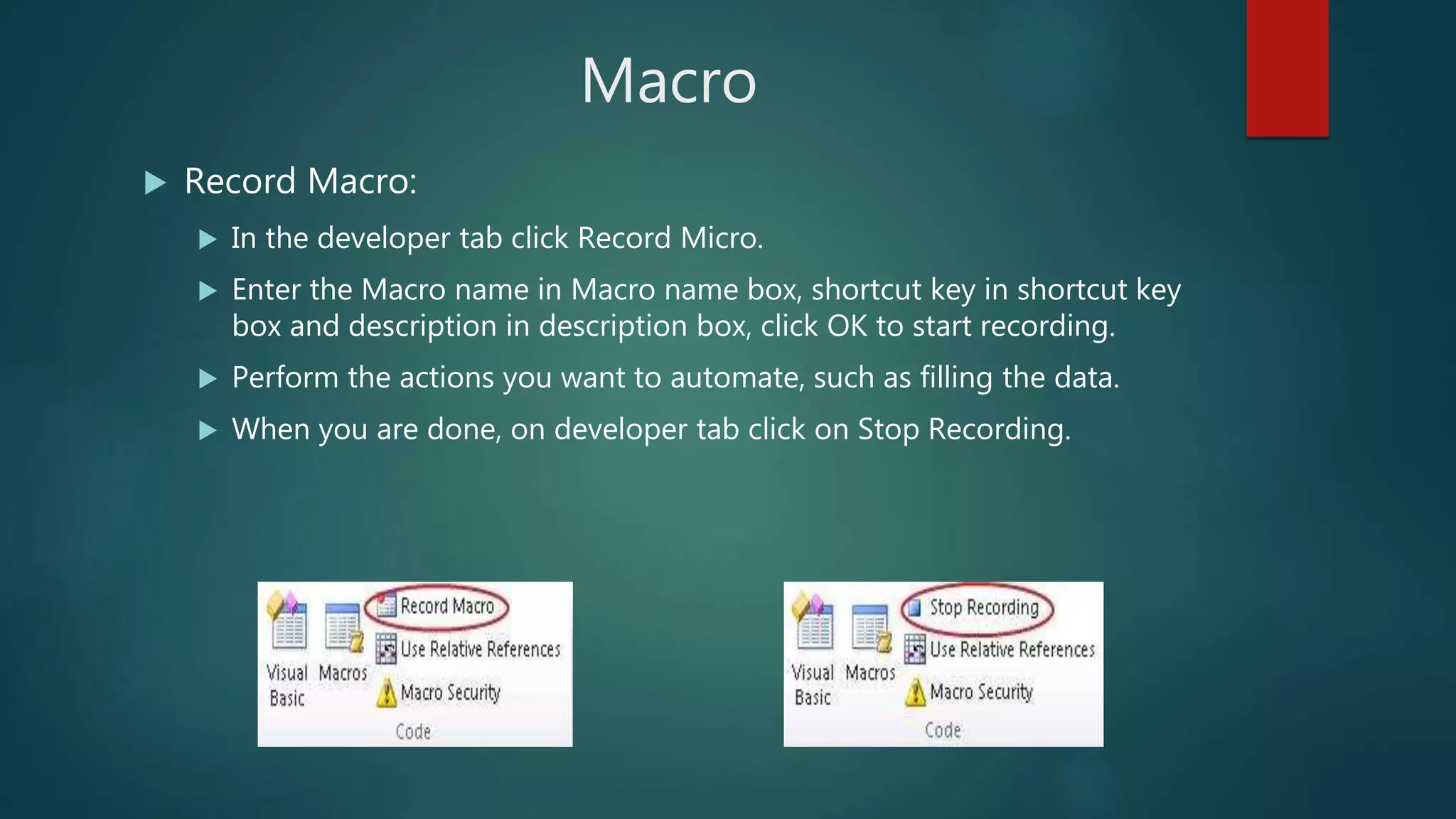
 In the developer tab click Record Micro.
 Enter the Macro name in Macro name box, shortcut key in shortcut key
box and description in description box, click OK to start recording.
 Perform the actions you want to automate, such as filling the data.
 When you are done, on developer tab click on Stop Recording.
Sorting
 You can quickly reorganize a worksheet by sorting your
data.
Types of Sorting:
 Sort Sheet: Organizes all of the data in your worksheet by one
column.
 Sort Range: sorts the data in a range of cells, which can be helpful
when working with a sheet that contains several tables.
Sorting
 To sort a Sheet:
 Select a cell in the column you want to sort by.
 Select the Data tab on the Ribbon, then click the Ascending command or the
Descending command.
 The worksheet will be sorted by the selected column.
 To sort a Range:
 Select the cell range you want to sort.
 Select the Data tab on the Ribbon, then click the Sort command.
 The Sort dialog box will appear. Choose the column you want to sort by.
 Decide the sorting order and then click OK.
 The cell range will be sorted by the selected column.
Filtering Data
 Filters can be used to narrow down the data in your worksheet.
 In order for filtering to work correctly, your worksheet should include a
header row.
 A drop-down arrow will appear in each header cell, then click to the drop
down arrow for the selected column.
 The filter menu will appear.
 Check the boxes next to the data you want to filter, uncheck all the other box
and then click OK.
 The data will be filtered.
Advanced
Tables
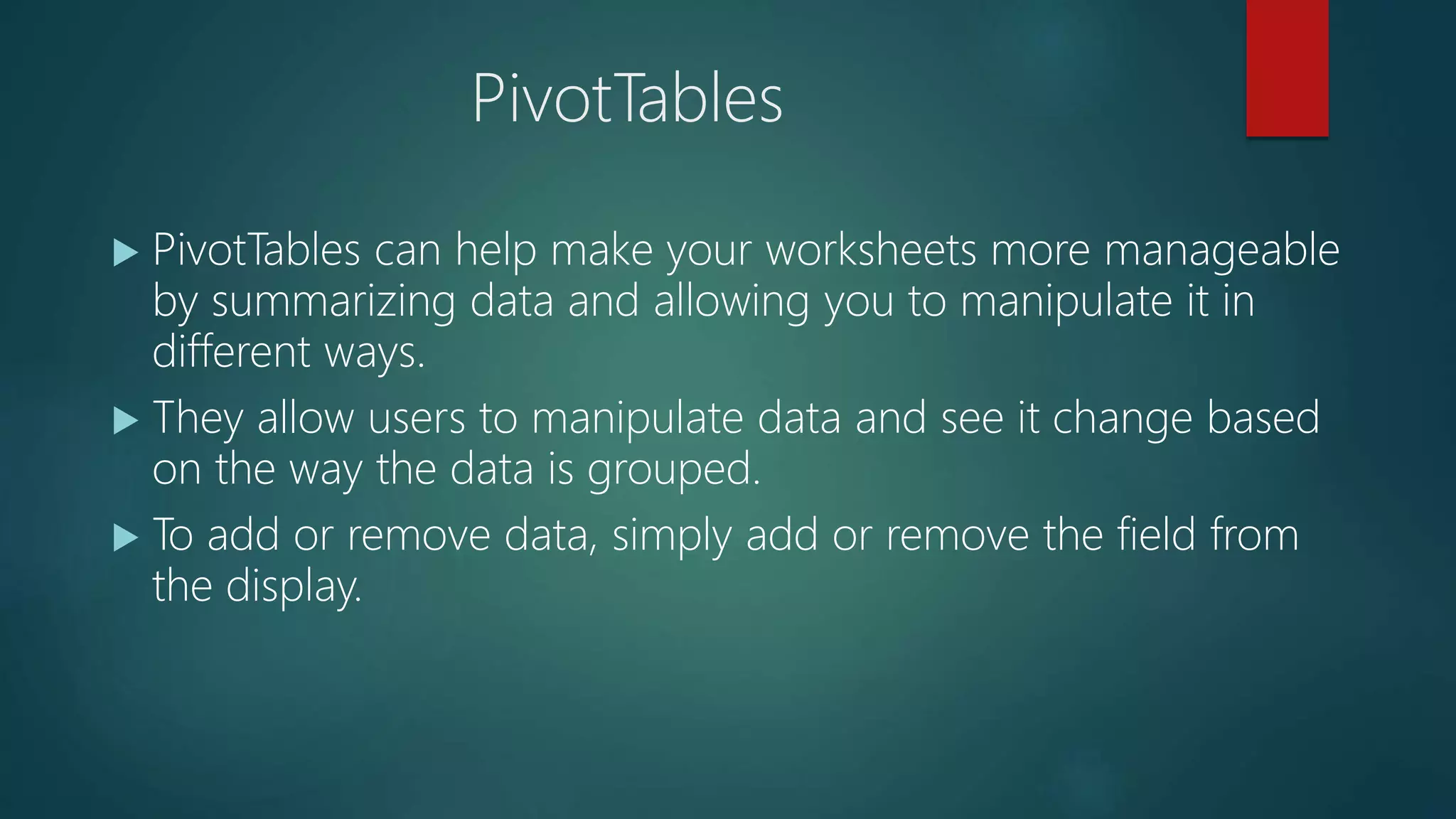
 Excel includes several tools and predefined table styles, allowing you to
create tables quickly and easily.
 To format data as a table:
 Select the cells you want to format as a table.
 From the Home tab, click the Format as Table command in the Styles group.
 Select a table style from the drop-down menu.
 A dialog box will appear, confirming the selected cell range for the table, click OK.
 The cell range will be formatted in the selected table style.
PivotTables
 PivotTables can help make your worksheets more manageable
by summarizing data and allowing you to manipulate it in
different ways.
 They allow users to manipulate data and see it change based
on the way the data is grouped.
 To add or remove data, simply add or remove the field from
the display.
PivotTables
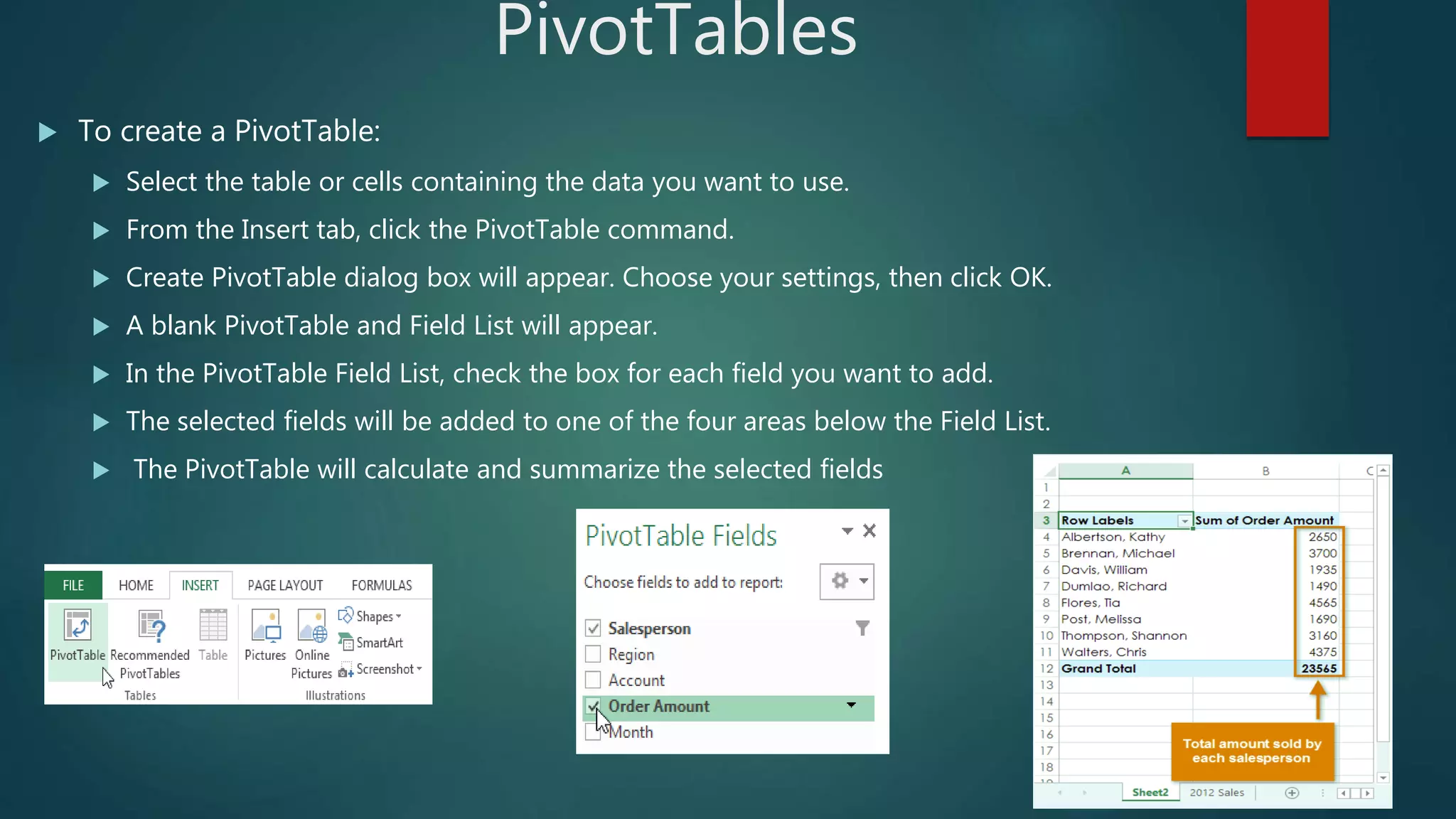
 To create a PivotTable:
 Select the table or cells containing the data you want to use.
 From the Insert tab, click the PivotTable command.
 Create PivotTable dialog box will appear. Choose your settings, then click OK.
 A blank PivotTable and Field List will appear.
 In the PivotTable Field List, check the box for each field you want to add.
 The selected fields will be added to one of the four areas below the Field List.
 The PivotTable will calculate and summarize the selected fields
PivotTables
 The advantage of a pivot table
is in the manipulation of data.
 Fields in a pivot table can be hidden, added, and
rearranged by any user on the fly using the field list.
 Other data related items are found on the Options tab.
 The Design tab helps with style formatting.
Charts
 Charts allow you to illustrate your workbook data graphically,
which makes it easy to visualize comparisons and trends.
 Excel has several different types of charts
 Columns Charts
 Pie Chart
 Line Chart
 Bar Chart
 Area Chart
 Surface Chart
Charts
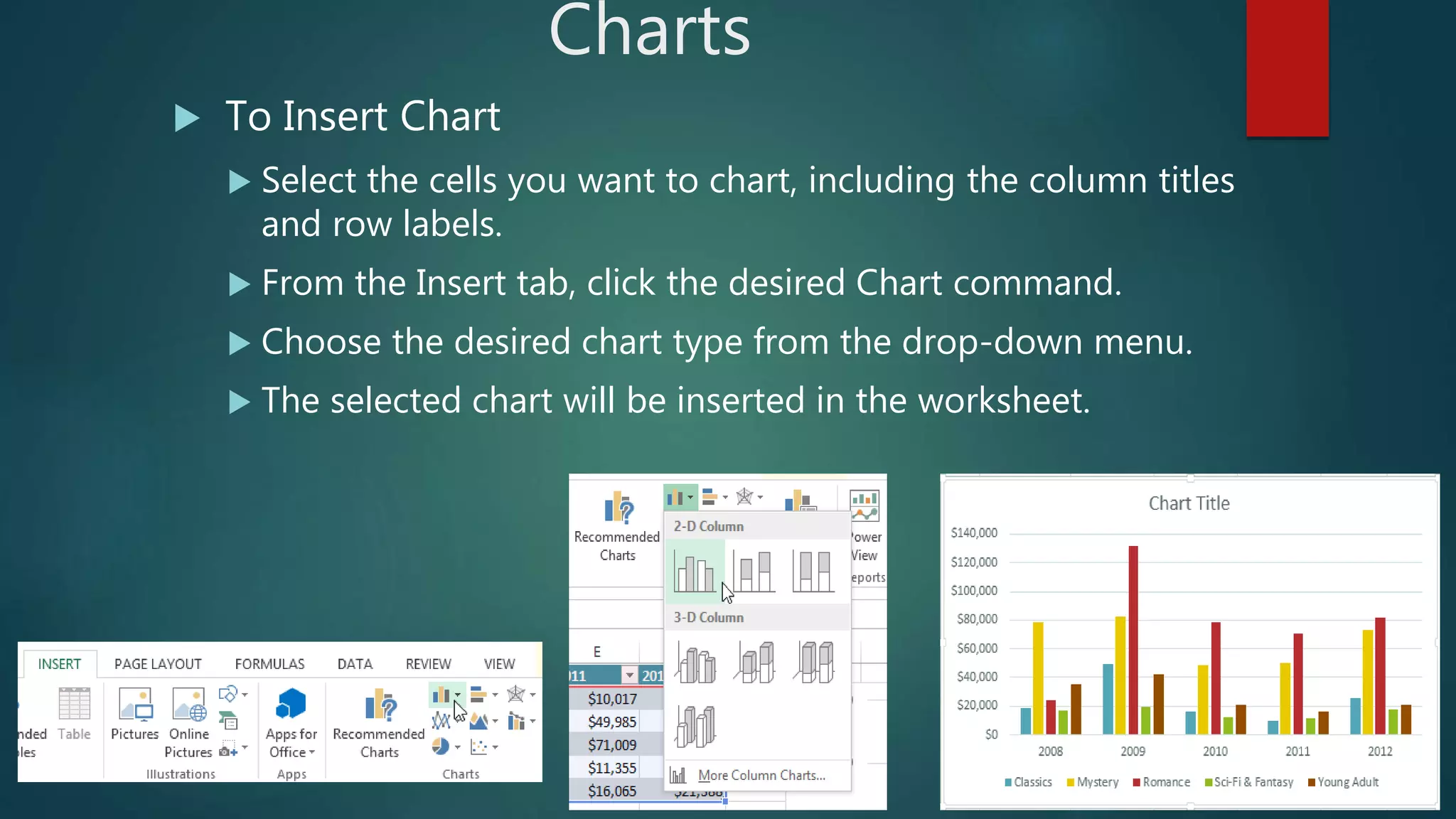
 To Insert Chart
 Select the cells you want to chart, including the column titles
and row labels.
 From the Insert tab, click the desired Chart command.
 Choose the desired chart type from the drop-down menu.
 The selected chart will be inserted in the worksheet.
Charts
 While creating and editing charts, you can also move a chart to a
new worksheet .
 Select the chart on the worksheet and select the Move Chart object on the
Design tab of the ribbon.
 Choose a new location for the chart.
 The ability to change the chart type is also available from the ribbon.
 Select the chart and choose Change Chart Type from the ribbons Design tab.
 Select the new chart type you wish to use.
 Charts can also be saved as templates.
Thank you

MS Excel 2013

  • 1.
  • 2.
    Presenter Note: Presenter Notes: TheWord Basics presentation is a preformatted solution designed to help familiarize you with the word processing application’s basic functions.
  • 3.
    What is Excel?  Excel 2013 is a spreadsheet program that allows you to store, organize, and analyze information.  It features calculation, graphing tools, pivot tables, and a macro programming language called Visual Basic for Applications.
  • 4.
    The Excel Cell Every worksheet is made up of thousands of rectangles, which are called cells.  A cell is the intersection of a row and a column.  Columns are identified by letters (A, B, C), while rows are identified by numbers (1, 2, 3).  Each cell has its own name—or cell address—based on its column and row.
  • 5.
    Cell Content  Cellcan contain different types of content, including text, formatting, formulas and functions. Text: Cells can contain text, such as letters, numbers, and dates. Formatting: Formatting attributes can change the way letters, numbers, and dates are displayed. Formulas and Functions: Cells can contain formulas and functions that calculate cell values.
  • 6.
    Worksheet Views  Excel2013 has a variety of viewing options.  You can choose to view any workbook in Normal view, Page Layout view, or Page Break view.  To change worksheet views, locate and select the desired worksheet view command in the bottom-right corner of the Excel window.
  • 7.
    Formatting Text andNumbers in Cells  Example: Change the number format for cells to modify the way dates are displayed.
  • 8.
    Simple Formulas  Exceluses standard operators for formula such as plus, minus multiplication, division, exponents.  Cell Reference: Creating simple formulas in Excel manually, you will use cell addresses to create a formula. This is known as making a cell reference.  By combining a mathematical operator with cell references, a variety of simple formulas can be created.
  • 9.
    Complex Formula  Acomplex formula has more than one mathematical operator.  When performing mathematical operations in Excel, keep in mind that the standard order of operations applies.  Standard order of operations:  Parenthesis.  Exponents.  Multiplication.  Division.  Addition.  Subtraction
  • 10.
    Insert Function Tool Insert function tool is used to ensure a formula is entered with the correct syntax.  you can select the function that most matches your needs. When the function is highlighted, a description is shown underneath the function list.  Select the cell that will contain the function.  Click the Formulas tab on the Ribbon, then select the Insert Function command.  The Insert Function dialog box will appear, type a few keywords, then click GO.  Review the results to find the desired function, then click OK.  The Function Arguments dialog box will appear, select the field, then enter the desired cell.  Click OK, the function will be calculated, and the result will appear in the cell.
  • 11.
    Creating Formulas  StartInsert Function Tool on cell where we want the total:  Select the SUM function:  Select the first cell of the set to add in the first box on the sum function screen.  Enter subsequent cell values in each box on the sum dialog  Select them individually, or drag the entire range(A1:A5)  Press OK for Total cell
  • 12.
  • 13.
    Relative and AbsoluteCell References  There are two types of cell references: Relative and Absolute.  Relative references: change when a formula is copied to another cell.  Example: Copy the formula =A1+B1 from row 1 to row 2, the formula will become =A2+B2  Absolute References: Absolute references do not change when copied or filled.  An absolute reference is designated in a formula by the addition of a dollar sign ($).
  • 14.
    Track Changes  InTrack Changes feature, every cell you edit will be highlighted with a unique border and indicator.  To turn on Track Changes:  From the Review tab, click the Track Changes command, then select Highlight Changes from the drop-down menu.  The dialog box will appear, click OK to save your workbook.  Track Changes will be turned on. A triangle and border color will appear in any cell you edit.
  • 15.
    Comments  Sometimes youmay want to add a comment to provide feedback instead of editing the contents of a cell.  To add a comment:  Select the cell where you want the comment to appear  From the Review tab, click the New Comment command.  A comment box will appear. Type your comment, then click anywhere outside the box to close the comment.  The comment will be added to the cell.
  • 16.
    Macro What is Macro? Amacro is an action or a set of actions that you can run as many times as you want. If you have tasks in Microsoft Excel that you do repeatedly, you can record a macro to automate those tasks. When you create a macro, you are recording your mouse clicks and keystrokes. After you create a macro, you can edit it to make minor changes to the way it works.
  • 17.
    Macro  Before recordingthe Macro make sure Developer tab is visible on ribbon.  By default, the Developer tab is not visible, so do the following:  Click the File tab, click Options and then click the Customize Ribbon category.  Under Customize the Ribbon, in the Main Tabs list, click Developer, and then click OK.  The developer tab will be visible.
  • 18.
    Macro  Record Macro: In the developer tab click Record Micro.  Enter the Macro name in Macro name box, shortcut key in shortcut key box and description in description box, click OK to start recording.  Perform the actions you want to automate, such as filling the data.  When you are done, on developer tab click on Stop Recording.
  • 19.
    Sorting  You canquickly reorganize a worksheet by sorting your data. Types of Sorting:  Sort Sheet: Organizes all of the data in your worksheet by one column.  Sort Range: sorts the data in a range of cells, which can be helpful when working with a sheet that contains several tables.
  • 20.
    Sorting  To sorta Sheet:  Select a cell in the column you want to sort by.  Select the Data tab on the Ribbon, then click the Ascending command or the Descending command.  The worksheet will be sorted by the selected column.  To sort a Range:  Select the cell range you want to sort.  Select the Data tab on the Ribbon, then click the Sort command.  The Sort dialog box will appear. Choose the column you want to sort by.  Decide the sorting order and then click OK.  The cell range will be sorted by the selected column.
  • 21.
    Filtering Data  Filterscan be used to narrow down the data in your worksheet.  In order for filtering to work correctly, your worksheet should include a header row.  A drop-down arrow will appear in each header cell, then click to the drop down arrow for the selected column.  The filter menu will appear.  Check the boxes next to the data you want to filter, uncheck all the other box and then click OK.  The data will be filtered.
  • 22.
  • 23.
    Tables  Excel includesseveral tools and predefined table styles, allowing you to create tables quickly and easily.  To format data as a table:  Select the cells you want to format as a table.  From the Home tab, click the Format as Table command in the Styles group.  Select a table style from the drop-down menu.  A dialog box will appear, confirming the selected cell range for the table, click OK.  The cell range will be formatted in the selected table style.
  • 24.
    PivotTables  PivotTables canhelp make your worksheets more manageable by summarizing data and allowing you to manipulate it in different ways.  They allow users to manipulate data and see it change based on the way the data is grouped.  To add or remove data, simply add or remove the field from the display.
  • 25.
    PivotTables  To createa PivotTable:  Select the table or cells containing the data you want to use.  From the Insert tab, click the PivotTable command.  Create PivotTable dialog box will appear. Choose your settings, then click OK.  A blank PivotTable and Field List will appear.  In the PivotTable Field List, check the box for each field you want to add.  The selected fields will be added to one of the four areas below the Field List.  The PivotTable will calculate and summarize the selected fields
  • 26.
    PivotTables  The advantageof a pivot table is in the manipulation of data.  Fields in a pivot table can be hidden, added, and rearranged by any user on the fly using the field list.  Other data related items are found on the Options tab.  The Design tab helps with style formatting.
  • 27.
    Charts  Charts allowyou to illustrate your workbook data graphically, which makes it easy to visualize comparisons and trends.  Excel has several different types of charts  Columns Charts  Pie Chart  Line Chart  Bar Chart  Area Chart  Surface Chart
  • 28.
    Charts  To InsertChart  Select the cells you want to chart, including the column titles and row labels.  From the Insert tab, click the desired Chart command.  Choose the desired chart type from the drop-down menu.  The selected chart will be inserted in the worksheet.
  • 29.
    Charts  While creatingand editing charts, you can also move a chart to a new worksheet .  Select the chart on the worksheet and select the Move Chart object on the Design tab of the ribbon.  Choose a new location for the chart.  The ability to change the chart type is also available from the ribbon.  Select the chart and choose Change Chart Type from the ribbons Design tab.  Select the new chart type you wish to use.  Charts can also be saved as templates.
  • 30.

Editor's Notes

  • #8 Instead of displaying all cell content in exactly the same way, you can use formatting to change the appearance of dates, times, decimals, percentages (%), currency ($), and much more. To modify the date: 1.Select the cells(s) you want to modify. 2.Click the drop-down arrow next to the Number Format command on the Home tab. The Number Formatting drop-down menu will appear. 3.Select the desired formatting option. In the Example we chose Long Date. 4. The selected cells will change to the new formatting style. **You can also press CTRL+1 on your keyboard for quick access.
  • #9 Excel uses standard operators for formulas, such as a plus sign for addition (+), a minus sign for subtraction (-), an asterisk for multiplication (*), a forward slash for division (/), and a caret (^) for exponents. **All formulas in Excel must begin with an equals sign (=). This is because the cell contains, or is equal to, the formula and the value it calculates
  • #10 When performing mathematical operations in Excel, keep in mind that the standard order of operations applies. Parenthesis Exponents Multiplication Division Addition Subtraction
  • #14 **When writing a formula, you can press the F4 key on your keyboard to switch between relative and absolute cell references. This is an easy way to quickly insert an absolute reference.
  • #22 **Filtering options can also be accessed from the Sort & Filter command on the Home tab.
  • #24 **If your table has headers, check the box next to My table has headers. **Filtering options can also be accessed from the Sort & Filter command on the Home tab.
  • #26 **If you change any of the data in your source worksheet, the PivotTable will not update automatically. To manually update it, select the PivotTable and then go to Analyze -> Refresh.
  • #27 There are four areas at the bottom of the field list which allow you to further filter and manipulate your data: Report Filter: Allows the entire report to be filtered by this column. If you wish to filter your pivot data by a particular item, set the column for that item in the report filter area. Column Labels: This area is where items are placed by default when checked. It contains the columns of the pivot table. Row Labels: This area can be used to add meaning to the data on the pivot table. Adding a field here will show the data for each item contained in the columns displayed, rather than a summary. Values: This area contains the summaries and totals for the numeric data are kept here.
  • #30 To move a chart to a new sheet: Click on the chart to select it. Select the Move chart object on the ribbon’s Design tab. To move the chart to a new sheet, select the New Sheet option and name the worksheet, or move the chart to a different existing worksheet by selecting the Object In option and choose the sheet from the drop-down menu. Press OK. **You can also use the chart formatting shortcut buttons to quickly add chart elements, change the chart style, and filter the chart data.