PRESENTER:-
Dr. Baharul Islam Choudhury
PGT
MODERATOR:-
Dr. M. Gayan
Asst. Proff.
Date- 04 /11 / 2015
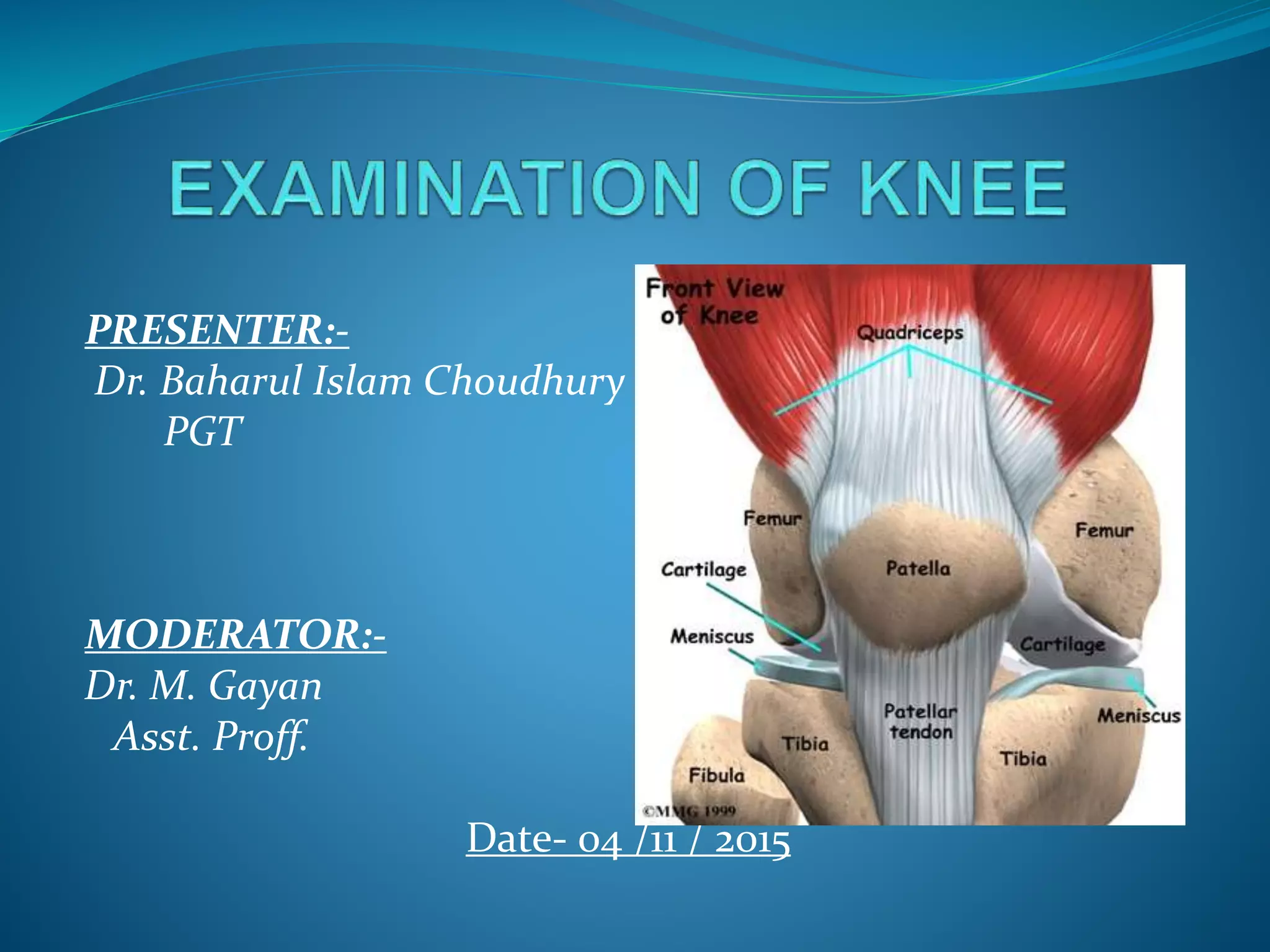
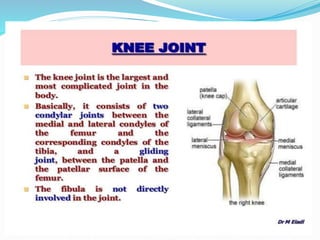
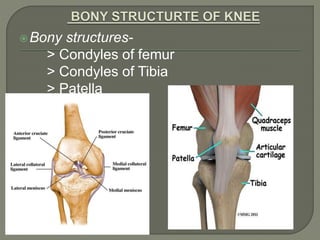
Bony structures-
> Condyles of femur
> Condyles of Tibia
> Patella
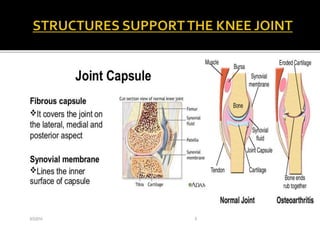
 JOINT CAPSULE
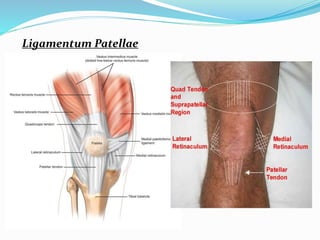
Ligamentum Patellae
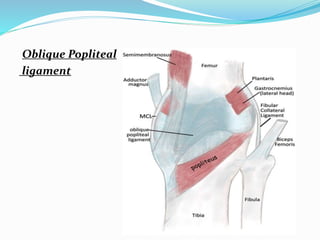
Oblique Popliteal
ligament
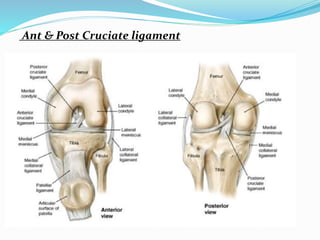
Ant & Post Cruciate ligament
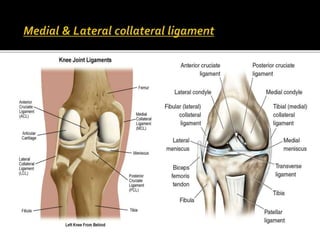
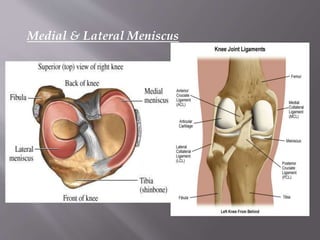
Medial & Lateral Meniscus
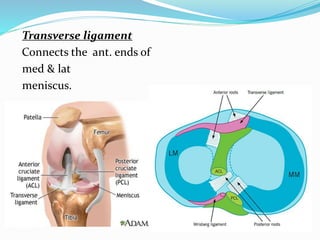
Transverse ligament
Connects the ant. ends of
med & lat
meniscus.
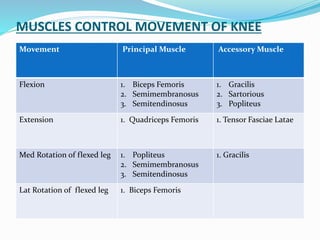
MUSCLES CONTROL MOVEMENT OF KNEE
Movement Principal Muscle Accessory Muscle
Flexion 1. Biceps Femoris
2. Semimembranosus
3. Semitendinosus
1. Gracilis
2. Sartorious
3. Popliteus
Extension 1. Quadriceps Femoris 1. Tensor Fasciae Latae
Med Rotation of flexed leg 1. Popliteus
2. Semimembranosus
3. Semitendinosus
1. Gracilis
Lat Rotation of flexed leg 1. Biceps Femoris
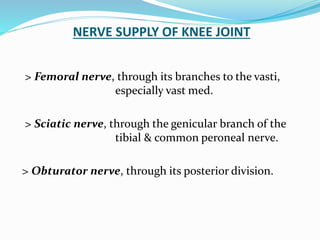
NERVE SUPPLY OF KNEE JOINT
> Femoral nerve, through its branches to the vasti,
especially vast med.
> Sciatic nerve, through the genicular branch of the
tibial & common peroneal nerve.
> Obturator nerve, through its posterior division.
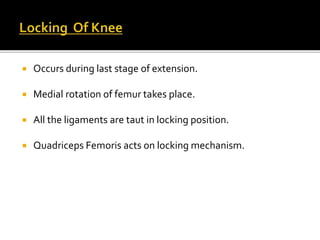
 Occurs during last stage of extension.
 Medial rotation of femur takes place.
 All the ligaments are taut in locking position.
 Quadriceps Femoris acts on locking mechanism.
 PAIN
 SWELLING
 STIFFNESS
 MECH. DISORDER ( locking, giving way, click)
 LIMP
 LOSS OF FUNCTION
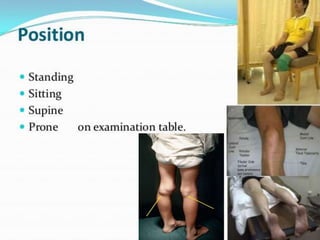
Position during examination
Standing
Sitting
Supine
prone
Inspection
Palpation
Deformity and R.O.M
Measurements
Special tests
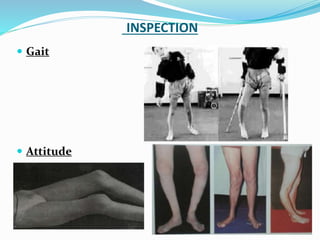
INSPECTION
 Gait
 Attitude
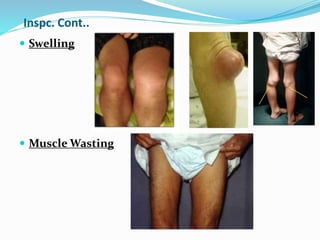
Inspc. Cont..
 Swelling
 Muscle Wasting
Inspc. Cont..
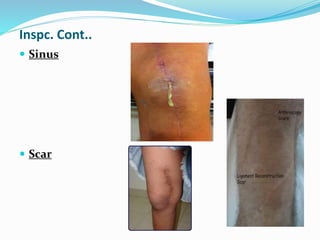
 Sinus
 Scar
Inspc. Cont..
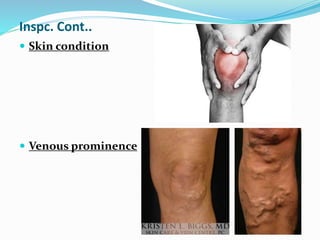
 Skin condition
 Venous prominence
PALPATION
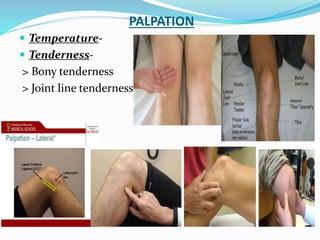
 Temperature-
 Tenderness-
> Bony tenderness
> Joint line tenderness
PALP CONT…
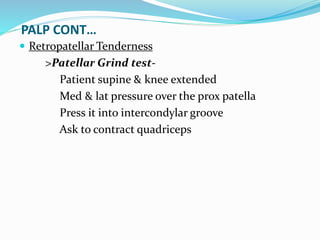
 Retropatellar Tenderness
>Patellar Grind test-
Patient supine & knee extended
Med & lat pressure over the prox patella
Press it into intercondylar groove
Ask to contract quadriceps
PALP. CONT…
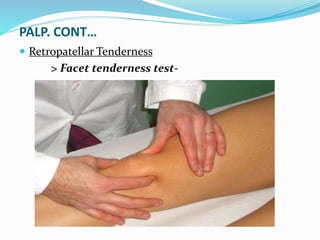
 Retropatellar Tenderness
> Facet tenderness test-
PALP.. CONT….
 Retropatellar Tenderness
> Friction test-
Patient supine > Knee extended > Compress
the patella > Glide the patella from med to lat &
sup to inf.
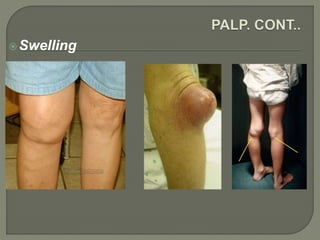
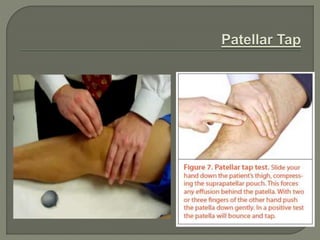
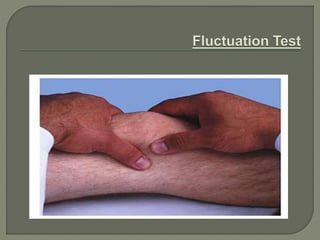
Swelling
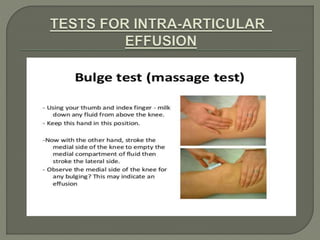
 Normally when knee is gradually flexed a hollow
appears & then disappears just lateral to the
patellar tendon. In the presence of fluid when
compared to the opposite knee refilling of the
hollow occurs at a lesser angle of flexion.
Other Test For Swelling
Transillumination Test.
+ive- on enlarged bursa, cystic swelling.
-ive-on swelling containing blood, pus.
Compression Test.
+ive in Baker’s cyst, popliteal aneurysm.
PALP. CONT…
 Palpation of patella
 Palpation of lower end of femur
 Palpation of upper ends of Tibia & Fibula
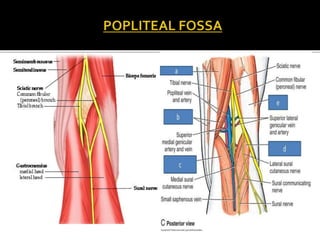
 Palpation of popliteal fossa
 Palpation of muscle
 Palpation for any crepitus
 Palpation of Lymph Nodes
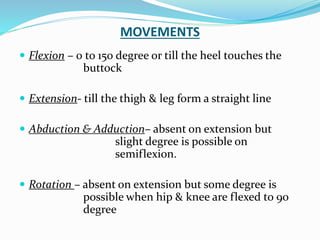
MOVEMENTS
 Flexion – 0 to 150 degree or till the heel touches the
buttock
 Extension- till the thigh & leg form a straight line
 Abduction & Adduction– absent on extension but
slight degree is possible on
semiflexion.
 Rotation – absent on extension but some degree is
possible when hip & knee are flexed to 90
degree
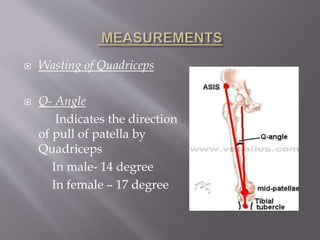
 Wasting of Quadriceps
 Q- Angle
Indicates the direction
of pull of patella by
Quadriceps
In male- 14 degree
In female – 17 degree
STABILITY TEST
 TESTS FOR ACL.
Lachman test
* Patient on supine.
* Knee on 15-20 deg flex.
* Femur is stabilized.
* Thumb on other hand
on jnt line.
*Anteriorly directed lift
ing force applied.
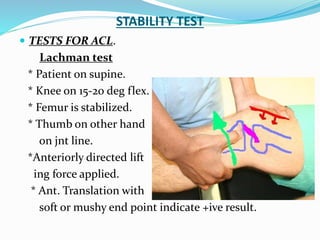
* Ant. Translation with
soft or mushy end point indicate +ive result.
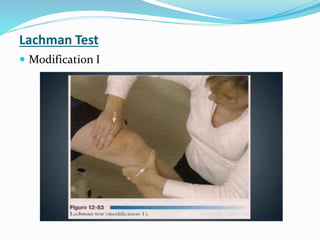
Lachman Test
 Modification I
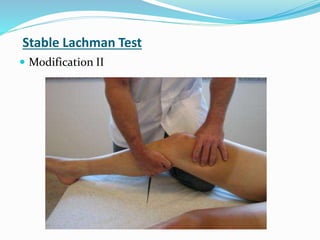
Stable Lachman Test
 Modification II
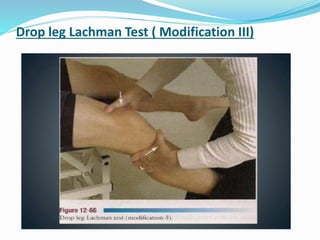
Drop leg Lachman Test ( Modification III)
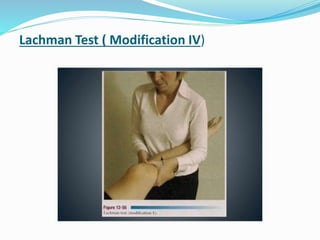
Lachman Test ( Modification IV)
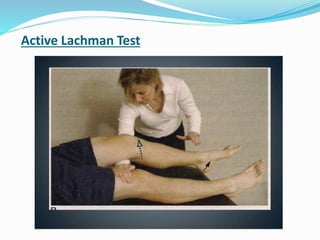
Active Lachman Test
ACL test cont..
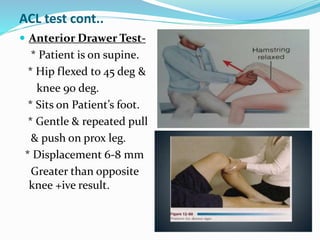
 Anterior Drawer Test-
* Patient is on supine.
* Hip flexed to 45 deg &
knee 90 deg.
* Sits on Patient’s foot.
* Gentle & repeated pull
& push on prox leg.
* Displacement 6-8 mm
Greater than opposite
knee +ive result.
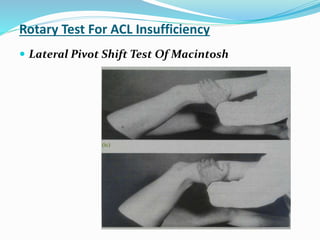
Rotary Test For ACL Insufficiency
 Lateral Pivot Shift Test Of Macintosh
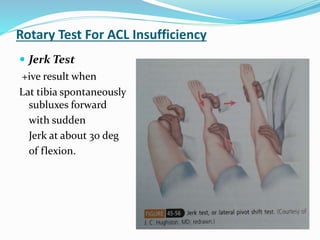
Rotary Test For ACL Insufficiency
 Jerk Test
+ive result when
Lat tibia spontaneously usly
subluxes forward
with sudden
Jerk at about 30 deg
of flexion.
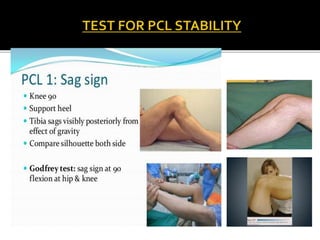
 Sag sign
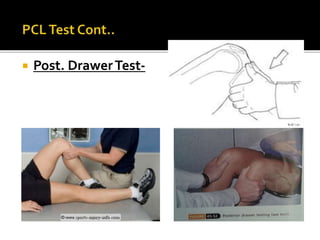
 Post. DrawerTest-
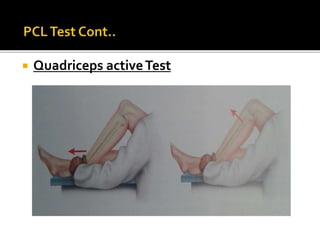
 Quadriceps activeTest
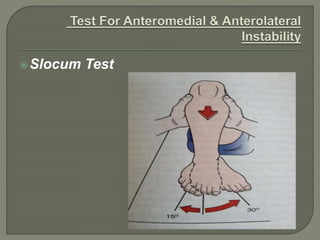
Slocum Test
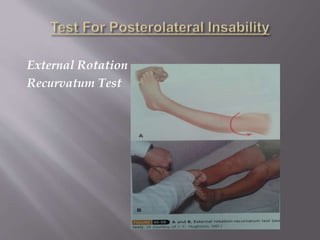
External Rotation
Recurvatum Test
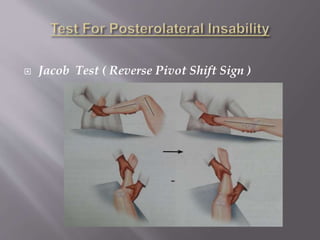
 Jacob Test ( Reverse Pivot Shift Sign )
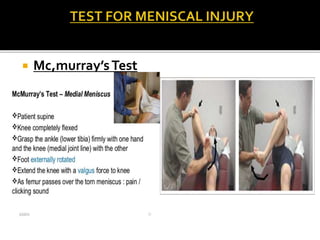
 Mc,murray’sTest
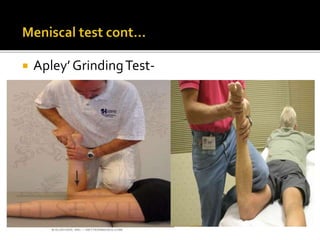
 Apley’ GrindingTest-
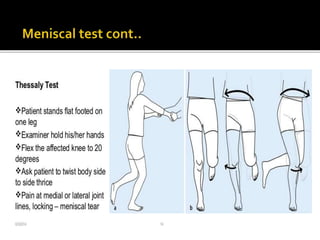
 ThessalyTest-
 SquatTest
Several repetition of full squat with feet & leg
alternately internally & externally rotated.
Pain on medial or lateral joint line corresponding
to the side of the torn meniscus.
pain in the internally rotated position suggests lat
meniscus inj & pain in externally rotated position
suggests med meniscus inj.
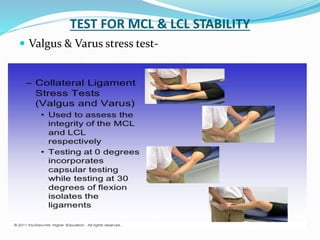
TEST FOR MCL & LCL STABILITY
 Valgus & Varus stress test-
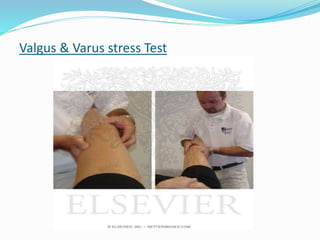
Valgus & Varus stress Test
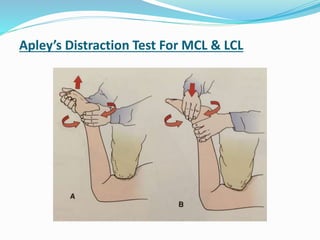
Apley’s Distraction Test For MCL & LCL
TEST FOR RECURRENT PATELLAR DISLOCATION
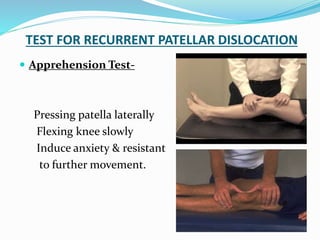
 Apprehension Test-
Pressing patella laterally
Flexing knee slowly
Induce anxiety & resistant
to further movement.
Examination Of Popliteal Fossa.
 Examination Of Hip.
THANKING YOU

Examination of knee