SPECIAL TESTS
LOWER LEG, ANKLE, AND FOOT
TESTS FOR NEUTRAL POSITION OF
THE TALUS
Neutral Position of the Talus (Weight-
Bearing Position)
PROCEDURE:
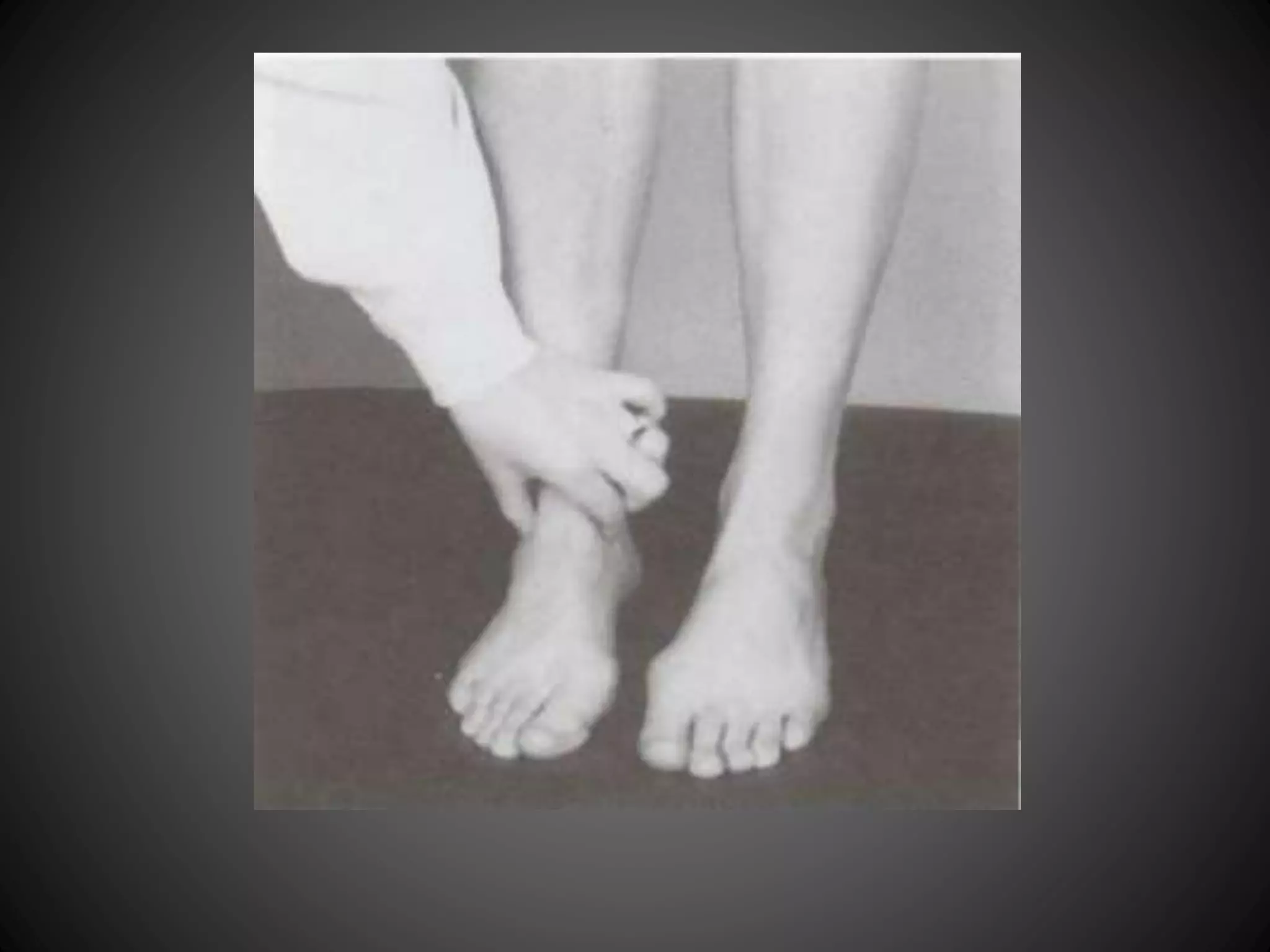
• The patient stands with the feet in a relaxed standing
position. The examiner palpates the head of the talus
on the dorsal aspect of the foot with the thumb and
forefinger of one hand. The patient is asked to slowly
rotate the trunk to the right and then to the left,
which causes the tibia to medially and laterally rotate
so that the talus supinates and pronates.
POSITIVE TEST/IMPLICATION :
• If the foot is positioned so that the talar head does
not appear to bulge to either side, then the subtalar
joint will be in its neutral position in weight bearing
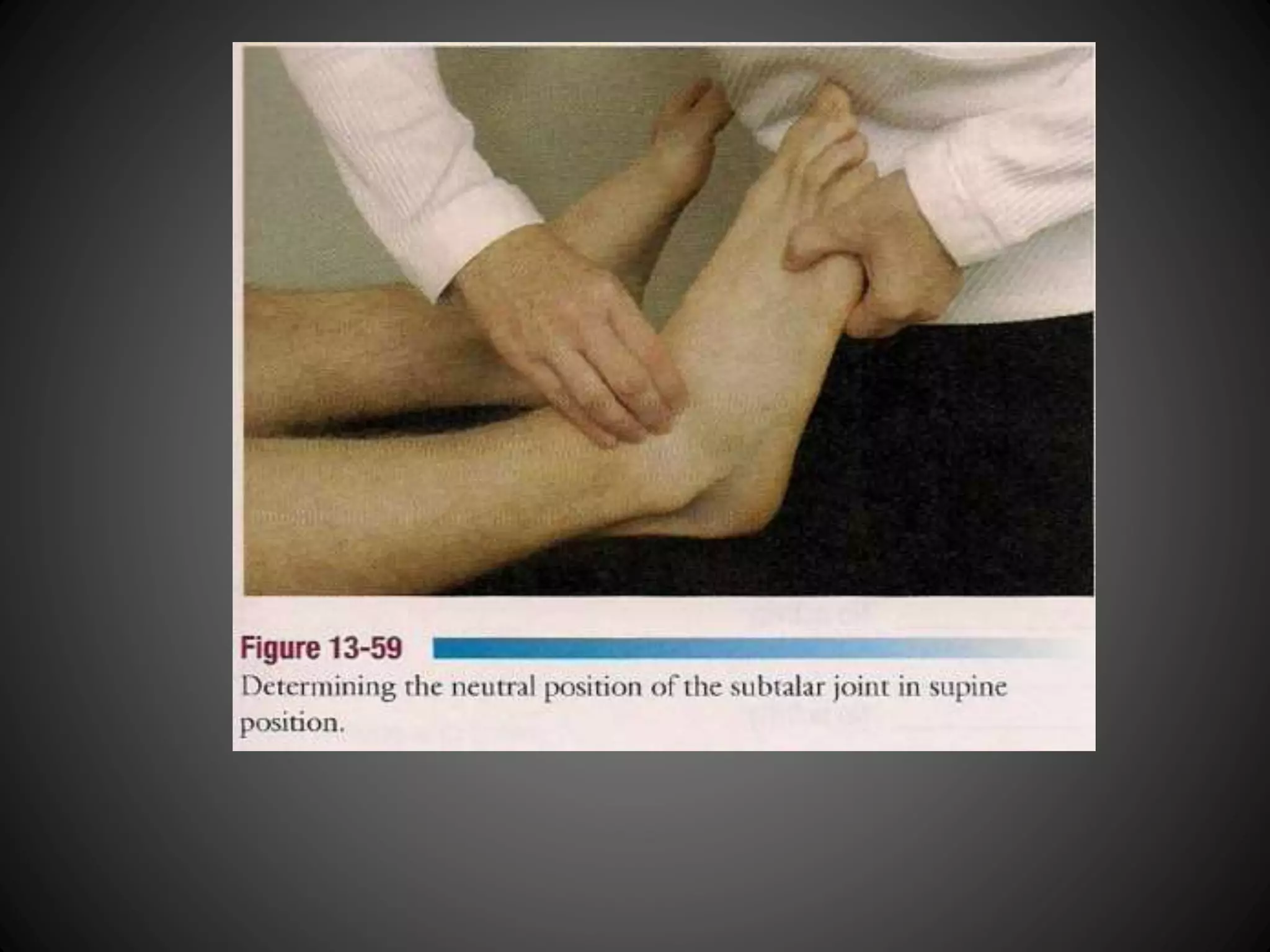
Neutral Position of the Talus (Supine)
• PROCEDURE:
The patient lies supine with the feet extending over the end
of the examining table. The examiner grasps the patient's
foot over the fourth and fifth metatarsal heads, using the
thumb and index finger of one hand. The examiner palpates
both sides of the head of the talus on the dorsum of the foot
with the thumb and index finger of the other hand. The
examiner then gently, passively dorsiflexes the foot until
resistance is felt. While the examiner maintains the
dorsiflexion, the foot is passively moved through an arc of
supination (talar head bulges laterally) and pronation (talar
head bulges medially).
• POSITIVE TEST/IMPLICATION :
If the foot is positioned so that the talar head does not
appear to bulge to either side, the subtalar joint will be in its
neutral nonweight- bearing.
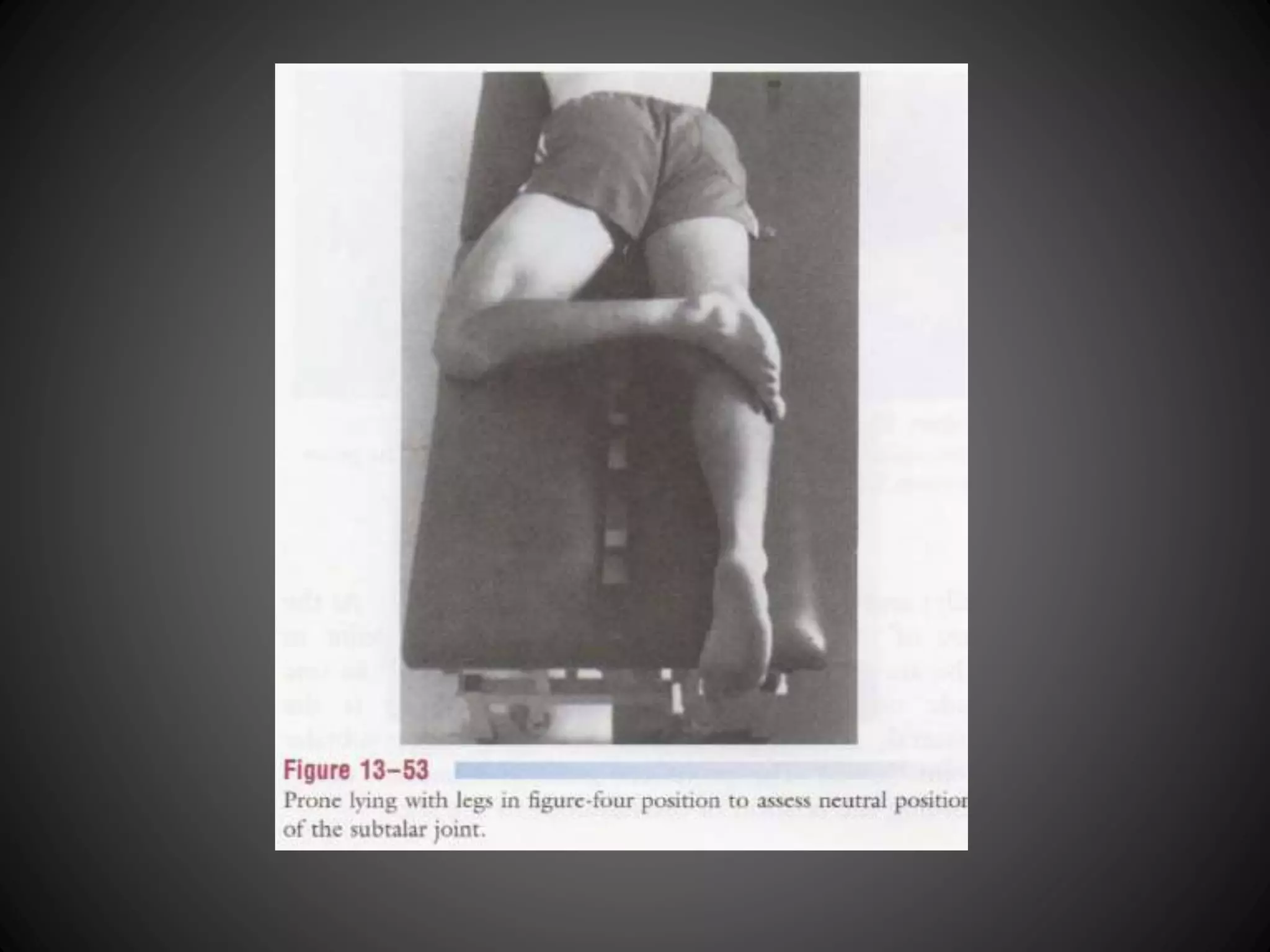
Neutral Position of the Talus (Prone)
• PROCEDURE:
The patient lies prone with the foot extended over the end of the
examining table. The examiner grasps the patient's foot over the
fourth and fifth metatarsal heads with the index finger and thumb of
one hand. The examiner palpates both sides of the talus on the
dorsum of the foot, using the thumb and index finger of the other
hand. The examiner then passively and gently dorsiflexes the foot
until resistance is felt. While maintaining the dorsiflexed position, the
examiner moves the foot back and forth through an arc of supination
(talar head bulges later-ally) and pronation (talar head bulges
medially).
• POSITIVE TEST/IMPLICATION :
As the arc of movement is performed, there is a point in the arc at
which the foot appears to "falloff" to one side or the other more
easily. This point is the neutral, non-weight-bearing position of the
subtalar joint.
TESTS FOR ALIGNMENT
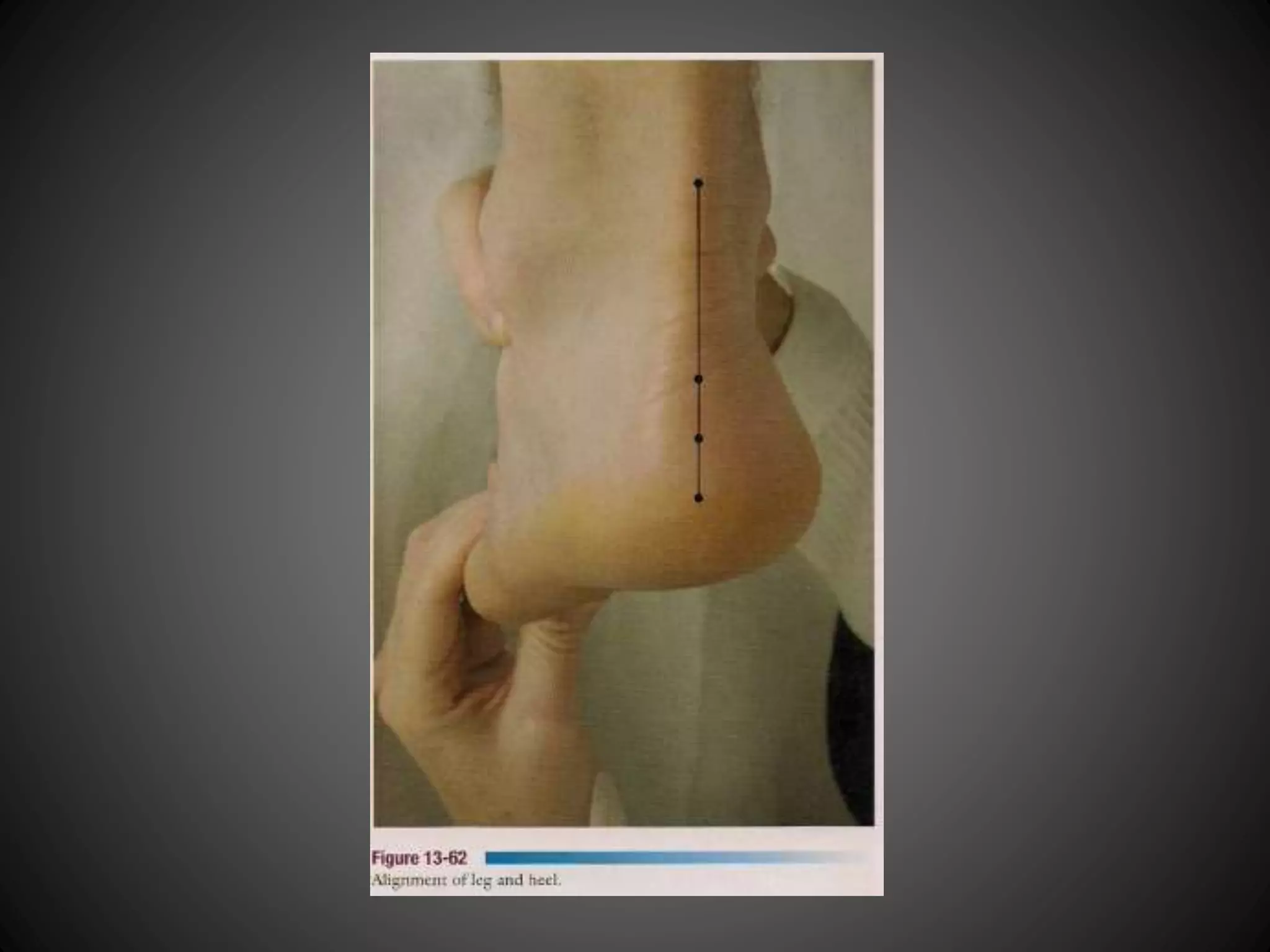
Leg-Heel Alignment• PROCEDURE:
The patient lies in the prone position with foot extending over the end
of the examining table. The examiner then places a mark over the
midline of the calcaneus at the insertion of the Achilles tendon, makes
a second mark ~1 cm distal to the first mark and as close to the midline
of the calcaneus as possible.
A calcaneal line is then made to join the two marks. Next, the examiner
makes two marks on the lower third of the leg in the midline forming
the tibial line, which represents the longitudinal axis of the tibia. The
examiner then places the subtalar joint in the prone neutral position.
While the subtalar joint is held in neutral, the examiner looks at the two
lines.
• POSITIVE TEST/IMPLICATION:
If the lines are parallel or in slight varus (2° to 8°), the leg-to-heel
alignment is considered normal. If the heel is inverted, the patient has
hindfoot varus; if the heel is everted, the patient has hindfoot valgus
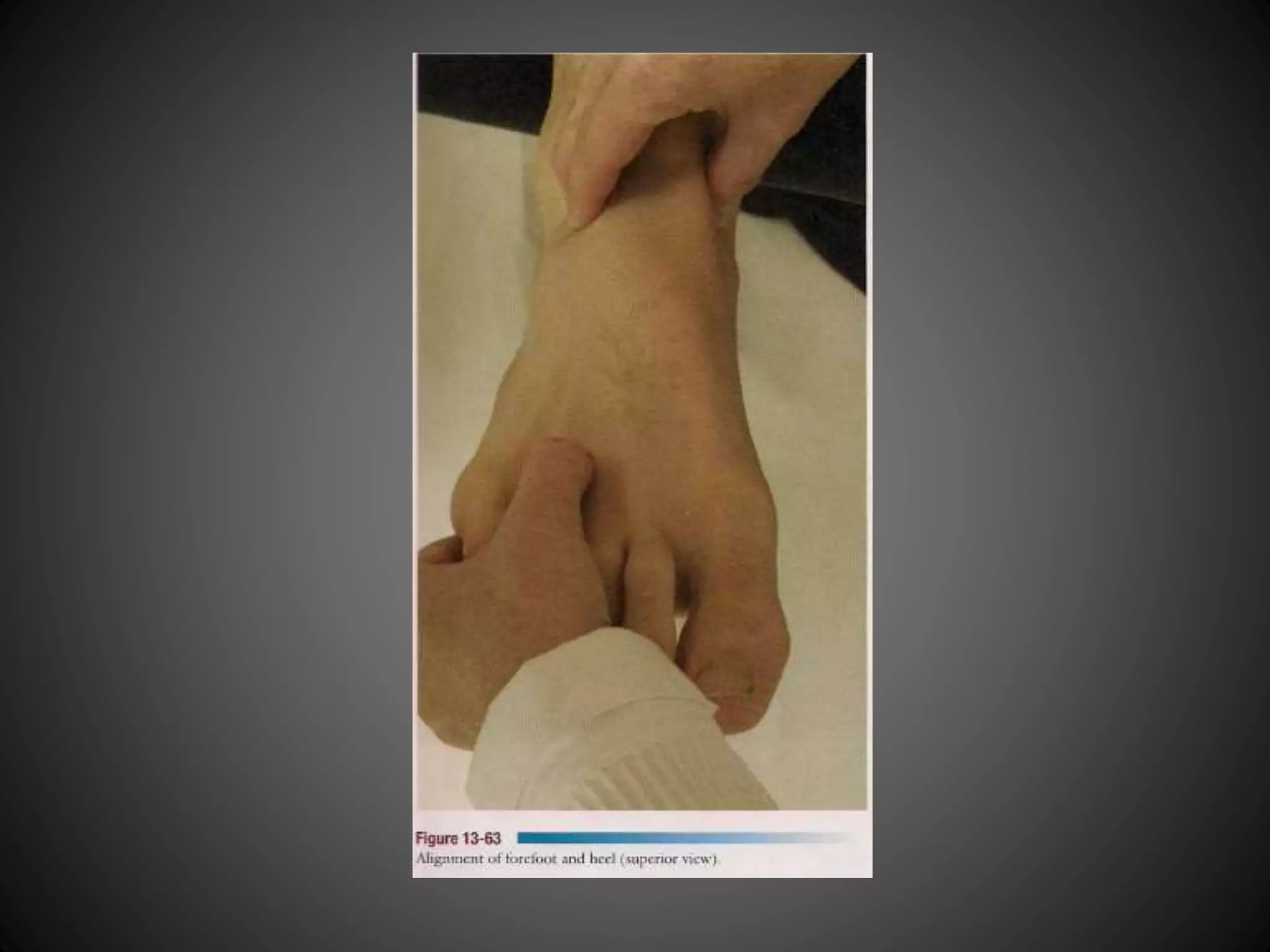
Forefoot- Heel Alignment
• PROCEDURE:
The patient lies supine with the feet extending over the end of
the examining table. The examiner positions the subtalar joint
in supine neutral position. While maintaining this position, the
examiner pronates the midtarsal joints maximally and then
observes the relation between the vertical axis of the heel and
the plane of the second through fourth metatarsal heads.
Normally, the plane is perpendicular to the vertical axis.
• POSITIVE TEST/IMPLICATION:
If the medial side of the foot is raised, the patient has a
forefoot varus; if the lateral side of the foot is raised, the
patient has a forefoot valgus.
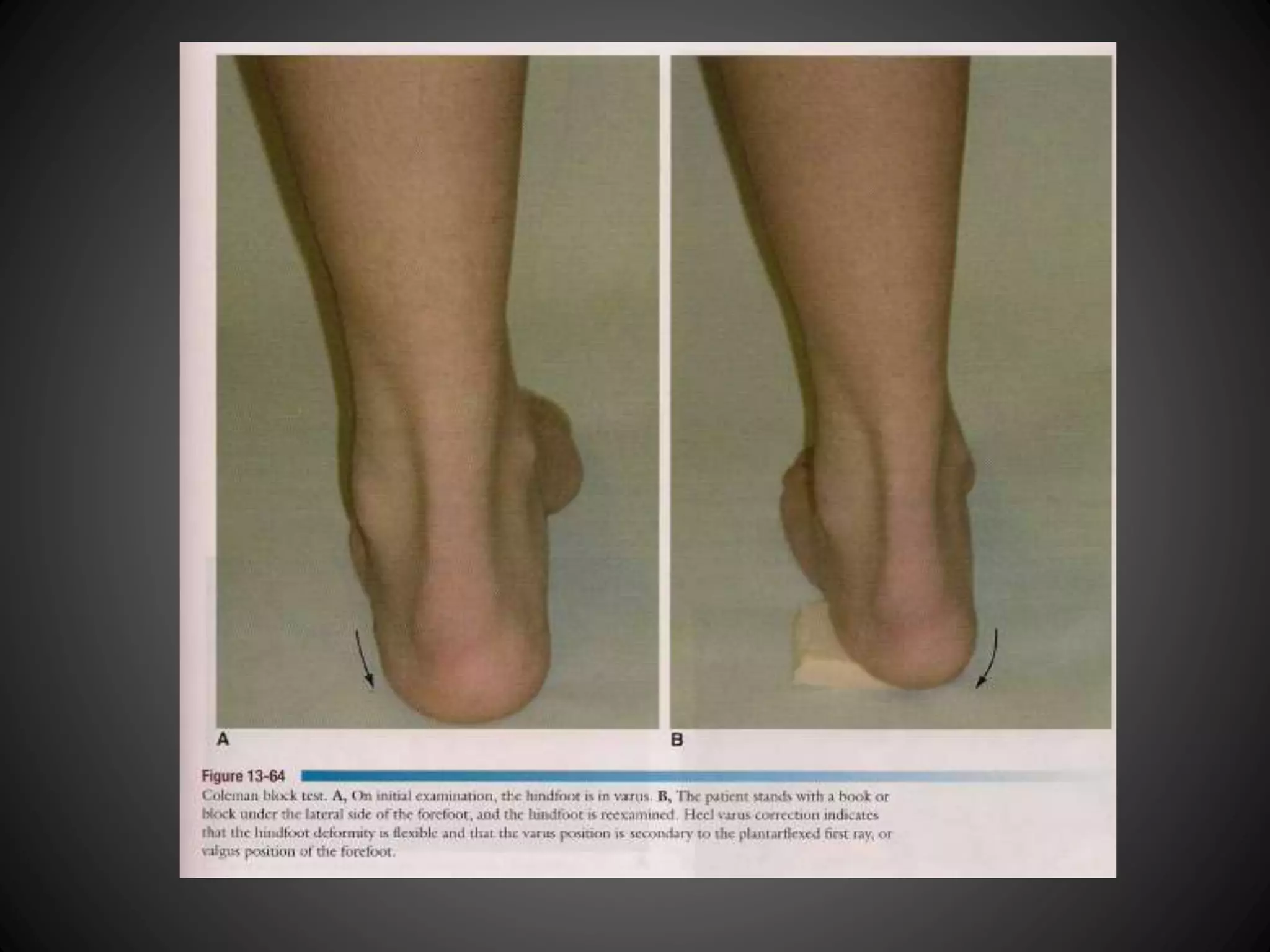
Coleman Block Test
• PROCEDURE:
This test differentiates a hindfoot varus resulting from a
forefoot valgus from a hindfoot varus resulting from a tight
tibialis posterior.
If the patient is found to have a hindfoot varus in standing,
the examiner places a lift or block under the lateral side of
the forefoot.
• POSITIVE TEST/IMPLICATION:
If the hindfoot varus is corrected it indicates the hindfoot is
flexible and the hindfoot varus is due to a plantar flexed first
ray or a valgus forefoot. If it does not correct, the tibialis
posterior is tight.
TESTS FOR TIBIAL TORSION
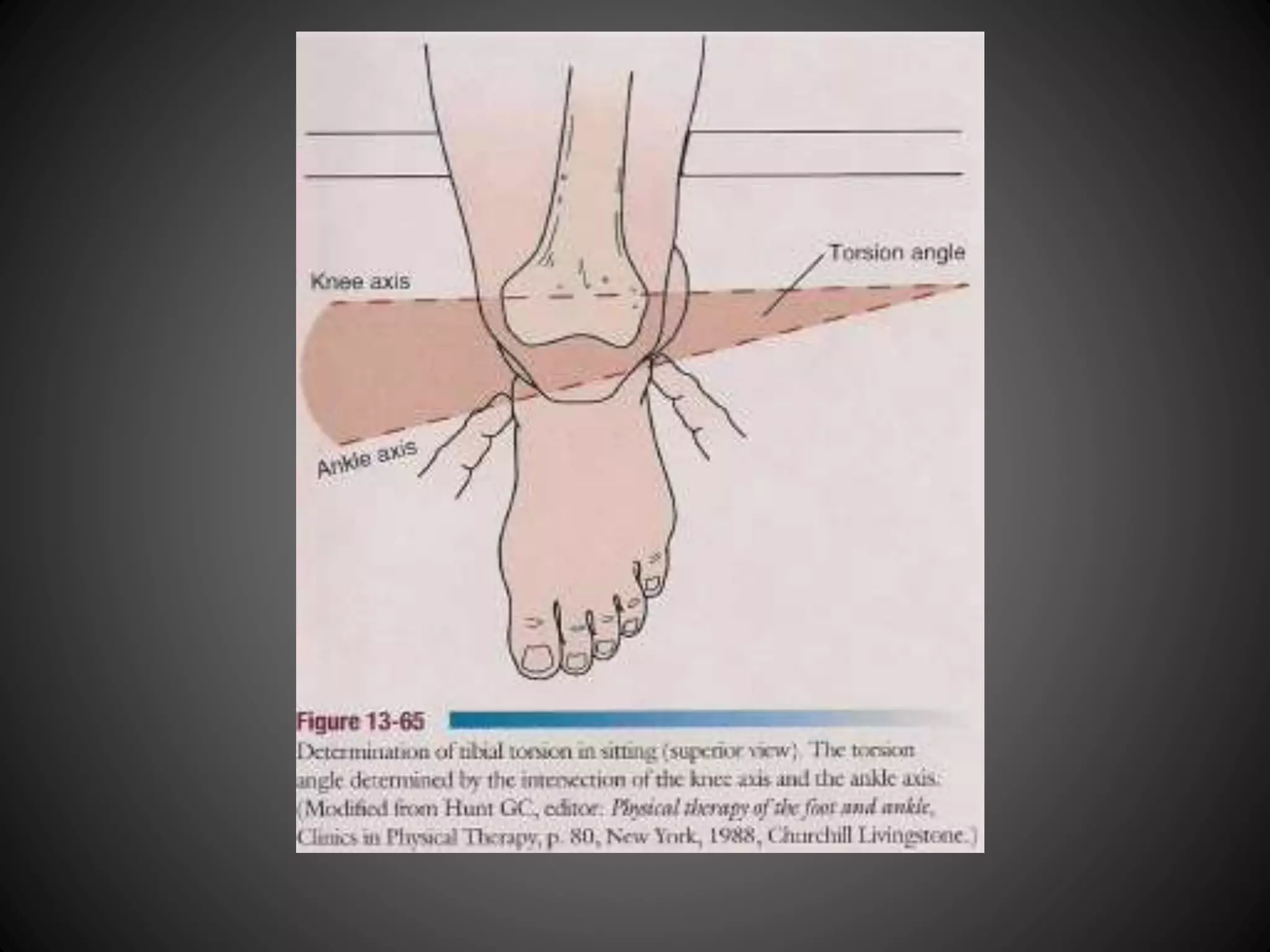
Tibial Torsion (Sitting)
• PROCEDURE:
Tibial torsion is measured by having the patient sit
with the knees flexed to 90° over the edge of the
examining table. The examiner places the thumb of
one hand over the apex of one malleolus and the
index finger of the same hand over the apex of the
other malleolus. Next, the examiner visualizes the
axes of the knee and of the ankle.
• POSITIVE TEST/IMPLICATION:
The lines are not normally parallel but instead form
an angle of 12° to 18° owing to lateral rotation of the
tibia.
Tibial Torsion (Supine)
• PROCEDURE:
The examiner ensures that the femoral condyle lies in the
frontal plane (patella facing straight up). The examiner
palpates the apex of both malleoli with one hand and
draws a line on the heel representing a line joining the
two apices. A second line is drawn on the heel parallel
to the floor. The angle formed by the intersection of the
two lines indicates the amount of lateral tibial torsion.
• POSITIVE TEST/IMPLICATION:
If the hindfoot varus is corrected it indicates the hindfoot is
flexible and the hindfoot varus is due to a plantar flexed first
ray or a valgus forefoot. If it does not correct, the tibialis
posterior is tight.
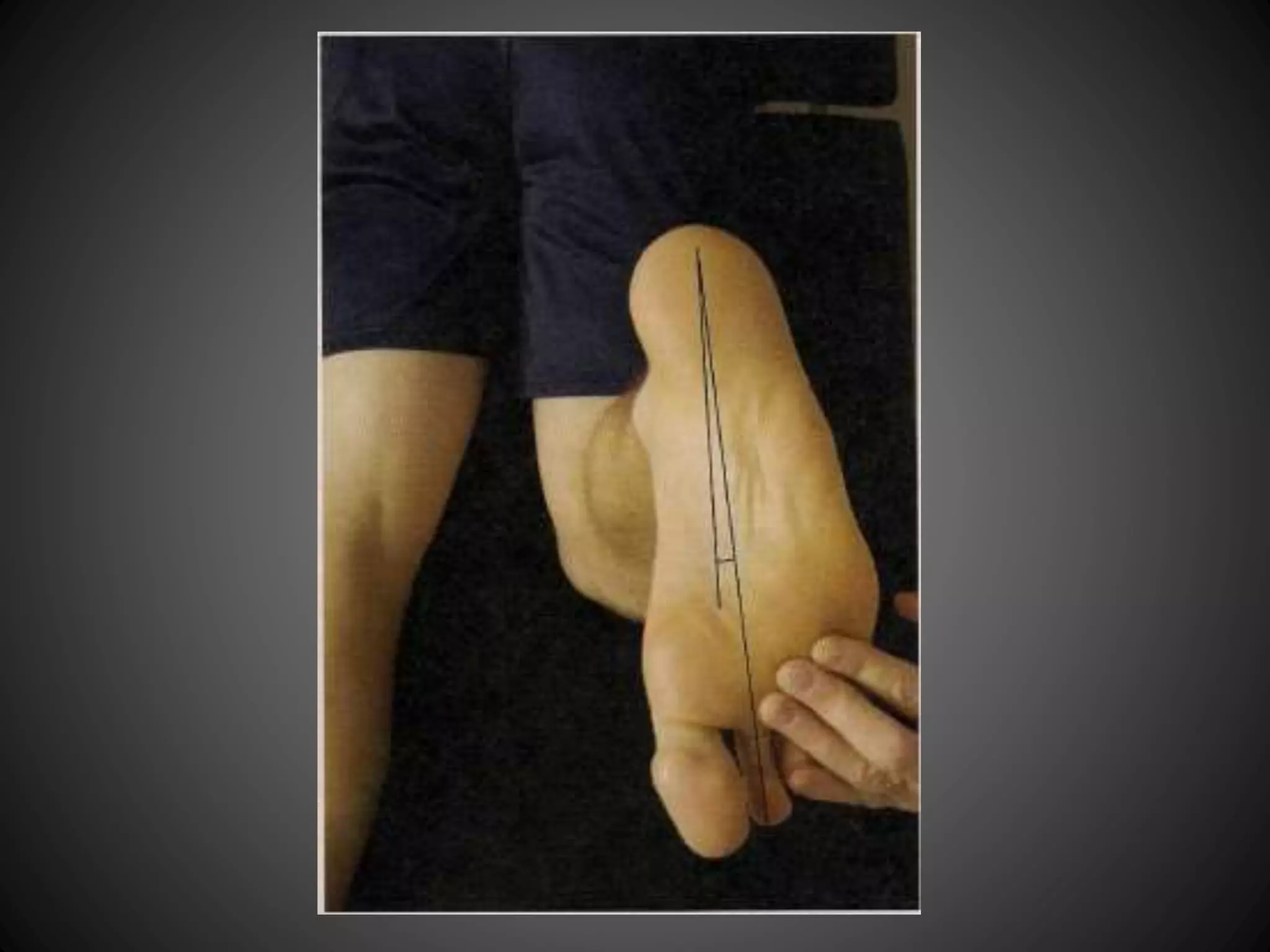
Tibial Torsion (Prone)
• PROCEDURE:
knee flexed to 90°. The examiner views from above
the angle formed by the foot and thigh
after the subtalar joint has been placed in the
neutral position, noting the angle the foot makes
with the tibia. This method is most often used in
children because it is easier to observe the feet
from above.
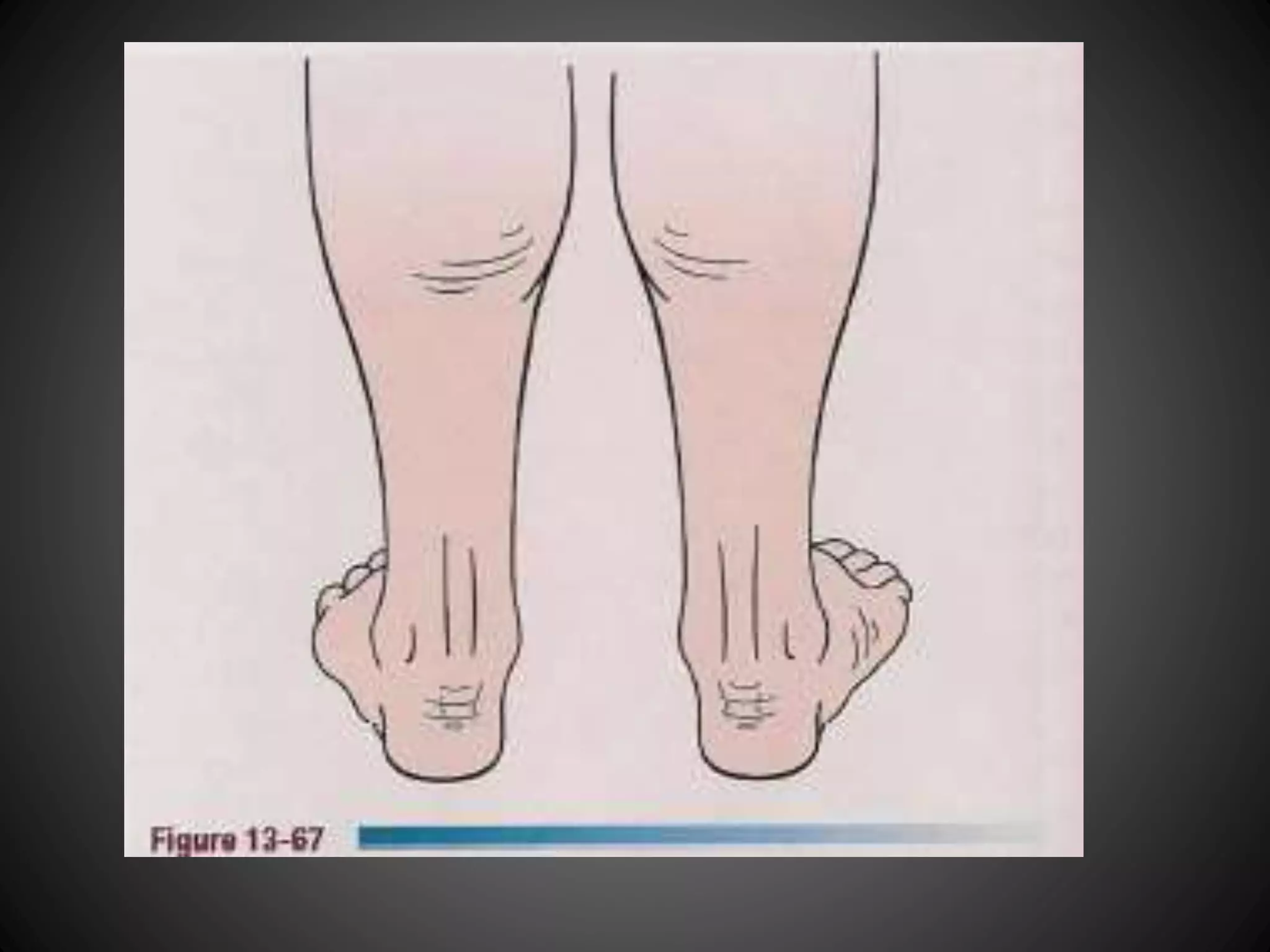
"Too Many Toes" Sign
• The patient stands in a normal relaxed position while the
examiner views the patient from behind. If the heel is in
valgus, the forefoot abducted, or the tibia laterally rotated
more than normal (tibial torsion), the examiner can see
more toes on the affected side than on the normal side.
• Similarly, lateral femoral torsion could cause the "too
many toes" test to be positive.
• If the talus is positioned in neutral and the calcaneus is in
neutral, the "too many toes" sign means the forefoot is
adducted on the rearfoot and may be seen with excessive
pronation (hyperpronation).
• Hyperpronation is often associated with metatarsalgia,
plantar fasciitis, hallux valgus, and posterior tibial tendon
pathology.
TESTS FOR LIGAMENTOUS
INSTABILITY
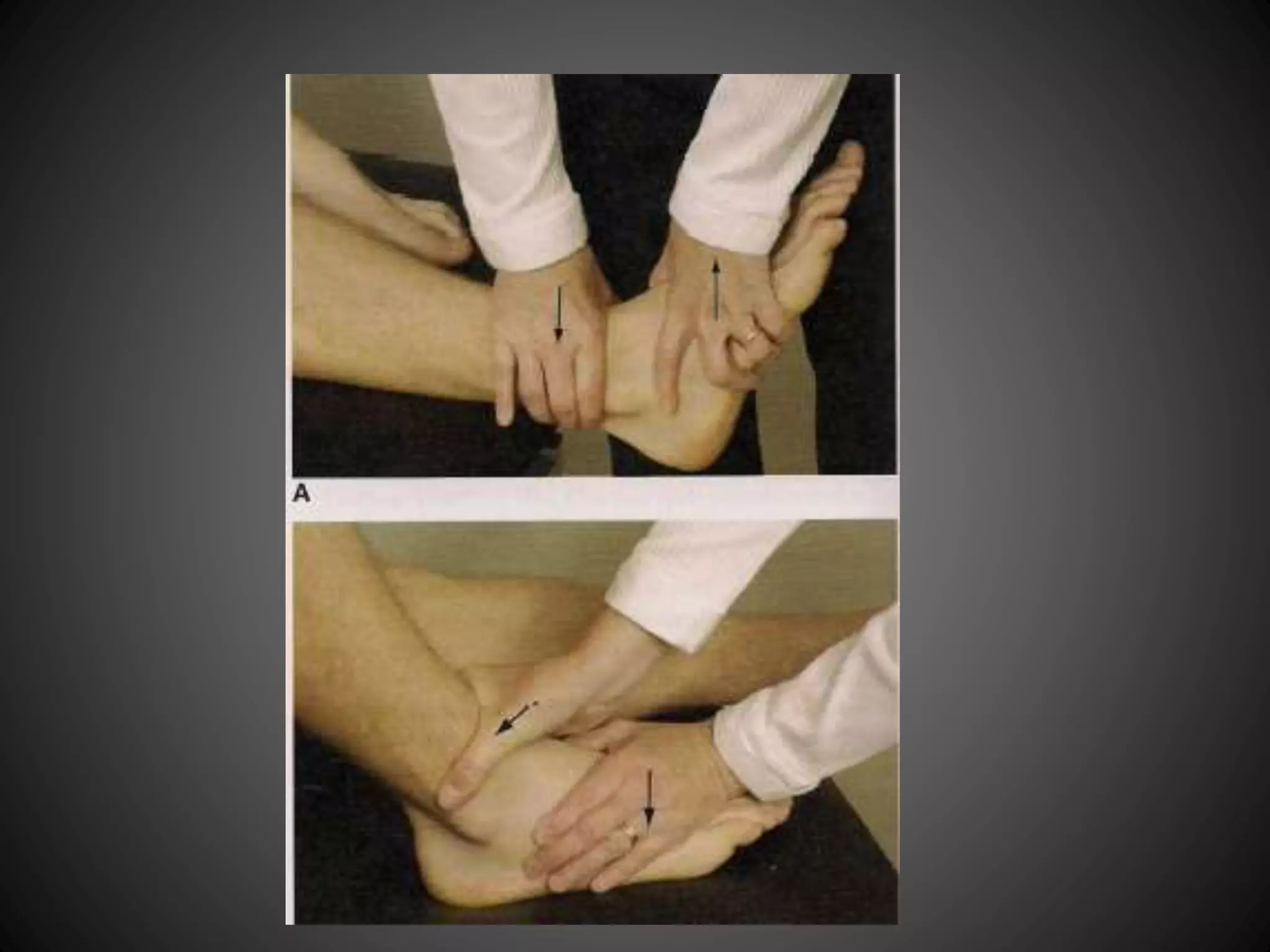
Anterior Drawer Test of the Ankle
PROCEDURE
• designed primarily to test for injuries to the anterior
• talofibular ligament
• The patient lies supine with the foot relaxed. The
examiner stabilizes the tibia and fibula, holds the
patient's foot in 20° of plantar flexion, and draws the
talus forward in the ankle mortise
POSITIVE TEST
Excessive anterior translation. Sometimes, a dimple
appears over the area of the anterior talofibular
ligament on anterior translation (dimple or suction
sign) if pain and muscle spasm are minimal
Prone Anterior Drawer Test
PROCEDURE
• The patient lies prone with the feet extending
over the end of the examining table. With one
hand, the examiner pushes the heel steadily
forward
POSITIVE TEST
• Excessive anterior movement and a “sucking
in” of the skin on both sides of the Achilles
tendon.
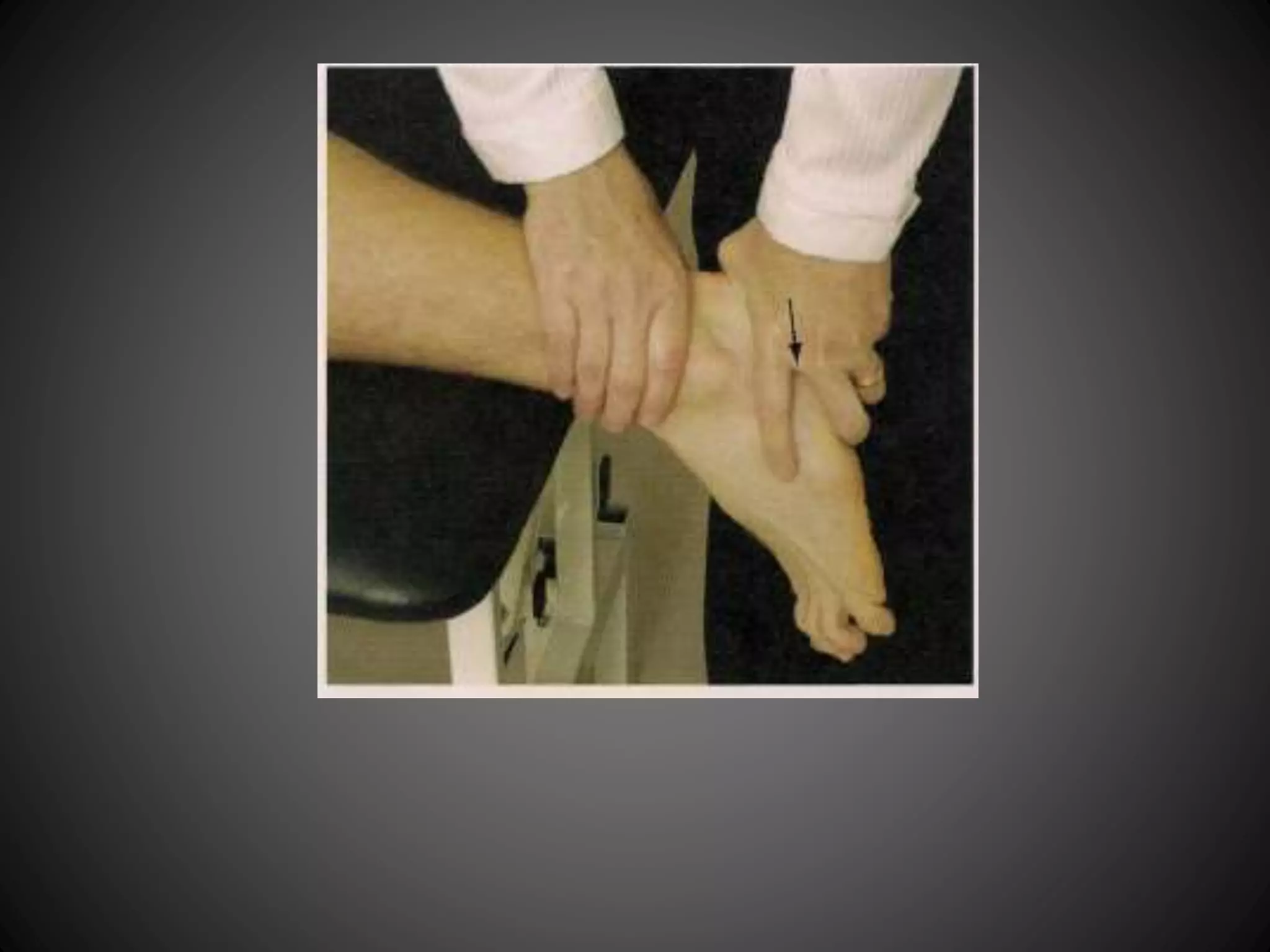
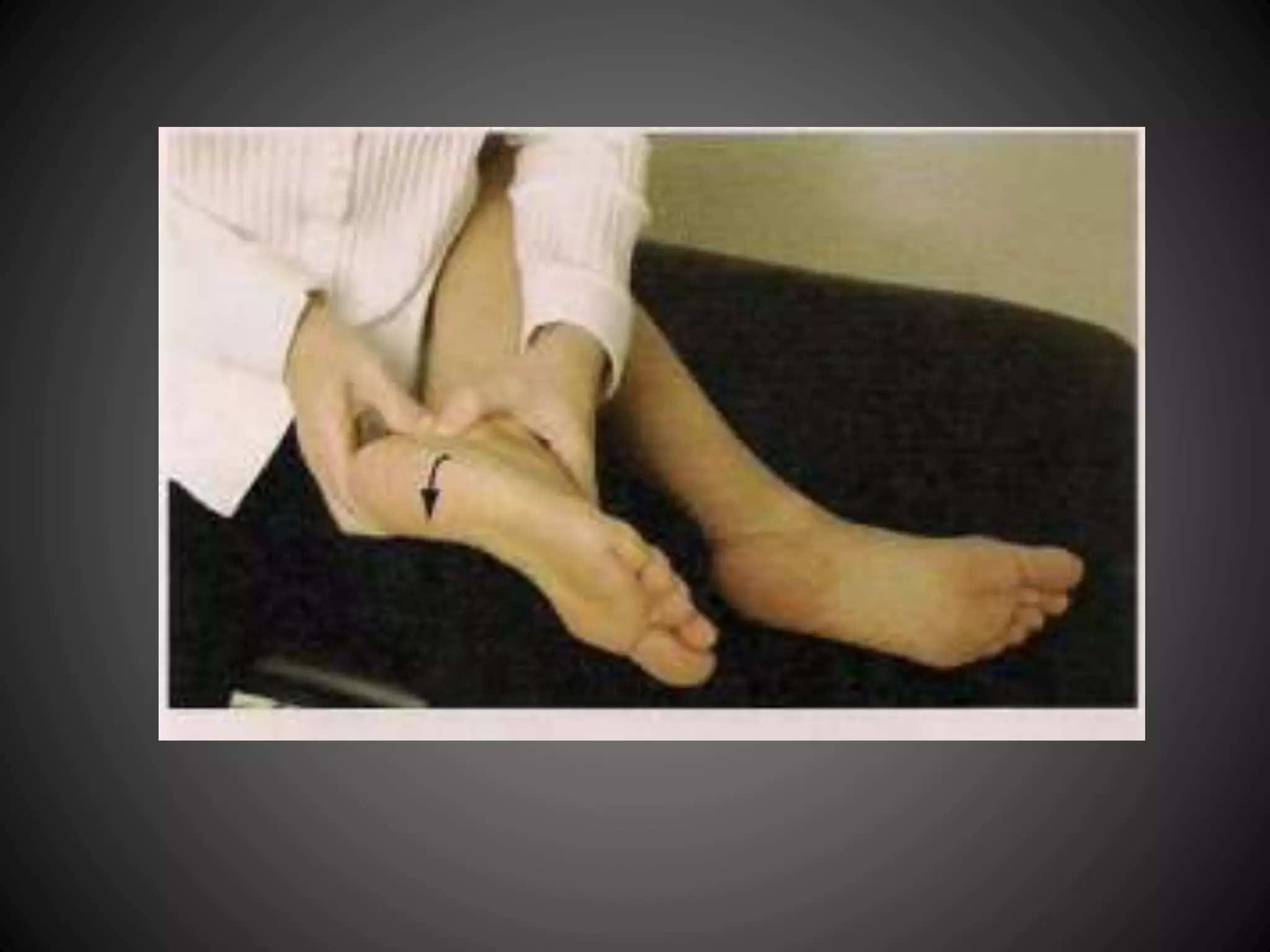
Talar Tilt Test
PROCEDURE
• The patient lies in the supine or side lying
position with the foot relaxed. The foot is held
in the anatomic (90°) position, which brings the
calcaneofibular ligament perpendicular to the
long axis of the talus. Talus is then tilted from
side to side into adduction and abduction
POSITIVE TEST
• Excessive movement on adduction
Squeeze Test of the Leg
PROCEDURE
• The patient lies supine.
• The examiner grasps the lower leg at midcalf and
squeezes the tibia and fibula together
POSITIVE TEST
• Pain in the lower leg may indicate a syndesmosis
injury, provided that fracture, contusion, and
compartment syndrome have been ruled out
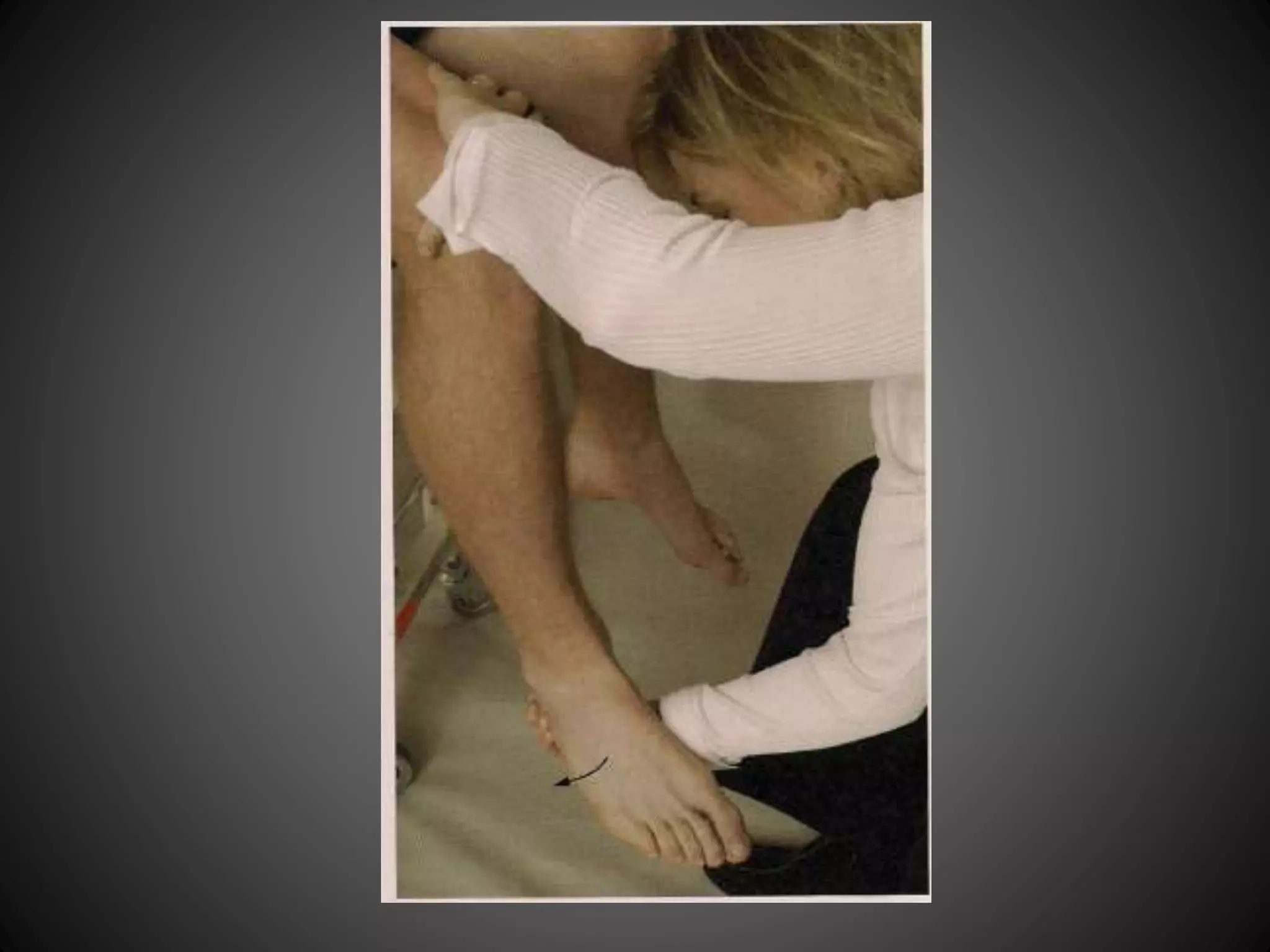
External Rotation Stress Test (Kleiger
Test)
PROCEDURE
• The patient is seated with the leg hanging over the
examining table with the knee at 90°. The examiner
faces the leg, holds the foot in plantigrade (90°) and
applies a
• passive lateral rotation stress to the foot and ankle
POSITIVE TEST
• positive for a syndesmosis injury if pain is produced
over the anterior or posterior tibiofibular ligaments
and the interosseous membrane
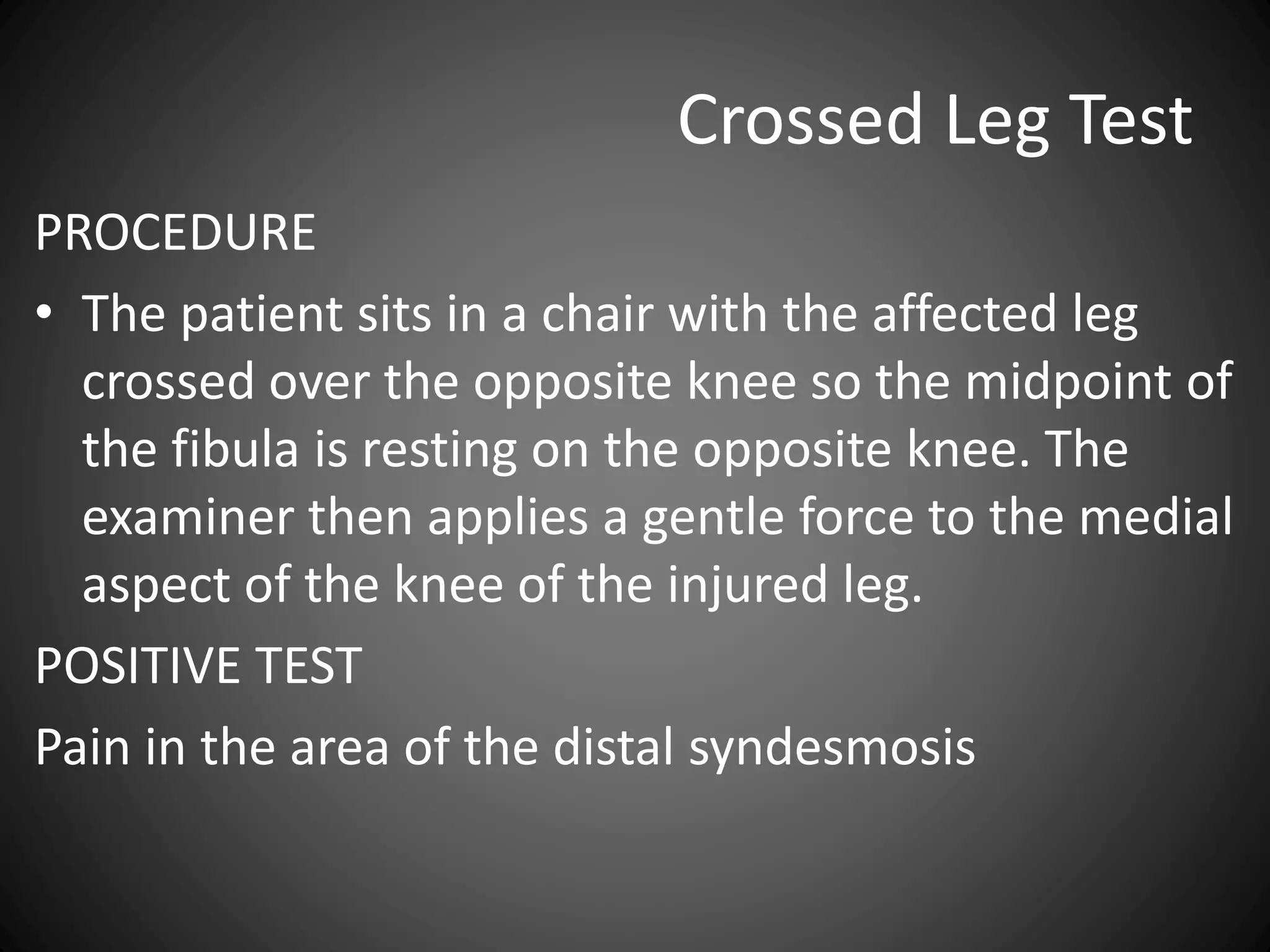
Point (Palpation) Test
PROCEDURE
• The patient is positioned in sitting or supine. The
examiner then applies a gradual pressure over the
anteroinferior tibiofibular ligament (anterior
aspect of the distal tibia fibular syndesmosis)
• using the index finger
POSITIVE
• Pain in the syndesmosis area
Cotton Test
PROCEDURE
• The examiner stabilizes the distal tibia and
fibula with one hand and applies a medial and
lateral translation force
POSITIVE TEST
• Any lateral translation (3 to 5mm) or clunk
indicates syndesmotic instability.
Dorsiflexion Maneuver
PROCEDURE
• The patient sits on the edge of the table. The
examiner stabilizes the patient’s leg with one
hand and with the other hand passively and
forcefully dorsiflexes the foot by holding onto
the heel and using the forearm to dorsiflex the
foot
POSITIVE TEST
• Pain on forced dorsiflexion indicates a positive
test
Dorsiflexion Compression Test
PROCEDURE
• While in bilateral weight-bearing, the patient is asked
to move his or her ankle into extreme. The patient is
asked to note whether this maneuver is painful while
the examiner notes the end range of motion. The
patient then assumes a normal standing position
again. The examiner applies a compression force
using two hands surrounding the malleoli of the
injured leg. While this compression is maintained,
the patient is asked to move into dorsiflexion again.
POSITIVE TEST
• A decrease in pain on dorsiflexion or an increase in
dorsiflexion range
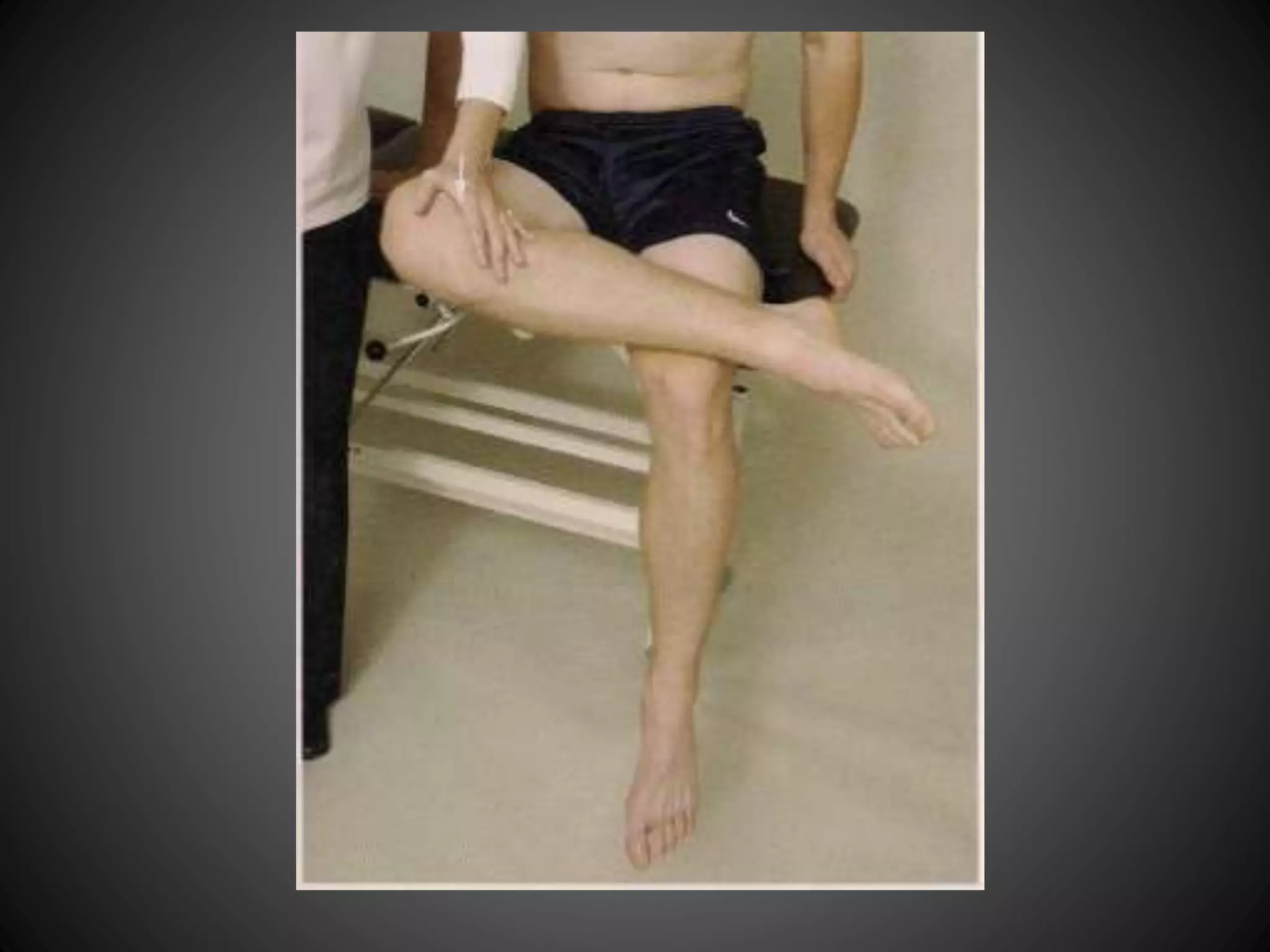
Crossed Leg Test
PROCEDURE
• The patient sits in a chair with the affected leg
crossed over the opposite knee so the midpoint of
the fibula is resting on the opposite knee. The
examiner then applies a gentle force to the medial
aspect of the knee of the injured leg.
POSITIVE TEST
Pain in the area of the distal syndesmosis
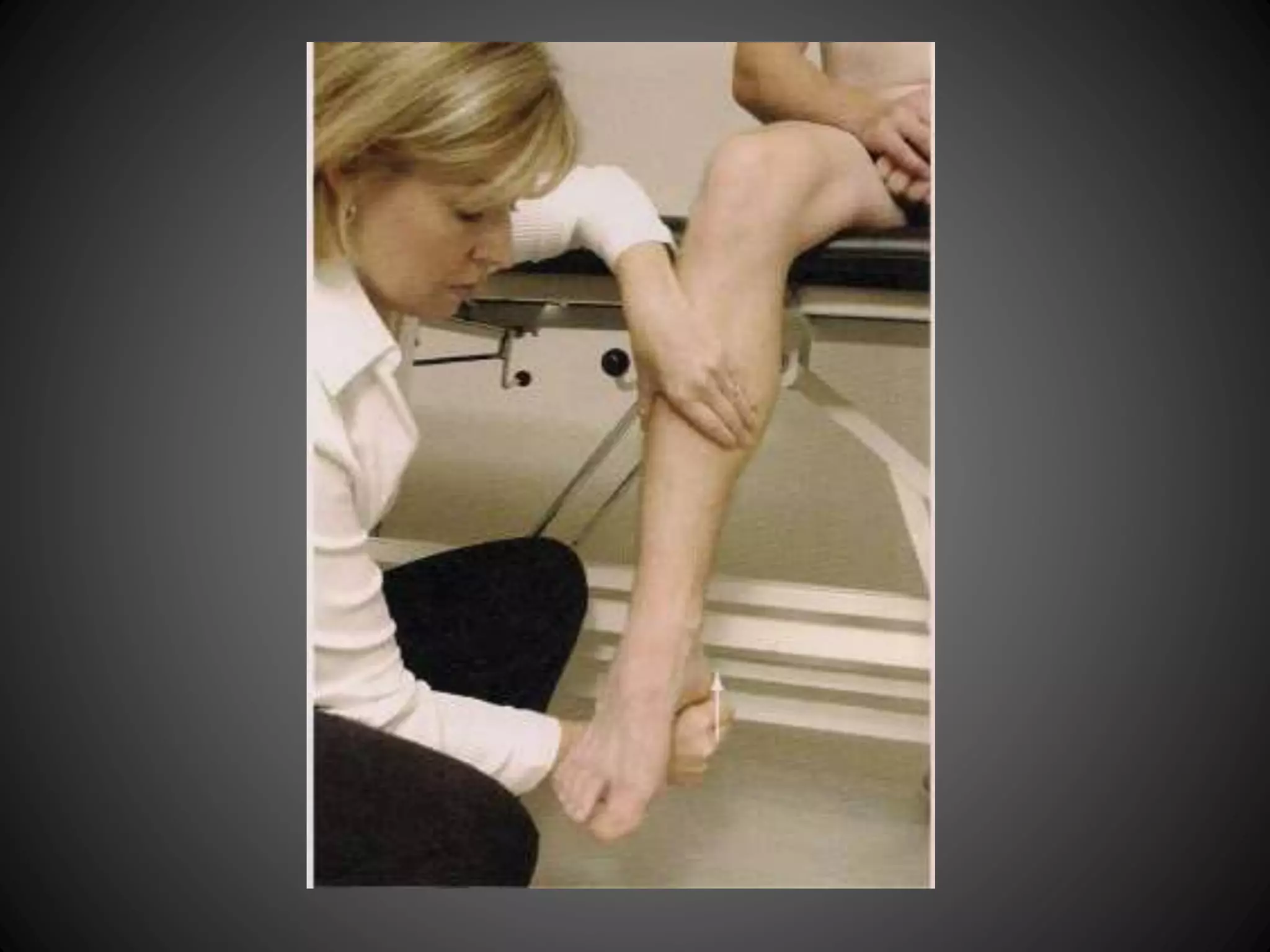
Heel Thump Test
• The patient is in sitting or lying. The examiner
uses one hand to stabilize the leg. With the other
hand, the examiner applies a firm thump on the
heel with the fist so that the force is applied to
the center of the heel and in line with the long
axis of the tibia.
• A positive test (i.e., pain) in the area of the ankle
indicates a syndesmosis injury. Pain along the
shaft of the tibia may indicate a stress fracture.
Thompson’s (Simmond’s) Test
• For Achilles tendon rupture
PROCEDURE
• The patient lies prone or kneels on a chair with
the feet over the edge of the table or chair. While
the patient is relaxed, the examiner squeezes the
calf muscles.
POSITIVE TEST
Absence of plantar flexion
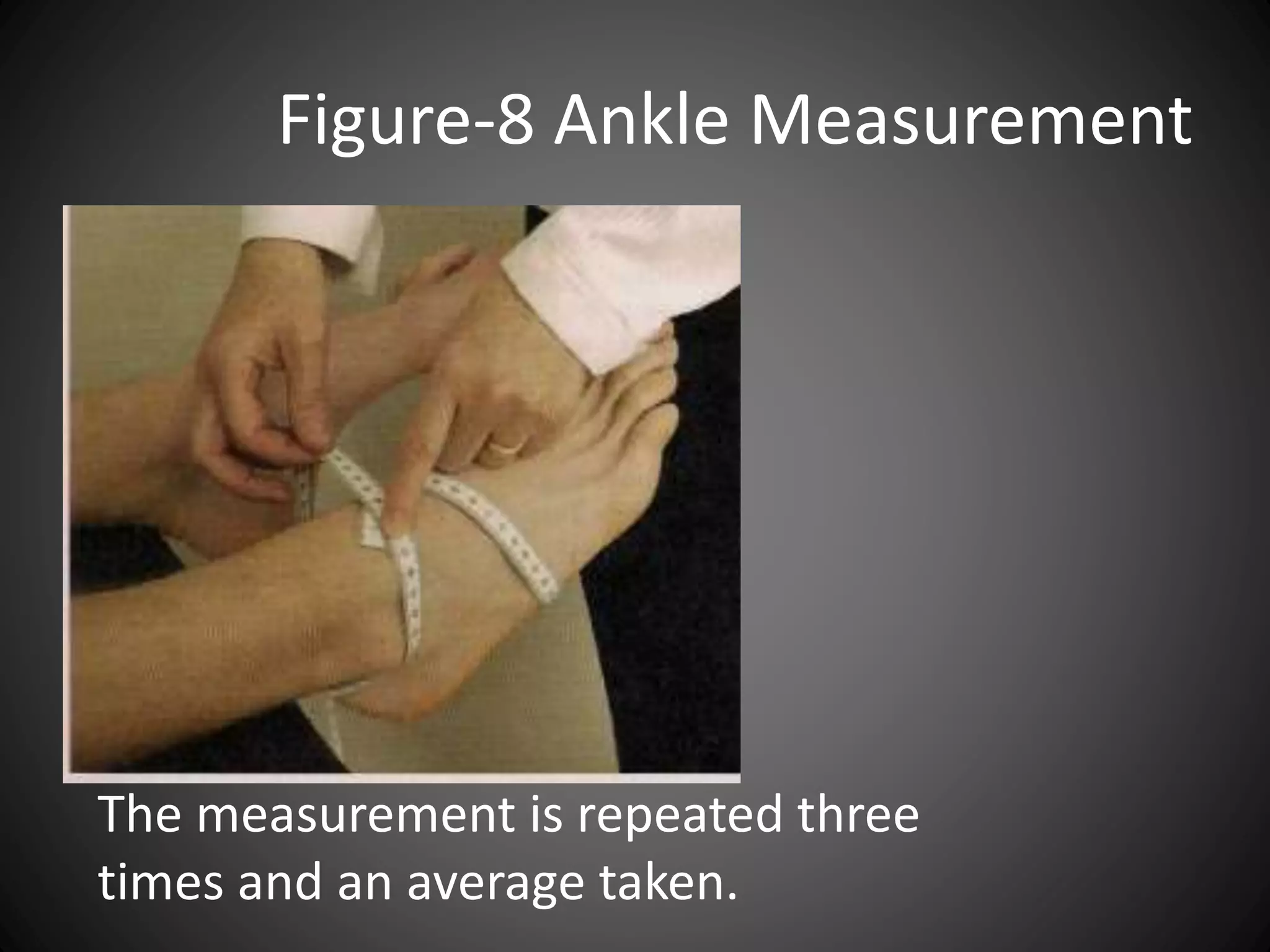
Figure-8 Ankle Measurement
The measurement is repeated three
times and an average taken.
Test for Peroneal Tendon Dislocation
PROCEDURE
• The patient is placed in prone on the examining
table with the knee flexed to 90°. The
posterolateral region of the ankle is inspected for
swelling. The patient is then asked to actively
dorsiflex and plantar flex the ankle along with
eversion against the examiner's resistance
POSITIVE TEST
• tendon subluxes from behind the lateral
malleolus
Patla Tibialis Posterior Length Test
PROCEDURE
• prone lying with the knee flexed to 90°
• calcaneus held in eversion and the ankle in
dorsiflexion with one hand.
• With the other hand, the examiner's thumb contacts
the plantar surface of the bases of the second, third,
and fourth metatarsals while the index and middle
fingers contact the plantar surface of the navicular.
The examiner then determines the end feel by
pushing dorsally on the navicular and metatarsal
heads. The end feel is compared with the normal
side.
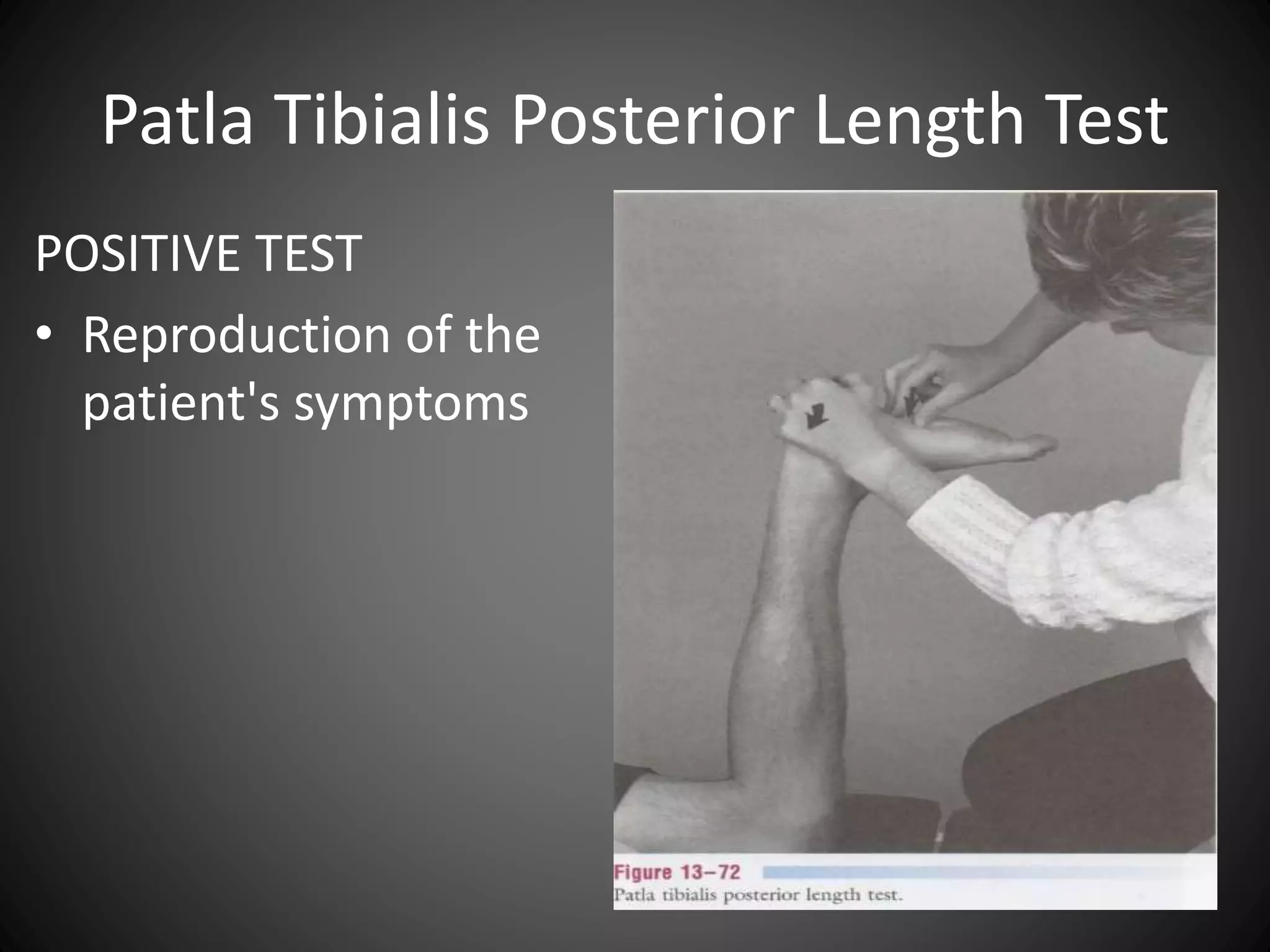
Patla Tibialis Posterior Length Test
POSITIVE TEST
• Reproduction of the
patient's symptoms
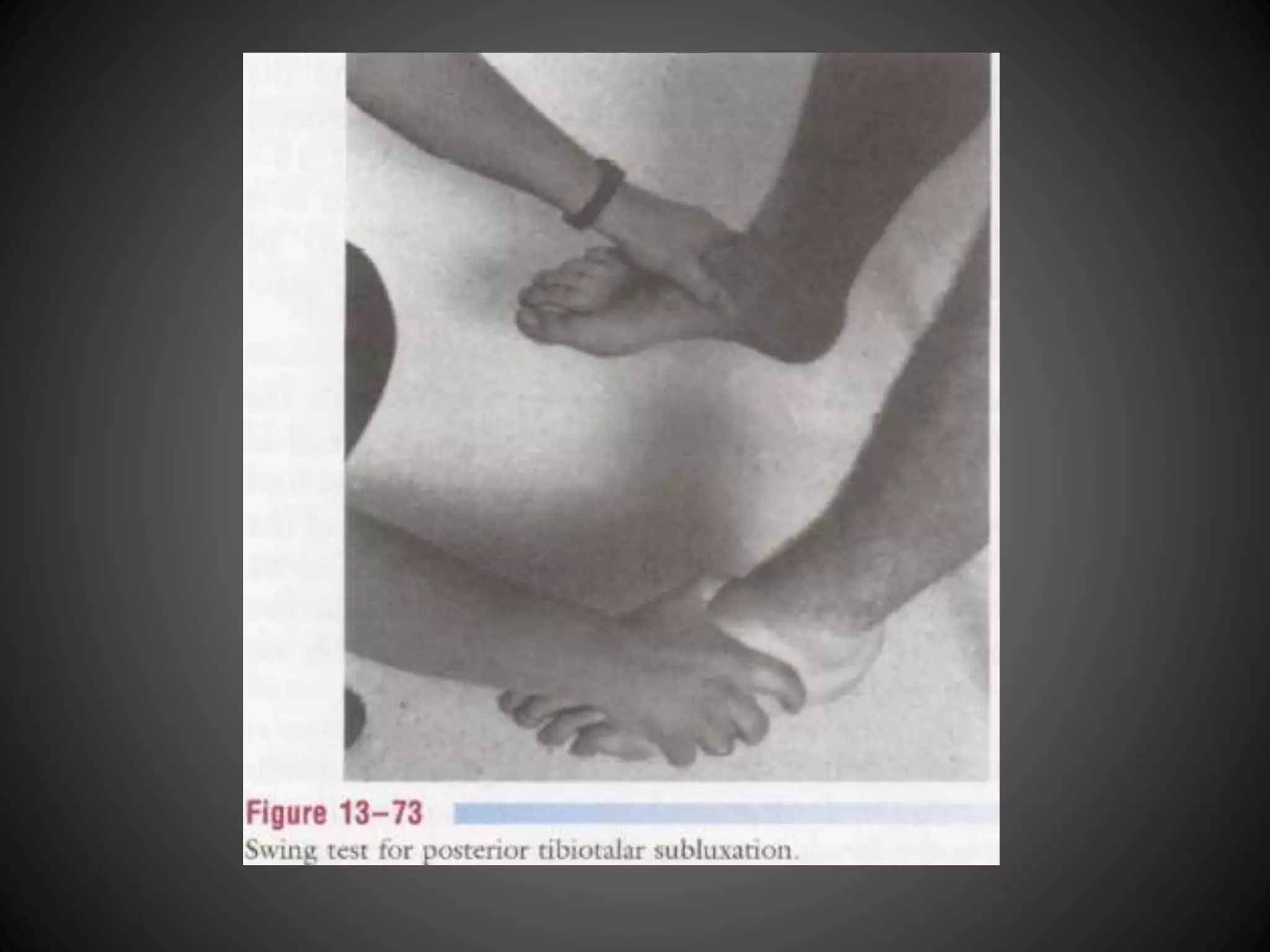
Swing Test for Posterior Tibiotalar
Subluxation
PROCEDURE
The patient sits with feet dangling over the edge of the
examining table. The examiner places the hands
around the dorsum of the foot using the fingers to keep
the feet parallel to the floor. With the thumbs, the
examiner palpates the anterior portion of the talus.
The examiner then passively plantar flexes and
dorsiflexes the foot and compares the quality and
degree of movement between feet, especially into
dorsiflexion.
POSITIVE TEST
Resistance to normal dorsiflexion in the injured ankle
(+) posterior tibiotalar subluxation.
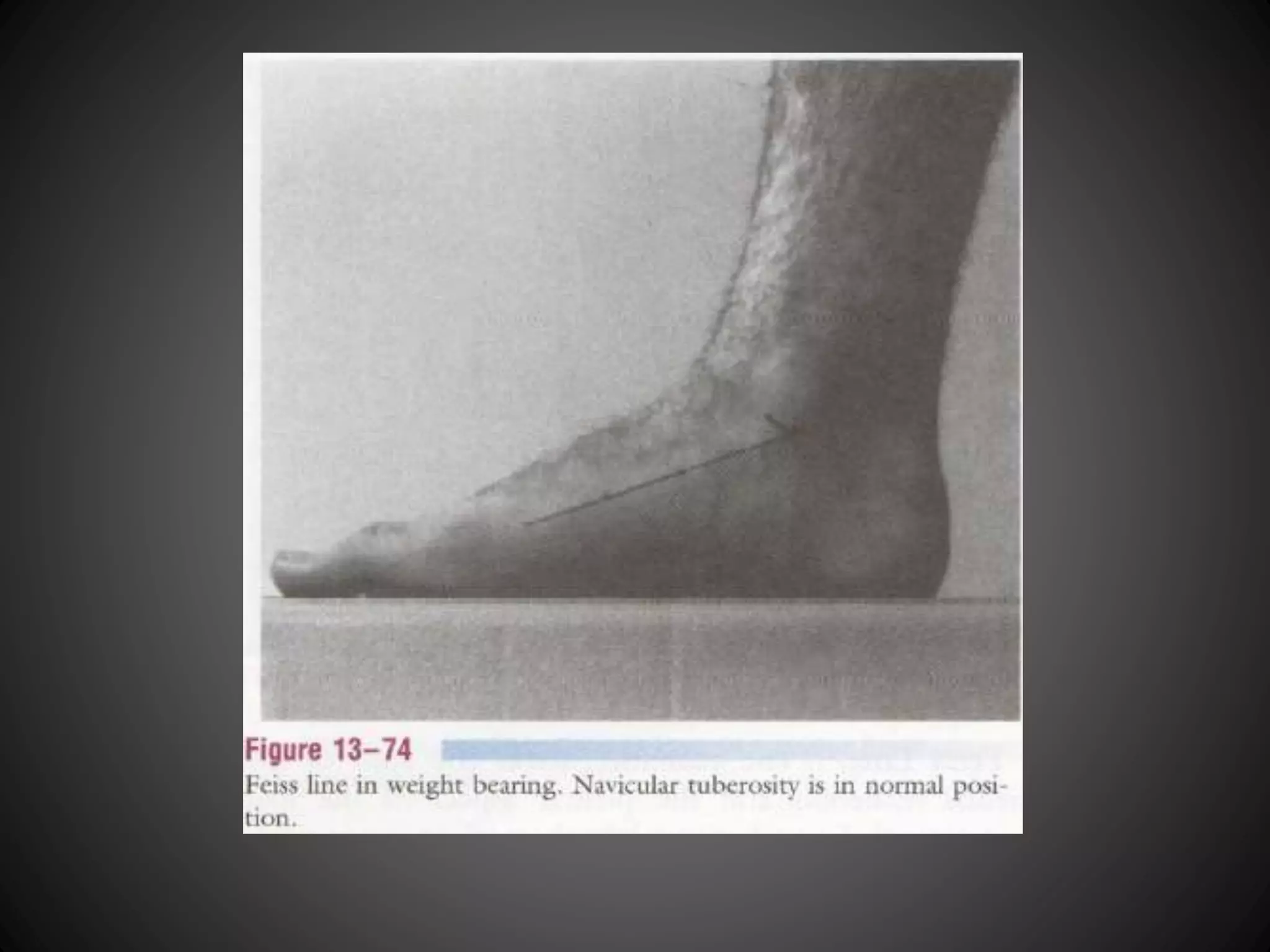
Feiss Line
PROCEDURE
• The examiner marks the apex of the medial malleolus and the
plantar aspect of the first metatarsophalangeal joint while the
patient is not bearing weight, palpates the navicular
tuberosity on the medial aspect of the foot, noting where it
lies relative to a line joining the two previously made points.
The patient then stands with the feet 8 to 15 cm (3 to 6
inches) apart.
• The two points are checked to ensure that they still represent
the apex of the medial malleolus and the plantar aspect of the
metatarsophalangeal joint. The navicular tubercle is again
palpated. The navicular tubercle normally lies on or close to
the line joining the two points.
POSITIVE TEST
• If the tubercle falls one third of the distance to
the floor, it represents a first-degree flatfoot; if
it falls two thirds of the distance, it represents
a second-degree flatfoot; if it rests on the
floor, it represents a third-degree flatfoot.
Hoffa’s Test
PROCEDURE
• The patient lies prone with the feet extended
over the edge of the examining table. The
examiner palpates the Achilles tendon while the
patient plantar flexes and dorsiflexes the foot.
POSITIVE TEST
• If one Achilles tendon (the injured one) feels less
taut than the other one, the test is (+) calcaneal
fracture.
• Passive dorsiflexion on the affected side is also
greater.
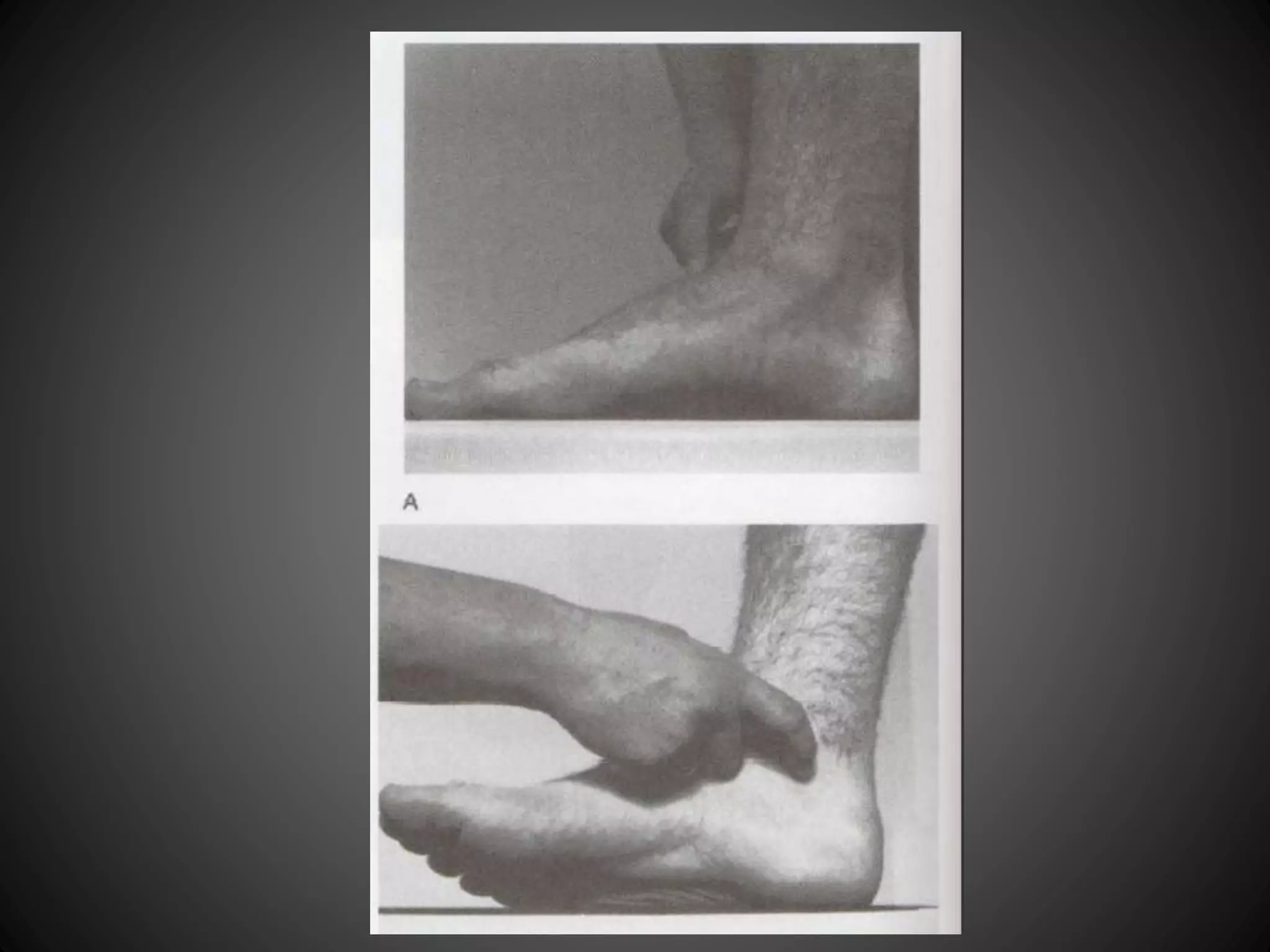
Tinel's Sign at the Ankle (Percussion
Sign)
PROCEDURE
• Tinel's sign may be elicited in two places around
the ankle. The anterior tibial branch of the deep
peroneal nerve may be percussed in front of the
ankle. The posterior tibial nerve may be
percussed as it passes behind the medial
malleolus.
POSITIVE TEST
• tingling or paresthesia
Duchenne Test
• Lesion of the superficial peroneal nerve (L4-S1)
PROCEDURE
The patient lies supine with the legs straight. The
examiner pushes up on the head of the first
metatarsal through the sole, pushing the foot into
dorsiflexion.
POSITIVE TEST
when the patient is asked to plantar flex the foot,
the medial border dorsiflexes and offers no
resistance while the lateral border plantar flexes
Morton’s Test
Test for fracture or neuroma
PROCEDURE
• The patient lies supine. The examiner grasps the
foot around the metatarsal heads and squeezes
the heads together.
POSITIVE TEST
Pain
Homan’s Sign
PROCEDURE
• The patient’s foot is passively dorsiflexed with
the knee extended.
POSITIVE TEST
• Pain
• Tenderness is also elicited on palpation of the
calf. In addition to these findings, the examiner
may find pallor and swelling in the leg and a
loss of the dorsalis pedis pulse.
Buerger’s Test
PROCEDURE
• The patient lies supine while the examiner
elevates the patient's leg to 45° for at least 3
minutes.
POSITIVE TEST
• If the foot blanches or the prominent veins
collapse shortly after elevation, the test is
positive for poor arterial blood circulation. The
examiner then asks the patient to sit with the
legs dangling for 1-2 mins. Limb color is restored
and test is confirmed positive.

Special Tests for Lower Leg, Ankle, and Foot

  • 1.
    SPECIAL TESTS LOWER LEG,ANKLE, AND FOOT
  • 2.
    TESTS FOR NEUTRALPOSITION OF THE TALUS
  • 3.
    Neutral Position ofthe Talus (Weight- Bearing Position) PROCEDURE: • The patient stands with the feet in a relaxed standing position. The examiner palpates the head of the talus on the dorsal aspect of the foot with the thumb and forefinger of one hand. The patient is asked to slowly rotate the trunk to the right and then to the left, which causes the tibia to medially and laterally rotate so that the talus supinates and pronates. POSITIVE TEST/IMPLICATION : • If the foot is positioned so that the talar head does not appear to bulge to either side, then the subtalar joint will be in its neutral position in weight bearing
  • 5.
    Neutral Position ofthe Talus (Supine) • PROCEDURE: The patient lies supine with the feet extending over the end of the examining table. The examiner grasps the patient's foot over the fourth and fifth metatarsal heads, using the thumb and index finger of one hand. The examiner palpates both sides of the head of the talus on the dorsum of the foot with the thumb and index finger of the other hand. The examiner then gently, passively dorsiflexes the foot until resistance is felt. While the examiner maintains the dorsiflexion, the foot is passively moved through an arc of supination (talar head bulges laterally) and pronation (talar head bulges medially). • POSITIVE TEST/IMPLICATION : If the foot is positioned so that the talar head does not appear to bulge to either side, the subtalar joint will be in its neutral nonweight- bearing.
  • 7.
    Neutral Position ofthe Talus (Prone) • PROCEDURE: The patient lies prone with the foot extended over the end of the examining table. The examiner grasps the patient's foot over the fourth and fifth metatarsal heads with the index finger and thumb of one hand. The examiner palpates both sides of the talus on the dorsum of the foot, using the thumb and index finger of the other hand. The examiner then passively and gently dorsiflexes the foot until resistance is felt. While maintaining the dorsiflexed position, the examiner moves the foot back and forth through an arc of supination (talar head bulges later-ally) and pronation (talar head bulges medially). • POSITIVE TEST/IMPLICATION : As the arc of movement is performed, there is a point in the arc at which the foot appears to "falloff" to one side or the other more easily. This point is the neutral, non-weight-bearing position of the subtalar joint.
  • 9.
  • 10.
    Leg-Heel Alignment• PROCEDURE: Thepatient lies in the prone position with foot extending over the end of the examining table. The examiner then places a mark over the midline of the calcaneus at the insertion of the Achilles tendon, makes a second mark ~1 cm distal to the first mark and as close to the midline of the calcaneus as possible. A calcaneal line is then made to join the two marks. Next, the examiner makes two marks on the lower third of the leg in the midline forming the tibial line, which represents the longitudinal axis of the tibia. The examiner then places the subtalar joint in the prone neutral position. While the subtalar joint is held in neutral, the examiner looks at the two lines. • POSITIVE TEST/IMPLICATION: If the lines are parallel or in slight varus (2° to 8°), the leg-to-heel alignment is considered normal. If the heel is inverted, the patient has hindfoot varus; if the heel is everted, the patient has hindfoot valgus
  • 12.
    Forefoot- Heel Alignment •PROCEDURE: The patient lies supine with the feet extending over the end of the examining table. The examiner positions the subtalar joint in supine neutral position. While maintaining this position, the examiner pronates the midtarsal joints maximally and then observes the relation between the vertical axis of the heel and the plane of the second through fourth metatarsal heads. Normally, the plane is perpendicular to the vertical axis. • POSITIVE TEST/IMPLICATION: If the medial side of the foot is raised, the patient has a forefoot varus; if the lateral side of the foot is raised, the patient has a forefoot valgus.
  • 14.
    Coleman Block Test •PROCEDURE: This test differentiates a hindfoot varus resulting from a forefoot valgus from a hindfoot varus resulting from a tight tibialis posterior. If the patient is found to have a hindfoot varus in standing, the examiner places a lift or block under the lateral side of the forefoot. • POSITIVE TEST/IMPLICATION: If the hindfoot varus is corrected it indicates the hindfoot is flexible and the hindfoot varus is due to a plantar flexed first ray or a valgus forefoot. If it does not correct, the tibialis posterior is tight.
  • 16.
  • 17.
    Tibial Torsion (Sitting) •PROCEDURE: Tibial torsion is measured by having the patient sit with the knees flexed to 90° over the edge of the examining table. The examiner places the thumb of one hand over the apex of one malleolus and the index finger of the same hand over the apex of the other malleolus. Next, the examiner visualizes the axes of the knee and of the ankle. • POSITIVE TEST/IMPLICATION: The lines are not normally parallel but instead form an angle of 12° to 18° owing to lateral rotation of the tibia.
  • 19.
    Tibial Torsion (Supine) •PROCEDURE: The examiner ensures that the femoral condyle lies in the frontal plane (patella facing straight up). The examiner palpates the apex of both malleoli with one hand and draws a line on the heel representing a line joining the two apices. A second line is drawn on the heel parallel to the floor. The angle formed by the intersection of the two lines indicates the amount of lateral tibial torsion. • POSITIVE TEST/IMPLICATION: If the hindfoot varus is corrected it indicates the hindfoot is flexible and the hindfoot varus is due to a plantar flexed first ray or a valgus forefoot. If it does not correct, the tibialis posterior is tight.
  • 20.
    Tibial Torsion (Prone) •PROCEDURE: knee flexed to 90°. The examiner views from above the angle formed by the foot and thigh after the subtalar joint has been placed in the neutral position, noting the angle the foot makes with the tibia. This method is most often used in children because it is easier to observe the feet from above.
  • 22.
    "Too Many Toes"Sign • The patient stands in a normal relaxed position while the examiner views the patient from behind. If the heel is in valgus, the forefoot abducted, or the tibia laterally rotated more than normal (tibial torsion), the examiner can see more toes on the affected side than on the normal side. • Similarly, lateral femoral torsion could cause the "too many toes" test to be positive. • If the talus is positioned in neutral and the calcaneus is in neutral, the "too many toes" sign means the forefoot is adducted on the rearfoot and may be seen with excessive pronation (hyperpronation). • Hyperpronation is often associated with metatarsalgia, plantar fasciitis, hallux valgus, and posterior tibial tendon pathology.
  • 24.
  • 25.
    Anterior Drawer Testof the Ankle PROCEDURE • designed primarily to test for injuries to the anterior • talofibular ligament • The patient lies supine with the foot relaxed. The examiner stabilizes the tibia and fibula, holds the patient's foot in 20° of plantar flexion, and draws the talus forward in the ankle mortise POSITIVE TEST Excessive anterior translation. Sometimes, a dimple appears over the area of the anterior talofibular ligament on anterior translation (dimple or suction sign) if pain and muscle spasm are minimal
  • 27.
    Prone Anterior DrawerTest PROCEDURE • The patient lies prone with the feet extending over the end of the examining table. With one hand, the examiner pushes the heel steadily forward POSITIVE TEST • Excessive anterior movement and a “sucking in” of the skin on both sides of the Achilles tendon.
  • 29.
    Talar Tilt Test PROCEDURE •The patient lies in the supine or side lying position with the foot relaxed. The foot is held in the anatomic (90°) position, which brings the calcaneofibular ligament perpendicular to the long axis of the talus. Talus is then tilted from side to side into adduction and abduction POSITIVE TEST • Excessive movement on adduction
  • 31.
    Squeeze Test ofthe Leg PROCEDURE • The patient lies supine. • The examiner grasps the lower leg at midcalf and squeezes the tibia and fibula together POSITIVE TEST • Pain in the lower leg may indicate a syndesmosis injury, provided that fracture, contusion, and compartment syndrome have been ruled out
  • 32.
    External Rotation StressTest (Kleiger Test) PROCEDURE • The patient is seated with the leg hanging over the examining table with the knee at 90°. The examiner faces the leg, holds the foot in plantigrade (90°) and applies a • passive lateral rotation stress to the foot and ankle POSITIVE TEST • positive for a syndesmosis injury if pain is produced over the anterior or posterior tibiofibular ligaments and the interosseous membrane
  • 34.
    Point (Palpation) Test PROCEDURE •The patient is positioned in sitting or supine. The examiner then applies a gradual pressure over the anteroinferior tibiofibular ligament (anterior aspect of the distal tibia fibular syndesmosis) • using the index finger POSITIVE • Pain in the syndesmosis area
  • 36.
    Cotton Test PROCEDURE • Theexaminer stabilizes the distal tibia and fibula with one hand and applies a medial and lateral translation force POSITIVE TEST • Any lateral translation (3 to 5mm) or clunk indicates syndesmotic instability.
  • 37.
    Dorsiflexion Maneuver PROCEDURE • Thepatient sits on the edge of the table. The examiner stabilizes the patient’s leg with one hand and with the other hand passively and forcefully dorsiflexes the foot by holding onto the heel and using the forearm to dorsiflex the foot POSITIVE TEST • Pain on forced dorsiflexion indicates a positive test
  • 38.
    Dorsiflexion Compression Test PROCEDURE •While in bilateral weight-bearing, the patient is asked to move his or her ankle into extreme. The patient is asked to note whether this maneuver is painful while the examiner notes the end range of motion. The patient then assumes a normal standing position again. The examiner applies a compression force using two hands surrounding the malleoli of the injured leg. While this compression is maintained, the patient is asked to move into dorsiflexion again. POSITIVE TEST • A decrease in pain on dorsiflexion or an increase in dorsiflexion range
  • 39.
    Crossed Leg Test PROCEDURE •The patient sits in a chair with the affected leg crossed over the opposite knee so the midpoint of the fibula is resting on the opposite knee. The examiner then applies a gentle force to the medial aspect of the knee of the injured leg. POSITIVE TEST Pain in the area of the distal syndesmosis
  • 41.
    Heel Thump Test •The patient is in sitting or lying. The examiner uses one hand to stabilize the leg. With the other hand, the examiner applies a firm thump on the heel with the fist so that the force is applied to the center of the heel and in line with the long axis of the tibia. • A positive test (i.e., pain) in the area of the ankle indicates a syndesmosis injury. Pain along the shaft of the tibia may indicate a stress fracture.
  • 43.
    Thompson’s (Simmond’s) Test •For Achilles tendon rupture PROCEDURE • The patient lies prone or kneels on a chair with the feet over the edge of the table or chair. While the patient is relaxed, the examiner squeezes the calf muscles. POSITIVE TEST Absence of plantar flexion
  • 44.
    Figure-8 Ankle Measurement Themeasurement is repeated three times and an average taken.
  • 45.
    Test for PeronealTendon Dislocation PROCEDURE • The patient is placed in prone on the examining table with the knee flexed to 90°. The posterolateral region of the ankle is inspected for swelling. The patient is then asked to actively dorsiflex and plantar flex the ankle along with eversion against the examiner's resistance POSITIVE TEST • tendon subluxes from behind the lateral malleolus
  • 46.
    Patla Tibialis PosteriorLength Test PROCEDURE • prone lying with the knee flexed to 90° • calcaneus held in eversion and the ankle in dorsiflexion with one hand. • With the other hand, the examiner's thumb contacts the plantar surface of the bases of the second, third, and fourth metatarsals while the index and middle fingers contact the plantar surface of the navicular. The examiner then determines the end feel by pushing dorsally on the navicular and metatarsal heads. The end feel is compared with the normal side.
  • 47.
    Patla Tibialis PosteriorLength Test POSITIVE TEST • Reproduction of the patient's symptoms
  • 48.
    Swing Test forPosterior Tibiotalar Subluxation PROCEDURE The patient sits with feet dangling over the edge of the examining table. The examiner places the hands around the dorsum of the foot using the fingers to keep the feet parallel to the floor. With the thumbs, the examiner palpates the anterior portion of the talus. The examiner then passively plantar flexes and dorsiflexes the foot and compares the quality and degree of movement between feet, especially into dorsiflexion. POSITIVE TEST Resistance to normal dorsiflexion in the injured ankle (+) posterior tibiotalar subluxation.
  • 50.
    Feiss Line PROCEDURE • Theexaminer marks the apex of the medial malleolus and the plantar aspect of the first metatarsophalangeal joint while the patient is not bearing weight, palpates the navicular tuberosity on the medial aspect of the foot, noting where it lies relative to a line joining the two previously made points. The patient then stands with the feet 8 to 15 cm (3 to 6 inches) apart. • The two points are checked to ensure that they still represent the apex of the medial malleolus and the plantar aspect of the metatarsophalangeal joint. The navicular tubercle is again palpated. The navicular tubercle normally lies on or close to the line joining the two points.
  • 51.
    POSITIVE TEST • Ifthe tubercle falls one third of the distance to the floor, it represents a first-degree flatfoot; if it falls two thirds of the distance, it represents a second-degree flatfoot; if it rests on the floor, it represents a third-degree flatfoot.
  • 53.
    Hoffa’s Test PROCEDURE • Thepatient lies prone with the feet extended over the edge of the examining table. The examiner palpates the Achilles tendon while the patient plantar flexes and dorsiflexes the foot. POSITIVE TEST • If one Achilles tendon (the injured one) feels less taut than the other one, the test is (+) calcaneal fracture. • Passive dorsiflexion on the affected side is also greater.
  • 54.
    Tinel's Sign atthe Ankle (Percussion Sign) PROCEDURE • Tinel's sign may be elicited in two places around the ankle. The anterior tibial branch of the deep peroneal nerve may be percussed in front of the ankle. The posterior tibial nerve may be percussed as it passes behind the medial malleolus. POSITIVE TEST • tingling or paresthesia
  • 56.
    Duchenne Test • Lesionof the superficial peroneal nerve (L4-S1) PROCEDURE The patient lies supine with the legs straight. The examiner pushes up on the head of the first metatarsal through the sole, pushing the foot into dorsiflexion. POSITIVE TEST when the patient is asked to plantar flex the foot, the medial border dorsiflexes and offers no resistance while the lateral border plantar flexes
  • 57.
    Morton’s Test Test forfracture or neuroma PROCEDURE • The patient lies supine. The examiner grasps the foot around the metatarsal heads and squeezes the heads together. POSITIVE TEST Pain
  • 58.
    Homan’s Sign PROCEDURE • Thepatient’s foot is passively dorsiflexed with the knee extended. POSITIVE TEST • Pain • Tenderness is also elicited on palpation of the calf. In addition to these findings, the examiner may find pallor and swelling in the leg and a loss of the dorsalis pedis pulse.
  • 59.
    Buerger’s Test PROCEDURE • Thepatient lies supine while the examiner elevates the patient's leg to 45° for at least 3 minutes. POSITIVE TEST • If the foot blanches or the prominent veins collapse shortly after elevation, the test is positive for poor arterial blood circulation. The examiner then asks the patient to sit with the legs dangling for 1-2 mins. Limb color is restored and test is confirmed positive.