THE HIP COMPLEX

   BIOMECHANICS


                  Sreeraj S R
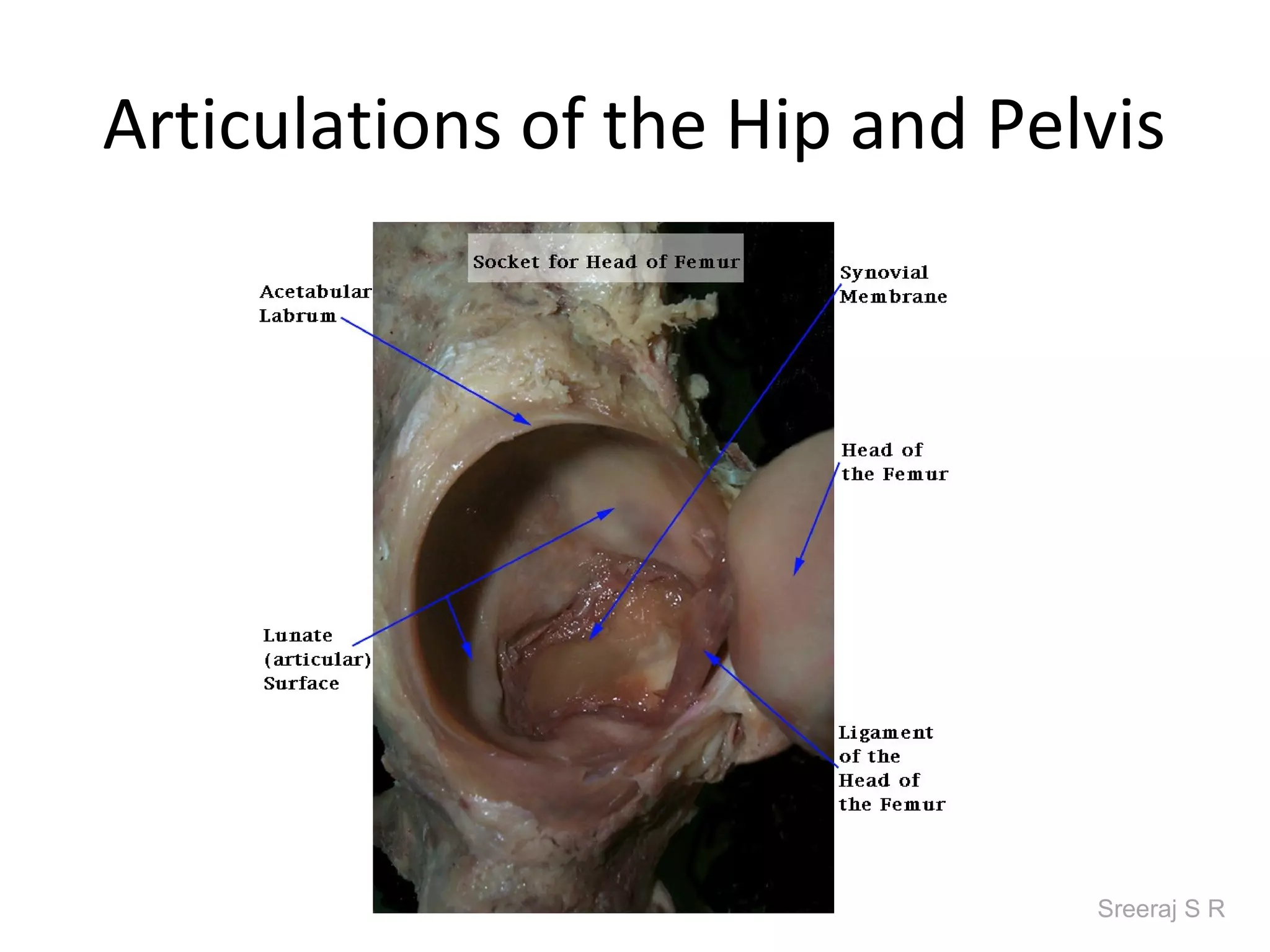
Articulations of the Hip and Pelvis


                                Sreeraj S R
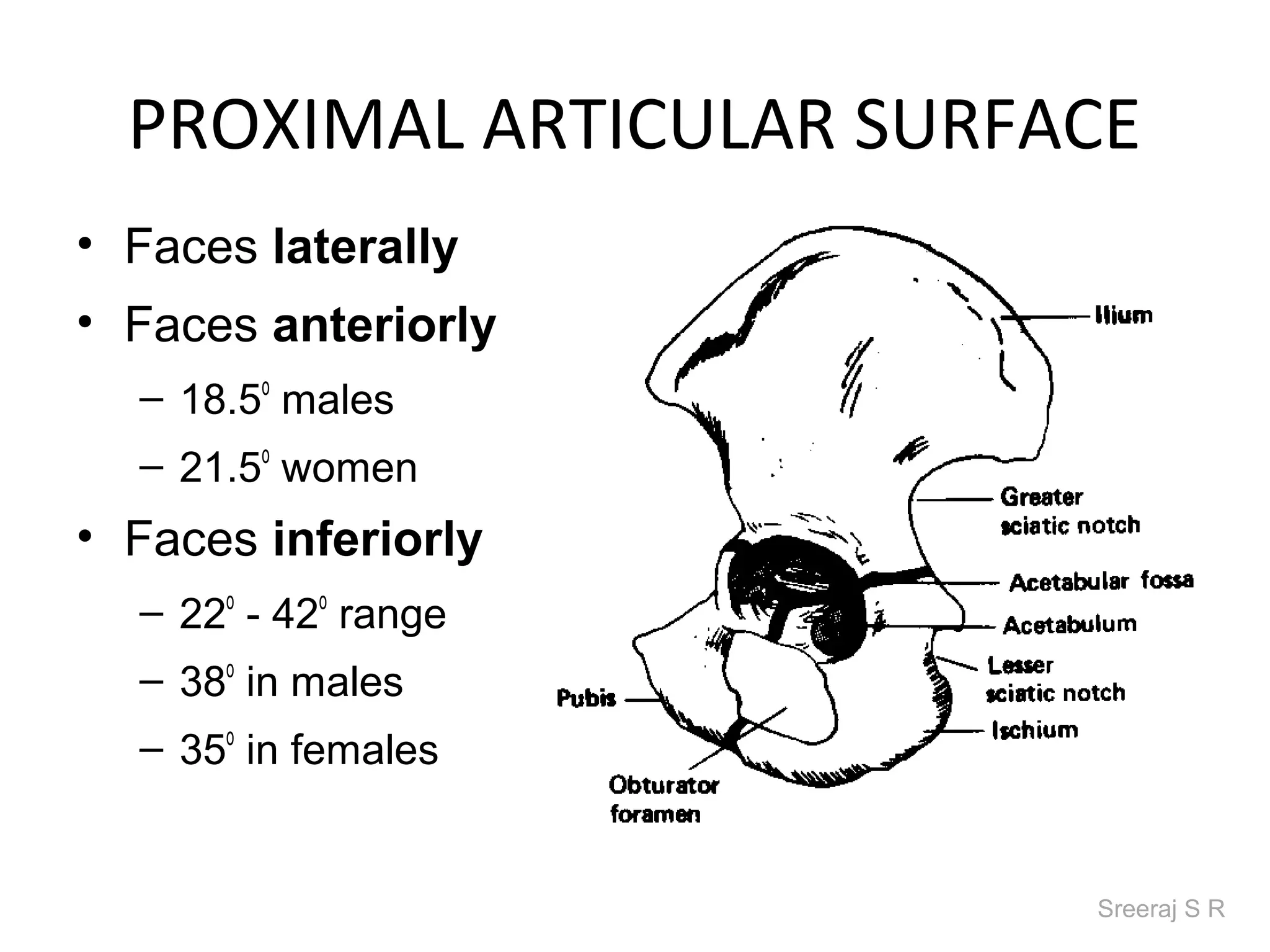
PROXIMAL ARTICULAR SURFACE
• Faces laterally
• Faces anteriorly
  – 18.5o males
  – 21.5o women
• Faces inferiorly
  – 22o - 42o range
  – 38o in males
  – 35o in females


                          Sreeraj S R
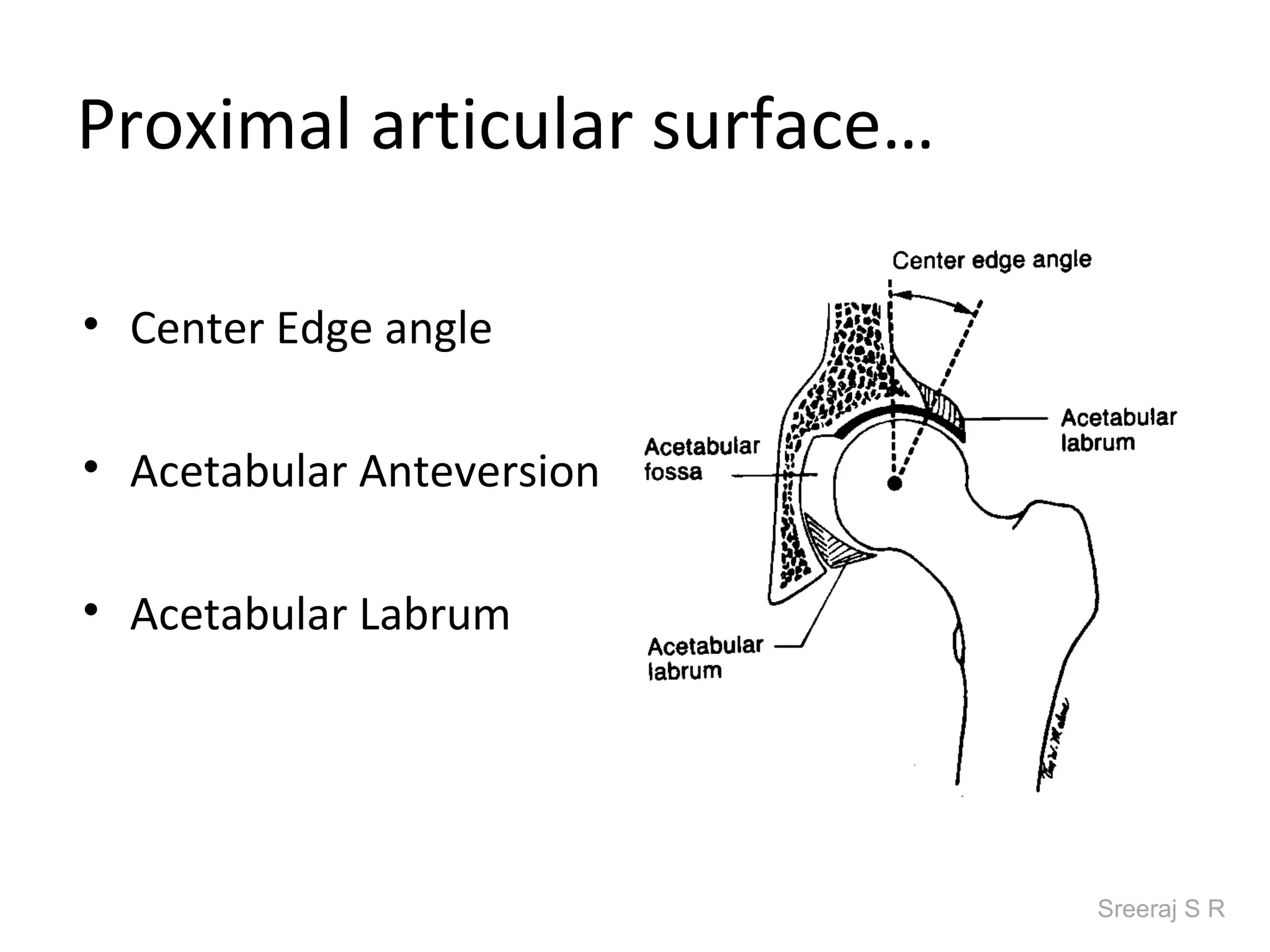
Proximal articular surface…

• Center Edge angle

• Acetabular Anteversion

• Acetabular Labrum


                              Sreeraj S R
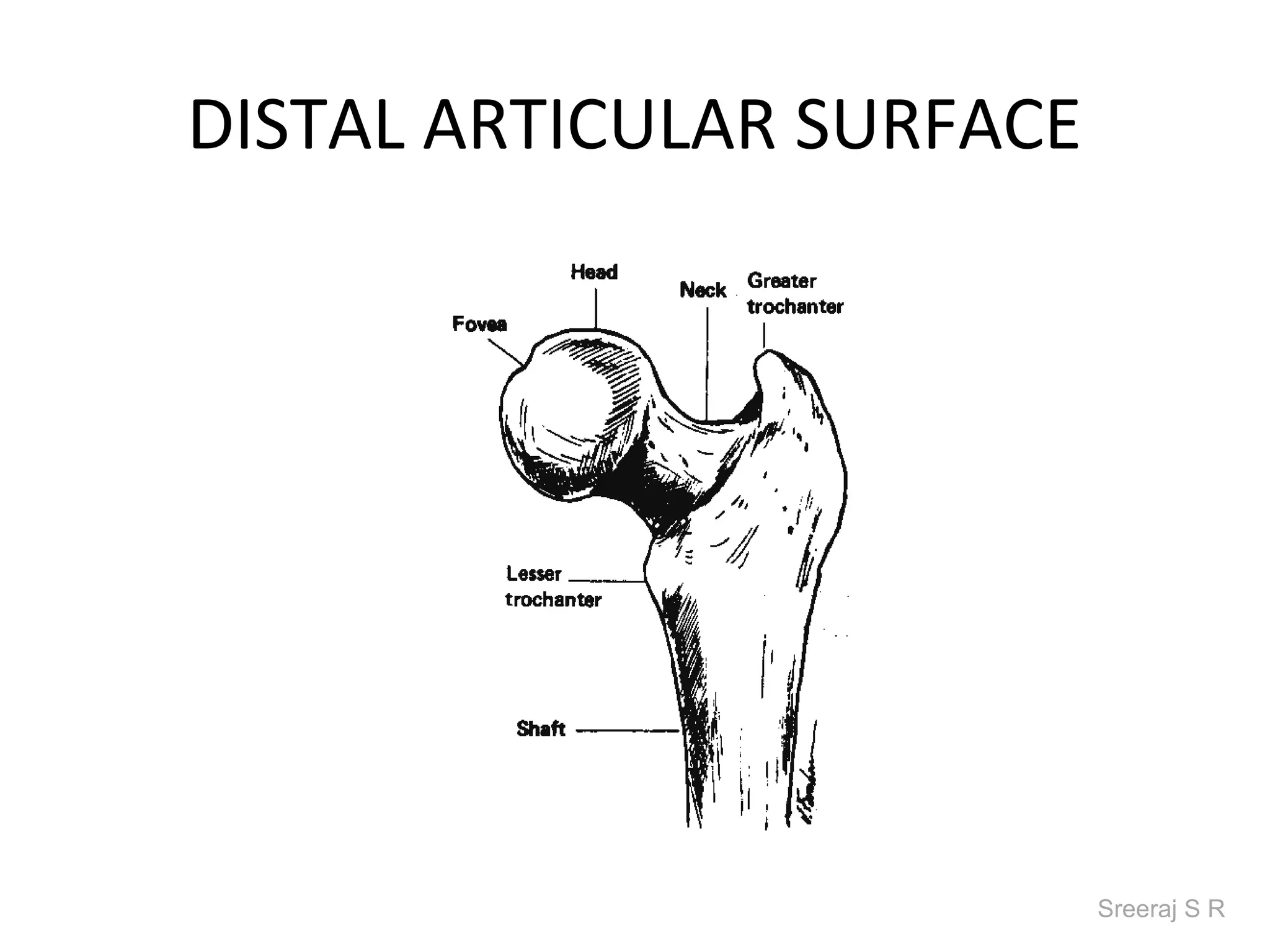
DISTAL ARTICULAR SURFACE


                           Sreeraj S R
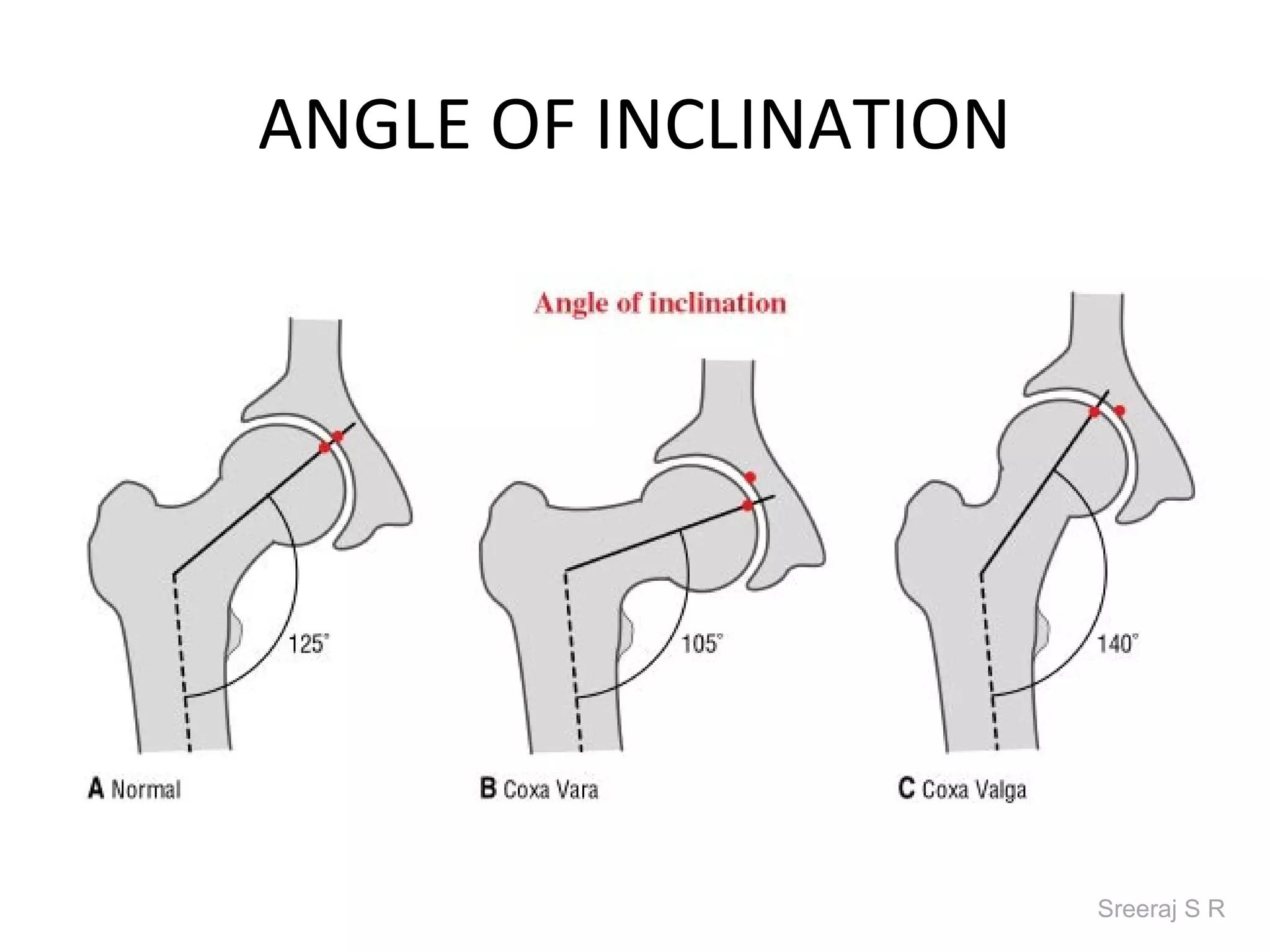
ANGLE OF INCLINATION


                       Sreeraj S R
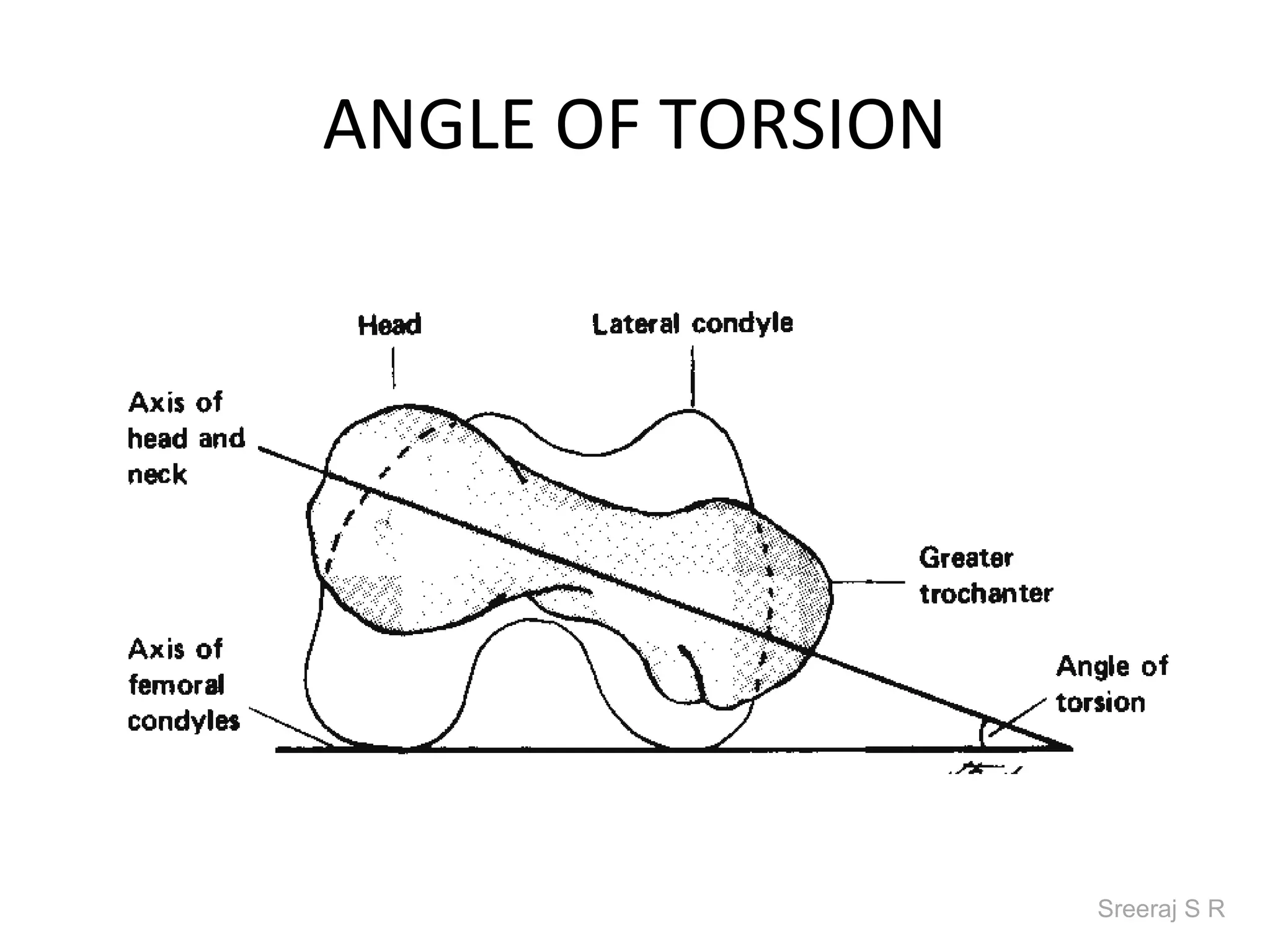
ANGLE OF TORSION


                   Sreeraj S R
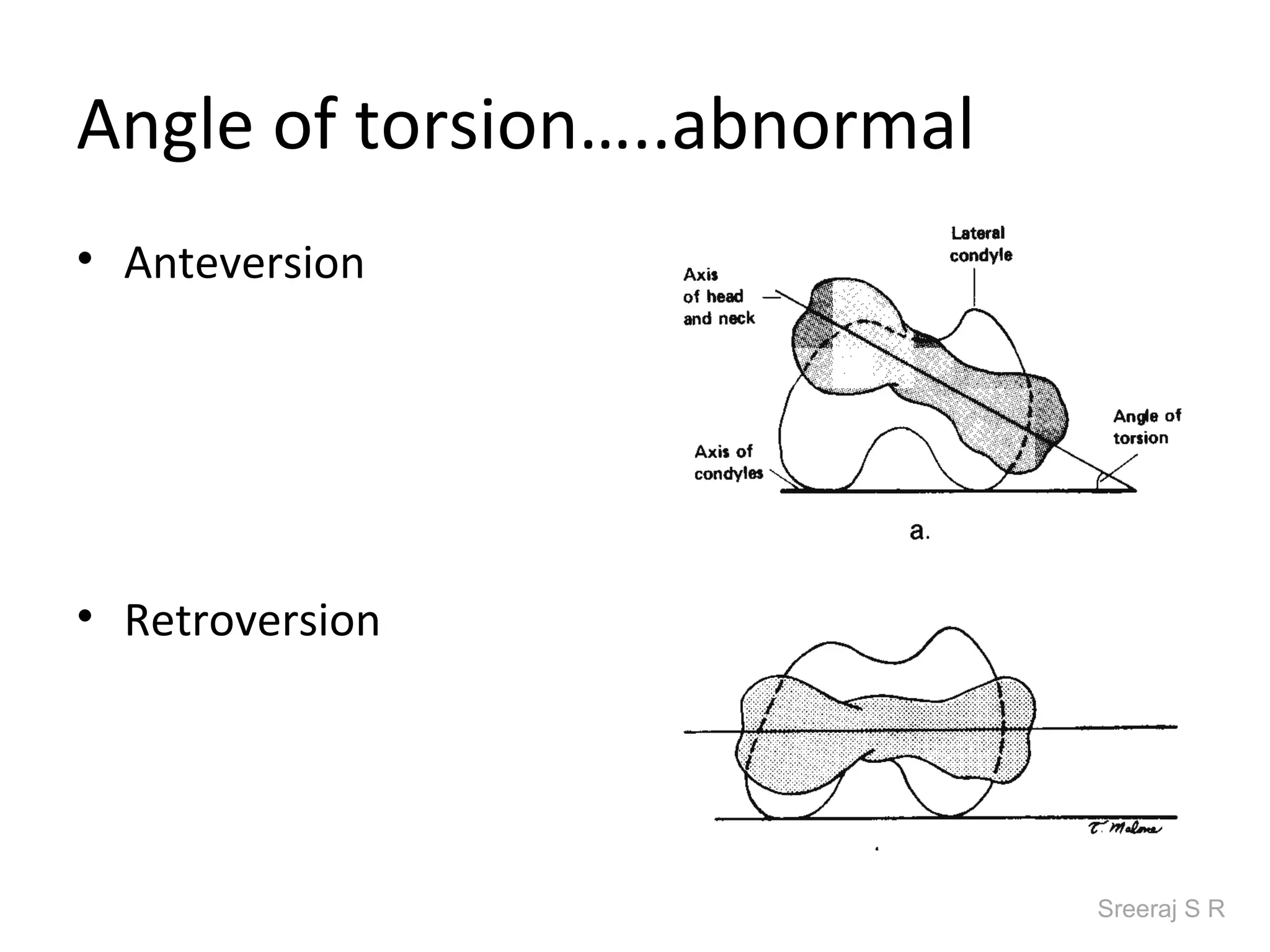
Angle of torsion…..abnormal
• Anteversion


• Retroversion


                              Sreeraj S R
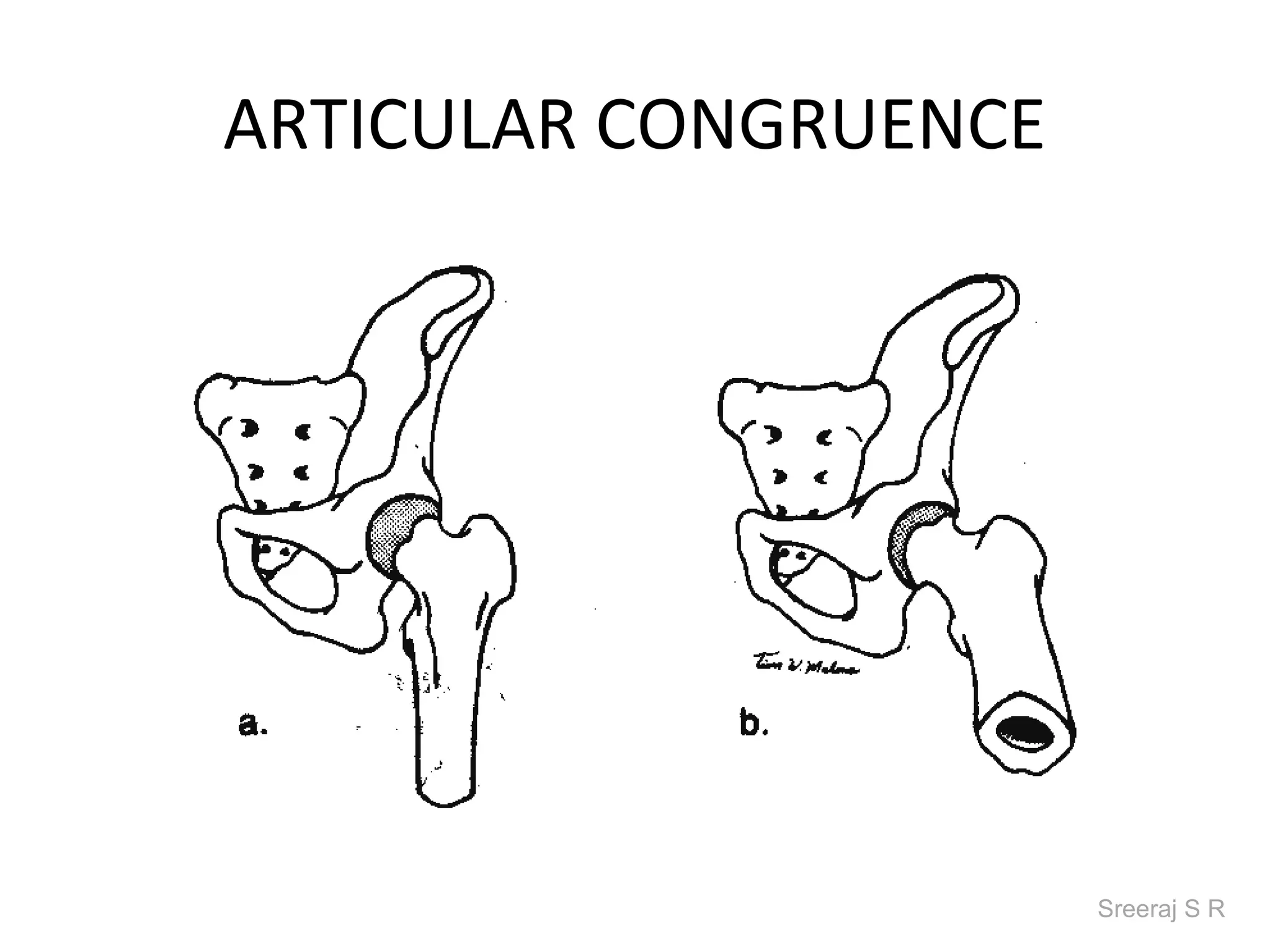
ARTICULAR CONGRUENCE


                       Sreeraj S R
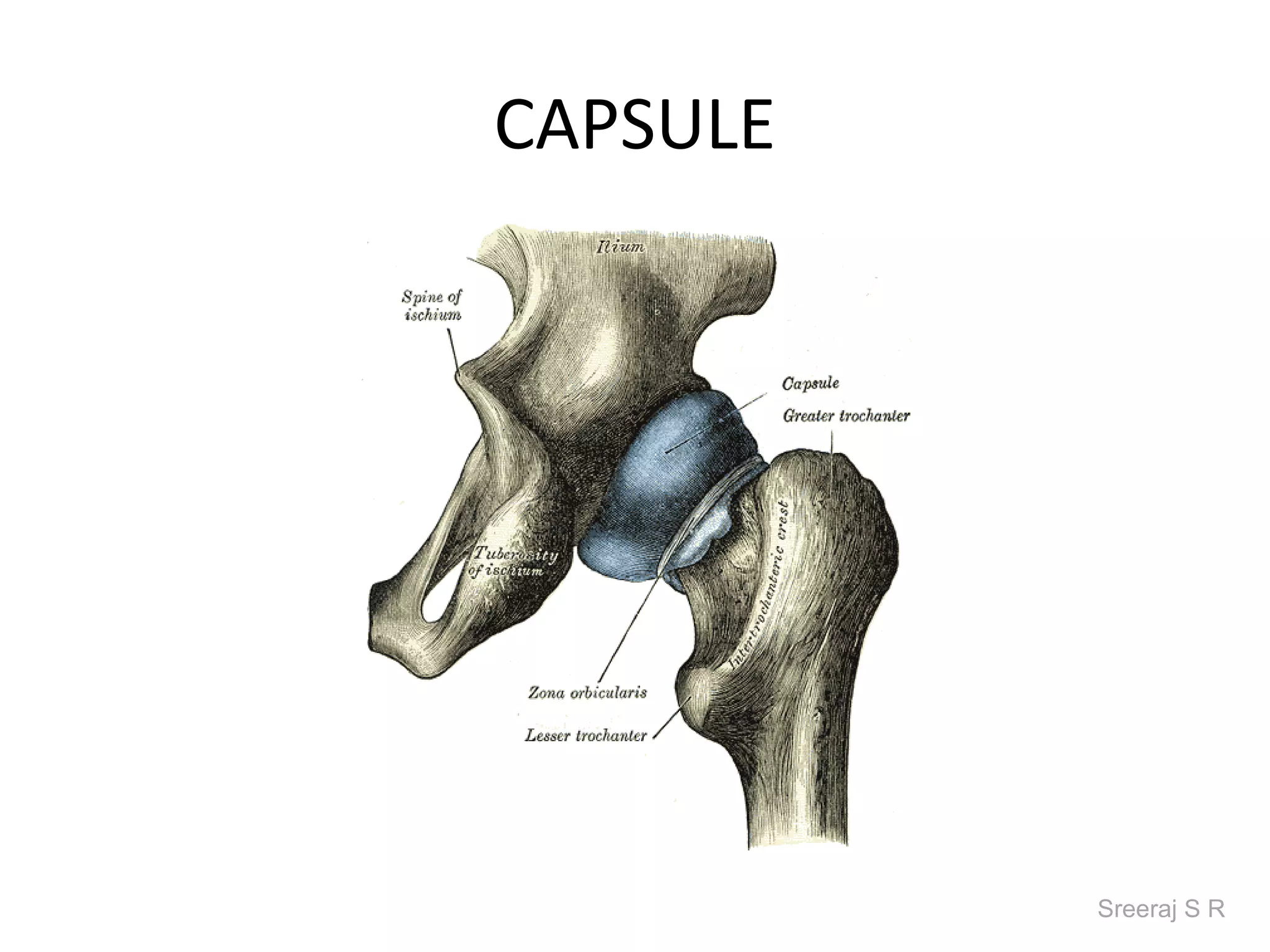
CAPSULE


          Sreeraj S R
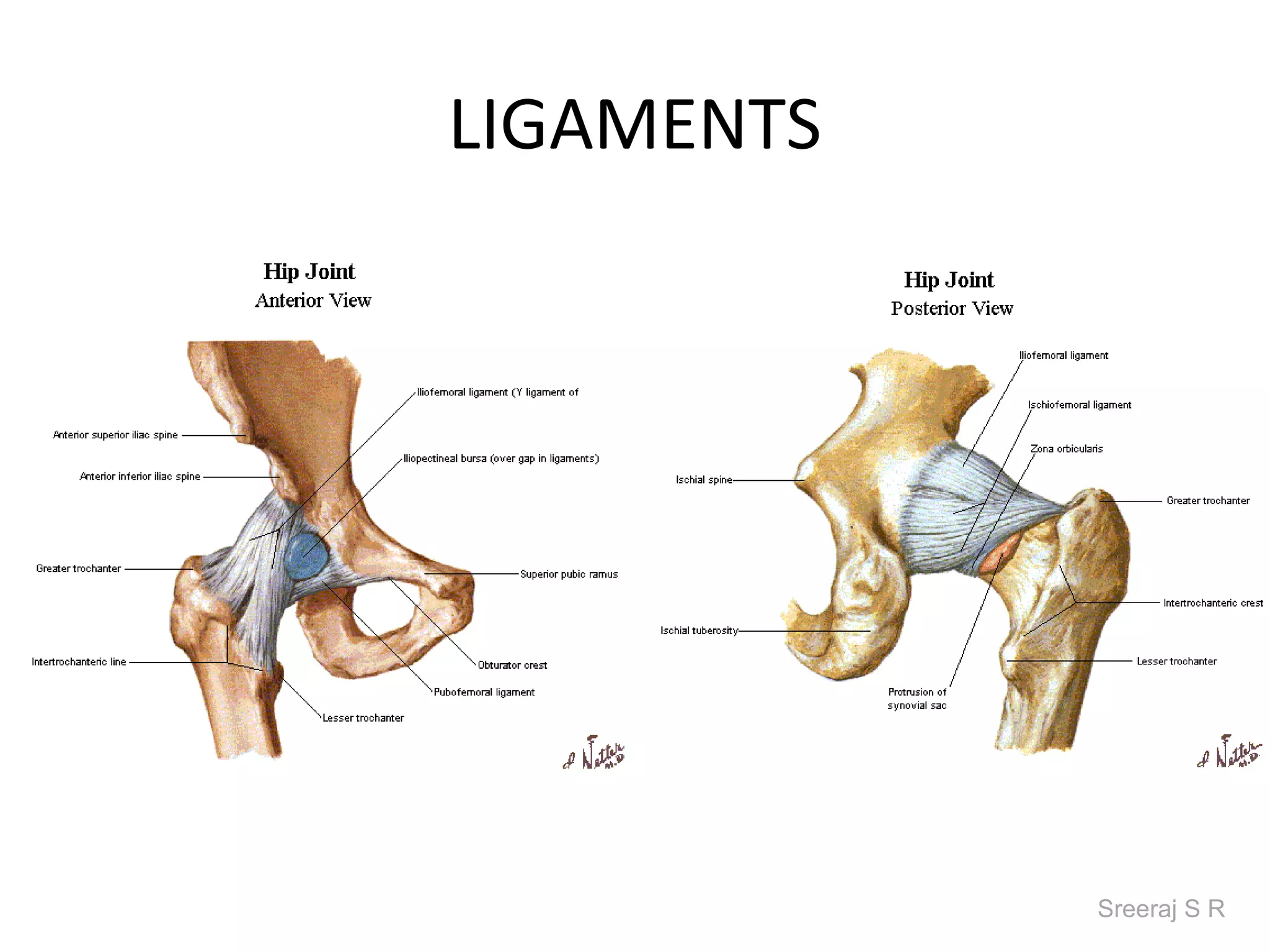
LIGAMENTS


            Sreeraj S R
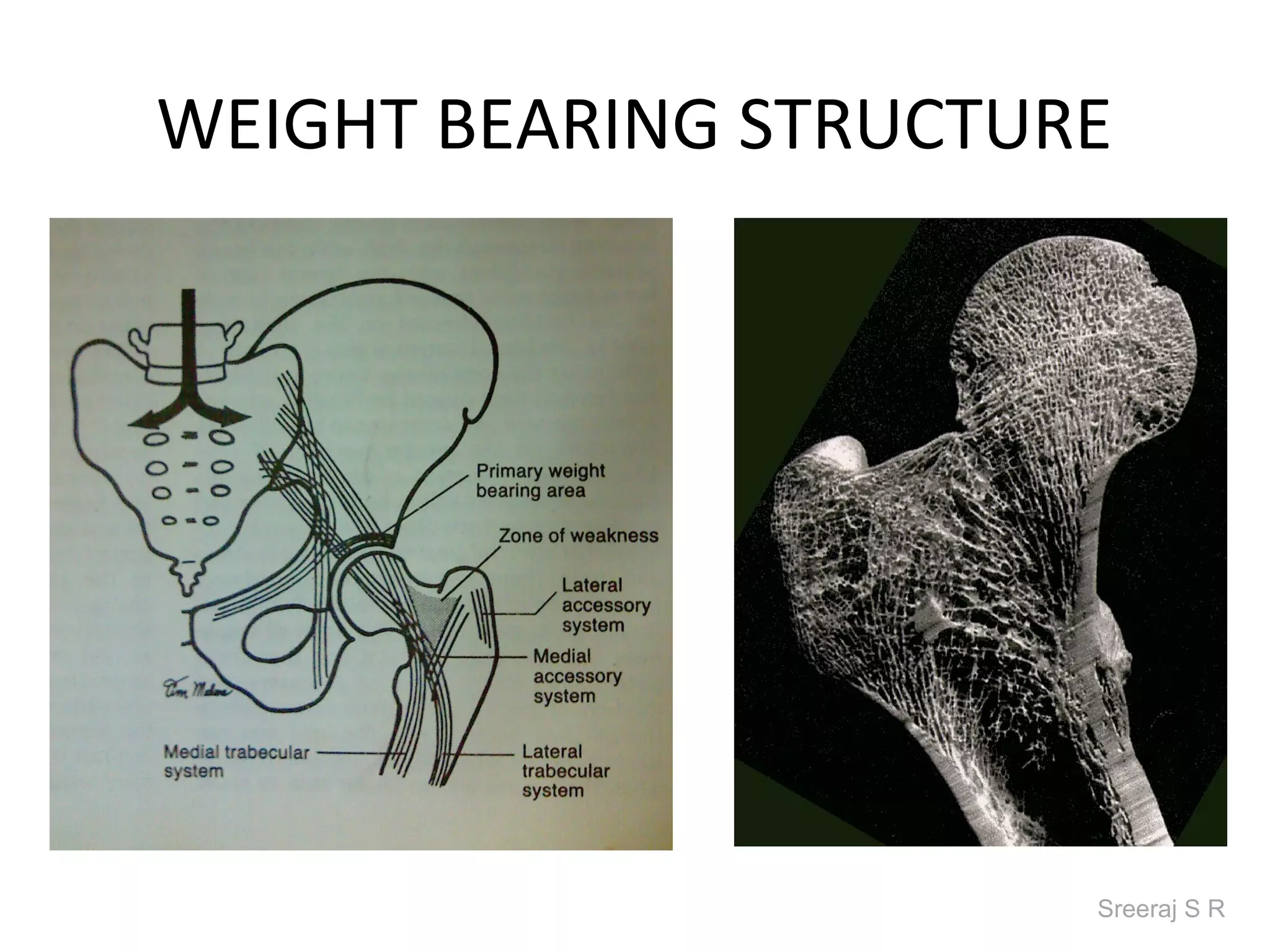
WEIGHT BEARING STRUCTURE


                       Sreeraj S R
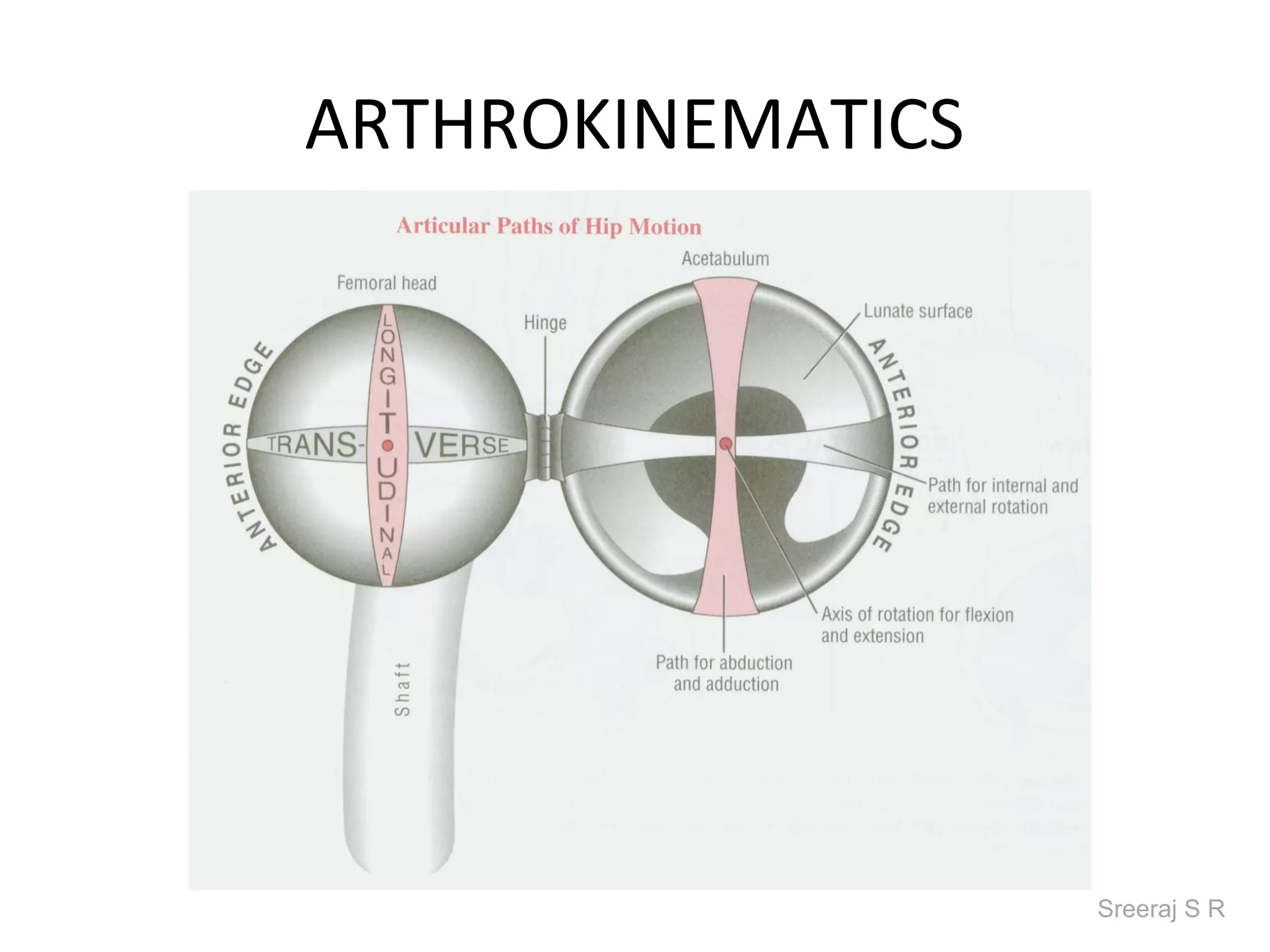
ARTHROKINEMATICS


                   Sreeraj S R
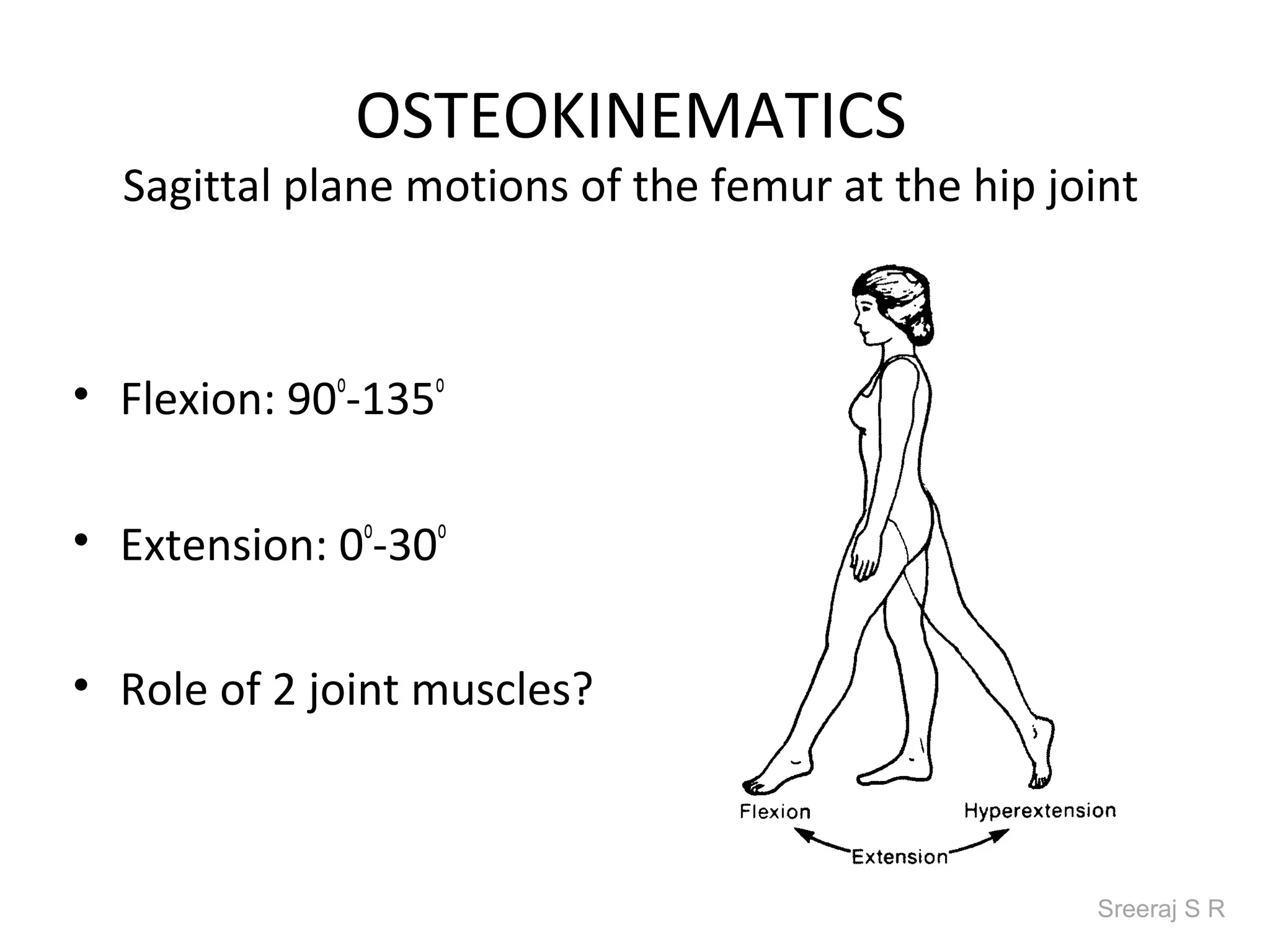
OSTEOKINEMATICS
  Sagittal plane motions of the femur at the hip joint


• Flexion: 90o-135o

• Extension: 0o-30o

• Role of 2 joint muscles?


                                                   Sreeraj S R
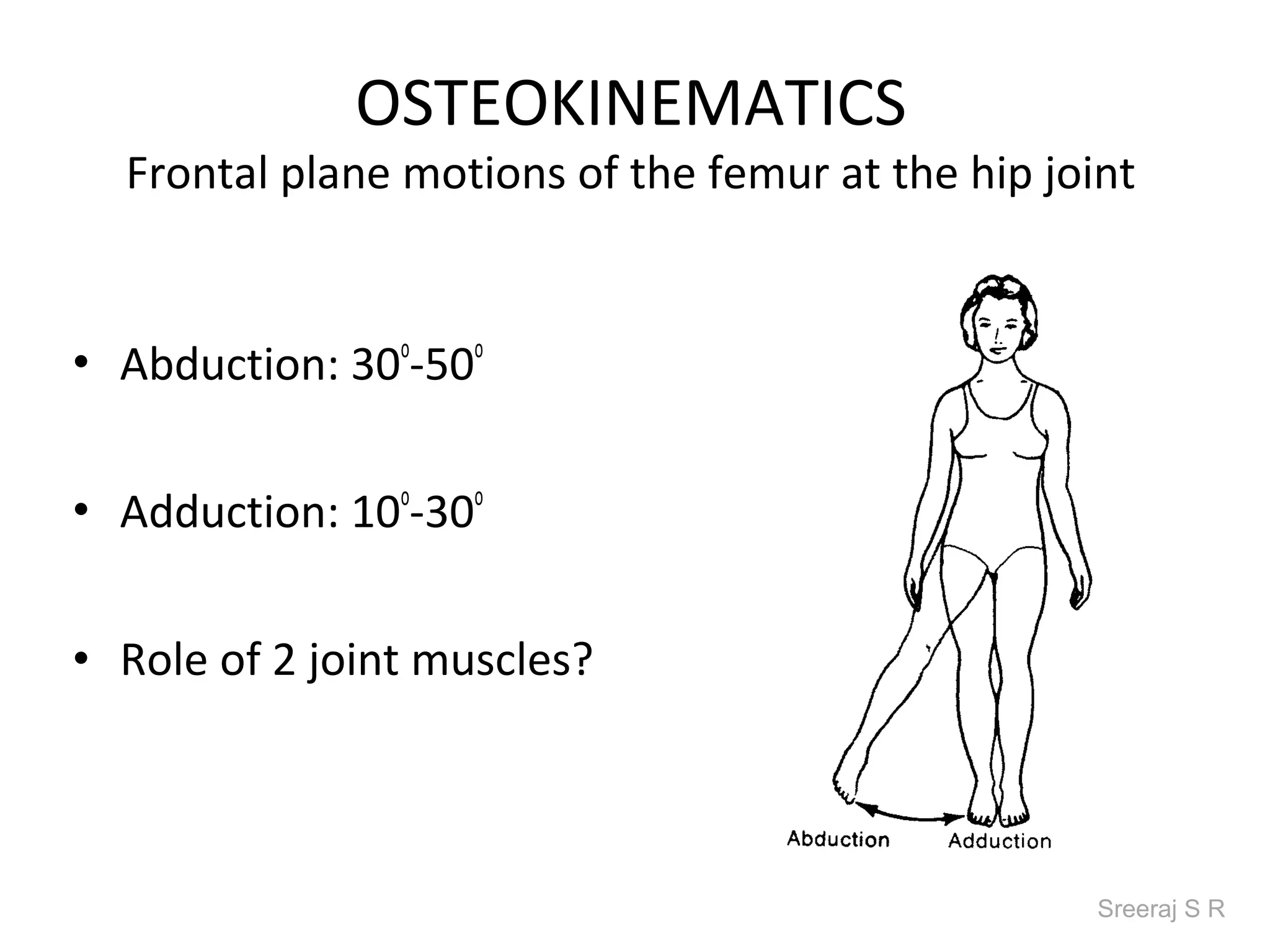
OSTEOKINEMATICS
  Frontal plane motions of the femur at the hip joint


• Abduction: 30o-50o

• Adduction: 10o-30o


• Role of 2 joint muscles?


                                                   Sreeraj S R
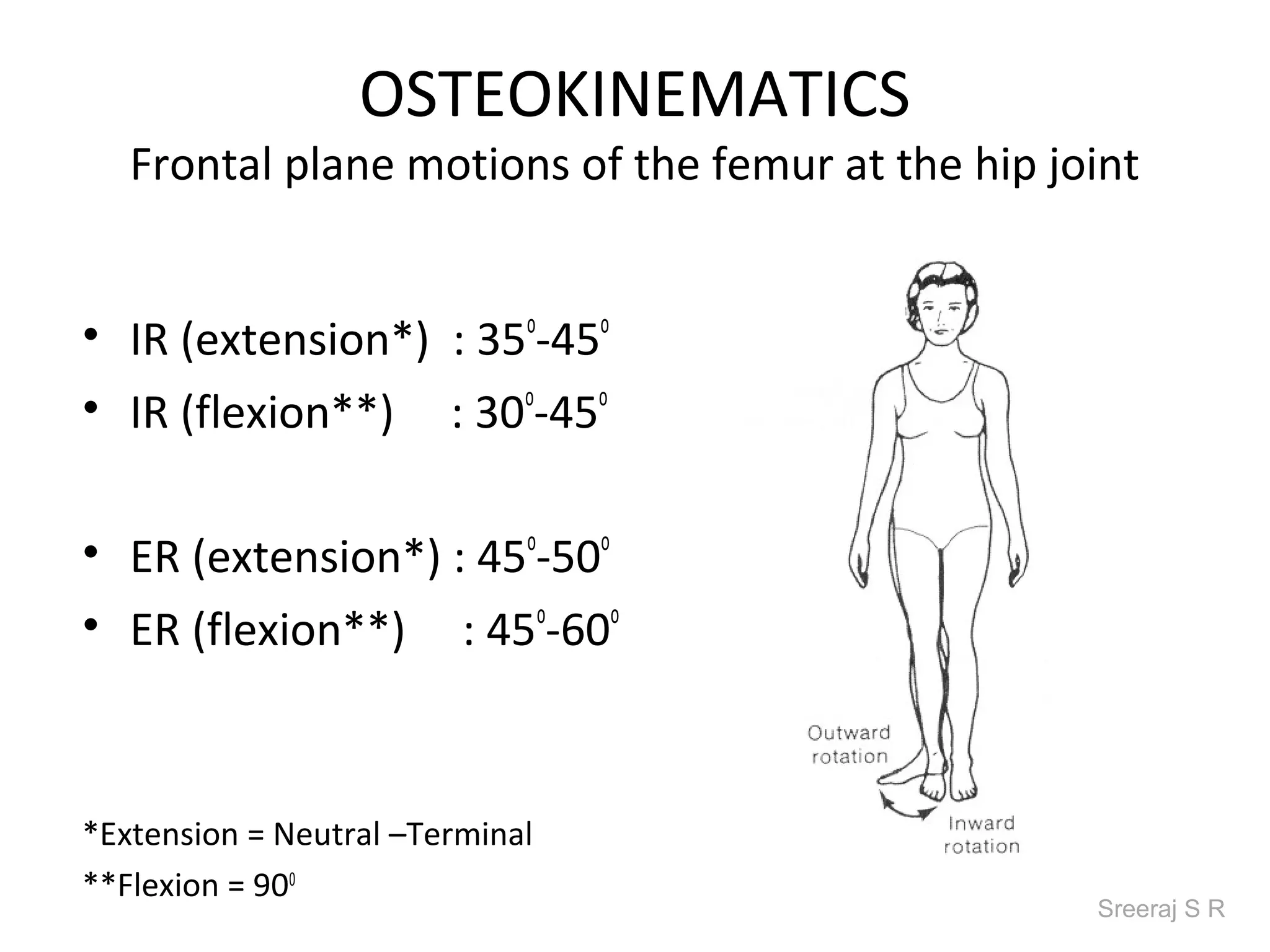
OSTEOKINEMATICS
   Frontal plane motions of the femur at the hip joint


• IR (extension*) : 35o-45o
• IR (flexion**) : 30o-45o

• ER (extension*) : 45o-50o
• ER (flexion**) : 45o-60o


*Extension = Neutral –Terminal
**Flexion = 900
                                                   Sreeraj S R
OSTEOKINEMATICS
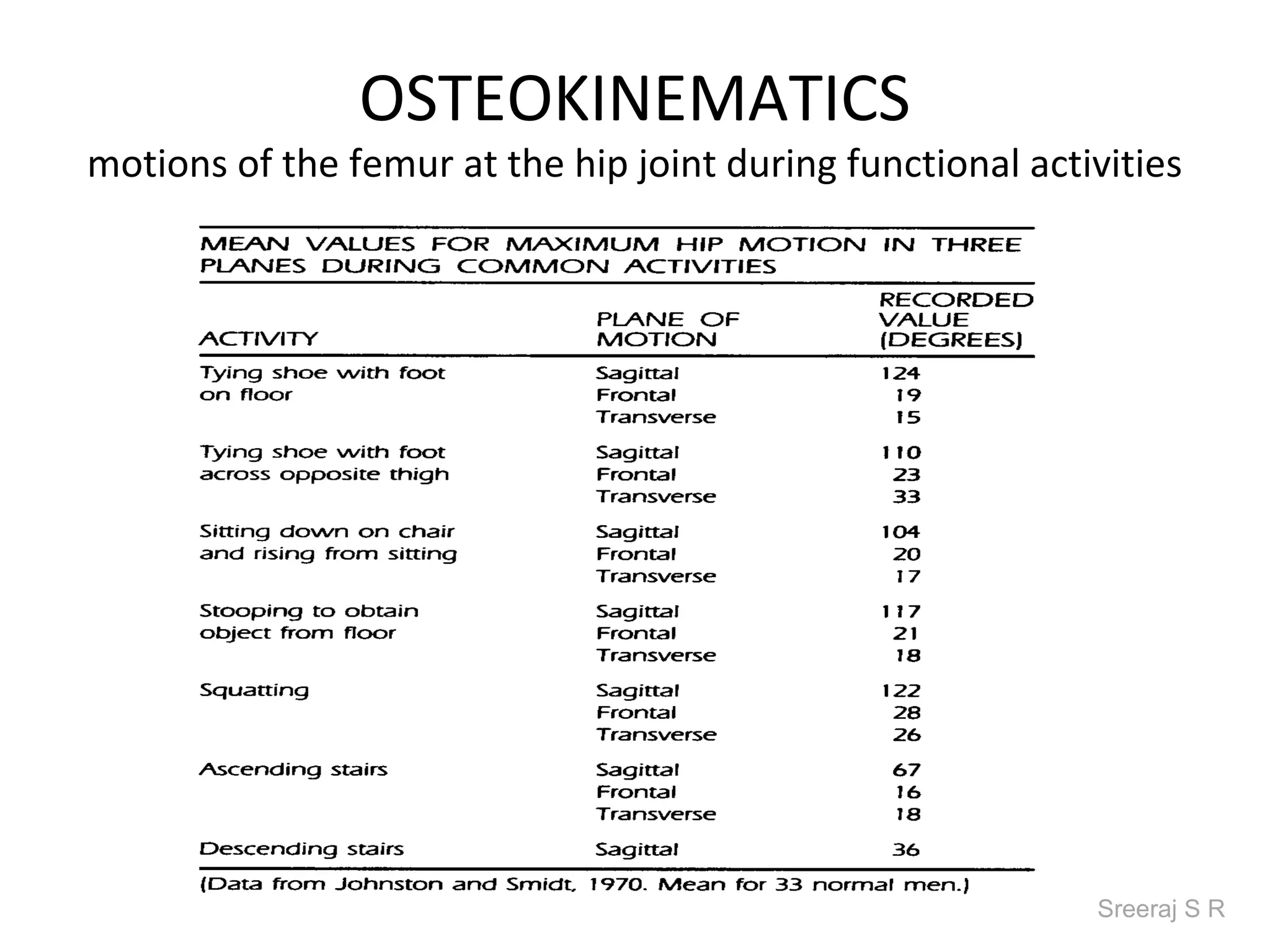
motions of the femur at the hip joint during functional activities


                                                            Sreeraj S R
OSTEOKINEMATICS
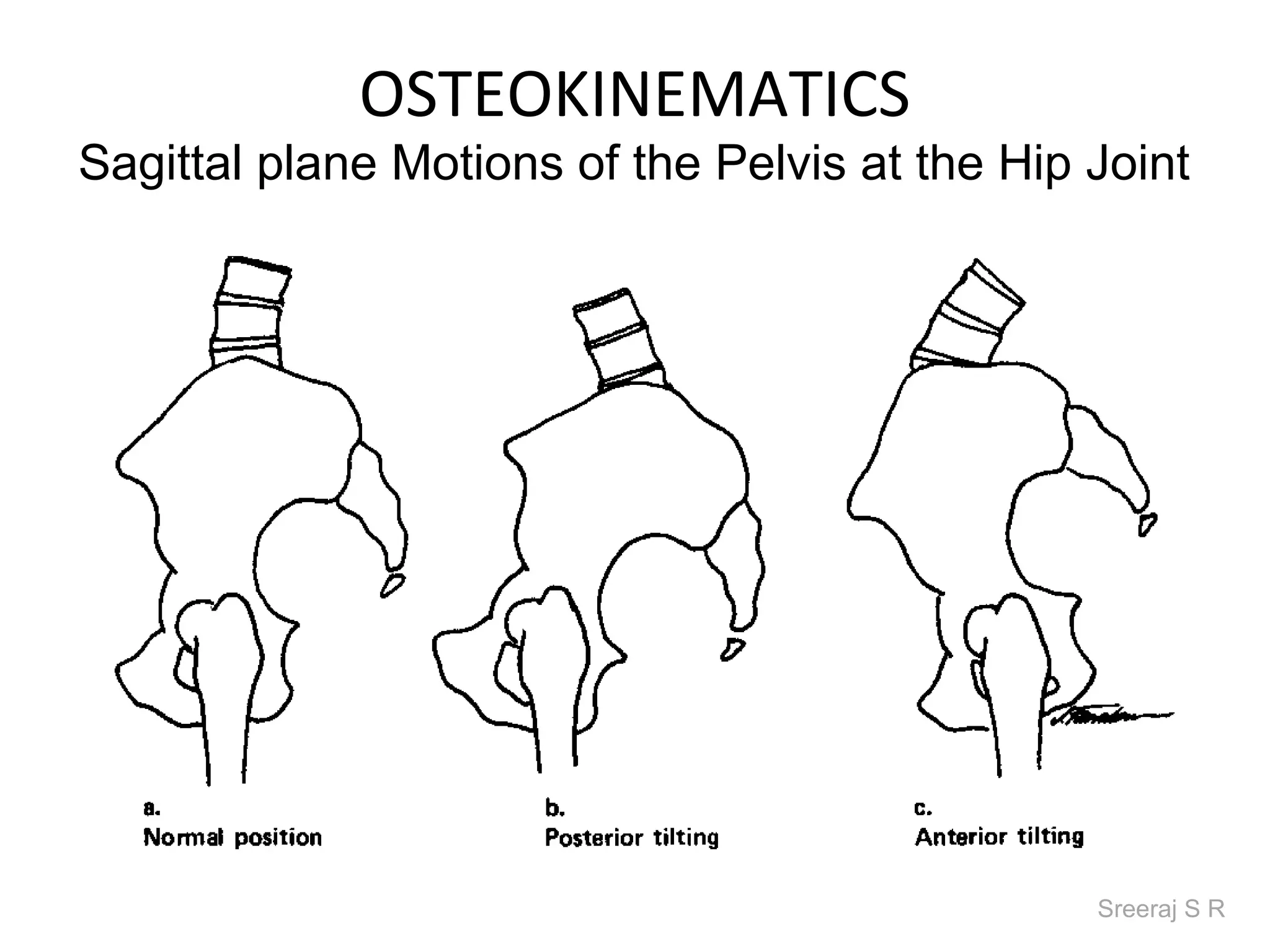
Sagittal plane Motions of the Pelvis at the Hip Joint


                                                Sreeraj S R
OSTEOKINEMATICS
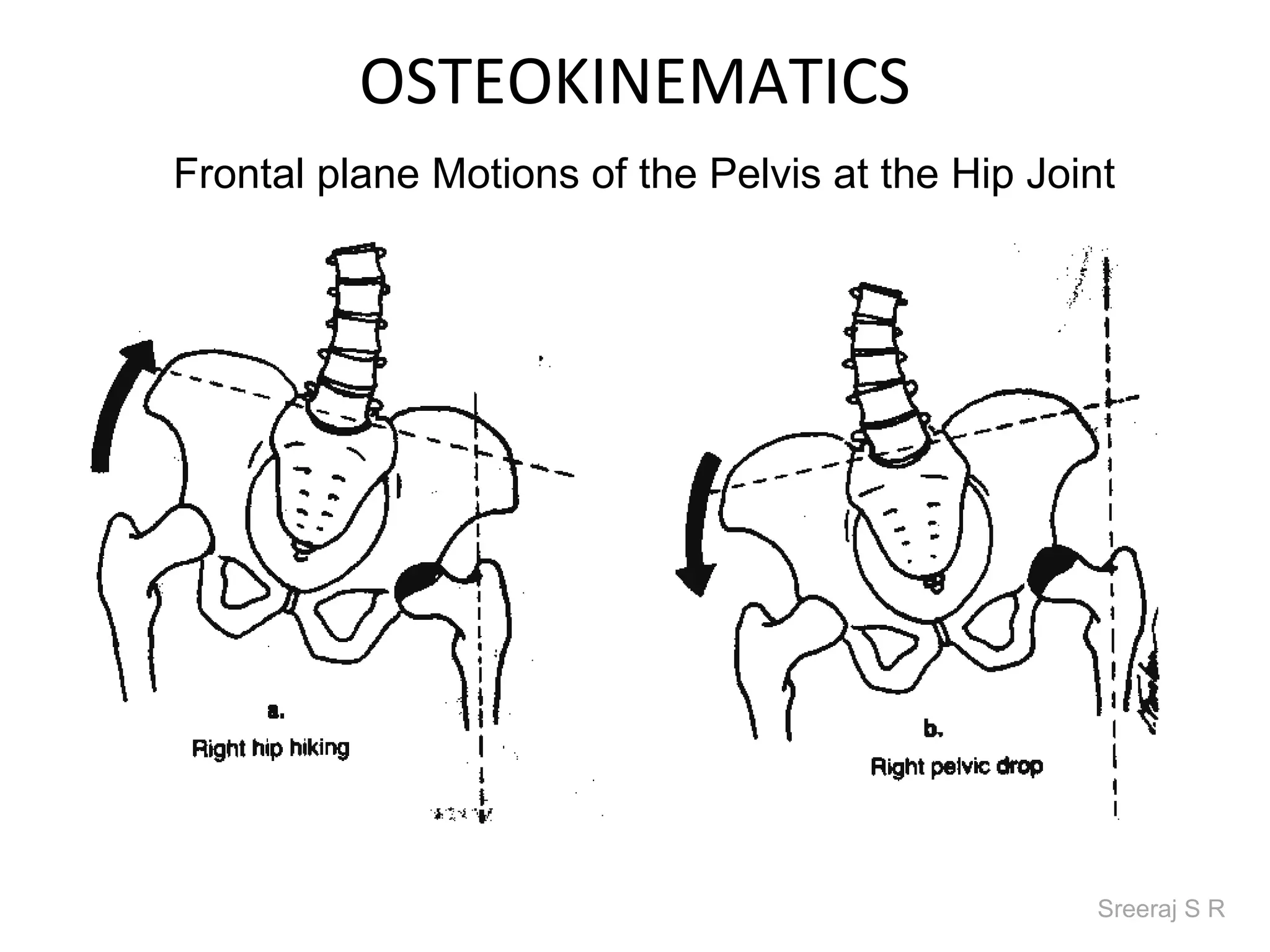
Frontal plane Motions of the Pelvis at the Hip Joint


                                                   Sreeraj S R
OSTEOKINEMATICS
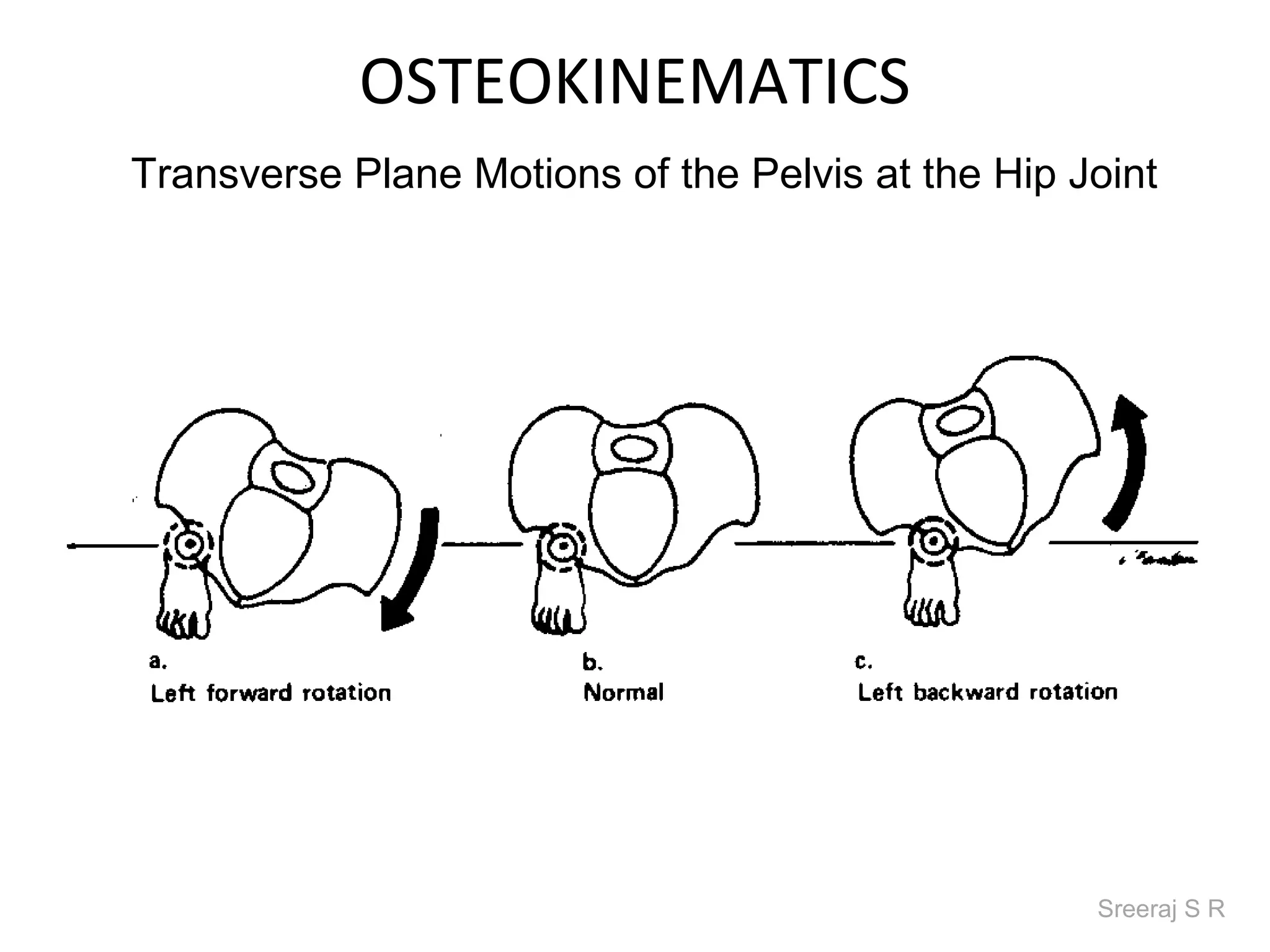
Transverse Plane Motions of the Pelvis at the Hip Joint


                                                   Sreeraj S R
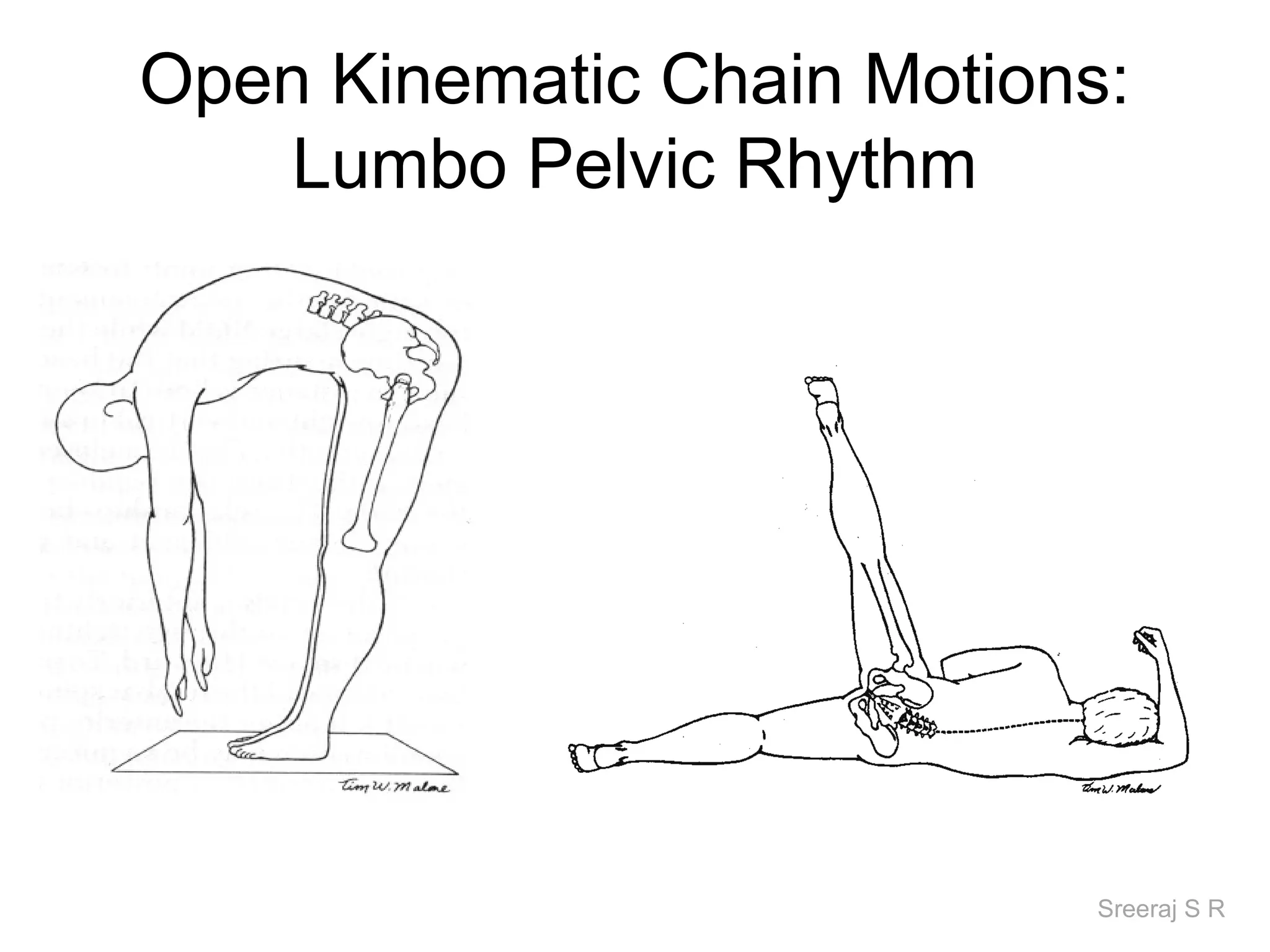
Open Kinematic Chain Motions:
    Lumbo Pelvic Rhythm


                            Sreeraj S R
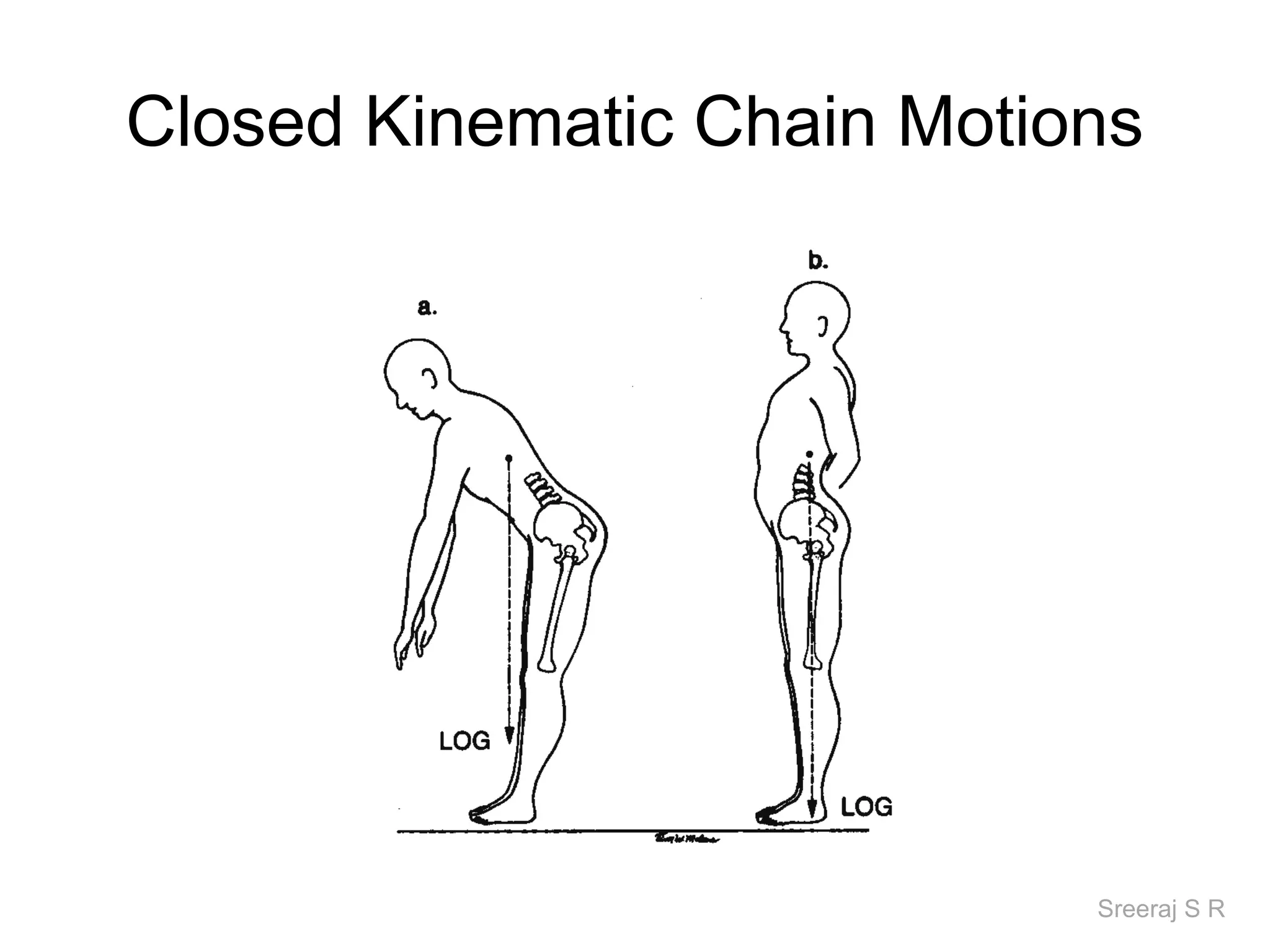
Closed Kinematic Chain Motions


                            Sreeraj S R
MUSCULATURE


              Sreeraj S R
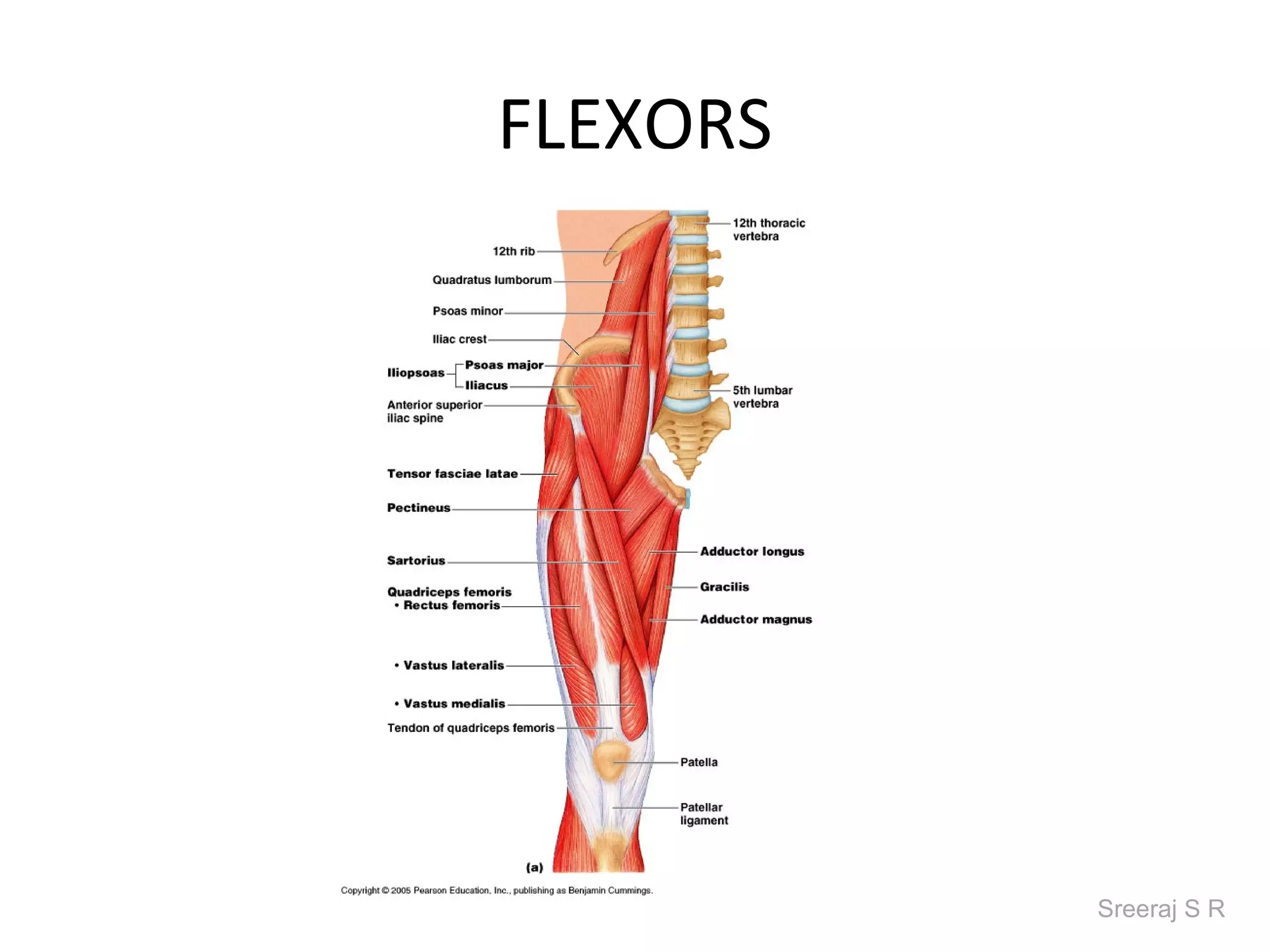
FLEXORS


          Sreeraj S R
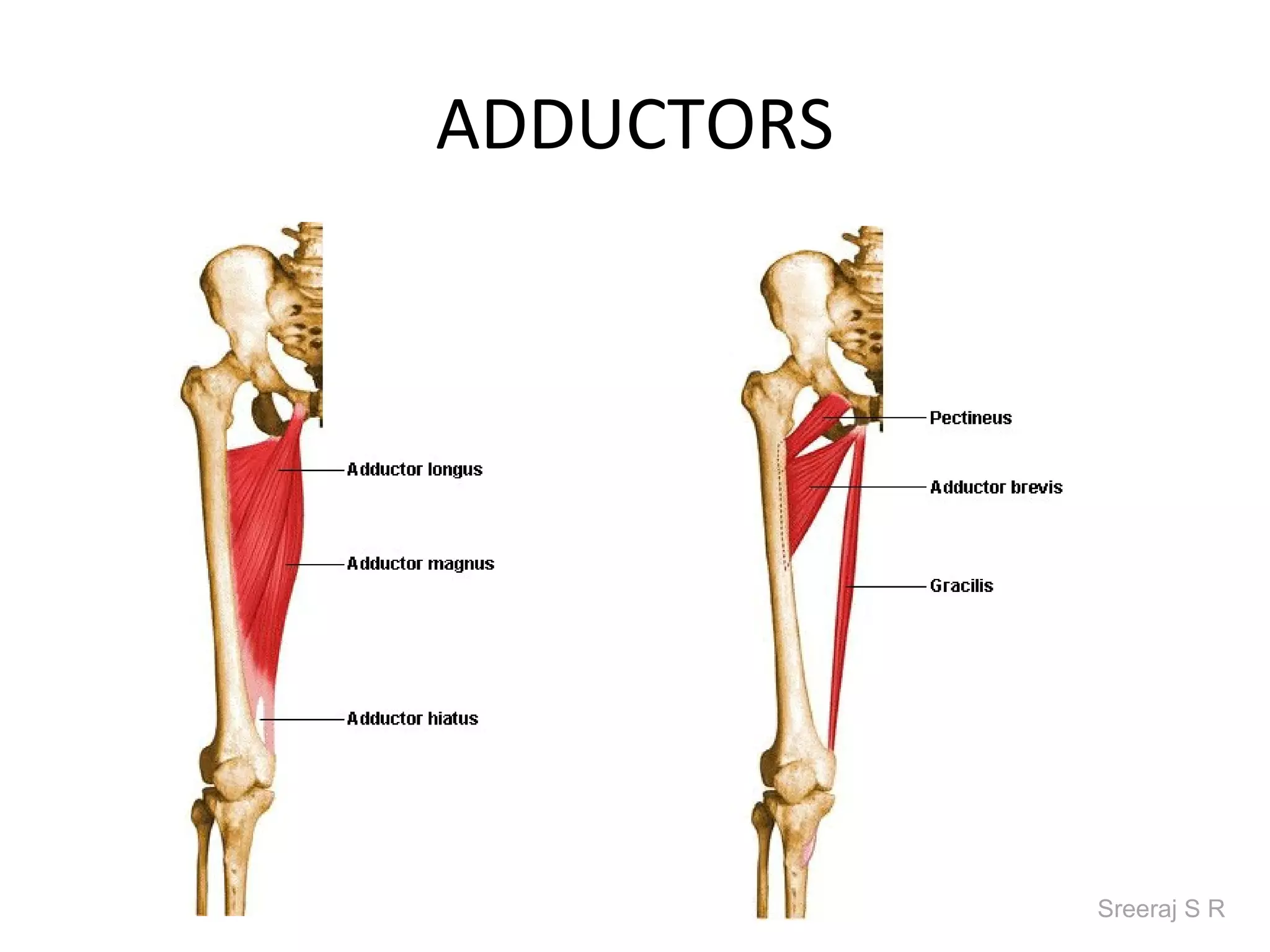
ADDUCTORS


            Sreeraj S R
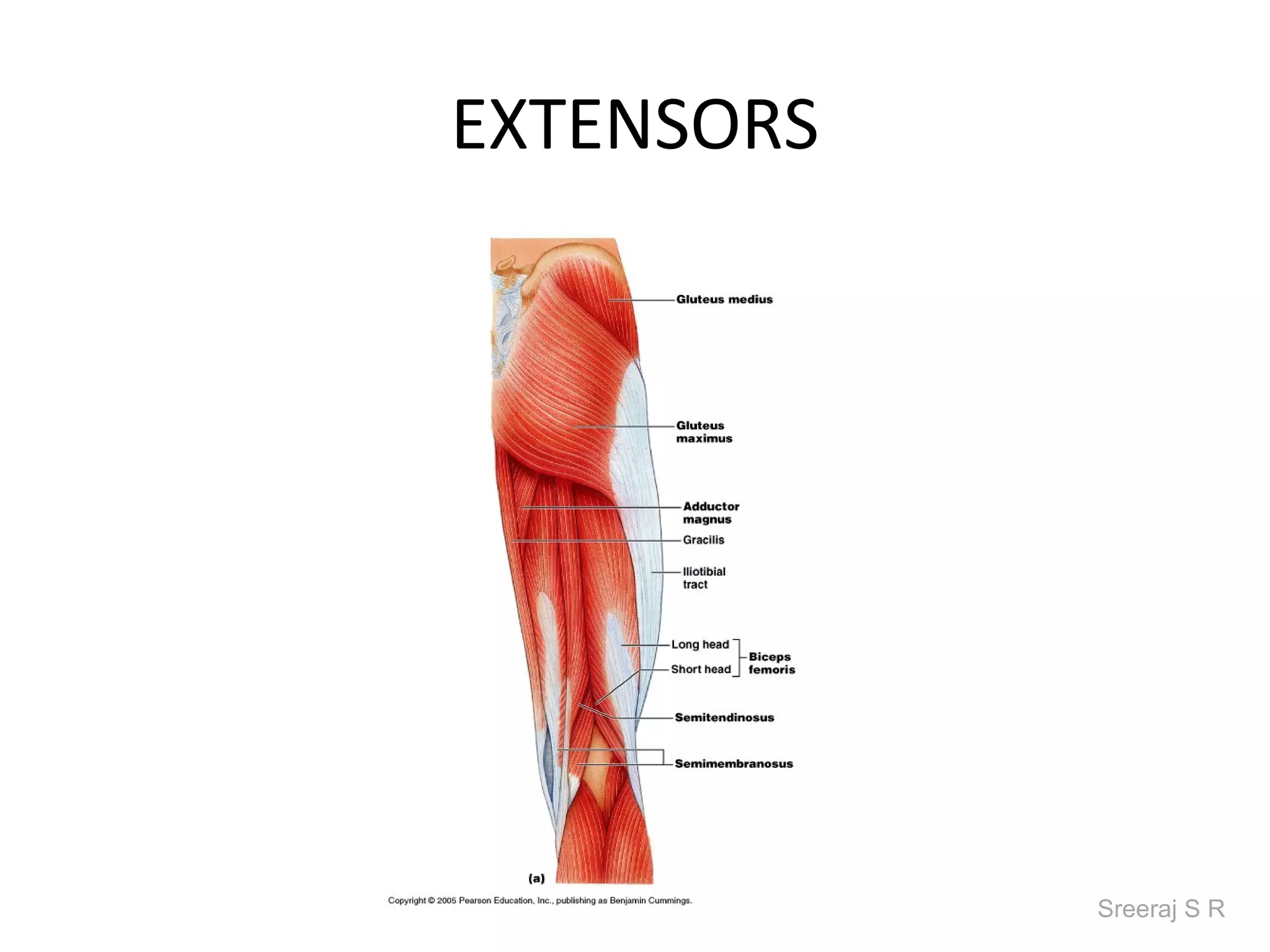
EXTENSORS


            Sreeraj S R
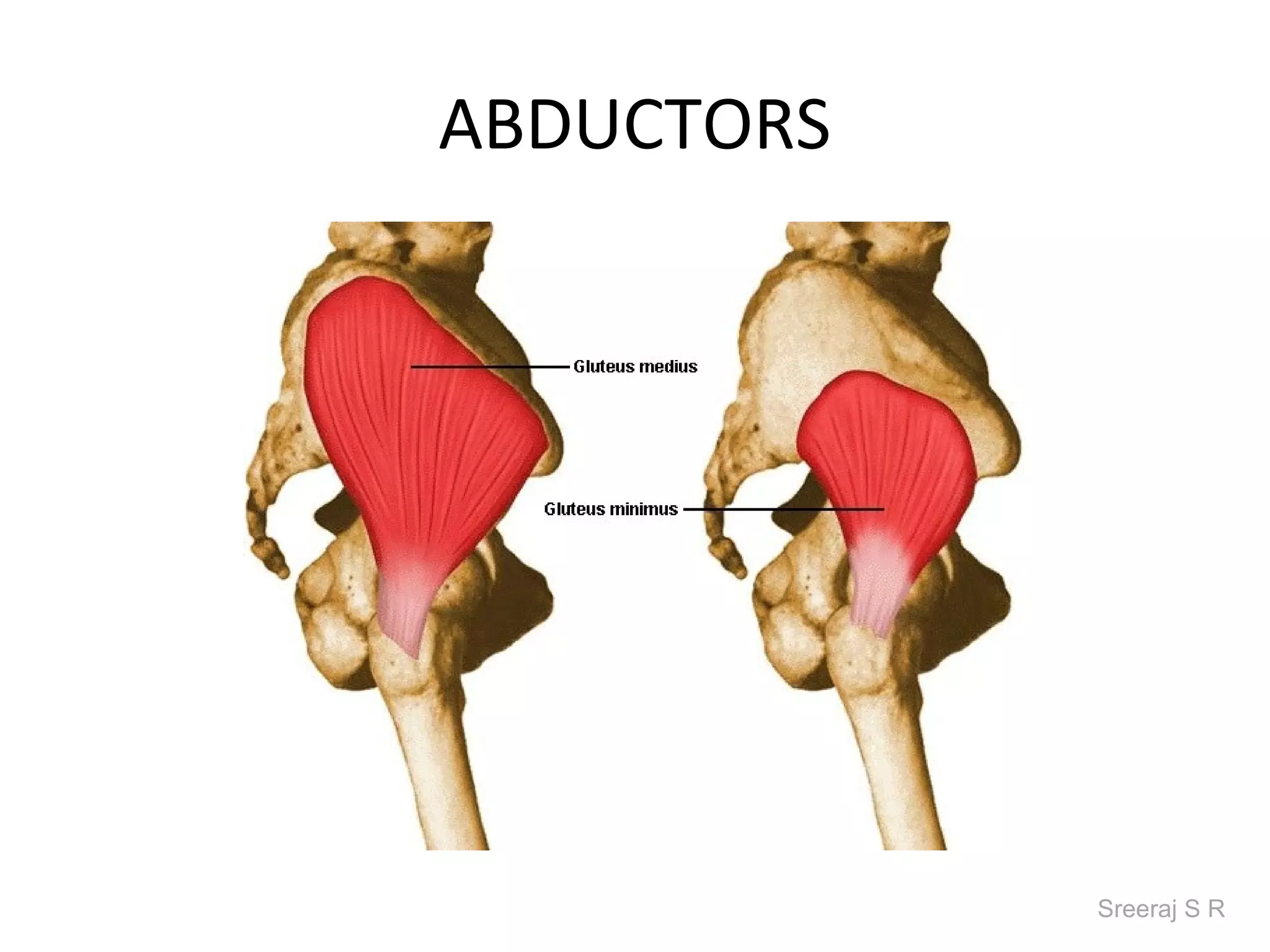
ABDUCTORS


            Sreeraj S R
LATERAL ROTATORS


                   Sreeraj S R
MEDIAL ROTATORS


                  Sreeraj S R
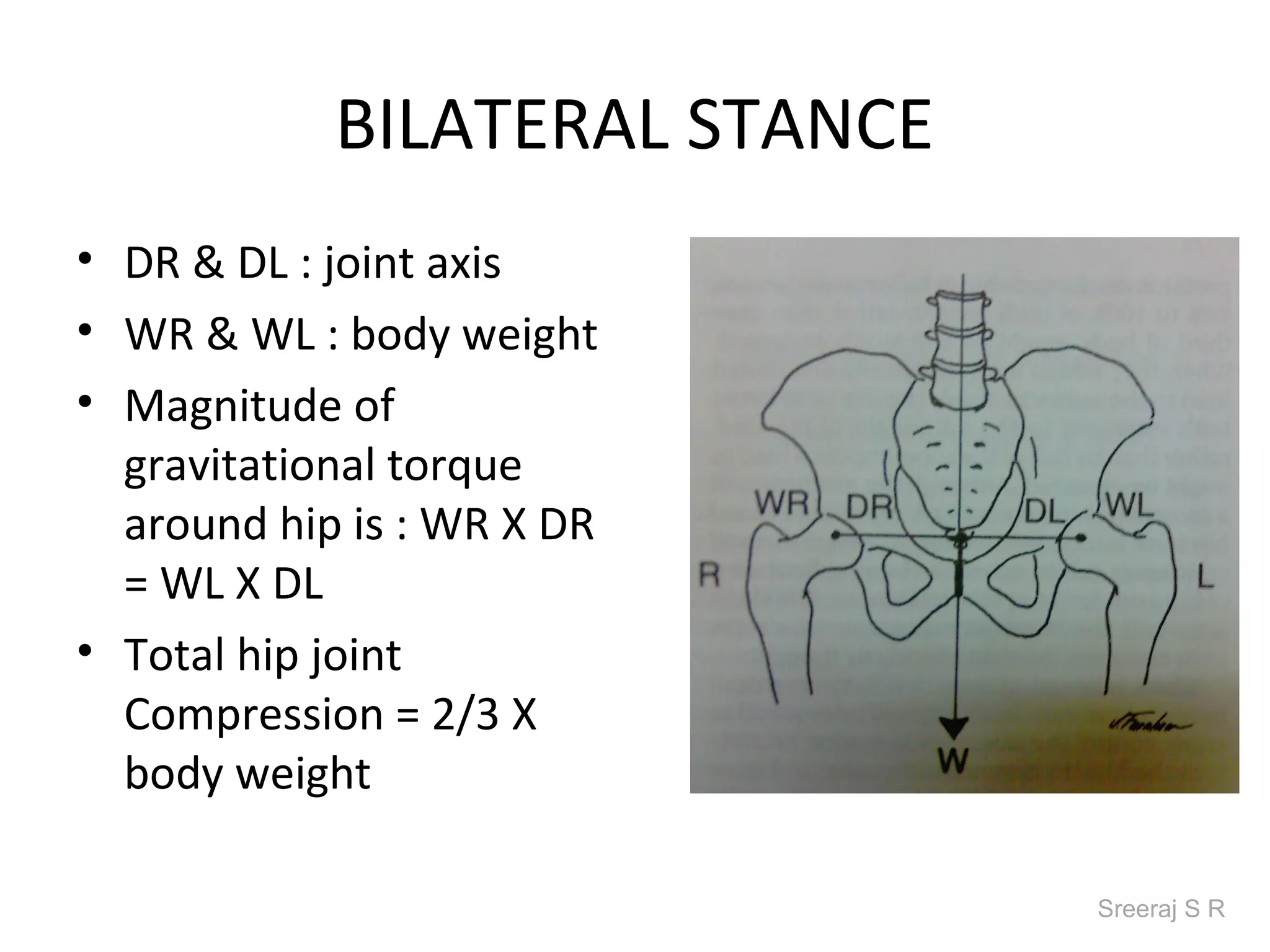
BILATERAL STANCE
• DR & DL : joint axis
• WR & WL : body weight
• Magnitude of
  gravitational torque
  around hip is : WR X DR
  = WL X DL
• Total hip joint
  Compression = 2/3 X
  body weight

                               Sreeraj S R
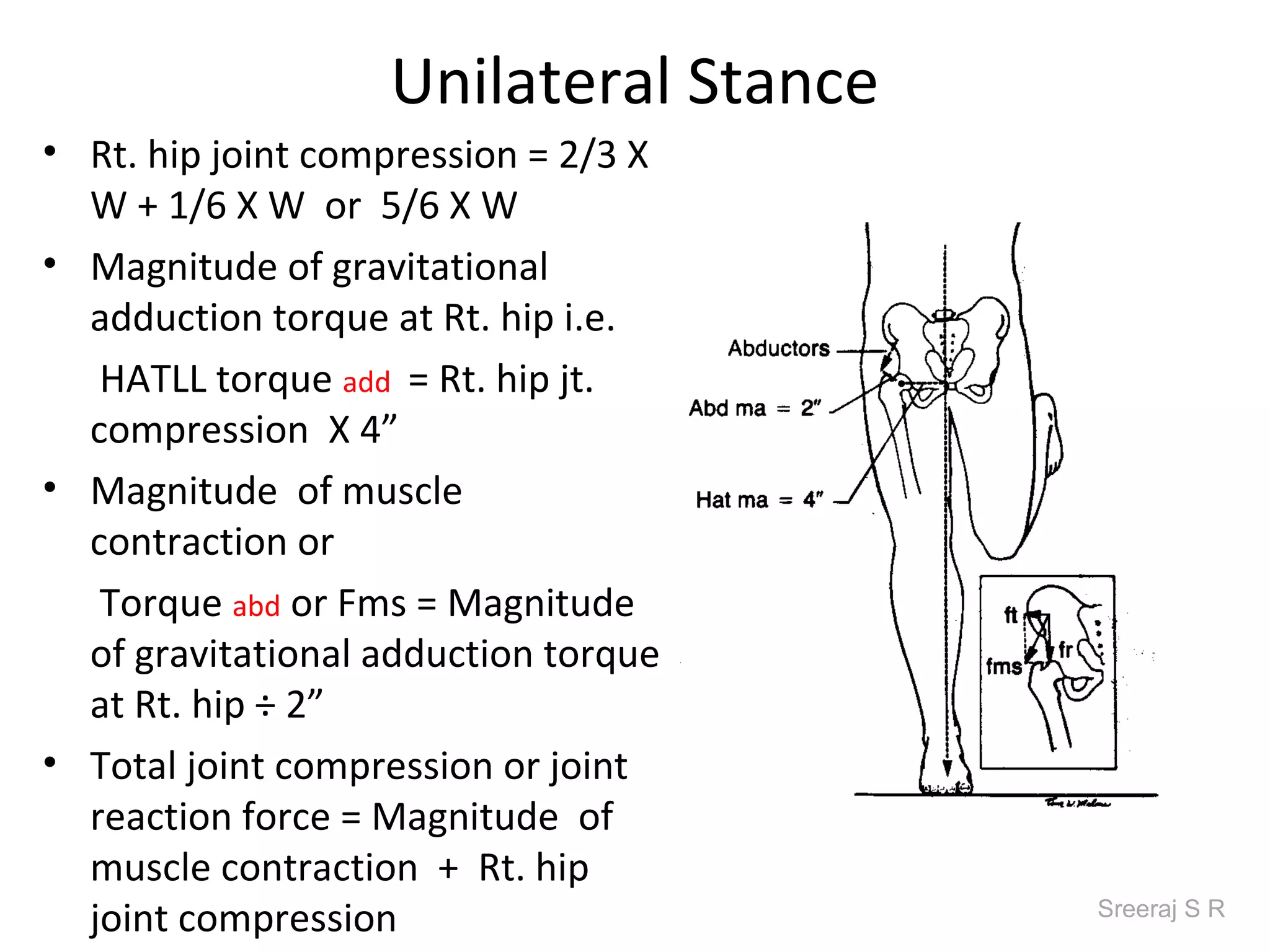
Unilateral Stance
• Rt. hip joint compression = 2/3 X
  W + 1/6 X W or 5/6 X W
• Magnitude of gravitational
  adduction torque at Rt. hip i.e.
   HATLL torque add = Rt. hip jt.
  compression X 4”
• Magnitude of muscle
  contraction or
   Torque abd or Fms = Magnitude
  of gravitational adduction torque
  at Rt. hip ÷ 2”
• Total joint compression or joint
  reaction force = Magnitude of
  muscle contraction + Rt. hip
  joint compression                    Sreeraj S R
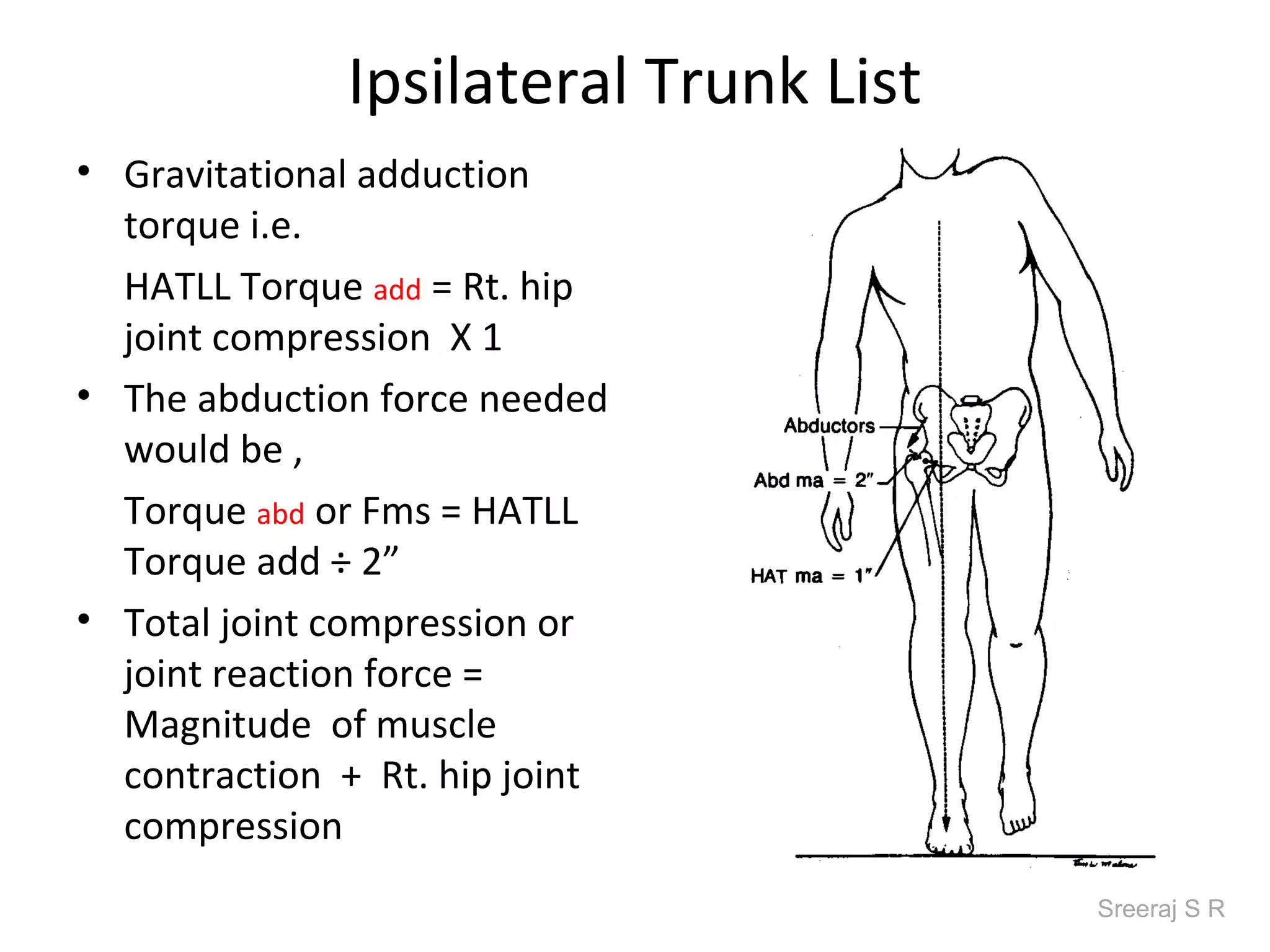
Ipsilateral Trunk List
• Gravitational adduction
  torque i.e.
  HATLL Torque add = Rt. hip
  joint compression X 1
• The abduction force needed
  would be ,
  Torque abd or Fms = HATLL
  Torque add ÷ 2”
• Total joint compression or
  joint reaction force =
  Magnitude of muscle
  contraction + Rt. hip joint
  compression
                                       Sreeraj S R
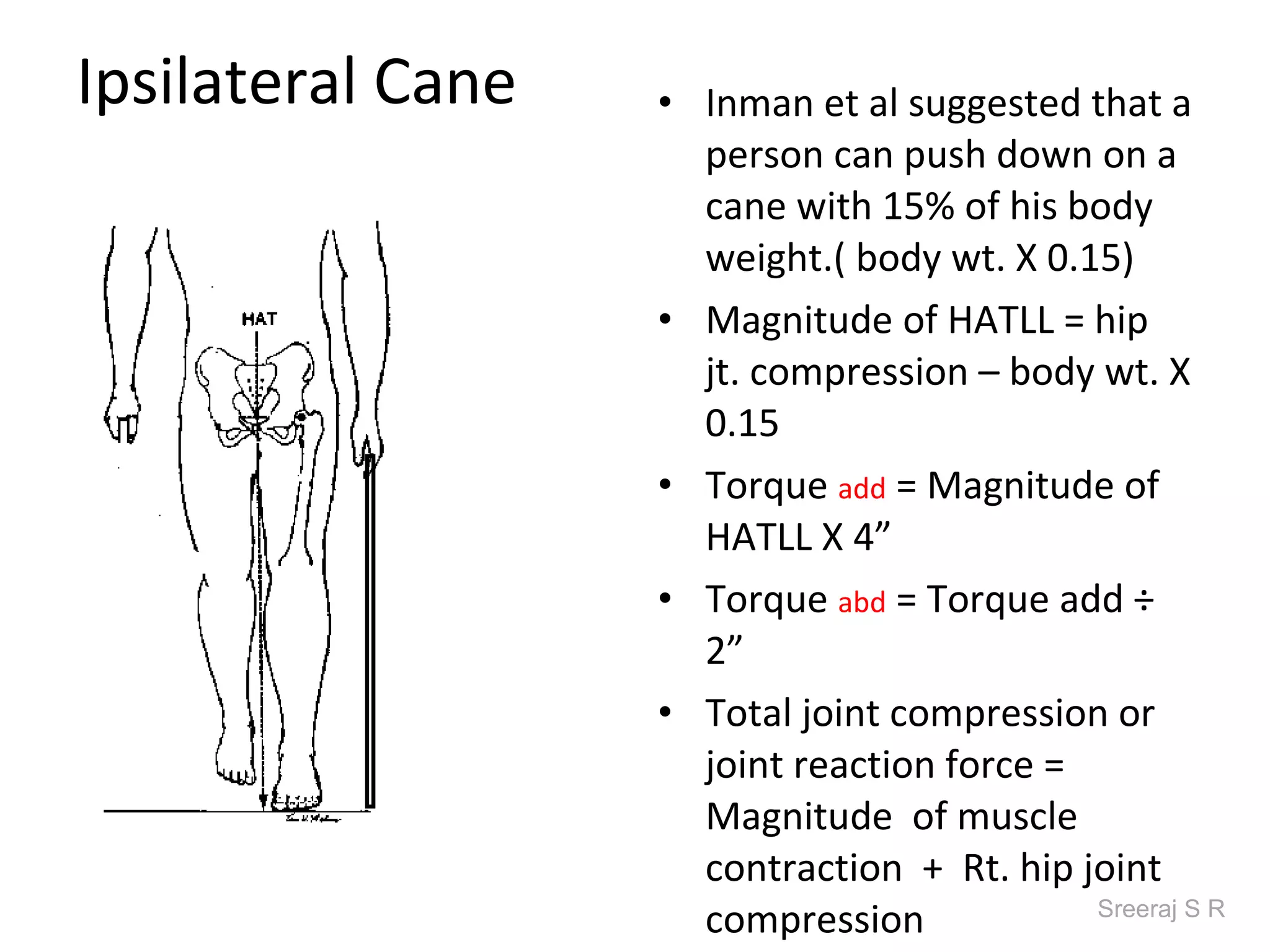
Ipsilateral Cane   • Inman et al suggested that a
                     person can push down on a
                     cane with 15% of his body
                     weight.( body wt. X 0.15)
                   • Magnitude of HATLL = hip
                     jt. compression – body wt. X
                     0.15
                   • Torque add = Magnitude of
                     HATLL X 4”
                   • Torque abd = Torque add ÷
                     2”
                   • Total joint compression or
                     joint reaction force =
                     Magnitude of muscle
                     contraction + Rt. hip joint
                     compression            Sreeraj S R
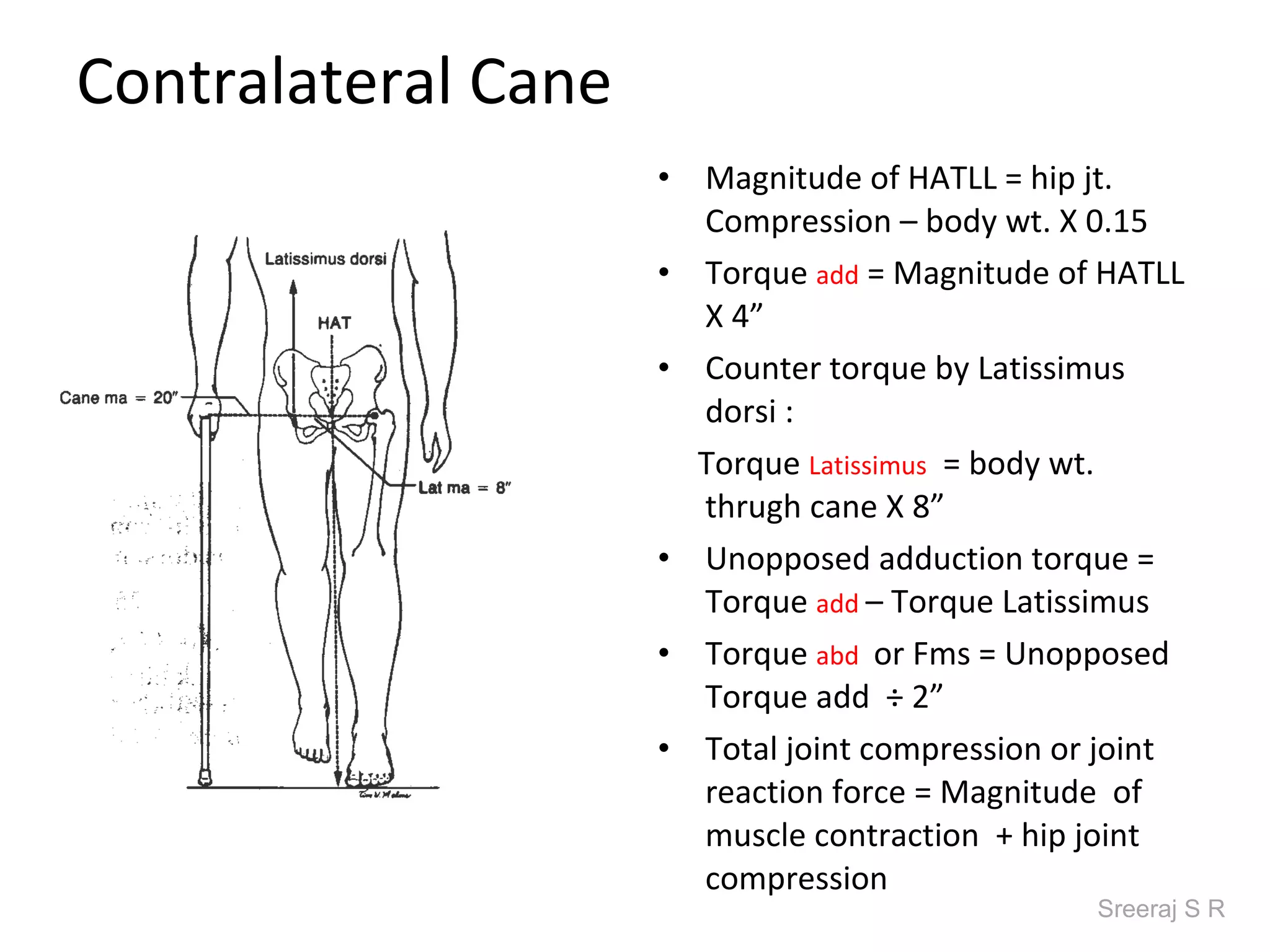
Contralateral Cane
                     •   Magnitude of HATLL = hip jt.
                         Compression – body wt. X 0.15
                     •   Torque add = Magnitude of HATLL
                         X 4”
                     •   Counter torque by Latissimus
                         dorsi :
                         Torque Latissimus = body wt.
                         thrugh cane X 8”
                     •   Unopposed adduction torque =
                         Torque add – Torque Latissimus
                     •   Torque abd or Fms = Unopposed
                         Torque add ÷ 2”
                     •   Total joint compression or joint
                         reaction force = Magnitude of
                         muscle contraction + hip joint
                         compression
                                                   Sreeraj S R

The Hip Biomechanics SRS

  • 1.
    THE HIP COMPLEX BIOMECHANICS Sreeraj S R
  • 2.
    Articulations of theHip and Pelvis Sreeraj S R
  • 3.
    PROXIMAL ARTICULAR SURFACE •Faces laterally • Faces anteriorly – 18.5o males – 21.5o women • Faces inferiorly – 22o - 42o range – 38o in males – 35o in females Sreeraj S R
  • 4.
    Proximal articular surface… •Center Edge angle • Acetabular Anteversion • Acetabular Labrum Sreeraj S R
  • 5.
  • 6.
  • 7.
    ANGLE OF TORSION Sreeraj S R
  • 8.
    Angle of torsion…..abnormal •Anteversion • Retroversion Sreeraj S R
  • 9.
  • 10.
    CAPSULE Sreeraj S R
  • 11.
    LIGAMENTS Sreeraj S R
  • 12.
  • 13.
    ARTHROKINEMATICS Sreeraj S R
  • 14.
    OSTEOKINEMATICS Sagittalplane motions of the femur at the hip joint • Flexion: 90o-135o • Extension: 0o-30o • Role of 2 joint muscles? Sreeraj S R
  • 15.
    OSTEOKINEMATICS Frontalplane motions of the femur at the hip joint • Abduction: 30o-50o • Adduction: 10o-30o • Role of 2 joint muscles? Sreeraj S R
  • 16.
    OSTEOKINEMATICS Frontal plane motions of the femur at the hip joint • IR (extension*) : 35o-45o • IR (flexion**) : 30o-45o • ER (extension*) : 45o-50o • ER (flexion**) : 45o-60o *Extension = Neutral –Terminal **Flexion = 900 Sreeraj S R
  • 17.
    OSTEOKINEMATICS motions of thefemur at the hip joint during functional activities Sreeraj S R
  • 18.
    OSTEOKINEMATICS Sagittal plane Motionsof the Pelvis at the Hip Joint Sreeraj S R
  • 19.
    OSTEOKINEMATICS Frontal plane Motionsof the Pelvis at the Hip Joint Sreeraj S R
  • 20.
    OSTEOKINEMATICS Transverse Plane Motionsof the Pelvis at the Hip Joint Sreeraj S R
  • 21.
    Open Kinematic ChainMotions: Lumbo Pelvic Rhythm Sreeraj S R
  • 22.
    Closed Kinematic ChainMotions Sreeraj S R
  • 23.
    MUSCULATURE Sreeraj S R
  • 24.
    FLEXORS Sreeraj S R
  • 25.
    ADDUCTORS Sreeraj S R
  • 26.
    EXTENSORS Sreeraj S R
  • 27.
    ABDUCTORS Sreeraj S R
  • 28.
    LATERAL ROTATORS Sreeraj S R
  • 29.
    MEDIAL ROTATORS Sreeraj S R
  • 30.
    BILATERAL STANCE • DR& DL : joint axis • WR & WL : body weight • Magnitude of gravitational torque around hip is : WR X DR = WL X DL • Total hip joint Compression = 2/3 X body weight Sreeraj S R
  • 31.
    Unilateral Stance • Rt.hip joint compression = 2/3 X W + 1/6 X W or 5/6 X W • Magnitude of gravitational adduction torque at Rt. hip i.e. HATLL torque add = Rt. hip jt. compression X 4” • Magnitude of muscle contraction or Torque abd or Fms = Magnitude of gravitational adduction torque at Rt. hip ÷ 2” • Total joint compression or joint reaction force = Magnitude of muscle contraction + Rt. hip joint compression Sreeraj S R
  • 32.
    Ipsilateral Trunk List •Gravitational adduction torque i.e. HATLL Torque add = Rt. hip joint compression X 1 • The abduction force needed would be , Torque abd or Fms = HATLL Torque add ÷ 2” • Total joint compression or joint reaction force = Magnitude of muscle contraction + Rt. hip joint compression Sreeraj S R
  • 33.
    Ipsilateral Cane • Inman et al suggested that a person can push down on a cane with 15% of his body weight.( body wt. X 0.15) • Magnitude of HATLL = hip jt. compression – body wt. X 0.15 • Torque add = Magnitude of HATLL X 4” • Torque abd = Torque add ÷ 2” • Total joint compression or joint reaction force = Magnitude of muscle contraction + Rt. hip joint compression Sreeraj S R
  • 34.
    Contralateral Cane • Magnitude of HATLL = hip jt. Compression – body wt. X 0.15 • Torque add = Magnitude of HATLL X 4” • Counter torque by Latissimus dorsi : Torque Latissimus = body wt. thrugh cane X 8” • Unopposed adduction torque = Torque add – Torque Latissimus • Torque abd or Fms = Unopposed Torque add ÷ 2” • Total joint compression or joint reaction force = Magnitude of muscle contraction + hip joint compression Sreeraj S R