Muscle Test of the
Knee Joint
Dr. Ahmed Assem
Lecturer of Physical Therapy
Knee Flexion
• The Hamstring Muscles of the Posterior
Compartment of the Thigh
• There are 3 muscles
• Medial Hamstring Muscles:
1. Semitendinosus.
2. Semimembranosus.
• Lateral Hamstring Muscles:
3. Biceps femoris
Semimembranosus
• Origin: posterior surface ischial
tuberosity
• Insertion: Posterior surface of the
medial tibial condyle
• Action: flexion and medial
rotation the knee
• Nerve Supply: Tibial portion of
sciatic nerve (L5, S1)
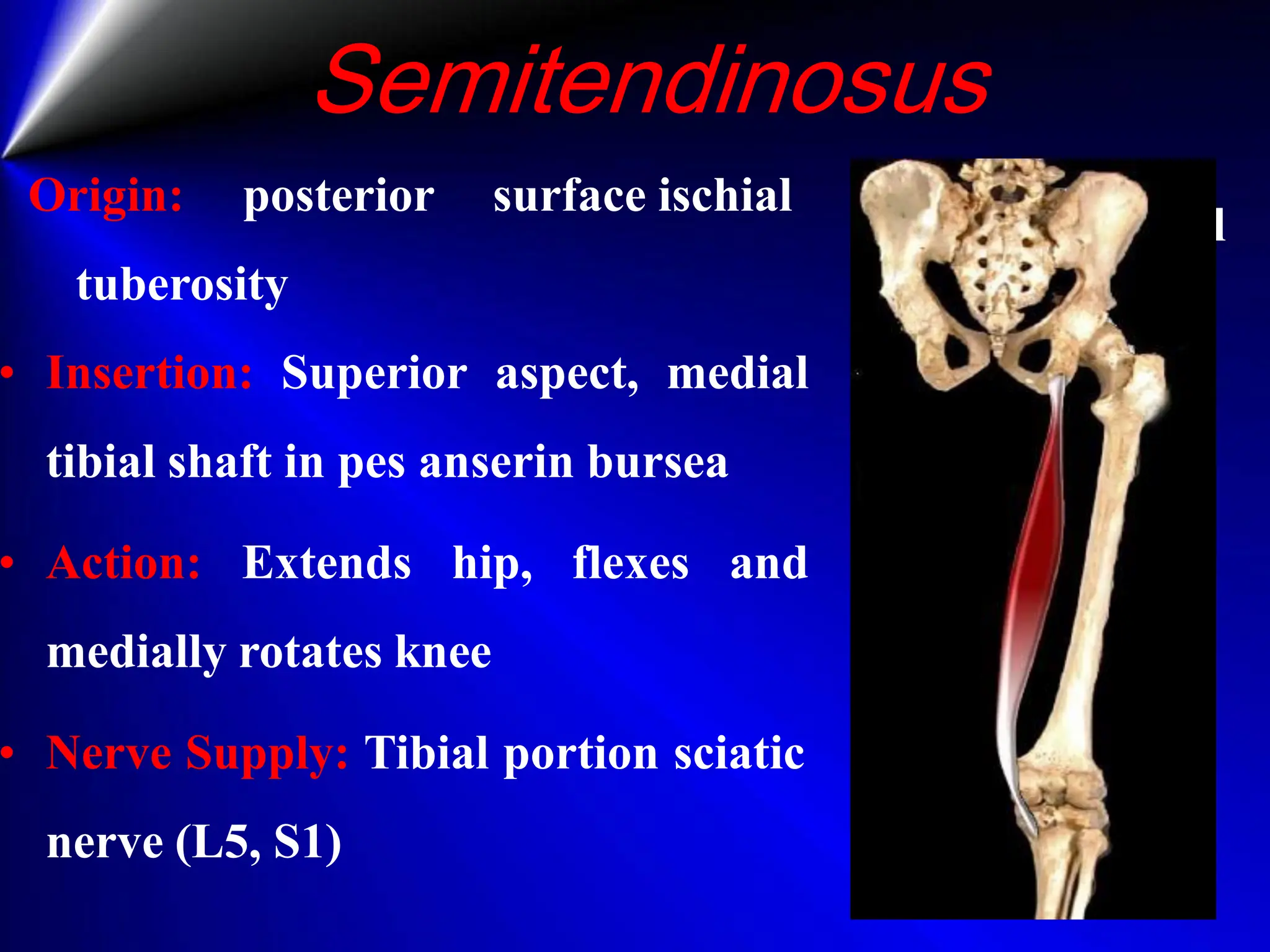
Semitendinosus
ischial
Origin: posterior surface ischial
tuberosity
• Insertion: Superior aspect, medial
tibial shaft in pes anserin bursea
• Action: Extends hip, flexes and
medially rotates knee
• Nerve Supply: Tibial portion sciatic
nerve (L5, S1)
Biceps femoris
• Origin: Long Head: the posterior
surface of the ischial tuberosity
• Short Head: linea aspera, lateral supracondylar ridge
of femur
• Insertion: Fibular head and lateral tibial condyle
• Action:Flexes the knee, rotates tibia laterally,
extends the hip joint
• Nerve supply Long head: tibial component of sciatic
nerve,
• Short head: common peroneal component of sciatic
Accessory Muscles:
1. Popliteal muscle.
2. Sartorius muscle.
3. Gracilis muscle.
4. Gastrocnemius muscle.
Factors Limiting Motion:
• The range of motion of the knee flexion is of 120o to
130
• Tension of the knee extensor muscles particularly
Rectus femoris if hip is extends.
• Contact of calf with posterior thigh.
Fixation: Weight of thigh and pelvis
NORMAL AND GOOD
• Patient Position: Prone with limbs straight and
toes hanging over the edge of the table. Test may be
started in about 45° of knee flexion.
• Therapist Position and Grasps: Standingbeside the
table on the side of the affected leg,
• The proximal hand stabilize pelvis and the distal
hand grasping above ankle to give resistance.
• Instructions to Patient: "Bend your knee. Hold it!
Don't let me straighten it."
To test biceps femoris
• Position of Patient: Prone with knee flexed
to less than 90°. Leg is in external rotation
(toes pointing laterally).
• Position of Therapist: Therapist resists
knee flexion at the ankle using a downward
and inward force
• Test: Patient flexes knee, maintaining leg
in external rotation (heel away from
examiner, toes pointing toward examiner)
NORMAL AND GOOD
• Grade 5 (Normal) : Resistance will be maximal,
and the end knee flexion position (approximately
90°) cannot be broken.
• Grade 4 (Good) : End knee flexion position is
held against strong to moderate resistance.
• Grade 3 (Fair) : Holds end range position but
tolerates no resistance
NORMAL AND GOOD
NORMAL AND GOOD
• To test semitendinosus and semimembranosus
Position of Patient: Prone with knee flexed to less
than 90°. Leg in internal rotation (toes pointing toward
midline).
• Position of Therapist: Hand giving resistance
grasps the leg at the ankle. Resistance is applied
in an oblique direction (down and out) toward knee
extension
• Test: Patient flexes knee, maintaining the leg in
internal rotation (heel toward examiner, toes pointing
• toward midline).
NORMAL AND GOOD
• To test semitendinosus and semimembranosus
only, the lower leg is rotated medially to put the
muscle in a good alignment.
• Resistance:
• Grade 4: Moderate leading resistance is given in a form
of pressing down directly opposing line of raising.
• Grade 5: Maximum resistance is applied throughout the
range of motion plus a "hold" position is kept at the end
of the range.
• Command:
•“Raise your lower leg up through full range of
motion, Relax”.
FAIR
Patient Position: Prone lying with
leg straight.
Therapist Position and Grasps:
Standing beside the table on
the side of the affected leg,
proximal hand above the thigh
proximal to knee to stabilize
thigh medially and laterally
without pressure over the
muscle group being tested.
Command: “Raise your lower leg
through full range of motion,
Relax”.
POOR
• Patient Position: Side lying with both
legs straight; the upper leg is
supported and the affected leg is
down.
• Therapist Position and Grasps:
Standing beside the table
• The distal hand supportingthe
upper leg.
• The proximal hand is placed above
the knee to stabilize the thigh.
TRACE AND ZERO
• Patient Position: Prone
lying, with the affected leg
slightly flexed knee and the
lower leg supported.
• The distal hand supports
the lower affected leg
• While the proximal hand
Palpates tendon of knee flexor
muscles on back of the thigh,
near the knee joint.
• Command: “Try to raise your
lower leg up, Relax”.
Notes:
a) Flexion of knee joint is actively produced up to
90° only against gravity but after that will be with
gravity assistance and produce smoothly by
eccentric contraction of quadriceps muscle.
b) In tests for Grades 3 and 2, the knee may be
placed in a 10° flexed position to start the test when
gastrocnemius weakness is present (the
gastrocnemius assists in knee flexion).
c) If biceps femoris is stronger, lower leg will
laterally rotate during flexion.
d) If semitendinosus and semimembranosus are stronger,
lower leg will medially rotate during flexion.
Substitutions
• Hip flexion substitution: The prone patient
may flex the hip to start knee flexion. The
buttock on the test side will rise as the hip
flexes, and the patient may appear to roll
slightly toward supine
• Sartorius substitution: The sartorius may
try to assist with knee flexion, but this also
causes flexion and external rotation of the
hip. Knee flexion when the hip is externally
rotated is less difficult because the leg is
not raised vertically against gravity.
• Gracilis substitution: Action of the gracilis
contributes a hip adduction motion.
• Gastrocnemius substitution: Do not permit
the patient to strongly dorsiflex in an
attempt to use the tenodesis effect of the
gastrocnemius.
Effects of Weakness
• Weakness of both medial and lateral
hamstrings causes hyperextension of the
knee.
• When this weakness is bilateral, anterior
pelvic tilt and the lumbar lordotic position
• Weakness of lateral hamstrings causes
tendency toward loss of lateral stability of
the knee.
• Weakness of medial hamstrings decreases
the medial stability of the knee
Effects of Shortness
• Shortness of the hamstrings muscles will cause a
restriction of knee extension and restriction of
the hip flexion
Effects of Contracture
• Contracture of both medial and lateral hamstrings
results in a position of knee flexion. If the
contraction is extreme, it will be accompanied by
posterior tilting of the pelvis and flattening of the
lumbar curve.
Knee extension
• RECTUS FEMORIS
• VASTUS INTERMEDIALIS
• VASTUS LATERALIS
RECTUS FEMORIS
• ORIGIN
Straight head: AIIS.
• Reflected head: ilium above acetabulum
• INSERTION
Quadriceps tendon to patella , via
ligamentum patellae into tubercle of tibia
• ACTION: Extends leg at knee. Flexes thigh at
hip
• NERVE: femoral nerve (L2,3, 4)
VASTUS INTERMEDIALIS
• ORIGIN: Anterior and lateral shaft of
proximal 2/3 of body of femur
• INSERTION: Quadriceps tendon to
patella, via ligamentum patellae into
tubercle of tibia
• ACTION: Extends knee
• NERVE: femoral nerve (L2,3, 4)
VASTUS LATERALIS
• ORIGIN: Upper intertrochanteric line, base of
greater trochanter, linea aspera, lateral
supracondylar ridge and lateral intermuscular
septum
• INSERTION
Lateral quadriceps tendon to patella, via
ligamentum patellae into tubercle of tibia
• ACTION: Extends knee
• NERVE: femoral nerve (L2,3,4)
VASTUS MEDIALIS
• ORIGIN
Lower intertrochanteric line, spiral line,
medial linea aspera and medial
intermuscular septum
• INSERTION
Medial quadriceps tendon to patella and
directly into medial patella, via ligamentum
patellae into tubercle of tibia
• ACTION: Extends knee. Stabilizes patella
• NERVE: femoral nerve (L2,3,4)
Knee extension
Range of Motion: I2O°-13O° TO 0°'
Factors Limiting Motion:
cruciate
• Tension of oblique popliteal, and
collateral ligaments of knee joint
• Tension of knee flexor muscles
Fixation:
• Weight of thigh and pelvis
NORMAL AND GOOD
- Patient Position: Sitting with legs over the
edge of the table. The affected leg is away
from the therapist, small cushion under the
knee. The patient’s hands grasp the edges of
table to stabilize pelvis.
The patient should be allowed to lean backward
to relieve hamstring muscle tension.
Do not allow the patient to hyperextend the
knee because this may lock it into position.
Therapist Position and Grasps: Standing at side
of limb to be tested
The proximal hand is placed over
the rectus femoris origin without
applying pressure.
The distal hand is placed on the
anterior part of the leg just above the
ankle joint to give resistance
• Resistance:
• Grade 4: Moderate leading resistance is given in a
form of pressing down directly opposing line of
raising.
• Grade 5: Maximum resistance is applied throughout
the range of motion plus a "hold" position is kept at
the end of the range.
•Command: “Raise your lower leg up through
full range of motion without medial or lateral
rotation of the hip, Relax”.
FAIR
• - Patient Position: Sitting with legs over
the edge of the table. The affected leg is
away from the therapist, small cushion
under the knee. The patient’s hands
grasp the edges of table to stabilize
pelvis
• * Therapist Position and Grasps:
Standing at side of limb to be tested.
• proximal hand is placed over the rectus
femoris origin without applying
pressure.
POOR
• Patient Position: Side lying,
affected leg down and flexed, the
upper leg is supported.
• Therapist Position and Grasps:
The therapist stands behind the
patient, the distal hand support
the upper leg, while the proximal
hand is placed above the knee
joint to stabilize the thigh. Avoid
pressure over quadriceps femoris.
POOR
Position of Patient: Side-lying with test limb
uppermost. Lowermost limb may be flexed for
stability. Limb to be tested is held in about 90° of
knee flexion. The hip should be in full extension.
Position of Therapist: Standing behind patient at
knee level. One arm cradles the test limb around
the thigh with the hand supporting the underside
Of the knee .The other hand holds the leg
just above the malleolus.
Test: Patient extends knee through the available
range of motion. The therapist supporting the limb
provides neither assistance nor resistance to the
patient's voluntary movement. This is part of the
art of muscle testing that must be acquired.
Be alert to activity by the internal rotators (see
Substitution, below).
Instructions to Patient: "Straighten your knee."
TRACE AND ZERO
• Supine: With knee flexed and supported
• Patient attempts to extend knee.
• Contraction of Quadriceps femoris is
determined by palpation of tendon
between patella and tuberosity of tibia
and fibers of muscle.
• Instructions to Patient: "Push the back of
your knee down into the table." OR
"Tighten your kneecap"
• (quadriceps setting).
Effects of Knee Extensor
Muscles Weakness
• Difficult in up and down stairs and getting up
and down from sitting chair.
• Leaning of trunk forward and extending the
knee joint by his hand
Effects of contracture
• Shortness or contracture of the knee
extensor muscles will produce restriction
of the knee flexion.
Substitution
When the patient is side-lying (as in the Grade 2 test), he or she
may use the hip internal rotators to substitute for the quadriceps,
thereby allowing the knee to fall into extension.
than

MMT of Knee.pdf

  • 1.
    Muscle Test ofthe Knee Joint Dr. Ahmed Assem Lecturer of Physical Therapy
  • 2.
    Knee Flexion • TheHamstring Muscles of the Posterior Compartment of the Thigh • There are 3 muscles • Medial Hamstring Muscles: 1. Semitendinosus. 2. Semimembranosus. • Lateral Hamstring Muscles: 3. Biceps femoris
  • 3.
    Semimembranosus • Origin: posteriorsurface ischial tuberosity • Insertion: Posterior surface of the medial tibial condyle • Action: flexion and medial rotation the knee • Nerve Supply: Tibial portion of sciatic nerve (L5, S1)
  • 4.
    Semitendinosus ischial Origin: posterior surfaceischial tuberosity • Insertion: Superior aspect, medial tibial shaft in pes anserin bursea • Action: Extends hip, flexes and medially rotates knee • Nerve Supply: Tibial portion sciatic nerve (L5, S1)
  • 5.
    Biceps femoris • Origin:Long Head: the posterior surface of the ischial tuberosity • Short Head: linea aspera, lateral supracondylar ridge of femur • Insertion: Fibular head and lateral tibial condyle • Action:Flexes the knee, rotates tibia laterally, extends the hip joint • Nerve supply Long head: tibial component of sciatic nerve, • Short head: common peroneal component of sciatic
  • 6.
    Accessory Muscles: 1. Poplitealmuscle. 2. Sartorius muscle. 3. Gracilis muscle. 4. Gastrocnemius muscle.
  • 7.
    Factors Limiting Motion: •The range of motion of the knee flexion is of 120o to 130 • Tension of the knee extensor muscles particularly Rectus femoris if hip is extends. • Contact of calf with posterior thigh. Fixation: Weight of thigh and pelvis
  • 8.
    NORMAL AND GOOD •Patient Position: Prone with limbs straight and toes hanging over the edge of the table. Test may be started in about 45° of knee flexion. • Therapist Position and Grasps: Standingbeside the table on the side of the affected leg, • The proximal hand stabilize pelvis and the distal hand grasping above ankle to give resistance. • Instructions to Patient: "Bend your knee. Hold it! Don't let me straighten it."
  • 9.
    To test bicepsfemoris • Position of Patient: Prone with knee flexed to less than 90°. Leg is in external rotation (toes pointing laterally). • Position of Therapist: Therapist resists knee flexion at the ankle using a downward and inward force • Test: Patient flexes knee, maintaining leg in external rotation (heel away from examiner, toes pointing toward examiner) NORMAL AND GOOD
  • 10.
    • Grade 5(Normal) : Resistance will be maximal, and the end knee flexion position (approximately 90°) cannot be broken. • Grade 4 (Good) : End knee flexion position is held against strong to moderate resistance. • Grade 3 (Fair) : Holds end range position but tolerates no resistance NORMAL AND GOOD
  • 11.
    NORMAL AND GOOD •To test semitendinosus and semimembranosus Position of Patient: Prone with knee flexed to less than 90°. Leg in internal rotation (toes pointing toward midline). • Position of Therapist: Hand giving resistance grasps the leg at the ankle. Resistance is applied in an oblique direction (down and out) toward knee extension • Test: Patient flexes knee, maintaining the leg in internal rotation (heel toward examiner, toes pointing • toward midline).
  • 12.
    NORMAL AND GOOD •To test semitendinosus and semimembranosus only, the lower leg is rotated medially to put the muscle in a good alignment.
  • 13.
    • Resistance: • Grade4: Moderate leading resistance is given in a form of pressing down directly opposing line of raising. • Grade 5: Maximum resistance is applied throughout the range of motion plus a "hold" position is kept at the end of the range. • Command: •“Raise your lower leg up through full range of motion, Relax”.
  • 14.
    FAIR Patient Position: Pronelying with leg straight. Therapist Position and Grasps: Standing beside the table on the side of the affected leg, proximal hand above the thigh proximal to knee to stabilize thigh medially and laterally without pressure over the muscle group being tested. Command: “Raise your lower leg through full range of motion, Relax”.
  • 15.
    POOR • Patient Position:Side lying with both legs straight; the upper leg is supported and the affected leg is down. • Therapist Position and Grasps: Standing beside the table • The distal hand supportingthe upper leg. • The proximal hand is placed above the knee to stabilize the thigh.
  • 16.
    TRACE AND ZERO •Patient Position: Prone lying, with the affected leg slightly flexed knee and the lower leg supported. • The distal hand supports the lower affected leg • While the proximal hand Palpates tendon of knee flexor muscles on back of the thigh, near the knee joint. • Command: “Try to raise your lower leg up, Relax”.
  • 17.
    Notes: a) Flexion ofknee joint is actively produced up to 90° only against gravity but after that will be with gravity assistance and produce smoothly by eccentric contraction of quadriceps muscle. b) In tests for Grades 3 and 2, the knee may be placed in a 10° flexed position to start the test when gastrocnemius weakness is present (the gastrocnemius assists in knee flexion). c) If biceps femoris is stronger, lower leg will laterally rotate during flexion. d) If semitendinosus and semimembranosus are stronger, lower leg will medially rotate during flexion.
  • 18.
    Substitutions • Hip flexionsubstitution: The prone patient may flex the hip to start knee flexion. The buttock on the test side will rise as the hip flexes, and the patient may appear to roll slightly toward supine
  • 19.
    • Sartorius substitution:The sartorius may try to assist with knee flexion, but this also causes flexion and external rotation of the hip. Knee flexion when the hip is externally rotated is less difficult because the leg is not raised vertically against gravity.
  • 20.
    • Gracilis substitution:Action of the gracilis contributes a hip adduction motion. • Gastrocnemius substitution: Do not permit the patient to strongly dorsiflex in an attempt to use the tenodesis effect of the gastrocnemius.
  • 21.
    Effects of Weakness •Weakness of both medial and lateral hamstrings causes hyperextension of the knee. • When this weakness is bilateral, anterior pelvic tilt and the lumbar lordotic position
  • 22.
    • Weakness oflateral hamstrings causes tendency toward loss of lateral stability of the knee. • Weakness of medial hamstrings decreases the medial stability of the knee
  • 23.
    Effects of Shortness •Shortness of the hamstrings muscles will cause a restriction of knee extension and restriction of the hip flexion
  • 24.
    Effects of Contracture •Contracture of both medial and lateral hamstrings results in a position of knee flexion. If the contraction is extreme, it will be accompanied by posterior tilting of the pelvis and flattening of the lumbar curve.
  • 25.
    Knee extension • RECTUSFEMORIS • VASTUS INTERMEDIALIS • VASTUS INTERMEDIALIS • VASTUS LATERALIS
  • 26.
    RECTUS FEMORIS • ORIGIN Straighthead: AIIS. • Reflected head: ilium above acetabulum • INSERTION Quadriceps tendon to patella , via ligamentum patellae into tubercle of tibia • ACTION: Extends leg at knee. Flexes thigh at hip • NERVE: femoral nerve (L2,3, 4)
  • 27.
    VASTUS INTERMEDIALIS • ORIGIN:Anterior and lateral shaft of proximal 2/3 of body of femur • INSERTION: Quadriceps tendon to patella, via ligamentum patellae into tubercle of tibia • ACTION: Extends knee • NERVE: femoral nerve (L2,3, 4)
  • 28.
    VASTUS LATERALIS • ORIGIN:Upper intertrochanteric line, base of greater trochanter, linea aspera, lateral supracondylar ridge and lateral intermuscular septum • INSERTION Lateral quadriceps tendon to patella, via ligamentum patellae into tubercle of tibia • ACTION: Extends knee • NERVE: femoral nerve (L2,3,4)
  • 29.
    VASTUS MEDIALIS • ORIGIN Lowerintertrochanteric line, spiral line, medial linea aspera and medial intermuscular septum • INSERTION Medial quadriceps tendon to patella and directly into medial patella, via ligamentum patellae into tubercle of tibia • ACTION: Extends knee. Stabilizes patella • NERVE: femoral nerve (L2,3,4)
  • 30.
    Knee extension Range ofMotion: I2O°-13O° TO 0°' Factors Limiting Motion: cruciate • Tension of oblique popliteal, and collateral ligaments of knee joint • Tension of knee flexor muscles Fixation: • Weight of thigh and pelvis
  • 31.
    NORMAL AND GOOD -Patient Position: Sitting with legs over the edge of the table. The affected leg is away from the therapist, small cushion under the knee. The patient’s hands grasp the edges of table to stabilize pelvis. The patient should be allowed to lean backward to relieve hamstring muscle tension. Do not allow the patient to hyperextend the knee because this may lock it into position. Therapist Position and Grasps: Standing at side of limb to be tested The proximal hand is placed over the rectus femoris origin without applying pressure. The distal hand is placed on the anterior part of the leg just above the ankle joint to give resistance
  • 32.
    • Resistance: • Grade4: Moderate leading resistance is given in a form of pressing down directly opposing line of raising. • Grade 5: Maximum resistance is applied throughout the range of motion plus a "hold" position is kept at the end of the range. •Command: “Raise your lower leg up through full range of motion without medial or lateral rotation of the hip, Relax”.
  • 33.
    FAIR • - PatientPosition: Sitting with legs over the edge of the table. The affected leg is away from the therapist, small cushion under the knee. The patient’s hands grasp the edges of table to stabilize pelvis • * Therapist Position and Grasps: Standing at side of limb to be tested. • proximal hand is placed over the rectus femoris origin without applying pressure.
  • 34.
    POOR • Patient Position:Side lying, affected leg down and flexed, the upper leg is supported. • Therapist Position and Grasps: The therapist stands behind the patient, the distal hand support the upper leg, while the proximal hand is placed above the knee joint to stabilize the thigh. Avoid pressure over quadriceps femoris.
  • 35.
    POOR Position of Patient:Side-lying with test limb uppermost. Lowermost limb may be flexed for stability. Limb to be tested is held in about 90° of knee flexion. The hip should be in full extension. Position of Therapist: Standing behind patient at knee level. One arm cradles the test limb around the thigh with the hand supporting the underside Of the knee .The other hand holds the leg just above the malleolus. Test: Patient extends knee through the available range of motion. The therapist supporting the limb provides neither assistance nor resistance to the patient's voluntary movement. This is part of the art of muscle testing that must be acquired. Be alert to activity by the internal rotators (see Substitution, below). Instructions to Patient: "Straighten your knee."
  • 36.
    TRACE AND ZERO •Supine: With knee flexed and supported • Patient attempts to extend knee. • Contraction of Quadriceps femoris is determined by palpation of tendon between patella and tuberosity of tibia and fibers of muscle. • Instructions to Patient: "Push the back of your knee down into the table." OR "Tighten your kneecap" • (quadriceps setting).
  • 37.
    Effects of KneeExtensor Muscles Weakness • Difficult in up and down stairs and getting up and down from sitting chair. • Leaning of trunk forward and extending the knee joint by his hand
  • 38.
    Effects of contracture •Shortness or contracture of the knee extensor muscles will produce restriction of the knee flexion. Substitution When the patient is side-lying (as in the Grade 2 test), he or she may use the hip internal rotators to substitute for the quadriceps, thereby allowing the knee to fall into extension.
  • 39.