CLINICAL EVALUATION OF THE
KNEE
Knee joint is a MODIFIED HINGETYPE
BICONDYLAR SYNOVIAL JOINT.
Knee joint is a combination of 2 joints:
1).Tibiofemoral joint
2). Patellofemoral joint
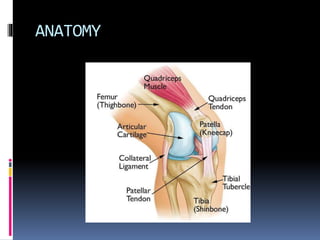
ANATOMY
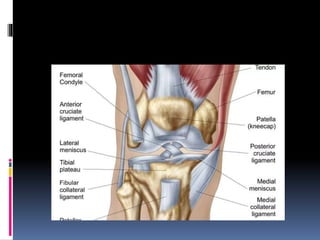
 MENISCI: medial & lateral
 CRUCIATES LIGAMENTS: acl & pcl
 COLLATERAL LIGAMENTS : medial & lateral
MENISCI
 Crescent shaped fibrocartilaginous structure.
 Fn as shock absorber,
depen articular surface,
provide stability to knee joint.
ACL & PCL
 ACL is distally attached to tibia (just ant. to
intercondylar eminence) & proximal to medial
wall of lateral femoral condyle.
 It prevents excess ant.translation of tibia over
femur
 PCL is attached proximally on the lateral wall of
MFC & distally to post. tibia 1-1.5 cm below
plateau in midline.
 It prevents excessive post. translation of tibia
over femur. it also helps in ‘screw home’(locking)
mechanism of knee.
MCL & LCL
 MCL is proximally attached on MFC just
below medial epicondyle & distally over
proximal medial tibia under pes anserinus.
 Fn : provides valgus stability to joint
especially in 30-90ᵒ flexion.
 LCL is proximally attached on lateral
epicondyle & distally over anterolateral part
of febular head.
 Fn: provides varus stability to joint in 5-30ᵒ
flexion
Posteromedial corner of knee
 Post. Oblique lig.(POL).
 Post. capsule
 Post. horn of medial meniscus
 semiM tendon
 Provides valgus stability in extension &
internal rotation stability.
Posterolateral corner of
knee
 LCL, popliteus tendon, popliteofibular
ligament, fabellofibular & arcuate ligament,
lateral capsule.
 It resists varus, external rotation & post.
translation forces on knee.
MPFL
 Stabilises patella into the trochlear groove
when knee flexes between 0-30ᵒ
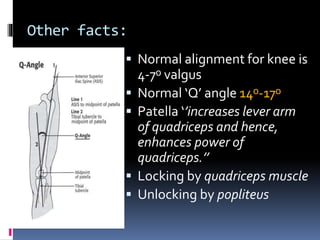
Other facts:
 Normal alignment for knee is
4-7ᵒ valgus
 Normal ‘Q’ angle 14ᵒ-17ᵒ
 Patella ‘’increases lever arm
of quadriceps and hence,
enhances power of
quadriceps.’’
 Locking by quadriceps muscle
 Unlocking by popliteus
HISTORY & ITS EVALUATION
 PAIN (M/C)
 SWELLING
 INSTABILITY
 DIFFICULTY IN MOVEMENTS
 LOCKING,PSEUDOLOCKING
 CLICKS
 MALALIGNMENT/LIMB LENGTH
DISCREPANCY.
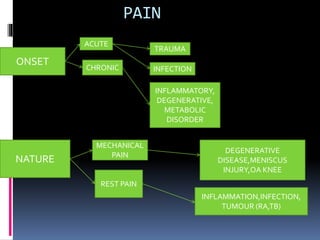
PAIN
ONSET
ACUTE
CHRONIC
TRAUMA
INFECTION
INFLAMMATORY,
DEGENERATIVE,
METABOLIC
DISORDER
NATURE
MECHANICAL
PAIN
REST PAIN
DEGENERATIVE
DISEASE,MENISCUS
INJURY,OA KNEE
INFLAMMATION,INFECTION,
TUMOUR (RA,TB)
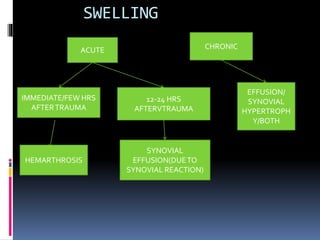
SWELLING
IMMEDIATE/FEW HRS
AFTERTRAUMA
12-24 HRS
AFTERVTRAUMA
CHRONIC
HEMARTHROSIS
SYNOVIAL
EFFUSION(DUETO
SYNOVIAL REACTION)
EFFUSION/
SYNOVIAL
HYPERTROPH
Y/BOTH
ACUTE
INSTABILITY
 Pt complains of “My knee gives way/ I cannot
trust my knee” while running, jumping,
turning, stair-climbing, walking on uneven
ground, etc.
Locking
 Pathological condition when Knee is
Locked/Stuck in Flexed Position.
 Commonly observed in Bucket HandleTear.
 * The knee never gets locked in full extension*.
 Pseudo-locking: not a true locking ,but a
mere muscular spasm not allowing further
movements. Seen in Patellofemoral arthritis
Clicks/Thuds
 Commonly seen in Discoid lateral meniscus
 Also seen in Maltracking Patella, Meniscal
tear or loose bodies.
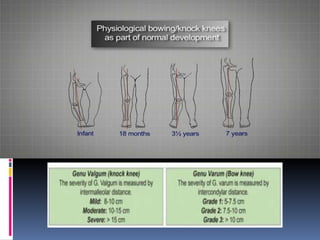
Malalignment
 GenuVarum(bow knee): Common in childhood
but resolves gradually, Also seen in OA,
Rickets, Paget’s Disease
 GenuValgum(knock knee) : Resolve by age of
6 years; commonly in females, Contributary
factor in Recurrent dislocation of patella,
Rickets,RA
 Genu Recurvatum : mostly due to joint laxity.
Sometimes Observed after Posterior Capsular
tear with PCL and PLC tears.
EXANINATION
 INSPECTION
 PALPATION
 MOVEMENTS
 MEASUREMENTS
INSPECTION
 1.DEFORMITY
 Coronal plane deformity-genu varum/valgum
 Sagittal plane deformity- flexion deformity/genu
recurvatum
 2. Muscle wasting-at thigh & calf.
 3. Limb length discrepancy-observe level of malleoli
& heel with both limb parallel to each other.
 4.positiopn of patella-normally rotated outwards &
LP is at level of joint line.
 5.swelling-I/A swelling gives rise to horse shoe
swelling.
PALPATION
a) local rise in temperature
b) tenderness over various bony & soft tissue
landmarks.
c) Swelling
d)Joint line tenderness- arthritis,meniscal
tear,mid substance collateral injury.
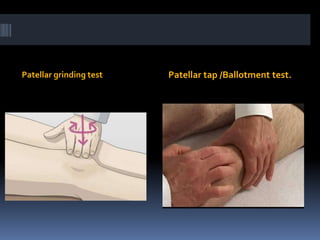
e) Patellar tap test- valid for moderate fluid.
f) stroke/bulge test for effusion.
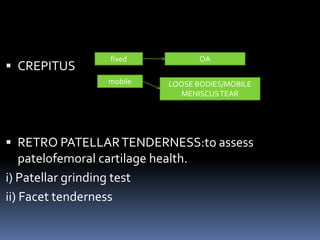
 CREPITUS
 RETRO PATELLARTENDERNESS:to assess
patelofemoral cartilage health.
i) Patellar grinding test
ii) Facet tenderness
fixed
mobile
OA
LOOSE BODIES/MOBILE
MENISCUSTEAR
Patellar grinding test Patellar tap /Ballotment test.
MOVEMENTS
 FLEXION 0-140*
 EXTENSION normally 0*(occasionally 10-20*)
 Some rotatory movements as well.
 Extensor lag: a condition where in knee fails to
come back to neutral in full extension or point of
starting of flexion ‘actively’.
 It is due to disuse related weakness of quadriceps
muscle(not paralyzed).
MEASUREMENTS
 A) length of the limb:
ASIS to medial joint line(femur) & medial
joint line to medial malleolus(tibia).
 B) wasting of thigh & calf muscle:
Muscle girth is measured over max.thigh &
max.calf girth and compared with normal
side.
 C) Q angle: it is measure of lateral pull
exerted by quadriceps on patella.
Grade of ligament laxity
 Gr.0: <3 mm laxity/opening
 Gr.1: 3-5 mm laxity/opening
 Gr.2: 5-10 mm laxity/opening
 Gr.3: >10 mm laxity/opening
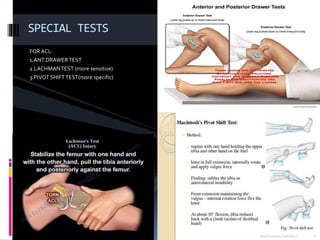
FOR ACL:
1.ANT.DRAWERTEST
2.LACHMANTEST (more sensitive)
3.PIVOT SHIFTTEST(more specific)
SPECIAL TESTS
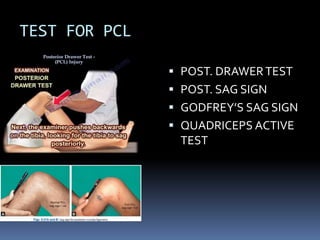
TEST FOR PCL
 POST. DRAWERTEST
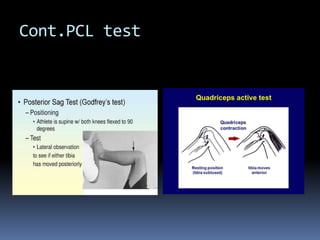
 POST. SAG SIGN
 GODFREY’S SAG SIGN
 QUADRICEPS ACTIVE
TEST
Cont.PCL test
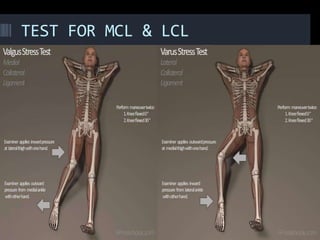
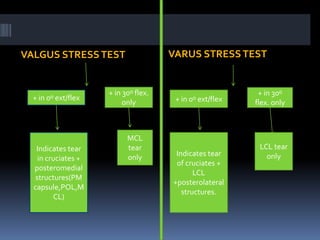
TEST FOR MCL & LCL
VALGUS STRESSTEST VARUS STRESSTEST
+ in 0ᵒ ext/flex
+ in 30ᵒ flex.
only + in 0ᵒ ext/flex
+ in 30ᵒ
flex. only
Indicates tear
in cruciates +
posteromedial
structures(PM
capsule,POL,M
CL)
MCL
tear
only Indicates tear
of cruciates +
LCL
+posterolateral
structures.
LCL tear
only
MENISCAL TESTS
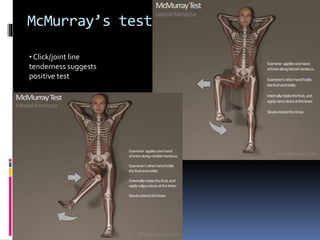
 1.McMurray’s test
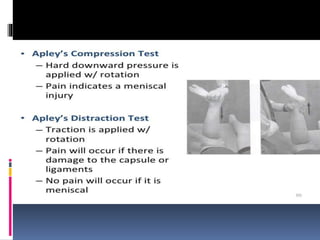
 2.Apley’s grinding
test(compression
[meniscus] & distraction
[lig.] ) test
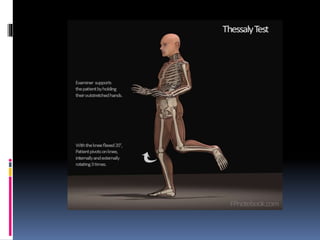
 3.Thessaly test: (most
sensitive & specific).
McMurray’s test
• Click/joint line
tenderness suggests
positive test
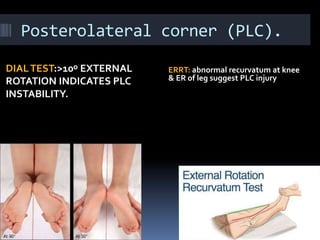
Posterolateral corner (PLC).
DIALTEST:>10ᵒ EXTERNAL
ROTATION INDICATES PLC
INSTABILITY.
ERRT: abnormal recurvatum at knee
& ER of leg suggest PLC injury
 In dial test if ER is more at 30ᵒ ‘only’, it implies
injured PLC & normal PCL.
 If ER is more at 30ᵒ & 90ᵒ it suggest PLC+PCL
injury.
Patella stability tests:
 1. fairbank’s apprehension test
 2.Quadrant test
 3.Patella horizontal tilt test
 4.patella maltracking (J-sign).
 Fairbank’s apprehension test: pt suoine &
knee in extension. Examiner holds patella b/w
thumb & index finger.patella is pushed
laterally by thumb while kne is gently flexed
from 0 to 30 and extended back to neutral
position.repeat same procedure few times.
 INTER: pt with RPD, shows apprehension on
face & stops examiner from performing
manoever.
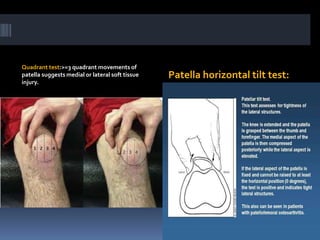
Quadrant test:>=3 quadrant movements of
patella suggests medial or lateral soft tissue
injury.
Patella horizontal tilt test:
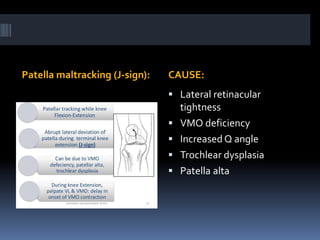
Patella maltracking (J-sign): CAUSE:
 Lateral retinacular
tightness
 VMO deficiency
 Increased Q angle
 Trochlear dysplasia
 Patella alta
Knee clinical examination by Dr YAGNIK

Knee clinical examination by Dr YAGNIK

  • 1.
  • 2.
    Knee joint isa MODIFIED HINGETYPE BICONDYLAR SYNOVIAL JOINT. Knee joint is a combination of 2 joints: 1).Tibiofemoral joint 2). Patellofemoral joint
  • 3.
  • 5.
     MENISCI: medial& lateral  CRUCIATES LIGAMENTS: acl & pcl  COLLATERAL LIGAMENTS : medial & lateral
  • 6.
    MENISCI  Crescent shapedfibrocartilaginous structure.  Fn as shock absorber, depen articular surface, provide stability to knee joint.
  • 7.
    ACL & PCL ACL is distally attached to tibia (just ant. to intercondylar eminence) & proximal to medial wall of lateral femoral condyle.  It prevents excess ant.translation of tibia over femur  PCL is attached proximally on the lateral wall of MFC & distally to post. tibia 1-1.5 cm below plateau in midline.  It prevents excessive post. translation of tibia over femur. it also helps in ‘screw home’(locking) mechanism of knee.
  • 8.
    MCL & LCL MCL is proximally attached on MFC just below medial epicondyle & distally over proximal medial tibia under pes anserinus.  Fn : provides valgus stability to joint especially in 30-90ᵒ flexion.  LCL is proximally attached on lateral epicondyle & distally over anterolateral part of febular head.  Fn: provides varus stability to joint in 5-30ᵒ flexion
  • 9.
    Posteromedial corner ofknee  Post. Oblique lig.(POL).  Post. capsule  Post. horn of medial meniscus  semiM tendon  Provides valgus stability in extension & internal rotation stability.
  • 10.
    Posterolateral corner of knee LCL, popliteus tendon, popliteofibular ligament, fabellofibular & arcuate ligament, lateral capsule.  It resists varus, external rotation & post. translation forces on knee.
  • 11.
    MPFL  Stabilises patellainto the trochlear groove when knee flexes between 0-30ᵒ
  • 12.
    Other facts:  Normalalignment for knee is 4-7ᵒ valgus  Normal ‘Q’ angle 14ᵒ-17ᵒ  Patella ‘’increases lever arm of quadriceps and hence, enhances power of quadriceps.’’  Locking by quadriceps muscle  Unlocking by popliteus
  • 13.
    HISTORY & ITSEVALUATION  PAIN (M/C)  SWELLING  INSTABILITY  DIFFICULTY IN MOVEMENTS  LOCKING,PSEUDOLOCKING  CLICKS  MALALIGNMENT/LIMB LENGTH DISCREPANCY.
  • 14.
  • 15.
  • 16.
    INSTABILITY  Pt complainsof “My knee gives way/ I cannot trust my knee” while running, jumping, turning, stair-climbing, walking on uneven ground, etc.
  • 17.
    Locking  Pathological conditionwhen Knee is Locked/Stuck in Flexed Position.  Commonly observed in Bucket HandleTear.  * The knee never gets locked in full extension*.  Pseudo-locking: not a true locking ,but a mere muscular spasm not allowing further movements. Seen in Patellofemoral arthritis
  • 18.
    Clicks/Thuds  Commonly seenin Discoid lateral meniscus  Also seen in Maltracking Patella, Meniscal tear or loose bodies.
  • 19.
    Malalignment  GenuVarum(bow knee):Common in childhood but resolves gradually, Also seen in OA, Rickets, Paget’s Disease  GenuValgum(knock knee) : Resolve by age of 6 years; commonly in females, Contributary factor in Recurrent dislocation of patella, Rickets,RA  Genu Recurvatum : mostly due to joint laxity. Sometimes Observed after Posterior Capsular tear with PCL and PLC tears.
  • 21.
  • 22.
    INSPECTION  1.DEFORMITY  Coronalplane deformity-genu varum/valgum  Sagittal plane deformity- flexion deformity/genu recurvatum  2. Muscle wasting-at thigh & calf.  3. Limb length discrepancy-observe level of malleoli & heel with both limb parallel to each other.  4.positiopn of patella-normally rotated outwards & LP is at level of joint line.  5.swelling-I/A swelling gives rise to horse shoe swelling.
  • 23.
    PALPATION a) local risein temperature b) tenderness over various bony & soft tissue landmarks. c) Swelling d)Joint line tenderness- arthritis,meniscal tear,mid substance collateral injury. e) Patellar tap test- valid for moderate fluid. f) stroke/bulge test for effusion.
  • 24.
     CREPITUS  RETROPATELLARTENDERNESS:to assess patelofemoral cartilage health. i) Patellar grinding test ii) Facet tenderness fixed mobile OA LOOSE BODIES/MOBILE MENISCUSTEAR
  • 25.
    Patellar grinding testPatellar tap /Ballotment test.
  • 26.
    MOVEMENTS  FLEXION 0-140* EXTENSION normally 0*(occasionally 10-20*)  Some rotatory movements as well.  Extensor lag: a condition where in knee fails to come back to neutral in full extension or point of starting of flexion ‘actively’.  It is due to disuse related weakness of quadriceps muscle(not paralyzed).
  • 27.
    MEASUREMENTS  A) lengthof the limb: ASIS to medial joint line(femur) & medial joint line to medial malleolus(tibia).  B) wasting of thigh & calf muscle: Muscle girth is measured over max.thigh & max.calf girth and compared with normal side.  C) Q angle: it is measure of lateral pull exerted by quadriceps on patella.
  • 28.
    Grade of ligamentlaxity  Gr.0: <3 mm laxity/opening  Gr.1: 3-5 mm laxity/opening  Gr.2: 5-10 mm laxity/opening  Gr.3: >10 mm laxity/opening
  • 29.
    FOR ACL: 1.ANT.DRAWERTEST 2.LACHMANTEST (moresensitive) 3.PIVOT SHIFTTEST(more specific) SPECIAL TESTS
  • 30.
    TEST FOR PCL POST. DRAWERTEST  POST. SAG SIGN  GODFREY’S SAG SIGN  QUADRICEPS ACTIVE TEST
  • 31.
  • 32.
  • 33.
    VALGUS STRESSTEST VARUSSTRESSTEST + in 0ᵒ ext/flex + in 30ᵒ flex. only + in 0ᵒ ext/flex + in 30ᵒ flex. only Indicates tear in cruciates + posteromedial structures(PM capsule,POL,M CL) MCL tear only Indicates tear of cruciates + LCL +posterolateral structures. LCL tear only
  • 34.
    MENISCAL TESTS  1.McMurray’stest  2.Apley’s grinding test(compression [meniscus] & distraction [lig.] ) test  3.Thessaly test: (most sensitive & specific).
  • 35.
    McMurray’s test • Click/jointline tenderness suggests positive test
  • 38.
    Posterolateral corner (PLC). DIALTEST:>10ᵒEXTERNAL ROTATION INDICATES PLC INSTABILITY. ERRT: abnormal recurvatum at knee & ER of leg suggest PLC injury
  • 39.
     In dialtest if ER is more at 30ᵒ ‘only’, it implies injured PLC & normal PCL.  If ER is more at 30ᵒ & 90ᵒ it suggest PLC+PCL injury.
  • 40.
    Patella stability tests: 1. fairbank’s apprehension test  2.Quadrant test  3.Patella horizontal tilt test  4.patella maltracking (J-sign).
  • 41.
     Fairbank’s apprehensiontest: pt suoine & knee in extension. Examiner holds patella b/w thumb & index finger.patella is pushed laterally by thumb while kne is gently flexed from 0 to 30 and extended back to neutral position.repeat same procedure few times.  INTER: pt with RPD, shows apprehension on face & stops examiner from performing manoever.
  • 42.
    Quadrant test:>=3 quadrantmovements of patella suggests medial or lateral soft tissue injury. Patella horizontal tilt test:
  • 43.
    Patella maltracking (J-sign):CAUSE:  Lateral retinacular tightness  VMO deficiency  Increased Q angle  Trochlear dysplasia  Patella alta