Presented by :
Gohil Sanjay B.
M.SC.Sem-3 (BOTANY)
contents
• Introduction
• Principles of conservation
• ex- situ conservation
• Techniques of ex situ conservation for plants
• Advantages of ex situ conservation
• Disadvantages of ex situ conservation
• Botanicale garden
→ The strategy of conservation depend on the nature
of the material and on the objective and scope of
the activity.
→ The nature of the material defined by the length of
the life cycle , the mode of reproduction , the size of
the individuals and its ecological status , whether
wind,or domesticated.
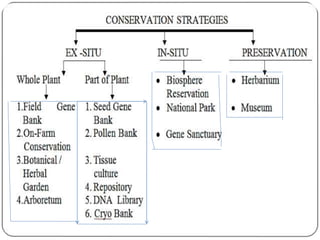
→ There are two basic approaches to germplasm
conservation namely in situ and ex situ conservation.
→ Conservation biologists seek to maintain three
important aspects of life on Earth: biological diversity,
ecologic integrity, and ecological health.
→ Biological diversity is a measure of the diversity of all
life at all levels of organization.
→ Ecological integrity is a measure of the composition,
structure, and function of biological systems.
→ Ecological health is a measure of a biological system’s
resiliency and ability to maintain itself over time.
→ The conservation of nature is important for nature’s
intrinsic values, its instrumental values, and its
psychological values.
→ Value systems determine how we view nature, and
this may vary within and among cultures.
 Intrinsic values are those of nature itself, separate
from a usefulness to humans.
 Instrumental values are based on the usefulness of
nature to humans.
 Psychological values are those that contribute to the
psychological well-being of humans.
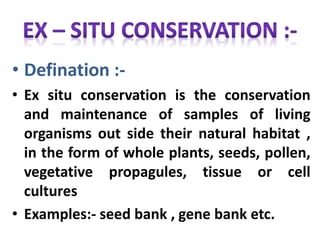
• Defination :-
• Ex situ conservation is the conservation
and maintenance of samples of living
organisms out side their natural habitat ,
in the form of whole plants, seeds, pollen,
vegetative propagules, tissue or cell
cultures
• Examples:- seed bank , gene bank etc.
What is Ex – situ conservation :-
• Ex situ conservation literally means “off site
conservation.
• It is the process of protecting an endangered
species, variety or breed of plant or animal out
side of its natural habitat.
• By removing part of the population from a
threatened habitat and placing it in a new
location, which may be a wild area or within
the care of humans.
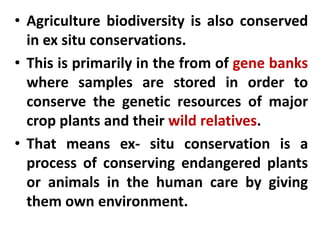
• Agriculture biodiversity is also conserved
in ex situ conservations.
• This is primarily in the from of gene banks
where samples are stored in order to
conserve the genetic resources of major
crop plants and their wild relatives.
• That means ex- situ conservation is a
process of conserving endangered plants
or animals in the human care by giving
them own environment.

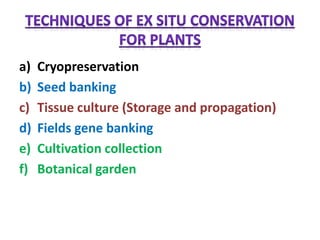
a) Cryopreservation
b) Seed banking
c) Tissue culture (Storage and propagation)
d) Fields gene banking
e) Cultivation collection
f) Botanical garden
Advantages of ex situ conservation:-
• Organisms are completely protected from
predation and poaching.
• Genetic diversity of the population can be
measured.
• Modern reproductive technology can increase
the chances of reproductive success.
• Animals and plants can be bred to
increase their numbers if endangered.
• Research in to reproductive physiology,
life style and ecology of an endangered
species.
• Conservation site can be used as
attraction to raise funds for further
conservation efforts.
• Conservation site can be also used for
education.
Disadvantages of ex situ conservation:-
• The organisms are living outside their
natural habitat.
• Nutrition issues may arise.
• Collect survival conditions may difficult to
achieve.
• Expensive to maintain.
• A botanical garden or botanical garden is a
garden dedicated to the collection,
cultivation and display of a wide range of
plants labelled with their botanical names .
• It may contain specialist plant collections
such as cacti and other succulent plants, herb
gardens, plants from particular parts of the
world, and so on;
• There may be greenhouses, shadehouses, again
with special collection such as tropical plants ,
alpine plants, or other exotic plants.
• Visitor services at a botanical garden might include
tours, educational displays, art exhibitions , book
rooms, open-air theatrical and musical
performances, and other entertainment
Defination
• BGCI has considered what makes a botanical
garden different from a public park or pleasure
gardens.
• In the international agenda for botanical garden
is as follows…
“Botanical gardens are institutions holding
documented collections of living plant for the
purpose of scientific research, conservation,
display and education.”
• There are botanical gardens are arboreta in
148 countries worldwide and they maintain
more than 4 million living plant collections.
• Amongst their collections are representatives
of more than 100,000 species, almost one
third of the known vascular plant sp. of the
world.
• There are a total of 142 million herbarium
specimens in botanical garden herbaria and
6.13 million accessions in their living
collections.
HISTORY OF BOTANICAL GARDENS
• Gardens and the cultivation of plant have been
around for thousands of years with the first
example dating to around 300 years ago in ancient
Egypt and Mesopotamia.
• The Romans were also keen gardens and they were
also aware of the medicinal properties of the
plants.
• They also used the beauty of plants and flowers as
a celebrations of god.
• Separate institution and schools of agriculture
were developed which meant that these
“cultivational” gardens were almost redundant.
• During the 19th and 20th century municipal and
civic gardens were created throught Europe an
the British Commonwealth.
• There are now currently 1775 botanical gardens
and arboreta in 148 countries around the world
with many more under construction or being
planned such as the first botanical garden in
Oman which will be one of the largest garden in
the world once it is completed and will house the
first large scale internal fog-forest in a huge
glasshouse.
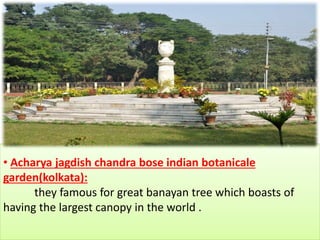
• Acharya jagdish chandra bose indian botanicale
garden(kolkata):
they famous for great banayan tree which boasts of
having the largest canopy in the world .
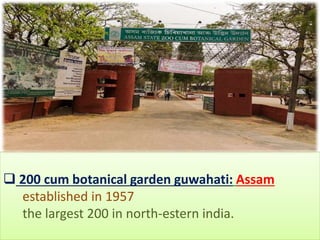
 200 cum botanical garden guwahati: Assam
established in 1957
the largest 200 in north-estern india.
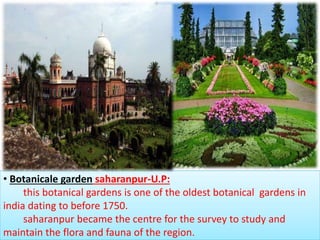
• Botanicale garden saharanpur-U.P:
this botanical gardens is one of the oldest botanical gardens in
india dating to before 1750.
saharanpur became the centre for the survey to study and
maintain the flora and fauna of the region.
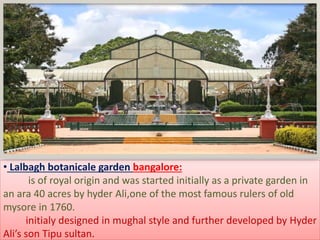
• Lalbagh botanicale garden bangalore:
is of royal origin and was started initially as a private garden in
an ara 40 acres by hyder Ali,one of the most famous rulers of old
mysore in 1760.
initialy designed in mughal style and further developed by Hyder
Ali’s son Tipu sultan.
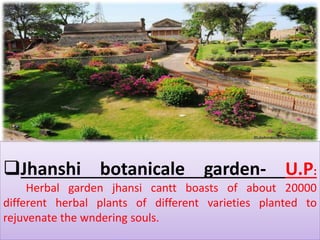
Jhanshi botanicale garden- U.P:
Herbal garden jhansi cantt boasts of about 20000
different herbal plants of different varieties planted to
rejuvenate the wndering souls.
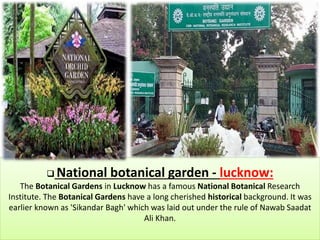
 National botanical garden - lucknow:
The Botanical Gardens in Lucknow has a famous National Botanical Research
Institute. The Botanical Gardens have a long cherished historical background. It was
earlier known as 'Sikandar Bagh' which was laid out under the rule of Nawab Saadat
Ali Khan.
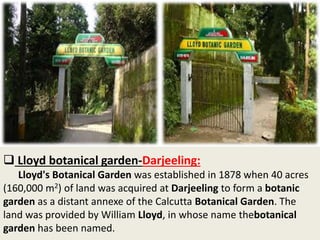
 Lloyd botanical garden-Darjeeling:
Lloyd's Botanical Garden was established in 1878 when 40 acres
(160,000 m2) of land was acquired at Darjeeling to form a botanic
garden as a distant annexe of the Calcutta Botanical Garden. The
land was provided by William Lloyd, in whose name thebotanical
garden has been named.
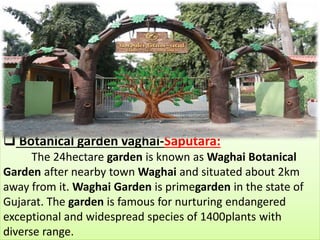
 Botanical garden vaghai-Saputara:
The 24hectare garden is known as Waghai Botanical
Garden after nearby town Waghai and situated about 2km
away from it. Waghai Garden is primegarden in the state of
Gujarat. The garden is famous for nurturing endangered
exceptional and widespread species of 1400plants with
diverse range.
Importance of Botanical gardens:
• Botanical gardens and Herbaria are important
places of sysetematic study and research on flora
of region.
• These are the places of great acedemic and
economic importance.
• A brief account of botanical garden and herbaria
fallows….
• Luca Ghini was the first person to establish a
botanical garden on scientific lines in 1543 at
pisa in Italy.
• At present there are over 600 important
botanical gardens in the world.
• Handerson (1983) however documented 800 of
them in the “International Directory of Botanical
Gardens”. (IDBG)
Role of Botanical Gardens:
1. Taxonomic studies:-
Botanical gardens provide valuble
information on various plants local flora,
bonsai, rare plant etc.. They act as “outdoor
laboratories” for students and researchers.
2. Botanical Research:-
Botanical gardens supply wide range
of plant species , seed, flowers fruit for
botanical research.
3. Conservation:-
Botanical gardens conserve and
propagate rare species and genetic diversity.
4. Education:-
They supply facilities for courses in
local flora, horticulture hybridization, plant
propagation etc…
There educational programmes
include workshope, training sessions for
teachers, students, naturalists etc…
5. Public services :-
They help the public in identifying the
local and exotic plant species ; provide
instructions for home gardening’s propagation
of plants: resource, through sale or exchange.
6. Aesthetic and Recreation :-
They attract people who have made
gardening their hobby.
7. Employment :-
They create job opportunities for large
number of young botanists.
 BIODIVERSITY AND PLANT RESOURCES
K.Jagmohan Reddy
 Environmental Sciences
- Purohit, Shammi & Agrawal
 Biodiversity Conservation
- P.C.Trivedi
-K.C.Sharma
 www.ex situ conservation.com
Ex situ conservation

Ex situ conservation

  • 1.
    Presented by : GohilSanjay B. M.SC.Sem-3 (BOTANY)
  • 2.
    contents • Introduction • Principlesof conservation • ex- situ conservation • Techniques of ex situ conservation for plants • Advantages of ex situ conservation • Disadvantages of ex situ conservation • Botanicale garden
  • 3.
    → The strategyof conservation depend on the nature of the material and on the objective and scope of the activity. → The nature of the material defined by the length of the life cycle , the mode of reproduction , the size of the individuals and its ecological status , whether wind,or domesticated. → There are two basic approaches to germplasm conservation namely in situ and ex situ conservation.
  • 4.
    → Conservation biologistsseek to maintain three important aspects of life on Earth: biological diversity, ecologic integrity, and ecological health. → Biological diversity is a measure of the diversity of all life at all levels of organization. → Ecological integrity is a measure of the composition, structure, and function of biological systems. → Ecological health is a measure of a biological system’s resiliency and ability to maintain itself over time.
  • 5.
    → The conservationof nature is important for nature’s intrinsic values, its instrumental values, and its psychological values. → Value systems determine how we view nature, and this may vary within and among cultures.  Intrinsic values are those of nature itself, separate from a usefulness to humans.  Instrumental values are based on the usefulness of nature to humans.  Psychological values are those that contribute to the psychological well-being of humans.
  • 6.
    • Defination :- •Ex situ conservation is the conservation and maintenance of samples of living organisms out side their natural habitat , in the form of whole plants, seeds, pollen, vegetative propagules, tissue or cell cultures • Examples:- seed bank , gene bank etc.
  • 7.
    What is Ex– situ conservation :- • Ex situ conservation literally means “off site conservation. • It is the process of protecting an endangered species, variety or breed of plant or animal out side of its natural habitat. • By removing part of the population from a threatened habitat and placing it in a new location, which may be a wild area or within the care of humans.
  • 8.
    • Agriculture biodiversityis also conserved in ex situ conservations. • This is primarily in the from of gene banks where samples are stored in order to conserve the genetic resources of major crop plants and their wild relatives. • That means ex- situ conservation is a process of conserving endangered plants or animals in the human care by giving them own environment.
  • 10.
    a) Cryopreservation b) Seedbanking c) Tissue culture (Storage and propagation) d) Fields gene banking e) Cultivation collection f) Botanical garden
  • 11.
    Advantages of exsitu conservation:- • Organisms are completely protected from predation and poaching. • Genetic diversity of the population can be measured. • Modern reproductive technology can increase the chances of reproductive success.
  • 12.
    • Animals andplants can be bred to increase their numbers if endangered. • Research in to reproductive physiology, life style and ecology of an endangered species. • Conservation site can be used as attraction to raise funds for further conservation efforts. • Conservation site can be also used for education.
  • 13.
    Disadvantages of exsitu conservation:- • The organisms are living outside their natural habitat. • Nutrition issues may arise. • Collect survival conditions may difficult to achieve. • Expensive to maintain.
  • 14.
    • A botanicalgarden or botanical garden is a garden dedicated to the collection, cultivation and display of a wide range of plants labelled with their botanical names . • It may contain specialist plant collections such as cacti and other succulent plants, herb gardens, plants from particular parts of the world, and so on;
  • 15.
    • There maybe greenhouses, shadehouses, again with special collection such as tropical plants , alpine plants, or other exotic plants. • Visitor services at a botanical garden might include tours, educational displays, art exhibitions , book rooms, open-air theatrical and musical performances, and other entertainment
  • 16.
    Defination • BGCI hasconsidered what makes a botanical garden different from a public park or pleasure gardens. • In the international agenda for botanical garden is as follows… “Botanical gardens are institutions holding documented collections of living plant for the purpose of scientific research, conservation, display and education.”
  • 17.
    • There arebotanical gardens are arboreta in 148 countries worldwide and they maintain more than 4 million living plant collections. • Amongst their collections are representatives of more than 100,000 species, almost one third of the known vascular plant sp. of the world. • There are a total of 142 million herbarium specimens in botanical garden herbaria and 6.13 million accessions in their living collections.
  • 18.
    HISTORY OF BOTANICALGARDENS • Gardens and the cultivation of plant have been around for thousands of years with the first example dating to around 300 years ago in ancient Egypt and Mesopotamia. • The Romans were also keen gardens and they were also aware of the medicinal properties of the plants. • They also used the beauty of plants and flowers as a celebrations of god.
  • 19.
    • Separate institutionand schools of agriculture were developed which meant that these “cultivational” gardens were almost redundant. • During the 19th and 20th century municipal and civic gardens were created throught Europe an the British Commonwealth. • There are now currently 1775 botanical gardens and arboreta in 148 countries around the world with many more under construction or being planned such as the first botanical garden in Oman which will be one of the largest garden in the world once it is completed and will house the first large scale internal fog-forest in a huge glasshouse.
  • 21.
    • Acharya jagdishchandra bose indian botanicale garden(kolkata): they famous for great banayan tree which boasts of having the largest canopy in the world .
  • 22.
     200 cumbotanical garden guwahati: Assam established in 1957 the largest 200 in north-estern india.
  • 23.
    • Botanicale gardensaharanpur-U.P: this botanical gardens is one of the oldest botanical gardens in india dating to before 1750. saharanpur became the centre for the survey to study and maintain the flora and fauna of the region.
  • 24.
    • Lalbagh botanicalegarden bangalore: is of royal origin and was started initially as a private garden in an ara 40 acres by hyder Ali,one of the most famous rulers of old mysore in 1760. initialy designed in mughal style and further developed by Hyder Ali’s son Tipu sultan.
  • 25.
    Jhanshi botanicale garden-U.P: Herbal garden jhansi cantt boasts of about 20000 different herbal plants of different varieties planted to rejuvenate the wndering souls.
  • 26.
     National botanicalgarden - lucknow: The Botanical Gardens in Lucknow has a famous National Botanical Research Institute. The Botanical Gardens have a long cherished historical background. It was earlier known as 'Sikandar Bagh' which was laid out under the rule of Nawab Saadat Ali Khan.
  • 27.
     Lloyd botanicalgarden-Darjeeling: Lloyd's Botanical Garden was established in 1878 when 40 acres (160,000 m2) of land was acquired at Darjeeling to form a botanic garden as a distant annexe of the Calcutta Botanical Garden. The land was provided by William Lloyd, in whose name thebotanical garden has been named.
  • 28.
     Botanical gardenvaghai-Saputara: The 24hectare garden is known as Waghai Botanical Garden after nearby town Waghai and situated about 2km away from it. Waghai Garden is primegarden in the state of Gujarat. The garden is famous for nurturing endangered exceptional and widespread species of 1400plants with diverse range.
  • 29.
    Importance of Botanicalgardens: • Botanical gardens and Herbaria are important places of sysetematic study and research on flora of region. • These are the places of great acedemic and economic importance. • A brief account of botanical garden and herbaria fallows….
  • 30.
    • Luca Ghiniwas the first person to establish a botanical garden on scientific lines in 1543 at pisa in Italy. • At present there are over 600 important botanical gardens in the world. • Handerson (1983) however documented 800 of them in the “International Directory of Botanical Gardens”. (IDBG)
  • 31.
    Role of BotanicalGardens: 1. Taxonomic studies:- Botanical gardens provide valuble information on various plants local flora, bonsai, rare plant etc.. They act as “outdoor laboratories” for students and researchers. 2. Botanical Research:- Botanical gardens supply wide range of plant species , seed, flowers fruit for botanical research.
  • 32.
    3. Conservation:- Botanical gardensconserve and propagate rare species and genetic diversity. 4. Education:- They supply facilities for courses in local flora, horticulture hybridization, plant propagation etc… There educational programmes include workshope, training sessions for teachers, students, naturalists etc…
  • 33.
    5. Public services:- They help the public in identifying the local and exotic plant species ; provide instructions for home gardening’s propagation of plants: resource, through sale or exchange. 6. Aesthetic and Recreation :- They attract people who have made gardening their hobby. 7. Employment :- They create job opportunities for large number of young botanists.
  • 34.
     BIODIVERSITY ANDPLANT RESOURCES K.Jagmohan Reddy  Environmental Sciences - Purohit, Shammi & Agrawal  Biodiversity Conservation - P.C.Trivedi -K.C.Sharma  www.ex situ conservation.com