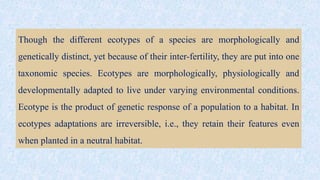
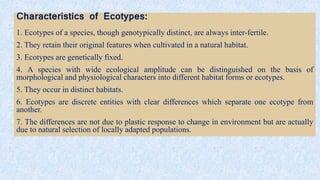
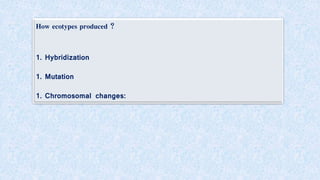
Ecads, also known as ecophenes or habitat forms, are environmentally induced variations within the same genetic stock or species. The variations in morphology, such as shape, size, and reproductive capacity, are temporary responses to environmental influences. In contrast, ecotypes are genetically distinct populations that are adapted to different habitats through natural selection. Ecotypes retain their distinguishing morphological and physiological traits even when placed in a new environment. Examples of ecotypes include different forms of Euphorbia hirta that grow in grasslands versus footpaths, which differ greatly in appearance but remain inter-fertile.