Generations of
mobile
communications
& its
standards
M.Sivakumar(Lecturer)
JNTUCE,Pulivendula
Kadapa-Andrapradesh
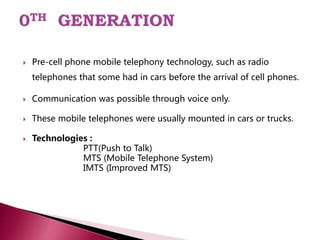
 Pre-cell phone mobile telephony technology, such as radio
telephones that some had in cars before the arrival of cell phones.
 Communication was possible through voice only.
 These mobile telephones were usually mounted in cars or trucks.
 Technologies :
PTT(Push to Talk)
MTS (Mobile Telephone System)
IMTS (Improved MTS)
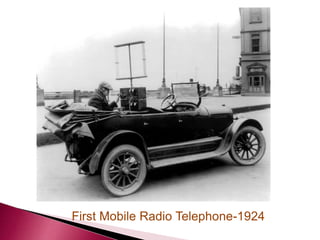
First Mobile Radio Telephone-1924
First Generation Cellular Systems
 First generation (1G) of cellular systems introduced in the late
1970s and early 1980s
 Evolved out of the growing number of mobile communication
users
 The use of semiconductor technology and microprocessors made
mobile devices smaller and lighter
 1G systems were based on analogue communication in the
900MHz frequency range
 Voice transmission only – easy to tap
 The most prominent 1G systems are
 Advanced Mobile Phone Systems (AMPS) - America
 Nordic Mobile Telephone (NMT) - France
 Total Access Communications System (TACS) – UK
 Jan 1985 Vodafone introduced the TACS system
First Generation Cellular Systems
Frequency Division Multiple Access (FDMA)
 Splits allocated spectrum into 30 channels, each channel is 30kHz
 Allocates a single channel to each established phone call
 The channel is agreed with the serving base-station before
transmission takes place on agreed and reserved channel
 Channel used by device to transmit and receive on this channel
 Ineffective methods since each analogue channel can only be used
by one user at a time
 FDMA does not take full advantage of available spectrum
Frequency Division Multiple Access (FDMA)
First Generation Cellular Systems
Frequency
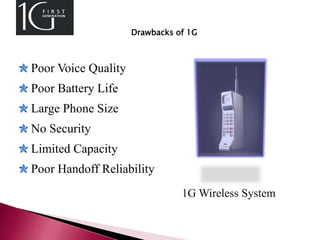
DRAWBACKS OF 1G
Poor Voice Quality
Poor Battery Life
Large Phone Size
No Security
Limited Capacity
Poor Handoff Reliability
1G Wireless System
Drawbacks of 1G
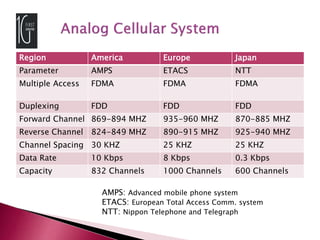
Region America Europe Japan
Parameter AMPS ETACS NTT
Multiple Access FDMA FDMA FDMA
Duplexing FDD FDD FDD
Forward Channel 869-894 MHZ 935-960 MHZ 870-885 MHZ
Reverse Channel 824-849 MHZ 890-915 MHZ 925-940 MHZ
Channel Spacing 30 KHZ 25 KHZ 25 KHZ
Data Rate 10 Kbps 8 Kbps 0.3 Kbps
Capacity 832 Channels 1000 Channels 600 Channels
AMPS: Advanced mobile phone system
ETACS: European Total Access Comm. system
NTT: Nippon Telephone and Telegraph
Second Generation Cellular Systems
 Development driven by the need to improve speech quality,
system capacity, coverage and security
 First system that used digital transmission
 Examples of Second Generation (2G) cellular systems ...
 Digital AMPS (D-AMPS) in the US,
 Personal Digital Communication (PDC) in Japan,
 Intrim Standard `94 (IS-94) in Korea and the US
 Global System for Mobile Communication (GSM)
 The GSM standard was defined by ETSI in 1989
 Originally called “ Groupe Spéciale Mobile which later changed
to the English version
 A majority of countries over the world have adopted GSM900
and the GSM1800 which are all based on the same original
GSM specification.
 The US uses an additional GSM 1900
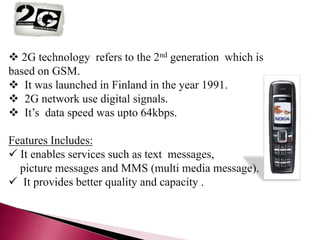
2G TECHNOLOGY
 2G technology refers to the 2nd generation which is
based on GSM.
 It was launched in Finland in the year 1991.
 2G network use digital signals.
 It’s data speed was upto 64kbps.
Features Includes:
 It enables services such as text messages,
picture messages and MMS (multi media message).
 It provides better quality and capacity .
2G
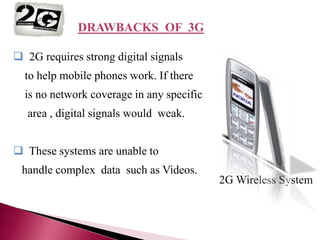
 2G requires strong digital signals
to help mobile phones work. If there
is no network coverage in any specific
area , digital signals would weak.
 These systems are unable to
handle complex data such as Videos.
2G Wireless System
DRAWBACKS OF 3G
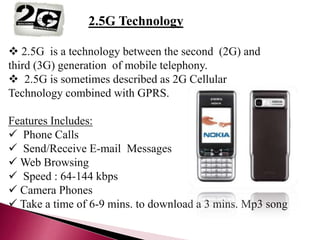
2.5G Technology
 2.5G is a technology between the second (2G) and
third (3G) generation of mobile telephony.
 2.5G is sometimes described as 2G Cellular
Technology combined with GPRS.
Features Includes:
 Phone Calls
 Send/Receive E-mail Messages
 Web Browsing
 Speed : 64-144 kbps
 Camera Phones
 Take a time of 6-9 mins. to download a 3 mins. Mp3 song
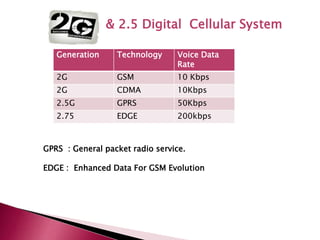
& 2.5 Digital Cellular System
Generation Technology Voice Data
Rate
2G GSM 10 Kbps
2G CDMA 10Kbps
2.5G GPRS 50Kbps
2.75 EDGE 200kbps
GPRS : General packet radio service.
EDGE : Enhanced Data For GSM Evolution
3rd GENERATION
2G networks were built mainly for voice data and slow
transmission. Due to rapid changes in user expectation, they
do not meet today's wireless needs.
3G networks provide the ability to transfer voice data and
non-voice data over the same network simultaneously.
Applications :
Internet, e-mail, fax, e-commerce, music,
video clips, and videoconferencing
The aim of the 3G is to allow for more coverage and growth
with minimum investment.
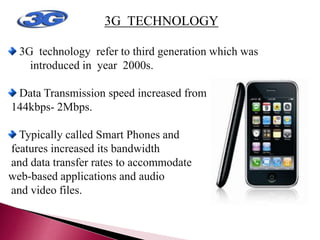
3G TECHNOLOGY
3G technology refer to third generation which was
introduced in year 2000s.
Data Transmission speed increased from
144kbps- 2Mbps.
Typically called Smart Phones and
features increased its bandwidth
and data transfer rates to accommodate
web-based applications and audio
and video files.
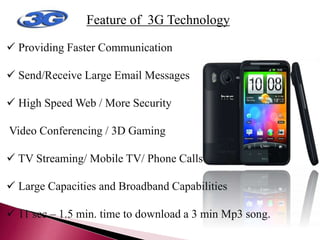
Feature of 3G Technology OF 3G
TECHNOLOGY
 Providing Faster Communication
 Send/Receive Large Email Messages
 High Speed Web / More Security
Video Conferencing / 3D Gaming
 TV Streaming/ Mobile TV/ Phone Calls
 Large Capacities and Broadband Capabilities
 11 sec – 1.5 min. time to download a 3 min Mp3 song.
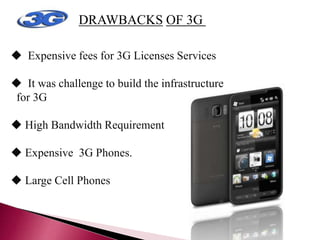
DRAWBACKS OF 3G TECHNOLOGY
 Expensive fees for 3G Licenses Services
 It was challenge to build the infrastructure
for 3G
 High Bandwidth Requirement
 Expensive 3G Phones.
 Large Cell Phones
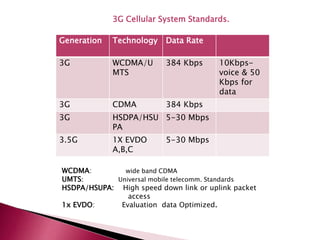
3G Cellular System Standards.
Generation Technology Data Rate
3G WCDMA/U
MTS
384 Kbps 10Kbps-
voice & 50
Kbps for
data
3G CDMA 384 Kbps
3G HSDPA/HSU
PA
5-30 Mbps
3.5G 1X EVDO
A,B,C
5-30 Mbps
WCDMA: wide band CDMA
UMTS: Universal mobile telecomm. Standards
HSDPA/HSUPA: High speed down link or uplink packet
access
1x EVDO: Evaluation data Optimized.
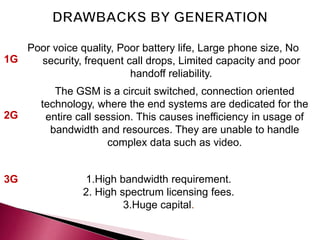
2G
1G
3G 1.High bandwidth requirement.
2. High spectrum licensing fees.
3.Huge capital.
The GSM is a circuit switched, connection oriented
technology, where the end systems are dedicated for the
entire call session. This causes inefficiency in usage of
bandwidth and resources. They are unable to handle
complex data such as video.
Poor voice quality, Poor battery life, Large phone size, No
security, frequent call drops, Limited capacity and poor
handoff reliability.
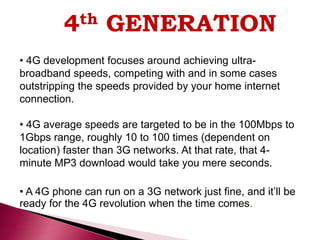
4th GENERATION
• 4G development focuses around achieving ultra-
broadband speeds, competing with and in some cases
outstripping the speeds provided by your home internet
connection.
• 4G average speeds are targeted to be in the 100Mbps to
1Gbps range, roughly 10 to 100 times (dependent on
location) faster than 3G networks. At that rate, that 4-
minute MP3 download would take you mere seconds.
• A 4G phone can run on a 3G network just fine, and it’ll be
ready for the 4G revolution when the time comes.
• There are two major systems in U.S, which are using the 4G
mobile technology – WiMax, backed by Clearwire and Long
Term Evolution or LTE.
• WiMax’s majority owner is Sprint Nextel. Sprint currently has
two mobile phones, the HTC Evo and the Samsung Epic,
which achieve speeds 10 times faster than 3G; coverage is
still limited to major metropolitan cities. Outside of these
areas, data speeds revert to 3G.
• Long Term Evolution is backed by Verizon. According to
cnet, Verizon has completed initial 4G wireless test, but not
available for widespread use until end of 2012.
Features include:
- A spectrally efficient system
- High network capacity
- Huge data rate
- Perfect connectivity & global roaming
- High quality of service
- Security & Privacy
Speed:
The data transfer is 100 Mbps for outdoor and 1Gbps
for indoor.
The word “MAGIC” also refers to 4G wireless
technology which stands for
Mobile multimedia, Any-where, Global mobility
solutions over, Integrated wireless and Customized
services.
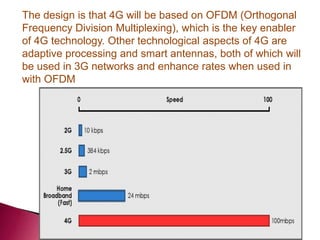
The design is that 4G will be based on OFDM (Orthogonal
Frequency Division Multiplexing), which is the key enabler
of 4G technology. Other technological aspects of 4G are
adaptive processing and smart antennas, both of which will
be used in 3G networks and enhance rates when used in
with OFDM
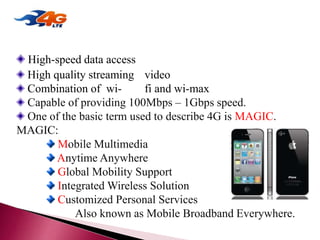
High-speed data access
High quality streaming video
Combination of wi- fi and wi-max
Capable of providing 100Mbps – 1Gbps speed.
One of the basic term used to describe 4G is MAGIC.
MAGIC:
Mobile Multimedia
Anytime Anywhere
Global Mobility Support
Integrated Wireless Solution
Customized Personal Services
Also known as Mobile Broadband Everywhere.
4G TECHNOLOGY
4G (Anytime, Anywhere)
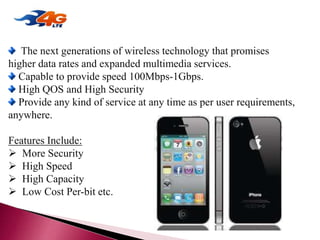
The next generations of wireless technology that promises
higher data rates and expanded multimedia services.
Capable to provide speed 100Mbps-1Gbps.
High QOS and High Security
Provide any kind of service at any time as per user requirements,
anywhere.
Features Include:
 More Security
 High Speed
 High Capacity
 Low Cost Per-bit etc.
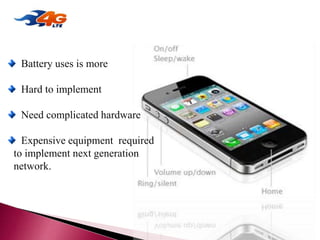
DRAWBACKS OF 4G
Battery uses is more
Hard to implement
Need complicated hardware
Expensive equipment required
to implement next generation
network.
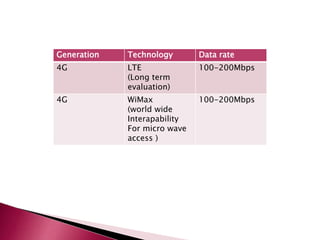
Generation Technology Data rate
4G LTE
(Long term
evaluation)
100-200Mbps
4G WiMax
(world wide
Interapability
For micro wave
access )
100-200Mbps
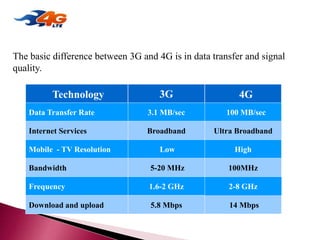
COMPARISON BETWEEN 3G Vs 4G
Technology 3G 4G
Data Transfer Rate 3.1 MB/sec 100 MB/sec
Internet Services Broadband Ultra Broadband
Mobile - TV Resolution Low High
Bandwidth 5-20 MHz 100MHz
Frequency 1.6-2 GHz 2-8 GHz
Download and upload 5.8 Mbps 14 Mbps
The basic difference between 3G and 4G is in data transfer and signal
quality.
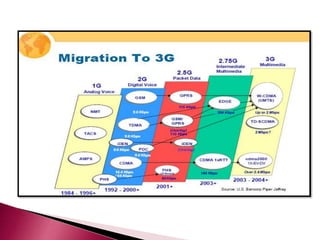
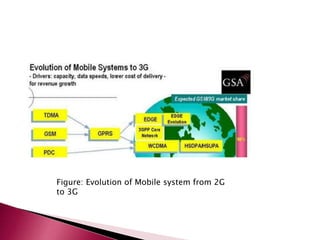
Figure: Evolution of Mobile system from 2G
to 3G
 LTE is a standard for wireless communication of
high-speed data for mobile phones and data
terminals.
 Supports at least 200 active data clients in every
5 MHz cell.
 It is based on the GSM/EDGE and UMTS/HSPA
network technologies, increasing the capacity and
speed using new modulation techniques.
 Ability to manage fast moving mobiles and
supports MBSFN (Multicast Broadcast Single
Frequency Network).
 It can deliver services such as Mobile TV
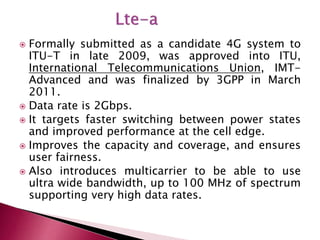
 Formally submitted as a candidate 4G system to
ITU-T in late 2009, was approved into ITU,
International Telecommunications Union, IMT-
Advanced and was finalized by 3GPP in March
2011.
 Data rate is 2Gbps.
 It targets faster switching between power states
and improved performance at the cell edge.
 Improves the capacity and coverage, and ensures
user fairness.
 Also introduces multicarrier to be able to use
ultra wide bandwidth, up to 100 MHz of spectrum
supporting very high data rates.
5G TECHNOLOGY
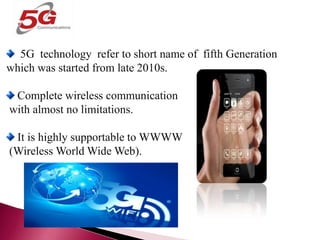
5G technology refer to short name of fifth Generation
which was started from late 2010s.
Complete wireless communication
with almost no limitations.
It is highly supportable to WWWW
(Wireless World Wide Web).
BENEFITS OF 5G TECHNOLOGY
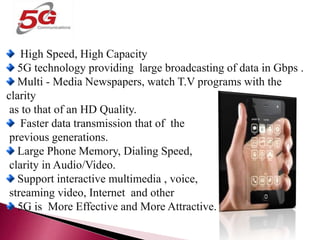
High Speed, High Capacity
5G technology providing large broadcasting of data in Gbps .
Multi - Media Newspapers, watch T.V programs with the
clarity
as to that of an HD Quality.
Faster data transmission that of the
previous generations.
Large Phone Memory, Dialing Speed,
clarity in Audio/Video.
Support interactive multimedia , voice,
streaming video, Internet and other
5G is More Effective and More Attractive.
COMPARISON BETWEEN 4G Vs 5G
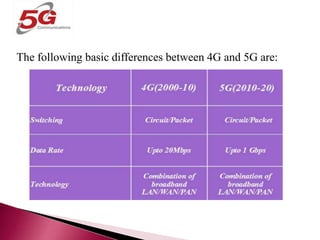
The following basic differences between 4G and 5G are:
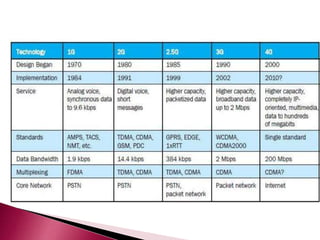
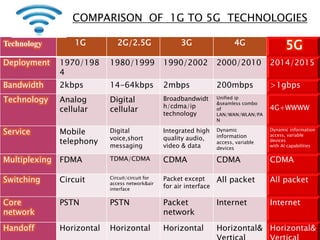
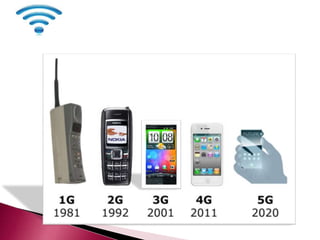
EVOLUTION OF 1G TO 5G TECHNOLOGY
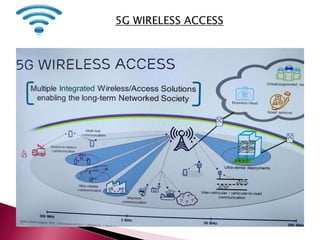
5G WIRELESS ACCESS
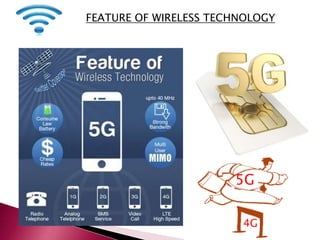
FEATURE OF WIRELESS TECHNOLOGY
5G
4G
Technology 1G 2G/2.5G 3G 4G 5G
Deployment 1970/198
4
1980/1999 1990/2002 2000/2010 2014/2015
Bandwidth 2kbps 14-64kbps 2mbps 200mbps >1gbps
Technology Analog
cellular
Digital
cellular
Broadbandwidt
h/cdma/ip
technology
Unified ip
&seamless combo
of
LAN/WAN/WLAN/PA
N
4G+WWWW
Service Mobile
telephony
Digital
voice,short
messaging
Integrated high
quality audio,
video & data
Dynamic
information
access, variable
devices
Dynamic information
access, variable
devices
with AI capabilities
Multiplexing FDMA TDMA/CDMA CDMA CDMA CDMA
Switching Circuit Circuit/circuit for
access network&air
interface
Packet except
for air interface
All packet All packet
Core
network
PSTN PSTN Packet
network
Internet Internet
Handoff Horizontal Horizontal Horizontal Horizontal& Horizontal&
COMPARISON OF 1G TO 5G TECHNOLOGIES
CONCLUSION
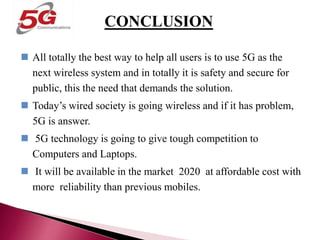
 All totally the best way to help all users is to use 5G as the
next wireless system and in totally it is safety and secure for
public, this the need that demands the solution.
 Today’s wired society is going wireless and if it has problem,
5G is answer.
 5G technology is going to give tough competition to
Computers and Laptops.
 It will be available in the market 2020 at affordable cost with
more reliability than previous mobiles.
CONCLUSION

Generations of Mobile Communications

  • 1.
  • 2.
     Pre-cell phonemobile telephony technology, such as radio telephones that some had in cars before the arrival of cell phones.  Communication was possible through voice only.  These mobile telephones were usually mounted in cars or trucks.  Technologies : PTT(Push to Talk) MTS (Mobile Telephone System) IMTS (Improved MTS)
  • 3.
    First Mobile RadioTelephone-1924
  • 4.
    First Generation CellularSystems  First generation (1G) of cellular systems introduced in the late 1970s and early 1980s  Evolved out of the growing number of mobile communication users  The use of semiconductor technology and microprocessors made mobile devices smaller and lighter  1G systems were based on analogue communication in the 900MHz frequency range  Voice transmission only – easy to tap  The most prominent 1G systems are  Advanced Mobile Phone Systems (AMPS) - America  Nordic Mobile Telephone (NMT) - France  Total Access Communications System (TACS) – UK  Jan 1985 Vodafone introduced the TACS system
  • 5.
    First Generation CellularSystems Frequency Division Multiple Access (FDMA)  Splits allocated spectrum into 30 channels, each channel is 30kHz  Allocates a single channel to each established phone call  The channel is agreed with the serving base-station before transmission takes place on agreed and reserved channel  Channel used by device to transmit and receive on this channel  Ineffective methods since each analogue channel can only be used by one user at a time  FDMA does not take full advantage of available spectrum
  • 6.
    Frequency Division MultipleAccess (FDMA) First Generation Cellular Systems Frequency
  • 7.
    DRAWBACKS OF 1G PoorVoice Quality Poor Battery Life Large Phone Size No Security Limited Capacity Poor Handoff Reliability 1G Wireless System Drawbacks of 1G
  • 8.
    Region America EuropeJapan Parameter AMPS ETACS NTT Multiple Access FDMA FDMA FDMA Duplexing FDD FDD FDD Forward Channel 869-894 MHZ 935-960 MHZ 870-885 MHZ Reverse Channel 824-849 MHZ 890-915 MHZ 925-940 MHZ Channel Spacing 30 KHZ 25 KHZ 25 KHZ Data Rate 10 Kbps 8 Kbps 0.3 Kbps Capacity 832 Channels 1000 Channels 600 Channels AMPS: Advanced mobile phone system ETACS: European Total Access Comm. system NTT: Nippon Telephone and Telegraph
  • 9.
    Second Generation CellularSystems  Development driven by the need to improve speech quality, system capacity, coverage and security  First system that used digital transmission  Examples of Second Generation (2G) cellular systems ...  Digital AMPS (D-AMPS) in the US,  Personal Digital Communication (PDC) in Japan,  Intrim Standard `94 (IS-94) in Korea and the US  Global System for Mobile Communication (GSM)  The GSM standard was defined by ETSI in 1989  Originally called “ Groupe Spéciale Mobile which later changed to the English version  A majority of countries over the world have adopted GSM900 and the GSM1800 which are all based on the same original GSM specification.  The US uses an additional GSM 1900
  • 10.
    2G TECHNOLOGY  2Gtechnology refers to the 2nd generation which is based on GSM.  It was launched in Finland in the year 1991.  2G network use digital signals.  It’s data speed was upto 64kbps. Features Includes:  It enables services such as text messages, picture messages and MMS (multi media message).  It provides better quality and capacity .
  • 11.
    2G  2G requiresstrong digital signals to help mobile phones work. If there is no network coverage in any specific area , digital signals would weak.  These systems are unable to handle complex data such as Videos. 2G Wireless System DRAWBACKS OF 3G
  • 12.
    2.5G Technology  2.5Gis a technology between the second (2G) and third (3G) generation of mobile telephony.  2.5G is sometimes described as 2G Cellular Technology combined with GPRS. Features Includes:  Phone Calls  Send/Receive E-mail Messages  Web Browsing  Speed : 64-144 kbps  Camera Phones  Take a time of 6-9 mins. to download a 3 mins. Mp3 song
  • 13.
    & 2.5 DigitalCellular System Generation Technology Voice Data Rate 2G GSM 10 Kbps 2G CDMA 10Kbps 2.5G GPRS 50Kbps 2.75 EDGE 200kbps GPRS : General packet radio service. EDGE : Enhanced Data For GSM Evolution
  • 14.
    3rd GENERATION 2G networkswere built mainly for voice data and slow transmission. Due to rapid changes in user expectation, they do not meet today's wireless needs. 3G networks provide the ability to transfer voice data and non-voice data over the same network simultaneously. Applications : Internet, e-mail, fax, e-commerce, music, video clips, and videoconferencing The aim of the 3G is to allow for more coverage and growth with minimum investment.
  • 15.
    3G TECHNOLOGY 3G technologyrefer to third generation which was introduced in year 2000s. Data Transmission speed increased from 144kbps- 2Mbps. Typically called Smart Phones and features increased its bandwidth and data transfer rates to accommodate web-based applications and audio and video files.
  • 16.
    Feature of 3GTechnology OF 3G TECHNOLOGY  Providing Faster Communication  Send/Receive Large Email Messages  High Speed Web / More Security Video Conferencing / 3D Gaming  TV Streaming/ Mobile TV/ Phone Calls  Large Capacities and Broadband Capabilities  11 sec – 1.5 min. time to download a 3 min Mp3 song.
  • 17.
    DRAWBACKS OF 3GTECHNOLOGY  Expensive fees for 3G Licenses Services  It was challenge to build the infrastructure for 3G  High Bandwidth Requirement  Expensive 3G Phones.  Large Cell Phones
  • 18.
    3G Cellular SystemStandards. Generation Technology Data Rate 3G WCDMA/U MTS 384 Kbps 10Kbps- voice & 50 Kbps for data 3G CDMA 384 Kbps 3G HSDPA/HSU PA 5-30 Mbps 3.5G 1X EVDO A,B,C 5-30 Mbps WCDMA: wide band CDMA UMTS: Universal mobile telecomm. Standards HSDPA/HSUPA: High speed down link or uplink packet access 1x EVDO: Evaluation data Optimized.
  • 20.
    2G 1G 3G 1.High bandwidthrequirement. 2. High spectrum licensing fees. 3.Huge capital. The GSM is a circuit switched, connection oriented technology, where the end systems are dedicated for the entire call session. This causes inefficiency in usage of bandwidth and resources. They are unable to handle complex data such as video. Poor voice quality, Poor battery life, Large phone size, No security, frequent call drops, Limited capacity and poor handoff reliability.
  • 21.
    4th GENERATION • 4Gdevelopment focuses around achieving ultra- broadband speeds, competing with and in some cases outstripping the speeds provided by your home internet connection. • 4G average speeds are targeted to be in the 100Mbps to 1Gbps range, roughly 10 to 100 times (dependent on location) faster than 3G networks. At that rate, that 4- minute MP3 download would take you mere seconds. • A 4G phone can run on a 3G network just fine, and it’ll be ready for the 4G revolution when the time comes.
  • 22.
    • There aretwo major systems in U.S, which are using the 4G mobile technology – WiMax, backed by Clearwire and Long Term Evolution or LTE. • WiMax’s majority owner is Sprint Nextel. Sprint currently has two mobile phones, the HTC Evo and the Samsung Epic, which achieve speeds 10 times faster than 3G; coverage is still limited to major metropolitan cities. Outside of these areas, data speeds revert to 3G. • Long Term Evolution is backed by Verizon. According to cnet, Verizon has completed initial 4G wireless test, but not available for widespread use until end of 2012.
  • 23.
    Features include: - Aspectrally efficient system - High network capacity - Huge data rate - Perfect connectivity & global roaming - High quality of service - Security & Privacy Speed: The data transfer is 100 Mbps for outdoor and 1Gbps for indoor. The word “MAGIC” also refers to 4G wireless technology which stands for Mobile multimedia, Any-where, Global mobility solutions over, Integrated wireless and Customized services.
  • 24.
    The design isthat 4G will be based on OFDM (Orthogonal Frequency Division Multiplexing), which is the key enabler of 4G technology. Other technological aspects of 4G are adaptive processing and smart antennas, both of which will be used in 3G networks and enhance rates when used in with OFDM
  • 25.
    High-speed data access Highquality streaming video Combination of wi- fi and wi-max Capable of providing 100Mbps – 1Gbps speed. One of the basic term used to describe 4G is MAGIC. MAGIC: Mobile Multimedia Anytime Anywhere Global Mobility Support Integrated Wireless Solution Customized Personal Services Also known as Mobile Broadband Everywhere. 4G TECHNOLOGY
  • 26.
    4G (Anytime, Anywhere) Thenext generations of wireless technology that promises higher data rates and expanded multimedia services. Capable to provide speed 100Mbps-1Gbps. High QOS and High Security Provide any kind of service at any time as per user requirements, anywhere. Features Include:  More Security  High Speed  High Capacity  Low Cost Per-bit etc.
  • 27.
    DRAWBACKS OF 4G Batteryuses is more Hard to implement Need complicated hardware Expensive equipment required to implement next generation network.
  • 28.
    Generation Technology Datarate 4G LTE (Long term evaluation) 100-200Mbps 4G WiMax (world wide Interapability For micro wave access ) 100-200Mbps
  • 29.
    COMPARISON BETWEEN 3GVs 4G Technology 3G 4G Data Transfer Rate 3.1 MB/sec 100 MB/sec Internet Services Broadband Ultra Broadband Mobile - TV Resolution Low High Bandwidth 5-20 MHz 100MHz Frequency 1.6-2 GHz 2-8 GHz Download and upload 5.8 Mbps 14 Mbps The basic difference between 3G and 4G is in data transfer and signal quality.
  • 31.
    Figure: Evolution ofMobile system from 2G to 3G
  • 32.
     LTE isa standard for wireless communication of high-speed data for mobile phones and data terminals.  Supports at least 200 active data clients in every 5 MHz cell.  It is based on the GSM/EDGE and UMTS/HSPA network technologies, increasing the capacity and speed using new modulation techniques.  Ability to manage fast moving mobiles and supports MBSFN (Multicast Broadcast Single Frequency Network).  It can deliver services such as Mobile TV
  • 33.
     Formally submittedas a candidate 4G system to ITU-T in late 2009, was approved into ITU, International Telecommunications Union, IMT- Advanced and was finalized by 3GPP in March 2011.  Data rate is 2Gbps.  It targets faster switching between power states and improved performance at the cell edge.  Improves the capacity and coverage, and ensures user fairness.  Also introduces multicarrier to be able to use ultra wide bandwidth, up to 100 MHz of spectrum supporting very high data rates.
  • 34.
    5G TECHNOLOGY 5G technologyrefer to short name of fifth Generation which was started from late 2010s. Complete wireless communication with almost no limitations. It is highly supportable to WWWW (Wireless World Wide Web).
  • 35.
    BENEFITS OF 5GTECHNOLOGY High Speed, High Capacity 5G technology providing large broadcasting of data in Gbps . Multi - Media Newspapers, watch T.V programs with the clarity as to that of an HD Quality. Faster data transmission that of the previous generations. Large Phone Memory, Dialing Speed, clarity in Audio/Video. Support interactive multimedia , voice, streaming video, Internet and other 5G is More Effective and More Attractive.
  • 36.
    COMPARISON BETWEEN 4GVs 5G The following basic differences between 4G and 5G are:
  • 37.
    EVOLUTION OF 1GTO 5G TECHNOLOGY
  • 38.
  • 39.
    FEATURE OF WIRELESSTECHNOLOGY 5G 4G
  • 40.
    Technology 1G 2G/2.5G3G 4G 5G Deployment 1970/198 4 1980/1999 1990/2002 2000/2010 2014/2015 Bandwidth 2kbps 14-64kbps 2mbps 200mbps >1gbps Technology Analog cellular Digital cellular Broadbandwidt h/cdma/ip technology Unified ip &seamless combo of LAN/WAN/WLAN/PA N 4G+WWWW Service Mobile telephony Digital voice,short messaging Integrated high quality audio, video & data Dynamic information access, variable devices Dynamic information access, variable devices with AI capabilities Multiplexing FDMA TDMA/CDMA CDMA CDMA CDMA Switching Circuit Circuit/circuit for access network&air interface Packet except for air interface All packet All packet Core network PSTN PSTN Packet network Internet Internet Handoff Horizontal Horizontal Horizontal Horizontal& Horizontal& COMPARISON OF 1G TO 5G TECHNOLOGIES
  • 41.
    CONCLUSION  All totallythe best way to help all users is to use 5G as the next wireless system and in totally it is safety and secure for public, this the need that demands the solution.  Today’s wired society is going wireless and if it has problem, 5G is answer.  5G technology is going to give tough competition to Computers and Laptops.  It will be available in the market 2020 at affordable cost with more reliability than previous mobiles. CONCLUSION