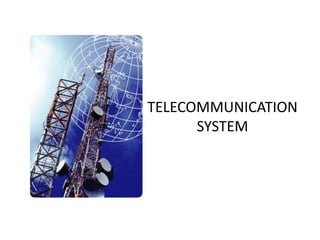
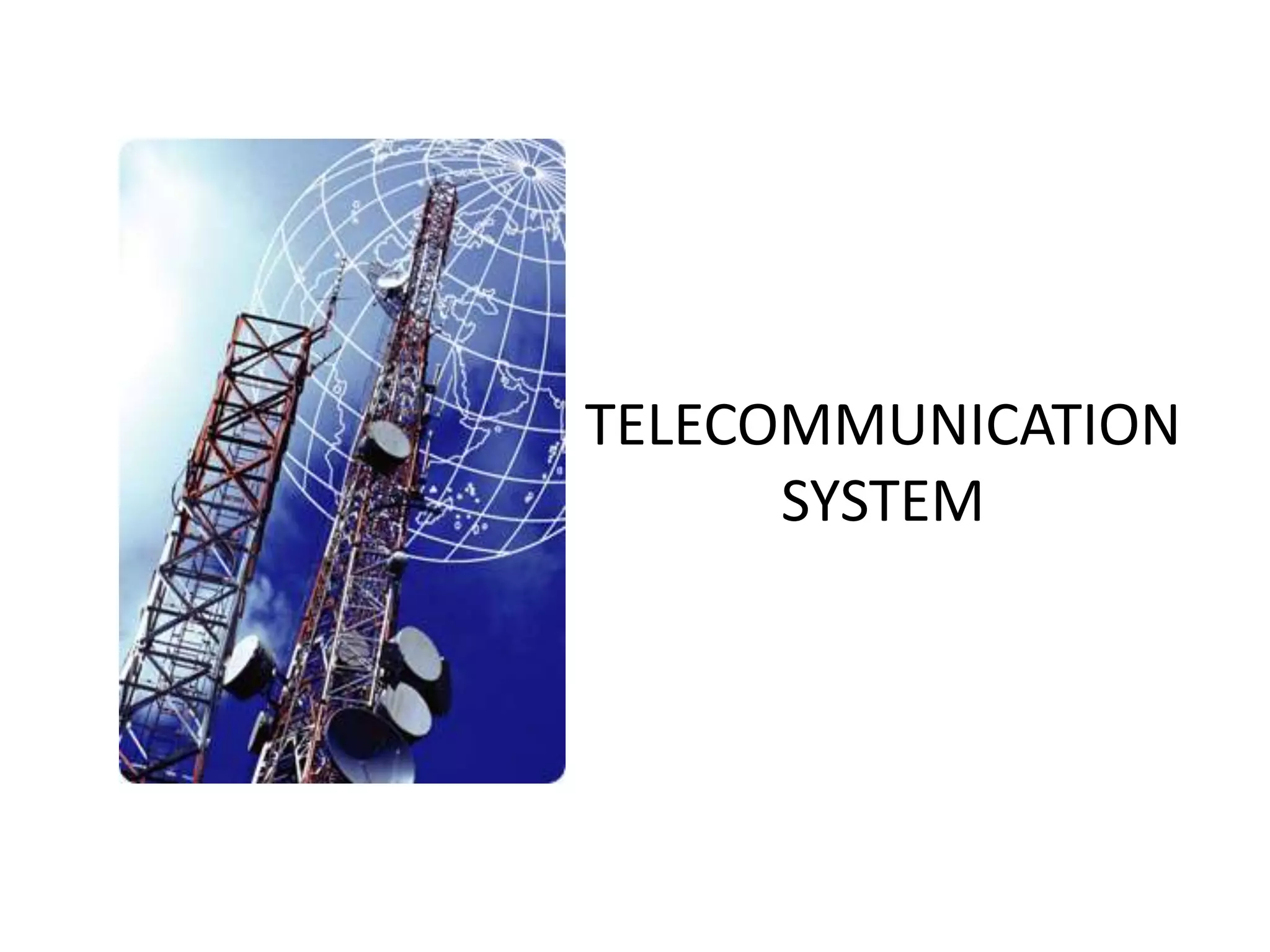
TELECOMMUNICATION SYSTEM
Telecommunication is the transmission of information over significant distances to communicate. In earlier times, telecommunications involved the use of visual signals, such as beacons, smoke signals, semaphore telegraphs, signal flags,
Simplex communication refers to communication that occurs in one direction only
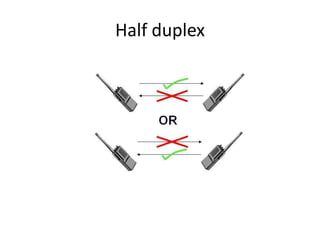
Half duplex
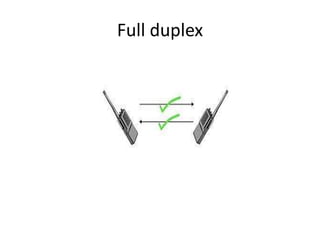
Full duplex
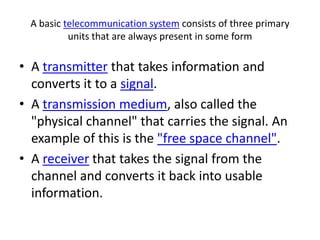
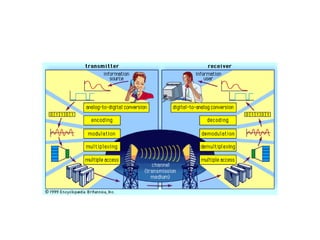
A basic telecommunication system consists of three primary units that are always present in some formA transmitter that takes information and converts it to a signal.A transmission medium, also called the "physical channel" that carries the signal. An example of this is the "free space channel".A receiver that takes the signal from the channel and converts it back into usable information.
Telecom The network used to connect the telephone to telephone exchange.The connection between telephone and exchange can be two copper wire or wave. If copper wires are used it is called wired connection.This connection also can be provided by a radio wave. It is called a wireless
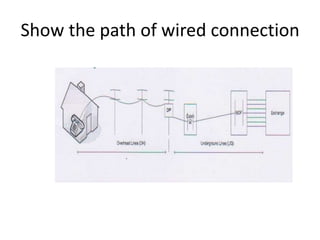
Show the path of wired connection
Stages involved to a wired connectionTelephone exchangeMDFCabinetDPTelephone
The function of telephone exchangeWhen a telephone dials a number it is received by the telephone exchange and analyses the number and connect to the relevant telephone via the remote exchange.For the calls received from the remote exchange the originated telephone exchange checks whether the relevant telephone is free or busy. If the telephone is busy the busy tone is sent to the other exchange. If the telephone is not busy the ring back tone is sent to the other exchange.
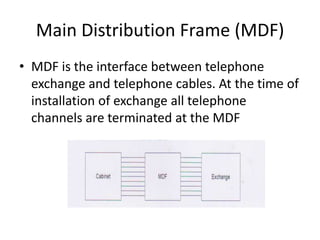
Main Distribution Frame (MDF)MDF is the interface between telephone exchange and telephone cables. At the time of installation of exchange all telephone channels are terminated at the MDF
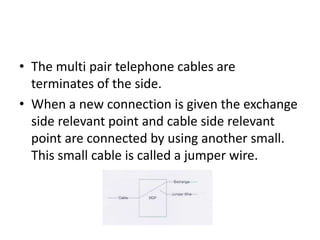
The multi pair telephone cables are terminates of the side.When a new connection is given the exchange side relevant point and cable side relevant point are connected by using another small. This small cable is called a jumper wire.
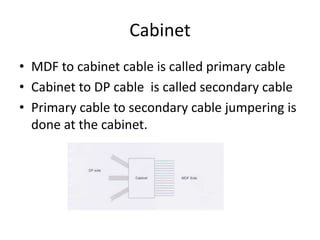
Cabinet MDF to cabinet cable is called primary cableCabinet to DP cable  is called secondary cablePrimary cable to secondary cable jumpering is done at the cabinet.
Distribution Point	A 10 pair or 5 pair cable is laid from cabinet to distribution point (DP). That means there are 10 loops or 5 loops in a DP. When a new connection is provided a pair of cable is drawn from DP to home
The works to be done to provide a telephone new connectionDP to house cabling ( over head cabling)Jumpering at MDFThe telephone exchange identifies a free line.Allocate a telephone number from the exchange and program it in the exchange
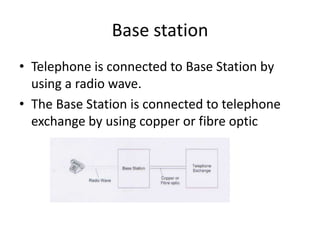
Base stationTelephone is connected to Base Station by using a radio wave. The Base Station is connected to telephone exchange by using copper or fibre optic
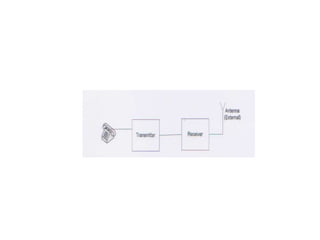
The components in Base StationTransmitterReceiverAntenna
The components of Customer PremisesTransmitterReceiverAntennaTelephone
Telephone componentsMicrophoneEarphoneDialbell
Building characteristic in telephone installationNumber storeyThe size of cable pairsFloor area
Telephone cable incoming sizeCategories 1More than 5 storey and the area of floor exceeding incoming 650 m2. Incoming size cable exceeding of 50 pairs.Categories 2Less than 5 storey and floor area less than 650 m2. Incoming size less than 50 pairs of cables.Categories 3Detached houses or bungalows for residential. 1 pairs of cable size.
Characteristic for domestic telecommunication wiringThe grey colored cable should be used for domestic telecommunication system wiring.The cable should be protected by a conduit pipe The cable should not be exposed to the weatherThe wiring cannot run on the ceilingThe wiring should be done in horizontal way or vertical way onlyBe precise on cable usage
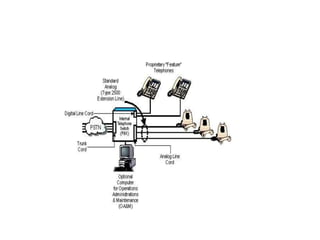
Private Branch Exchange (PBX) SystemThis diagram shows a private branch exchange (PBX) system. This diagram shows a PBX with telephone sets, voice mail system, and trunk connections to PSTN. The PBX switch calls between telephone sets and also provides them switched access to the PSTN. The voice mail depends on the PBX to switch all calls needing access to it along with the appropriate information to process the call.
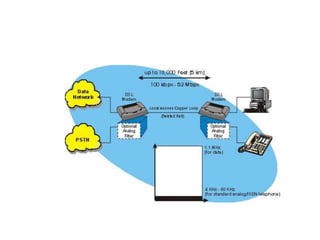
Digital Subscriber Line (DSL) SystemThis figure shows a basic DSL system. This diagram shows that the key to DSL technologies is a more efficient use of the 1 MHz of bandwidth available on a single pair of copper telephone lines. A DSL system consists of compatible modems on each end of the local loop. For some systems, the DSL system allows for multiple types of transmission on a single copper pair. This includes analog or ISDN telephone (e.g., POTS) and digital communications (ADSL or VDSL). This diagram shows that there are basic trade offs for DSL systems. Generally, the longer the distance of the copper line, the lower the data rate. Distances of less than 1,000 feet can achieve data rates of over 50 Mbps.
rate. Distances of less than 1,000 feet can achieve data rates of over 50 Mbps.

Telecommunication system

  • 1.
  • 2.
    Telecommunication is thetransmission of information over significant distances to communicate. In earlier times, telecommunications involved the use of visual signals, such as beacons, smoke signals, semaphore telegraphs, signal flags,
  • 3.
    Simplex communication refersto communication that occurs in one direction only
  • 4.
  • 5.
  • 6.
    A basic telecommunicationsystem consists of three primary units that are always present in some formA transmitter that takes information and converts it to a signal.A transmission medium, also called the "physical channel" that carries the signal. An example of this is the "free space channel".A receiver that takes the signal from the channel and converts it back into usable information.
  • 8.
    Telecom The networkused to connect the telephone to telephone exchange.The connection between telephone and exchange can be two copper wire or wave. If copper wires are used it is called wired connection.This connection also can be provided by a radio wave. It is called a wireless
  • 9.
    Show the pathof wired connection
  • 10.
    Stages involved toa wired connectionTelephone exchangeMDFCabinetDPTelephone
  • 11.
    The function oftelephone exchangeWhen a telephone dials a number it is received by the telephone exchange and analyses the number and connect to the relevant telephone via the remote exchange.For the calls received from the remote exchange the originated telephone exchange checks whether the relevant telephone is free or busy. If the telephone is busy the busy tone is sent to the other exchange. If the telephone is not busy the ring back tone is sent to the other exchange.
  • 12.
    Main Distribution Frame(MDF)MDF is the interface between telephone exchange and telephone cables. At the time of installation of exchange all telephone channels are terminated at the MDF
  • 13.
    The multi pairtelephone cables are terminates of the side.When a new connection is given the exchange side relevant point and cable side relevant point are connected by using another small. This small cable is called a jumper wire.
  • 14.
    Cabinet MDF tocabinet cable is called primary cableCabinet to DP cable is called secondary cablePrimary cable to secondary cable jumpering is done at the cabinet.
  • 15.
    Distribution Point A 10pair or 5 pair cable is laid from cabinet to distribution point (DP). That means there are 10 loops or 5 loops in a DP. When a new connection is provided a pair of cable is drawn from DP to home
  • 16.
    The works tobe done to provide a telephone new connectionDP to house cabling ( over head cabling)Jumpering at MDFThe telephone exchange identifies a free line.Allocate a telephone number from the exchange and program it in the exchange
  • 17.
    Base stationTelephone isconnected to Base Station by using a radio wave. The Base Station is connected to telephone exchange by using copper or fibre optic
  • 18.
    The components inBase StationTransmitterReceiverAntenna
  • 19.
    The components ofCustomer PremisesTransmitterReceiverAntennaTelephone
  • 21.
  • 22.
    Building characteristic intelephone installationNumber storeyThe size of cable pairsFloor area
  • 23.
    Telephone cable incomingsizeCategories 1More than 5 storey and the area of floor exceeding incoming 650 m2. Incoming size cable exceeding of 50 pairs.Categories 2Less than 5 storey and floor area less than 650 m2. Incoming size less than 50 pairs of cables.Categories 3Detached houses or bungalows for residential. 1 pairs of cable size.
  • 24.
    Characteristic for domestictelecommunication wiringThe grey colored cable should be used for domestic telecommunication system wiring.The cable should be protected by a conduit pipe The cable should not be exposed to the weatherThe wiring cannot run on the ceilingThe wiring should be done in horizontal way or vertical way onlyBe precise on cable usage
  • 25.
    Private Branch Exchange(PBX) SystemThis diagram shows a private branch exchange (PBX) system. This diagram shows a PBX with telephone sets, voice mail system, and trunk connections to PSTN. The PBX switch calls between telephone sets and also provides them switched access to the PSTN. The voice mail depends on the PBX to switch all calls needing access to it along with the appropriate information to process the call.
  • 27.
    Digital Subscriber Line(DSL) SystemThis figure shows a basic DSL system. This diagram shows that the key to DSL technologies is a more efficient use of the 1 MHz of bandwidth available on a single pair of copper telephone lines. A DSL system consists of compatible modems on each end of the local loop. For some systems, the DSL system allows for multiple types of transmission on a single copper pair. This includes analog or ISDN telephone (e.g., POTS) and digital communications (ADSL or VDSL). This diagram shows that there are basic trade offs for DSL systems. Generally, the longer the distance of the copper line, the lower the data rate. Distances of less than 1,000 feet can achieve data rates of over 50 Mbps.
  • 28.
    rate. Distances ofless than 1,000 feet can achieve data rates of over 50 Mbps.