3G 
TECHNOLOGY 
Presented by, 
Anushree Nene. 
Guided by, 
Prof. Ila Sawant .
CONTENTS 
 Wireless Technology 
 First generation (1G) 
 Second generation (2G) 
 Need for 3G 
 Literature survey 
 Standards of 3G 
 CDMA2000 evolution to 3G 
 3GPP family technologies evolution 
 Features of 3G 
 Applications of 3G 
 Advantages & Disadvantages 
 Fourth generation (4G) 
 Fifth generation (5G)
WIRELESS TECHNOLOGY 
 The word wireless is dictionary defined as 
“having no wires.” 
 In networking technology , wireless means 
any computer where there is no physical 
wired connection between sender and 
receiver. 
 Radio waves or microwaves used to 
maintain communications.
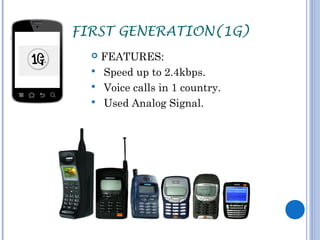
FIRST GENERATION(1G) 
 FEATURES: 
 Speed up to 2.4kbps. 
 Voice calls in 1 country. 
 Used Analog Signal.
SECOND GENERATION(2G) 
 Based on GSM. 
 Launched in1991. 
 Digital signals. 
 Data speed up to 64kbps. 
 Text messages, picture 
messages, MMS. 
 Better quality and capacity.
DRAWBACKS OF 2G 
 GSM does not support high data rates 
 Inefficient usage of bandwidth and 
resources 
 Unable to handle complex data 
 Reduced range of sound 
 Weaker digital signal
NEED FOR 3G! 
 80% of wireless subscribers 
 Demand for high speed data services 
 Interest in multimedia services 
 To remove drawbacks of 2g
LITERATURE SURVEY OF 3G 
o First launched by : NTT DOCOMO 
o BRANDED FOMA 
o Pre-release of WCDMA technology 
o 3G in India 
o Approved by MTNL 
o Place : Delhi , Mumbai 
o Date : 11 December 2008
STANDARDS OF 3G 
 UMTS system in 2001. 
Standardized by 3GPP 
Used in Japan, China 
UMTS & GSM hybrid cell phones 
 CDMA2000 system in 2002. 
Standardized by 3GPP2 
Used in North America 
Infrastructure IS-95 std 
 EVDO Rev B offers peak rates of 14.7 
Mbit/s 
 (Oct. 2007) WiMAX profile of 
IEEE802.16 added as a sixth radio 
interface technology
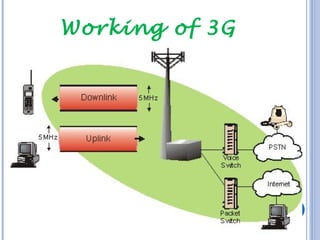
Working of 3G
12
Shortcut Name Download Upload Display 
GSM 
Global System 
for Mobile 
Communicatio 
ns 
14,4 Kbit/s 14,4 Kbit/s 2G 
GPRS 
General 
Packet Radio 
Service 
53,6 Kbit/s 26,8 Kbit/s G 
EDGE 
Enhanced 
Data Rate for 
GSM 
Evolution 
217,6 Kbit/s 108,8 Kbit/s E 
UMTS 
Universal 
Mobile 
Telecommunic 
ation Service 
384 Kbit/s 384 Kbit/s 3G 
HSPA High Speed 
Packed Access 7,2 M bit/s 1,4 Mbit/s H 
HSPA+ 
Evolved High 
Speed Packed 
Access 
84 M bit/s 10,8 Mbit/s H+ 
LTE Long Term 
Evolution 100 M bit/s 50 Mbit/s 4G
FEATURES OF 3G 
 Seamless roaming. 
 Data rates : 
 2 Mbit/s for stationary 
 384 kbit/s in a moving vehicle 
 High speed WEB. 
 Greater security 
 Improved voice quality.
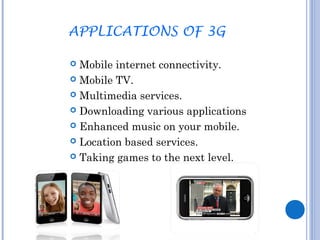
APPLICATIONS OF 3G 
 Mobile internet connectivity. 
 Mobile TV. 
 Multimedia services. 
 Downloading various applications 
 Enhanced music on your mobile. 
 Location based services. 
 Taking games to the next level.
ADVANTAGES OF 3G 
 Support for multimedia data applications 
such as video and photography. 
 Faster data transfer rates. 
 Cheap call rates worldwide. 
 Capability to determine geographic 
position of mobiles and report it. 
 Anywhere access to internet.
DISADVANTAGES OF 3G 
 High spectrum licensing fees. 
 Huge capital required to build 
infrastructure. 
 Health impact because of the 
electromagnetic waves. 
 Comparatively higher prices. 
 Majority of users preferring 2G services.
4G 
Technology
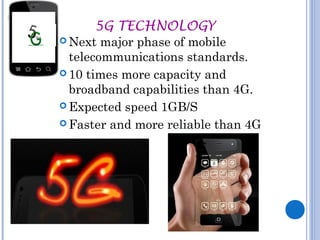
5G TECHNOLOGY 
Next major phase of mobile 
telecommunications standards. 
10 times more capacity and 
broadband capabilities than 4G. 
Expected speed 1GB/S 
Faster and more reliable than 4G
3 g (3rd generation mobile technology)

3 g (3rd generation mobile technology)

  • 1.
    3G TECHNOLOGY Presentedby, Anushree Nene. Guided by, Prof. Ila Sawant .
  • 2.
    CONTENTS  WirelessTechnology  First generation (1G)  Second generation (2G)  Need for 3G  Literature survey  Standards of 3G  CDMA2000 evolution to 3G  3GPP family technologies evolution  Features of 3G  Applications of 3G  Advantages & Disadvantages  Fourth generation (4G)  Fifth generation (5G)
  • 3.
    WIRELESS TECHNOLOGY The word wireless is dictionary defined as “having no wires.”  In networking technology , wireless means any computer where there is no physical wired connection between sender and receiver.  Radio waves or microwaves used to maintain communications.
  • 4.
    FIRST GENERATION(1G) FEATURES:  Speed up to 2.4kbps.  Voice calls in 1 country.  Used Analog Signal.
  • 6.
    SECOND GENERATION(2G) Based on GSM.  Launched in1991.  Digital signals.  Data speed up to 64kbps.  Text messages, picture messages, MMS.  Better quality and capacity.
  • 7.
    DRAWBACKS OF 2G  GSM does not support high data rates  Inefficient usage of bandwidth and resources  Unable to handle complex data  Reduced range of sound  Weaker digital signal
  • 8.
    NEED FOR 3G!  80% of wireless subscribers  Demand for high speed data services  Interest in multimedia services  To remove drawbacks of 2g
  • 9.
    LITERATURE SURVEY OF3G o First launched by : NTT DOCOMO o BRANDED FOMA o Pre-release of WCDMA technology o 3G in India o Approved by MTNL o Place : Delhi , Mumbai o Date : 11 December 2008
  • 10.
    STANDARDS OF 3G  UMTS system in 2001. Standardized by 3GPP Used in Japan, China UMTS & GSM hybrid cell phones  CDMA2000 system in 2002. Standardized by 3GPP2 Used in North America Infrastructure IS-95 std  EVDO Rev B offers peak rates of 14.7 Mbit/s  (Oct. 2007) WiMAX profile of IEEE802.16 added as a sixth radio interface technology
  • 11.
  • 12.
  • 13.
    Shortcut Name DownloadUpload Display GSM Global System for Mobile Communicatio ns 14,4 Kbit/s 14,4 Kbit/s 2G GPRS General Packet Radio Service 53,6 Kbit/s 26,8 Kbit/s G EDGE Enhanced Data Rate for GSM Evolution 217,6 Kbit/s 108,8 Kbit/s E UMTS Universal Mobile Telecommunic ation Service 384 Kbit/s 384 Kbit/s 3G HSPA High Speed Packed Access 7,2 M bit/s 1,4 Mbit/s H HSPA+ Evolved High Speed Packed Access 84 M bit/s 10,8 Mbit/s H+ LTE Long Term Evolution 100 M bit/s 50 Mbit/s 4G
  • 14.
    FEATURES OF 3G  Seamless roaming.  Data rates :  2 Mbit/s for stationary  384 kbit/s in a moving vehicle  High speed WEB.  Greater security  Improved voice quality.
  • 15.
    APPLICATIONS OF 3G  Mobile internet connectivity.  Mobile TV.  Multimedia services.  Downloading various applications  Enhanced music on your mobile.  Location based services.  Taking games to the next level.
  • 16.
    ADVANTAGES OF 3G  Support for multimedia data applications such as video and photography.  Faster data transfer rates.  Cheap call rates worldwide.  Capability to determine geographic position of mobiles and report it.  Anywhere access to internet.
  • 17.
    DISADVANTAGES OF 3G  High spectrum licensing fees.  Huge capital required to build infrastructure.  Health impact because of the electromagnetic waves.  Comparatively higher prices.  Majority of users preferring 2G services.
  • 18.
  • 19.
    5G TECHNOLOGY Nextmajor phase of mobile telecommunications standards. 10 times more capacity and broadband capabilities than 4G. Expected speed 1GB/S Faster and more reliable than 4G