Embrace and Enliven the  World of Snakes  Renuka Rajasekaran
1 Snake: Variety
Variety is the Spice of Life From the poisonous types to the pets, snakes come in different forms, sizes, shapes, and colors.
World Distribution of Snakes Snakes occur practically all over the world, apart from places like Greenland, Iceland, and Antarctica. However, it is in the tropical regions of the world that most snakes are found.
Snakes: Big and Small From enormous ones like the python, which can swallow animals as large as a deer whole, to snakes that are just a few inches long. As for the size, while the anaconda can grow up to 38 feet in length, the brahminy blind snake is just 2 inches long, making it the smallest snake.  Picture Courtesy Top:  http://geology.com/press-release/top-ten-species-2009/smallest-snake.jpg Bottom: http://pileofphotos.com/pics/pic_1177049578.jpg
Snakes: Habitats Snakes can be found in all types of habitats. While some climb trees, others live underground, and still others are found in the waters of lakes and even seas.
2 Snake: Goodness
Snake is Older than Man Man evolved only after snake. Fossil and  DNA  evidence suggests that the snakes were already around when the  first mammals  evolved some 100 million years ago. The  reptiles  were thus among the first serious predators mammals faced.  Picture courtesy  top: http://www.saudicaves.com/starwell/snake.jpg bottom http://www.twilightearth.com/wp-content/uploads/2008/12/whitelemuroidpossum.jpg
The First Snakes Early snakes killed their prey using surprise attacks and by suffocating them to death—the method of  boa constrictors .  Picture Courtesy http://pileofphotos.com/pics/pic_1177049582.jpg
Snakes became Venomous Only Later!  The improved vision of primates, combined with other snake-coping strategies developed by other animals, forced snakes to evolve a new weapon:  venom . This important milestone in snake evolution occurred about 60 million years ago. Picture Courtesy: http://funnyhub.com/content_images/5525_2763_snake-bites-face.jpg
Snakes became Venomous only by Compulsion of Circumstances!! There are around 3000 snake species in the world, and about 375 of these are only venomous.
3  Snake: Features
Snake: General Anatomic Structure
Color: Why are Snakes Colored? Snakes occur in a large variety of colors, ranging from dull to brilliant hues with striking patterns. Snakes that have dull coloring use it for camouflage, while those that are brightly colored are usually poisonous. They use their bright colors to warn predators to stay off. Some non-poisonous snakes mimic the patterns and bright colors of poisonous snakes to fool predators.
Snake: Cold-bloodedness and Topicality Like all reptiles, snakes are cold-blooded, which means they do not have the ability of generating adequate amounts of heat in order to keep their body temperature at a constant level.  Instead, they are dependent on the heat from their surroundings and the sun to control the temperature of their body. This is the reason most snake species are found in the humid and warm climes of tropical regions.
Do Snakes have Eyes and Ears? Snakes do not have any eyelids; instead, a transparent scale protects their eyes.  Picture courtesy http://www.photovault.com/Link/Animals/Reptiles/Snakes/ARSVolume01/ARSV01P04_08B.1713.tn.jpg
Snake’s Vision A snake’s vision is mainly used for detecting movement of prey. They have difficulty seeing motionless prey or enemies. Objects probably appear as a blur at 40 feet, but at 10 to 15 feet, the objects appear sharper. The vision of many snakes, like the rattlesnake, is better suited for nocturnal searching. Some species, such as racers and garter snakes, have eyes specialized for daytime activity. Snakes appear to stare at their prey because they have no eyelids. The eyes of snakes are lidless, but are protected by a tough, transparent covering, or scale, that is shed with the skin. The pupil or the black portion of a rattlesnake’s eye is elliptical, not round as found with the nonvenomous snakes. (Figure compliments of Missouri Dept. of Conservation)
Blind Snake This species, like many of the others in this family, resembles a long earthworm. It lives underground in burrows, and since it has no use for vision, its eyes are mostly  vestigial .  Picture Courtesy http://upload.wikimedia.org/wikipedia/commons/thumb/f/f6/Leptotyphlops_humilis.jpg/240px-Leptotyphlops_humilis.jpg
Snake: Hearing Snakes do not have external ears and are probably deaf to most sounds. They "hear" by sensing ground vibrations with their belly scales and lower jaw. Picture courtesy: Top:  http://www.fotosearch.com/bthumb/STK/STK021/PCL17794.jpg Bottom http://www.molon.de/galleries/India/Rajahstan/Jaipur/Misc/images01/07%20Cobra%20and%20snake%20charmer.jpg
Snakes can Smell  Snakes have elongated movable forked mouthpart (tongue-like) having olfactory, tactile, and gustatory functions; it is not used to ingest food Snakes use their forked tongue to smell.  The tongue gathers particles that are airborne which it then passes to the Jacobson’s Organ, a specialized organ located on the roof of the snake’s mouth.  .  Picture Courtesy http://animals.nationalgeographic.com/staticfiles/NGS/Shared/StaticFiles/animals/images/150/Snake%20gallery%20images%20150/snake-tongue-tn.jpg
Meticulous Detection of Prey Pit organs enable a snake to locate prey by the body heat the animal gives off. As the snake moves its head from side to side, the pit organs detect changes in the air temperature. The snake can accurately direct its strike even in the dark.  Picture courtesy: World Book diagram by Patricia J. Wynne
Swallow Huge Preys Snakes have the unique ability of swallowing prey three times larger than their mouth. They can do this because the special tendons located in their mouth are highly stretchable and because the two halves of their jaws are not attached to each other rigidly.
Hollow Fangs Inject Venom The teeth of venomous vipers, adders, mambas and cobras include hollow fangs that inject tissue-digesting and/or neurotoxic venom, under pressure, via tubes attached to venom sacs positioned in the lateral posterior of the head. Picture courtesy http://visual.merriam-webster.com/images/animal-kingdom/reptiles/snake/morphology-venomous-snake-head.jpg
Snake has More than 200 Teeth Snakes have more than 200 teeth, which they do not use to chew, since they point backwards, but bite and grip their prey securely.  Picture courtesy Top:  http://www.bugsinthenews.com/Head_with_teeth.jpg Bottom:  http://www.bugsinthenews.com/Cottonmouth%20gape%2001%203%20annot.jpg
Snake’s Diet Control Snakes have the ability of surviving without food for many days at a stretch after having a filling meal. This is because they have a slow rate of metabolism. In fact, the King Cobra, for example, can go for months without food.  Picture courtesy http://www.google.com/images?q=tbn:39C4WyGW2RmeBM::www.avidpets.com/images/ballpython.jpg&h=94&w=130&usg=__ZtOm72HHrVi56hTcRqz1V5a9Zrk=
4  Snake: Molting
Molting or Ecdysis Just like us, snakes constantly grow new skin cells and must shed the old skin cells. We shed our old skin cells continuously in small quantities, but snakes shed their old skins in a continuous sheet (a process called  ecdysis ).  Picture courtesy; http://z.about.com/d/exoticpets/1/G/A/J/1/snakeskin_imageafter.JPG
Molting: The Transmutation Process Many religious philosophers believe that the transmutation of birth-death-rebirth cycle is exemplified by the shedding of snake’s skin.
Molting Frequency  A snake indulges in molting approximately 4 to 8 times per year. The interval between sheds depends on several factors, including age, growth rate, and environmental factors. Young, growing snakes shed frequently (every few weeks); adult snakes shed less often, perhaps a few times a year, sometimes less.  Picture courtesy http://www.google.com/images?q=tbn:g8ATF-7q7YmStM::cache.eb.com/eb/image%253Fid%253D66413%2526rendTypeId%253D4&h=94&w=147&usg=__8EWGQ-u0XyOidSoPFQa-koxorz4=
Signs of a Snake Ready to Molt  Eyes turn a cloudy, bluish color (the eye cap, a specially adapted scale which covers the eye, is loosened up in order to be shed along with the skin, which causes this change). Just prior to shedding, the eyes will clear up again.  Skin becomes dull or hazy in appearance (sometimes the belly may appear a little pink at first)  Your snake may hide more than usual and go off food.  Your snake may become more skittish or defensive because it can't see well.  When your snake is ready to shed, he or she will seek out rough surfaces in the enclosure to help rub the skin off.  Picture Courtesy Top http://i.ehow.com/images/GlobalPhoto/Articles/4687785/96641-main_Full.jpg Bottom http://www.snakepictures.co.uk/images/snake_picture_111.jpg
Molting: The Discarded Skin Snakes shed their skin by rubbing their head against something rough and hard, like a piece of wood or a rock. This causes the skin, which is already stretched, to split open. The snake keeps on rubbing its skin on various rough objects, resulting in the skin peeling off from its head, enabling it to crawl out, turning the skin inside out.  Picture courtesy http://www.snakepictures.co.uk/images/snake_picture_113.jpg
5  Snake: Skeleton and Hood
Snake Head: Wonderful Technological Piece Look at the precise engineering principles laden in the structure of a snake’s skull. The skeleton of a snake, though sometimes described as a simple structure, is anything but.  A complicated--architecturally and functionally--skull at its head
Snake: Skeleton – High Technology The head is followed, to the tail, by at least five divisions of vertebral structures.  First come two un-ribbed "Atlas" vertebrae, followed by 1-3  un-ribbed neck vertebrae. Next follow from 100-600 ribbed mid-body vertebrae and 2-10 un-ribbed pre-pelvic and pelvic vertebrae.  These are attached to a variable number of un-ribbed tail vertebrae that are often modified, individually and collectively, to perform specialized functions peculiar to the species. 
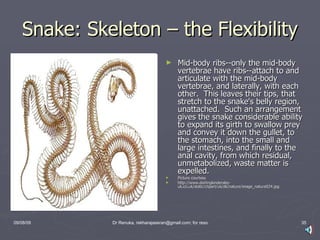
Snake: Skeleton – the Flexibility Mid-body ribs--only the mid-body vertebrae have ribs--attach to and articulate with the mid-body vertebrae, and laterally, with each other.  This leaves their tips, that stretch to the snake's belly region, unattached.  Such an arrangement gives the snake considerable ability to expand its girth to swallow prey and convey it down the gullet, to the stomach, into the small and large intestines, and finally to the anal cavity, from which residual, unmetabolized, waste matter is expelled. Picture courtesy http://www.dorlingkindersley-uk.co.uk/static/clipart/uk/dk/nature/image_nature024.jpg
The Mysterious Hood When disturbed, most of these snakes can rear up and spread their neck (or hood) in a characteristic threat display. However, not all snakes referred to as cobras are of the same genus, or even of the same family.
Snake: The Unintelligent Brain The snake's brain (in structure) is very similar to a bird's brain but the snakes lacks the enlarged cerebral hemispheres found in birds and mammals. The cerebral is the part of the brain, which contains the learning.  Sine the absence of the cerebral hemispheres, it is correct to say that snakes aren't very intelligent. But they can learn a fair amount. Some snakes have learnt when their feeding times are and often the owner will find them waiting.
6  Snake: Drape
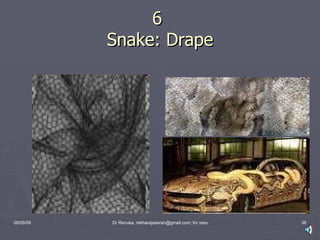
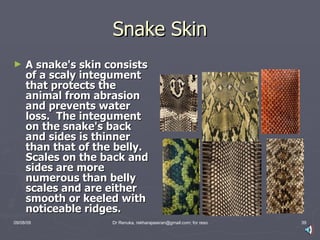
Snake Skin A snake's skin consists of a scaly integument that protects the animal from abrasion and prevents water loss.  The integument on the snake's back and sides is thinner than that of the belly.  Scales on the back and sides are more numerous than belly scales and are either smooth or keeled with noticeable ridges.
Belly Scales Belly scales, also referred to as scutes, are thick and large, and are commonly arranged in narrow strips that extend from one side of the belly to the other; under-tail scales--those extending beyond the snake's venter--are either singular like those of the belly, divided, or initially singular then divided; the particular arrangement of the under-tail scales is distinctive to a species.  Picture courtesy Top:  http://www.google.com/images?q=tbn:--  tTP8n_57GHiM::img2.photographersdirect.com/img/25343/wm/pd2390017.jpg&h=94&w=141&usg=__bNuFyktc_ndXepYxBMhJRcXs9Gs=  Bottom: http://www.google.com/images?q=tbn:wRD6vP6MRWeBRM::museum.gov.ns.ca/mnh/nature/snakes/img0015.jpg&h=94&w=142&usg=__LRrChXLoBNfHSTpsoO0LVkB14gg=
7 Snake: Coiling Nature
Snakes Coil for Reasons  Snakes coil in order to contain their body within a controllable space Second, being cold-blooded, in order to conserve their heat, snakes coil up tightly, so that only a small portion of their skin is exposed to colder air.
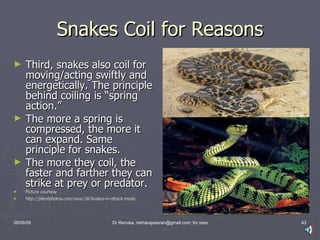
Snakes Coil for Reasons Third, snakes also coil for moving/acting swiftly and energetically. The principle behind coiling is “spring action.” The more a spring is compressed, the more it can expand. Same principle for snakes. The more they coil, the faster and farther they can strike at prey or predator.  Picture courtesy http://pileofphotos.com/view/18/Snakes-in-attack-mode
Snakes Coil for Seasons When conditions become too cold, snakes seek out protected sites, such as underground dens, where they pass the winter in a state of reduced activity similar to  hibernation .  Top: Snakes getting into hibernation Bottom: Snakes emerging from hibernation Picture courtesy http://www.ardea.com/cache/tcache2/80021233.JPG Bottom: http://www.ardea.com/cache/pcache/00003298.jpg
Coiling Nature: Left or Right Adult snakes (16 of 20 snakes) preferred to coil in the clockwise direction. Many female snakes (15 of 20 snakes), but few male snakes (only 4 of 10 snakes), also tended to coil in a clockwise pattern.  Dr. Roth suggests that the location of internal organs such as the lungs, kidney and stomach may affect coiling direction. For example, in some snakes, the right lung is pushed aside by the stomach and the left lung is smaller than the right lung. These anatomical features may influence coiling direction so that the snake can maximize behaviors such as striking or regulating body temperature. Coiling direction may also be influenced by differences in the anatomy of the right and left sides of the snake brain. Just as humans have a right or left  brain dominance  for many behaviors, snakes may also have brain asymmetries to control what they do.  Roth, E.D., 'Handedness' in snakes? Lateralization of coiling behaviour in a cottonmouth,  Agkistrodon piscivorus leucostoma , population.  Animal Behaviour , 66:337-341, 2003.
8 Snake Locomotion
Snake Walks Without Legs Snakes are highly evolved reptiles. They move quickly without legs, which gives them some advantage over reptiles that push themselves along with legs while dragging their bellies on the ground. But how is it possible to move without legs?
The Crawling Styles Although we usually say that snakes crawl, they can actually move in different ways Serpentine movement, Concertina movement, Rectilinear creeping, and Sidewinding.  The type of movement used depends largely on the terrain. Picture courtesy http://www.google.com/images?q=tbn:A1cR4K9tWInkUM::www.coral-snake.com/images/clip_image004_0001.jpg&h=94&w=87&usg=__AZMUwkiwE9IXVDmZpZxJcz1hehw=
Serpentine Movement The most common type of snake movement is called lateral undulation, or serpentine movement.  In this style of movement, a snake alternately tightens and relaxes a set of muscles along each side of its body to produce horizontal waves that travel down the body. At the same time, the snake orients itself so that its tail pushes against a resisting force, such as land, water, or tree branches. Moving in this way, some snakes achieve speeds up to 10 km/h (6 mph).
9 Snake: Moral and Spiritual Significance
Snake: The Creator of Human Civilization More commonly in Christianity, the serpent has been seen as a representative of  evil  and sly plotting, which can be seen in the description in  Genesis  chapter 3 of a snake in the  Garden of Eden  tempting  Eve .  Saint Patrick  is reputed to have expelled all snakes from  Ireland  while Christianising the country in the 5th century, thus explaining the absence of snakes there. Picture Courtesy: http://t2.gstatic.com/images?q=tbn:GRfKWM6rxWXZgM:http://www.christusrex.org/www1/sistine/6-Serpent.jpg
Snake: Integral Part of Church Worship However, in  Christianity ,  Christ 's redemptive work is compared to saving one's life through beholding the  Serpent  of  brass  ( Gospel of John  3:14).  Snake handlers  use snakes as an integral part of church worship in order to exhibit their faith in divine protection.
Snake Worship Precedes Idol Worship Snakes have occupied a special niche in human life
Snake: Psychic Energy Generally, Snake represents wisdom, rebirth, initiation and resurrection. Both the Celts and Native Americans believed Snake symbolizes transmutation, the ability to alter appearance nature, and form, particularly to higher ones. Snake totem is the power of creation and embodies immortality and psychic energy. He has fire energy which, emotionally, are charisma, intellect, power and the intellect; spiritually, connection with Spirit, wisdom, wholeness and understanding. On the physical level, they are vitality and passion. Picture Courtesy https://images.stanzapub.com/readers/2008/11/30/nag_1.jpg
Snake:  Symbol of Health and Wealth The Hindu people believe that Snake Gods are associated with wealth and healthy life and they will act as great securities when the people meet difficulties in their life. It is also believed that Snake Gods are having separate world and Shri Nagarajan (male kobra) and Shri Nagarani (female kobra)  are ruling that world.
Snake: The Healing Power To the Celts, Adder symbolized transmutation, life’s energy and healing. He signifies getting rid old the old for the better new, reincarnation, wisdom and cunning. Further reading  http://paganismwicca.suite101.com/article.cfm/snake_pagan_symbol_transmutation#ixzz0QQTYnPR9 Statue of Asclepius in the  Pergamon  Museum ,  Berlin
Snake: The Magical Power The English believed the skin had magical properties. It could draw thorns from the body, hung on the chimney attracted luck and hung on the rafters, prevented fires. To see Adder near the front door was a death omen. Native Americans also believed that snake symbolized transmutation.  Picture courtesy http://blogs.tampabay.com/.a/6a00d83451b05569e20120a519b7b2970b-600wi
Snake: The Symbol of Consciousness “ Snake molting symbolizes the energy of wholeness, consciousness, and the ability to experience anything willingly without resistance.” Picture Courtesy http://www.usefilm.com/images/6/0/1/5/6015/1539966-medium.jpg
Snake: Symbol of  Supreme Nature It is the knowledge that all things are equal in creation ---” Picture Courtesy http://upload.wikimedia.org/wikipedia/en/thumb/f/f8/Buddha_shielded_by_Naga.jpg/180px-Buddha_shielded_by_Naga.jpg
10  Snake in Art and Culture:  Snake Dance
Snake Dance: An Integral Component of World’s Performing  Arts Picture Courtesy http://4.bp.blogs pot.com/_kxtHoOEH1a8/SPdbipp88VI/AAAAAAAAH6k/8C-R6Tb-8F0/s320/snake_dance.jpg
Snake Dance: Popular Even Today  Snakes are so blended with the culture of people that in various parts of the world, snake dance is a tradition art form. Picture courtesy http://z.hubpages.com/u/881796_f520.jpg
11  Snake: Reproduction
Mating and Copulation Snake mate so that they can have babies Copulation and Fertilization lead to the development of the babies. Videos cited below show how snakes mate www.youtube.com/watch?v=RgP7QcBxZpM   www.youtube.com/watch?v=jn1yrhBmj4g
Fertilization Modes Snakes produce offspring in 2 basic ways: Giving birth to young ones (viviparous) Egg-laying (oviparous) Picture courtesy http://www.snakeeducation.com/photos/snakes/PineSnake%20website%20size%20Sept%2006.JPG
Viviparous Reproduction The first involves development of the fertilized eggs within the body of the female. When the embryos are fully developed, the offspring are born, appearing like miniature adults. Boa constrictors, water and garter snakes, and rattlesnakes are live bearing species and are considered ovoviviparous.  For mating and birth of  snakes, view the following video video .nationalgeographic.com/ video /player/animals/reptiles-animals/ snakes /cobra_reproduction.html  -
Oviparous Reproduction The second method involves deposition of oblong, leathery-shelled eggs within the environment, where the eggs incubate. At the completion of embryonic development, the eggs hatch, producing miniature adults. Pythons and rat and mild snakes are egg layers, and are considered oviparous. In either case, the newborn or newly hatched can fend for themselves and receive no parental nurturing.  Picture Courtesy Top http://www.reptileworld.net.au/news%20pics/Snake%20Hatching.JPG Bottom http://pileofphotos.com/pics/pic_1177049585.jpg
12 Snake Longevity
Snakes: Live Long It is interesting to learn that snakes are capable of living for more than 30 years in captivity. Pythons and boas live the longest around 50 years in captivity Under natural conditions, they would live longer
Snakes Grow For Ever Snakes continue to grow throughout their lives, and the largest specimens of a species are usually the oldest.   http://www.popsci.com/files/imagecache/photogallery_image/files/articl es/rattlesnake_cytotox.jpg
13 Snakes are Precious
Man Kills Snakes Mercilessly Man has been the greatest destroyer of snakes Snakes are being killed by human beings for no good reasons Picture courtesy http://barfblog.foodsafety.ksu.edu/snakes-on-a-plane-5(1).jpg
Killing Continues Some of the species of snakes are actually endangered.  These endangered species are: • The San Francisco Garter snake that is found in California. • Eastern Indigo snake: Found in Alabama • The King Cobra: Found in India, the Philippines, Malaysia,  southeast Asia  and southern China. • Dumeril’s Boa: Found in Madagascar.  Picture Courtesy http://www.herpnet.net/Iowa-Herpetology/images/stories/reptiles/snakes/Heterodon_nasicus_Western_Hognose_Snake/Heterodon_nasicus_Western_hognose_snake_ventral_03_02.jpg
Man is Afraid of Snakes New research by psychologists suggests we are born ready to look for snakes. As this video reports, a series of experiments showed that people, even toddlers, tend to recognize and locate a snake faster than other plants and animals.  Picture Courtesy http://fohn.net/corn-snake-pictures-facts/corn-snake-pictures/snow-corn-snake.jpg
Save Snakes for a Better World Snakes are actually friendly creatures. In fact they are afraid of us, the human beings. They try to keep themselves away From human beings But man kills snakes for he/she has fear for snakes. This fear should go. Not all snakes are venomous By learning about poisonous snakes and about how to identify them, we can always protect ourselves from them because a snake even if it is venomous tries to escape from us unless it is absolutely necessary for it to bite or attack us Picture Courtesy http://comps.fotosearch.com/comp/IGS/IGS736/woman-taking-picture_~IS713-010.jpg
Our Fear of Snakes is Baseless:  Let Us Get Rid of Snake Fear Because we evolved much later to snakes and because we frequently see snakes and because we are aware that at least some of them are venomous, we have developed about snakes. It is a baseless fear. Let us get rid of it. Let us embrace snakes with fond and concern They are lovable creatures, magnanimous, and wonderful Let us protect them in our fold  Picture courtesy http://shoutaboutcarolina.com/wp-content/uploads/2009/01/peting-a-python-thats-constricting-its-prey-300x225.jpg
Picture Courtesy Slide 37 Top http://www.google.com/images?q=tbn:ThqlvvrAZyh3XM::www.dkimages.com/discover/previews/801/912181.JPG&h=86&w=143&usg=__xlvmX5Du0LMNTAiw3xxjpLdNHfY=\Bottom http://www.google.com/images?q=tbn:mm6_KykdzD3BZM::www.tapirback.com/tapirgal/gifts/friends/reptiles/cobra-snake-plastic-f450.jpg&h=94&w=128&usg=__wVhO0KXki58ef0s2vmQ_iDLvKG4= Slide 50 Middle http://www.snakecult8.com/snakepics/serpcross.jpg The picture on Left is Lord Krishna; the one on the right is Lord Shiva. Both are Hindu Gods Slide 53 Right http://www.google.com/images?q=tbn:7Cfxwkt0jvvZaM::www.languageinindia.com/oct2007/nagaworship.jpg&h=94&w=81&usg=__uSGjXlKqNrvj6wLOoUu9OJBKEPs = Left http://www.google.com/images?q=tbn:G1t53gimy-OgwM::www.snakecult8.com/snakepics/miss_hopi.JPG&h=94&w=75&usg=__YsfowLOMJtlWpjGsaooTy0vAXs8= Slide 55 Top:  http://upload.wikimedia.org/wikipedia/commons/thumb/1/15/Sarpa-Kavu-2.jpg/180px-Sarpa-Kavu-2.jpg Bottom http://upload.wikimedia.org/wikipedia/en/thumb/e/e8/Naga3.jpg/250px-Naga3.jpg Slide 61 Right http://www.google.com/images?q=tbn:BnxzdLHNB-TCIM::travelerstales.com/carpet/snake-dance.jpg&h=94&w=107&usg=__TlaQRHsFBru7hnhh239KFAFsdAo= Left http://www.google.com/images?q=tbn:Hyuhsn3axqME4M::www.best-horror-movies.com/images/from-dusk-till-dawn-snake-dance.jpg&h=94&w=75&usg=__7GmRzVYYvu-LVxEPHhyqV9FTk2I= Slide 68 http://wwwdelivery.superstock.com/WI/223/1555/PreviewComp/SuperStock_1555R-55037.jpg Slide 69 http://www.tees2greens.com/photos/forum_post_photos/images/3065/original.aspx Slide 70:  http://retiredrambler.typepad.com/tonys_ramblings/images/snake_man_01.jpg Others www.fotosearch.com
About this Presentation I have chosen this topic for it is highly relevant in today’s context of  the need to conserve snakes. The objective of the presentation is a simplistic overview of  the essential facts about snakes so that the audience understands and appreciates the uniqueness and goodwill of snakes. This a compilation of existing literature on snakes. It is hoped that the presentation will kindle in the minds of the audience an interest to know more about snakes and an urge to desist from torturing them
Embrace and Enliven the World of Snakes

Snakes

  • 1.
    Embrace and Enliventhe World of Snakes Renuka Rajasekaran
  • 2.
  • 3.
    Variety is theSpice of Life From the poisonous types to the pets, snakes come in different forms, sizes, shapes, and colors.
  • 4.
    World Distribution ofSnakes Snakes occur practically all over the world, apart from places like Greenland, Iceland, and Antarctica. However, it is in the tropical regions of the world that most snakes are found.
  • 5.
    Snakes: Big andSmall From enormous ones like the python, which can swallow animals as large as a deer whole, to snakes that are just a few inches long. As for the size, while the anaconda can grow up to 38 feet in length, the brahminy blind snake is just 2 inches long, making it the smallest snake. Picture Courtesy Top: http://geology.com/press-release/top-ten-species-2009/smallest-snake.jpg Bottom: http://pileofphotos.com/pics/pic_1177049578.jpg
  • 6.
    Snakes: Habitats Snakescan be found in all types of habitats. While some climb trees, others live underground, and still others are found in the waters of lakes and even seas.
  • 7.
  • 8.
    Snake is Olderthan Man Man evolved only after snake. Fossil and DNA evidence suggests that the snakes were already around when the first mammals evolved some 100 million years ago. The reptiles were thus among the first serious predators mammals faced. Picture courtesy top: http://www.saudicaves.com/starwell/snake.jpg bottom http://www.twilightearth.com/wp-content/uploads/2008/12/whitelemuroidpossum.jpg
  • 9.
    The First SnakesEarly snakes killed their prey using surprise attacks and by suffocating them to death—the method of boa constrictors . Picture Courtesy http://pileofphotos.com/pics/pic_1177049582.jpg
  • 10.
    Snakes became VenomousOnly Later! The improved vision of primates, combined with other snake-coping strategies developed by other animals, forced snakes to evolve a new weapon: venom . This important milestone in snake evolution occurred about 60 million years ago. Picture Courtesy: http://funnyhub.com/content_images/5525_2763_snake-bites-face.jpg
  • 11.
    Snakes became Venomousonly by Compulsion of Circumstances!! There are around 3000 snake species in the world, and about 375 of these are only venomous.
  • 12.
    3 Snake:Features
  • 13.
  • 14.
    Color: Why areSnakes Colored? Snakes occur in a large variety of colors, ranging from dull to brilliant hues with striking patterns. Snakes that have dull coloring use it for camouflage, while those that are brightly colored are usually poisonous. They use their bright colors to warn predators to stay off. Some non-poisonous snakes mimic the patterns and bright colors of poisonous snakes to fool predators.
  • 15.
    Snake: Cold-bloodedness andTopicality Like all reptiles, snakes are cold-blooded, which means they do not have the ability of generating adequate amounts of heat in order to keep their body temperature at a constant level. Instead, they are dependent on the heat from their surroundings and the sun to control the temperature of their body. This is the reason most snake species are found in the humid and warm climes of tropical regions.
  • 16.
    Do Snakes haveEyes and Ears? Snakes do not have any eyelids; instead, a transparent scale protects their eyes. Picture courtesy http://www.photovault.com/Link/Animals/Reptiles/Snakes/ARSVolume01/ARSV01P04_08B.1713.tn.jpg
  • 17.
    Snake’s Vision Asnake’s vision is mainly used for detecting movement of prey. They have difficulty seeing motionless prey or enemies. Objects probably appear as a blur at 40 feet, but at 10 to 15 feet, the objects appear sharper. The vision of many snakes, like the rattlesnake, is better suited for nocturnal searching. Some species, such as racers and garter snakes, have eyes specialized for daytime activity. Snakes appear to stare at their prey because they have no eyelids. The eyes of snakes are lidless, but are protected by a tough, transparent covering, or scale, that is shed with the skin. The pupil or the black portion of a rattlesnake’s eye is elliptical, not round as found with the nonvenomous snakes. (Figure compliments of Missouri Dept. of Conservation)
  • 18.
    Blind Snake Thisspecies, like many of the others in this family, resembles a long earthworm. It lives underground in burrows, and since it has no use for vision, its eyes are mostly vestigial . Picture Courtesy http://upload.wikimedia.org/wikipedia/commons/thumb/f/f6/Leptotyphlops_humilis.jpg/240px-Leptotyphlops_humilis.jpg
  • 19.
    Snake: Hearing Snakesdo not have external ears and are probably deaf to most sounds. They "hear" by sensing ground vibrations with their belly scales and lower jaw. Picture courtesy: Top: http://www.fotosearch.com/bthumb/STK/STK021/PCL17794.jpg Bottom http://www.molon.de/galleries/India/Rajahstan/Jaipur/Misc/images01/07%20Cobra%20and%20snake%20charmer.jpg
  • 20.
    Snakes can Smell Snakes have elongated movable forked mouthpart (tongue-like) having olfactory, tactile, and gustatory functions; it is not used to ingest food Snakes use their forked tongue to smell. The tongue gathers particles that are airborne which it then passes to the Jacobson’s Organ, a specialized organ located on the roof of the snake’s mouth. . Picture Courtesy http://animals.nationalgeographic.com/staticfiles/NGS/Shared/StaticFiles/animals/images/150/Snake%20gallery%20images%20150/snake-tongue-tn.jpg
  • 21.
    Meticulous Detection ofPrey Pit organs enable a snake to locate prey by the body heat the animal gives off. As the snake moves its head from side to side, the pit organs detect changes in the air temperature. The snake can accurately direct its strike even in the dark. Picture courtesy: World Book diagram by Patricia J. Wynne
  • 22.
    Swallow Huge PreysSnakes have the unique ability of swallowing prey three times larger than their mouth. They can do this because the special tendons located in their mouth are highly stretchable and because the two halves of their jaws are not attached to each other rigidly.
  • 23.
    Hollow Fangs InjectVenom The teeth of venomous vipers, adders, mambas and cobras include hollow fangs that inject tissue-digesting and/or neurotoxic venom, under pressure, via tubes attached to venom sacs positioned in the lateral posterior of the head. Picture courtesy http://visual.merriam-webster.com/images/animal-kingdom/reptiles/snake/morphology-venomous-snake-head.jpg
  • 24.
    Snake has Morethan 200 Teeth Snakes have more than 200 teeth, which they do not use to chew, since they point backwards, but bite and grip their prey securely. Picture courtesy Top: http://www.bugsinthenews.com/Head_with_teeth.jpg Bottom: http://www.bugsinthenews.com/Cottonmouth%20gape%2001%203%20annot.jpg
  • 25.
    Snake’s Diet ControlSnakes have the ability of surviving without food for many days at a stretch after having a filling meal. This is because they have a slow rate of metabolism. In fact, the King Cobra, for example, can go for months without food. Picture courtesy http://www.google.com/images?q=tbn:39C4WyGW2RmeBM::www.avidpets.com/images/ballpython.jpg&h=94&w=130&usg=__ZtOm72HHrVi56hTcRqz1V5a9Zrk=
  • 26.
    4 Snake:Molting
  • 27.
    Molting or EcdysisJust like us, snakes constantly grow new skin cells and must shed the old skin cells. We shed our old skin cells continuously in small quantities, but snakes shed their old skins in a continuous sheet (a process called ecdysis ). Picture courtesy; http://z.about.com/d/exoticpets/1/G/A/J/1/snakeskin_imageafter.JPG
  • 28.
    Molting: The TransmutationProcess Many religious philosophers believe that the transmutation of birth-death-rebirth cycle is exemplified by the shedding of snake’s skin.
  • 29.
    Molting Frequency A snake indulges in molting approximately 4 to 8 times per year. The interval between sheds depends on several factors, including age, growth rate, and environmental factors. Young, growing snakes shed frequently (every few weeks); adult snakes shed less often, perhaps a few times a year, sometimes less. Picture courtesy http://www.google.com/images?q=tbn:g8ATF-7q7YmStM::cache.eb.com/eb/image%253Fid%253D66413%2526rendTypeId%253D4&h=94&w=147&usg=__8EWGQ-u0XyOidSoPFQa-koxorz4=
  • 30.
    Signs of aSnake Ready to Molt Eyes turn a cloudy, bluish color (the eye cap, a specially adapted scale which covers the eye, is loosened up in order to be shed along with the skin, which causes this change). Just prior to shedding, the eyes will clear up again. Skin becomes dull or hazy in appearance (sometimes the belly may appear a little pink at first) Your snake may hide more than usual and go off food. Your snake may become more skittish or defensive because it can't see well. When your snake is ready to shed, he or she will seek out rough surfaces in the enclosure to help rub the skin off. Picture Courtesy Top http://i.ehow.com/images/GlobalPhoto/Articles/4687785/96641-main_Full.jpg Bottom http://www.snakepictures.co.uk/images/snake_picture_111.jpg
  • 31.
    Molting: The DiscardedSkin Snakes shed their skin by rubbing their head against something rough and hard, like a piece of wood or a rock. This causes the skin, which is already stretched, to split open. The snake keeps on rubbing its skin on various rough objects, resulting in the skin peeling off from its head, enabling it to crawl out, turning the skin inside out. Picture courtesy http://www.snakepictures.co.uk/images/snake_picture_113.jpg
  • 32.
    5 Snake:Skeleton and Hood
  • 33.
    Snake Head: WonderfulTechnological Piece Look at the precise engineering principles laden in the structure of a snake’s skull. The skeleton of a snake, though sometimes described as a simple structure, is anything but.  A complicated--architecturally and functionally--skull at its head
  • 34.
    Snake: Skeleton –High Technology The head is followed, to the tail, by at least five divisions of vertebral structures.  First come two un-ribbed "Atlas" vertebrae, followed by 1-3  un-ribbed neck vertebrae. Next follow from 100-600 ribbed mid-body vertebrae and 2-10 un-ribbed pre-pelvic and pelvic vertebrae.  These are attached to a variable number of un-ribbed tail vertebrae that are often modified, individually and collectively, to perform specialized functions peculiar to the species. 
  • 35.
    Snake: Skeleton –the Flexibility Mid-body ribs--only the mid-body vertebrae have ribs--attach to and articulate with the mid-body vertebrae, and laterally, with each other.  This leaves their tips, that stretch to the snake's belly region, unattached.  Such an arrangement gives the snake considerable ability to expand its girth to swallow prey and convey it down the gullet, to the stomach, into the small and large intestines, and finally to the anal cavity, from which residual, unmetabolized, waste matter is expelled. Picture courtesy http://www.dorlingkindersley-uk.co.uk/static/clipart/uk/dk/nature/image_nature024.jpg
  • 36.
    The Mysterious HoodWhen disturbed, most of these snakes can rear up and spread their neck (or hood) in a characteristic threat display. However, not all snakes referred to as cobras are of the same genus, or even of the same family.
  • 37.
    Snake: The UnintelligentBrain The snake's brain (in structure) is very similar to a bird's brain but the snakes lacks the enlarged cerebral hemispheres found in birds and mammals. The cerebral is the part of the brain, which contains the learning. Sine the absence of the cerebral hemispheres, it is correct to say that snakes aren't very intelligent. But they can learn a fair amount. Some snakes have learnt when their feeding times are and often the owner will find them waiting.
  • 38.
    6 Snake:Drape
  • 39.
    Snake Skin Asnake's skin consists of a scaly integument that protects the animal from abrasion and prevents water loss.  The integument on the snake's back and sides is thinner than that of the belly.  Scales on the back and sides are more numerous than belly scales and are either smooth or keeled with noticeable ridges.
  • 40.
    Belly Scales Bellyscales, also referred to as scutes, are thick and large, and are commonly arranged in narrow strips that extend from one side of the belly to the other; under-tail scales--those extending beyond the snake's venter--are either singular like those of the belly, divided, or initially singular then divided; the particular arrangement of the under-tail scales is distinctive to a species.  Picture courtesy Top: http://www.google.com/images?q=tbn:-- tTP8n_57GHiM::img2.photographersdirect.com/img/25343/wm/pd2390017.jpg&h=94&w=141&usg=__bNuFyktc_ndXepYxBMhJRcXs9Gs= Bottom: http://www.google.com/images?q=tbn:wRD6vP6MRWeBRM::museum.gov.ns.ca/mnh/nature/snakes/img0015.jpg&h=94&w=142&usg=__LRrChXLoBNfHSTpsoO0LVkB14gg=
  • 41.
  • 42.
    Snakes Coil forReasons Snakes coil in order to contain their body within a controllable space Second, being cold-blooded, in order to conserve their heat, snakes coil up tightly, so that only a small portion of their skin is exposed to colder air.
  • 43.
    Snakes Coil forReasons Third, snakes also coil for moving/acting swiftly and energetically. The principle behind coiling is “spring action.” The more a spring is compressed, the more it can expand. Same principle for snakes. The more they coil, the faster and farther they can strike at prey or predator. Picture courtesy http://pileofphotos.com/view/18/Snakes-in-attack-mode
  • 44.
    Snakes Coil forSeasons When conditions become too cold, snakes seek out protected sites, such as underground dens, where they pass the winter in a state of reduced activity similar to hibernation . Top: Snakes getting into hibernation Bottom: Snakes emerging from hibernation Picture courtesy http://www.ardea.com/cache/tcache2/80021233.JPG Bottom: http://www.ardea.com/cache/pcache/00003298.jpg
  • 45.
    Coiling Nature: Leftor Right Adult snakes (16 of 20 snakes) preferred to coil in the clockwise direction. Many female snakes (15 of 20 snakes), but few male snakes (only 4 of 10 snakes), also tended to coil in a clockwise pattern. Dr. Roth suggests that the location of internal organs such as the lungs, kidney and stomach may affect coiling direction. For example, in some snakes, the right lung is pushed aside by the stomach and the left lung is smaller than the right lung. These anatomical features may influence coiling direction so that the snake can maximize behaviors such as striking or regulating body temperature. Coiling direction may also be influenced by differences in the anatomy of the right and left sides of the snake brain. Just as humans have a right or left brain dominance for many behaviors, snakes may also have brain asymmetries to control what they do. Roth, E.D., 'Handedness' in snakes? Lateralization of coiling behaviour in a cottonmouth, Agkistrodon piscivorus leucostoma , population. Animal Behaviour , 66:337-341, 2003.
  • 46.
  • 47.
    Snake Walks WithoutLegs Snakes are highly evolved reptiles. They move quickly without legs, which gives them some advantage over reptiles that push themselves along with legs while dragging their bellies on the ground. But how is it possible to move without legs?
  • 48.
    The Crawling StylesAlthough we usually say that snakes crawl, they can actually move in different ways Serpentine movement, Concertina movement, Rectilinear creeping, and Sidewinding. The type of movement used depends largely on the terrain. Picture courtesy http://www.google.com/images?q=tbn:A1cR4K9tWInkUM::www.coral-snake.com/images/clip_image004_0001.jpg&h=94&w=87&usg=__AZMUwkiwE9IXVDmZpZxJcz1hehw=
  • 49.
    Serpentine Movement Themost common type of snake movement is called lateral undulation, or serpentine movement. In this style of movement, a snake alternately tightens and relaxes a set of muscles along each side of its body to produce horizontal waves that travel down the body. At the same time, the snake orients itself so that its tail pushes against a resisting force, such as land, water, or tree branches. Moving in this way, some snakes achieve speeds up to 10 km/h (6 mph).
  • 50.
    9 Snake: Moraland Spiritual Significance
  • 51.
    Snake: The Creatorof Human Civilization More commonly in Christianity, the serpent has been seen as a representative of evil and sly plotting, which can be seen in the description in Genesis chapter 3 of a snake in the Garden of Eden tempting Eve . Saint Patrick is reputed to have expelled all snakes from Ireland while Christianising the country in the 5th century, thus explaining the absence of snakes there. Picture Courtesy: http://t2.gstatic.com/images?q=tbn:GRfKWM6rxWXZgM:http://www.christusrex.org/www1/sistine/6-Serpent.jpg
  • 52.
    Snake: Integral Partof Church Worship However, in Christianity , Christ 's redemptive work is compared to saving one's life through beholding the Serpent of brass ( Gospel of John 3:14). Snake handlers use snakes as an integral part of church worship in order to exhibit their faith in divine protection.
  • 53.
    Snake Worship PrecedesIdol Worship Snakes have occupied a special niche in human life
  • 54.
    Snake: Psychic EnergyGenerally, Snake represents wisdom, rebirth, initiation and resurrection. Both the Celts and Native Americans believed Snake symbolizes transmutation, the ability to alter appearance nature, and form, particularly to higher ones. Snake totem is the power of creation and embodies immortality and psychic energy. He has fire energy which, emotionally, are charisma, intellect, power and the intellect; spiritually, connection with Spirit, wisdom, wholeness and understanding. On the physical level, they are vitality and passion. Picture Courtesy https://images.stanzapub.com/readers/2008/11/30/nag_1.jpg
  • 55.
    Snake: Symbolof Health and Wealth The Hindu people believe that Snake Gods are associated with wealth and healthy life and they will act as great securities when the people meet difficulties in their life. It is also believed that Snake Gods are having separate world and Shri Nagarajan (male kobra) and Shri Nagarani (female kobra) are ruling that world.
  • 56.
    Snake: The HealingPower To the Celts, Adder symbolized transmutation, life’s energy and healing. He signifies getting rid old the old for the better new, reincarnation, wisdom and cunning. Further reading http://paganismwicca.suite101.com/article.cfm/snake_pagan_symbol_transmutation#ixzz0QQTYnPR9 Statue of Asclepius in the Pergamon Museum , Berlin
  • 57.
    Snake: The MagicalPower The English believed the skin had magical properties. It could draw thorns from the body, hung on the chimney attracted luck and hung on the rafters, prevented fires. To see Adder near the front door was a death omen. Native Americans also believed that snake symbolized transmutation. Picture courtesy http://blogs.tampabay.com/.a/6a00d83451b05569e20120a519b7b2970b-600wi
  • 58.
    Snake: The Symbolof Consciousness “ Snake molting symbolizes the energy of wholeness, consciousness, and the ability to experience anything willingly without resistance.” Picture Courtesy http://www.usefilm.com/images/6/0/1/5/6015/1539966-medium.jpg
  • 59.
    Snake: Symbol of Supreme Nature It is the knowledge that all things are equal in creation ---” Picture Courtesy http://upload.wikimedia.org/wikipedia/en/thumb/f/f8/Buddha_shielded_by_Naga.jpg/180px-Buddha_shielded_by_Naga.jpg
  • 60.
    10 Snakein Art and Culture: Snake Dance
  • 61.
    Snake Dance: AnIntegral Component of World’s Performing Arts Picture Courtesy http://4.bp.blogs pot.com/_kxtHoOEH1a8/SPdbipp88VI/AAAAAAAAH6k/8C-R6Tb-8F0/s320/snake_dance.jpg
  • 62.
    Snake Dance: PopularEven Today Snakes are so blended with the culture of people that in various parts of the world, snake dance is a tradition art form. Picture courtesy http://z.hubpages.com/u/881796_f520.jpg
  • 63.
    11 Snake:Reproduction
  • 64.
    Mating and CopulationSnake mate so that they can have babies Copulation and Fertilization lead to the development of the babies. Videos cited below show how snakes mate www.youtube.com/watch?v=RgP7QcBxZpM www.youtube.com/watch?v=jn1yrhBmj4g
  • 65.
    Fertilization Modes Snakesproduce offspring in 2 basic ways: Giving birth to young ones (viviparous) Egg-laying (oviparous) Picture courtesy http://www.snakeeducation.com/photos/snakes/PineSnake%20website%20size%20Sept%2006.JPG
  • 66.
    Viviparous Reproduction Thefirst involves development of the fertilized eggs within the body of the female. When the embryos are fully developed, the offspring are born, appearing like miniature adults. Boa constrictors, water and garter snakes, and rattlesnakes are live bearing species and are considered ovoviviparous. For mating and birth of snakes, view the following video video .nationalgeographic.com/ video /player/animals/reptiles-animals/ snakes /cobra_reproduction.html -
  • 67.
    Oviparous Reproduction Thesecond method involves deposition of oblong, leathery-shelled eggs within the environment, where the eggs incubate. At the completion of embryonic development, the eggs hatch, producing miniature adults. Pythons and rat and mild snakes are egg layers, and are considered oviparous. In either case, the newborn or newly hatched can fend for themselves and receive no parental nurturing. Picture Courtesy Top http://www.reptileworld.net.au/news%20pics/Snake%20Hatching.JPG Bottom http://pileofphotos.com/pics/pic_1177049585.jpg
  • 68.
  • 69.
    Snakes: Live LongIt is interesting to learn that snakes are capable of living for more than 30 years in captivity. Pythons and boas live the longest around 50 years in captivity Under natural conditions, they would live longer
  • 70.
    Snakes Grow ForEver Snakes continue to grow throughout their lives, and the largest specimens of a species are usually the oldest. http://www.popsci.com/files/imagecache/photogallery_image/files/articl es/rattlesnake_cytotox.jpg
  • 71.
    13 Snakes arePrecious
  • 72.
    Man Kills SnakesMercilessly Man has been the greatest destroyer of snakes Snakes are being killed by human beings for no good reasons Picture courtesy http://barfblog.foodsafety.ksu.edu/snakes-on-a-plane-5(1).jpg
  • 73.
    Killing Continues Someof the species of snakes are actually endangered.  These endangered species are: • The San Francisco Garter snake that is found in California. • Eastern Indigo snake: Found in Alabama • The King Cobra: Found in India, the Philippines, Malaysia, southeast Asia and southern China. • Dumeril’s Boa: Found in Madagascar. Picture Courtesy http://www.herpnet.net/Iowa-Herpetology/images/stories/reptiles/snakes/Heterodon_nasicus_Western_Hognose_Snake/Heterodon_nasicus_Western_hognose_snake_ventral_03_02.jpg
  • 74.
    Man is Afraidof Snakes New research by psychologists suggests we are born ready to look for snakes. As this video reports, a series of experiments showed that people, even toddlers, tend to recognize and locate a snake faster than other plants and animals. Picture Courtesy http://fohn.net/corn-snake-pictures-facts/corn-snake-pictures/snow-corn-snake.jpg
  • 75.
    Save Snakes fora Better World Snakes are actually friendly creatures. In fact they are afraid of us, the human beings. They try to keep themselves away From human beings But man kills snakes for he/she has fear for snakes. This fear should go. Not all snakes are venomous By learning about poisonous snakes and about how to identify them, we can always protect ourselves from them because a snake even if it is venomous tries to escape from us unless it is absolutely necessary for it to bite or attack us Picture Courtesy http://comps.fotosearch.com/comp/IGS/IGS736/woman-taking-picture_~IS713-010.jpg
  • 76.
    Our Fear ofSnakes is Baseless: Let Us Get Rid of Snake Fear Because we evolved much later to snakes and because we frequently see snakes and because we are aware that at least some of them are venomous, we have developed about snakes. It is a baseless fear. Let us get rid of it. Let us embrace snakes with fond and concern They are lovable creatures, magnanimous, and wonderful Let us protect them in our fold Picture courtesy http://shoutaboutcarolina.com/wp-content/uploads/2009/01/peting-a-python-thats-constricting-its-prey-300x225.jpg
  • 77.
    Picture Courtesy Slide37 Top http://www.google.com/images?q=tbn:ThqlvvrAZyh3XM::www.dkimages.com/discover/previews/801/912181.JPG&h=86&w=143&usg=__xlvmX5Du0LMNTAiw3xxjpLdNHfY=\Bottom http://www.google.com/images?q=tbn:mm6_KykdzD3BZM::www.tapirback.com/tapirgal/gifts/friends/reptiles/cobra-snake-plastic-f450.jpg&h=94&w=128&usg=__wVhO0KXki58ef0s2vmQ_iDLvKG4= Slide 50 Middle http://www.snakecult8.com/snakepics/serpcross.jpg The picture on Left is Lord Krishna; the one on the right is Lord Shiva. Both are Hindu Gods Slide 53 Right http://www.google.com/images?q=tbn:7Cfxwkt0jvvZaM::www.languageinindia.com/oct2007/nagaworship.jpg&h=94&w=81&usg=__uSGjXlKqNrvj6wLOoUu9OJBKEPs = Left http://www.google.com/images?q=tbn:G1t53gimy-OgwM::www.snakecult8.com/snakepics/miss_hopi.JPG&h=94&w=75&usg=__YsfowLOMJtlWpjGsaooTy0vAXs8= Slide 55 Top: http://upload.wikimedia.org/wikipedia/commons/thumb/1/15/Sarpa-Kavu-2.jpg/180px-Sarpa-Kavu-2.jpg Bottom http://upload.wikimedia.org/wikipedia/en/thumb/e/e8/Naga3.jpg/250px-Naga3.jpg Slide 61 Right http://www.google.com/images?q=tbn:BnxzdLHNB-TCIM::travelerstales.com/carpet/snake-dance.jpg&h=94&w=107&usg=__TlaQRHsFBru7hnhh239KFAFsdAo= Left http://www.google.com/images?q=tbn:Hyuhsn3axqME4M::www.best-horror-movies.com/images/from-dusk-till-dawn-snake-dance.jpg&h=94&w=75&usg=__7GmRzVYYvu-LVxEPHhyqV9FTk2I= Slide 68 http://wwwdelivery.superstock.com/WI/223/1555/PreviewComp/SuperStock_1555R-55037.jpg Slide 69 http://www.tees2greens.com/photos/forum_post_photos/images/3065/original.aspx Slide 70: http://retiredrambler.typepad.com/tonys_ramblings/images/snake_man_01.jpg Others www.fotosearch.com
  • 78.
    About this PresentationI have chosen this topic for it is highly relevant in today’s context of the need to conserve snakes. The objective of the presentation is a simplistic overview of the essential facts about snakes so that the audience understands and appreciates the uniqueness and goodwill of snakes. This a compilation of existing literature on snakes. It is hoped that the presentation will kindle in the minds of the audience an interest to know more about snakes and an urge to desist from torturing them
  • 79.
    Embrace and Enliventhe World of Snakes