02/05/18 17:39cottingham
 What is digestion?
 What happens to food after you swallow it?
 How does your digestive system work?
 What is the difference between mechanical and chemical digestion?
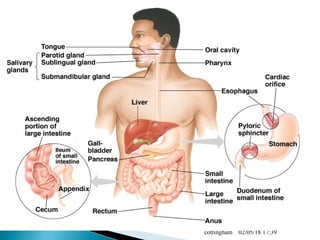
 What are the organs of the digestive system? (in order)
 How does each digestive system organ relate to each other?
 What are accessory organs? How do they contribute to the digestive
system?
 What role do enzymes play in digestion?
 What is a nutrient?
 How does your body get the necessary nutrients it needs to survive.
02/05/18 17:39cottingham
 How can the digestive system be negatively affected?
 What are some disorders that effect the digestive system?
02/05/18 17:39cottingham
 Nutrition
 Roughage
 Ingestion
 Digestion -mechanical and chemical
 Egestion – defacation, feces!
 Absorption
 Tract
 Alimentary Canal
 Mouth
◦ Teeth
◦ Tongue
◦ Saliva
 Esophagus
 Peristalsis
 Epiglottis
 Stomach
◦ Cardiac and pyloric sphincter
◦ Hydrochloric acid
 Small Intestine
◦ Villi
◦ Microvilli
◦ Lacteal
 Large Intestine
◦ Colon
◦ Rectum
 Gall Bladder
 Liver
 Pancreas
 Appendix
02/05/18 17:39cottingham
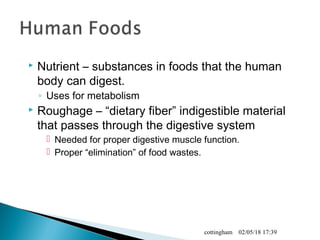
 Nutrient – substances in foods that the human
body can digest.
◦ Uses for metabolism
 Roughage – “dietary fiber” indigestible material
that passes through the digestive system
 Needed for proper digestive muscle function.
 Proper “elimination” of food wastes.
02/05/18 17:39cottingham
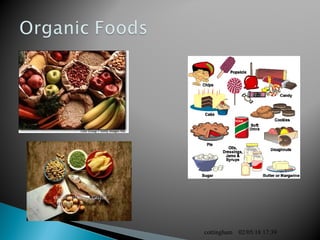
 What are the four organic molecules?
 Carbohydrates
 Lipids
 Proteins
 Nucleic Acids
 MUST BE DIGESTED TO BE ABSORBED AND
USED BY THE DIGESTIVE SYSTEM!
02/05/18 17:39cottingham
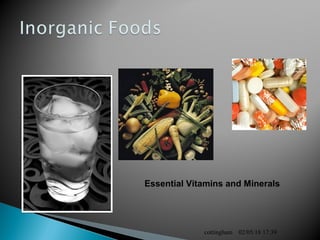
 What are the three inorganic molecule that you
take in as part of food?
 Water
 Vitamins
 Minerals
 Are small molecules that can be absorbed
without needing to be digested!
02/05/18 17:39cottingham
Essential Vitamins and Minerals
 What are enzymes? How do they work?
 Enzymes are proteins that lower the energy of
activation and allow chemical reactions to occur
within living organisms.
02/05/18 17:39cottingham
 What is digestion?
 Breaking food down into smaller molecules.
 This can be done by physically pounding the molecules, or
chemically breaking the molecules apart.
 What is the medical term for anything digestive?
◦ GASTRO – Greek Origin
 What sort of molecules help with chemical
digestion?
◦ Enzymes
 Which reaction is involved in digestion, hydrolysis
or dehydration synthesis?
◦ Hydrolysis
02/05/18 17:39cottingham
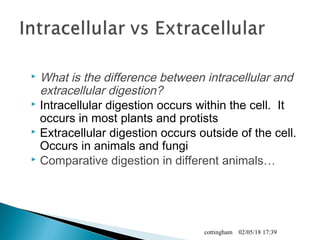
 What is the difference between intracellular and
extracellular digestion?
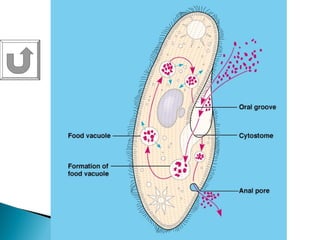
 Intracellular digestion occurs within the cell. It
occurs in most plants and protists
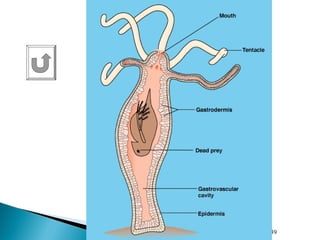
 Extracellular digestion occurs outside of the cell.
Occurs in animals and fungi
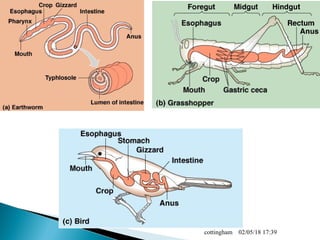
 Comparative digestion in different animals…
02/05/18 17:39cottingham
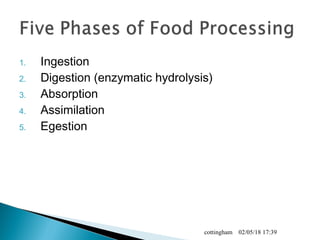
1. Ingestion
2. Digestion (enzymatic hydrolysis)
3. Absorption
4. Assimilation
5. Egestion
02/05/18 17:39cottingham
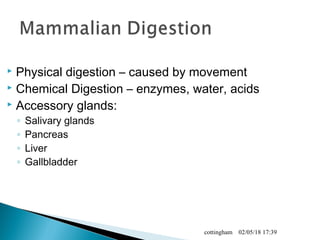
 Physical digestion – caused by movement
 Chemical Digestion – enzymes, water, acids
 Accessory glands:
◦ Salivary glands
◦ Pancreas
◦ Liver
◦ Gallbladder
02/05/18 17:39cottingham
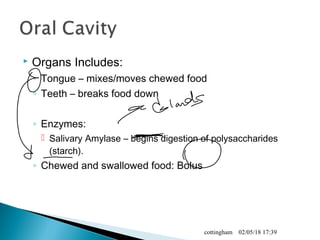
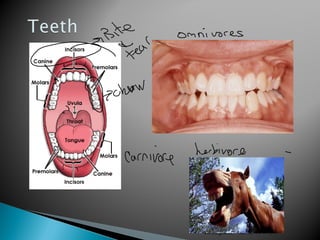
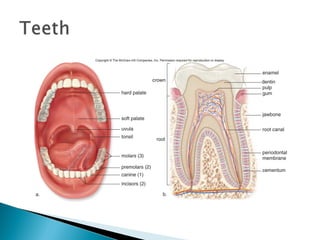
 Organs Includes:
◦ Tongue – mixes/moves chewed food
◦ Teeth – breaks food down
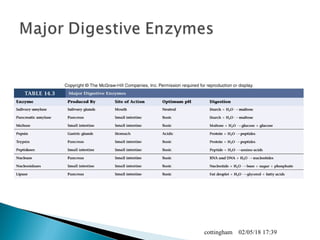
◦ Enzymes:
 Salivary Amylase – begins digestion of polysaccharides
(starch).
◦ Chewed and swallowed food: Bolus
02/05/18 17:39cottingham
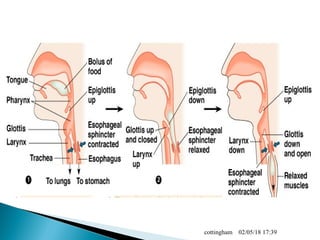
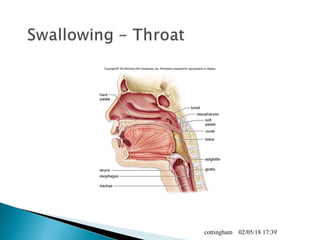
 Tract – the continuous tube from the esophagus
to rectum (alimentary canal)
 Pharynx – begins digestive tract
◦ Receives air from the nasal cavities and food from the
mouth
◦ Epiglottis – prevents food from moving into the trachea
◦ Swallowing
 A reflex action
 Soft palate closes off the nasopharynx
 Trachea moves up causing the epiglottis to cover the glottis
02/05/18 17:39cottingham
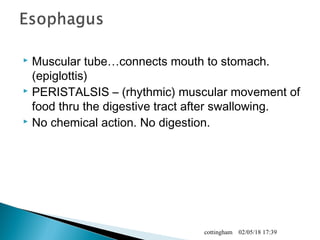
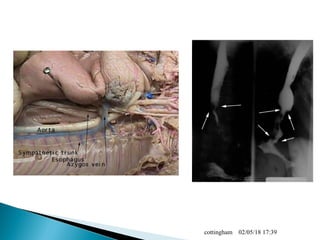
 Muscular tube…connects mouth to stomach.
(epiglottis)
 PERISTALSIS – (rhythmic) muscular movement of
food thru the digestive tract after swallowing.
 No chemical action. No digestion.
02/05/18 17:39cottingham
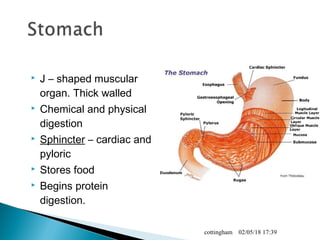
 J – shaped muscular
organ. Thick walled
 Chemical and physical
digestion
 Sphincter – cardiac and
pyloric
 Stores food
 Begins protein
digestion.
02/05/18 17:39cottingham
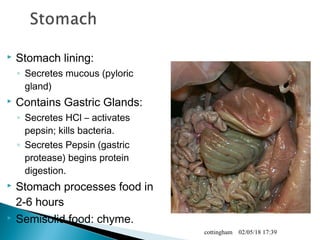
 Stomach lining:
◦ Secretes mucous (pyloric
gland)
 Contains Gastric Glands:
◦ Secretes HCl – activates
pepsin; kills bacteria.
◦ Secretes Pepsin (gastric
protease) begins protein
digestion.
 Stomach processes food in
2-6 hours
 Semisolid food: chyme.
02/05/18 17:39cottingham
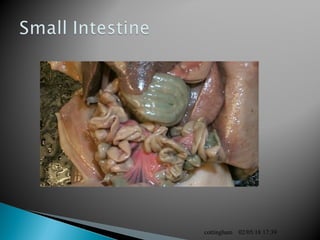
 Small diameter….6.5 meters long
 Some physical; mostly chemical digestion.
 Receives secretions from the liver/ gall bladder
and pancreas.
 3 sections: duodenum, jejunum, ileum
 Absorption of nutrients begins in the lining of the
small intestine.
02/05/18 17:39cottingham
 When food is present:
◦ Peristalsis occurs to:
 Squeeze chyme through the small intestine
 Mix chyme and enzymes
 physical digestion
 Speed up absorption – allows digested nutrients to contact
inner SI wall.
 Duodenum – most chemical digestion
 Pancreas – secretes liquid to neutralize acidic
chyme. (duct)
02/05/18 17:39cottingham
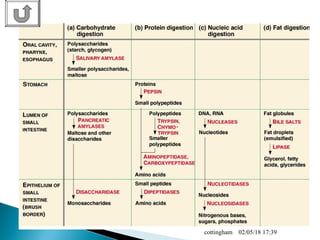
 Protein –
 Trypsin (pancreas) continues protein digestion.
 Peptidase (small intestine) completes protein digestion
 Fat –
 Bile – (liver) not an enzyme. Breaks down large fat molecules
– emulsify – increase surface area for enzyme action
 Lipase – (pancreas) digests fats.
 Carbohydrates
 Amylase (pancreas) continues starch digestion
 Maltase, lactase, sucrase (small intestine) completes
carbohydrate digestion (into glucose).
02/05/18 17:39cottingham
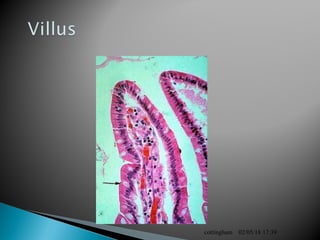
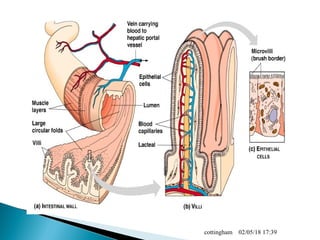
 Wall of the small intestine has circular folds with
fingerlike projections, called VILLI.
 The epithelial cells of each villus have extensions
called microvilli.
 Function:
◦ increase the small intestine's surface area for nutrient
absorption.
 Each Villus
 blood vessels ( amino acid, glucose, vitamin, mineral absorption)
 Lacteals ( fat absorption)
02/05/18 17:39cottingham
 Occurs at the cell level
 Nutrients converted into the substances the body
needs to survive….
◦ Glucose – ATP
◦ Amino Acids – Protein
◦ Fats – Cell Membranes
02/05/18 17:39cottingham
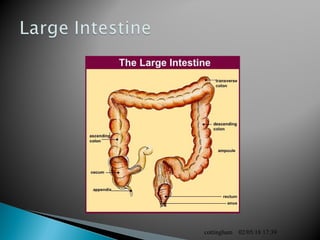
 Larger diameter…shorter tube (1.5m)
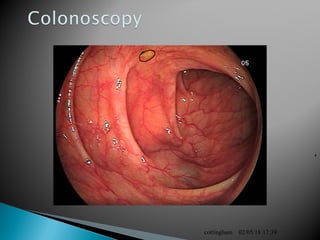
 Main Sections: Colon and Rectum
 No Digestion!
 Functions:
◦ Reabsorbs water.
◦ Absorption of some vitamins from intestinal bacteria (K
and B)
◦ Elimination (egestion) of Waste (Feces)
02/05/18 17:39cottingham
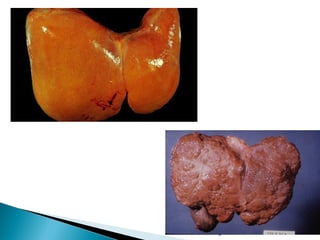
Largest gland in the body – 4 “lobes”
 Functions:
◦ Filters blood of “poisons”
◦ Maintains blood glucose levels (glycogen)
◦ Produces bile
02/05/18 17:39cottingham
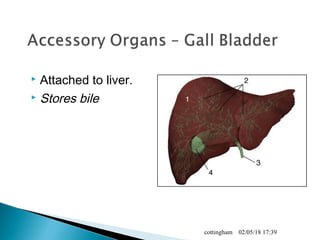
 Attached to liver.
 Stores bile
02/05/18 17:39cottingham
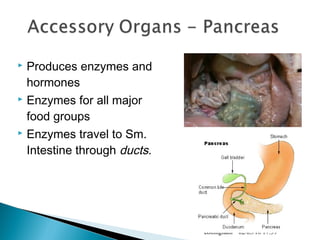
 Produces enzymes and
hormones
 Enzymes for all major
food groups
 Enzymes travel to Sm.
Intestine through ducts.
02/05/18 17:39cottingham
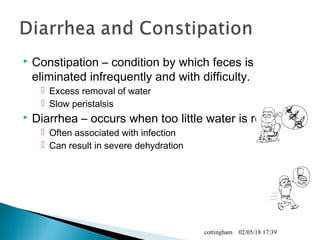
 Constipation – condition by which feces is
eliminated infrequently and with difficulty.
 Excess removal of water
 Slow peristalsis
 Diarrhea – occurs when too little water is removed
 Often associated with infection
 Can result in severe dehydration
02/05/18 17:39cottingham
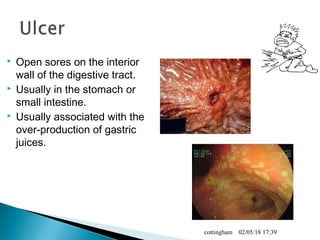
 Open sores on the interior
wall of the digestive tract.
 Usually in the stomach or
small intestine.
 Usually associated with the
over-production of gastric
juices.
02/05/18 17:39cottingham
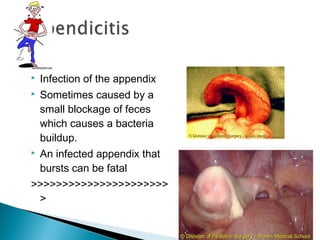
 Infection of the appendix
 Sometimes caused by a
small blockage of feces
which causes a bacteria
buildup.
 An infected appendix that
bursts can be fatal
>>>>>>>>>>>>>>>>>>>>>>
>
02/05/18 17:39cottingham
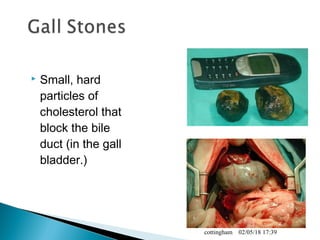
 Small, hard
particles of
cholesterol that
block the bile
duct (in the gall
bladder.)
02/05/18 17:39cottingham
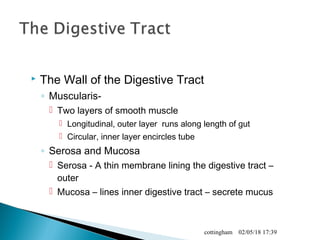
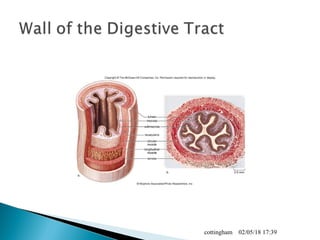
 The Wall of the Digestive Tract
◦ Muscularis-
 Two layers of smooth muscle
 Longitudinal, outer layer runs along length of gut
 Circular, inner layer encircles tube
◦ Serosa and Mucosa
 Serosa - A thin membrane lining the digestive tract –
outer
 Mucosa – lines inner digestive tract – secrete mucus
02/05/18 17:39cottingham

Digestive system master honors2016

  • 1.
  • 2.
     What isdigestion?  What happens to food after you swallow it?  How does your digestive system work?  What is the difference between mechanical and chemical digestion?  What are the organs of the digestive system? (in order)  How does each digestive system organ relate to each other?  What are accessory organs? How do they contribute to the digestive system?  What role do enzymes play in digestion?  What is a nutrient?  How does your body get the necessary nutrients it needs to survive. 02/05/18 17:39cottingham
  • 3.
     How canthe digestive system be negatively affected?  What are some disorders that effect the digestive system? 02/05/18 17:39cottingham
  • 4.
     Nutrition  Roughage Ingestion  Digestion -mechanical and chemical  Egestion – defacation, feces!  Absorption  Tract  Alimentary Canal  Mouth ◦ Teeth ◦ Tongue ◦ Saliva  Esophagus  Peristalsis  Epiglottis  Stomach ◦ Cardiac and pyloric sphincter ◦ Hydrochloric acid  Small Intestine ◦ Villi ◦ Microvilli ◦ Lacteal  Large Intestine ◦ Colon ◦ Rectum  Gall Bladder  Liver  Pancreas  Appendix 02/05/18 17:39cottingham
  • 5.
     Nutrient –substances in foods that the human body can digest. ◦ Uses for metabolism  Roughage – “dietary fiber” indigestible material that passes through the digestive system  Needed for proper digestive muscle function.  Proper “elimination” of food wastes. 02/05/18 17:39cottingham
  • 6.
     What arethe four organic molecules?  Carbohydrates  Lipids  Proteins  Nucleic Acids  MUST BE DIGESTED TO BE ABSORBED AND USED BY THE DIGESTIVE SYSTEM! 02/05/18 17:39cottingham
  • 7.
  • 8.
     What arethe three inorganic molecule that you take in as part of food?  Water  Vitamins  Minerals  Are small molecules that can be absorbed without needing to be digested! 02/05/18 17:39cottingham
  • 9.
  • 10.
     What areenzymes? How do they work?  Enzymes are proteins that lower the energy of activation and allow chemical reactions to occur within living organisms. 02/05/18 17:39cottingham
  • 11.
  • 12.
     What isdigestion?  Breaking food down into smaller molecules.  This can be done by physically pounding the molecules, or chemically breaking the molecules apart.  What is the medical term for anything digestive? ◦ GASTRO – Greek Origin  What sort of molecules help with chemical digestion? ◦ Enzymes  Which reaction is involved in digestion, hydrolysis or dehydration synthesis? ◦ Hydrolysis 02/05/18 17:39cottingham
  • 13.
     What isthe difference between intracellular and extracellular digestion?  Intracellular digestion occurs within the cell. It occurs in most plants and protists  Extracellular digestion occurs outside of the cell. Occurs in animals and fungi  Comparative digestion in different animals… 02/05/18 17:39cottingham
  • 14.
  • 15.
  • 16.
  • 17.
  • 18.
    1. Ingestion 2. Digestion(enzymatic hydrolysis) 3. Absorption 4. Assimilation 5. Egestion 02/05/18 17:39cottingham
  • 19.
     Physical digestion– caused by movement  Chemical Digestion – enzymes, water, acids  Accessory glands: ◦ Salivary glands ◦ Pancreas ◦ Liver ◦ Gallbladder 02/05/18 17:39cottingham
  • 20.
  • 21.
  • 22.
  • 24.
     Organs Includes: ◦Tongue – mixes/moves chewed food ◦ Teeth – breaks food down ◦ Enzymes:  Salivary Amylase – begins digestion of polysaccharides (starch). ◦ Chewed and swallowed food: Bolus 02/05/18 17:39cottingham
  • 25.
  • 26.
  • 28.
  • 29.
     Tract –the continuous tube from the esophagus to rectum (alimentary canal)  Pharynx – begins digestive tract ◦ Receives air from the nasal cavities and food from the mouth ◦ Epiglottis – prevents food from moving into the trachea ◦ Swallowing  A reflex action  Soft palate closes off the nasopharynx  Trachea moves up causing the epiglottis to cover the glottis 02/05/18 17:39cottingham
  • 30.
  • 31.
     Muscular tube…connectsmouth to stomach. (epiglottis)  PERISTALSIS – (rhythmic) muscular movement of food thru the digestive tract after swallowing.  No chemical action. No digestion. 02/05/18 17:39cottingham
  • 32.
  • 33.
     J –shaped muscular organ. Thick walled  Chemical and physical digestion  Sphincter – cardiac and pyloric  Stores food  Begins protein digestion. 02/05/18 17:39cottingham
  • 35.
     Stomach lining: ◦Secretes mucous (pyloric gland)  Contains Gastric Glands: ◦ Secretes HCl – activates pepsin; kills bacteria. ◦ Secretes Pepsin (gastric protease) begins protein digestion.  Stomach processes food in 2-6 hours  Semisolid food: chyme. 02/05/18 17:39cottingham
  • 36.
     Small diameter….6.5meters long  Some physical; mostly chemical digestion.  Receives secretions from the liver/ gall bladder and pancreas.  3 sections: duodenum, jejunum, ileum  Absorption of nutrients begins in the lining of the small intestine. 02/05/18 17:39cottingham
  • 37.
  • 38.
     When foodis present: ◦ Peristalsis occurs to:  Squeeze chyme through the small intestine  Mix chyme and enzymes  physical digestion  Speed up absorption – allows digested nutrients to contact inner SI wall.  Duodenum – most chemical digestion  Pancreas – secretes liquid to neutralize acidic chyme. (duct) 02/05/18 17:39cottingham
  • 39.
  • 40.
     Protein – Trypsin (pancreas) continues protein digestion.  Peptidase (small intestine) completes protein digestion  Fat –  Bile – (liver) not an enzyme. Breaks down large fat molecules – emulsify – increase surface area for enzyme action  Lipase – (pancreas) digests fats.  Carbohydrates  Amylase (pancreas) continues starch digestion  Maltase, lactase, sucrase (small intestine) completes carbohydrate digestion (into glucose). 02/05/18 17:39cottingham
  • 41.
  • 42.
     Wall ofthe small intestine has circular folds with fingerlike projections, called VILLI.  The epithelial cells of each villus have extensions called microvilli.  Function: ◦ increase the small intestine's surface area for nutrient absorption.  Each Villus  blood vessels ( amino acid, glucose, vitamin, mineral absorption)  Lacteals ( fat absorption) 02/05/18 17:39cottingham
  • 43.
  • 44.
     Occurs atthe cell level  Nutrients converted into the substances the body needs to survive…. ◦ Glucose – ATP ◦ Amino Acids – Protein ◦ Fats – Cell Membranes 02/05/18 17:39cottingham
  • 45.
     Larger diameter…shortertube (1.5m)  Main Sections: Colon and Rectum  No Digestion!  Functions: ◦ Reabsorbs water. ◦ Absorption of some vitamins from intestinal bacteria (K and B) ◦ Elimination (egestion) of Waste (Feces) 02/05/18 17:39cottingham
  • 46.
  • 47.
  • 48.
    Largest gland inthe body – 4 “lobes”  Functions: ◦ Filters blood of “poisons” ◦ Maintains blood glucose levels (glycogen) ◦ Produces bile 02/05/18 17:39cottingham
  • 49.
  • 50.
     Attached toliver.  Stores bile 02/05/18 17:39cottingham
  • 51.
     Produces enzymesand hormones  Enzymes for all major food groups  Enzymes travel to Sm. Intestine through ducts. 02/05/18 17:39cottingham
  • 52.
  • 53.
     Constipation –condition by which feces is eliminated infrequently and with difficulty.  Excess removal of water  Slow peristalsis  Diarrhea – occurs when too little water is removed  Often associated with infection  Can result in severe dehydration 02/05/18 17:39cottingham
  • 54.
     Open soreson the interior wall of the digestive tract.  Usually in the stomach or small intestine.  Usually associated with the over-production of gastric juices. 02/05/18 17:39cottingham
  • 55.
     Infection ofthe appendix  Sometimes caused by a small blockage of feces which causes a bacteria buildup.  An infected appendix that bursts can be fatal >>>>>>>>>>>>>>>>>>>>>> > 02/05/18 17:39cottingham
  • 56.
     Small, hard particlesof cholesterol that block the bile duct (in the gall bladder.) 02/05/18 17:39cottingham
  • 57.
  • 58.
     The Wallof the Digestive Tract ◦ Muscularis-  Two layers of smooth muscle  Longitudinal, outer layer runs along length of gut  Circular, inner layer encircles tube ◦ Serosa and Mucosa  Serosa - A thin membrane lining the digestive tract – outer  Mucosa – lines inner digestive tract – secrete mucus 02/05/18 17:39cottingham