Introduction to Investigating an
Outbreak:
The 13 Steps Approach
J
Sheriff Muideen (MBBS, MPH, FRSPH) 10/06/2021
Learning Objectives
• Know the Epidemiological concept
of a disease Outbreak
• Know the Importance of Outbreak
Investigation to Public Health
• Understand the 13 steps involved
in an Outbreak Investigation
• Give and example of a Single
Overriding Communication
Objective (SOCO) in an Outbreak
Investigation
Introduction to Investigating an Outbreak
Introduction:
• The terms Case, Outbreak,
Epidemic, and Pandemic have
become part of the world
general vocabulary
• They can be use in Health,
Financial, Marriage or other
social maladies.
Introduction to Investigating an Outbreak
Introduction:
Imagine comments like:
• An Epidemic of Obesity among our
Children
• An Outbreak of Corporate
Corruption
• A case of Failed Marriage
• A Pandemic Religion Phobia
Introduction to Investigating an Outbreak
• The word “Outbreak’ gets our
attention and indicates that
something is awry
• But what is an Outbreak from
Epidemiologic Point of view?
• How do we determine if an
event or Observation
represent an Outbreak?
Introduction to Investigating an Outbreak
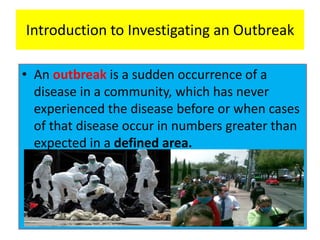
• An outbreak is a sudden occurrence of a
disease in a community, which has never
experienced the disease before or when cases
of that disease occur in numbers greater than
expected in a defined area.
Level of Disease in Epidemiology
• Level of Disease in Epidemiology
• Case definition: A case definition is a set of
standard criteria for determining whether an
individual should be categorized (based on
presentation, clinical features and/or signs
and symptoms) as having a particular disease
or health-related condition.
Level of Disease in Epidemiology
• Sporadic: refers to a disease that occurs
infrequently and irregularly
• Cluster: several new cases seen in a
particular area during a relatively brief
period of time
• Outbreak: carries the same definition of
epidemic, but is often used for a more limited
geographic area
Level of Disease in Epidemiology
• Epidemic refers to an increase, often sudden, in
the number of cases of a disease above what is
normally expected in that population in that area
• Endemic refers to the constant presence and/or
usual prevalence of a disease or infectious agent
in a population within a geographic area
• Pandemic refers to an epidemic that has spread
over several countries or continents, usually
affecting a large number of people
Introduction to Investigating an Outbreak
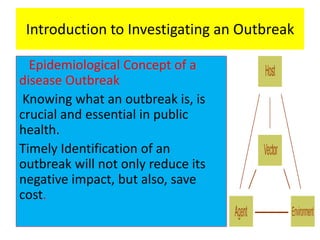
Epidemiological Concept of a
disease Outbreak
Knowing what an outbreak is, is
crucial and essential in public
health.
Timely Identification of an
outbreak will not only reduce its
negative impact, but also, save
cost.
Reasons to Investigate an Outbreak
Identify the source of the outbreak
 control and Prevention measures
Strengthen existing/Develop new strategies to
prevent future occurrence of outbreak
Training and Research Opportunities
 Address public concern
Because it’s your Job…..
How do we Detect an Outbreak
• Sources of an Outbreak Information
From surveillance Data
Medical Practitioner/Pharmacy stores
From Affected Persons/Groups
Public Concerns
From Media
When To Investigate an Outbreak
Always Consider the following Factors:
Severity of the disease
Transmissibility of the disease
Ongoing Illness or Exposure of the
disease
Growing Public Concern
Unanswered Questions
Principle of Outbreak Investigation
• Be systematic in your approach
 Follow the same step for every type of
outbreak
 Write Down Case Definition
 Ask same questions from all cases
Principle of Outbreak Investigation
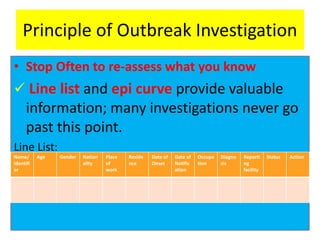
• Stop Often to re-assess what you know
 Line list and epi curve provide valuable
information; many investigations never go
past this point.
Line List:
Name/
Identifi
er
Age Gender Nation
ality
Place
of
work
Reside
nce
Date of
Onset
Date of
Notific
ation
Occupa
tion
Diagno
sis
Reporti
ng
facility
Status Action
Principle of Outbreak Investigation
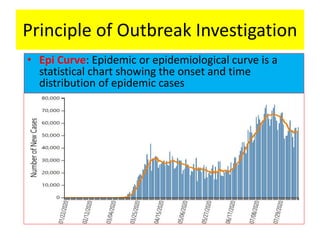
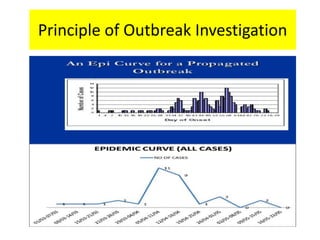
• Epi Curve: Epidemic or epidemiological curve is a
statistical chart showing the onset and time
distribution of epidemic cases
Principle of Outbreak Investigation
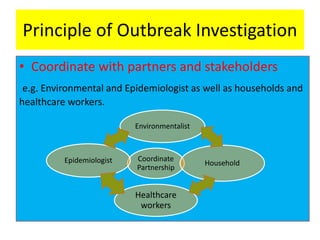
• Coordinate with partners and stakeholders
e.g. Environmental and Epidemiologist as well as households and
healthcare workers.
Coordinate
Partnership
Environmentalist
Household
Healthcare
workers
Epidemiologist
The 13 steps of an outbreak Investigation
1) Identify investigation team, resources needed and prepare
for field work
2) Establish the existence of an Outbreak
3) Verify the Diagnosis
4) Define and Identify cases
5) Find Cases systematically and develop line listing
6) Perform Descriptive Epidemiology (Orientate your data in
term of Time, Place & Person)
7) Develop your Hypotheses (i.e. explain the exposure that
cause the disease)
The 13 steps of an outbreak
Investigation
8) Evaluate your Hypotheses epidemiologically
(Determine who is at risk of becoming ill)
9) Reconsider, refine, and re-evaluate hypotheses as
necessary
10) Execute additional studies (compare and reconcile
with laboratory or environmental studies)
11) Implement Control and Prevention Measure
12) Initiate or maintain surveillance
13) Communicate your findings with follow up
recommendations
Steps of an Outbreak Investigation
Step 1:
Identify investigation team, resources needed and prepare for
field work
• Investigation Resources
 Epi Team with scientific knowledge
 Supplies
 Equipment
• Administration
 Administrative procedure (cash advances, travel documents)
 personal matters
• Consultation
 Know expected role
 Local Contact Person
Steps of an Outbreak Investigation
Step 2:
Establish the existence of an Outbreak
• Compare the current number of cases with the
number of cases from comparable period during the previous
years.
 surveillance records
 hospital records, registries, mortality statistics, data from
neighbouring areas or community survey
Steps of an Outbreak Investigation
Step 3:
Verifying the Diagnosis
• Ensure proper diagnosis of reported cases
• Rule out laboratory error as the basis for the
increase in diagnosed cases
 review clinical findings
 review laboratory results
 summarize the clinical findings with
frequency distribution
 visit patients
Steps of an Outbreak Investigation
Step 4:
Define and Identify cases
• A) Establish a case Definition
standard set of criteria for the health condition
 clinical criteria (signs and symptoms)
 restrictions by time, place and person
 apply without bias
NOTE: Never include the EXPOSURE or RISK FACTOR in the case
definition
Steps of an Outbreak Investigation
Examples of case definition of diseases used by the National
Epidemic Sentinel Surveillance System (NESSS).
Tuberculosis: Fever, Cough >3 weeks, weight loss, Night
sweating, Significant CXR findings, Positive Monteux, Positive
AAFB sample (3 series).
Component of Case Definition
 Person …………. Type of Illness (e.g. a person with TB)
 Place …………... Location of Suspected Exposure
 Time …………… Based on incubation period (if known)
Steps of an Outbreak Investigation
Step 4:
Define and Identify Cases
• B) Identify and Count Cases
 Identifying information ( name, address, telephone no)
 demographic information (age, sex, race, occupation)
 clinical information (date of onset, hospitalization,
death
 Risk factor information ( food or water sources, toilet
facility
 Reporter information
Steps of an Outbreak Investigation
Step 5:
Find Cases systematically and develop line listing
• What to Put on a Line List
1. Clinical information
• Symptoms (type, duration)
• Onset dates and/or times
2. Demographic information
3. Exposure information
Use line list to summarize information
Steps of an Outbreak Investigation
• Step 6:
Perform Descriptive Epidemiology (Orientate your data in terms of Time,
Place & Person)
• characterize by TIME
. Draw an epidemic curve
 can be used to determine:
• the type of epidemic
• the difference between maximum & minimum incubation period
• the probable time of exposure
• the incubation period when probable time of exposure is known
Steps of an Outbreak Investigation
• Step 6:
Perform Descriptive Epidemiology
• characterize by PLACE
 geographic extent
• spot map
• area map
Steps of an Outbreak Investigation
• Step 6:
Perform Descriptive Epidemiology
• characterize by PERSON
 host characteristics
age sex
race medical status
 exposures
occupation leisure activities
tobacco use use of medications/drugs
Steps of an Outbreak Investigation
Step7:
Develop your Hypotheses (i.e. explain the exposure that cause
the disease)
Consider:
 source of the agent
 mode of transmission
 vectors of transmission
 risk factors
* hypotheses should be tested.
Steps of an Outbreak Investigation
Step 8:
Evaluate your Hypotheses epidemiologically (Determine who
is at risk of becoming ill)
• compare with established facts
• use analytical epidemiology
case-control studies
retrospective cohort studies
Steps of an Outbreak Investigation
Step 9:
Reconsider, refine, and re-evaluate hypotheses as necessary
• why:
1) unrevealing analytic studies
- poor hypotheses
2) need more specific exposure histories
3) need more specific control group
Steps of an Outbreak Investigation
Step 10:
Execute additional studies (compare and reconcile with laboratory or
environmental studies
Additional Studies
• Types
Cohort
Case-control
• Designed to assess exposures equally among ill and non-ill
Steps of an Outbreak Investigation
Step 10:
• Cohort Studies
 Include EVERYONE who could have been exposed
– Only use if a complete list is available
Meeting attendees, students, LTCF (Long-Term Care Facility)
residents, etc.
 Measure of association = Relative Risk
Relative Risk (RR)
 RR = 1.0, Risk same among exposed and unexposed
 RR > 1.0, Risk is HIGHER among exposed
 RR < 1.0, Risk is LOWER among exposed Case-Control Studies
Steps of an Outbreak Investigation
Step 10:
• Case-Control Studies
 Compare exposures among ill persons (case-patients) and
non-ill persons (controls)
 Used when a complete list is not available or too large –
Restaurant outbreaks, national outbreaks, etc.
 Measure of association = Odds Ratio
Interpretation of Odds Ratio
 OR = 1.0 Same odds of exposure among ill and non-ill
 OR > 1.0 HIGHER odds of exposure among ill
 OR < 1.0 LOWER odds of exposure among ill
Steps of an Outbreak Investigation
Step 11:
Implement Control and Prevention Measure
 For Primary public health reason
• prevent additional cases
• prevent outbreaks in the future
Steps of an Outbreak Investigation
• Control Measures
 Can occur at any point during outbreak
 Isolation, cohorting, product recall
 Balance between preventing further disease and
protecting credibility and reputation of institution
 Should be guided by epidemiologic results in
conjunction with environmental investigation
Steps of an Outbreak Investigation
Step 12:
Initiate or maintain surveillance
 Once control and prevention measures have been
implemented, they must continue to be monitored.
 Initiate or continue active surveillance to:
…1) continue to monitor the situation and determine
whether the prevention and control measures are working
…2) Is the number of new cases slowing down or, better
yet, stopping? Or are new cases continuing to occur?
Steps of an Outbreak Investigation
Step 13:
Communicate your findings with follow up recommendations
 Summarize the Investigation, Its finding and Outcome in a
report
 Communicate the report to the appropriate authorities and/or
organizations
Through:
1) Writing and disseminating full reports
2) Meetings and discussions
Steps of an Outbreak Investigation
• local and mass media.
To the:
• local government officials • local health workers
• concerned authorities • regional health authorities
• Department of Health
 Finally, a report that finds its way into the public health
literature serves the broader purpose of contributing to the
knowledge base of epidemiology and public health
Steps of an Outbreak Investigation
Step13:
Follow-up Recommendation is based on:
what activities have been undertaken
 if health status has improved
 if health problems has been reduced
Steps of an Outbreak Investigation
Conclusion
Epidemiologic investigations are essential to
determine source of outbreaks
Be systematic
Follow the steps accordingly.
Steps of an Outbreak Investigation
Questions…..Q#1
• For the month of August, 12 new cases of
tuberculosis and 12 new cases of West
Nile virus infection were reported to a
district PMD. You are not sure if either
group of cases is a cluster or an outbreak.
What additional information might be
helpful in making this determination?
Answer…
• First, you should check the dates of onset
rather than dates of report…
• Classifying the cases as an outbreak
depends on whether the 12 cases exceed the
usual number of cases reported in August in
that District .
• The number of cases during August could be
compared with: a) the numbers reported
during the preceding several months;
• and b) the numbers reported during August of
the preceding few years.
Q#2
• Which of the following is not a reason to
investigate an outbreak?
a) For training and research purpose
b) To Identify source of disease outbreak
c) For Control and Prevention measure
d) Compare exposures among ill persons and
non-ill persons
e) Address public concern
Q#3
• All are sources of outbreaks information
except
a) From surveillance Data
b) Medical Practitioner/Pharmacy stores
c) From Affected Persons/Groups
d) Passers-by and researchers
e) From Media
Q#4
• For each of the following situations, identify whether it reflects:
a) Sporadic disease
b) Endemic disease
c) Hyperendemic disease
d) Pandemic disease
e) Epidemic disease
1. ____ 22 cases of legionellosis occurred within 3 weeks among
residents of a particular neighborhood (usually 0 or 1 per year)
2. ____ Average annual incidence was 364 cases of pulmonary
tuberculosis per 100,000 population in one area, compared with national
average of 134 cases per 100,000 population
3. ____ Over 20 million people worldwide died from influenza in 1918–1919
4. ____ Single case of histoplasmosis was diagnosed in a community
5. ____ About 60 cases of gonorrhea are usually reported in this region per
week, slightly less than the national average
Q#5
Factors that influence a health department’s decision
whether or not to conduct a field investigation in response
to one or more cases of disease include:
a) The nature of the disease
b) The number of cases
c) Resources available
d) None of the above
e) All of the Above
Q#6
A case definition during an outbreak
investigation should specify:
a) Clinical features
b) Time
c) Place
d) Person
e) Hypothesized exposure
References
• Center for Disease Prevention and Control (213). Principles of
Epidemiology in Public Health Practice, Third Edition
An Introduction to Applied Epidemiology and Biostatistics. 3rd Ed.
• Pan American Health Organizations (2018). Steps in outbreak
Investigations
https://cursos.campusvirtualsp.org/mod/tab/view.php?id=34164&forceview=
1
• Introduction to Outbreak Investigation .
http://samples.jbpub.com/9780763784591/84591_CH02_FINAL.pdf

Outbreak investigation ppt

  • 1.
    Introduction to Investigatingan Outbreak: The 13 Steps Approach J Sheriff Muideen (MBBS, MPH, FRSPH) 10/06/2021
  • 2.
    Learning Objectives • Knowthe Epidemiological concept of a disease Outbreak • Know the Importance of Outbreak Investigation to Public Health • Understand the 13 steps involved in an Outbreak Investigation • Give and example of a Single Overriding Communication Objective (SOCO) in an Outbreak Investigation
  • 3.
    Introduction to Investigatingan Outbreak Introduction: • The terms Case, Outbreak, Epidemic, and Pandemic have become part of the world general vocabulary • They can be use in Health, Financial, Marriage or other social maladies.
  • 4.
    Introduction to Investigatingan Outbreak Introduction: Imagine comments like: • An Epidemic of Obesity among our Children • An Outbreak of Corporate Corruption • A case of Failed Marriage • A Pandemic Religion Phobia
  • 5.
    Introduction to Investigatingan Outbreak • The word “Outbreak’ gets our attention and indicates that something is awry • But what is an Outbreak from Epidemiologic Point of view? • How do we determine if an event or Observation represent an Outbreak?
  • 6.
    Introduction to Investigatingan Outbreak • An outbreak is a sudden occurrence of a disease in a community, which has never experienced the disease before or when cases of that disease occur in numbers greater than expected in a defined area.
  • 7.
    Level of Diseasein Epidemiology • Level of Disease in Epidemiology • Case definition: A case definition is a set of standard criteria for determining whether an individual should be categorized (based on presentation, clinical features and/or signs and symptoms) as having a particular disease or health-related condition.
  • 8.
    Level of Diseasein Epidemiology • Sporadic: refers to a disease that occurs infrequently and irregularly • Cluster: several new cases seen in a particular area during a relatively brief period of time • Outbreak: carries the same definition of epidemic, but is often used for a more limited geographic area
  • 9.
    Level of Diseasein Epidemiology • Epidemic refers to an increase, often sudden, in the number of cases of a disease above what is normally expected in that population in that area • Endemic refers to the constant presence and/or usual prevalence of a disease or infectious agent in a population within a geographic area • Pandemic refers to an epidemic that has spread over several countries or continents, usually affecting a large number of people
  • 10.
    Introduction to Investigatingan Outbreak Epidemiological Concept of a disease Outbreak Knowing what an outbreak is, is crucial and essential in public health. Timely Identification of an outbreak will not only reduce its negative impact, but also, save cost.
  • 11.
    Reasons to Investigatean Outbreak Identify the source of the outbreak  control and Prevention measures Strengthen existing/Develop new strategies to prevent future occurrence of outbreak Training and Research Opportunities  Address public concern Because it’s your Job…..
  • 12.
    How do weDetect an Outbreak • Sources of an Outbreak Information From surveillance Data Medical Practitioner/Pharmacy stores From Affected Persons/Groups Public Concerns From Media
  • 13.
    When To Investigatean Outbreak Always Consider the following Factors: Severity of the disease Transmissibility of the disease Ongoing Illness or Exposure of the disease Growing Public Concern Unanswered Questions
  • 14.
    Principle of OutbreakInvestigation • Be systematic in your approach  Follow the same step for every type of outbreak  Write Down Case Definition  Ask same questions from all cases
  • 15.
    Principle of OutbreakInvestigation • Stop Often to re-assess what you know  Line list and epi curve provide valuable information; many investigations never go past this point. Line List: Name/ Identifi er Age Gender Nation ality Place of work Reside nce Date of Onset Date of Notific ation Occupa tion Diagno sis Reporti ng facility Status Action
  • 16.
    Principle of OutbreakInvestigation • Epi Curve: Epidemic or epidemiological curve is a statistical chart showing the onset and time distribution of epidemic cases
  • 17.
    Principle of OutbreakInvestigation
  • 18.
    Principle of OutbreakInvestigation • Coordinate with partners and stakeholders e.g. Environmental and Epidemiologist as well as households and healthcare workers. Coordinate Partnership Environmentalist Household Healthcare workers Epidemiologist
  • 19.
    The 13 stepsof an outbreak Investigation 1) Identify investigation team, resources needed and prepare for field work 2) Establish the existence of an Outbreak 3) Verify the Diagnosis 4) Define and Identify cases 5) Find Cases systematically and develop line listing 6) Perform Descriptive Epidemiology (Orientate your data in term of Time, Place & Person) 7) Develop your Hypotheses (i.e. explain the exposure that cause the disease)
  • 20.
    The 13 stepsof an outbreak Investigation 8) Evaluate your Hypotheses epidemiologically (Determine who is at risk of becoming ill) 9) Reconsider, refine, and re-evaluate hypotheses as necessary 10) Execute additional studies (compare and reconcile with laboratory or environmental studies) 11) Implement Control and Prevention Measure 12) Initiate or maintain surveillance 13) Communicate your findings with follow up recommendations
  • 21.
    Steps of anOutbreak Investigation Step 1: Identify investigation team, resources needed and prepare for field work • Investigation Resources  Epi Team with scientific knowledge  Supplies  Equipment • Administration  Administrative procedure (cash advances, travel documents)  personal matters • Consultation  Know expected role  Local Contact Person
  • 22.
    Steps of anOutbreak Investigation Step 2: Establish the existence of an Outbreak • Compare the current number of cases with the number of cases from comparable period during the previous years.  surveillance records  hospital records, registries, mortality statistics, data from neighbouring areas or community survey
  • 23.
    Steps of anOutbreak Investigation Step 3: Verifying the Diagnosis • Ensure proper diagnosis of reported cases • Rule out laboratory error as the basis for the increase in diagnosed cases  review clinical findings  review laboratory results  summarize the clinical findings with frequency distribution  visit patients
  • 24.
    Steps of anOutbreak Investigation Step 4: Define and Identify cases • A) Establish a case Definition standard set of criteria for the health condition  clinical criteria (signs and symptoms)  restrictions by time, place and person  apply without bias NOTE: Never include the EXPOSURE or RISK FACTOR in the case definition
  • 25.
    Steps of anOutbreak Investigation Examples of case definition of diseases used by the National Epidemic Sentinel Surveillance System (NESSS). Tuberculosis: Fever, Cough >3 weeks, weight loss, Night sweating, Significant CXR findings, Positive Monteux, Positive AAFB sample (3 series). Component of Case Definition  Person …………. Type of Illness (e.g. a person with TB)  Place …………... Location of Suspected Exposure  Time …………… Based on incubation period (if known)
  • 26.
    Steps of anOutbreak Investigation Step 4: Define and Identify Cases • B) Identify and Count Cases  Identifying information ( name, address, telephone no)  demographic information (age, sex, race, occupation)  clinical information (date of onset, hospitalization, death  Risk factor information ( food or water sources, toilet facility  Reporter information
  • 27.
    Steps of anOutbreak Investigation Step 5: Find Cases systematically and develop line listing • What to Put on a Line List 1. Clinical information • Symptoms (type, duration) • Onset dates and/or times 2. Demographic information 3. Exposure information Use line list to summarize information
  • 28.
    Steps of anOutbreak Investigation • Step 6: Perform Descriptive Epidemiology (Orientate your data in terms of Time, Place & Person) • characterize by TIME . Draw an epidemic curve  can be used to determine: • the type of epidemic • the difference between maximum & minimum incubation period • the probable time of exposure • the incubation period when probable time of exposure is known
  • 29.
    Steps of anOutbreak Investigation • Step 6: Perform Descriptive Epidemiology • characterize by PLACE  geographic extent • spot map • area map
  • 30.
    Steps of anOutbreak Investigation • Step 6: Perform Descriptive Epidemiology • characterize by PERSON  host characteristics age sex race medical status  exposures occupation leisure activities tobacco use use of medications/drugs
  • 31.
    Steps of anOutbreak Investigation Step7: Develop your Hypotheses (i.e. explain the exposure that cause the disease) Consider:  source of the agent  mode of transmission  vectors of transmission  risk factors * hypotheses should be tested.
  • 32.
    Steps of anOutbreak Investigation Step 8: Evaluate your Hypotheses epidemiologically (Determine who is at risk of becoming ill) • compare with established facts • use analytical epidemiology case-control studies retrospective cohort studies
  • 33.
    Steps of anOutbreak Investigation Step 9: Reconsider, refine, and re-evaluate hypotheses as necessary • why: 1) unrevealing analytic studies - poor hypotheses 2) need more specific exposure histories 3) need more specific control group
  • 34.
    Steps of anOutbreak Investigation Step 10: Execute additional studies (compare and reconcile with laboratory or environmental studies Additional Studies • Types Cohort Case-control • Designed to assess exposures equally among ill and non-ill
  • 35.
    Steps of anOutbreak Investigation Step 10: • Cohort Studies  Include EVERYONE who could have been exposed – Only use if a complete list is available Meeting attendees, students, LTCF (Long-Term Care Facility) residents, etc.  Measure of association = Relative Risk Relative Risk (RR)  RR = 1.0, Risk same among exposed and unexposed  RR > 1.0, Risk is HIGHER among exposed  RR < 1.0, Risk is LOWER among exposed Case-Control Studies
  • 36.
    Steps of anOutbreak Investigation Step 10: • Case-Control Studies  Compare exposures among ill persons (case-patients) and non-ill persons (controls)  Used when a complete list is not available or too large – Restaurant outbreaks, national outbreaks, etc.  Measure of association = Odds Ratio Interpretation of Odds Ratio  OR = 1.0 Same odds of exposure among ill and non-ill  OR > 1.0 HIGHER odds of exposure among ill  OR < 1.0 LOWER odds of exposure among ill
  • 37.
    Steps of anOutbreak Investigation Step 11: Implement Control and Prevention Measure  For Primary public health reason • prevent additional cases • prevent outbreaks in the future
  • 38.
    Steps of anOutbreak Investigation • Control Measures  Can occur at any point during outbreak  Isolation, cohorting, product recall  Balance between preventing further disease and protecting credibility and reputation of institution  Should be guided by epidemiologic results in conjunction with environmental investigation
  • 39.
    Steps of anOutbreak Investigation Step 12: Initiate or maintain surveillance  Once control and prevention measures have been implemented, they must continue to be monitored.  Initiate or continue active surveillance to: …1) continue to monitor the situation and determine whether the prevention and control measures are working …2) Is the number of new cases slowing down or, better yet, stopping? Or are new cases continuing to occur?
  • 40.
    Steps of anOutbreak Investigation Step 13: Communicate your findings with follow up recommendations  Summarize the Investigation, Its finding and Outcome in a report  Communicate the report to the appropriate authorities and/or organizations Through: 1) Writing and disseminating full reports 2) Meetings and discussions
  • 41.
    Steps of anOutbreak Investigation • local and mass media. To the: • local government officials • local health workers • concerned authorities • regional health authorities • Department of Health  Finally, a report that finds its way into the public health literature serves the broader purpose of contributing to the knowledge base of epidemiology and public health
  • 42.
    Steps of anOutbreak Investigation Step13: Follow-up Recommendation is based on: what activities have been undertaken  if health status has improved  if health problems has been reduced
  • 43.
    Steps of anOutbreak Investigation Conclusion Epidemiologic investigations are essential to determine source of outbreaks Be systematic Follow the steps accordingly.
  • 44.
    Steps of anOutbreak Investigation
  • 45.
    Questions…..Q#1 • For themonth of August, 12 new cases of tuberculosis and 12 new cases of West Nile virus infection were reported to a district PMD. You are not sure if either group of cases is a cluster or an outbreak. What additional information might be helpful in making this determination?
  • 46.
    Answer… • First, youshould check the dates of onset rather than dates of report… • Classifying the cases as an outbreak depends on whether the 12 cases exceed the usual number of cases reported in August in that District . • The number of cases during August could be compared with: a) the numbers reported during the preceding several months; • and b) the numbers reported during August of the preceding few years.
  • 47.
    Q#2 • Which ofthe following is not a reason to investigate an outbreak? a) For training and research purpose b) To Identify source of disease outbreak c) For Control and Prevention measure d) Compare exposures among ill persons and non-ill persons e) Address public concern
  • 48.
    Q#3 • All aresources of outbreaks information except a) From surveillance Data b) Medical Practitioner/Pharmacy stores c) From Affected Persons/Groups d) Passers-by and researchers e) From Media
  • 49.
    Q#4 • For eachof the following situations, identify whether it reflects: a) Sporadic disease b) Endemic disease c) Hyperendemic disease d) Pandemic disease e) Epidemic disease 1. ____ 22 cases of legionellosis occurred within 3 weeks among residents of a particular neighborhood (usually 0 or 1 per year) 2. ____ Average annual incidence was 364 cases of pulmonary tuberculosis per 100,000 population in one area, compared with national average of 134 cases per 100,000 population 3. ____ Over 20 million people worldwide died from influenza in 1918–1919 4. ____ Single case of histoplasmosis was diagnosed in a community 5. ____ About 60 cases of gonorrhea are usually reported in this region per week, slightly less than the national average
  • 50.
    Q#5 Factors that influencea health department’s decision whether or not to conduct a field investigation in response to one or more cases of disease include: a) The nature of the disease b) The number of cases c) Resources available d) None of the above e) All of the Above
  • 51.
    Q#6 A case definitionduring an outbreak investigation should specify: a) Clinical features b) Time c) Place d) Person e) Hypothesized exposure
  • 52.
    References • Center forDisease Prevention and Control (213). Principles of Epidemiology in Public Health Practice, Third Edition An Introduction to Applied Epidemiology and Biostatistics. 3rd Ed. • Pan American Health Organizations (2018). Steps in outbreak Investigations https://cursos.campusvirtualsp.org/mod/tab/view.php?id=34164&forceview= 1 • Introduction to Outbreak Investigation . http://samples.jbpub.com/9780763784591/84591_CH02_FINAL.pdf

Editor's Notes

  • #36 LTCF residents- Long-Term Care Facility residents refers to adults living in specialized facilities that provides a variety of services including personal and medical to those adults or elderly who can not take care of themselves or live independently.