EVIDENCE BASED
PRACTICE (EBP)
INTRODUCTION
• RESEARCH UTILIZATION (RU) :
RU is the use of findings from a study or set of
studies in a practical application that is unrelated
to original research.
• EVIDENCE BASED PRACTICE :
– Broader concept than RU which integrates
research findings with other factors.
EVIDENCE BASED PRACTICE
EBP begins with a search for information about
how best to solve specific practical problem
• Definition:
“Evidence based practice is using the best evidence
available to guide clinical decision making”
-Benefield –
“The integration of best research evidence with clinical
expertise and patient values”
-sackett-
Evidence based practice in nursing
Evidence based practice(EBP) in nursing is
a process of locating, appraising and applying
the best evidence from nursing and medical
literature to improve the quality of clinical
nursing practice.
Purposes
• EBP is an approach which tries to specify the way
in which the professional or other decision maker
should make decisions by identifying evidences
• Eliminate unsound or excessively risky
procedures.
• Contributed towards better patient outcome
• To provide highest quality and most cost-efficient
nursing care possible
• To improve the quality of nursing care
• Clinical decision making
Features of EBP
• It deemphasizes decision making based on
custom, authority opinion or ritual,
• Identifying the best available research
evidence and integrating with clinical
expertise, patient input and existing resources.
• Solution to sustaining high health care quality
in our current cost-constrained environment.
TYPES OF EVIDENCE
AND
EVIDENCE HIERARCHIES
Types of evidence and evidence
hierarchies
• According to the strength of the evidences
positions has been given to evidences, represents
as evidence hierarchies :-
– Level 1:systematic Review
– Level 2: Individual RCT/Single RCT
– Level 3:Single Non-Randomized-Trail (Quasi-
Experiment )
– Level 4:Single Prospective / Cohort Study
– Level 5:Single Case-control Study.(Eg: Survey)
– Level 6:Single In-depth Qualitative Study
– Level 7: Expert Opinion, Case Reports, Etc
Resources of evidences
• Systematic reviews
– Meta analysis
– Meta synthesis
• Clinical practice guidelines
– Eg :
• The Canadian Medical Association
• National Guidelines Clearing House
• Other appraised evidence
MODELS AND THEORIES
OF
EVIDENCE BASED PRACTICE
Models and theories of evidence based
practice
• Models offers frame works for understanding
the EBP process and designing and
implementing on EBP project in setting.
• Each models offers,
– Different perspectives in how to translate research
findings into practice.
• Several steps and procedures are similar across the
models
Models and theories of evidence based
practice
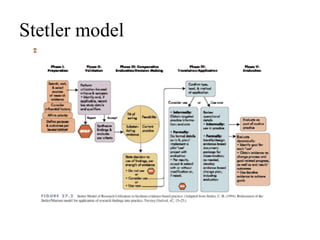
• Stetler model
• Iowa model
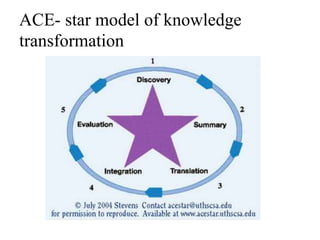
• ACE- star model
Stetler model
Iowa model
ACE- star model of knowledge
transformation
BARRIERS
IN
EVIDENCE BASED PRACTICE
Barriers in EBP
• Research related barriers
• Nurse related barriers
• Organizational barriers
• Barriers relating to nursing profession
Research related barriers
• The state the act of research knowledge is fairly
primitive
• Result reported in literature may not merit
translation into practice of methodologic flaws
are extensive
• A solid base of valid and trustworthy study
results has not been developed
• Nurses have to wait for ‘perfect studies’ before
basic clinical decisions on research findings
Research related barriers
• Single studies rarely provide an adequate basis
for making changes in nursing practice.
• Researches reported in way that make
findings inaccessible to practitioners.
• Complex statistical information and dense
research jargon
Tips .…..
Collaborate with clinicians
Do high quality research
Replicate
Communicate clearly
Present findings amenable to meta analysis
Suggest clinical implications
Disseminate aggressively
Disseminate broadly
Prepare integrative research review
Nurse related barriers
• Educational preparation and their research
skills (not received any formal instructions)
• Lacks skills to judge the merits of study
• Nurses attitudes towards research and their
motivation to engage in EBP.
Some nurses considered as research utilization as
little more than a “necessary evil”
• People are often resistant to change
Nurse related barriers
• Change also perceived as threatening (Eg: Job
security)
• Opposition to introducing innovations in
practice setting
Tips…..
Read widely and critically
Attend professional conferences
Learn to expect evidence that a procedure is
effective
Become involved in a journal club
Pursue and participate in EBP project
Organizational barriers
• Failed to motivate or reward nurses to seek
ways to implement appropriate findings in
their practice
• Insufficient time on the job to implement new
ideas
• Organization may be reluctant to expand
resource for EBP activities or for changing
organizational policy
Tips…..
• Foster a climate of intellectual curiosity
• Offer emotional and moral support
• Offer financial or research support for
utilization
• Reward efforts for using research
• Seek opportunities for institutional RU/EBP
projects
Barriers relating to nursing profession
• Shortage of appropriate role models- nurses.
Tips …
Incorporate research findings into the
curriculum
Encourage the research and research use
Place demands on researcher
THE PROCESS OF USING
RESEARCH
IN
NURSING PRACTICE
The process of using research in
nursing practice
1. Selecting a topic or problem
2. Assembling and evaluating evidences
3. Assisting implementation potential
4. Developing, implementing and evaluating the
observations
The process of EBP….
1. Selecting a topic or problem
– Selected problem should have,
• Clinical relevance
• Research literature
2. Assembling and evaluating evidence
– Team have to be formed to work on project
– Search for assemble research evidence
– Doing literature review
– High-quality integrative review
The process of EBP….
3. Assisting implementation potential
– Pilot testing of innovation
– Evaluate the appropriateness of innovation
• Issues to be considered,
– Transferability of the innovation
– Feasibility of implementing
– Its cost benefit ratio
The process of EBP….
4. Developing, implementing and evaluating
the observations
1. Developing an evaluation plan
2. Collecting baseline data relating to those outcome

3. Developing a written EBP guidelines based on
the synthesis of evidence
4. Training relevant staff in the use of evidence
5. Trying the guidelines out one more units or a
sample of clients
The process of EBP….
4. Developing, implementing and evaluating
the observations
6. Evaluating the pilot project in terms of both
processes and outcome
 Dissemination
 The end result this process is a decision about
whether to adopt the innovation or to revert to
the prior practice .
Conclusion
THANK YOU

Evidence based practice

  • 1.
  • 2.
    INTRODUCTION • RESEARCH UTILIZATION(RU) : RU is the use of findings from a study or set of studies in a practical application that is unrelated to original research. • EVIDENCE BASED PRACTICE : – Broader concept than RU which integrates research findings with other factors.
  • 4.
    EVIDENCE BASED PRACTICE EBPbegins with a search for information about how best to solve specific practical problem • Definition: “Evidence based practice is using the best evidence available to guide clinical decision making” -Benefield – “The integration of best research evidence with clinical expertise and patient values” -sackett-
  • 5.
    Evidence based practicein nursing Evidence based practice(EBP) in nursing is a process of locating, appraising and applying the best evidence from nursing and medical literature to improve the quality of clinical nursing practice.
  • 6.
    Purposes • EBP isan approach which tries to specify the way in which the professional or other decision maker should make decisions by identifying evidences • Eliminate unsound or excessively risky procedures. • Contributed towards better patient outcome • To provide highest quality and most cost-efficient nursing care possible • To improve the quality of nursing care • Clinical decision making
  • 7.
    Features of EBP •It deemphasizes decision making based on custom, authority opinion or ritual, • Identifying the best available research evidence and integrating with clinical expertise, patient input and existing resources. • Solution to sustaining high health care quality in our current cost-constrained environment.
  • 8.
  • 9.
    Types of evidenceand evidence hierarchies • According to the strength of the evidences positions has been given to evidences, represents as evidence hierarchies :- – Level 1:systematic Review – Level 2: Individual RCT/Single RCT – Level 3:Single Non-Randomized-Trail (Quasi- Experiment ) – Level 4:Single Prospective / Cohort Study – Level 5:Single Case-control Study.(Eg: Survey) – Level 6:Single In-depth Qualitative Study – Level 7: Expert Opinion, Case Reports, Etc
  • 11.
    Resources of evidences •Systematic reviews – Meta analysis – Meta synthesis • Clinical practice guidelines – Eg : • The Canadian Medical Association • National Guidelines Clearing House • Other appraised evidence
  • 12.
  • 13.
    Models and theoriesof evidence based practice • Models offers frame works for understanding the EBP process and designing and implementing on EBP project in setting. • Each models offers, – Different perspectives in how to translate research findings into practice. • Several steps and procedures are similar across the models
  • 14.
    Models and theoriesof evidence based practice • Stetler model • Iowa model • ACE- star model
  • 15.
  • 16.
  • 17.
    ACE- star modelof knowledge transformation
  • 18.
  • 19.
    Barriers in EBP •Research related barriers • Nurse related barriers • Organizational barriers • Barriers relating to nursing profession
  • 20.
    Research related barriers •The state the act of research knowledge is fairly primitive • Result reported in literature may not merit translation into practice of methodologic flaws are extensive • A solid base of valid and trustworthy study results has not been developed • Nurses have to wait for ‘perfect studies’ before basic clinical decisions on research findings
  • 21.
    Research related barriers •Single studies rarely provide an adequate basis for making changes in nursing practice. • Researches reported in way that make findings inaccessible to practitioners. • Complex statistical information and dense research jargon
  • 22.
    Tips .….. Collaborate withclinicians Do high quality research Replicate Communicate clearly Present findings amenable to meta analysis Suggest clinical implications Disseminate aggressively Disseminate broadly Prepare integrative research review
  • 23.
    Nurse related barriers •Educational preparation and their research skills (not received any formal instructions) • Lacks skills to judge the merits of study • Nurses attitudes towards research and their motivation to engage in EBP. Some nurses considered as research utilization as little more than a “necessary evil” • People are often resistant to change
  • 24.
    Nurse related barriers •Change also perceived as threatening (Eg: Job security) • Opposition to introducing innovations in practice setting
  • 25.
    Tips….. Read widely andcritically Attend professional conferences Learn to expect evidence that a procedure is effective Become involved in a journal club Pursue and participate in EBP project
  • 26.
    Organizational barriers • Failedto motivate or reward nurses to seek ways to implement appropriate findings in their practice • Insufficient time on the job to implement new ideas • Organization may be reluctant to expand resource for EBP activities or for changing organizational policy
  • 27.
    Tips….. • Foster aclimate of intellectual curiosity • Offer emotional and moral support • Offer financial or research support for utilization • Reward efforts for using research • Seek opportunities for institutional RU/EBP projects
  • 28.
    Barriers relating tonursing profession • Shortage of appropriate role models- nurses. Tips … Incorporate research findings into the curriculum Encourage the research and research use Place demands on researcher
  • 29.
    THE PROCESS OFUSING RESEARCH IN NURSING PRACTICE
  • 30.
    The process ofusing research in nursing practice 1. Selecting a topic or problem 2. Assembling and evaluating evidences 3. Assisting implementation potential 4. Developing, implementing and evaluating the observations
  • 31.
    The process ofEBP…. 1. Selecting a topic or problem – Selected problem should have, • Clinical relevance • Research literature 2. Assembling and evaluating evidence – Team have to be formed to work on project – Search for assemble research evidence – Doing literature review – High-quality integrative review
  • 32.
    The process ofEBP…. 3. Assisting implementation potential – Pilot testing of innovation – Evaluate the appropriateness of innovation • Issues to be considered, – Transferability of the innovation – Feasibility of implementing – Its cost benefit ratio
  • 33.
    The process ofEBP…. 4. Developing, implementing and evaluating the observations 1. Developing an evaluation plan 2. Collecting baseline data relating to those outcome 3. Developing a written EBP guidelines based on the synthesis of evidence 4. Training relevant staff in the use of evidence 5. Trying the guidelines out one more units or a sample of clients
  • 34.
    The process ofEBP…. 4. Developing, implementing and evaluating the observations 6. Evaluating the pilot project in terms of both processes and outcome  Dissemination  The end result this process is a decision about whether to adopt the innovation or to revert to the prior practice .
  • 35.
  • 36.