SUBHANALLA abdulGANI
23pr021
EVIDENCE BASED
MEDICINE
DEPARTMENT OF PHARMACY PRACTICE
H.K.E.S MATOSHREE TARADEVI RAMPURE
INSTITUTE OF PHARMACEUTICAL SCIENCES
GULBARGA -585 105
UNDER THE GUIDANCE
OF
DR. S.S BIRADAR
DEFINITION:
Evidence based medicine
(EBM) is an approach to medical
practice that uses the results of
patient care research and other
available objective evidence as a
component of clinical decision
making.
There is increasing realization among clinicians that years of
experience that has enabled them to sharpen the clinical skills and
improve clinical judgment, if unaccompanied by updating of knowledge
can result in decline of clinical performance.
The need for valid information about diagnosis, therapy, prognosis,
and prevention.
The awareness level in the general public about health related has
increased.
The common man has access to the very same medical literature as the
clinicians through numerous sources.
The patients are increasingly accessing medical information and are
looking to their physicians for interpretation and opinion.
Why EBM:
The traditional sources of information for the clinician are generally
found to be inadequate because they are out of date (textbooks),
frequently wrong (experts!!), ineffective
The limited time available to the clinician for acquiring information is
a major impediment for updating the knowledge from traditional
sources.
Information equips the clinician with newer and more efficient tools of
information gathering.
To improve quality of care , and the elimination of those that are ineffective or
harmful
EBM promotes critical thinking.
It demands that the effectiveness of clinical interventions, the accuracy and
precision of diagnostic tests, and the power of prognostic markers should be
scrutinized and their usefulness proven.
It requires clinicians to be open minded and look for and try new methods that
are scientifically proven to be effective and to discard methods shown to be
ineffective or harmful
Health care professionals develop key EBM skills including the ability to find.
Critically appraise, and incorporate sound scientific evidence into their own
practice.
NEED OF EBM:
To deliver optimal patient care through the integration of current best
evidence and patient preferences, and should also incorporate expertise in
performing clinical history and physical examination.
To develop the knowledge and experience may be integrated with
patients' preferences and available evidence in the making of clinical
decisions.
AIM OF EBM:
CONTENTS OF EVIDENCE BASED MEDICINE:
1. Practice guidelines and standards setting bodies
2. Quality assurance systems
3. Research appraisal processs
4. Research commissional process
5. Databases
6. Journals
7. Reference texts of latest and best evidence
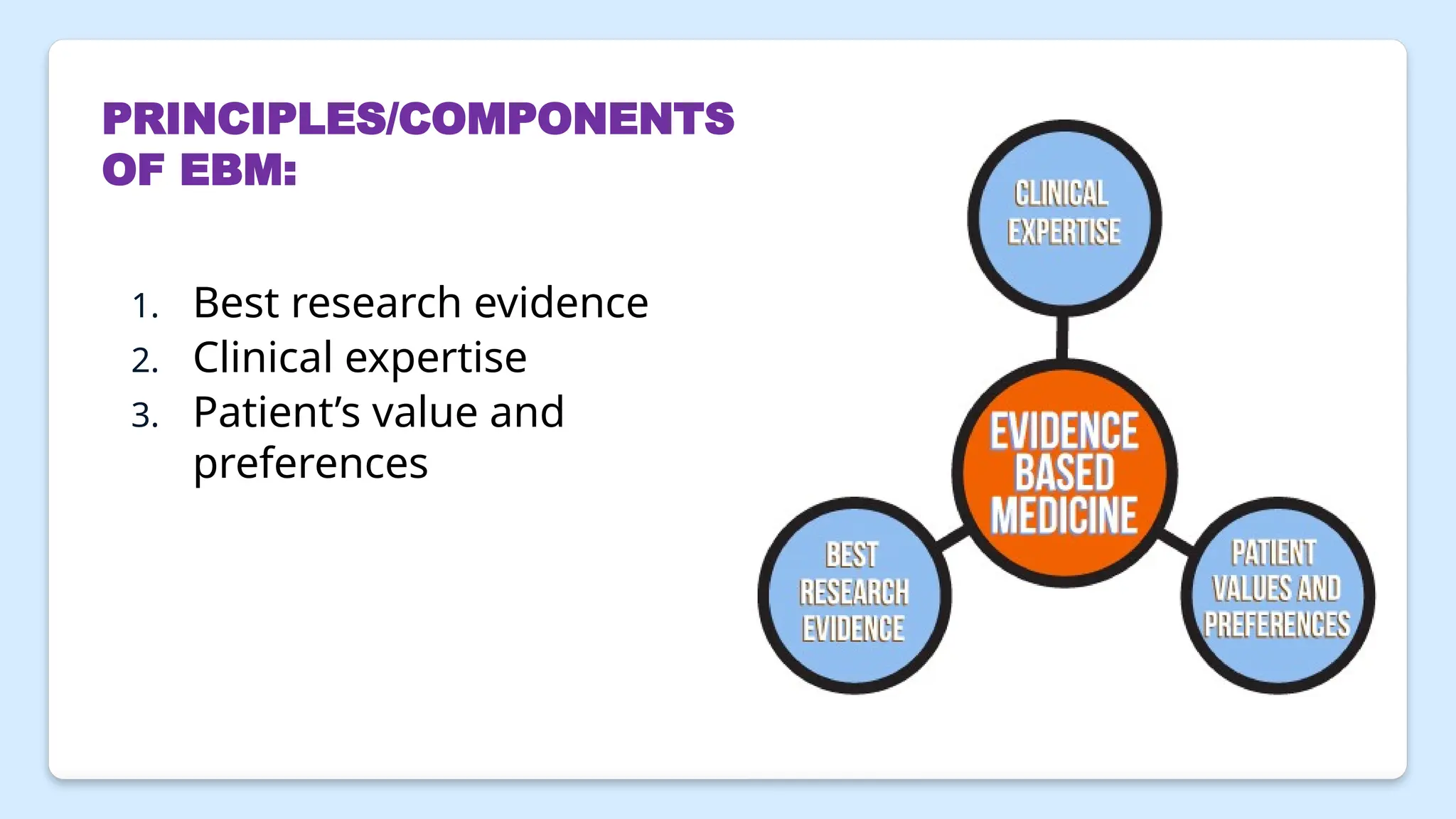
PRINCIPLES/COMPONENTS
OF EBM:
1. Best research evidence
2. Clinical expertise
3. Patient’s value and
preferences
OBJECTIVES OF EBM:
1. To recognise an information
needed, while caring for a
patient.
2. To identify the best existing
evidence to help resolve the
problems.
3. To integrate the evidence into a
medical plan.
STEPS INVOLVED IN APPLYING EBM PROCESS TO
A PHARMACOTHERAPEUTIC DECISION MAKING:
The steps involved in applying the EBM process to a
Pharmacotherapeutic decision are:
1. Recognise information needs & convert them into answerable
questions.
2. Conduct efficient searches for the best evidence with which to answer
these questions.
3. Critically appraise the evidence for its validity and usefulness.
4. Apply the results to patient situations to best assist clinical decision
making.
Formulate the
clinical question
Search for
evidence
Appraise the
evidence
Incorporate
evidence into
decision making
Evaluate the
process
5 ‘A’s
1. To Ask Question
The first and foremost step is convert the need for information into a
patient focused, pertinent, relevant and answerable question.
 A patient with a particular problem, various questions may arise for
which would like answers. These questions are frequently unstructured
and complex, and may not be clear in our minds.
 Translate the clinical problem into an answerable question
 Thus an answerable clinical question should be structured in the
 PICO (Patient or Problem, Intervention, Comparison, Outcome/s) or
PIO (Patient or Problem, Intervention, Outcome/s) format
 P - Patient, Population or Problem
How would you describe a group of patients similar to yours? What are the
most important characteristics of the patient?
 I - Intervention, prognostic factor, or exposure
Which main intervention, prognostic factor, or exposure are you
considering? What do you want to do for the patient?
 C - Comparison
What is the main alternative to compare with the intervention?
 0 - Outcome
What can you hope to accomplish measure, improve or affect? What are you
trying to do for the patient?
2. ACCESS (Conducting an efficient search) :
Health care professionals have four options as they try to identify the
best evidence available to answer a well-framed question:
i) Ask a colleague for his/her expert opinion.
ii) Review practice guidelines (evidence-based/ expert-opinion-based)
or a textbook for appropriate disease management.
iii) Consult electronic databases of systematic reviews or mata-analyses.
iv) Conduct a literature search using an electronic database like
“MEDLINE”.
3. Appraise The Evidence:
 After obtained relevant articles on questions, the next step is to appraise the
evidence for its validity and clinical usefulness.
 To know whether this is the best available evidence or not is the next step.
 The critical appraisal of the article is an important step in the whole process.
 It is essential that master the skills of critical appraisal of the literature, if they
are to apply evidence-based medicine to the daily clinical problems they
encounter.
 Putting unreliable evidence into practice could lead to harm being caused or
limited resources being wasted.
 Research evidence may be appraised with regard to three main areas: a validity,
 Importance and
 Applicability to the patient or patients of interest.
Editorials and Expert Opinions
This is evidence based on the opinions of a panel of experts aiming to shape common
medical practice.
Case-Series and Case-Reports
Case series are descriptive studies following one small group of people. They are
additions or supplements of case reports. A case report is a detailed report of the
symptoms, signs, diagnosis, treatment, and follow-up of an individual patient.
Case-Control Studies
A case-control study is an observational retrospective study (looking at historical data)
that compares patients who have a disease with patients who do not have the disease.
Cohort Studies
The modern definition of a 'cohort' in clinical studies is a group of people with defined
characteristics who are followed in order to determine health-related outcomes.
Randomised Clinical Trial (RCT)
4. Applying the results:
Several patient-specific factors must be considered in the final analysis:
i) Compare the patient with those in the society:
Mainly done on the basis of:
a) Similar disease state and stages
b) Similar baseline characteristics
This assessment should ensure that the population studied has a similar disease state and
prognostic factors as the patient now being treated.
ii) Consider the patient’s baseline risk:
This is done to check:
c) The outcome of interest
d) Potential risks associated with the therapy
iii) Consider the patient’s values:
 Consider patient’s beliefs, concerns and readiness for the intervention.
 Health care delivery characteristics like cost & accessibility must be considered.
5. Assess The Patient Condition
 History
 Diagnosis
◦ Physical Examination
◦ Objective data-Lab details like X rays, blood tests
 Differential diagnosis should be conducted in all the
diseases.
MERITS OF EVIDENCE BASED MEDICINE:
1. Minimizes the error and optimizes the quality in patient care.
2. Reduces the cost of treatment.
3. Provides all the groups (involved in providing health care) with a
rigorous and acceptable framework for making complex decisions.
4. Enables professionals to be confident in their decisions and to
communicate them effectively to fellow colleagues and patients.
FACTORS INFLUENCING EBM:
1. Reproducible evidence strategies.
2. Overwhelming size of literature.
3. Inadequacy of textbook.
4. Difficulty in synthesizing evidence and translating into practice.
5. Increased number of RCTs (Randomized, Controlled Trials).
6. Available computerised databases.
THANK YOU

EVIDENCE BASED MEDICINE (EBM) ... .pptx

  • 1.
    SUBHANALLA abdulGANI 23pr021 EVIDENCE BASED MEDICINE DEPARTMENTOF PHARMACY PRACTICE H.K.E.S MATOSHREE TARADEVI RAMPURE INSTITUTE OF PHARMACEUTICAL SCIENCES GULBARGA -585 105 UNDER THE GUIDANCE OF DR. S.S BIRADAR
  • 2.
    DEFINITION: Evidence based medicine (EBM)is an approach to medical practice that uses the results of patient care research and other available objective evidence as a component of clinical decision making.
  • 3.
    There is increasingrealization among clinicians that years of experience that has enabled them to sharpen the clinical skills and improve clinical judgment, if unaccompanied by updating of knowledge can result in decline of clinical performance. The need for valid information about diagnosis, therapy, prognosis, and prevention. The awareness level in the general public about health related has increased. The common man has access to the very same medical literature as the clinicians through numerous sources. The patients are increasingly accessing medical information and are looking to their physicians for interpretation and opinion. Why EBM:
  • 4.
    The traditional sourcesof information for the clinician are generally found to be inadequate because they are out of date (textbooks), frequently wrong (experts!!), ineffective The limited time available to the clinician for acquiring information is a major impediment for updating the knowledge from traditional sources. Information equips the clinician with newer and more efficient tools of information gathering.
  • 5.
    To improve qualityof care , and the elimination of those that are ineffective or harmful EBM promotes critical thinking. It demands that the effectiveness of clinical interventions, the accuracy and precision of diagnostic tests, and the power of prognostic markers should be scrutinized and their usefulness proven. It requires clinicians to be open minded and look for and try new methods that are scientifically proven to be effective and to discard methods shown to be ineffective or harmful Health care professionals develop key EBM skills including the ability to find. Critically appraise, and incorporate sound scientific evidence into their own practice. NEED OF EBM:
  • 6.
    To deliver optimalpatient care through the integration of current best evidence and patient preferences, and should also incorporate expertise in performing clinical history and physical examination. To develop the knowledge and experience may be integrated with patients' preferences and available evidence in the making of clinical decisions. AIM OF EBM:
  • 7.
    CONTENTS OF EVIDENCEBASED MEDICINE: 1. Practice guidelines and standards setting bodies 2. Quality assurance systems 3. Research appraisal processs 4. Research commissional process 5. Databases 6. Journals 7. Reference texts of latest and best evidence
  • 8.
    PRINCIPLES/COMPONENTS OF EBM: 1. Bestresearch evidence 2. Clinical expertise 3. Patient’s value and preferences
  • 9.
    OBJECTIVES OF EBM: 1.To recognise an information needed, while caring for a patient. 2. To identify the best existing evidence to help resolve the problems. 3. To integrate the evidence into a medical plan.
  • 10.
    STEPS INVOLVED INAPPLYING EBM PROCESS TO A PHARMACOTHERAPEUTIC DECISION MAKING: The steps involved in applying the EBM process to a Pharmacotherapeutic decision are: 1. Recognise information needs & convert them into answerable questions. 2. Conduct efficient searches for the best evidence with which to answer these questions. 3. Critically appraise the evidence for its validity and usefulness. 4. Apply the results to patient situations to best assist clinical decision making.
  • 11.
    Formulate the clinical question Searchfor evidence Appraise the evidence Incorporate evidence into decision making Evaluate the process 5 ‘A’s
  • 12.
    1. To AskQuestion The first and foremost step is convert the need for information into a patient focused, pertinent, relevant and answerable question.  A patient with a particular problem, various questions may arise for which would like answers. These questions are frequently unstructured and complex, and may not be clear in our minds.  Translate the clinical problem into an answerable question  Thus an answerable clinical question should be structured in the  PICO (Patient or Problem, Intervention, Comparison, Outcome/s) or PIO (Patient or Problem, Intervention, Outcome/s) format
  • 13.
     P -Patient, Population or Problem How would you describe a group of patients similar to yours? What are the most important characteristics of the patient?  I - Intervention, prognostic factor, or exposure Which main intervention, prognostic factor, or exposure are you considering? What do you want to do for the patient?  C - Comparison What is the main alternative to compare with the intervention?  0 - Outcome What can you hope to accomplish measure, improve or affect? What are you trying to do for the patient?
  • 14.
    2. ACCESS (Conductingan efficient search) : Health care professionals have four options as they try to identify the best evidence available to answer a well-framed question: i) Ask a colleague for his/her expert opinion. ii) Review practice guidelines (evidence-based/ expert-opinion-based) or a textbook for appropriate disease management. iii) Consult electronic databases of systematic reviews or mata-analyses. iv) Conduct a literature search using an electronic database like “MEDLINE”.
  • 15.
    3. Appraise TheEvidence:  After obtained relevant articles on questions, the next step is to appraise the evidence for its validity and clinical usefulness.  To know whether this is the best available evidence or not is the next step.  The critical appraisal of the article is an important step in the whole process.  It is essential that master the skills of critical appraisal of the literature, if they are to apply evidence-based medicine to the daily clinical problems they encounter.  Putting unreliable evidence into practice could lead to harm being caused or limited resources being wasted.  Research evidence may be appraised with regard to three main areas: a validity,  Importance and  Applicability to the patient or patients of interest.
  • 16.
    Editorials and ExpertOpinions This is evidence based on the opinions of a panel of experts aiming to shape common medical practice. Case-Series and Case-Reports Case series are descriptive studies following one small group of people. They are additions or supplements of case reports. A case report is a detailed report of the symptoms, signs, diagnosis, treatment, and follow-up of an individual patient. Case-Control Studies A case-control study is an observational retrospective study (looking at historical data) that compares patients who have a disease with patients who do not have the disease. Cohort Studies The modern definition of a 'cohort' in clinical studies is a group of people with defined characteristics who are followed in order to determine health-related outcomes. Randomised Clinical Trial (RCT)
  • 17.
    4. Applying theresults: Several patient-specific factors must be considered in the final analysis: i) Compare the patient with those in the society: Mainly done on the basis of: a) Similar disease state and stages b) Similar baseline characteristics This assessment should ensure that the population studied has a similar disease state and prognostic factors as the patient now being treated. ii) Consider the patient’s baseline risk: This is done to check: c) The outcome of interest d) Potential risks associated with the therapy iii) Consider the patient’s values:  Consider patient’s beliefs, concerns and readiness for the intervention.  Health care delivery characteristics like cost & accessibility must be considered.
  • 18.
    5. Assess ThePatient Condition  History  Diagnosis ◦ Physical Examination ◦ Objective data-Lab details like X rays, blood tests  Differential diagnosis should be conducted in all the diseases.
  • 19.
    MERITS OF EVIDENCEBASED MEDICINE: 1. Minimizes the error and optimizes the quality in patient care. 2. Reduces the cost of treatment. 3. Provides all the groups (involved in providing health care) with a rigorous and acceptable framework for making complex decisions. 4. Enables professionals to be confident in their decisions and to communicate them effectively to fellow colleagues and patients.
  • 20.
    FACTORS INFLUENCING EBM: 1.Reproducible evidence strategies. 2. Overwhelming size of literature. 3. Inadequacy of textbook. 4. Difficulty in synthesizing evidence and translating into practice. 5. Increased number of RCTs (Randomized, Controlled Trials). 6. Available computerised databases.
  • 21.