



Evidence Based
Practice (EBP)
Evidence based Midwifery practice
 Introduction:
Evidence based practice (EBP) is the integration of
best research evidence with clinical expertise and
patient values to deliver optimal care. Best
research means clinically relevant, Patient
centered research studies.
Definition
Evidence based practice is the conscientious
use of current best evidence in making
clinical decisions about patient care.
 In many areas of clinical decision making research
has demonstrated that “tried and true” methods or
practices taught in basic nursing education are not
always best.
 For example, although many nurses were taught to
give Enema to the Pregnant mother during 1st stage
of labour, But now there is persuasive evidence
that the enema during labour is contraindicated as
it increases risk of infection to the baby during
birth.
 A basic feature of Evidence based practice as a clinical
problem solving strategy is that it de emphasis is on
indentifying the best available research evidence and
integrating it with other factors.
 Evidence based decision making should integrate best
research evidence with clinical expertise, patient
preferences and circumstances and awareness of the
clinical setting and resource constraints.
The Benefits of Evidence-Based Practice
Nurses are responsible for the care they provide to their
patients.
 Evidence-based practice in nursing means making
decisions about patient care on the basis of current best
available evidence.
It helps the nurse provide high-quality care to her patients
based on research and knowledge.
"Sue and Bill" is Copyrighted by Flickr user: jamesfischer
(Jim Fischer) under the Creative Commons Attribution
license.
 Efficiency
Evidence-based practice increases the efficiency of
nurses.
 Making decisions based on knowledge that is
backed by research makes it easier for a nurse to
choose what care to provide to her patient as
opposed to trying something that may or may not
be beneficial to her patient.
 This saves her time, which she can devote to
patients who need more intensive care from her.
 Better Patient Outcome
Nurses regularly make decisions on what care to
provide for their patients.
These decisions can impact the patients' health
negatively or positively.
The patient will likely experience a better outcome
when the care is based on researched and proven
methods.
 It Keeps Nursing Practice Current
For nurses to apply evidence-based practice in the
care they provide, they have to stay informed on
any new discoveries that have been made.
This encourages them to read materials that cover
nursing research thus keeping their practice
current.
 Decision Making
Using evidence-based practice to provide care to
patients increases the nurse's confidence.
This is because she knows that she is basing her
decisions about patient care on valid information that
has been thoroughly researched.
 Magnet Status
 Incorporating evidence-based practice into the
nursing care at a hospital may help the hospital
achieve Magnet status.
 The Magnet Recognition Program recognizes
quality patient care, nursing excellence and
innovations in nursing practice.
 Being a magnet facility, assures patients that they
are getting excellent nursing service.
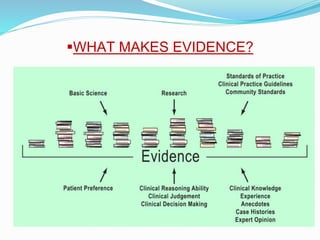
WHAT MAKES EVIDENCE?
Resources for evidence based practice
 Systematic Reviews
 Evidence based practice relies on meticulous
integration of research evidence on a topic.
 The emphasis on best evidence in evidence based
practice implies that all or most evidence about a
clinical problem has been gathered, evaluated and
synthesized so that conclusion can be drawn about
effective practices.
 Systematic reviews can take various forms. Until, fairly
recently, the most common type of systematic review
was a traditional narrative (qualitative) integration to
merge and synthesize research findings.
 Narrative reviews of quantitative studies increasingly are
being replaced by a type of systematic review known as
Meta analysis.
 Meta analysis is a technique for integrating quantitative
research findings statistically. Meta analysis treats the
findings from as study as one piece of information.
 The findings from multiple studies on the same topic
are combined and then all the all information is
analyzed statistically in a manner similar to that in
usual study.
 Thus instead of study participants being the unit of
analysis, the individual studies are the unit of analysis
in the Meta analysis.
 A meta synthesis involves integrating qualitative
research findings on a specific topic that are themselves
interpretive synthesis of narrative information.
Clinical practice guidelines
 Evidence based clinical practice guidelines, like systematic
reviews, represent an effort to distill a large body of evidence
into a manageable form.
 First and foremost , clinical practice guidelines, which are
usually based on systematic reviews, give specific practice
recommendations and prescriptions for evidence based
decision making.
 Second guidelines also attempt to address all the issues
relevant to a clinical decision, including the balancing of
benefits and risks.
The major steps in Evidence based practice include
the following
 Asking clinical questions that are answerable with research
evidence.
 Searching for and collecting relevant evidence.
 Appraising and synthesizing the evidence
 Integrating the evidence with your own clinical expertise,
patient preferences, and local context.
 Assessing the effectiveness of the decision, intervention or
advice.
ASKING WELL WORDED CLINICAL QUESTIONS:
 Fineout Overholt and Johnston recommended a 5
component scheme for formulating EBP questions
and used an acronym (PICOT) as a guide.
 The five components are
- Populations (p)
- interventions or issues (i)
- Comparison of interest (c)
- Outcome (O)
- Time (T)
FINDING RESEARCH EVIDENCE:
 For an EBP endeavor, the best place to begin is by
searching for evidence in a systematic review, clinical
practice guidelines or other preprocessed source
because this approach leads to much quicker answer .
 This is partly because researchers who prepare
reviews and clinical guidelines typically are well
trained in research methods and use exemplary
standards in conducting their evaluation of the
evidence.
APPRAISING THE EVIDENCE
 After locating appropriate evidence, it should be appraised
before taking any clinical action. The critical appraisal of
evidence for the purposes of EBP may involve several types of
assessments. Questions for appraising the evidence are:
- What is the quality of the evidence – that is how reliable is it?
- What is the evidence – what is the effect?
- How precise is the estimate of effects?
- What evidence is there of any side effects or side benefits?
- What is the financial cost of applying the evidence?
- Is the evidence relevant to particular clinical situation?
INTEGRATING EVIDENCE
 As the definition for EBP implies, research
evidence needs to be integrated with other types of
information, including own clinical expertise and
knowledge about clinical setting. Patient
preference and values are also important.
IMPLEMENTING THE EVIDENCE AND
EVALUATING OUTCOMES
 After the first four steps of the EBP process have
been completed use the integrated information to
make an evidence based decision or to provide
evidence based advice.
 Last step is Evaluation . Part of the evaluation
process involves following up to determine
whether our action or decision was useful and
achieved the desired outcome.
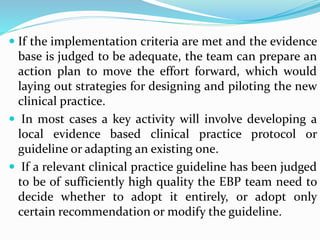
 If the implementation criteria are met and the evidence
base is judged to be adequate, the team can prepare an
action plan to move the effort forward, which would
laying out strategies for designing and piloting the new
clinical practice.
 In most cases a key activity will involve developing a
local evidence based clinical practice protocol or
guideline or adapting an existing one.
 If a relevant clinical practice guideline has been judged
to be of sufficiently high quality the EBP team need to
decide whether to adopt it entirely, or adopt only
certain recommendation or modify the guideline.
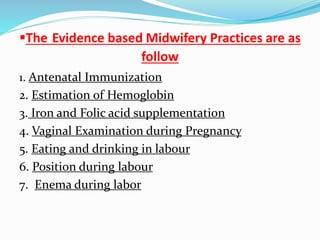
The Evidence based Midwifery Practices are as
follow
1. Antenatal Immunization
2. Estimation of Hemoglobin
3. Iron and Folic acid supplementation
4. Vaginal Examination during Pregnancy
5. Eating and drinking in labour
6. Position during labour
7. Enema during labor
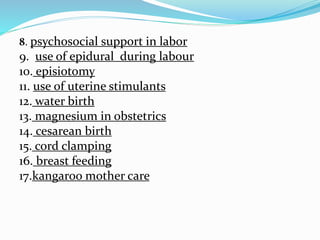
8. psychosocial support in labor
9. use of epidural during labour
10. episiotomy
11. use of uterine stimulants
12. water birth
13. magnesium in obstetrics
14. cesarean birth
15. cord clamping
16. breast feeding
17.kangaroo mother care
Evidence Base Practice (EBP)-Define, Benefits,Resource, steps PPT

Evidence Base Practice (EBP)-Define, Benefits,Resource, steps PPT

  • 1.
  • 2.
    Evidence based Midwiferypractice  Introduction: Evidence based practice (EBP) is the integration of best research evidence with clinical expertise and patient values to deliver optimal care. Best research means clinically relevant, Patient centered research studies.
  • 3.
    Definition Evidence based practiceis the conscientious use of current best evidence in making clinical decisions about patient care.
  • 4.
     In manyareas of clinical decision making research has demonstrated that “tried and true” methods or practices taught in basic nursing education are not always best.  For example, although many nurses were taught to give Enema to the Pregnant mother during 1st stage of labour, But now there is persuasive evidence that the enema during labour is contraindicated as it increases risk of infection to the baby during birth.
  • 5.
     A basicfeature of Evidence based practice as a clinical problem solving strategy is that it de emphasis is on indentifying the best available research evidence and integrating it with other factors.  Evidence based decision making should integrate best research evidence with clinical expertise, patient preferences and circumstances and awareness of the clinical setting and resource constraints.
  • 6.
    The Benefits ofEvidence-Based Practice Nurses are responsible for the care they provide to their patients.  Evidence-based practice in nursing means making decisions about patient care on the basis of current best available evidence. It helps the nurse provide high-quality care to her patients based on research and knowledge. "Sue and Bill" is Copyrighted by Flickr user: jamesfischer (Jim Fischer) under the Creative Commons Attribution license.
  • 7.
     Efficiency Evidence-based practiceincreases the efficiency of nurses.  Making decisions based on knowledge that is backed by research makes it easier for a nurse to choose what care to provide to her patient as opposed to trying something that may or may not be beneficial to her patient.  This saves her time, which she can devote to patients who need more intensive care from her.
  • 8.
     Better PatientOutcome Nurses regularly make decisions on what care to provide for their patients. These decisions can impact the patients' health negatively or positively. The patient will likely experience a better outcome when the care is based on researched and proven methods.
  • 9.
     It KeepsNursing Practice Current For nurses to apply evidence-based practice in the care they provide, they have to stay informed on any new discoveries that have been made. This encourages them to read materials that cover nursing research thus keeping their practice current.
  • 10.
     Decision Making Usingevidence-based practice to provide care to patients increases the nurse's confidence. This is because she knows that she is basing her decisions about patient care on valid information that has been thoroughly researched.
  • 11.
     Magnet Status Incorporating evidence-based practice into the nursing care at a hospital may help the hospital achieve Magnet status.  The Magnet Recognition Program recognizes quality patient care, nursing excellence and innovations in nursing practice.  Being a magnet facility, assures patients that they are getting excellent nursing service.
  • 12.
  • 13.
    Resources for evidencebased practice  Systematic Reviews  Evidence based practice relies on meticulous integration of research evidence on a topic.  The emphasis on best evidence in evidence based practice implies that all or most evidence about a clinical problem has been gathered, evaluated and synthesized so that conclusion can be drawn about effective practices.
  • 14.
     Systematic reviewscan take various forms. Until, fairly recently, the most common type of systematic review was a traditional narrative (qualitative) integration to merge and synthesize research findings.  Narrative reviews of quantitative studies increasingly are being replaced by a type of systematic review known as Meta analysis.  Meta analysis is a technique for integrating quantitative research findings statistically. Meta analysis treats the findings from as study as one piece of information.
  • 15.
     The findingsfrom multiple studies on the same topic are combined and then all the all information is analyzed statistically in a manner similar to that in usual study.  Thus instead of study participants being the unit of analysis, the individual studies are the unit of analysis in the Meta analysis.  A meta synthesis involves integrating qualitative research findings on a specific topic that are themselves interpretive synthesis of narrative information.
  • 16.
    Clinical practice guidelines Evidence based clinical practice guidelines, like systematic reviews, represent an effort to distill a large body of evidence into a manageable form.  First and foremost , clinical practice guidelines, which are usually based on systematic reviews, give specific practice recommendations and prescriptions for evidence based decision making.  Second guidelines also attempt to address all the issues relevant to a clinical decision, including the balancing of benefits and risks.
  • 17.
    The major stepsin Evidence based practice include the following  Asking clinical questions that are answerable with research evidence.  Searching for and collecting relevant evidence.  Appraising and synthesizing the evidence  Integrating the evidence with your own clinical expertise, patient preferences, and local context.  Assessing the effectiveness of the decision, intervention or advice.
  • 18.
    ASKING WELL WORDEDCLINICAL QUESTIONS:  Fineout Overholt and Johnston recommended a 5 component scheme for formulating EBP questions and used an acronym (PICOT) as a guide.  The five components are - Populations (p) - interventions or issues (i) - Comparison of interest (c) - Outcome (O) - Time (T)
  • 19.
    FINDING RESEARCH EVIDENCE: For an EBP endeavor, the best place to begin is by searching for evidence in a systematic review, clinical practice guidelines or other preprocessed source because this approach leads to much quicker answer .  This is partly because researchers who prepare reviews and clinical guidelines typically are well trained in research methods and use exemplary standards in conducting their evaluation of the evidence.
  • 20.
    APPRAISING THE EVIDENCE After locating appropriate evidence, it should be appraised before taking any clinical action. The critical appraisal of evidence for the purposes of EBP may involve several types of assessments. Questions for appraising the evidence are: - What is the quality of the evidence – that is how reliable is it? - What is the evidence – what is the effect? - How precise is the estimate of effects? - What evidence is there of any side effects or side benefits? - What is the financial cost of applying the evidence? - Is the evidence relevant to particular clinical situation?
  • 21.
    INTEGRATING EVIDENCE  Asthe definition for EBP implies, research evidence needs to be integrated with other types of information, including own clinical expertise and knowledge about clinical setting. Patient preference and values are also important.
  • 22.
    IMPLEMENTING THE EVIDENCEAND EVALUATING OUTCOMES  After the first four steps of the EBP process have been completed use the integrated information to make an evidence based decision or to provide evidence based advice.  Last step is Evaluation . Part of the evaluation process involves following up to determine whether our action or decision was useful and achieved the desired outcome.
  • 23.
     If theimplementation criteria are met and the evidence base is judged to be adequate, the team can prepare an action plan to move the effort forward, which would laying out strategies for designing and piloting the new clinical practice.  In most cases a key activity will involve developing a local evidence based clinical practice protocol or guideline or adapting an existing one.  If a relevant clinical practice guideline has been judged to be of sufficiently high quality the EBP team need to decide whether to adopt it entirely, or adopt only certain recommendation or modify the guideline.
  • 24.
    The Evidence basedMidwifery Practices are as follow 1. Antenatal Immunization 2. Estimation of Hemoglobin 3. Iron and Folic acid supplementation 4. Vaginal Examination during Pregnancy 5. Eating and drinking in labour 6. Position during labour 7. Enema during labor
  • 25.
    8. psychosocial supportin labor 9. use of epidural during labour 10. episiotomy 11. use of uterine stimulants 12. water birth 13. magnesium in obstetrics 14. cesarean birth 15. cord clamping 16. breast feeding 17.kangaroo mother care