Cohort Study
Hari Prasad Kafle
Assistant Professor
Pokhara University
Cohort Study


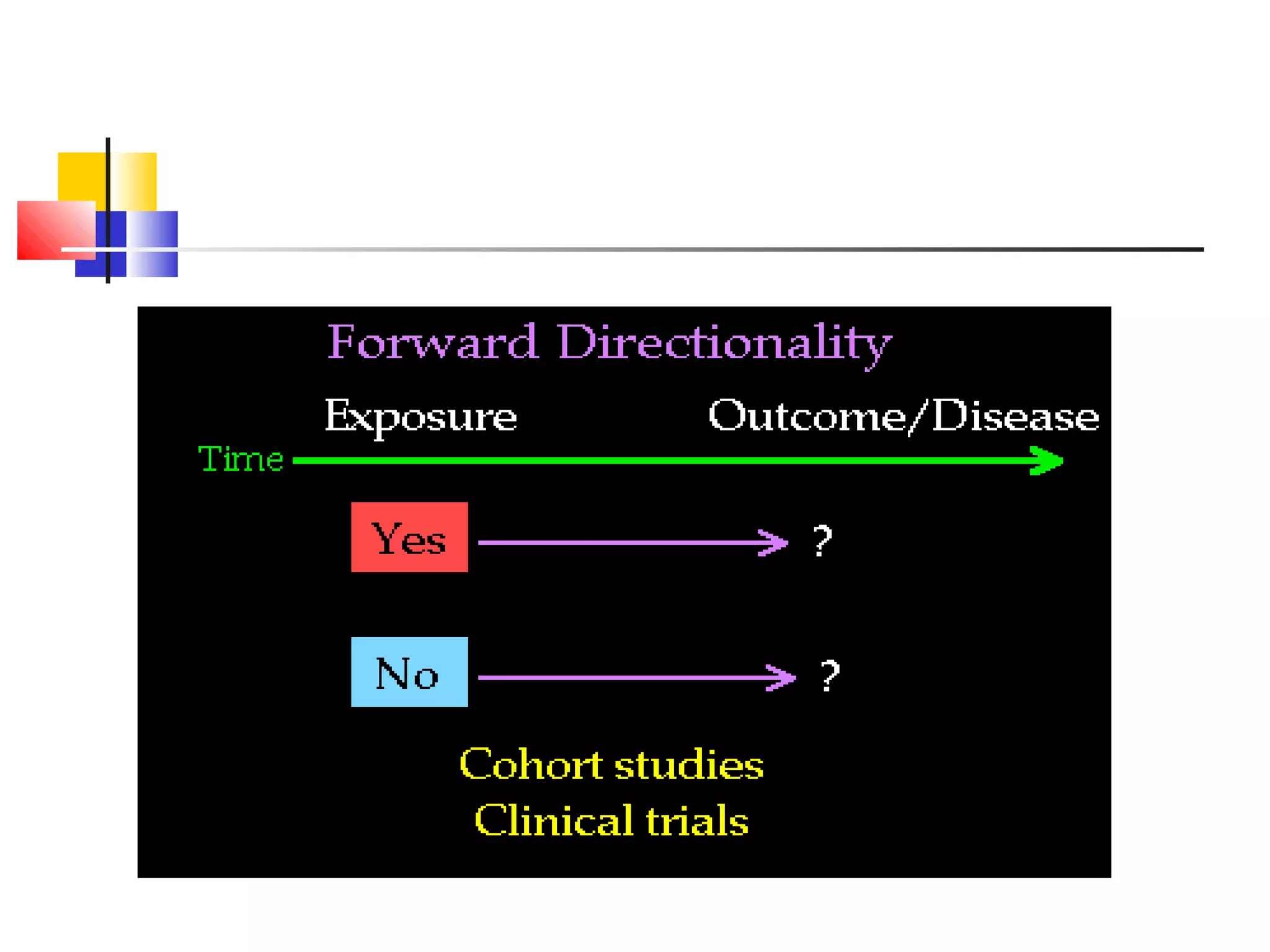
Cohort study is undertaken to support the
existence of association between suspected cause
and disease



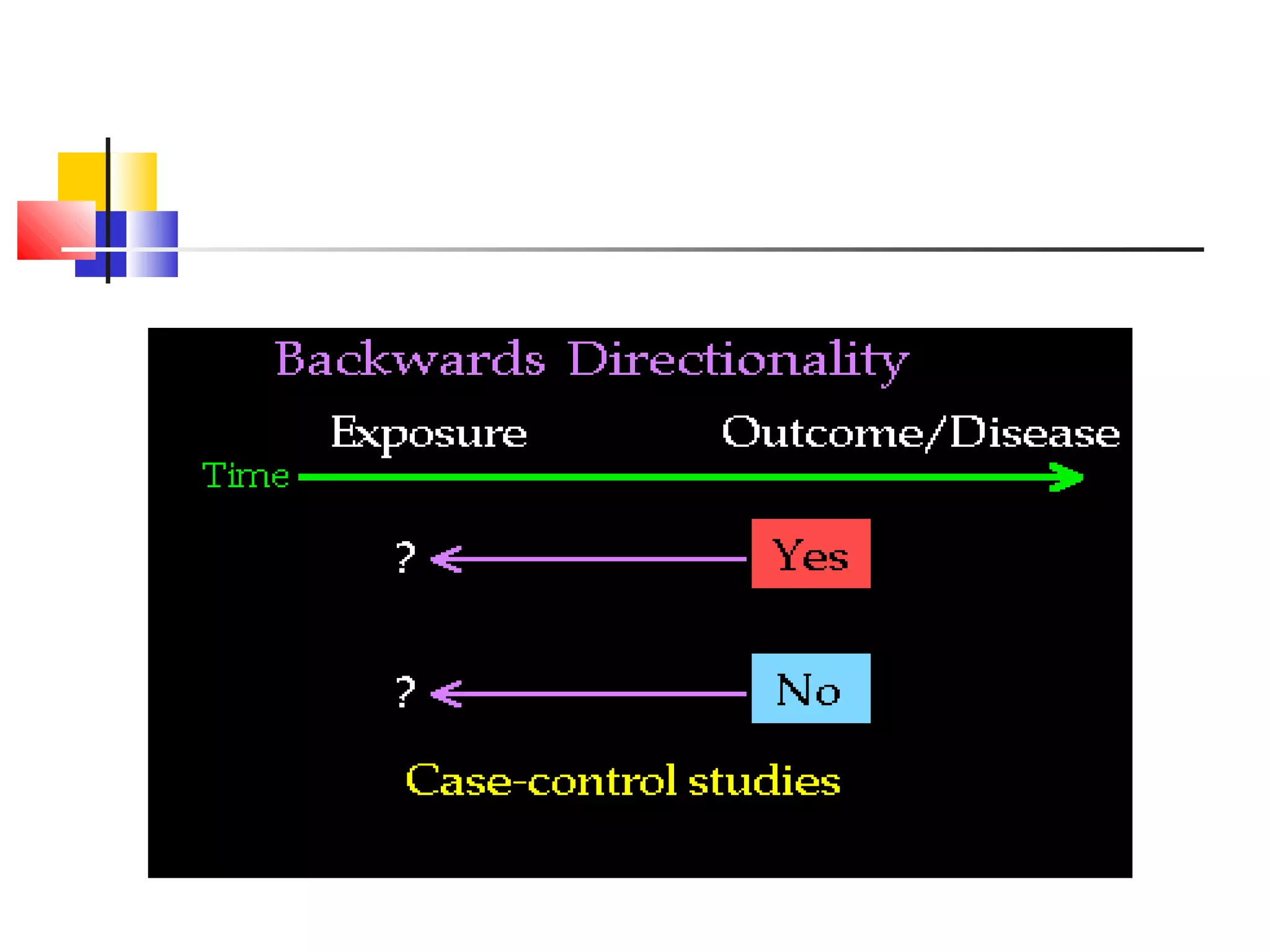
A major limitation of cross-sectional surveys and
case-control studies is difficulty in determining if
exposure or risk factor preceded the disease or
outcome.
Cohort Study


Cohort Study:

Key Point:


Presence or absence of risk factor is
determined before outcome occurs.
What is Cohort ?







Ancient Roman military
unit, A band of warriors.
Persons banded together.
Group of persons with a
common statistical
characteristic. [Latin]
E.g. age, birth date,
What is Cohort ?


Cohort is a group of people who share common
characteristic or experience within the defined
period of time.



E.g. birth cohort, marriage cohort, Exposure
cohort, Synthetic cohort etc.
Cohort studies









longitudinal
Prospective studies
Forward looking study
Incidence study

starts with people free of disease
assesses exposure at “baseline”
assesses disease status at “follow-up”
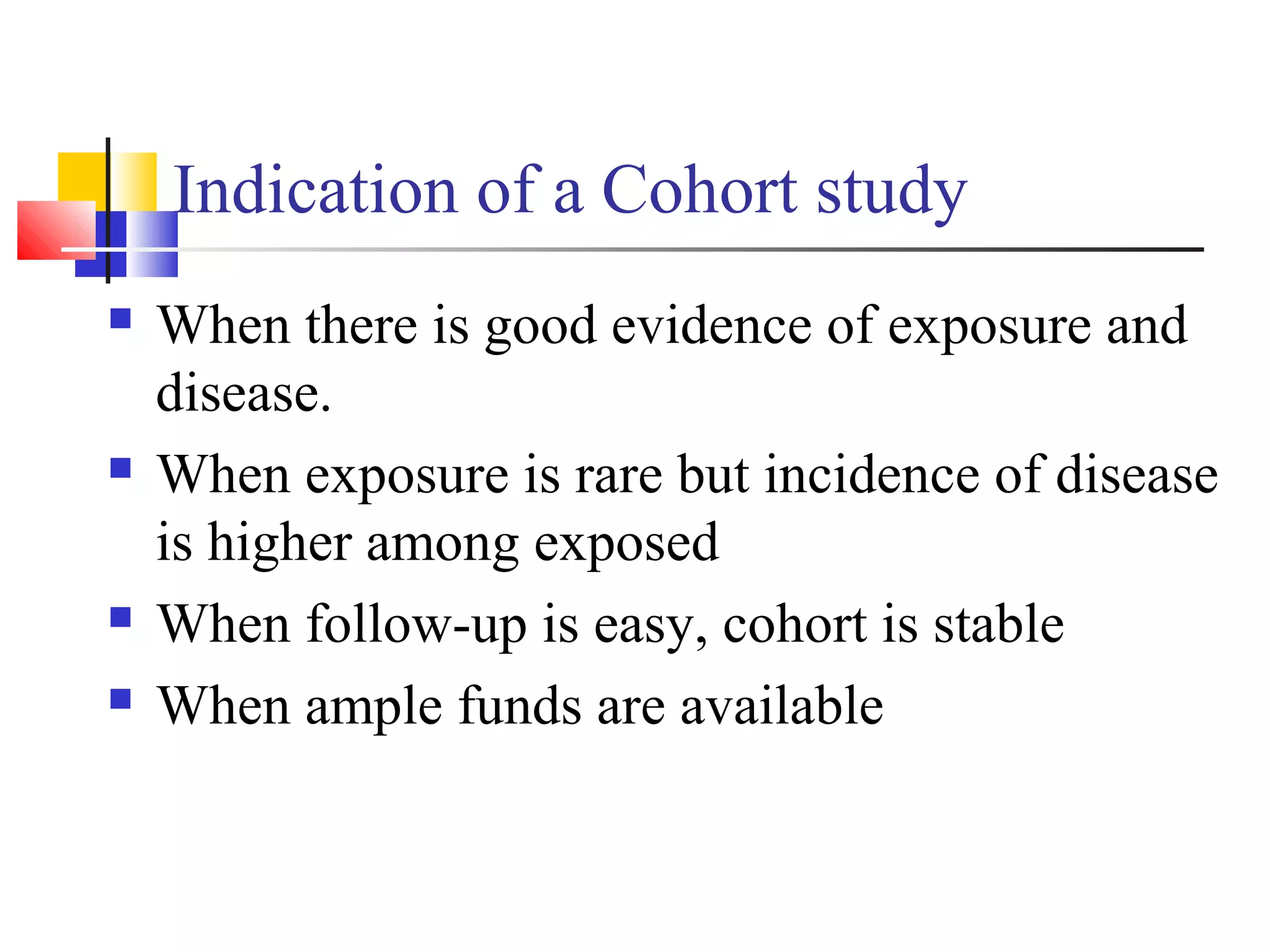
Indication of a Cohort study







When there is good evidence of exposure and
disease.
When exposure is rare but incidence of disease
is higher among exposed
When follow-up is easy, cohort is stable
When ample funds are available
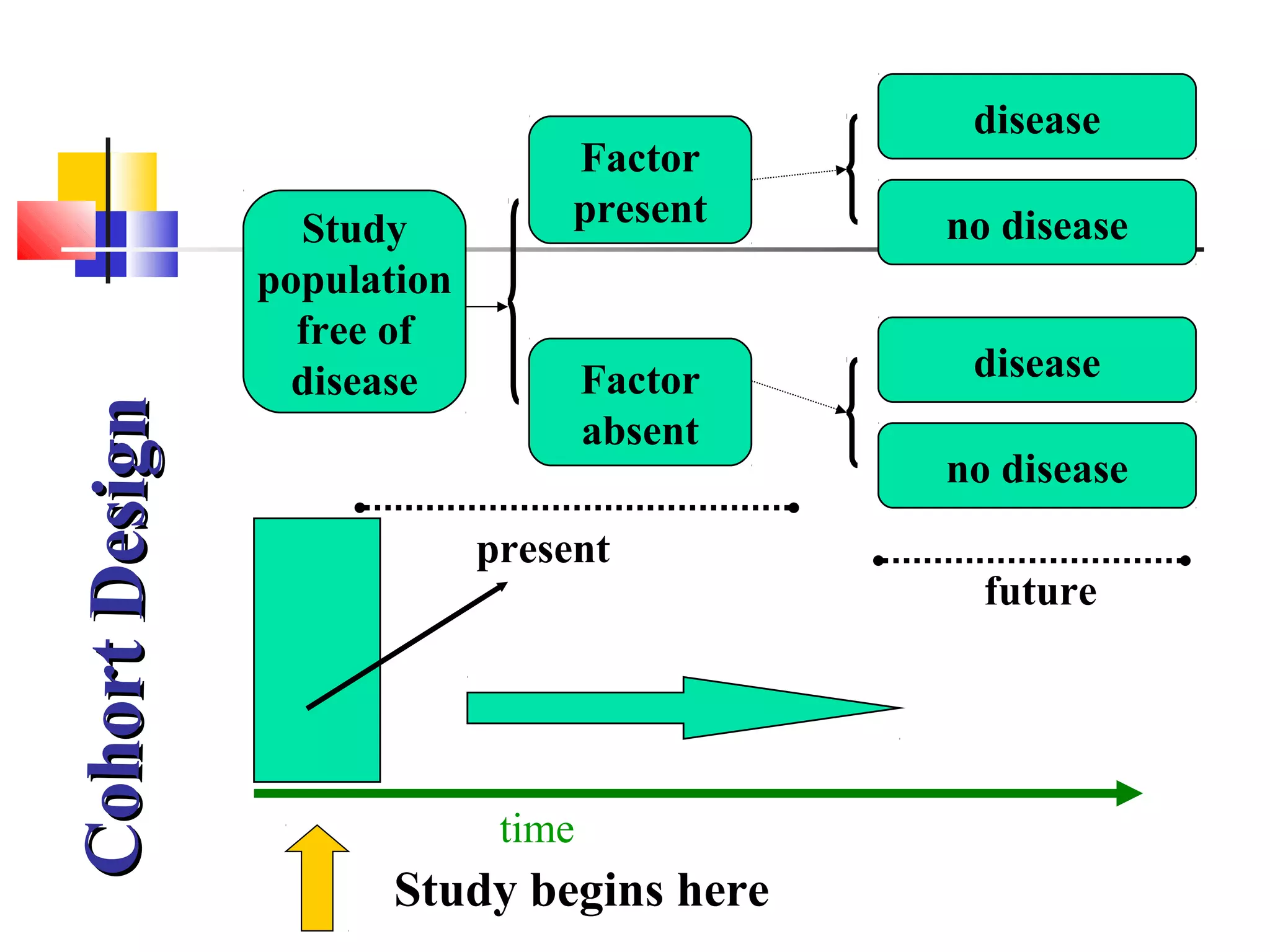
C ohort Desig n

Study
population
free of
disease

Factor
present

Factor
absent
present

time

Study begins here

disease
no disease
disease
no disease
future
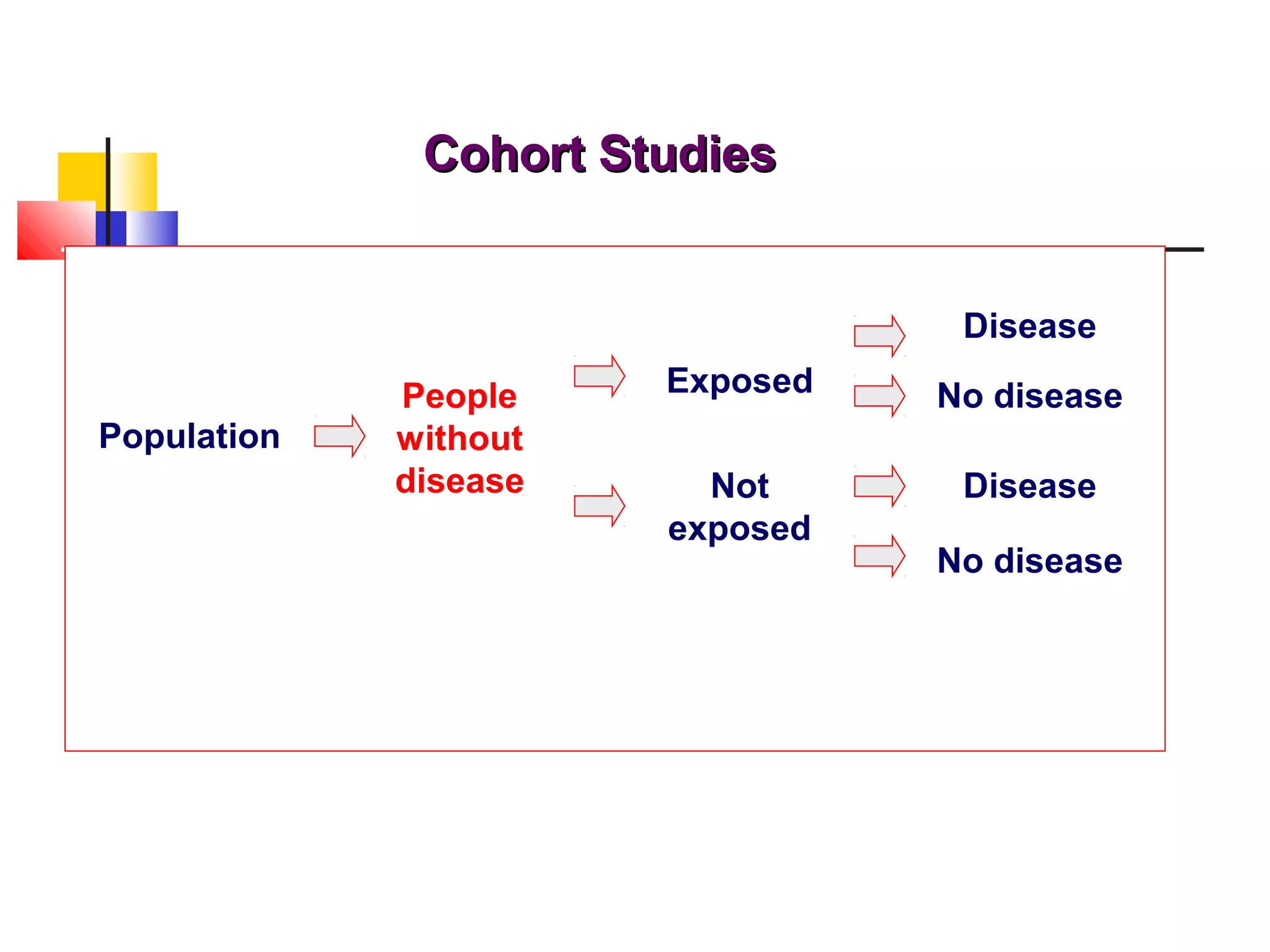
Cohort Studies
Disease
Population

People
without
disease

Exposed

No disease

Not
exposed

Disease
No disease
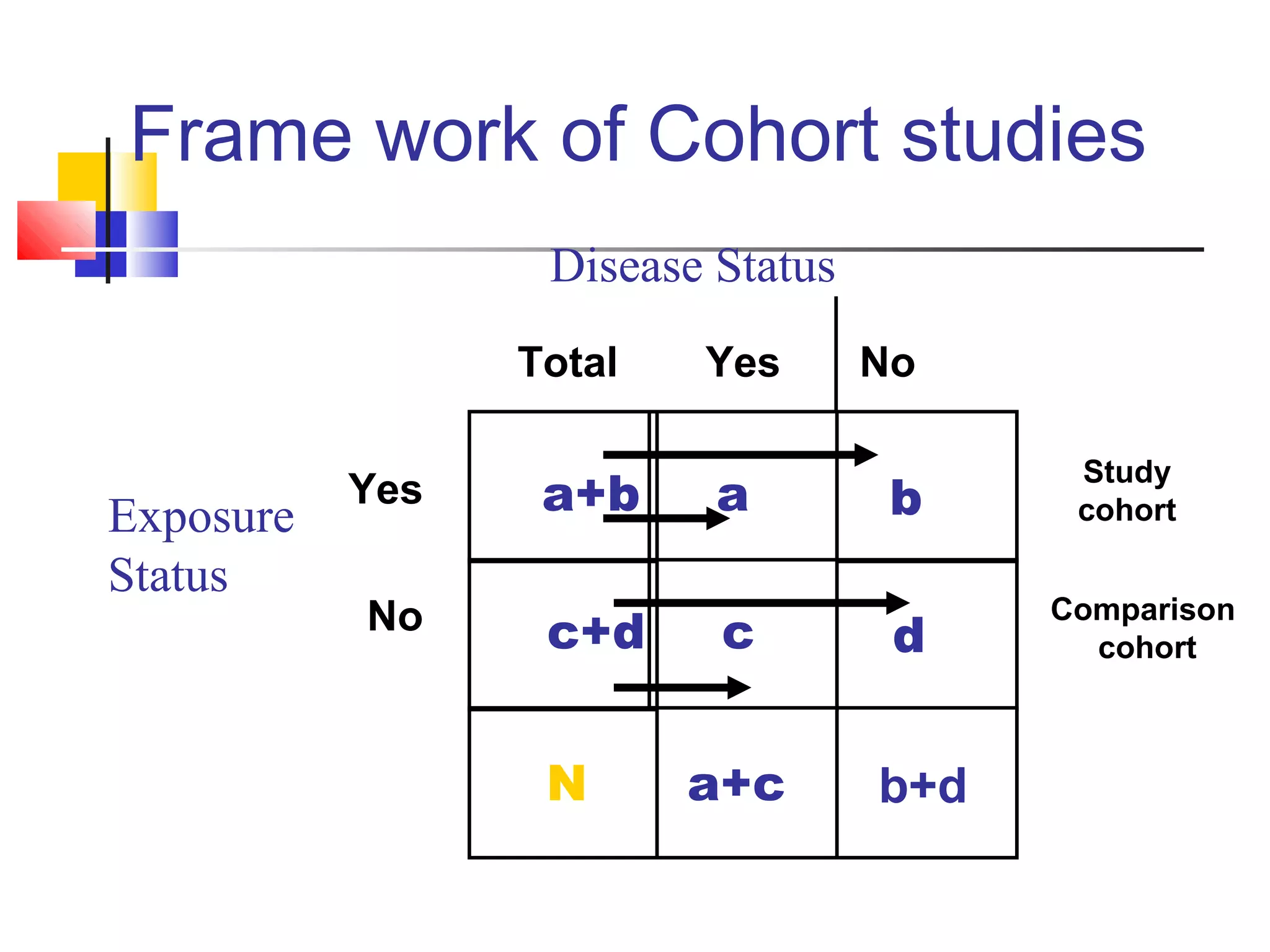
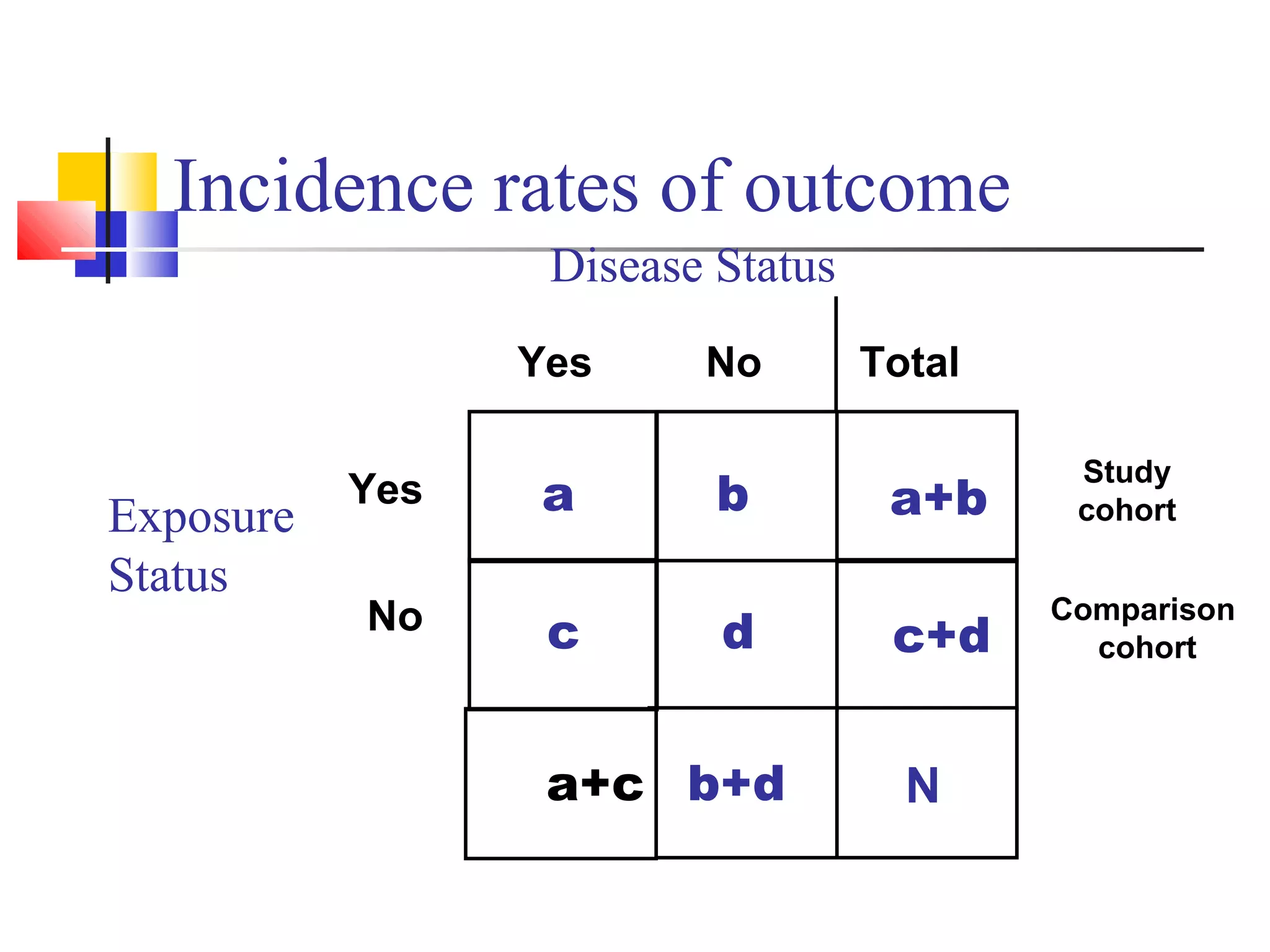
Frame work of Cohort studies
Disease Status
Total

Exposure
Status

Yes
No

a+b
c+d
N

Yes

a

No

b

c

d

a+c

b+d

Study
cohort
Comparison
cohort
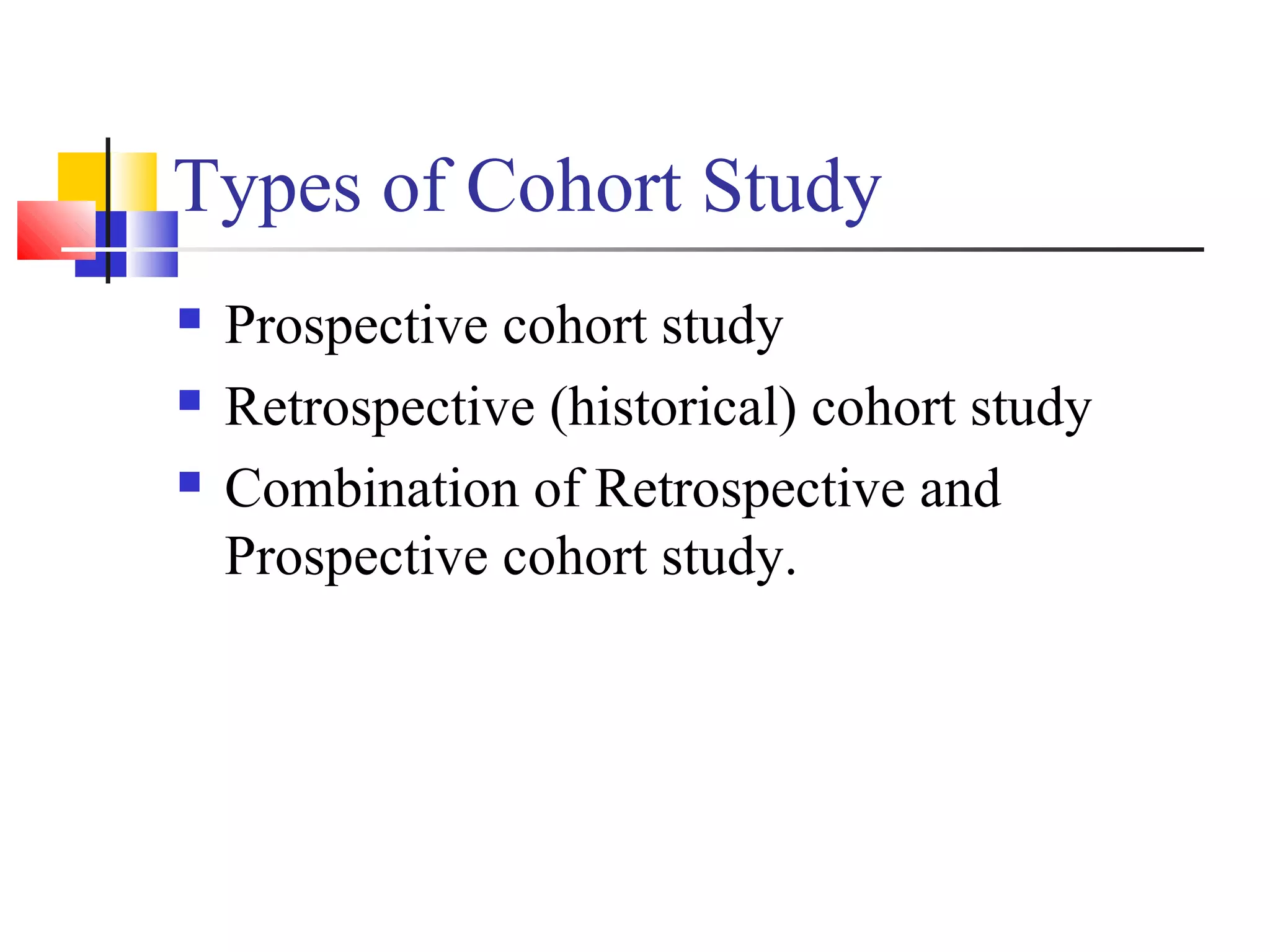
Types of Cohort Study




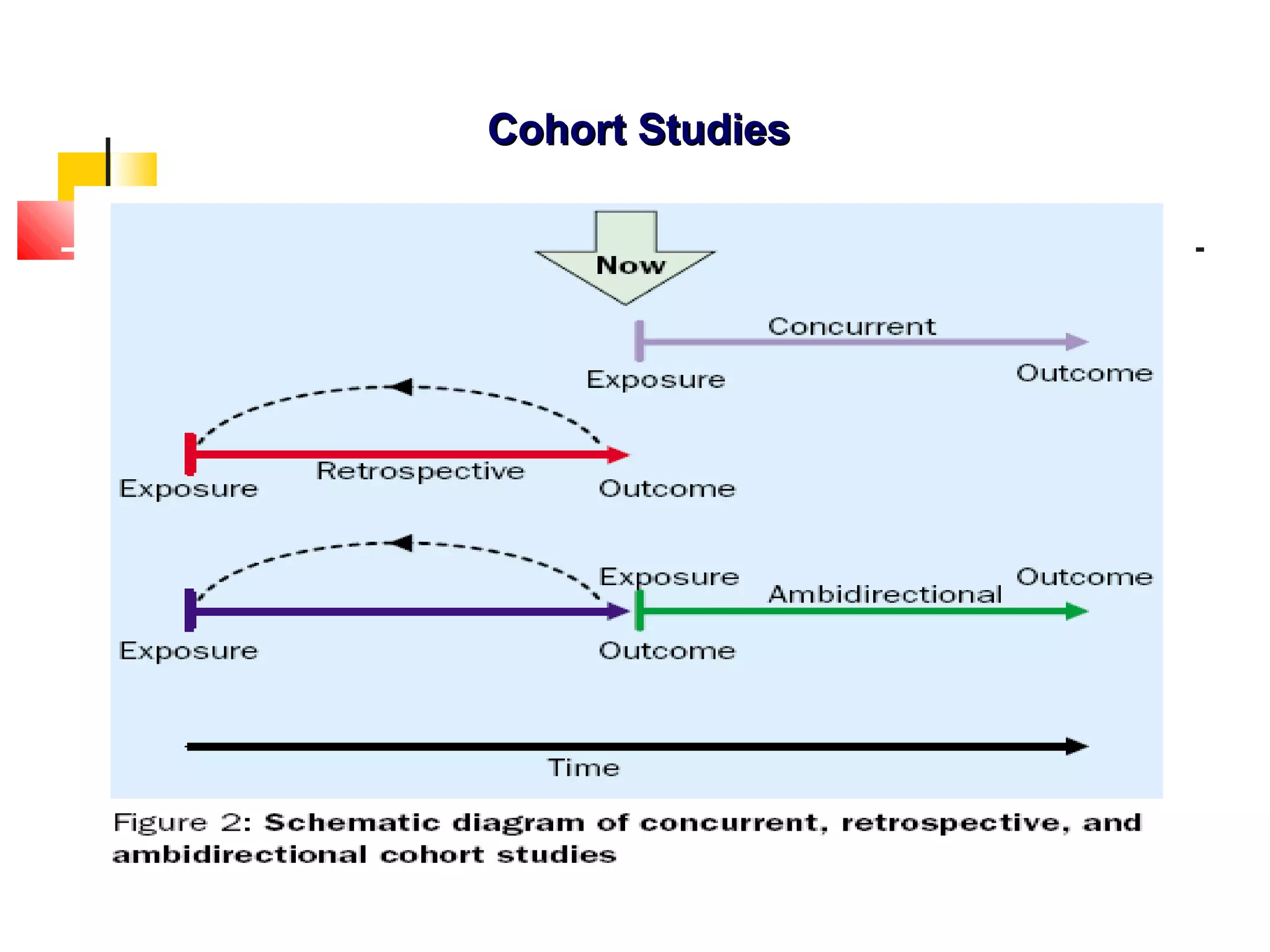
Prospective cohort study
Retrospective (historical) cohort study
Combination of Retrospective and
Prospective cohort study.
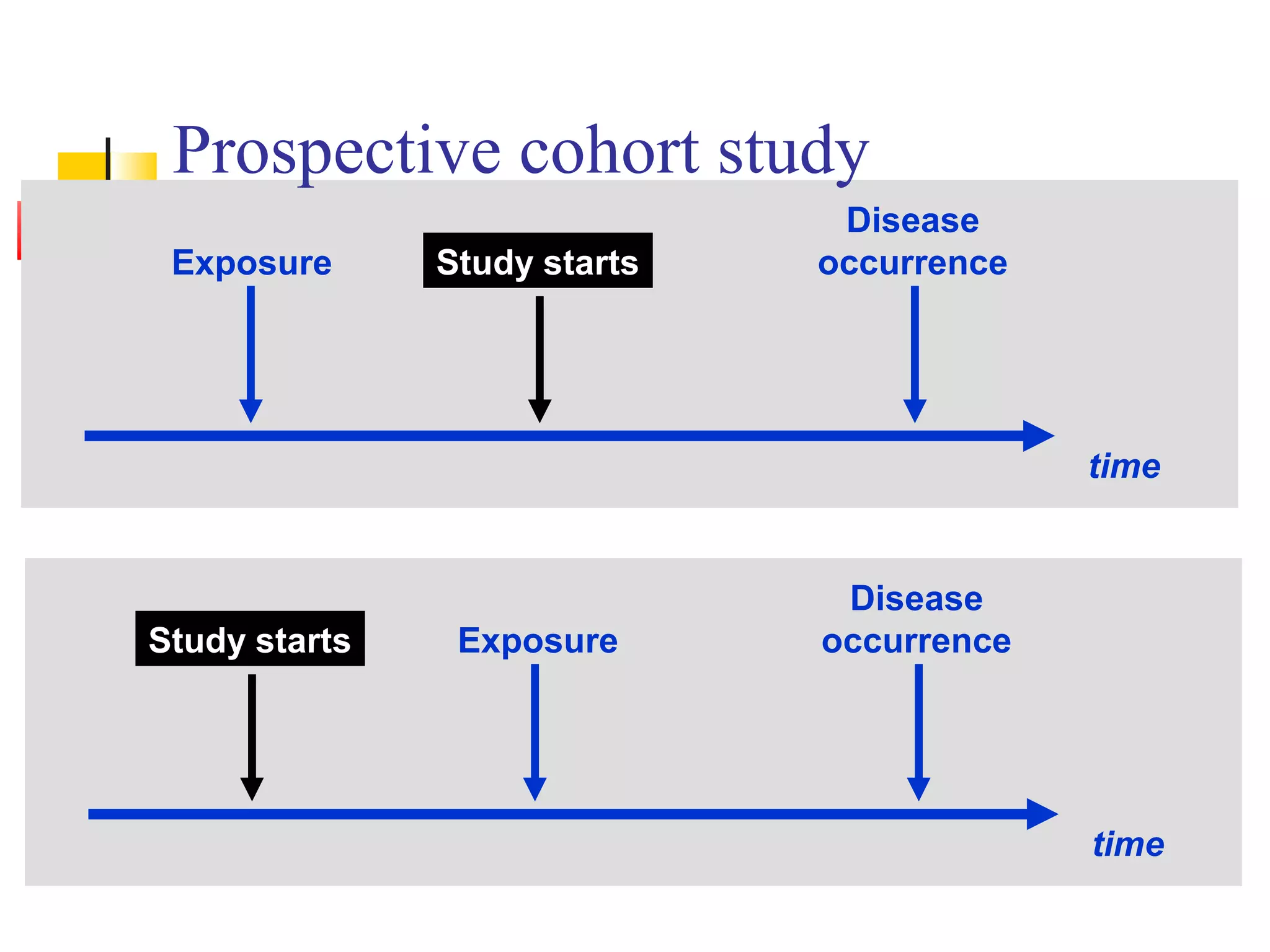
Prospective cohort study
Exposure

Study starts

Disease
occurrence

time

Study starts

Exposure

Disease
occurrence

time
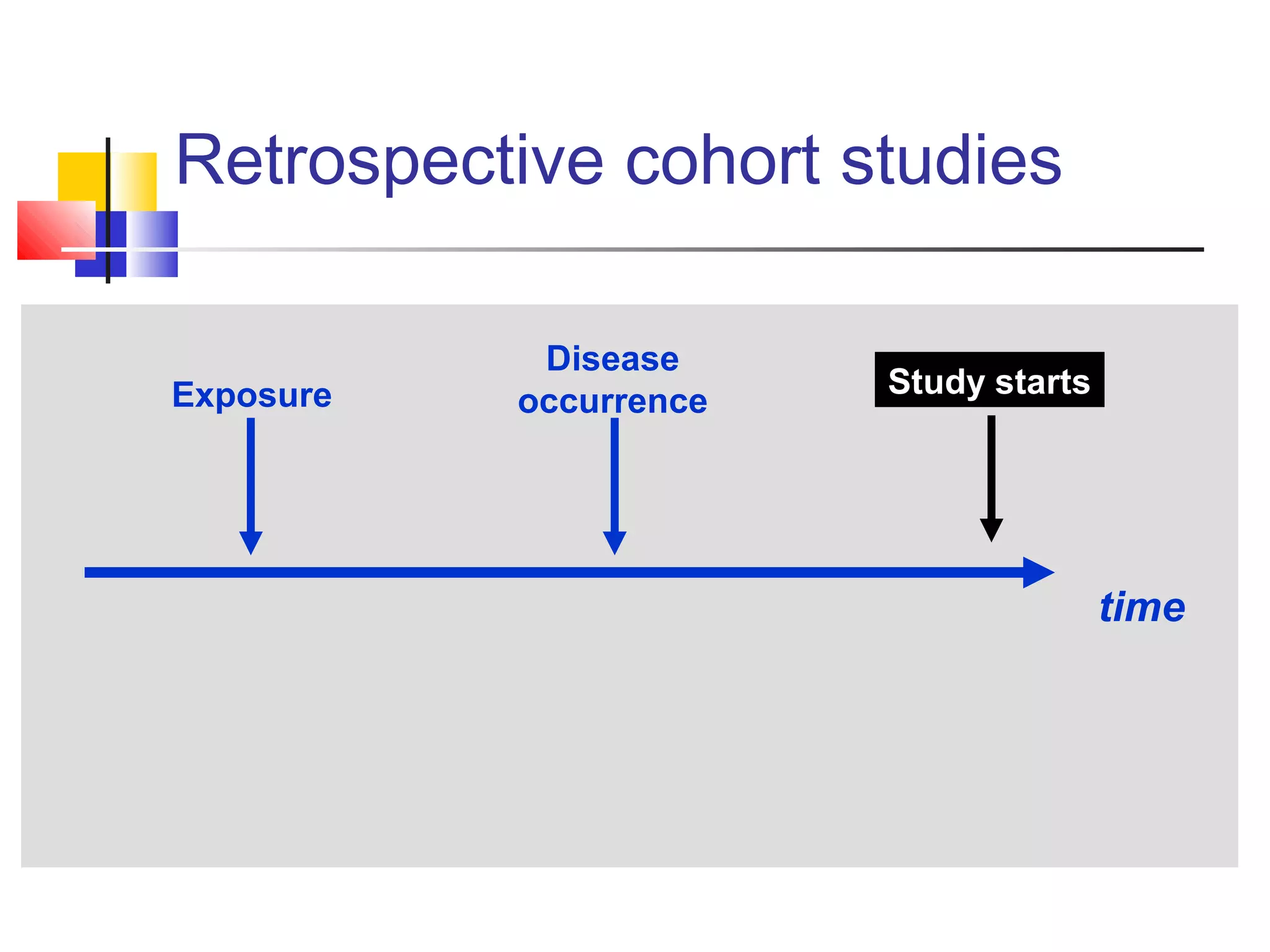
Retrospective cohort studies
Exposure

Disease
occurrence

Study starts

time
Cohort Studies
General consideration while
selection of cohorts






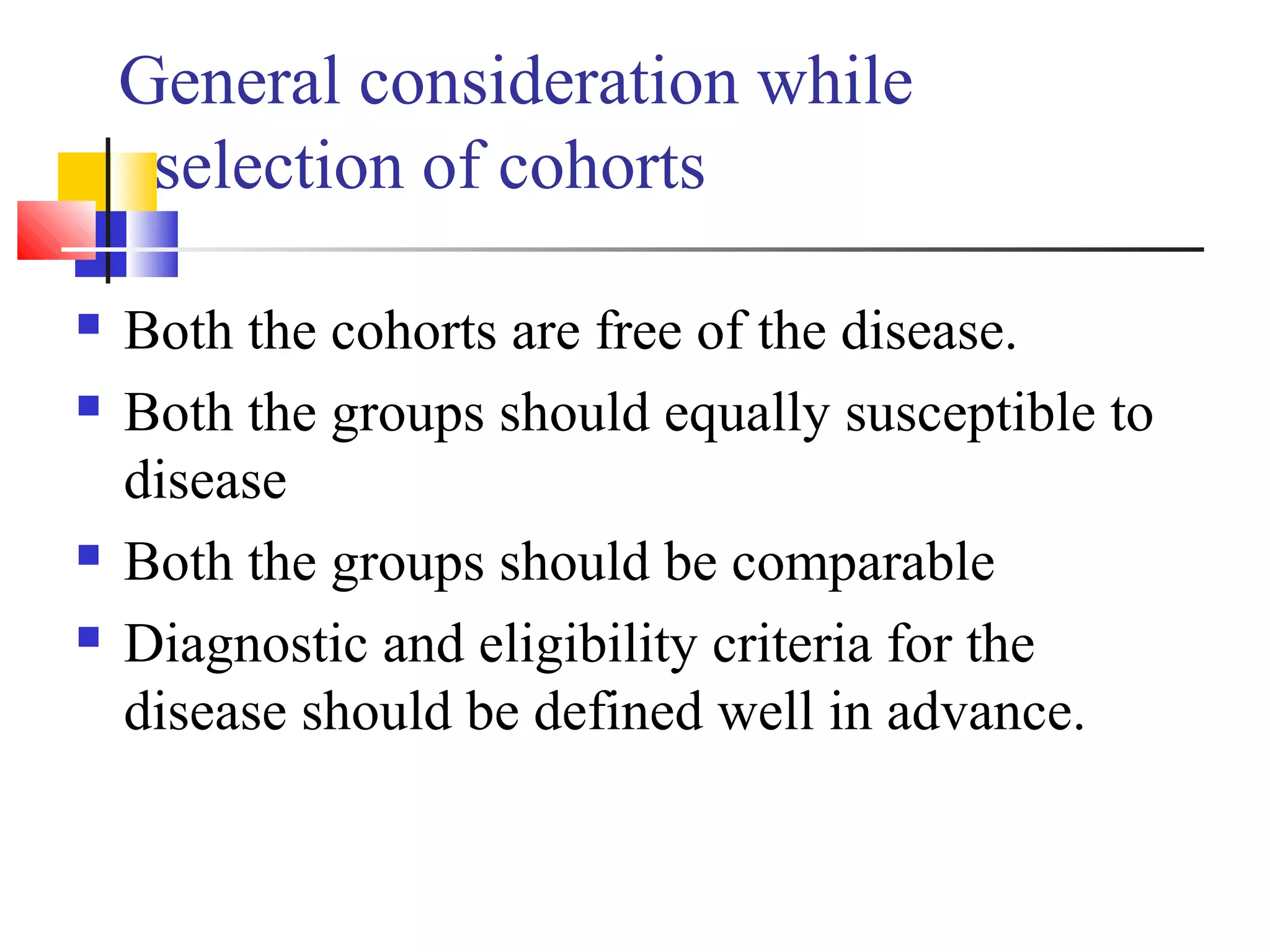
Both the cohorts are free of the disease.
Both the groups should equally susceptible to
disease
Both the groups should be comparable
Diagnostic and eligibility criteria for the
disease should be defined well in advance.
Elements of cohort study

1.
2.
3.
4.
5.

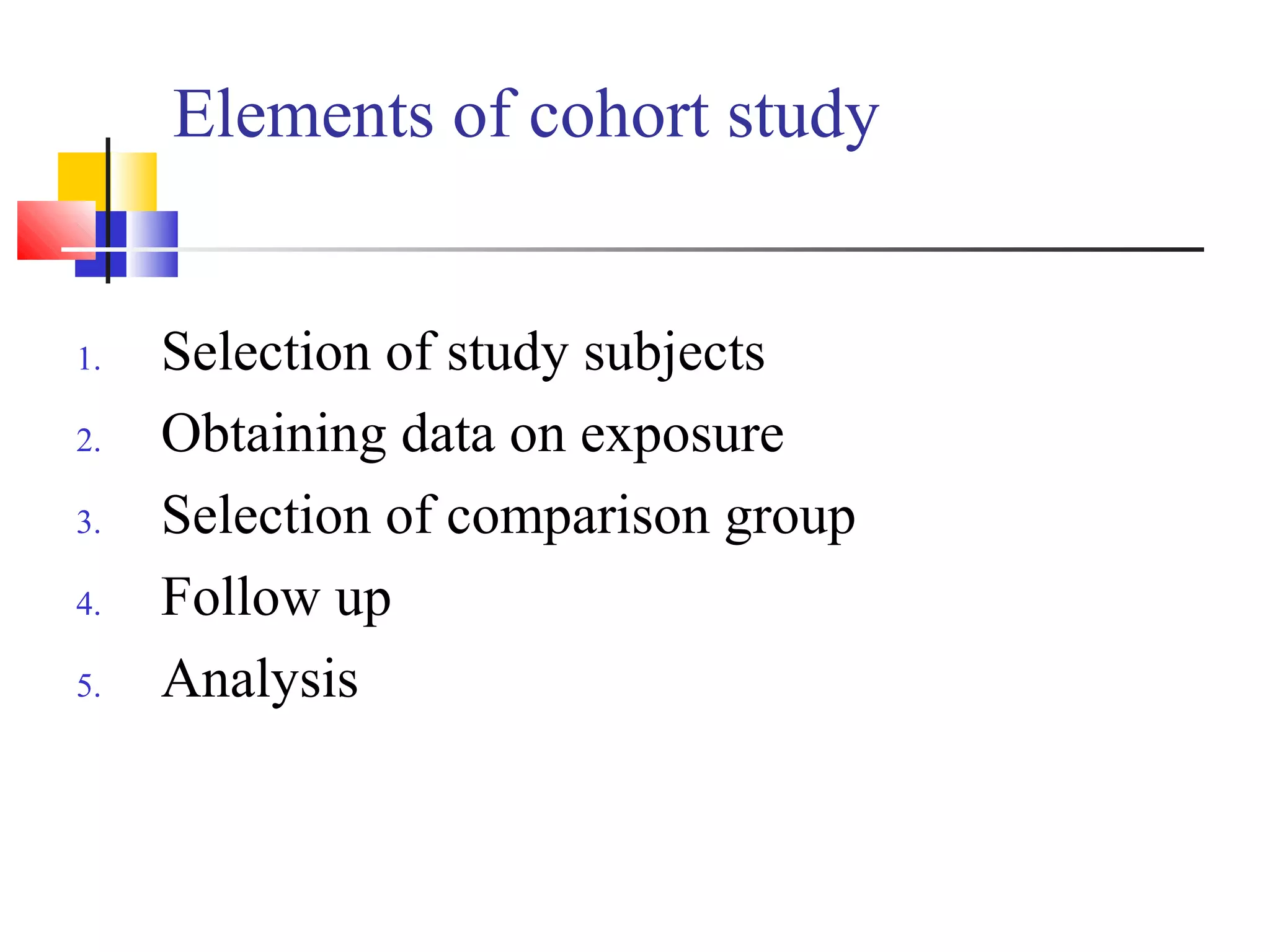
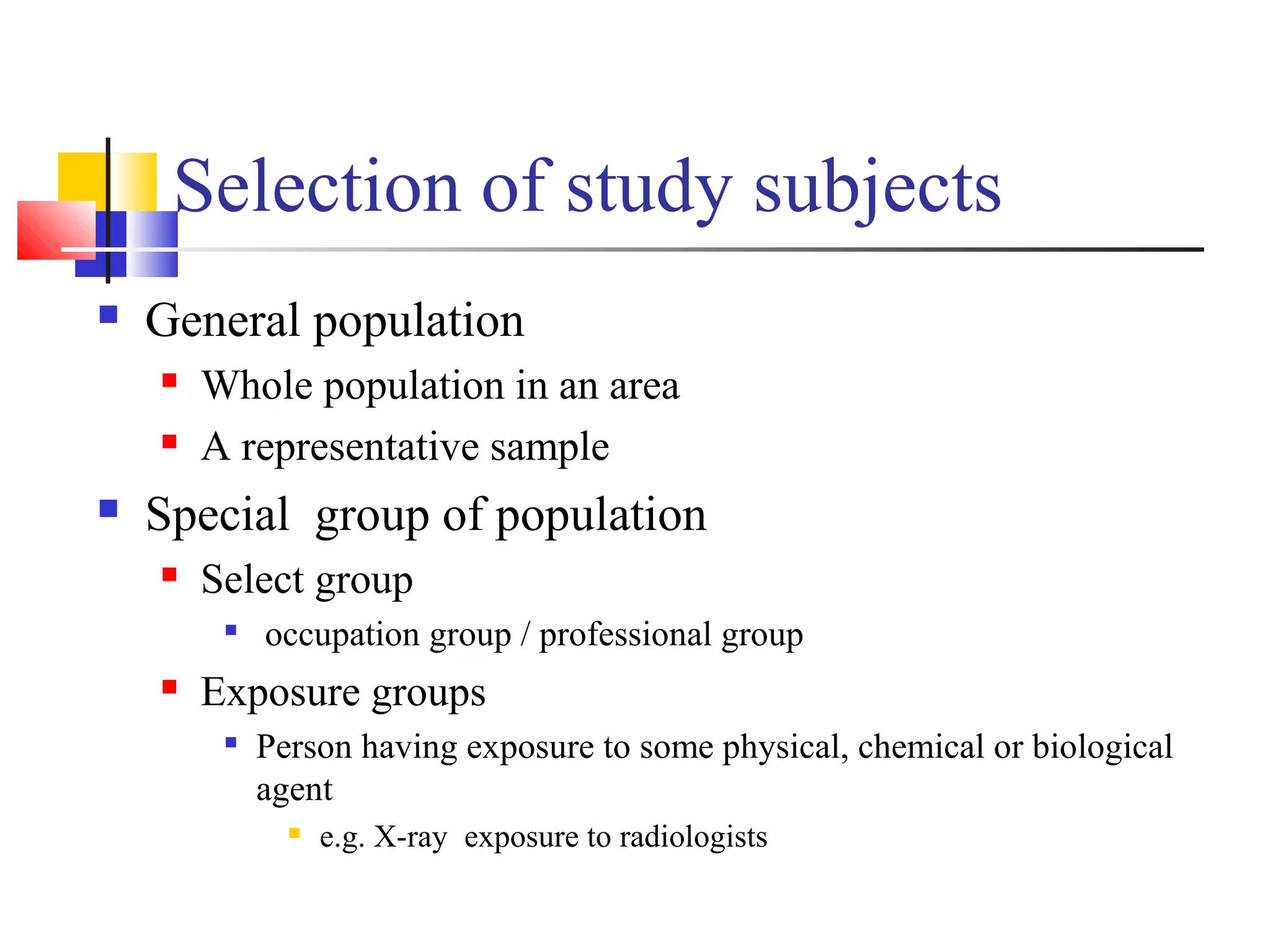
Selection of study subjects
Obtaining data on exposure
Selection of comparison group
Follow up
Analysis
Selection of study subjects


General population





Whole population in an area
A representative sample

Special group of population


Select group




occupation group / professional group

Exposure groups


Person having exposure to some physical, chemical or biological
agent


e.g. X-ray exposure to radiologists
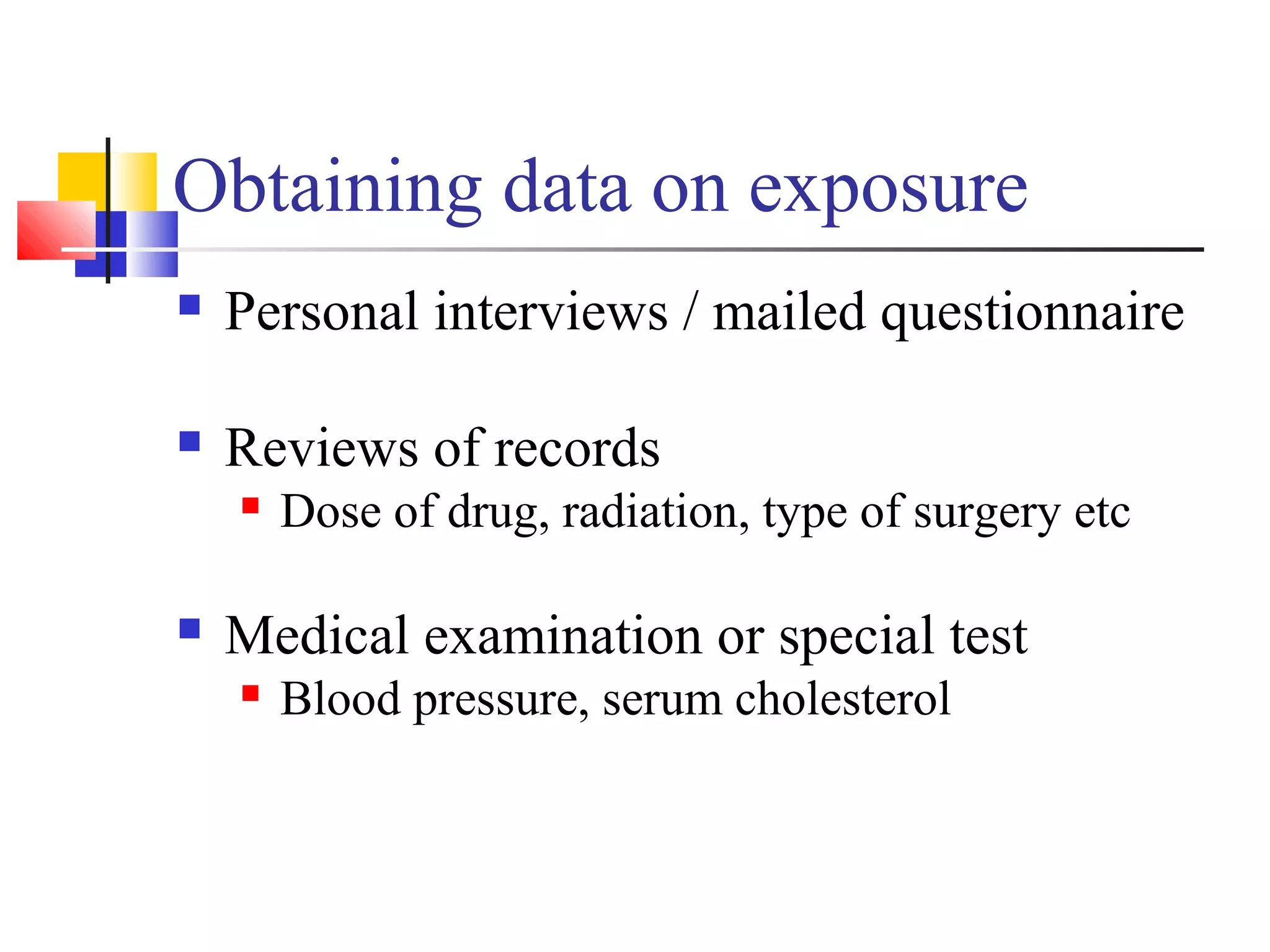
Obtaining data on exposure


Personal interviews / mailed questionnaire



Reviews of records




Dose of drug, radiation, type of surgery etc

Medical examination or special test


Blood pressure, serum cholesterol
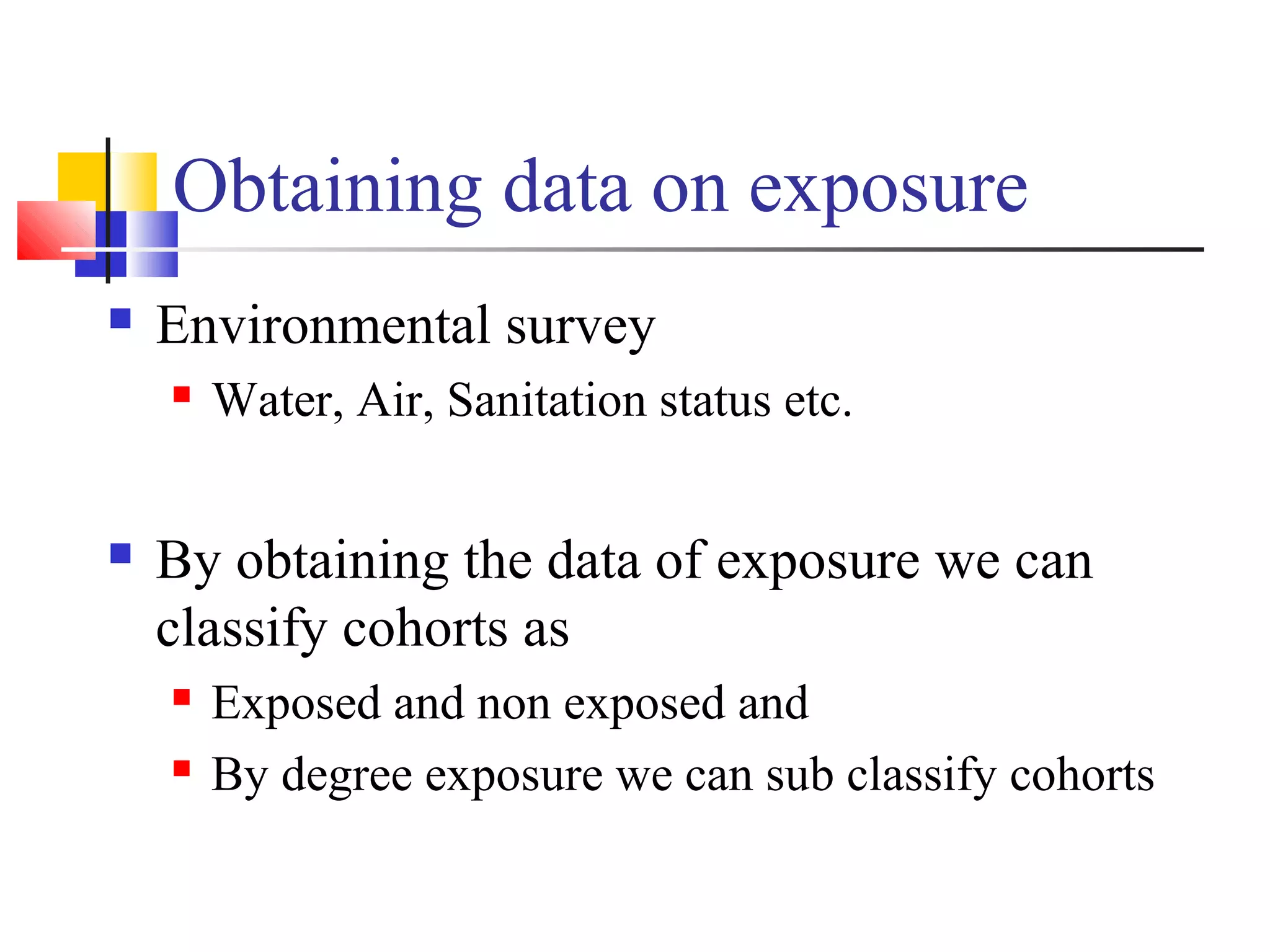
Obtaining data on exposure


Environmental survey




Water, Air, Sanitation status etc.

By obtaining the data of exposure we can
classify cohorts as



Exposed and non exposed and
By degree exposure we can sub classify cohorts
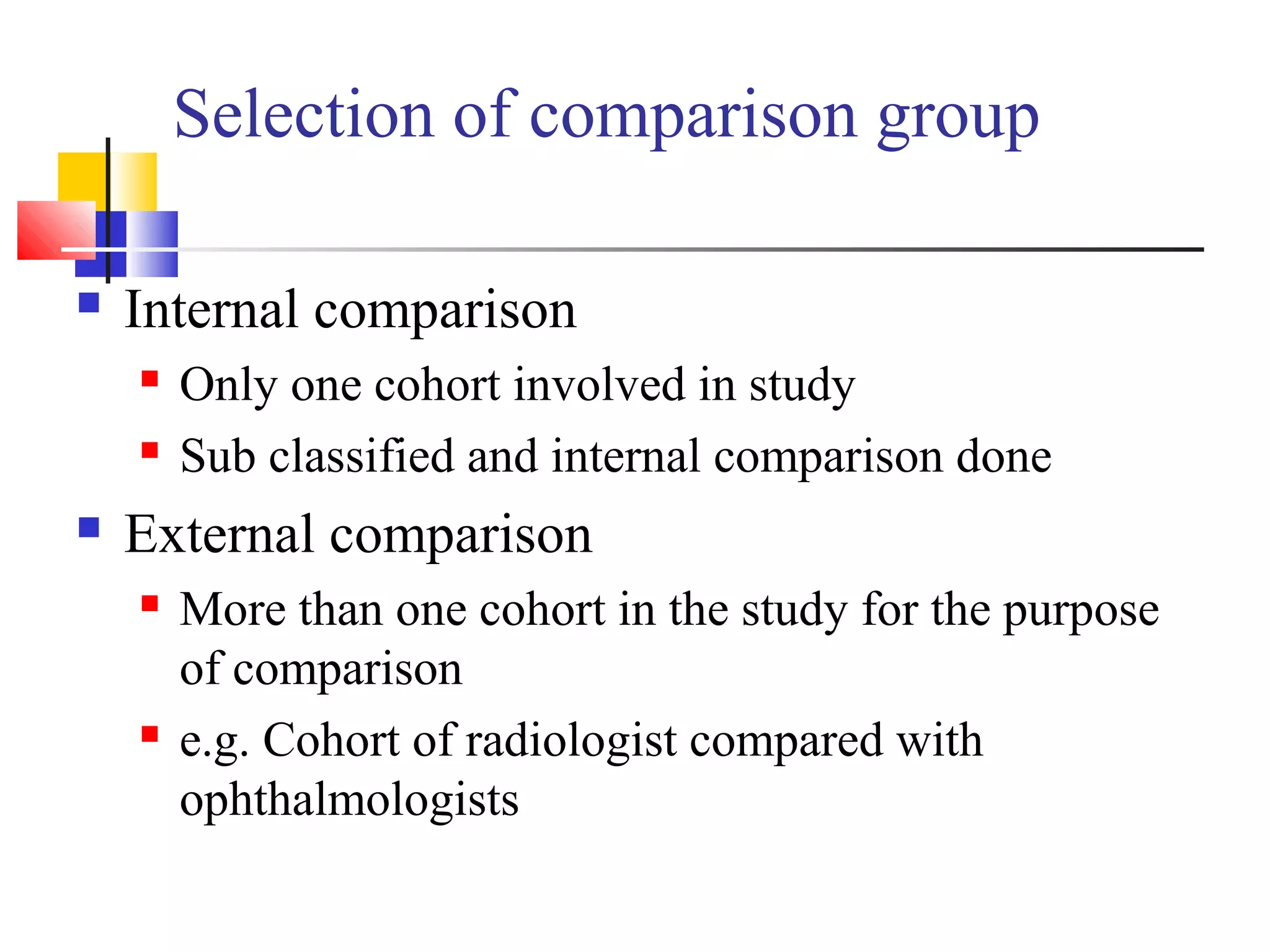
Selection of comparison group


Internal comparison





Only one cohort involved in study
Sub classified and internal comparison done

External comparison




More than one cohort in the study for the purpose
of comparison
e.g. Cohort of radiologist compared with
ophthalmologists
Selection of comparison group


Comparison with general population rates




If no comparison group is available we can
compare the rates of study cohort with general
population.
Cancer rate of uranium miners with cancer in
general population
Follow-up


To obtain data about outcome to be
determined (morbidity or death)







Mailed questionnaire, telephone calls, personal
interviews
Periodic medical examination
Reviewing records
Surveillance of death records
Follow up is the most critical part of the study
Follow-up


Some loss to follow up is inevitable due to death
change of address, migration, change of
occupation.



Loss to follow-up is one of the draw-back of the
cohort study.
ANALYSIS


Calculation of incidence rates among
exposed and non exposed groups



Estimation of risk
Incidence rates of outcome
Disease Status
Yes

Exposure
Status

Yes
No

a
c

No

b
d

a+c b+d

Total

a+b
c+d
N

Study
cohort
Comparison
cohort
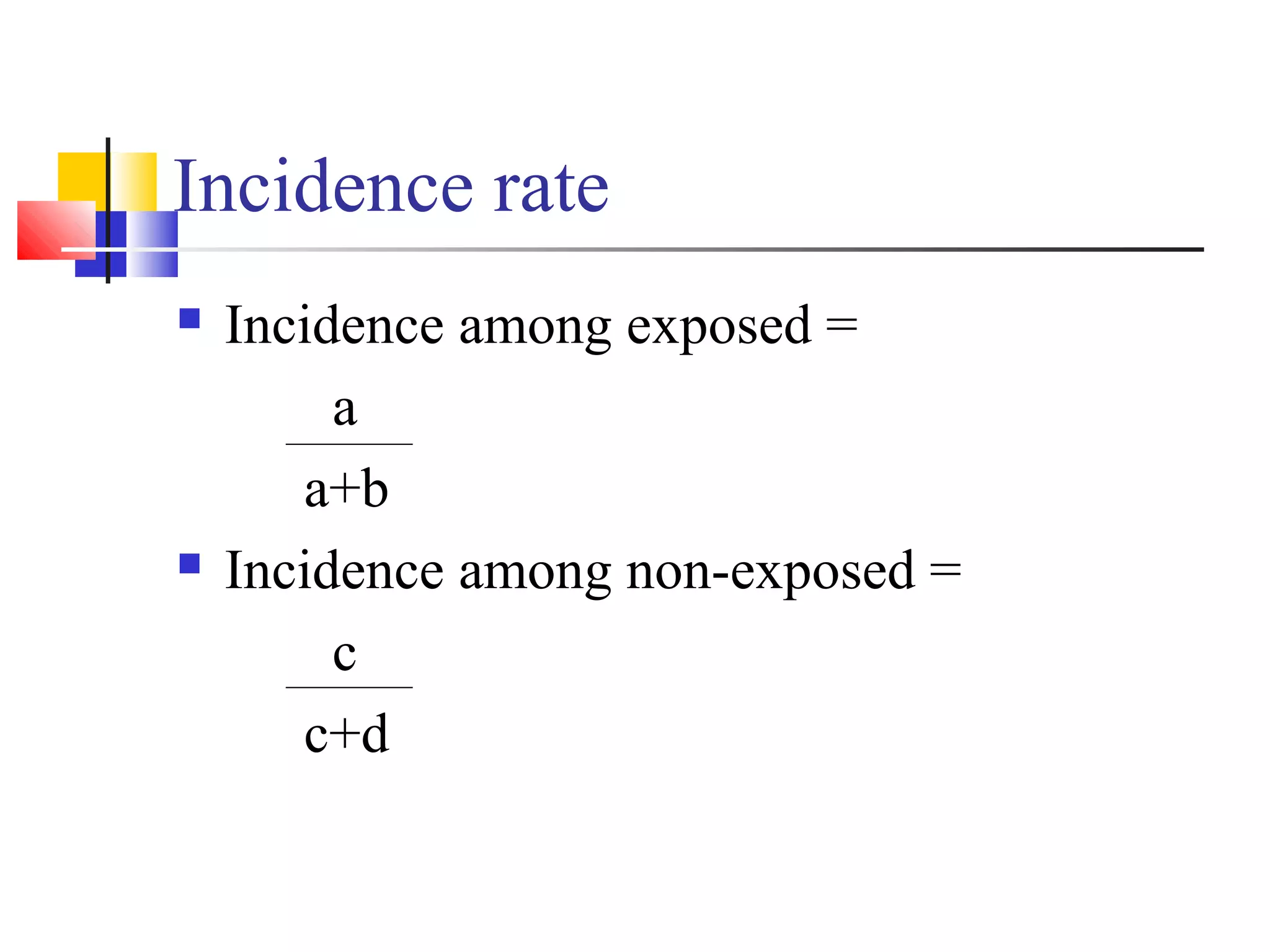
Incidence rate




Incidence among exposed =
a
a+b
Incidence among non-exposed =
c
c+d
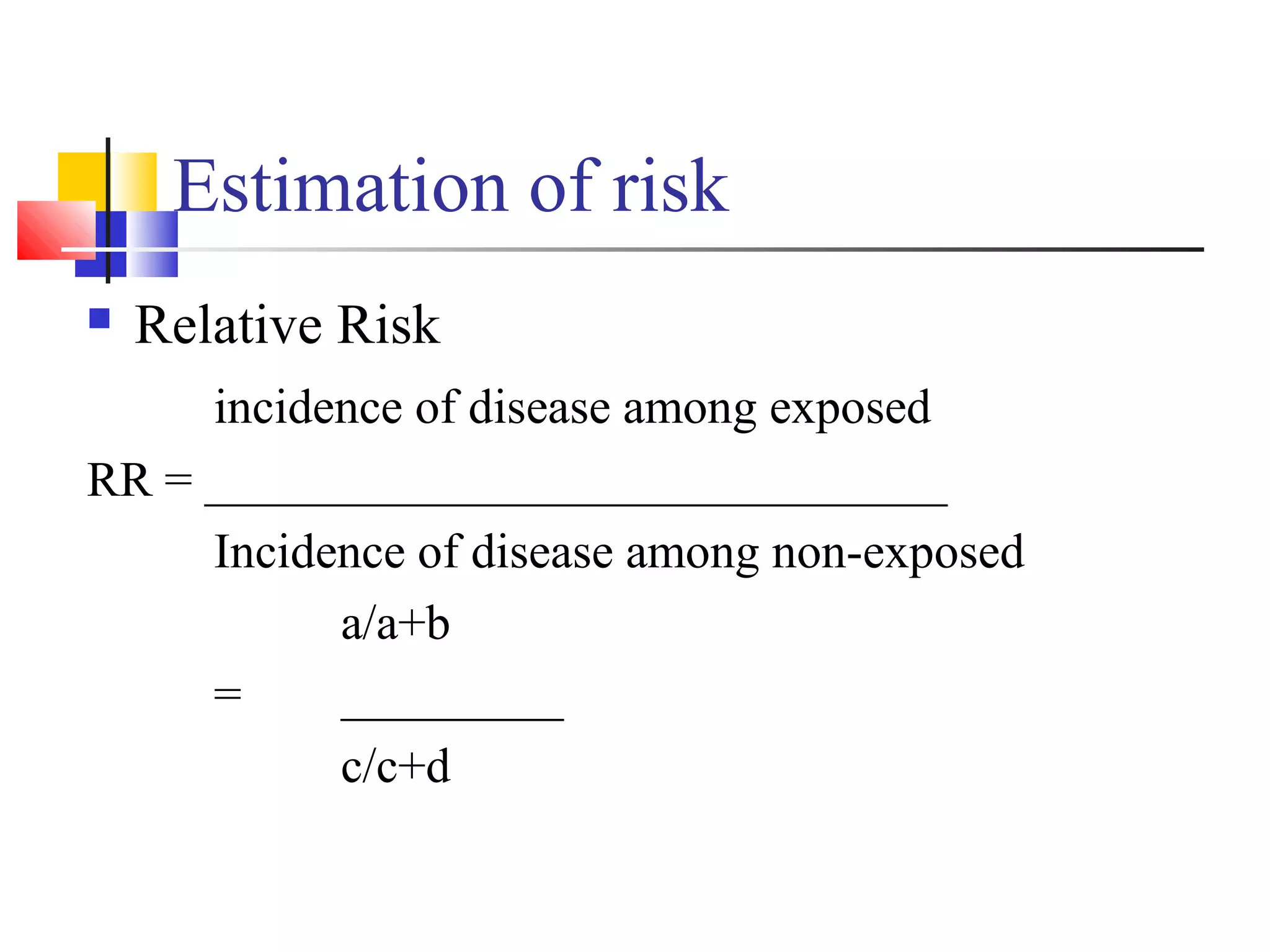
Estimation of risk


Relative Risk

incidence of disease among exposed
RR = ______________________________
Incidence of disease among non-exposed
a/a+b
=
_________
c/c+d
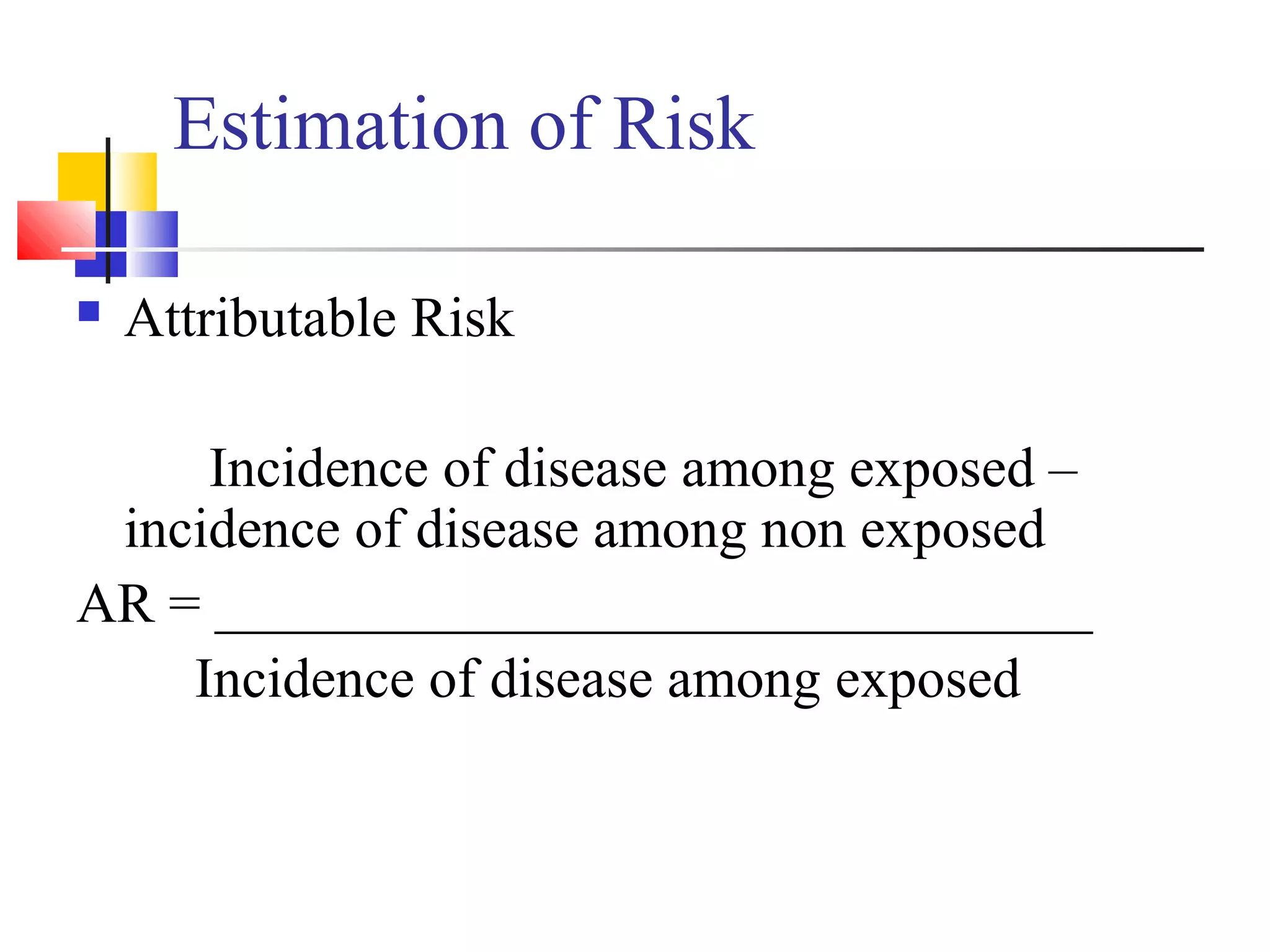
Estimation of Risk


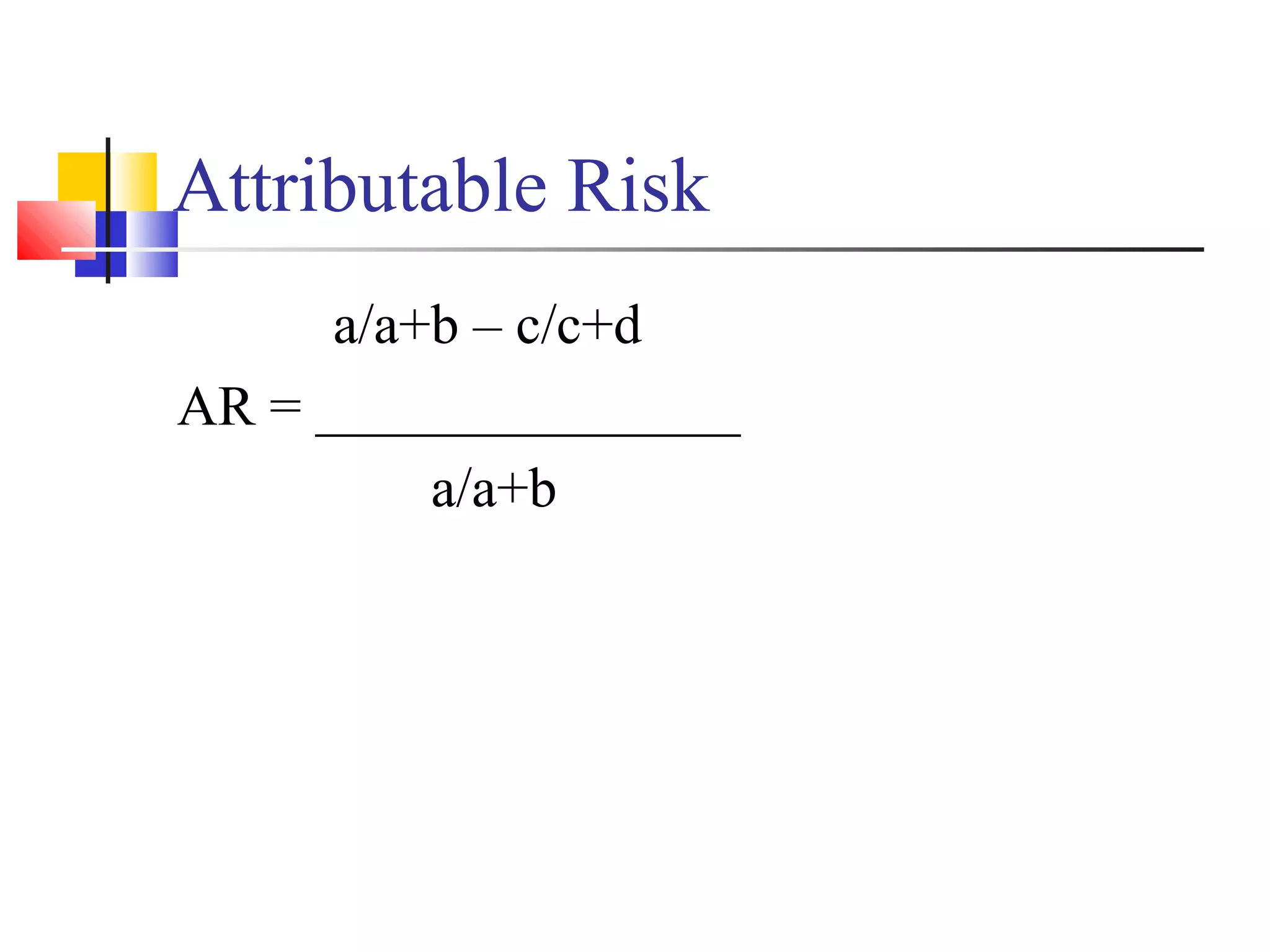
Attributable Risk

Incidence of disease among exposed –
incidence of disease among non exposed
AR = _______________________________
Incidence of disease among exposed
Attributable Risk
a/a+b – c/c+d
AR = _______________
a/a+b
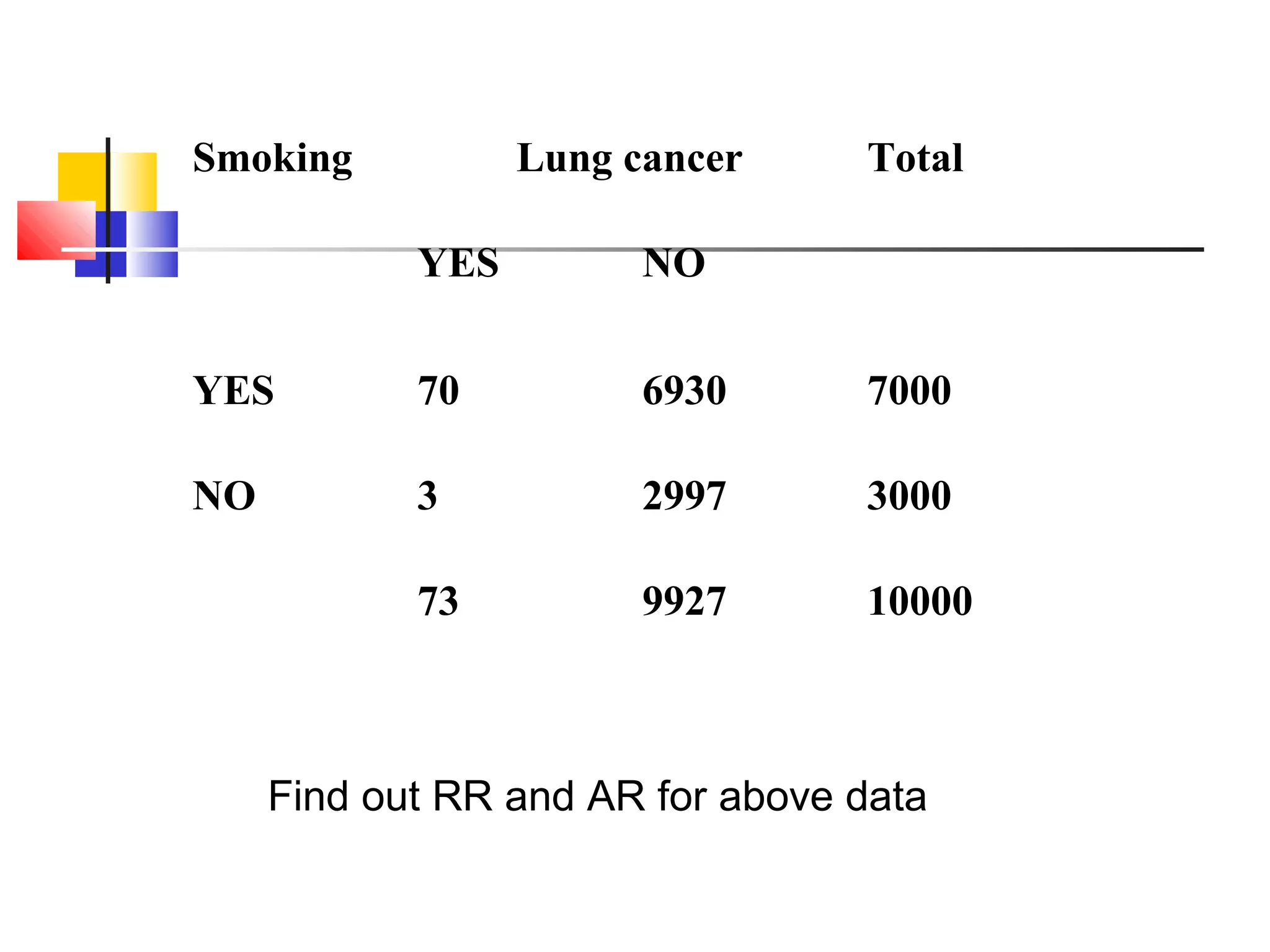
Smoking

Lung cancer

Total

YES

NO

YES

70

6930

7000

NO

3

2997

3000

73

9927

10000

Find out RR and AR for above data
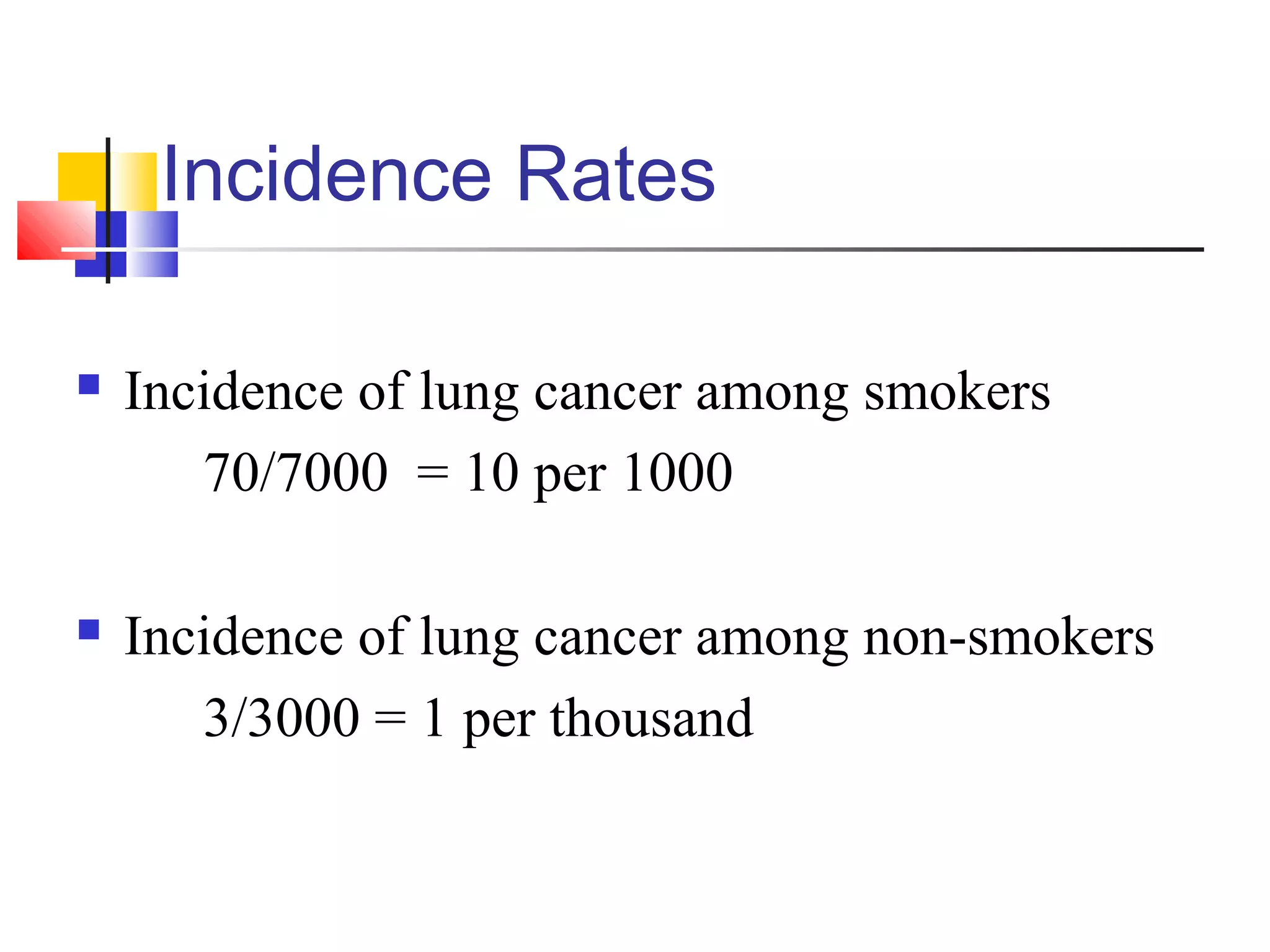
Incidence Rates


Incidence of lung cancer among smokers
70/7000 = 10 per 1000



Incidence of lung cancer among non-smokers
3/3000 = 1 per thousand
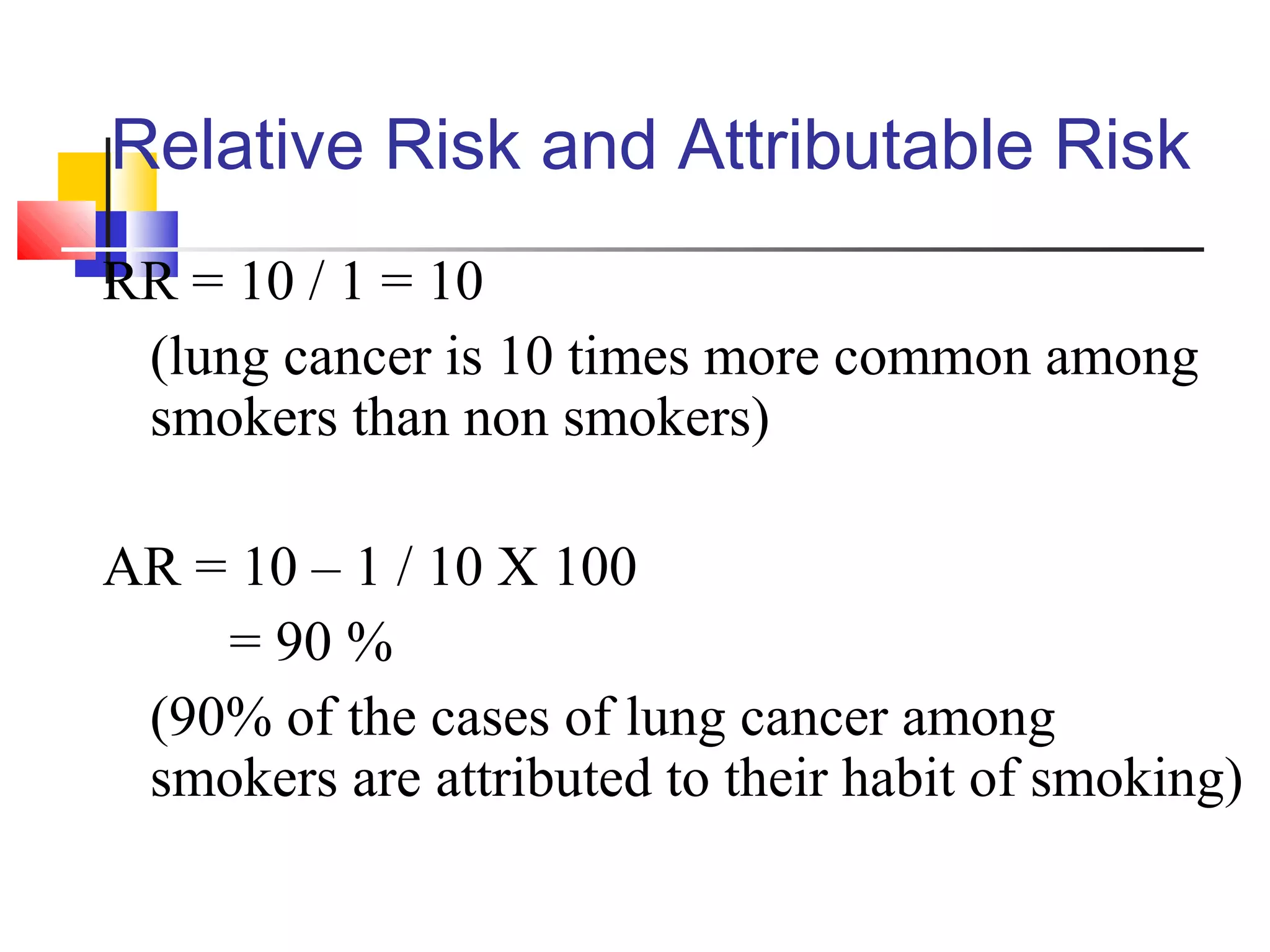
Relative Risk and Attributable Risk
RR = 10 / 1 = 10
(lung cancer is 10 times more common among
smokers than non smokers)
AR = 10 – 1 / 10 X 100
= 90 %
(90% of the cases of lung cancer among
smokers are attributed to their habit of smoking)
Strengths of Cohort studies







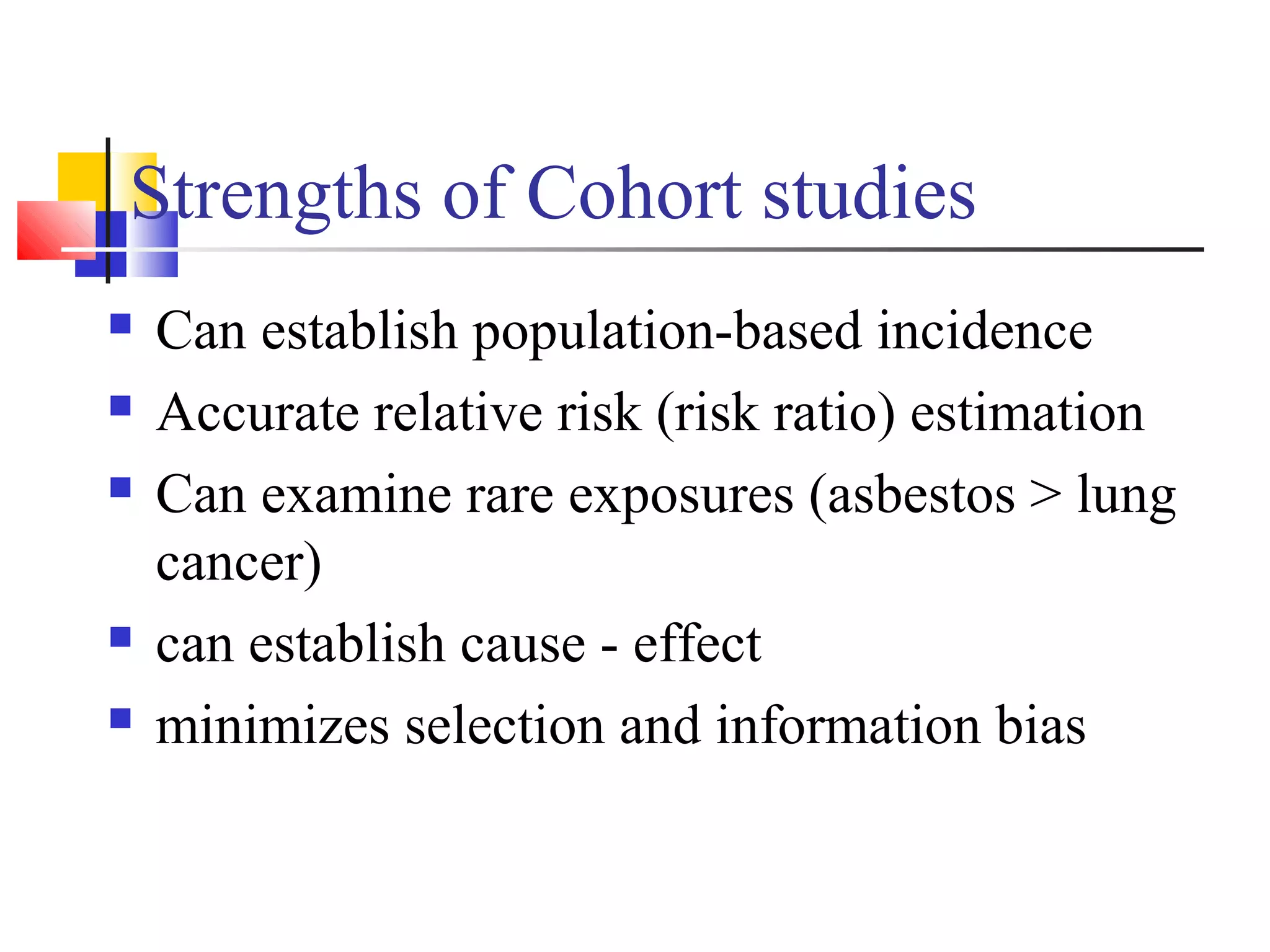
Can establish population-based incidence
Accurate relative risk (risk ratio) estimation
Can examine rare exposures (asbestos > lung
cancer)
can establish cause - effect
minimizes selection and information bias
Strengths of Cohort studies
•

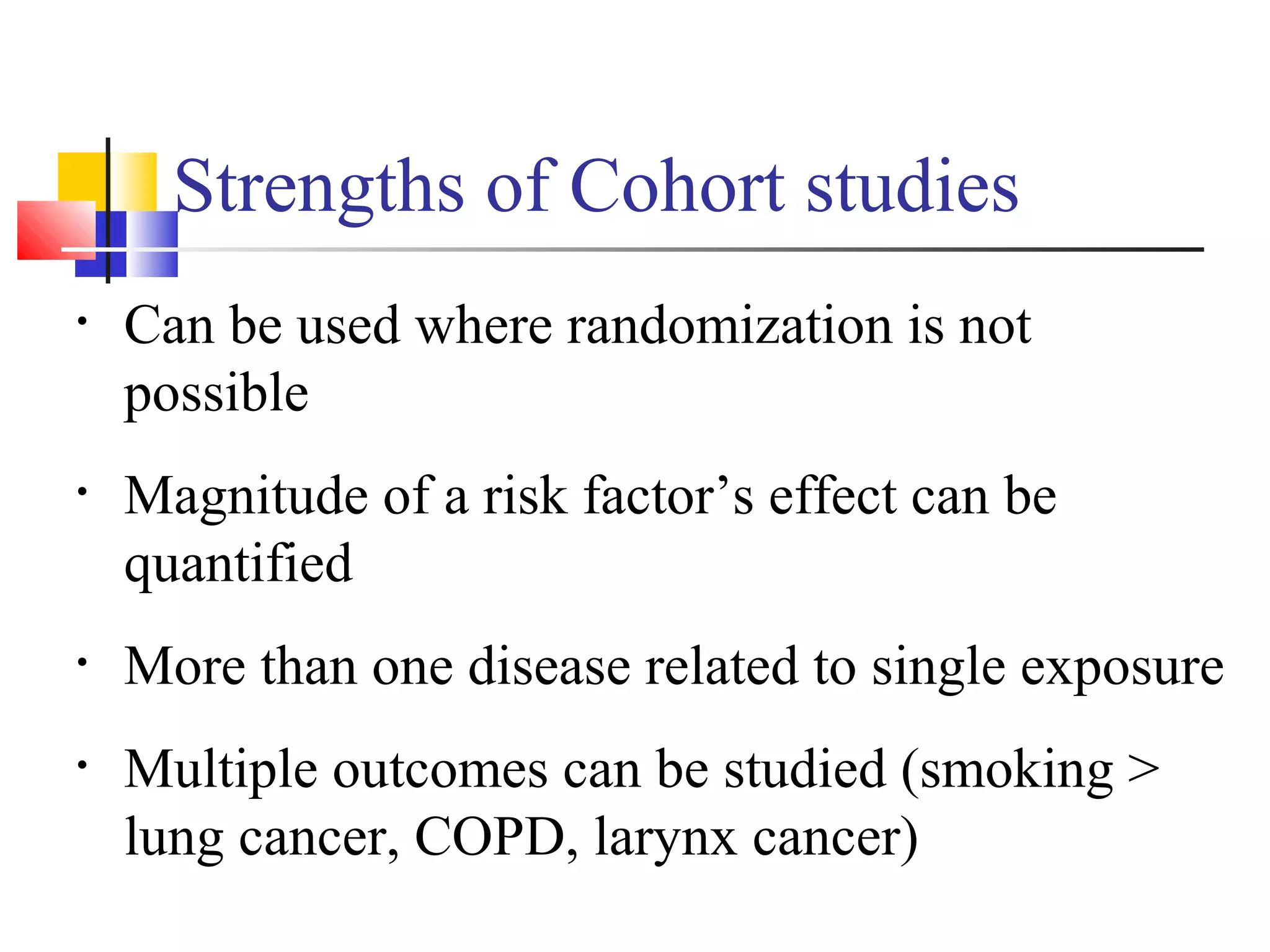
Can be used where randomization is not
possible

•

Magnitude of a risk factor’s effect can be
quantified

•

More than one disease related to single exposure

•

Multiple outcomes can be studied (smoking >
lung cancer, COPD, larynx cancer)
Weaknesses of Cohort studies








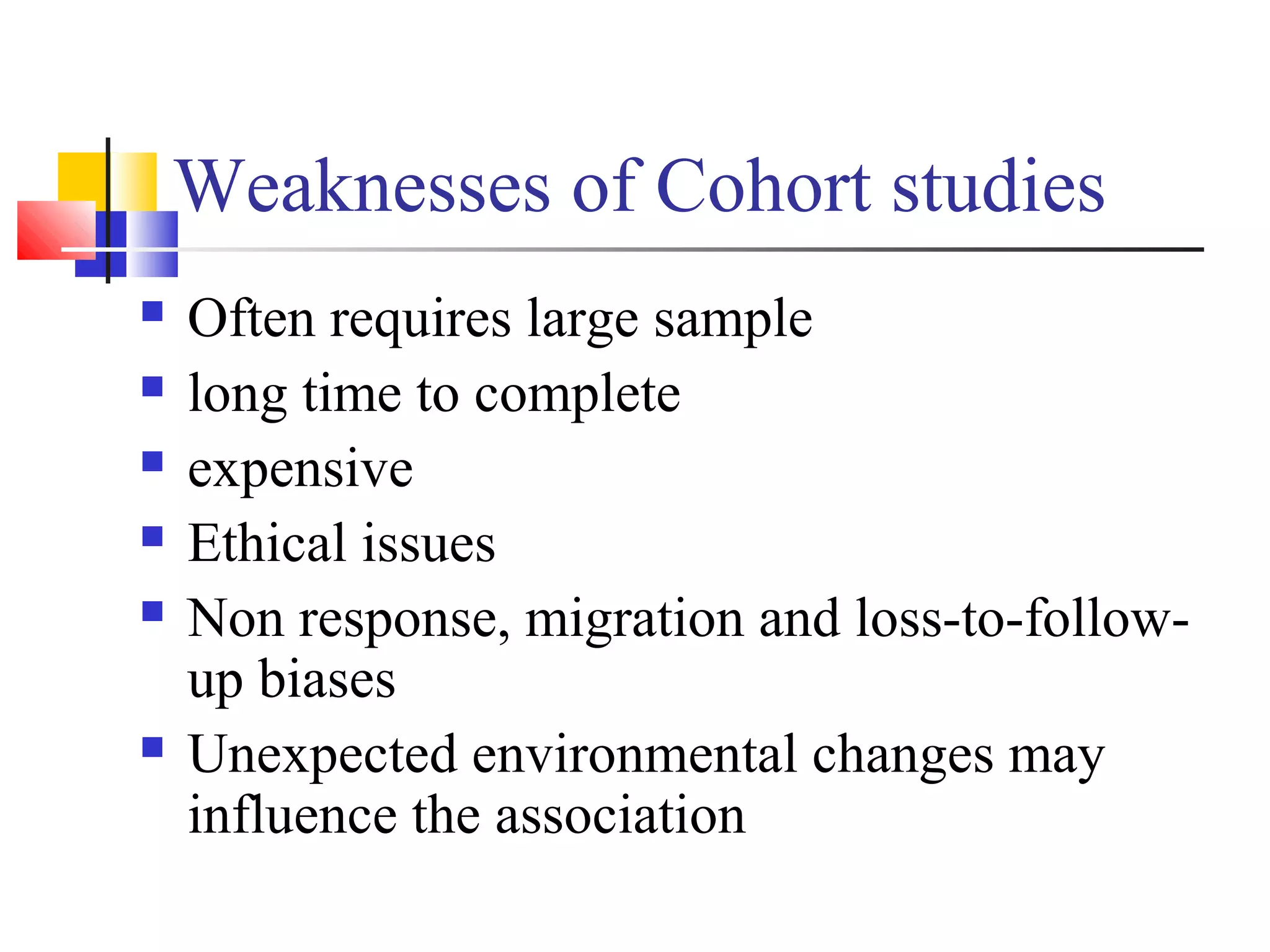
Often requires large sample
long time to complete
expensive
Ethical issues
Non response, migration and loss-to-followup biases
Unexpected environmental changes may
influence the association
THANK YOU
Examples
Presentation of cohort data:
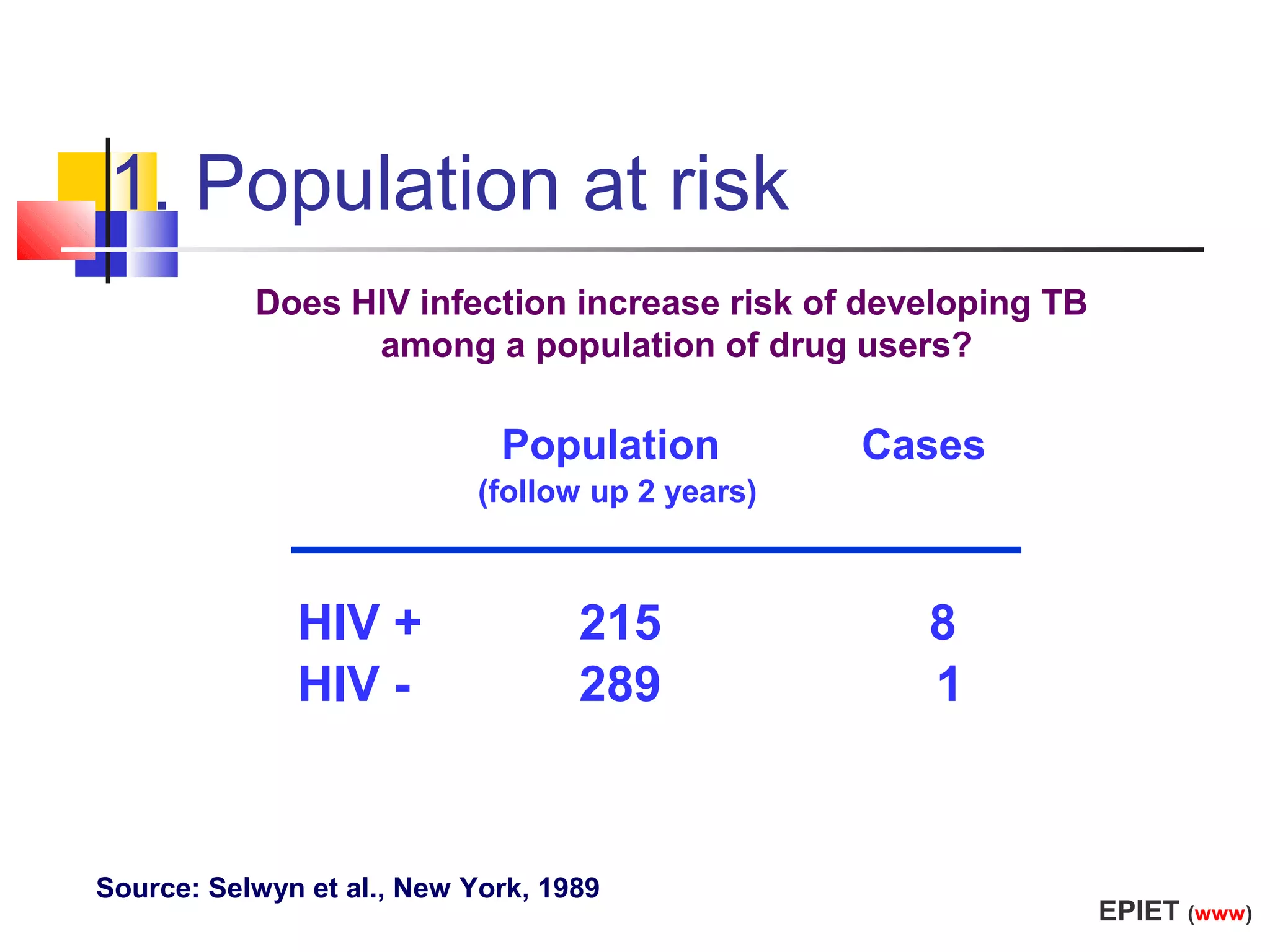
1. Population at risk
Does HIV infection increase risk of developing TB
among a population of drug users?

Population

Cases

(follow up 2 years)

HIV +
HIV -

215
289

Source: Selwyn et al., New York, 1989

8
1

EPIET (www)
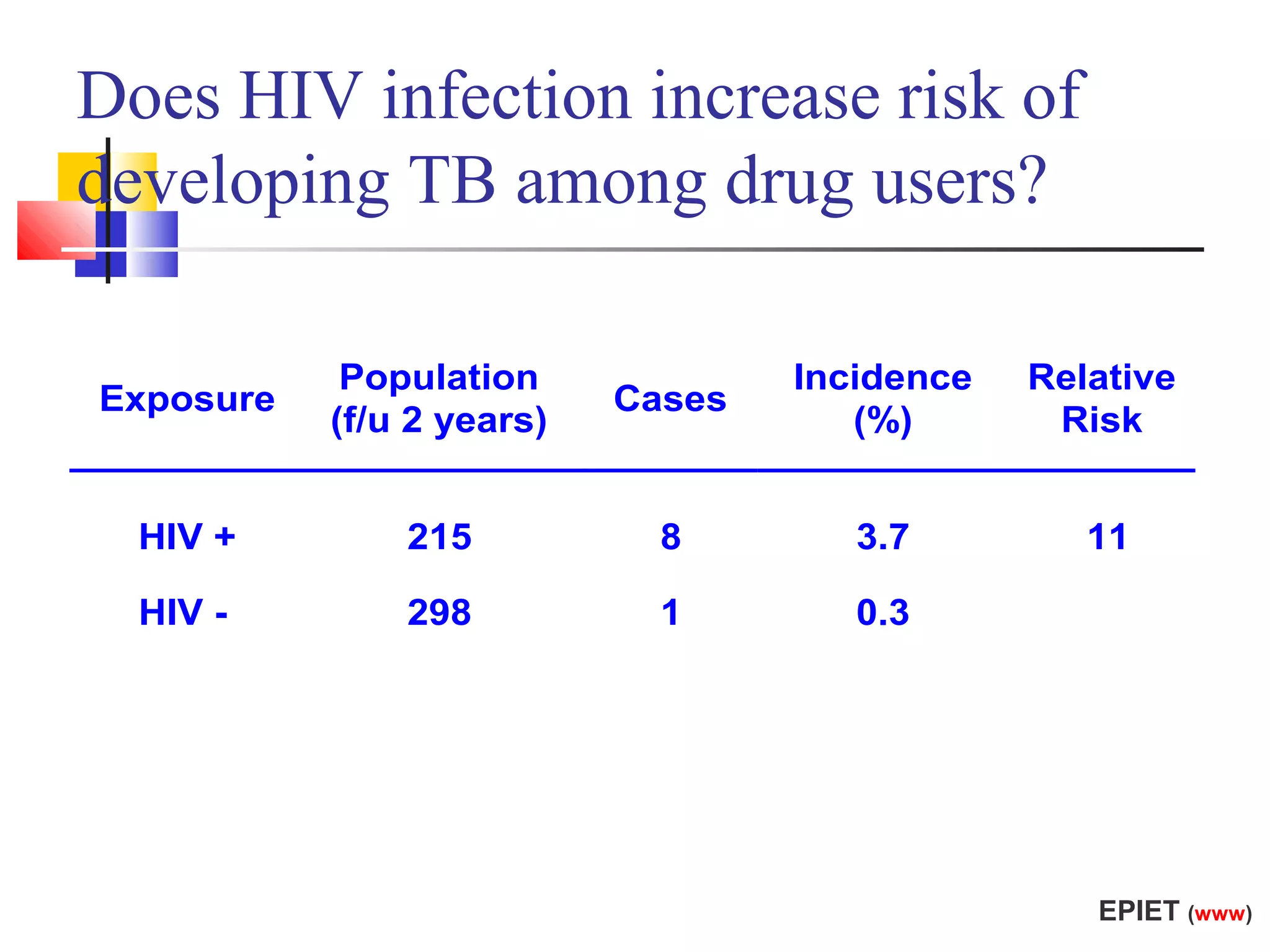
Does HIV infection increase risk of
developing TB among drug users?
Exposure

Population
(f/u 2 years)

Cases

Incidence
(%)

Relative
Risk

HIV +

215

8

3.7

11

HIV -

298

1

0.3

EPIET (www)
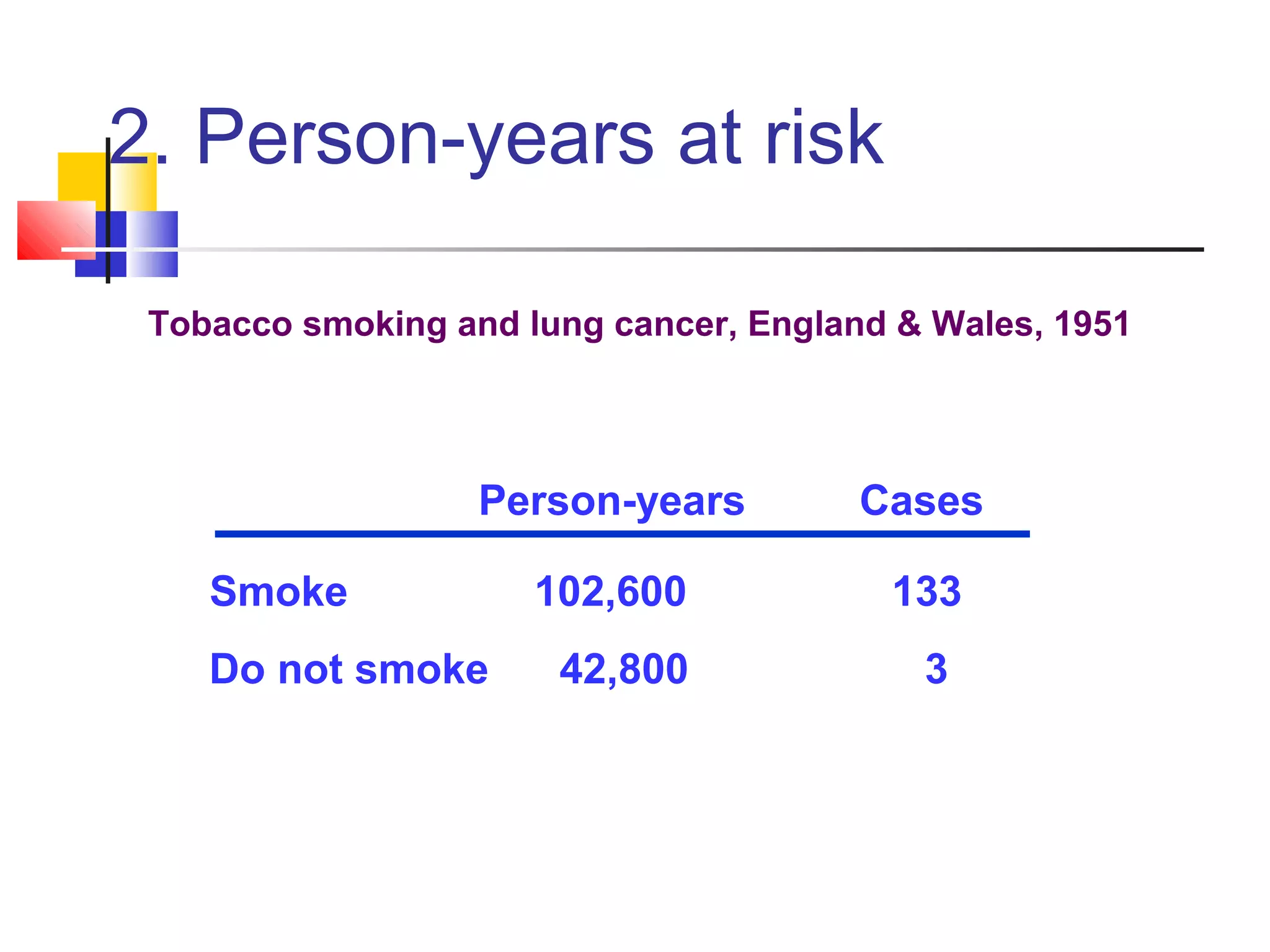
2. Person-years at risk
Tobacco smoking and lung cancer, England & Wales, 1951

Person-years

Cases

102,600

133

Smoke
Do not smoke

42,800

3
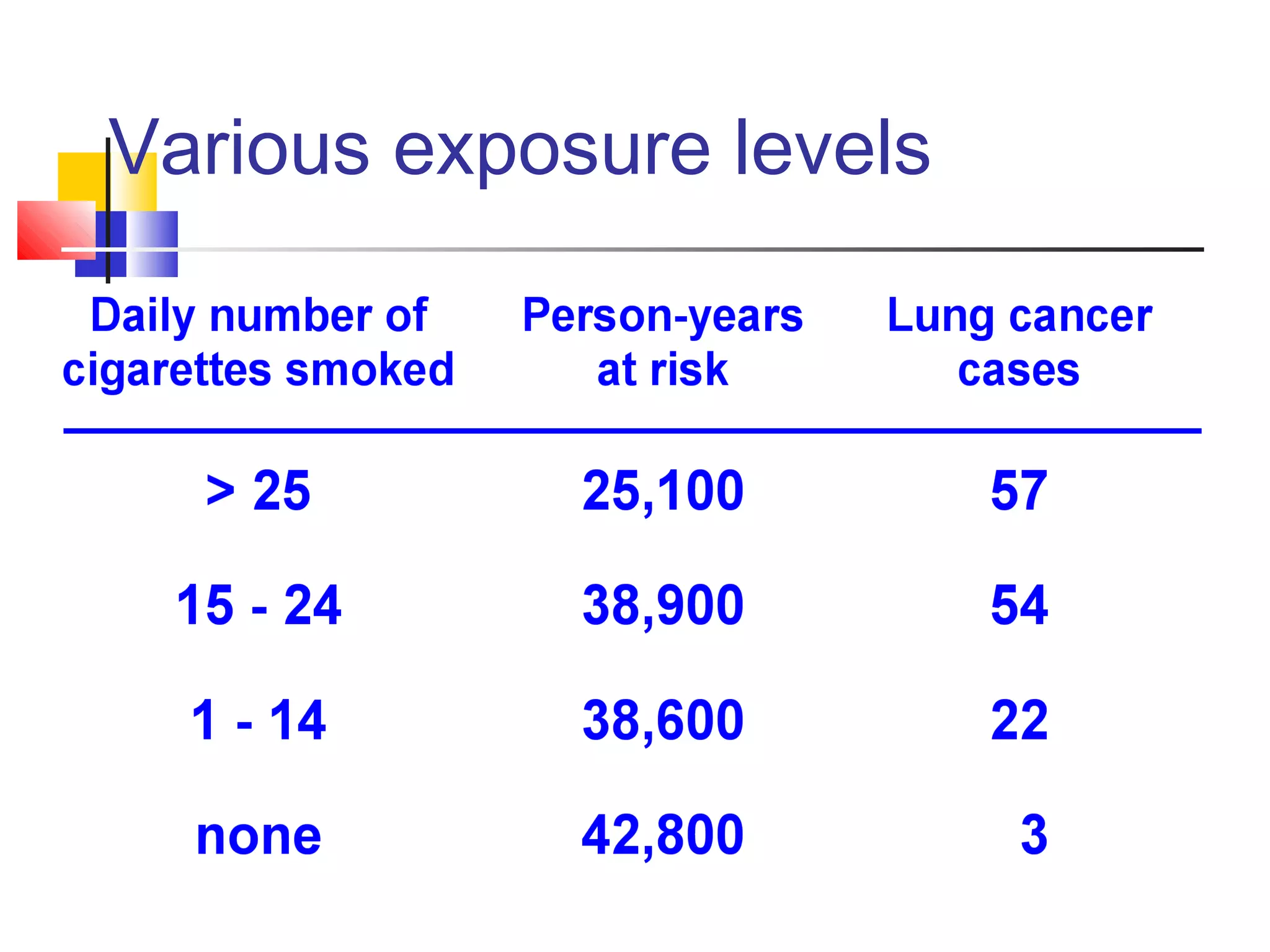
Various exposure levels
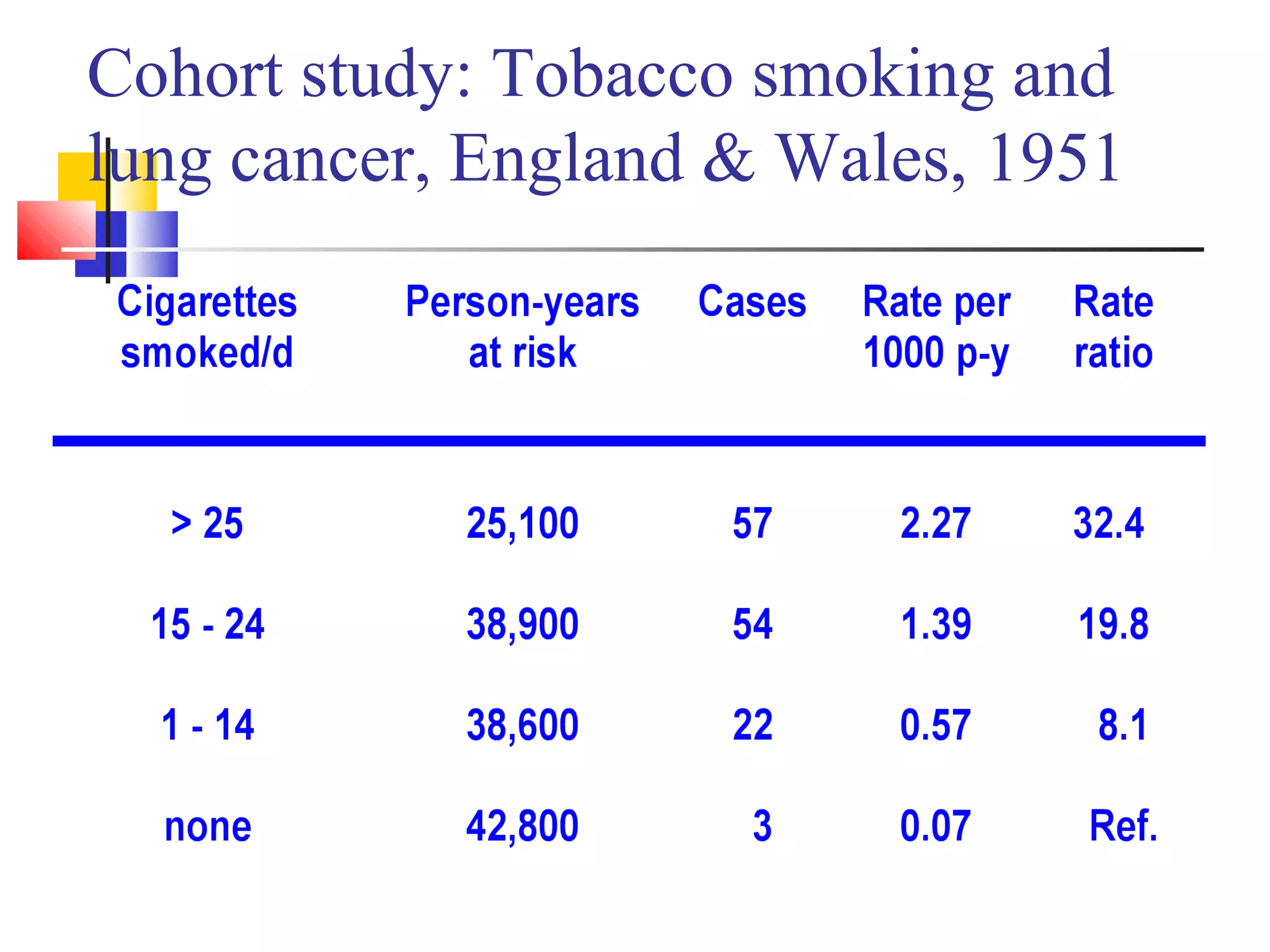
Cohort study: Tobacco smoking and
lung cancer, England & Wales, 1951
Cohort ppt
Cohort ppt
Cohort ppt

Cohort ppt

  • 1.
    Cohort Study Hari PrasadKafle Assistant Professor Pokhara University
  • 2.
    Cohort Study  Cohort studyis undertaken to support the existence of association between suspected cause and disease  A major limitation of cross-sectional surveys and case-control studies is difficulty in determining if exposure or risk factor preceded the disease or outcome.
  • 3.
    Cohort Study  Cohort Study: KeyPoint:  Presence or absence of risk factor is determined before outcome occurs.
  • 4.
    What is Cohort?     Ancient Roman military unit, A band of warriors. Persons banded together. Group of persons with a common statistical characteristic. [Latin] E.g. age, birth date,
  • 5.
    What is Cohort?  Cohort is a group of people who share common characteristic or experience within the defined period of time.  E.g. birth cohort, marriage cohort, Exposure cohort, Synthetic cohort etc.
  • 6.
    Cohort studies        longitudinal Prospective studies Forwardlooking study Incidence study starts with people free of disease assesses exposure at “baseline” assesses disease status at “follow-up”
  • 7.
    Indication of aCohort study     When there is good evidence of exposure and disease. When exposure is rare but incidence of disease is higher among exposed When follow-up is easy, cohort is stable When ample funds are available
  • 10.
    C ohort Design Study population free of disease Factor present Factor absent present time Study begins here disease no disease disease no disease future
  • 11.
  • 12.
    Frame work ofCohort studies Disease Status Total Exposure Status Yes No a+b c+d N Yes a No b c d a+c b+d Study cohort Comparison cohort
  • 13.
    Types of CohortStudy    Prospective cohort study Retrospective (historical) cohort study Combination of Retrospective and Prospective cohort study.
  • 14.
    Prospective cohort study Exposure Studystarts Disease occurrence time Study starts Exposure Disease occurrence time
  • 15.
  • 16.
  • 17.
    General consideration while selectionof cohorts     Both the cohorts are free of the disease. Both the groups should equally susceptible to disease Both the groups should be comparable Diagnostic and eligibility criteria for the disease should be defined well in advance.
  • 18.
    Elements of cohortstudy 1. 2. 3. 4. 5. Selection of study subjects Obtaining data on exposure Selection of comparison group Follow up Analysis
  • 19.
    Selection of studysubjects  General population    Whole population in an area A representative sample Special group of population  Select group   occupation group / professional group Exposure groups  Person having exposure to some physical, chemical or biological agent  e.g. X-ray exposure to radiologists
  • 20.
    Obtaining data onexposure  Personal interviews / mailed questionnaire  Reviews of records   Dose of drug, radiation, type of surgery etc Medical examination or special test  Blood pressure, serum cholesterol
  • 21.
    Obtaining data onexposure  Environmental survey   Water, Air, Sanitation status etc. By obtaining the data of exposure we can classify cohorts as   Exposed and non exposed and By degree exposure we can sub classify cohorts
  • 22.
    Selection of comparisongroup  Internal comparison    Only one cohort involved in study Sub classified and internal comparison done External comparison   More than one cohort in the study for the purpose of comparison e.g. Cohort of radiologist compared with ophthalmologists
  • 23.
    Selection of comparisongroup  Comparison with general population rates   If no comparison group is available we can compare the rates of study cohort with general population. Cancer rate of uranium miners with cancer in general population
  • 24.
    Follow-up  To obtain dataabout outcome to be determined (morbidity or death)      Mailed questionnaire, telephone calls, personal interviews Periodic medical examination Reviewing records Surveillance of death records Follow up is the most critical part of the study
  • 25.
    Follow-up  Some loss tofollow up is inevitable due to death change of address, migration, change of occupation.  Loss to follow-up is one of the draw-back of the cohort study.
  • 26.
    ANALYSIS  Calculation of incidencerates among exposed and non exposed groups  Estimation of risk
  • 27.
    Incidence rates ofoutcome Disease Status Yes Exposure Status Yes No a c No b d a+c b+d Total a+b c+d N Study cohort Comparison cohort
  • 28.
    Incidence rate   Incidence amongexposed = a a+b Incidence among non-exposed = c c+d
  • 29.
    Estimation of risk  RelativeRisk incidence of disease among exposed RR = ______________________________ Incidence of disease among non-exposed a/a+b = _________ c/c+d
  • 30.
    Estimation of Risk  AttributableRisk Incidence of disease among exposed – incidence of disease among non exposed AR = _______________________________ Incidence of disease among exposed
  • 31.
    Attributable Risk a/a+b –c/c+d AR = _______________ a/a+b
  • 32.
  • 33.
    Incidence Rates  Incidence oflung cancer among smokers 70/7000 = 10 per 1000  Incidence of lung cancer among non-smokers 3/3000 = 1 per thousand
  • 34.
    Relative Risk andAttributable Risk RR = 10 / 1 = 10 (lung cancer is 10 times more common among smokers than non smokers) AR = 10 – 1 / 10 X 100 = 90 % (90% of the cases of lung cancer among smokers are attributed to their habit of smoking)
  • 35.
    Strengths of Cohortstudies      Can establish population-based incidence Accurate relative risk (risk ratio) estimation Can examine rare exposures (asbestos > lung cancer) can establish cause - effect minimizes selection and information bias
  • 36.
    Strengths of Cohortstudies • Can be used where randomization is not possible • Magnitude of a risk factor’s effect can be quantified • More than one disease related to single exposure • Multiple outcomes can be studied (smoking > lung cancer, COPD, larynx cancer)
  • 37.
    Weaknesses of Cohortstudies       Often requires large sample long time to complete expensive Ethical issues Non response, migration and loss-to-followup biases Unexpected environmental changes may influence the association
  • 38.
  • 39.
  • 40.
    1. Population atrisk Does HIV infection increase risk of developing TB among a population of drug users? Population Cases (follow up 2 years) HIV + HIV - 215 289 Source: Selwyn et al., New York, 1989 8 1 EPIET (www)
  • 41.
    Does HIV infectionincrease risk of developing TB among drug users? Exposure Population (f/u 2 years) Cases Incidence (%) Relative Risk HIV + 215 8 3.7 11 HIV - 298 1 0.3 EPIET (www)
  • 42.
    2. Person-years atrisk Tobacco smoking and lung cancer, England & Wales, 1951 Person-years Cases 102,600 133 Smoke Do not smoke 42,800 3
  • 43.
  • 44.
    Cohort study: Tobaccosmoking and lung cancer, England & Wales, 1951