Assignment
Open Source VOIP Makes The Business Connection & Present Scenario
                 ETE -605 IP Telephony
                    ETE- 605 IP Telephony


                          Prepared by:
                    Name: Ridhwana Mohammad
                            Afrina Naznin
                    ID # 071403056
                          ID# 063514056
                    Section: 2 ETE Program
                         MS in


                         Prepared for:
                      Dr.Mashiur Rahman
                   Department of Computer Science
                      North South University


                                 Date:
                            th
                          15 April, 2008
                        15th April 15, 2008


                      North South University
Acknowledgement

All thanks and prayers to Allah, without his support I couldn’t have attempted to do
this. I am very gratitude to our respected teacher Dr. Mashiur Rahman Instructor
of our course to provide us such type of idea of the recent market and valuable
assistance to the right way to the goal.
Open source VoIP makes the business connection and present scenario


Objective:

Million of startup computer network company with an innovative network security
technology needs to document their technology rapidly to support a significant increase
in their valuation in impending acquisition talks with another company. Here are some
topic related discussion related to IP implementation in or country according to present
need to keep constant connection with around the world. The objective of this case study
is to create the new IP market and to fill the holes of our position in IP telephony future
market. And also use IP to raise money & increase valuation.


IP telephony:

IP telephony (Internet Protocol telephony) is a general term for the technologies that use
the Internet Protocol's packet-switched connections to exchange voice, fax, and other
forms of information that have traditionally been carried over the dedicated circuit-
switched connections of the public switched telephone network (PSTN). Using the
Internet, calls travel as packets of data on shared lines, avoiding the tolls of the PSTN.
The challenge in IP telephony is to deliver the voice, fax, or video packets in a
dependable flow to the user. Much of IP telephony focuses on that challenge. Different
type of protocol as the Internet protocol are the basis of IP networking. Different type of
protocol is used,among them the most suitable and friendly is Asterisk as it is an open
source. Thanks to worthwhile IP PBX alternatives such as Asterisk, open source VoIP is
ready for targeted enterprise deployment That’s not to say that the enterprise is deaf to
the benefits of open source itself. To be sure, companies are increasingly vetting open
source alternatives before considering commercial wares. But despite this interest in open
source elsewhere in the enterprise, the phone system has, by and large, remained off-
limits to open source experimentation.
When it comes to open-sourcing dial tone, the feeling among most enterprises is that
there’s just too much at stake. After all, network troubles translate to help desk calls and
lost revenue, but if the phones go down, it could mean life or death. And when it comes
to melding the lockstep world of traditional five-nines PBXes into the land of Patch
Tuesday and the frequent reboot, calling on a commercial vendor can feel a lot more
comforting than signing off on that level of responsibility yourself.

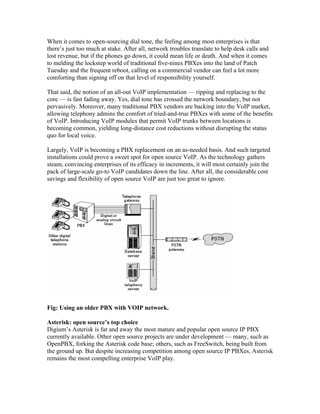
That said, the notion of an all-out VoIP implementation — ripping and replacing to the
core — is fast fading away. Yes, dial tone has crossed the network boundary, but not
pervasively. Moreover, many traditional PBX vendors are backing into the VoIP market,
allowing telephony admins the comfort of tried-and-true PBXes with some of the benefits
of VoIP. Introducing VoIP modules that permit VoIP trunks between locations is
becoming common, yielding long-distance cost reductions without disrupting the status
quo for local voice.

Largely, VoIP is becoming a PBX replacement on an as-needed basis. And such targeted
installations could prove a sweet spot for open source VoIP. As the technology gathers
steam, convincing enterprises of its efficacy in increments, it will most certainly join the
pack of large-scale go-to VoIP candidates down the line. After all, the considerable cost
savings and flexibility of open source VoIP are just too great to ignore.


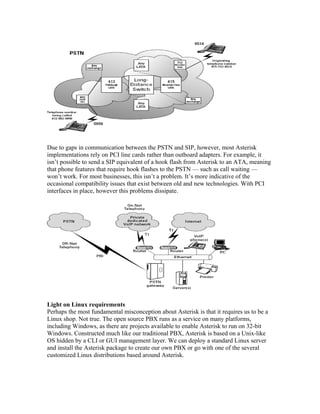
Fig: Using an older PBX with VOIP network.

Asterisk: open source’s top choice
Digium’s Asterisk is far and away the most mature and popular open source IP PBX
currently available. Other open source projects are under development — many, such as
OpenPBX, forking the Asterisk code base; others, such as FreeSwitch, being built from
the ground up. But despite increasing competition among open source IP PBXes, Asterisk
remains the most compelling enterprise VoIP play.
So much so that Sam Houston State University last year migrated 6,000-plus extensions
from Cisco CallManager to Asterisk, eliminating phone licensing costs and increasing
customization control and security in the process. And Summer Bay Resorts, a time-share
vacation property company, logs more than a million voice minutes per month on its 13-
server Asterisk system .But despite such proof that large-scale implementations of
Asterisk are viable, Digium remains focused predominantly on the midmarket .

Digium’s tempered stance toward widespread enterprise Asterisk adoption is
understandable, given the reservations many enterprises have about open source VoIP.
Chief among purported detractors are a perceived lack of support, questions about the
availability of features, and concerns about required skills for implementation and
management, as well as reservations about platform compatibilities. A closer look at
Asterisk and its rapidly evolving base of developers suggests that these anxieties are
unfounded and that Asterisk is ready for targeted enterprise deployment.

Makeup of an enterprise contender
Created by Spencer in 1999, Asterisk is a complete IP PBX released as open source under
the GNU General Public License. It is built to run on commodity hardware, providing
considerable cost savings when compared with commercial IP PBXes, and it leverages
the open source community for additional testing, bug fixes, and feature development.
Asterisk is available both as a business edition purchasable just like any other IP PBX —
with seat licenses, warranties, support contracts, and shiny-binder reference materials —
and as a free download, allowing all to take a test run before signing any checks.

In terms of replacing traditional PBX, Asterisk can tie analog phones to a central switch,
but scalability is an issue. It can interface with analog handsets through use of FXS
(foreign exchange station) line cards; IP-to-analog converters, such as Digium’s IAXy
ATA (analog telephony adapter); or competing products from Grandstream Networks and
Linksys, among others.

This is said that, Asterisk is built primarily for IP phones based either on its native IAX
(Inter-Asterisk eXchange) VoIP protocol or standard SIP. Asterisk modules that can talk
SCCP (Skinny Client Control Protocol) to Cisco phones are generally less reliable, given
the protocol’s proprietary nature.

Despite Asterisk’s IP phone bias, outbound trunks do not have to be IP. Not only can
Asterisk link with commercial VoIP providers such as BroadVoice and VoicePulse, but
with the right hardware in place, it can also handle TDM circuits such as channelized T1s
to deliver dial tone from the PSTN. Individual analog PSTN lines can also be brought
into play with PCI line cards within the Asterisk server or via outboard FXO (foreign
exchange office) ATAs such as the Grandstream GXW-4108, which can handle eight
POTS lines, each addressable as a unique SIP trunk within Asterisk.
Due to gaps in communication between the PSTN and SIP, however, most Asterisk
implementations rely on PCI line cards rather than outboard adapters. For example, it
isn’t possible to send a SIP equivalent of a hook flash from Asterisk to an ATA, meaning
that phone features that require hook flashes to the PSTN — such as call waiting —
won’t work. For most businesses, this isn’t a problem. It’s more indicative of the
occasional compatibility issues that exist between old and new technologies. With PCI
interfaces in place, however this problems dissipate.


Light on Linux requirements
Perhaps the most fundamental misconception about Asterisk is that it requires us to be a
Linux shop. Not true. The open source PBX runs as a service on many platforms,
including Windows, as there are projects available to enable Asterisk to run on 32-bit
Windows. Constructed much like our traditional PBX, Asterisk is based on a Unix-like
OS hidden by a CLI or GUI management layer. We can deploy a standard Linux server
and install the Asterisk package to create our own PBX or go with one of the several
customized Linux distributions based around Asterisk.
Today’s most popular distribution is Trixbox, which consolidates a CentOS Linux
platform, Asterisk, a bevy of open source Asterisk management tools, and custom code to
make rollouts easier. With Trixbox, any one can go from bare metal to a fully functional
Asterisk IP PBX in 20 minutes. The same can be said for Digium’s recently released
AsteriskONE, which takes a similar tack as Trixbox but offers different management
tools.

In delineating differences between Trixbox and AsteriskONE, Spencer points out that,
although Trixbox uses Asterisk, it is completely separate from Asterisk itself.
“AsteriskONE is basically an HTML gateway between Asterisk and your Web browser,”
he says,-“If you make a manual change, it’s reflected in both Asterisk and the Web UI.
Trixbox doesn’t have that.”

Trixbox does, however, offer significant features AsteriskONE lacks, such as easy
implementation and configuration of the HUDLite user GUI, SugarCRM integration, and
configuration tools for popular IP phone models. That said, AsteriskONE is still in beta.

As for managing an Asterisk deployment, a baseline grasp of Linux is advisable but not
required. Open source tools such as FreePBX offer a full Web UI for managing Asterisk,
from simple extension and trunk configuration to complex dial plans, IVR (interactive
voice response) functions, voice mail, and more. In fact, any one can build and deploy an
Asterisk PBX without touching a command line, although familiarity with the Linux and
Asterisk shells are necessary for large deployments. Smaller shops will likely never see
what’s behind the scenes, much as they don’t worry about Linux running on security
appliances.

The value of community
Support may be the most substantive knock against open source VoIP for the enterprise.
Even then, Asterisk is an exception to the rule.

Whereas support for open source projects typically consists of online forums, mailing
lists, and the occasional book, Asterisk has a company behind it. Digium offers support
services in addition to hardware vetted for Asterisk use, such as analog and digital
interface cards to connect Asterisk with the PSTN. Whether Digium’s support scales to
enterprise levels is yet to be seen, but it will at least lend Asterisk proposals legitimacy as
they wend their way through the corporate food chain in quest of funding.

But the major boon for Asterisk adopters — besides cost savings — is that, with the right
admins in place, the open source IP PBX can be modified to do just about anything. In
fact, much of Asterisk is already modular, using the AGI (Asterisk Gateway Interface),
which is patterned on the CGI intrinsic to Web servers. AGI allows admins to write plug-
ins for Asterisk in just about any language, including Python, PHP, Ruby, Java, C, and
Perl. As such, customizing your PBX’s feature set is relatively easy, and with the
community of developers designing tools for Asterisk growing rapidly, ready-made
features abound. Examples include a trouble-ticket management app that accepts ticket
number input from a dial pad and another that performs an Amazon lookup of keyed-in
10-digit ISBN numbers and recites book prices back to the caller.

Open for experimentation
The phone system may very well remain the most commonly used and relied-on
corporate app. Interaction with the phone system is constant, and the features,
performance, and stability of the system are under constant subconscious scrutiny. Voice
mail features and ease of use, voice mail/e-mail gateways, call quality, and follow-me
features are all highly visible components of any PBX, to users on both sides of the dial
tone, and IVR functions and reliability can make or break sales and business
relationships. As such, commitment to an IP PBX should by no means be taken lightly —
especially when it comes to assessing how well a VoIP solution will adapt to future
evolutions in enterprise.


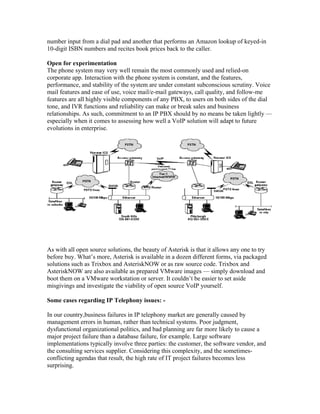
As with all open source solutions, the beauty of Asterisk is that it allows any one to try
before buy. What’s more, Asterisk is available in a dozen different forms, via packaged
solutions such as Trixbox and AsteriskNOW or as raw source code. Trixbox and
AsteriskNOW are also available as prepared VMware images — simply download and
boot them on a VMware workstation or server. It couldn’t be easier to set aside
misgivings and investigate the viability of open source VoIP yourself.

Some cases regarding IP Telephony issues: -

In our country,business failures in IP telephony market are generally caused by
management errors in human, rather than technical systems. Poor judgment,
dysfunctional organizational politics, and bad planning are far more likely to cause a
major project failure than a database failure, for example. Large software
implementations typically involve three parties: the customer, the software vendor, and
the consulting services supplier. Considering this complexity, and the sometimes-
conflicting agendas that result, the high rate of IT project failures becomes less
surprising.
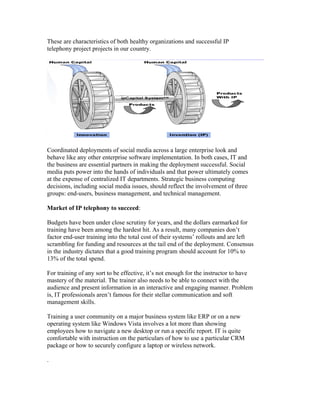
These are characteristics of both healthy organizations and successful IP
telephony project projects in our country.


Coordinated deployments of social media across a large enterprise look and
behave like any other enterprise software implementation. In both cases, IT and
the business are essential partners in making the deployment successful. Social
media puts power into the hands of individuals and that power ultimately comes
at the expense of centralized IT departments. Strategic business computing
decisions, including social media issues, should reflect the involvement of three
groups: end-users, business management, and technical management.

Market of IP telephony to succeed:

Budgets have been under close scrutiny for years, and the dollars earmarked for
training have been among the hardest hit. As a result, many companies don’t
factor end-user training into the total cost of their systems’ rollouts and are left
scrambling for funding and resources at the tail end of the deployment. Consensus
in the industry dictates that a good training program should account for 10% to
13% of the total spend.

For training of any sort to be effective, it’s not enough for the instructor to have
mastery of the material. The trainer also needs to be able to connect with the
audience and present information in an interactive and engaging manner. Problem
is, IT professionals aren’t famous for their stellar communication and soft
management skills.

Training a user community on a major business system like ERP or on a new
operating system like Windows Vista involves a lot more than showing
employees how to navigate a new desktop or run a specific report. IT is quite
comfortable with instruction on the particulars of how to use a particular CRM
package or how to securely configure a laptop or wireless network.

.
Conclusion:

Benefits of IP telephony :

The most significant benefit of IPT and driver of its evolution is money-saving and easy
implementation of innovative services:

       •   In the future, Internet Telephony Service Providers (ITSP) may use a single
           infrastructure for providing both, Internet access and Internet telephony .Only
           data-oriented switches could be deployed for switching data as well as voice.
           Multiplexing data and voice could also result in better bandwidth utilization
           than in today's over-engineered voice-or-nothing links. Not only the
           providers, but also their clients will profit of lower costs eventually.
       •   Now, customers may take advantage of flat Internet rating vs. hierarchical
           PSTN rating and save money while letting their long-distance calls be routed
           over Internet. This is especially true in Europe, where the prices of long-
           distance calls are still higher than in US. But: according to some estimations,
           the prices of the traditional and the Internet telephony will equalize together
           with the convergence of quality of services provided by them.
       •   The IPT users may also profit of its software-oriented nature: software
           solutions may be easily extended and integrated with other services and
           applications, e.g. white boarding , electronic calendar, or WWW. Deployment
           of new IP telephony services requires significantly lower investment in terms
           of time and money than in the traditional PSTN environmenHuman resource
           departments and dedicated in-house training group are obvious candidates for
           partnerships that can help IP bring the requisite business context and formal
           learning methodologies to its curriculum. IP telephony change the direction of
           the telephony industry, Feature is rich, coast effective, flexible and portable,
           enhanced network, better utilization of personnel, better utilization and
           reduced coast. Now a days, it is really very much need of our country to drive
           forward and IP telephony is the most important part of this development.
Bibliography

VoiP for DUMMIES.By-Timothy V. Kelly.

www.verizon.com ,

www.sbc.com

www.att.com

www.sprint.com

www.bellsouth.com .


.

Ridhwana Mohammad (071403056)

  • 1.
    Assignment Open Source VOIPMakes The Business Connection & Present Scenario ETE -605 IP Telephony ETE- 605 IP Telephony Prepared by: Name: Ridhwana Mohammad Afrina Naznin ID # 071403056 ID# 063514056 Section: 2 ETE Program MS in Prepared for: Dr.Mashiur Rahman Department of Computer Science North South University Date: th 15 April, 2008 15th April 15, 2008 North South University
  • 2.
    Acknowledgement All thanks andprayers to Allah, without his support I couldn’t have attempted to do this. I am very gratitude to our respected teacher Dr. Mashiur Rahman Instructor of our course to provide us such type of idea of the recent market and valuable assistance to the right way to the goal.
  • 3.
    Open source VoIPmakes the business connection and present scenario Objective: Million of startup computer network company with an innovative network security technology needs to document their technology rapidly to support a significant increase in their valuation in impending acquisition talks with another company. Here are some topic related discussion related to IP implementation in or country according to present need to keep constant connection with around the world. The objective of this case study is to create the new IP market and to fill the holes of our position in IP telephony future market. And also use IP to raise money & increase valuation. IP telephony: IP telephony (Internet Protocol telephony) is a general term for the technologies that use the Internet Protocol's packet-switched connections to exchange voice, fax, and other forms of information that have traditionally been carried over the dedicated circuit- switched connections of the public switched telephone network (PSTN). Using the Internet, calls travel as packets of data on shared lines, avoiding the tolls of the PSTN. The challenge in IP telephony is to deliver the voice, fax, or video packets in a dependable flow to the user. Much of IP telephony focuses on that challenge. Different type of protocol as the Internet protocol are the basis of IP networking. Different type of protocol is used,among them the most suitable and friendly is Asterisk as it is an open source. Thanks to worthwhile IP PBX alternatives such as Asterisk, open source VoIP is ready for targeted enterprise deployment That’s not to say that the enterprise is deaf to the benefits of open source itself. To be sure, companies are increasingly vetting open source alternatives before considering commercial wares. But despite this interest in open source elsewhere in the enterprise, the phone system has, by and large, remained off- limits to open source experimentation.
  • 4.
    When it comesto open-sourcing dial tone, the feeling among most enterprises is that there’s just too much at stake. After all, network troubles translate to help desk calls and lost revenue, but if the phones go down, it could mean life or death. And when it comes to melding the lockstep world of traditional five-nines PBXes into the land of Patch Tuesday and the frequent reboot, calling on a commercial vendor can feel a lot more comforting than signing off on that level of responsibility yourself. That said, the notion of an all-out VoIP implementation — ripping and replacing to the core — is fast fading away. Yes, dial tone has crossed the network boundary, but not pervasively. Moreover, many traditional PBX vendors are backing into the VoIP market, allowing telephony admins the comfort of tried-and-true PBXes with some of the benefits of VoIP. Introducing VoIP modules that permit VoIP trunks between locations is becoming common, yielding long-distance cost reductions without disrupting the status quo for local voice. Largely, VoIP is becoming a PBX replacement on an as-needed basis. And such targeted installations could prove a sweet spot for open source VoIP. As the technology gathers steam, convincing enterprises of its efficacy in increments, it will most certainly join the pack of large-scale go-to VoIP candidates down the line. After all, the considerable cost savings and flexibility of open source VoIP are just too great to ignore. Fig: Using an older PBX with VOIP network. Asterisk: open source’s top choice Digium’s Asterisk is far and away the most mature and popular open source IP PBX currently available. Other open source projects are under development — many, such as OpenPBX, forking the Asterisk code base; others, such as FreeSwitch, being built from the ground up. But despite increasing competition among open source IP PBXes, Asterisk remains the most compelling enterprise VoIP play.
  • 5.
    So much sothat Sam Houston State University last year migrated 6,000-plus extensions from Cisco CallManager to Asterisk, eliminating phone licensing costs and increasing customization control and security in the process. And Summer Bay Resorts, a time-share vacation property company, logs more than a million voice minutes per month on its 13- server Asterisk system .But despite such proof that large-scale implementations of Asterisk are viable, Digium remains focused predominantly on the midmarket . Digium’s tempered stance toward widespread enterprise Asterisk adoption is understandable, given the reservations many enterprises have about open source VoIP. Chief among purported detractors are a perceived lack of support, questions about the availability of features, and concerns about required skills for implementation and management, as well as reservations about platform compatibilities. A closer look at Asterisk and its rapidly evolving base of developers suggests that these anxieties are unfounded and that Asterisk is ready for targeted enterprise deployment. Makeup of an enterprise contender Created by Spencer in 1999, Asterisk is a complete IP PBX released as open source under the GNU General Public License. It is built to run on commodity hardware, providing considerable cost savings when compared with commercial IP PBXes, and it leverages the open source community for additional testing, bug fixes, and feature development. Asterisk is available both as a business edition purchasable just like any other IP PBX — with seat licenses, warranties, support contracts, and shiny-binder reference materials — and as a free download, allowing all to take a test run before signing any checks. In terms of replacing traditional PBX, Asterisk can tie analog phones to a central switch, but scalability is an issue. It can interface with analog handsets through use of FXS (foreign exchange station) line cards; IP-to-analog converters, such as Digium’s IAXy ATA (analog telephony adapter); or competing products from Grandstream Networks and Linksys, among others. This is said that, Asterisk is built primarily for IP phones based either on its native IAX (Inter-Asterisk eXchange) VoIP protocol or standard SIP. Asterisk modules that can talk SCCP (Skinny Client Control Protocol) to Cisco phones are generally less reliable, given the protocol’s proprietary nature. Despite Asterisk’s IP phone bias, outbound trunks do not have to be IP. Not only can Asterisk link with commercial VoIP providers such as BroadVoice and VoicePulse, but with the right hardware in place, it can also handle TDM circuits such as channelized T1s to deliver dial tone from the PSTN. Individual analog PSTN lines can also be brought into play with PCI line cards within the Asterisk server or via outboard FXO (foreign exchange office) ATAs such as the Grandstream GXW-4108, which can handle eight POTS lines, each addressable as a unique SIP trunk within Asterisk.
  • 6.
    Due to gapsin communication between the PSTN and SIP, however, most Asterisk implementations rely on PCI line cards rather than outboard adapters. For example, it isn’t possible to send a SIP equivalent of a hook flash from Asterisk to an ATA, meaning that phone features that require hook flashes to the PSTN — such as call waiting — won’t work. For most businesses, this isn’t a problem. It’s more indicative of the occasional compatibility issues that exist between old and new technologies. With PCI interfaces in place, however this problems dissipate. Light on Linux requirements Perhaps the most fundamental misconception about Asterisk is that it requires us to be a Linux shop. Not true. The open source PBX runs as a service on many platforms, including Windows, as there are projects available to enable Asterisk to run on 32-bit Windows. Constructed much like our traditional PBX, Asterisk is based on a Unix-like OS hidden by a CLI or GUI management layer. We can deploy a standard Linux server and install the Asterisk package to create our own PBX or go with one of the several customized Linux distributions based around Asterisk.
  • 7.
    Today’s most populardistribution is Trixbox, which consolidates a CentOS Linux platform, Asterisk, a bevy of open source Asterisk management tools, and custom code to make rollouts easier. With Trixbox, any one can go from bare metal to a fully functional Asterisk IP PBX in 20 minutes. The same can be said for Digium’s recently released AsteriskONE, which takes a similar tack as Trixbox but offers different management tools. In delineating differences between Trixbox and AsteriskONE, Spencer points out that, although Trixbox uses Asterisk, it is completely separate from Asterisk itself. “AsteriskONE is basically an HTML gateway between Asterisk and your Web browser,” he says,-“If you make a manual change, it’s reflected in both Asterisk and the Web UI. Trixbox doesn’t have that.” Trixbox does, however, offer significant features AsteriskONE lacks, such as easy implementation and configuration of the HUDLite user GUI, SugarCRM integration, and configuration tools for popular IP phone models. That said, AsteriskONE is still in beta. As for managing an Asterisk deployment, a baseline grasp of Linux is advisable but not required. Open source tools such as FreePBX offer a full Web UI for managing Asterisk, from simple extension and trunk configuration to complex dial plans, IVR (interactive voice response) functions, voice mail, and more. In fact, any one can build and deploy an Asterisk PBX without touching a command line, although familiarity with the Linux and Asterisk shells are necessary for large deployments. Smaller shops will likely never see what’s behind the scenes, much as they don’t worry about Linux running on security appliances. The value of community Support may be the most substantive knock against open source VoIP for the enterprise. Even then, Asterisk is an exception to the rule. Whereas support for open source projects typically consists of online forums, mailing lists, and the occasional book, Asterisk has a company behind it. Digium offers support services in addition to hardware vetted for Asterisk use, such as analog and digital interface cards to connect Asterisk with the PSTN. Whether Digium’s support scales to enterprise levels is yet to be seen, but it will at least lend Asterisk proposals legitimacy as they wend their way through the corporate food chain in quest of funding. But the major boon for Asterisk adopters — besides cost savings — is that, with the right admins in place, the open source IP PBX can be modified to do just about anything. In fact, much of Asterisk is already modular, using the AGI (Asterisk Gateway Interface), which is patterned on the CGI intrinsic to Web servers. AGI allows admins to write plug- ins for Asterisk in just about any language, including Python, PHP, Ruby, Java, C, and Perl. As such, customizing your PBX’s feature set is relatively easy, and with the community of developers designing tools for Asterisk growing rapidly, ready-made features abound. Examples include a trouble-ticket management app that accepts ticket
  • 8.
    number input froma dial pad and another that performs an Amazon lookup of keyed-in 10-digit ISBN numbers and recites book prices back to the caller. Open for experimentation The phone system may very well remain the most commonly used and relied-on corporate app. Interaction with the phone system is constant, and the features, performance, and stability of the system are under constant subconscious scrutiny. Voice mail features and ease of use, voice mail/e-mail gateways, call quality, and follow-me features are all highly visible components of any PBX, to users on both sides of the dial tone, and IVR functions and reliability can make or break sales and business relationships. As such, commitment to an IP PBX should by no means be taken lightly — especially when it comes to assessing how well a VoIP solution will adapt to future evolutions in enterprise. As with all open source solutions, the beauty of Asterisk is that it allows any one to try before buy. What’s more, Asterisk is available in a dozen different forms, via packaged solutions such as Trixbox and AsteriskNOW or as raw source code. Trixbox and AsteriskNOW are also available as prepared VMware images — simply download and boot them on a VMware workstation or server. It couldn’t be easier to set aside misgivings and investigate the viability of open source VoIP yourself. Some cases regarding IP Telephony issues: - In our country,business failures in IP telephony market are generally caused by management errors in human, rather than technical systems. Poor judgment, dysfunctional organizational politics, and bad planning are far more likely to cause a major project failure than a database failure, for example. Large software implementations typically involve three parties: the customer, the software vendor, and the consulting services supplier. Considering this complexity, and the sometimes- conflicting agendas that result, the high rate of IT project failures becomes less surprising.
  • 9.
    These are characteristicsof both healthy organizations and successful IP telephony project projects in our country. Coordinated deployments of social media across a large enterprise look and behave like any other enterprise software implementation. In both cases, IT and the business are essential partners in making the deployment successful. Social media puts power into the hands of individuals and that power ultimately comes at the expense of centralized IT departments. Strategic business computing decisions, including social media issues, should reflect the involvement of three groups: end-users, business management, and technical management. Market of IP telephony to succeed: Budgets have been under close scrutiny for years, and the dollars earmarked for training have been among the hardest hit. As a result, many companies don’t factor end-user training into the total cost of their systems’ rollouts and are left scrambling for funding and resources at the tail end of the deployment. Consensus in the industry dictates that a good training program should account for 10% to 13% of the total spend. For training of any sort to be effective, it’s not enough for the instructor to have mastery of the material. The trainer also needs to be able to connect with the audience and present information in an interactive and engaging manner. Problem is, IT professionals aren’t famous for their stellar communication and soft management skills. Training a user community on a major business system like ERP or on a new operating system like Windows Vista involves a lot more than showing employees how to navigate a new desktop or run a specific report. IT is quite comfortable with instruction on the particulars of how to use a particular CRM package or how to securely configure a laptop or wireless network. .
  • 10.
    Conclusion: Benefits of IPtelephony : The most significant benefit of IPT and driver of its evolution is money-saving and easy implementation of innovative services: • In the future, Internet Telephony Service Providers (ITSP) may use a single infrastructure for providing both, Internet access and Internet telephony .Only data-oriented switches could be deployed for switching data as well as voice. Multiplexing data and voice could also result in better bandwidth utilization than in today's over-engineered voice-or-nothing links. Not only the providers, but also their clients will profit of lower costs eventually. • Now, customers may take advantage of flat Internet rating vs. hierarchical PSTN rating and save money while letting their long-distance calls be routed over Internet. This is especially true in Europe, where the prices of long- distance calls are still higher than in US. But: according to some estimations, the prices of the traditional and the Internet telephony will equalize together with the convergence of quality of services provided by them. • The IPT users may also profit of its software-oriented nature: software solutions may be easily extended and integrated with other services and applications, e.g. white boarding , electronic calendar, or WWW. Deployment of new IP telephony services requires significantly lower investment in terms of time and money than in the traditional PSTN environmenHuman resource departments and dedicated in-house training group are obvious candidates for partnerships that can help IP bring the requisite business context and formal learning methodologies to its curriculum. IP telephony change the direction of the telephony industry, Feature is rich, coast effective, flexible and portable, enhanced network, better utilization of personnel, better utilization and reduced coast. Now a days, it is really very much need of our country to drive forward and IP telephony is the most important part of this development.
  • 11.
    Bibliography VoiP for DUMMIES.By-TimothyV. Kelly. www.verizon.com , www.sbc.com www.att.com www.sprint.com www.bellsouth.com . .