Ashish sahu
 Introduction of exotic fishes.
 Definition.
 Exotic fishes in India.
 Exotic fishes transplanted in India.
a. Game fishes.
b. Food fishes.
c. Larvicidal fishes.
d. Ornamental fishes.
e. Unauthorised introduction.
 Common name.
 Home country.
 Year of introduction.
 Place of Introduction and
 Purpose of exotic fishes introduction.
 Advantage and Disadvantage of exotic sp.
Introduction.
 Impact of exotic over indigenous fish
species.
 Effection other fishes of indigenous origin.
 Conclusion.
 Reference.
 . At the beginning of the 1950s development of
intensive fisheries and aquaculture induced the
initiation of significant fish culture activities all
over the world.
 Introduction of artificial reproduction of fish,
elaboration of polyculture stocking structures and
starting genetic manipulations required a greater
number of fish
 Species, including foreign fish species. The
introduction of common carp (Cyprinus carpio L.)
to rivers of India and South-East Asia was carried
out at this time.
 Later the silver carp (Hypophthalmichthys
molitrix), bighead carp (Aristichthys nobilis) and
grass carp ( Ctenopharyngodon idella) were
introduced in Europe .
 India and South- East Asia, then the Indian carps,
Catla catla, Labeo rohita and Cirrhinas mrigala
enlarged the species composition of aquaculture in
Asia exotic animals are defined as “species
occurring outside of its natural range”.
 Exotic species, also called non-indigenous
species, are organisms that have moved beyond
their natural geographical range of habitat.
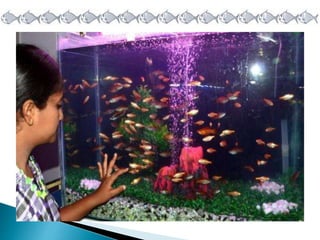
 These include various food fishes, game fishes,
Larvicidal fishes, ornamental fishes and
unauthorized fishes in other words, the fish
species which are not of Indian origin but
transplanted into Indian waters for culture purpose
are called exotic fishes.
 During the last several decades over 300 species
of exotic fishes have been brought into India for
experimental aquaculture sport fishing mosquito
control.
 Several exotic species are now established in the
natural water bodies of India.
 The fishery department had also sent a report
regarding the existence of exotic fishes to the
National Bureau of Fish Genetic Resources
(NBFGR), Lucknow.
 NBFGR works to achieve its mandate related to
database development, genotyping, registration of
aquatic germplasm, genebanking and evaluation of
endangered and exotic species.
S0. N0. SPECIES COMMO
N NAME
HOME
COUNT
RY
YEAR
OF
INTR
ODU
CTIO
N
PLACE OF
INTRODU
CTION
PURPOSE
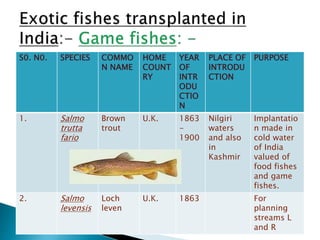
1. Salmo
trutta
fario
Brown
trout
U.K. 1863
-
1900
Nilgiri
waters
and also
in
Kashmir
Implantatio
n made in
cold water
of India
valued of
food fishes
and game
fishes.
2. Salmo
levensis
Loch
leven
U.K. 1863 For
planning
streams L
and R
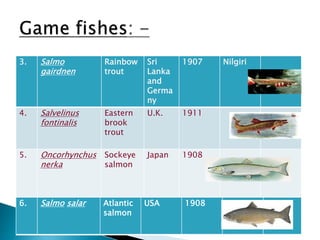
3. Salmo
gairdnen
Rainbow
trout
Sri
Lanka
and
Germa
ny
1907 Nilgiri
4. Salvelinus
fontinalis
Eastern
brook
trout
U.K. 1911
5. Oncorhynchus
nerka
Sockeye
salmon
Japan 1908
6. Salmo salar Atlantic
salmon
USA 1908
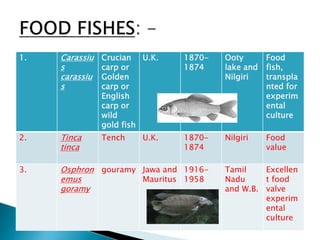
1. Carassiu
s
carassiu
s
Crucian
carp or
Golden
carp or
English
carp or
wild
gold fish
U.K. 1870-
1874
Ooty
lake and
Nilgiri
Food
fish,
transpla
nted for
experim
ental
culture
2. Tinca
tinca
Tench U.K. 1870-
1874
Nilgiri Food
value
3. Osphron
emus
goramy
gouramy Jawa and
Mauritus
1916-
1958
Tamil
Nadu
and W.B.
Excellen
t food
valve
experim
ental
culture
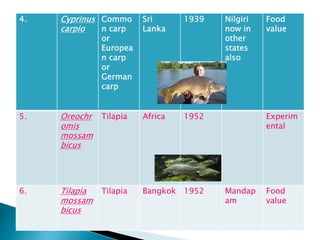
4. Cyprinus
carpio
Commo
n carp
or
Europea
n carp
or
German
carp
Sri
Lanka
1939 Nilgiri
now in
other
states
also
Food
value
5. Oreochr
omis
mossam
bicus
Tilapia Africa 1952 Experim
ental
6. Tilapia
mossam
bicus
Tilapia Bangkok 1952 Mandap
am
Food
value
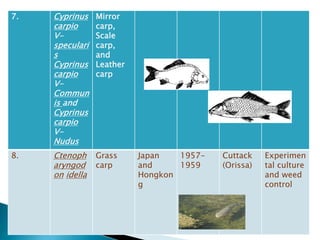
7. Cyprinus
carpio
V-
speculari
s
Cyprinus
carpio
V-
Commun
is and
Cyprinus
carpio
V-
Nudus
Mirror
carp,
Scale
carp,
and
Leather
carp
8. Ctenoph
aryngod
on idella
Grass
carp
Japan
and
Hongkon
g
1957-
1959
Cuttack
(Orissa)
Experimen
tal culture
and weed
control
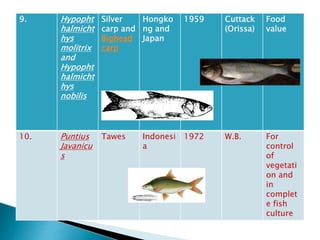
9. Hypopht
halmicht
hys
molitrix
and
Hypopht
halmicht
hys
nobilis
Silver
carp and
Bighead
carp
Hongko
ng and
Japan
1959 Cuttack
(Orissa)
Food
value
10. Puntius
Javanicu
s
Tawes Indonesi
a
1972 W.B. For
control
of
vegetati
on and
in
complet
e fish
culture
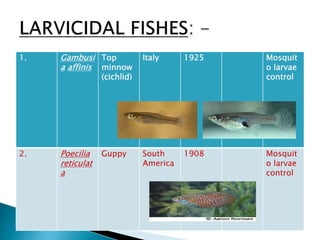
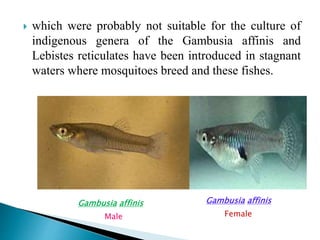
1. Gambusi
a affinis
Top
minnow
(cichlid)
Italy 1925 Mosquit
o larvae
control
2. Poecilia
reticulat
a
Guppy South
America
1908 Mosquit
o larvae
control
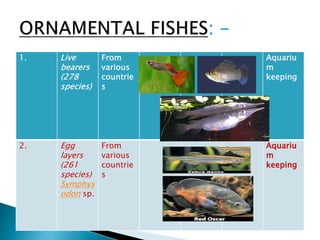
1. Live
bearers
(278
species)
From
various
countrie
s
Aquariu
m
keeping
2. Egg
layers
(261
species)
Symphys
odon sp.
From
various
countrie
s
Aquariu
m
keeping
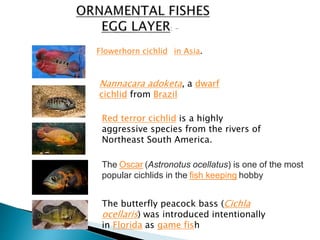
Flowerhorn cichlid in Asia.
Nannacara adoketa, a dwarf
cichlid from Brazil
Red terror cichlid is a highly
aggressive species from the rivers of
Northeast South America.
The Oscar (Astronotus ocellatus) is one of the most
popular cichlids in the fish keeping hobby
The butterfly peacock bass (Cichla
ocellaris) was introduced intentionally
in Florida as game fish
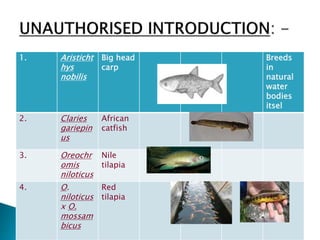
1. Aristicht
hys
nobilis
Big head
carp
Breeds
in
natural
water
bodies
itsel
2. Claries
gariepin
us
African
catfish
3. Oreochr
omis
niloticus
Nile
tilapia
4. O.
niloticus
x O.
mossam
bicus
Red
tilapia
Fish Culture is beneficial activity as it extends several
direct and indirect benefits;
a) In addition to agriculture and animal husbandry, fish
culture provides a new commercial avenue,
b) Provides easily digestible protein rich food - fish,
which helps in improving nutritional status of the
mass.
c) Its production provide additional income to the
growers and thus uplifts their purchasing power.
d) moreover, an integrated fish culture approach with
(mils - banana/papaya and vegetable farming, with
cattle or poultry and duck farming, do not provide
fish only but provide many other agricultural and
animal husbandry products at low or lower cost
which are essentials to the mass.
 The impacts of introducing non-indigenous species
can be divided into two areas: ecological, and
economic. These categories, however, are inter-
dependent; an exotic Species.
 An accurate accounting of the benefits derived
from exotic species is essential.
 Which has an ecological impact also has an
economic one, and vice versa.
 Effects of introduced fish on ecological and (Socio-
economic) environments by reason for the
introduction. Data represents number of records
from fish base.
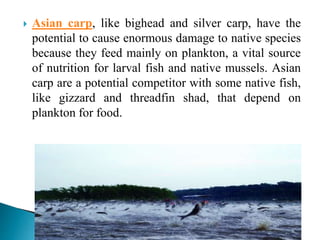
 Asian carp, like bighead and silver carp, have the
potential to cause enormous damage to native species
because they feed mainly on plankton, a vital source
of nutrition for larval fish and native mussels. Asian
carp are a potential competitor with some native fish,
like gizzard and threadfin shad, that depend on
plankton for food.
 The introduction of exotic fishes in inland
waters is of considerable importance.
 Some of the exotic fishes are of high food
value and have established well in Indian
water.
 Further, they have established in those
regions of our country.
 feed on their larvae.
 which were probably not suitable for the culture of
indigenous genera of the Gambusia affinis and
Lebistes reticulates have been introduced in stagnant
waters where mosquitoes breed and these fishes.
Gambusia affinisGambusia affinis
Male Female
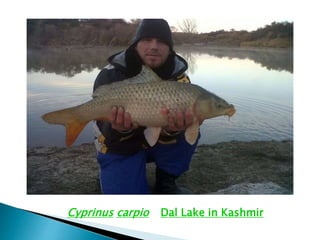
 The different phenototypes of the exotic carp,
Cyprinus carpio, were introduced in Kashmir waters
in late fifities.
 From the investigations studies conducted on the Dal
Lake in Kashmir with regard to fish population
dynamics, it was possible to identify three main
impacts of species introduction.
Cyprinus carpio Dal Lake in Kashmir
 Terms of both time and space scales, it can be
assumed that international species transferred.
 These movements can definitively be considered as
efficient tools for increasing protein production,
improving human nutrition and generating income
and employment.
 Introductions have resulted in much more
beneficial impacts than negative ones.
 The use of exotic fish for improving wild stocks,
and consequently enhancing fisheries for example,
the introduction of tilapias species into reservoirs
or natural water bodies of Asia, Africa and
America.
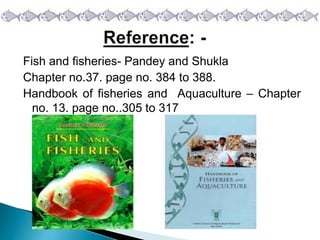
Fish and fisheries- Pandey and Shukla
Chapter no.37. page no. 384 to 388.
Handbook of fisheries and Aquaculture – Chapter
no. 13. page no..305 to 317
THANK
YOU.