



ESTUARIESL A N D S C A P E R E S O U R C E S
V.Akhil Akash | 1190700032 | M.Arch Landscape | II year III sem | SPAV
CONTENT
• Introduction
• Characteristics
• Types of estuaries
• Estuaries in India
Landscape Resources
• Faunal resources
• Ecosystem resources
• Economic resources
• Cultural resources
• Environmental value
• People and estuaries
• Threats Estuarine
habitats
INTRODUCTION
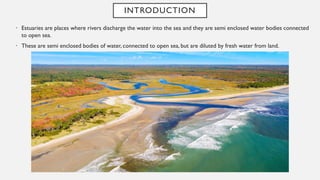
• Estuaries are places where rivers discharge the water into the sea and they are semi enclosed water bodies connected
to open sea.
• These are semi enclosed bodies of water, connected to open sea, but are diluted by fresh water from land.
CHARACTERISTICS
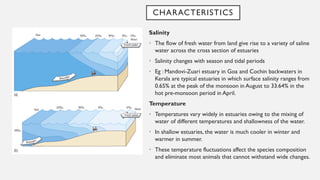
Salinity
• The flow of fresh water from land give rise to a variety of saline
water across the cross section of estuaries
• Salinity changes with season and tidal periods
• Eg : Mandovi-Zuari estuary in Goa and Cochin backwaters in
Kerala are typical estuaries in which surface salinity ranges from
0.65% at the peak of the monsoon in August to 33.64% in the
hot pre-monsoon period in April.
Temperature
• Temperatures vary widely in estuaries owing to the mixing of
water of different temperatures and shallowness of the water.
• In shallow estuaries, the water is much cooler in winter and
warmer in summer.
• These temperature fluctuations affect the species composition
and eliminate most animals that cannot withstand wide changes.
CHARACTERISTICS
Sediments
• The sediment type influences the organisms living in the estuary,
especially plants and benthic animals. (animals that occur at
bottom of the ocean)
• Mudflats are common.The substrate here is composed of soft,
loose mud or a mixture of mud and sand.
• Characteristic vegetation such as eel grass in temperate areas
and mangroves in the tropics develops on mudflats, making
estuarine ecosystems very productive and at the same time
providing special habitat for animals.
• Mangroves are found in most estuaries along the Indian coast.
Sediment flow inWaikato andWaipa rivers
Source: Compound Specific Stable Isotope tracing of sediment sources - tools to manage a sticky problem
in New Zealand’s freshwaters and estuaries | NIWA
CHARACTERISTICS
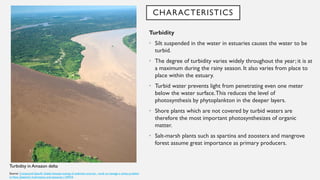
Turbidity
• Silt suspended in the water in estuaries causes the water to be
turbid.
• The degree of turbidity varies widely throughout the year; it is at
a maximum during the rainy season. It also varies from place to
place within the estuary.
• Turbid water prevents light from penetrating even one meter
below the water surface.This reduces the level of
photosynthesis by phytoplankton in the deeper layers.
• Shore plants which are not covered by turbid waters are
therefore the most important photosynthesizes of organic
matter.
• Salt-marsh plants such as spartina and zoostera and mangrove
forest assume great importance as primary producers.
Turbidity in Amazon delta
Source: Compound Specific Stable Isotope tracing of sediment sources - tools to manage a sticky problem
in New Zealand’s freshwaters and estuaries | NIWA
CHARACTERISTICS
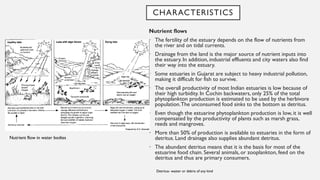
Nutrient flows
• The fertility of the estuary depends on the flow of nutrients from
the river and on tidal currents.
• Drainage from the land is the major source of nutrient inputs into
the estuary. In addition, industrial effluents and city waters also find
their way into the estuary.
• Some estuaries in Gujarat are subject to heavy industrial pollution,
making it difficult for fish to survive.
• The overall productivity of most Indian estuaries is low because of
their high turbidity. In Cochin backwaters, only 25% of the total
phytoplankton production is estimated to be used by the herbivore
population.The unconsumed food sinks to the bottom as detritus.
• Even though the estuarine phytoplankton production is low, it is well
compensated by the productivity of plants such as marsh grass,
reeds and mangroves.
• More than 50% of production is available to estuaries in the form of
detritus. Land drainage also supplies abundant detritus.
• The abundant detritus means that it is the basis for most of the
estuarine food chain. Several animals, or zooplankton, feed on the
detritus and thus are primary consumers.
Detritus- waster or debris of any kind
Nutrient flow in water bodies
TYPES
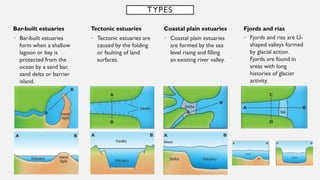
• Bar-built estuaries
form when a shallow
lagoon or bay is
protected from the
ocean by a sand bar,
sand delta or barrier
island.
Bar-built estuaries
• Tectonic estuaries are
caused by the folding
or faulting of land
surfaces.
Tectonic estuaries
• Coastal plain estuaries
are formed by the sea
level rising and filling
an existing river valley.
Coastal plain estuaries
• Fjords and rias are U-
shaped valleys formed
by glacial action.
Fjords are found in
areas with long
histories of glacier
activity.
Fjords and rias
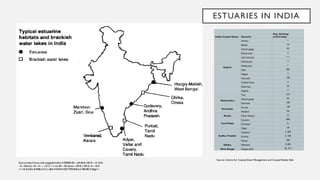
ESTUARIES IN INDIA
Indian Coastal States Estuaries
Avg. discharge
(m3/sec/day)
Gujarat
Ambica 1
Bhadar 16
Daman ganga 93
Dhatarwadi 2
Gulf of Kutch < 1
Machhundri 3
Madhuvanti 1
Mahi 383
Meghal 7
Narmada 190
Prabhas Patan 4
Sabarmati 33
Singoda 3
Tapi 210
Maharashtra
Daman ganga 93
Narmada 190
Karnataka
Karwar 128
Mandovi 56
Kerala Periar Estuary 8
Tamil Nadu
Cauvery 600
Ponnaiyar 21
Vaigai 28
Andhra Pradesh
Godavari 3, 500
Krishna 2, 100
Pennar 200
Odisha Mahanadi 2,100
West Bengal Ganges delta 35, 217
Source: Centre for Coastal Zone Management and Coastal Shelter Belt
Source http://www.nzdl.org/gsdlmod?e=d-00000-00---off-0hdl--00-0----0-10-0-
--0---0direct-10---4-------0-1l--11-en-50---20-about---00-0-1-00-0--4----0-0-
11-10-0utfZz-8-00&cl=CL1.2&d=HASHd10071ff5b9a81a2180c80.4.3&gt=1
LANDSCAPE RESOURCES
FAUNAL RESOURCES
• Brackish waters are poorer in species diversity as compared to
the sea or fresh water.
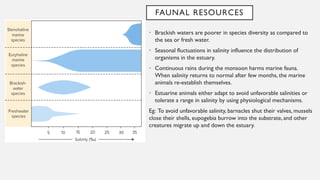
• Seasonal fluctuations in salinity influence the distribution of
organisms in the estuary.
• Continuous rains during the monsoon harms marine fauna.
When salinity returns to normal after few months, the marine
animals re-establish themselves.
• Estuarine animals either adapt to avoid unfavorable salinities or
tolerate a range in salinity by using physiological mechanisms.
Eg: To avoid unfavorable salinity, barnacles shut their valves, mussels
close their shells, eupogebia burrow into the substrate, and other
creatures migrate up and down the estuary.
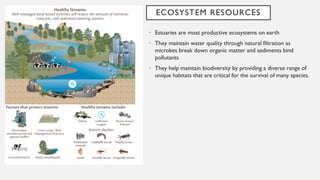
ECOSYSTEM RESOURCES
• Estuaries are most productive ecosystems on earth
• They maintain water quality through natural filtration as
microbes break down organic matter and sediments bind
pollutants
• They help maintain biodiversity by providing a diverse range of
unique habitats that are critical for the survival of many species.
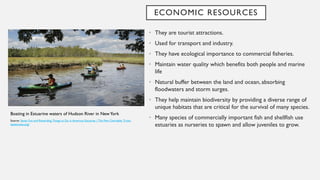
ECONOMIC RESOURCES
• They are tourist attractions.
• Used for transport and industry.
• They have ecological importance to commercial fisheries.
• Maintain water quality which benefits both people and marine
life
• Natural buffer between the land and ocean, absorbing
floodwaters and storm surges.
• They help maintain biodiversity by providing a diverse range of
unique habitats that are critical for the survival of many species.
• Many species of commercially important fish and shellfish use
estuaries as nurseries to spawn and allow juveniles to grow.
Boating in Estuarine waters of Hudson River in NewYork
Source: Seven Fun and Rewarding Things to Do in Americas Estuaries | The Pew Charitable Trusts
(pewtrusts.org)
CULTURAL RESOURCES
• People value estuaries for recreation, scientific knowledge,
education, aesthetic and traditional practices
• Estuaries also provide a great deal of aesthetic enjoyment for the
people who live, work, or use them for recreation.
• Estuaries provide us with numerous resources upon which
cannot be valued in market terms.
• They offer benefits and services which greatly improve our
lifestyle.
• Estuaries are an irreplaceable natural resource that must be
managed carefully for the mutual benefit of all who enjoy and
depend on them.
Sundarbans,West Bengal
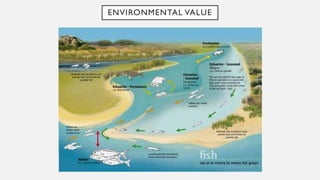
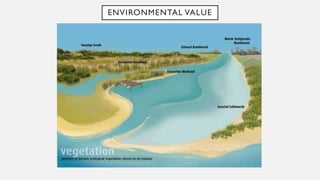
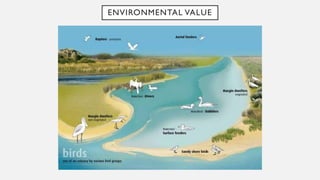
ENVIRONMENTAL VALUE
ENVIRONMENTAL VALUE
ENVIRONMENTAL VALUE
PEOPLE AND ESTUARIES
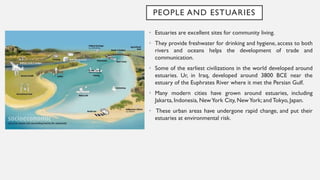
• Estuaries are excellent sites for community living.
• They provide freshwater for drinking and hygiene, access to both
rivers and oceans helps the development of trade and
communication.
• Some of the earliest civilizations in the world developed around
estuaries. Ur, in Iraq, developed around 3800 BCE near the
estuary of the Euphrates River where it met the Persian Gulf.
• Many modern cities have grown around estuaries, including
Jakarta, Indonesia, NewYork City, NewYork; and Tokyo, Japan.
• These urban areas have undergone rapid change, and put their
estuaries at environmental risk.
THREATS
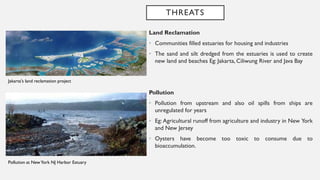
Land Reclamation
• Communities filled estuaries for housing and industries
• The sand and silt dredged from the estuaries is used to create
new land and beaches Eg: Jakarta, Ciliwung River and Java Bay
Pollution
• Pollution from upstream and also oil spills from ships are
unregulated for years
• Eg: Agricultural runoff from agriculture and industry in New York
and New Jersey
• Oysters have become too toxic to consume due to
bioaccumulation.
Jakarta's land reclamation project
Pollution at NewYork NJ Harbor Estuary
THREATS
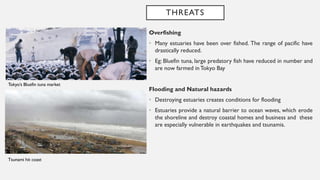
Overfishing
• Many estuaries have been over fished. The range of pacific have
drastically reduced.
• Eg: Bluefin tuna, large predatory fish have reduced in number and
are now farmed in Tokyo Bay
Flooding and Natural hazards
• Destroying estuaries creates conditions for flooding
• Estuaries provide a natural barrier to ocean waves, which erode
the shoreline and destroy coastal homes and business and these
are especially vulnerable in earthquakes and tsunamis.
Tokyo’s Bluefin tuna market
Tsunami hit coast
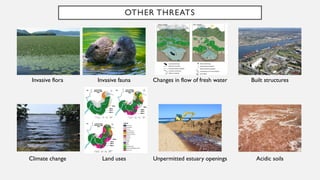
OTHER THREATS
Invasive flora Invasive fauna Changes in flow of fresh water Built structures
Climate change Land uses Unpermitted estuary openings Acidic soils
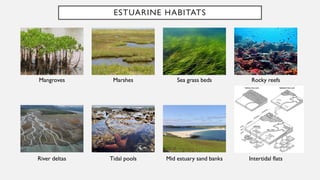
ESTUARINE HABITATS
Mangroves Marshes Sea grass beds Rocky reefs
River deltas Tidal pools Mid estuary sand banks Intertidal flats
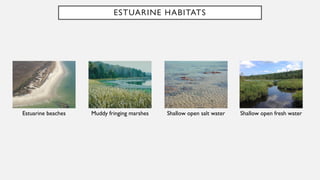
ESTUARINE HABITATS
Estuarine beaches Muddy fringing marshes Shallow open salt water Shallow open fresh water
REFERENCES
• Estuaries | NIWA
• estuary | National Geographic Society

Estuaries

  • 1.
    ESTUARIESL A ND S C A P E R E S O U R C E S V.Akhil Akash | 1190700032 | M.Arch Landscape | II year III sem | SPAV
  • 2.
    CONTENT • Introduction • Characteristics •Types of estuaries • Estuaries in India Landscape Resources • Faunal resources • Ecosystem resources • Economic resources • Cultural resources • Environmental value • People and estuaries • Threats Estuarine habitats
  • 3.
    INTRODUCTION • Estuaries areplaces where rivers discharge the water into the sea and they are semi enclosed water bodies connected to open sea. • These are semi enclosed bodies of water, connected to open sea, but are diluted by fresh water from land.
  • 4.
    CHARACTERISTICS Salinity • The flowof fresh water from land give rise to a variety of saline water across the cross section of estuaries • Salinity changes with season and tidal periods • Eg : Mandovi-Zuari estuary in Goa and Cochin backwaters in Kerala are typical estuaries in which surface salinity ranges from 0.65% at the peak of the monsoon in August to 33.64% in the hot pre-monsoon period in April. Temperature • Temperatures vary widely in estuaries owing to the mixing of water of different temperatures and shallowness of the water. • In shallow estuaries, the water is much cooler in winter and warmer in summer. • These temperature fluctuations affect the species composition and eliminate most animals that cannot withstand wide changes.
  • 5.
    CHARACTERISTICS Sediments • The sedimenttype influences the organisms living in the estuary, especially plants and benthic animals. (animals that occur at bottom of the ocean) • Mudflats are common.The substrate here is composed of soft, loose mud or a mixture of mud and sand. • Characteristic vegetation such as eel grass in temperate areas and mangroves in the tropics develops on mudflats, making estuarine ecosystems very productive and at the same time providing special habitat for animals. • Mangroves are found in most estuaries along the Indian coast. Sediment flow inWaikato andWaipa rivers Source: Compound Specific Stable Isotope tracing of sediment sources - tools to manage a sticky problem in New Zealand’s freshwaters and estuaries | NIWA
  • 6.
    CHARACTERISTICS Turbidity • Silt suspendedin the water in estuaries causes the water to be turbid. • The degree of turbidity varies widely throughout the year; it is at a maximum during the rainy season. It also varies from place to place within the estuary. • Turbid water prevents light from penetrating even one meter below the water surface.This reduces the level of photosynthesis by phytoplankton in the deeper layers. • Shore plants which are not covered by turbid waters are therefore the most important photosynthesizes of organic matter. • Salt-marsh plants such as spartina and zoostera and mangrove forest assume great importance as primary producers. Turbidity in Amazon delta Source: Compound Specific Stable Isotope tracing of sediment sources - tools to manage a sticky problem in New Zealand’s freshwaters and estuaries | NIWA
  • 7.
    CHARACTERISTICS Nutrient flows • Thefertility of the estuary depends on the flow of nutrients from the river and on tidal currents. • Drainage from the land is the major source of nutrient inputs into the estuary. In addition, industrial effluents and city waters also find their way into the estuary. • Some estuaries in Gujarat are subject to heavy industrial pollution, making it difficult for fish to survive. • The overall productivity of most Indian estuaries is low because of their high turbidity. In Cochin backwaters, only 25% of the total phytoplankton production is estimated to be used by the herbivore population.The unconsumed food sinks to the bottom as detritus. • Even though the estuarine phytoplankton production is low, it is well compensated by the productivity of plants such as marsh grass, reeds and mangroves. • More than 50% of production is available to estuaries in the form of detritus. Land drainage also supplies abundant detritus. • The abundant detritus means that it is the basis for most of the estuarine food chain. Several animals, or zooplankton, feed on the detritus and thus are primary consumers. Detritus- waster or debris of any kind Nutrient flow in water bodies
  • 8.
    TYPES • Bar-built estuaries formwhen a shallow lagoon or bay is protected from the ocean by a sand bar, sand delta or barrier island. Bar-built estuaries • Tectonic estuaries are caused by the folding or faulting of land surfaces. Tectonic estuaries • Coastal plain estuaries are formed by the sea level rising and filling an existing river valley. Coastal plain estuaries • Fjords and rias are U- shaped valleys formed by glacial action. Fjords are found in areas with long histories of glacier activity. Fjords and rias
  • 9.
    ESTUARIES IN INDIA IndianCoastal States Estuaries Avg. discharge (m3/sec/day) Gujarat Ambica 1 Bhadar 16 Daman ganga 93 Dhatarwadi 2 Gulf of Kutch < 1 Machhundri 3 Madhuvanti 1 Mahi 383 Meghal 7 Narmada 190 Prabhas Patan 4 Sabarmati 33 Singoda 3 Tapi 210 Maharashtra Daman ganga 93 Narmada 190 Karnataka Karwar 128 Mandovi 56 Kerala Periar Estuary 8 Tamil Nadu Cauvery 600 Ponnaiyar 21 Vaigai 28 Andhra Pradesh Godavari 3, 500 Krishna 2, 100 Pennar 200 Odisha Mahanadi 2,100 West Bengal Ganges delta 35, 217 Source: Centre for Coastal Zone Management and Coastal Shelter Belt Source http://www.nzdl.org/gsdlmod?e=d-00000-00---off-0hdl--00-0----0-10-0- --0---0direct-10---4-------0-1l--11-en-50---20-about---00-0-1-00-0--4----0-0- 11-10-0utfZz-8-00&cl=CL1.2&d=HASHd10071ff5b9a81a2180c80.4.3&gt=1
  • 10.
  • 11.
    FAUNAL RESOURCES • Brackishwaters are poorer in species diversity as compared to the sea or fresh water. • Seasonal fluctuations in salinity influence the distribution of organisms in the estuary. • Continuous rains during the monsoon harms marine fauna. When salinity returns to normal after few months, the marine animals re-establish themselves. • Estuarine animals either adapt to avoid unfavorable salinities or tolerate a range in salinity by using physiological mechanisms. Eg: To avoid unfavorable salinity, barnacles shut their valves, mussels close their shells, eupogebia burrow into the substrate, and other creatures migrate up and down the estuary.
  • 12.
    ECOSYSTEM RESOURCES • Estuariesare most productive ecosystems on earth • They maintain water quality through natural filtration as microbes break down organic matter and sediments bind pollutants • They help maintain biodiversity by providing a diverse range of unique habitats that are critical for the survival of many species.
  • 13.
    ECONOMIC RESOURCES • Theyare tourist attractions. • Used for transport and industry. • They have ecological importance to commercial fisheries. • Maintain water quality which benefits both people and marine life • Natural buffer between the land and ocean, absorbing floodwaters and storm surges. • They help maintain biodiversity by providing a diverse range of unique habitats that are critical for the survival of many species. • Many species of commercially important fish and shellfish use estuaries as nurseries to spawn and allow juveniles to grow. Boating in Estuarine waters of Hudson River in NewYork Source: Seven Fun and Rewarding Things to Do in Americas Estuaries | The Pew Charitable Trusts (pewtrusts.org)
  • 14.
    CULTURAL RESOURCES • Peoplevalue estuaries for recreation, scientific knowledge, education, aesthetic and traditional practices • Estuaries also provide a great deal of aesthetic enjoyment for the people who live, work, or use them for recreation. • Estuaries provide us with numerous resources upon which cannot be valued in market terms. • They offer benefits and services which greatly improve our lifestyle. • Estuaries are an irreplaceable natural resource that must be managed carefully for the mutual benefit of all who enjoy and depend on them. Sundarbans,West Bengal
  • 15.
  • 16.
  • 17.
  • 18.
    PEOPLE AND ESTUARIES •Estuaries are excellent sites for community living. • They provide freshwater for drinking and hygiene, access to both rivers and oceans helps the development of trade and communication. • Some of the earliest civilizations in the world developed around estuaries. Ur, in Iraq, developed around 3800 BCE near the estuary of the Euphrates River where it met the Persian Gulf. • Many modern cities have grown around estuaries, including Jakarta, Indonesia, NewYork City, NewYork; and Tokyo, Japan. • These urban areas have undergone rapid change, and put their estuaries at environmental risk.
  • 19.
    THREATS Land Reclamation • Communitiesfilled estuaries for housing and industries • The sand and silt dredged from the estuaries is used to create new land and beaches Eg: Jakarta, Ciliwung River and Java Bay Pollution • Pollution from upstream and also oil spills from ships are unregulated for years • Eg: Agricultural runoff from agriculture and industry in New York and New Jersey • Oysters have become too toxic to consume due to bioaccumulation. Jakarta's land reclamation project Pollution at NewYork NJ Harbor Estuary
  • 20.
    THREATS Overfishing • Many estuarieshave been over fished. The range of pacific have drastically reduced. • Eg: Bluefin tuna, large predatory fish have reduced in number and are now farmed in Tokyo Bay Flooding and Natural hazards • Destroying estuaries creates conditions for flooding • Estuaries provide a natural barrier to ocean waves, which erode the shoreline and destroy coastal homes and business and these are especially vulnerable in earthquakes and tsunamis. Tokyo’s Bluefin tuna market Tsunami hit coast
  • 21.
    OTHER THREATS Invasive floraInvasive fauna Changes in flow of fresh water Built structures Climate change Land uses Unpermitted estuary openings Acidic soils
  • 22.
    ESTUARINE HABITATS Mangroves MarshesSea grass beds Rocky reefs River deltas Tidal pools Mid estuary sand banks Intertidal flats
  • 23.
    ESTUARINE HABITATS Estuarine beachesMuddy fringing marshes Shallow open salt water Shallow open fresh water
  • 24.
    REFERENCES • Estuaries |NIWA • estuary | National Geographic Society