Prof. Lakshman Madurasinghe, PhD Consultant Psychologist, Attorney ESSENTIALS OF COUNSELLING
What is Counselling ? Why do we need it ?
  Counselling may be defined as  1.providing help and support to a client
  2. creating a climate of acceptance
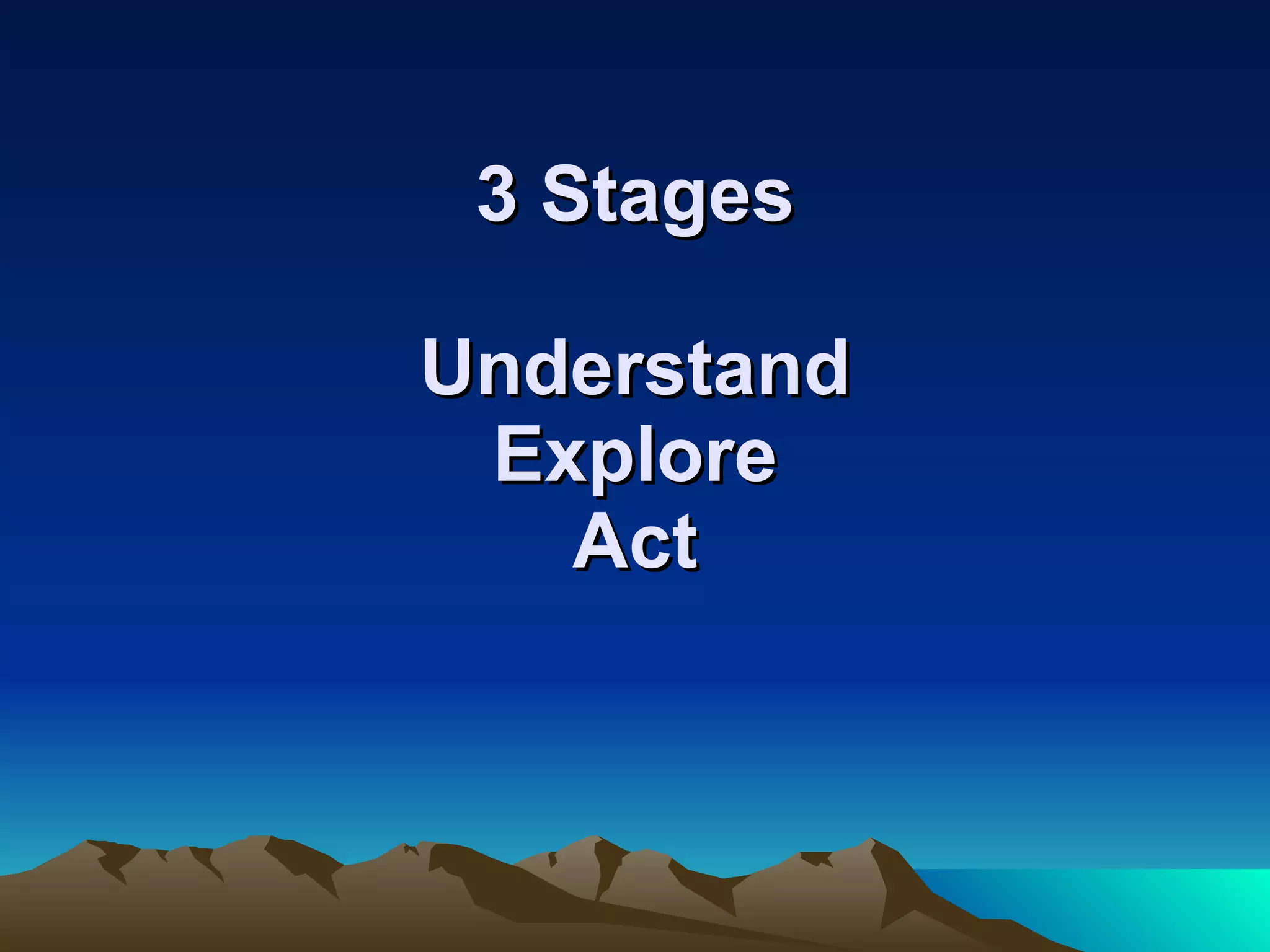
  3. Assisting the client to explore, understand and act (EUA)
  It is a dynamic relationship between two or more persons- A QUANTUM MODEL
  consilium ….grasp with sellan ….to sell or deliver counselling is delivered and counselee grasps together with counsellor
GOALS AND AIMS OF COUNSELLING To understand the counselee’s current situation. To understand how he has tried to handle the problem. To understand his view of the problem……….
To understand his emotional reactions. To evaluate the total problem. To help him clarify his life situation
Prof. Edwin Herr…. Hypothesis testing
Triple filter of Integrity Honest Accountable Just & Equitable
Herrmann Brain-dominance instrument Left brain- logical thinkers left brain –limbic- sequential thinkers Right brain- holistic thinkers Right-brain-limbic- emotional thinkers
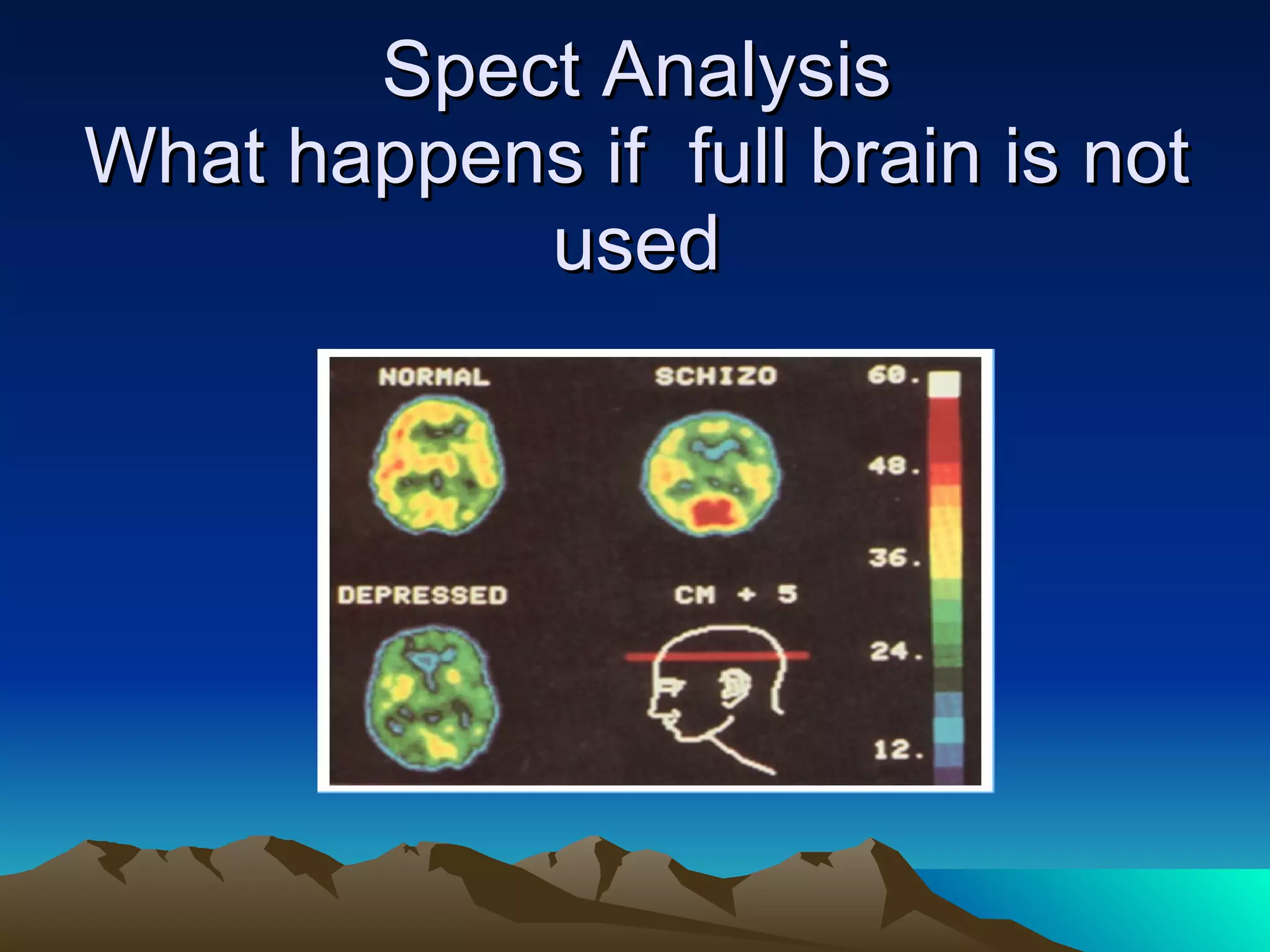
Spect Analysis What happens if  full brain is not used
What is the reality around us ?
Confucius in Analects says Wealth and honour are what every person desires. But if they have been obtained in violation of moral principles, they must not be kept
Socrates in Apology says The moral person does not put money or anything above virtue
EastIndiaChina/Japan1000+ BCE Judaism : Moses 1500-1350 BCE   Hinduism : 2000 BCE  600 BCE Zoroastrianism : Zoroaster 628-527 BCE Jainism : Mahavira 599-527 BCE  Buddhism : Buddha 563-483   BCE    
  Taoism : Lao Tse 580-500 BCE Confucianism : Confucius 551-579 BCE 100 CE   Christianity : Jesus 1-33 CE    Shinto : 100 CE600 CE  Islam : Muhammad 570-636 CE 
Shakespeare on Roses A rose by any other name smells as sweet……..
Mini wars, hostages, hi-jackings, hundred other horrors and terrors  is disquieting. Inside society there is societal entropy.  Crimes are escalating. Violence and vices are spiraling .
Counselling is not….. Advice giving Opinion giving Sympathizing
Counselling is not….. Giving practical help Not simply interviewing Not simply listening
Skills are gradual not sudden , so constant practice is vital a few months……
Psychological approaches to Counselling Client Centred- Carl Rogers Psychodynamic- Freud Gestalt- Frit Perls Humanistic- RET-Ellis Personal Construct- Kelly Behavioural- Watson, Skinner Transactional Analysis- Berne
WHAT ARE THE 3 P’S
Premise Person Process
Premise Human interaction is primary to life   1.  Interdependence 2.  Independence
Person Accept 3 factors 1. Recognize importance of spiritual values 2. Love others as self 3. Accept self as human
Counsellor’s qualities
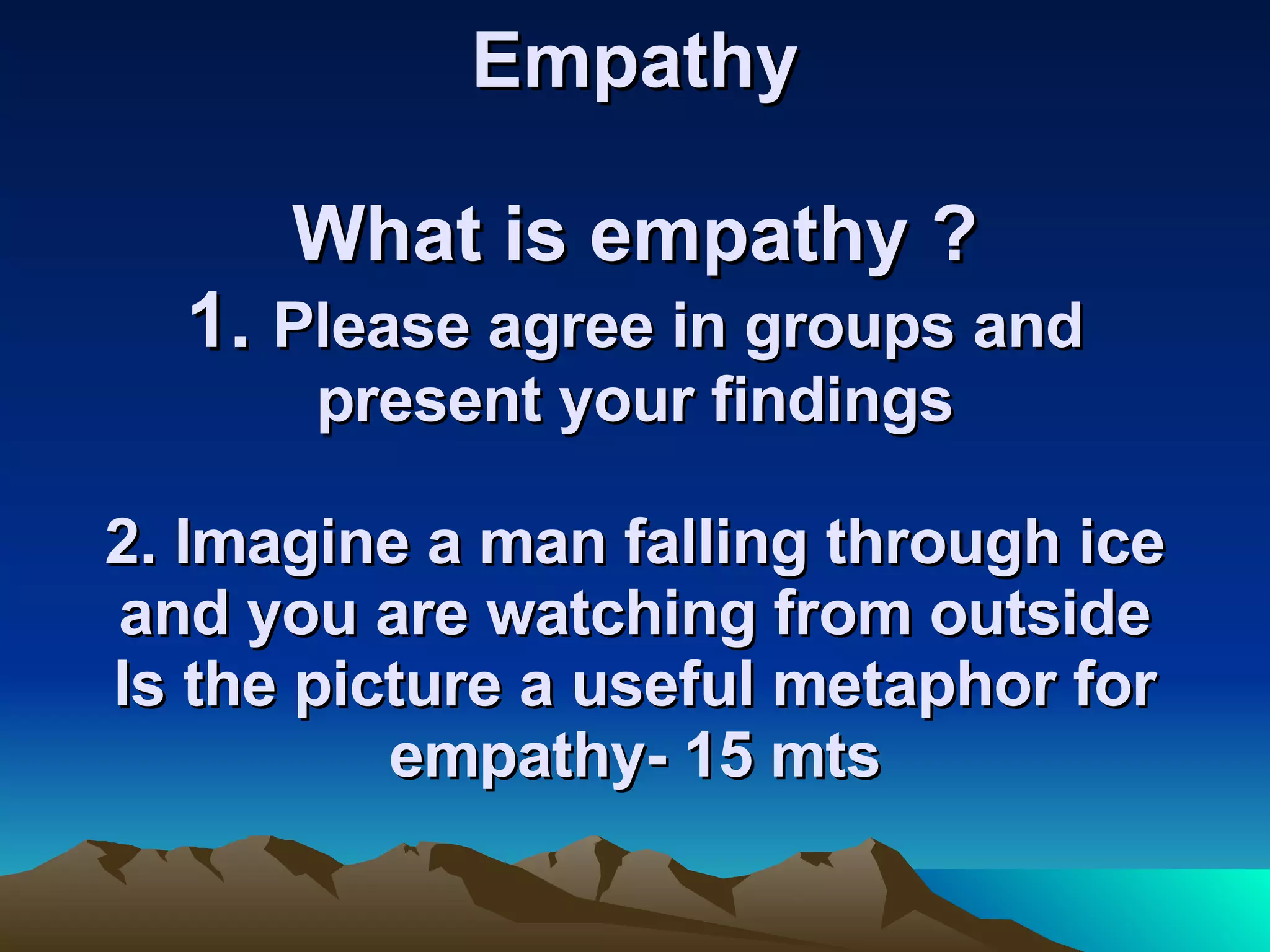
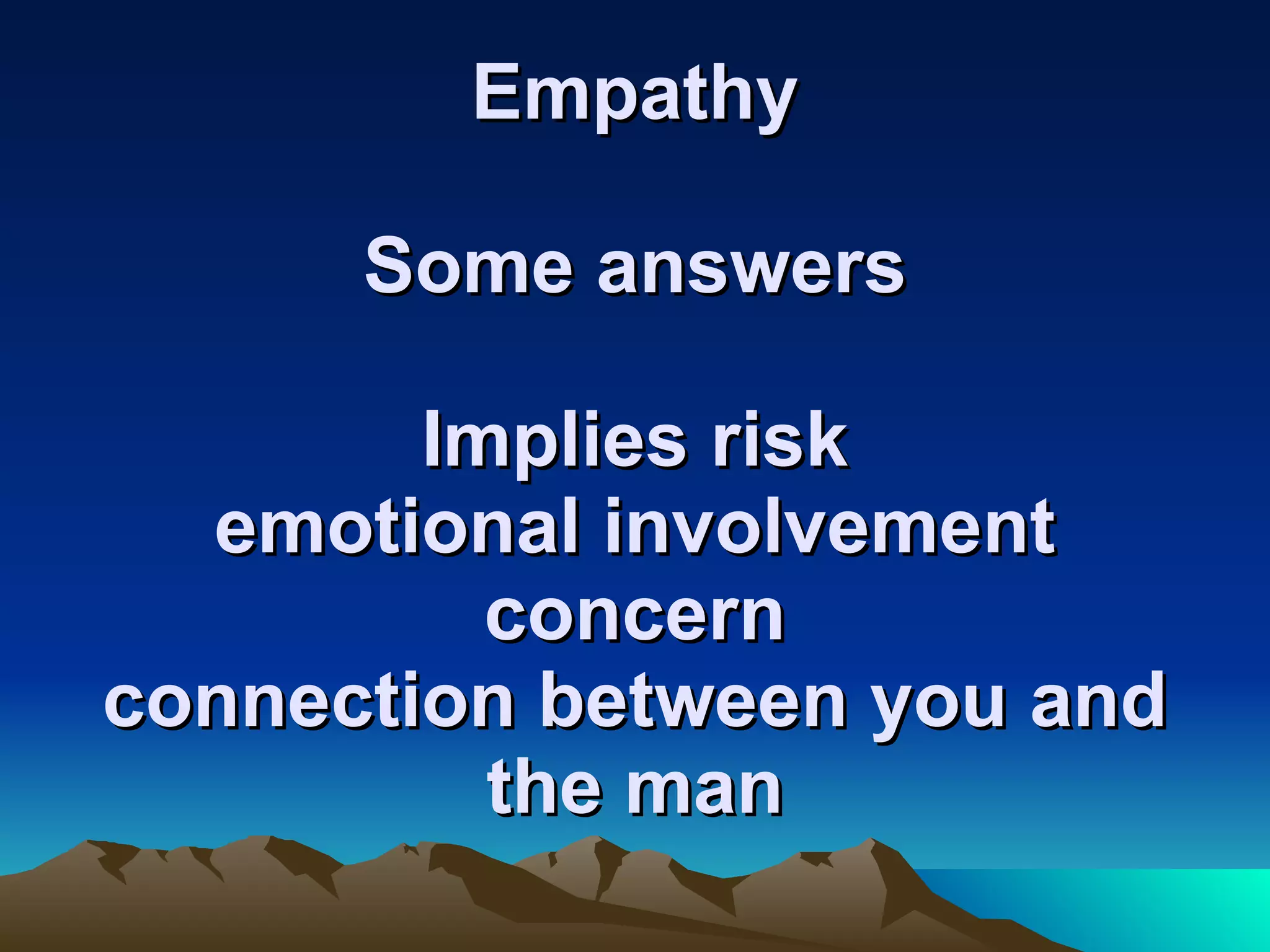
Empathy Some answers Implies risk emotional involvement concern connection between you and the man
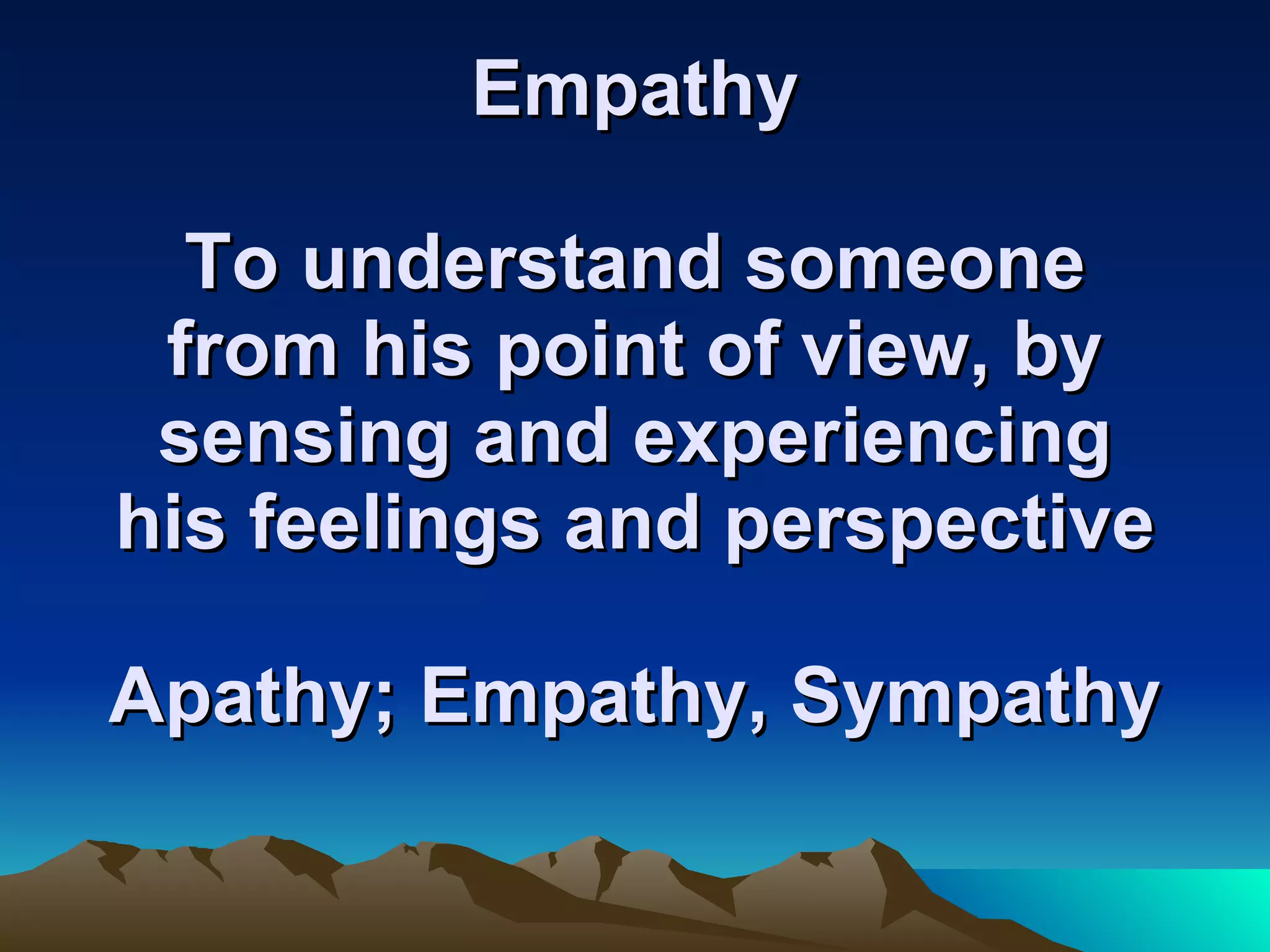
Empathy To understand someone from his point of view, by sensing and experiencing his feelings and perspective Apathy; Empathy, Sympathy
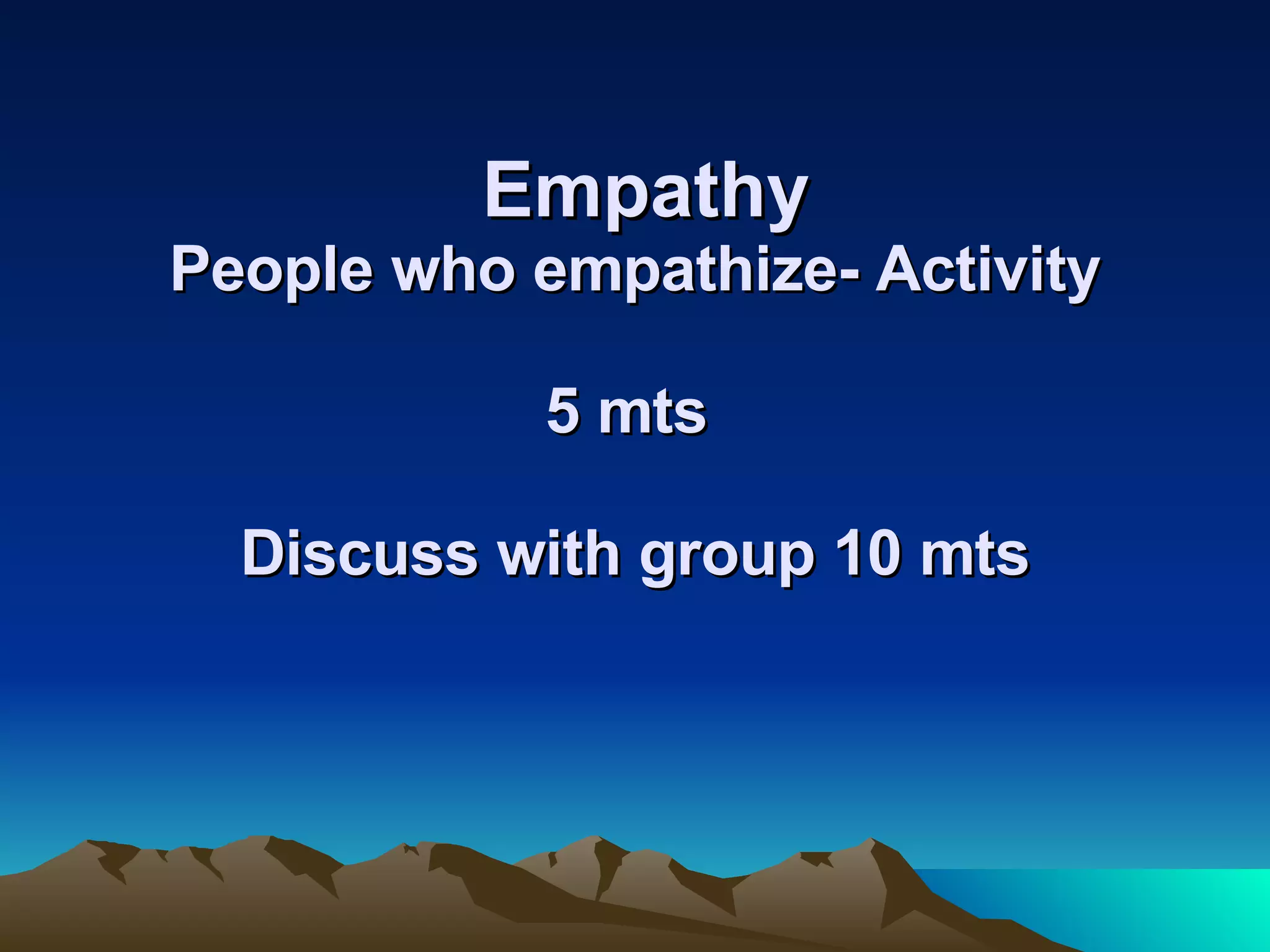
  Empathy Negotiation Conflict Management Managing diversity Developing others  Customer needs networking
Counsellor’s qualities 1. Empathy- Your hurt is my hurt 2. Positive regard 3. Genuineness  4. Concreteness
Counsellor’s qualities 5. Clear thinking 6. Common sense 7. Self awareness  8. Warmth
Counsellor’s Motivation
Counsellor’s Motivation 1. The need for relationships 2. The need to control
Counsellor’s Motivation  3. The need to rescue 4. The need for information
Counsellor’s Motivation  5. Just fashionable…..
Some don’ts in Counselling Don’t Moralize Don’t compare with your experience Don’t offer advice on personal and emotional issues Don’t tell the client they don’t feel a certain way- of course you are not depressed…..
Counsellor’s Role
Counsellor’s Role   1. Being hasty instead of deliberate 2. Being disrespectful  instead of sympathetic
Counsellor’s Role   3. Being judgmental instead of unbiased 4. Being directive instead of interpretive
Counsellor’s Role   5. Emotionally over involved 6.Artificial- not authentic
The Counselee The Counselee’s rights must be respected Right to speak and be heard Right to his/her opinion Right to defend him/herself Right to personal philosophy
The process
Moving Interviews forward
3 Stages Understand Explore Act
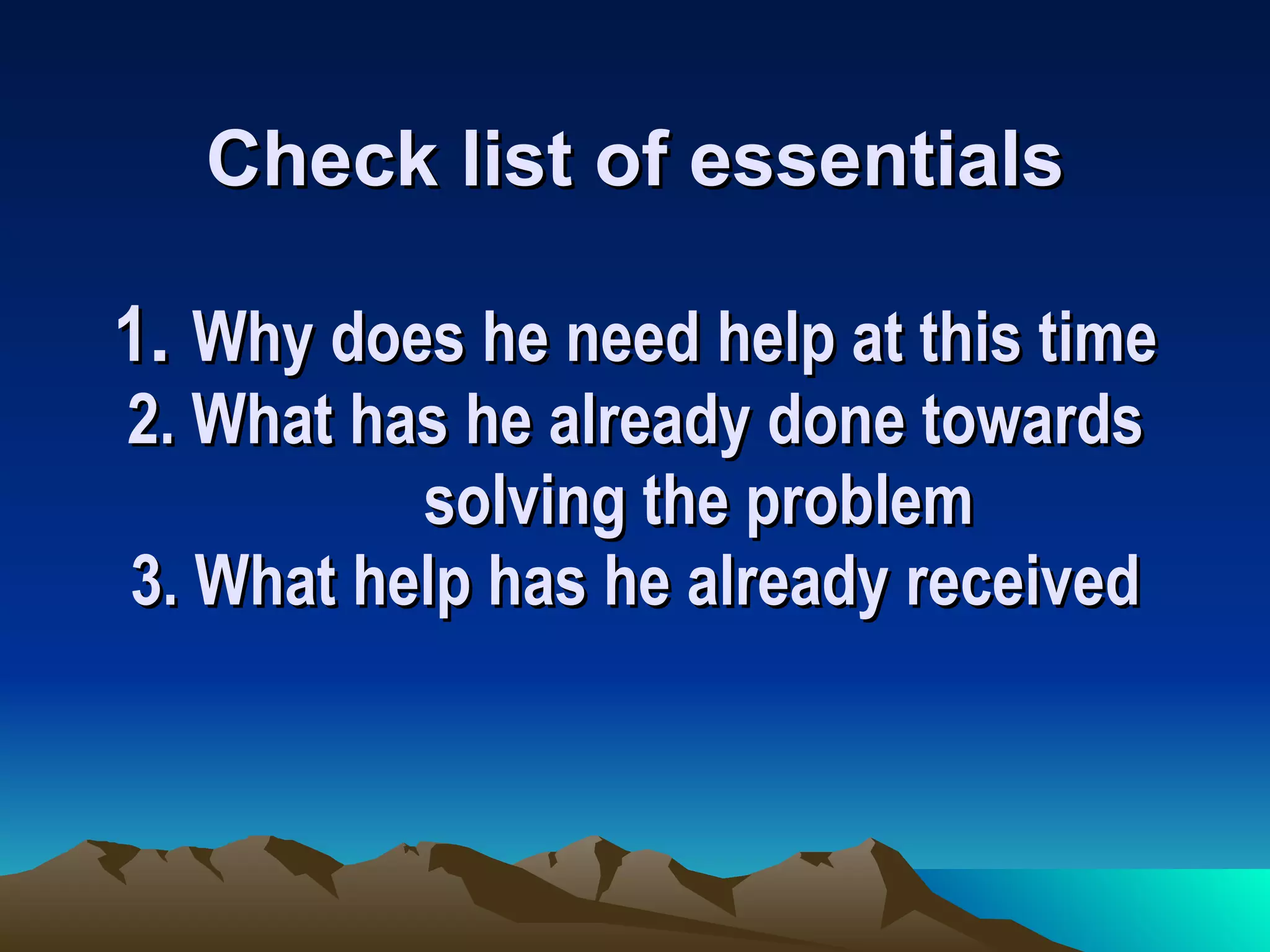
Check list of essentials 1 .  Why does he need help at this time 2. What has he already done towards solving the problem 3. What help has he already received
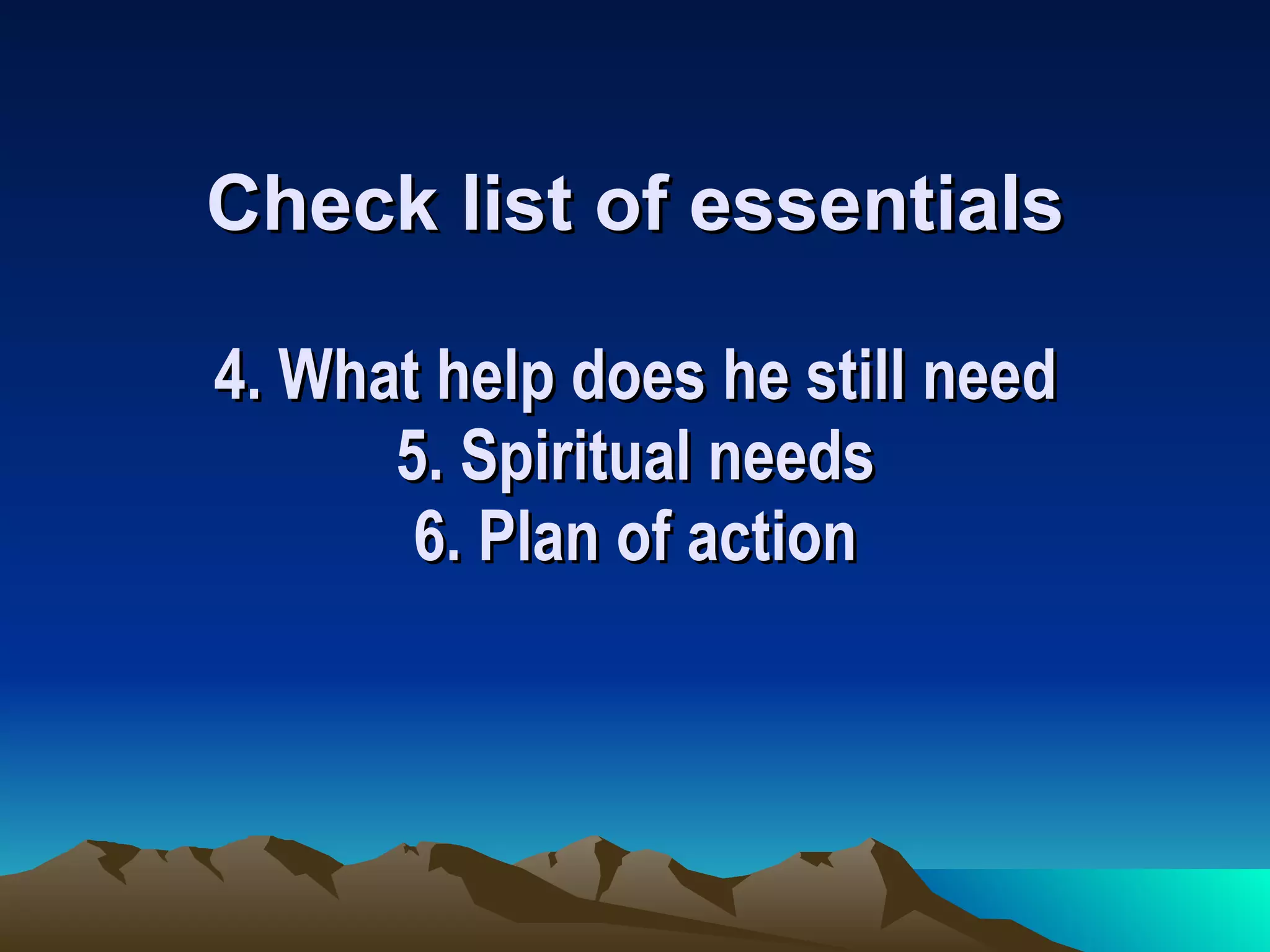
Check list of essentials 4. What help does he still need 5. Spiritual needs 6. Plan of action
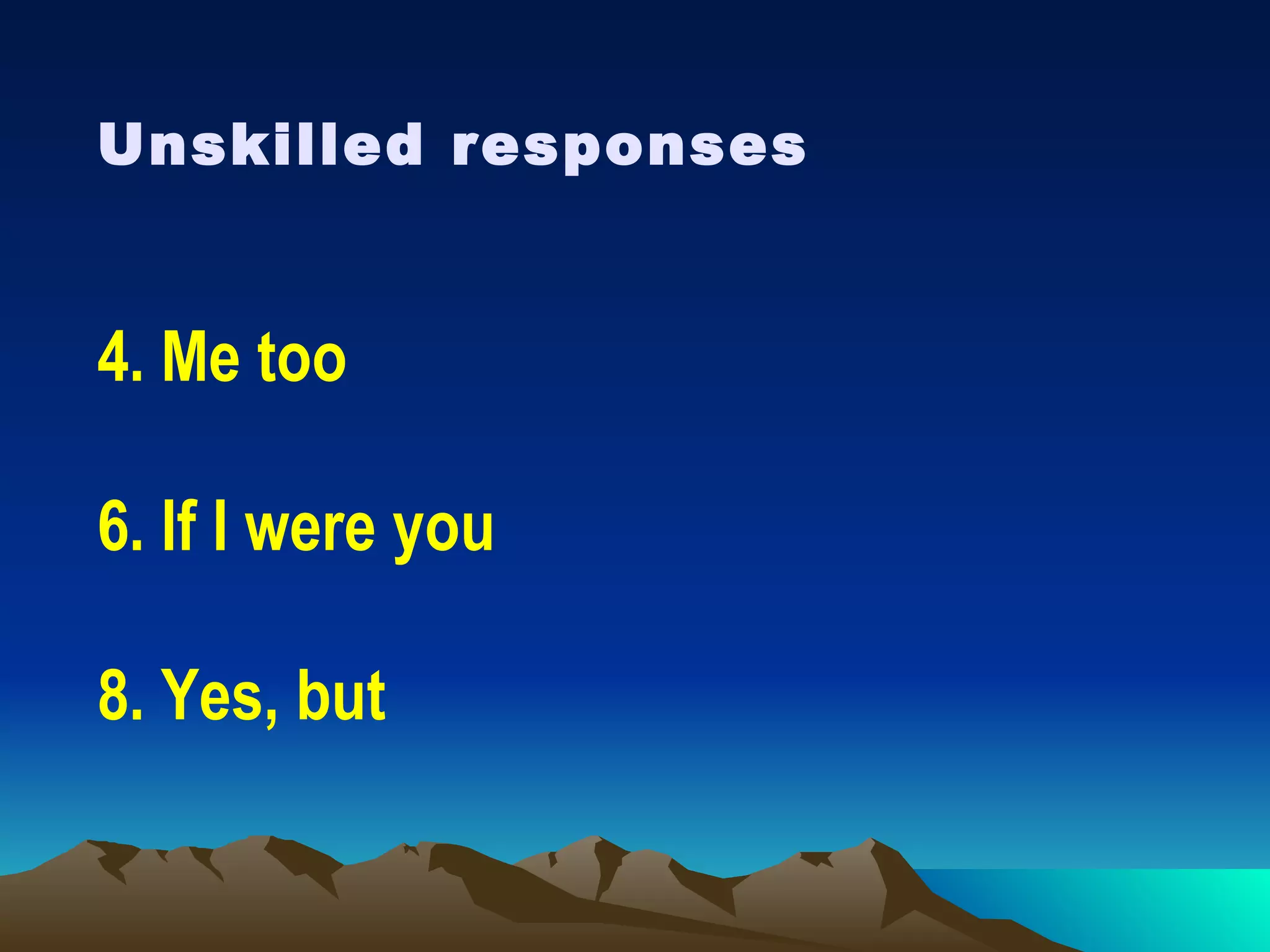
Unskilled responses Me too If I were you Yes, but
Active listening is a learned skill and not a natural attribute
Listening Assessment
Effective Listening behaviour SOLER 1. Sitting squarely 2. Open position 3. Leaning forward 4. Eye contact 5. Relaxing
Check List of listening skills Be accepting Be concerned Be patient Be specific Be honest Be faithful
1. Be Accepting Take a non-judgmental stance Accept him for what he is Accept him for where he is
2. Be Concerned Caring and willing to get involved Attentive to what the client says Your motivation is love
3. Be patient The client sets the schedule Giving time suggests interest Do not force the pace
4. Be specific Ask specific questions Give concrete statements Confront inconsistencies
5. Be honest Respond in a way that reflects your feelings Your responses are to be congruent with your feelings Your responses should be gracious
6. Be faithful Absolute confidentiality Refrain from passing along info given by client Always keep an appointment with client
The Complete Message Please fill out the % ?? % Non Verbal ?? % ?? % Tone Content
The Complete Message Nonverbal – 55 % Tone of voice- 38 % Actual words- 7 % !!

Essentials Of Counselling

  • 1.
    Prof.Lakshman Madurasinghe, PhD Consultant Psychologist, Attorney ESSENTIALS OF COUNSELLING
  • 2.
    What is Counselling? Why do we need it ?
  • 3.
    Counsellingmay be defined as 1.providing help and support to a client
  • 4.
    2.creating a climate of acceptance
  • 5.
    3.Assisting the client to explore, understand and act (EUA)
  • 6.
    Itis a dynamic relationship between two or more persons- A QUANTUM MODEL
  • 7.
    consilium….grasp with sellan ….to sell or deliver counselling is delivered and counselee grasps together with counsellor
  • 8.
    GOALS AND AIMSOF COUNSELLING To understand the counselee’s current situation. To understand how he has tried to handle the problem. To understand his view of the problem……….
  • 9.
    To understand hisemotional reactions. To evaluate the total problem. To help him clarify his life situation
  • 10.
    Prof. Edwin Herr….Hypothesis testing
  • 11.
    Triple filter ofIntegrity Honest Accountable Just & Equitable
  • 12.
    Herrmann Brain-dominance instrumentLeft brain- logical thinkers left brain –limbic- sequential thinkers Right brain- holistic thinkers Right-brain-limbic- emotional thinkers
  • 13.
    Spect Analysis Whathappens if full brain is not used
  • 14.
    What is thereality around us ?
  • 15.
    Confucius in Analectssays Wealth and honour are what every person desires. But if they have been obtained in violation of moral principles, they must not be kept
  • 16.
    Socrates in Apologysays The moral person does not put money or anything above virtue
  • 17.
    EastIndiaChina/Japan1000+ BCE Judaism: Moses 1500-1350 BCE Hinduism : 2000 BCE  600 BCE Zoroastrianism : Zoroaster 628-527 BCE Jainism : Mahavira 599-527 BCE Buddhism : Buddha 563-483 BCE  
  • 18.
    Taoism: Lao Tse 580-500 BCE Confucianism : Confucius 551-579 BCE 100 CE Christianity : Jesus 1-33 CE   Shinto : 100 CE600 CE Islam : Muhammad 570-636 CE 
  • 19.
    Shakespeare on RosesA rose by any other name smells as sweet……..
  • 20.
    Mini wars, hostages,hi-jackings, hundred other horrors and terrors is disquieting. Inside society there is societal entropy. Crimes are escalating. Violence and vices are spiraling .
  • 21.
    Counselling is not…..Advice giving Opinion giving Sympathizing
  • 22.
    Counselling is not…..Giving practical help Not simply interviewing Not simply listening
  • 23.
    Skills are gradualnot sudden , so constant practice is vital a few months……
  • 24.
    Psychological approaches toCounselling Client Centred- Carl Rogers Psychodynamic- Freud Gestalt- Frit Perls Humanistic- RET-Ellis Personal Construct- Kelly Behavioural- Watson, Skinner Transactional Analysis- Berne
  • 25.
    WHAT ARE THE3 P’S
  • 26.
  • 27.
    Premise Human interactionis primary to life 1. Interdependence 2. Independence
  • 28.
    Person Accept 3factors 1. Recognize importance of spiritual values 2. Love others as self 3. Accept self as human
  • 29.
  • 30.
    Empathy Some answersImplies risk emotional involvement concern connection between you and the man
  • 31.
    Empathy To understandsomeone from his point of view, by sensing and experiencing his feelings and perspective Apathy; Empathy, Sympathy
  • 32.
    EmpathyNegotiation Conflict Management Managing diversity Developing others Customer needs networking
  • 33.
    Counsellor’s qualities 1.Empathy- Your hurt is my hurt 2. Positive regard 3. Genuineness 4. Concreteness
  • 34.
    Counsellor’s qualities 5.Clear thinking 6. Common sense 7. Self awareness 8. Warmth
  • 35.
  • 36.
    Counsellor’s Motivation 1.The need for relationships 2. The need to control
  • 37.
    Counsellor’s Motivation 3. The need to rescue 4. The need for information
  • 38.
    Counsellor’s Motivation 5. Just fashionable…..
  • 39.
    Some don’ts inCounselling Don’t Moralize Don’t compare with your experience Don’t offer advice on personal and emotional issues Don’t tell the client they don’t feel a certain way- of course you are not depressed…..
  • 40.
  • 41.
    Counsellor’s Role 1. Being hasty instead of deliberate 2. Being disrespectful instead of sympathetic
  • 42.
    Counsellor’s Role 3. Being judgmental instead of unbiased 4. Being directive instead of interpretive
  • 43.
    Counsellor’s Role 5. Emotionally over involved 6.Artificial- not authentic
  • 44.
    The Counselee TheCounselee’s rights must be respected Right to speak and be heard Right to his/her opinion Right to defend him/herself Right to personal philosophy
  • 45.
  • 46.
  • 47.
  • 48.
    Check list ofessentials 1 . Why does he need help at this time 2. What has he already done towards solving the problem 3. What help has he already received
  • 49.
    Check list ofessentials 4. What help does he still need 5. Spiritual needs 6. Plan of action
  • 50.
    Unskilled responses Metoo If I were you Yes, but
  • 51.
    Active listening isa learned skill and not a natural attribute
  • 52.
  • 53.
    Effective Listening behaviourSOLER 1. Sitting squarely 2. Open position 3. Leaning forward 4. Eye contact 5. Relaxing
  • 54.
    Check List oflistening skills Be accepting Be concerned Be patient Be specific Be honest Be faithful
  • 55.
    1. Be AcceptingTake a non-judgmental stance Accept him for what he is Accept him for where he is
  • 56.
    2. Be ConcernedCaring and willing to get involved Attentive to what the client says Your motivation is love
  • 57.
    3. Be patientThe client sets the schedule Giving time suggests interest Do not force the pace
  • 58.
    4. Be specificAsk specific questions Give concrete statements Confront inconsistencies
  • 59.
    5. Be honestRespond in a way that reflects your feelings Your responses are to be congruent with your feelings Your responses should be gracious
  • 60.
    6. Be faithfulAbsolute confidentiality Refrain from passing along info given by client Always keep an appointment with client
  • 61.
    The Complete MessagePlease fill out the % ?? % Non Verbal ?? % ?? % Tone Content
  • 62.
    The Complete MessageNonverbal – 55 % Tone of voice- 38 % Actual words- 7 % !!