WORK PLACE COUNSELLING
Dr. SONIA.S
INTRODUCTION
Counselling is a process by means of which the
helper expresses care and concern towards the
person with a problem, and facilitates that person's
personal growth and brings about change through
self-knowledge.
Counselling deals with wellness, personal growth,
career, and pathological concerns. In other words,
counsellors work in areas that involve
relationships.
DEFINITION
• The British Association for Counselling (BAC) may have been the first professional association to
adopt a definition of professional counselling. In 1986 it published the following definition:
“Counselling is the skilled and principled use of relationship to facilitate self- knowledge, emotional
acceptance and growth and the optimal development of personal resources. The overall aim is to
provide an opportunity to work towards living more satisfyingly and resourcefully. Counselling
relationships will vary according to need but may be concerned with developmental issues,
addressing and resolving specific problems, making decisions, coping with crisis, developing
personal insights and knowledge, working through feelings of inner conflict or improving
relationships with others. The counsellor’s role is to facilitate the clients work in ways that respect
the client’s values, personal resources and capacity for self-determination.”
DEFINITION
THE COUNSELLING PROCESS
• Stage One: Relationship Building
• The successful outcomes in counselling is associated with the counsellor- client relationship
which is the outcome of all therapeutic efforts.
• The vital first interview can set the scene for what is to come, with the client reading the
counselor’s verbal and nonverbal signals to draw inferences about the counselor and the process.
The counselor focuses on using good listening skills and building a positive relationship.
• When successful, it ensures a strong foundation for future dialogue and the continuing counseling
process.
THE COUNSELLING PROCESS
• Stage two: (In-depth exploration) Problem assessment
• The counselor carefully listens and draws out information
regarding the client’s situation (life, work, home, education, etc.)
and the reason they have engaged in counseling.
• Information crucial to subsequent stages of counseling includes
identifying triggers, timing, environmental factors, stress levels,
and other contributing factors.
THE COUNSELLING PROCESS
Stage three: (Commitment to action) Goal
setting
Effective counselling relies on setting appropriate
and realistic goals, building on the previous stages.
The goals must be identified and developed
collaboratively, with the client committing to a set
of steps leading to a particular outcome.
THE COUNSELLING PROCESS
Stage four: Counseling intervention
This stage varies depending on the counselor and
the theories they are familiar with, as well as the
situation the client faces.
For example, a behavioral approach may suggest
engaging in activities designed to help the client
alter their behavior. In comparison, a
person-centered approach seeks to engage the
client’s self-actualizing tendency.
THE COUNSELLING PROCESS
Stage five: Termination
Termination can be done when clients have
worked through their concerns and are able to
proceed forward in their lives without the
counsellor's assistance. At this point, counselling
can be terminated. It is usually best for the
counsellor and client to agree on a termination
date, reducing the chance of premature
termination or feelings of ambivalence.
Counselling skills
Active Listening Active listening by the clinician encourages the client to share information by
providing verbal and nonverbal expressions of interest
• Focusing on all aspects of a client's expression.
• Resist distractions.
• Listen to the client's tone of voice.
• Listen for cues to the client's feelings.
• Listen for generalizations, deletions, and distortions.
• Listen for common cognitive and emotional themes.
Counselling skills
• Verbal listening: It is the audible demonstration that you are
listening to the concerns or problems of your client. Using
verbal cues or affirmations like, "I understand**", "Go on", "**I
see", "I agree" or repeating important points that your client
said is a great way to make the client comfortable and show
that you are listening to them.
Counselling skills
• Non Verbal Listening
• Maintains eye contact
• Makes few distracting movements
• Leans forward, faces speaker
• Has an open posture
• Allows few interruptions
• Signals interest with encouragers and facial expressions
Counselling skills
• Active Listening Skills Active listening includes the following
skills:
• Attending
• Paraphrasing
• Reflection of feelings
• Summarizing
Counselling skills
• Attending
• Attending is expressing awareness and interest in what the client is
communicating both verbally and nonverbally.
Proper attending involves
• Appropriate eye contact, facial expressions
• Maintaining a relaxed posture and leaning forward occasionally, using
natural hand and arm movements
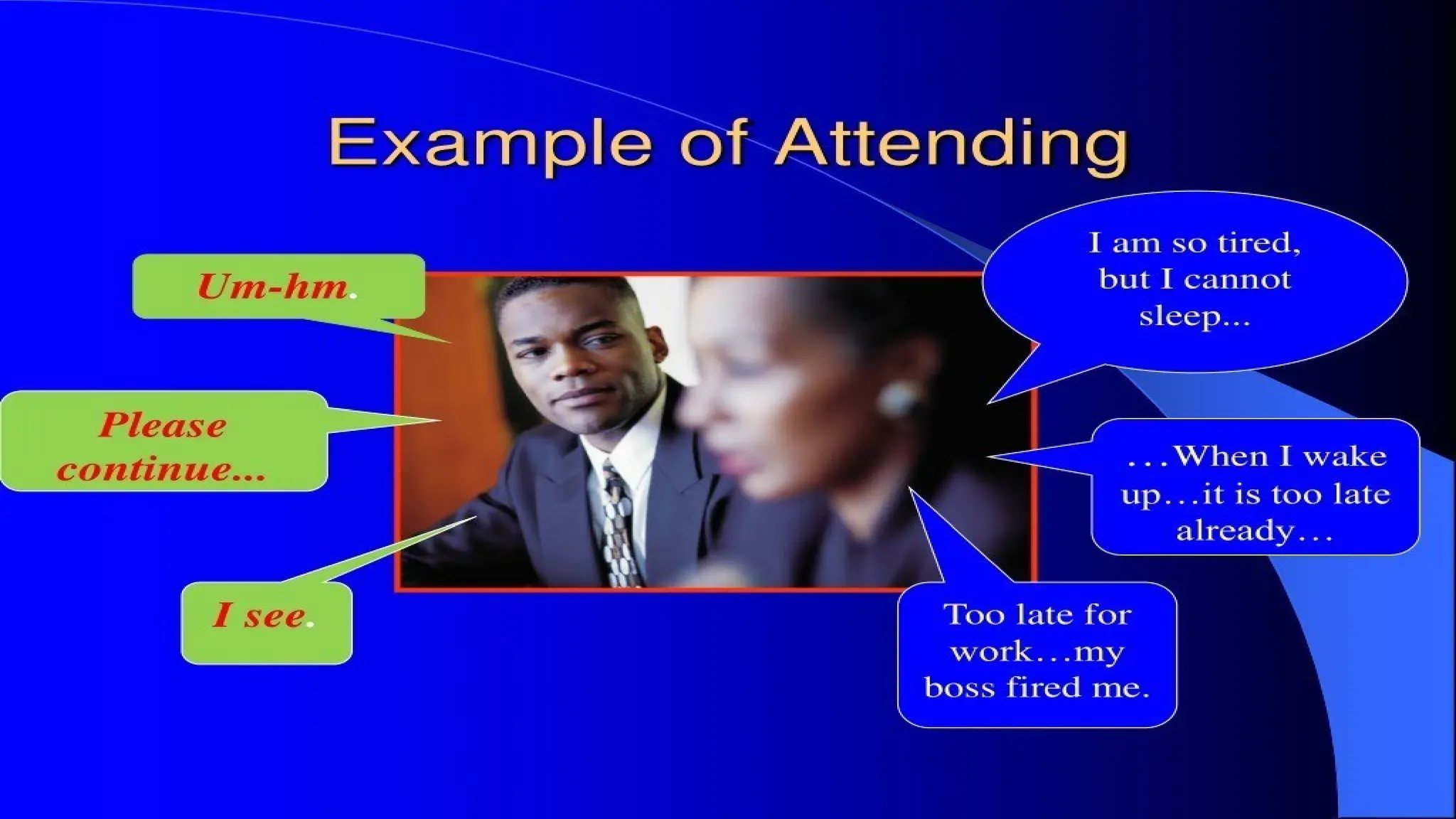
• Verbally “following” the client, using a variety of brief encouragements
such as “Um-hm” or “Yes,” or by repeating key words
• Observing the client’s body language
Counselling skills
• Reflecting in counselling is part of the ‘art of listening’. It is making
sure that the client knows their story is being listened to.
• This is achieved by the helper/counsellor by both repeating and
feeding a shorter version of their story back to the client. This
known as 'paraphrasing'.
Counselling skills
• Summarising
• • Summarising is an important way for the clinician to gather
together what has already been said, make sure that the client
has been understood correctly, and prepare the client to move
on. • Summarising is putting together a group of reflections.
The summary 'sums up' the main themes that are emerging.
Counselling skills
Processing Processing is the act of the clinician thinking about his
or her observations about the client and what the client has
communicated.
Responding Responding is the act of communicating information
to the client that includes providing feedback and emotional
support, addressing issues of concern, and teaching skills.
Counselling skills
Expressing empathy Empathy is the action of understanding,
being aware of, being sensitive to, and vicariously
experiencing the feelings, thoughts, and experiences of
another.
Important schools of counselling
• Psychoanalysis is defined as a set of psychological theories and therapeutic
methods which have their origin in the work and theories of Sigmund Freud.
• The primary assumption of psychoanalysis is the belief that all people
possess unconscious thoughts, feelings, desires, and memories.
• The aim of psychoanalysis therapy is to release repressed emotions and
experiences, i.e., make the unconscious conscious. It is only having a
cathartic (i.e., healing) experience can the person be helped and "cured."
Important schools of counselling
Unconscious-large below the surface area which contains thoughts,
wishes, feelings and memories, of which we are unaware.
Free association-the patient is asked to relax and say whatever comes
to mind, no matter how embarrassing or trivial.
Important schools of counselling
• The psychoanalyst uses various techniques
Rorschach inkblots
• The Rorschach inkblot itself doesn't mean anything, it's
ambiguous (i.e., unclear). It is what you read into it that is
important. Different people will see different things depending
on what unconscious connections they make.
Important schools of counselling
• Freudian Slip
• Unconscious thoughts and feelings can transfer to the conscious mind
in the form of parapraxes, popularly known as Freudian slips or slips of
the tongue. We reveal what is really on our mind by saying something
we didn't mean to.
• example is where a person may call a friend's new partner by the name
of a previous one, whom we liked better.
Important schools of counselling
• Free Association
• Free association is a practice in psychoanalytic therapy, in which
a patient talks of whatever comes into their mind. This technique
involves a therapist giving a word or idea, and the patient
immediately responds with the first word that comes to mind.
• It is hoped that fragments of repressed memories will emerge in
the course of free association, giving an insight into the
unconscious mind.
Important schools of counselling
• Dream Analysis
• According to Freud the analysis of dreams is "the royal road to
the unconscious." He argued that the conscious mind is like a
censor, but it is less vigilant when we are asleep.
• As a result, repressed ideas come to the surface - though what we
remember may well have been altered during the dream process.
Important schools of counselling
• Gestalt therapy is a form of psychotherapy that is centered on
increasing a person's awareness, freedom, and self-direction. It's a form
of therapy that focuses on the present moment rather than past
experiences.
• Gestalt therapy is based on the idea that people are influenced by their
present environment.
Disorders Can Be Treated Using Gestalt Therapy
• Gestalt therapy has become a proven and effective therapeutic approach in addressing
and treating different mental health conditions. Some of these conditions include:
• Anxiety. Gestalt therapy helps people focus on the present. This allows individuals to
discover what immediate thoughts, feelings, or behavior may make them feel anxious
.
Disorders Can Be Treated Using Gestalt Therapy
• Behavioural health issues. Gestalt therapy can help people with behavioral
conditions like bipolar disorder.
• Depression. Since gestalt therapy focuses on self-awareness, it can help people
with depression become aware of possible stressful situations that trigger their
depression.
Disorders Can Be Treated Using Gestalt Therapy
• Relationship difficulties. Gestalt therapy can help couples recognize
underlying destructive behaviors that may be negatively impacting their
relationships. This can help them work toward making positive changes in
their relationship and individual lifestyles.
Self-esteem issues. Gestalt therapy helps people with low self-esteem identify
and overcome underlying factors that contribute to their low self-esteem.
Gestalt therapy techniques
• Paradoxical change. The theory of paradoxical change focuses on the need
for self-acceptance. It helps individuals develop an improved sense of self-
awareness. When an individual makes peace with who they are as a person, it helps
them live in the present. This results in more positive feelings and mood.
• "Here" and "now". This technique enables individuals to appreciate past
experiences and how they influence their present thoughts and behavior. By being
conscious of internal factors that influence their present lives, individuals can learn
to let go of the past. This helps them focus on the here and now.
Gestalt therapy techniques
• Empty chair technique. This technique helps individuals to open up and practice
talking with an empty chair. The goal of this technique is to visualize yourself
opening up to a particular person you needed to talk with. When you open up as if
the person was sitting there listening, the therapeutic experience of opening up
sets the stage for healing.
• Exaggeration technique. This technique works by making an individual become
aware of underlying issues that could be linked to their present problem. The
therapist may request you to exaggerate a specific behavior or emotion. This helps
in identifying and addressing the root of the problem.
Rational emotive behavior therapy
• Rational emotive behavior therapy (REBT) is a type of cognitive
behavioral therapy (CBT) that aims to help a person challenge
unhelpful thoughts to avoid negative emotions or behaviors.
• REBT focuses attention on the present and helps a person develop a
new way of thinking about events to prevent maladaptive behaviors and
negative emotions.
Rational emotive behavior therapy
• REBT can help a person realize that they have more control
over their reactions than they previously believed, which can
lead to an improved quality of life.
Rational emotive behavior therapy
• Principles of REBT
• REBT operates by altering what therapists often refer to as the ABCs of CBT. The goal is to
adjust the negative beliefs associated with an event or action to change the consequences of
the actions.
• The ABC principles stand for:
• A refers to an activating situation or event that triggers a negative response or reaction.
• B refers to the belief or thought about the event that is negative or irrational.
• C refers to the consequences of the belief or thought, which often include negative emotions
or behaviors.
Client-centered therapy
• Client-centered therapy, also known as person-centered therapy or
Rogerian therapy, is a non-directive form of talk therapy developed
by humanist psychologist Carl Rogers during the 1940s and 1950s. In
this approach, you act as an equal partner in the therapy process, while
your therapist remains non-directive—they don't pass judgments on
your feelings or offer suggestions or solutions.
Client-centered therapy
• Rogers also suggested that people have a self-actualizing
tendency, or a desire to fulfill their potential and become the
best that they can be. His form of therapy was intended to
allow clients to fulfill that potential by relying on their own
strength to change
Behavioural Therapy
• This form of therapy looks to identify and help change
potentially self-destructive or unhealthy behaviors. It’s based
on the idea that all behaviors are learned and that behaviors
can be changed. The focus of treatment is often on current
problems and how to change them.
Who can benefit from behavioral therapy
• Behavioral therapy can benefit people with a wide range of disorders.
• People most commonly look for behavioral therapy to treat:
• depression
• anxiety
• panic disorders
• disorders involving excessive anger

WORK PLACE COUNSELLING INTRODUCTION. PPT

  • 1.
  • 2.
    INTRODUCTION Counselling is aprocess by means of which the helper expresses care and concern towards the person with a problem, and facilitates that person's personal growth and brings about change through self-knowledge. Counselling deals with wellness, personal growth, career, and pathological concerns. In other words, counsellors work in areas that involve relationships.
  • 3.
    DEFINITION • The BritishAssociation for Counselling (BAC) may have been the first professional association to adopt a definition of professional counselling. In 1986 it published the following definition: “Counselling is the skilled and principled use of relationship to facilitate self- knowledge, emotional acceptance and growth and the optimal development of personal resources. The overall aim is to provide an opportunity to work towards living more satisfyingly and resourcefully. Counselling relationships will vary according to need but may be concerned with developmental issues, addressing and resolving specific problems, making decisions, coping with crisis, developing personal insights and knowledge, working through feelings of inner conflict or improving relationships with others. The counsellor’s role is to facilitate the clients work in ways that respect the client’s values, personal resources and capacity for self-determination.”
  • 4.
  • 6.
    THE COUNSELLING PROCESS •Stage One: Relationship Building • The successful outcomes in counselling is associated with the counsellor- client relationship which is the outcome of all therapeutic efforts. • The vital first interview can set the scene for what is to come, with the client reading the counselor’s verbal and nonverbal signals to draw inferences about the counselor and the process. The counselor focuses on using good listening skills and building a positive relationship. • When successful, it ensures a strong foundation for future dialogue and the continuing counseling process.
  • 8.
    THE COUNSELLING PROCESS •Stage two: (In-depth exploration) Problem assessment • The counselor carefully listens and draws out information regarding the client’s situation (life, work, home, education, etc.) and the reason they have engaged in counseling. • Information crucial to subsequent stages of counseling includes identifying triggers, timing, environmental factors, stress levels, and other contributing factors.
  • 9.
    THE COUNSELLING PROCESS Stagethree: (Commitment to action) Goal setting Effective counselling relies on setting appropriate and realistic goals, building on the previous stages. The goals must be identified and developed collaboratively, with the client committing to a set of steps leading to a particular outcome.
  • 10.
    THE COUNSELLING PROCESS Stagefour: Counseling intervention This stage varies depending on the counselor and the theories they are familiar with, as well as the situation the client faces. For example, a behavioral approach may suggest engaging in activities designed to help the client alter their behavior. In comparison, a person-centered approach seeks to engage the client’s self-actualizing tendency.
  • 11.
    THE COUNSELLING PROCESS Stagefive: Termination Termination can be done when clients have worked through their concerns and are able to proceed forward in their lives without the counsellor's assistance. At this point, counselling can be terminated. It is usually best for the counsellor and client to agree on a termination date, reducing the chance of premature termination or feelings of ambivalence.
  • 12.
    Counselling skills Active ListeningActive listening by the clinician encourages the client to share information by providing verbal and nonverbal expressions of interest • Focusing on all aspects of a client's expression. • Resist distractions. • Listen to the client's tone of voice. • Listen for cues to the client's feelings. • Listen for generalizations, deletions, and distortions. • Listen for common cognitive and emotional themes.
  • 13.
    Counselling skills • Verballistening: It is the audible demonstration that you are listening to the concerns or problems of your client. Using verbal cues or affirmations like, "I understand**", "Go on", "**I see", "I agree" or repeating important points that your client said is a great way to make the client comfortable and show that you are listening to them.
  • 14.
    Counselling skills • NonVerbal Listening • Maintains eye contact • Makes few distracting movements • Leans forward, faces speaker • Has an open posture • Allows few interruptions • Signals interest with encouragers and facial expressions
  • 15.
    Counselling skills • ActiveListening Skills Active listening includes the following skills: • Attending • Paraphrasing • Reflection of feelings • Summarizing
  • 16.
    Counselling skills • Attending •Attending is expressing awareness and interest in what the client is communicating both verbally and nonverbally. Proper attending involves • Appropriate eye contact, facial expressions • Maintaining a relaxed posture and leaning forward occasionally, using natural hand and arm movements • Verbally “following” the client, using a variety of brief encouragements such as “Um-hm” or “Yes,” or by repeating key words • Observing the client’s body language
  • 18.
    Counselling skills • Reflectingin counselling is part of the ‘art of listening’. It is making sure that the client knows their story is being listened to. • This is achieved by the helper/counsellor by both repeating and feeding a shorter version of their story back to the client. This known as 'paraphrasing'.
  • 20.
    Counselling skills • Summarising •• Summarising is an important way for the clinician to gather together what has already been said, make sure that the client has been understood correctly, and prepare the client to move on. • Summarising is putting together a group of reflections. The summary 'sums up' the main themes that are emerging.
  • 21.
    Counselling skills Processing Processingis the act of the clinician thinking about his or her observations about the client and what the client has communicated. Responding Responding is the act of communicating information to the client that includes providing feedback and emotional support, addressing issues of concern, and teaching skills.
  • 22.
    Counselling skills Expressing empathyEmpathy is the action of understanding, being aware of, being sensitive to, and vicariously experiencing the feelings, thoughts, and experiences of another.
  • 23.
    Important schools ofcounselling • Psychoanalysis is defined as a set of psychological theories and therapeutic methods which have their origin in the work and theories of Sigmund Freud. • The primary assumption of psychoanalysis is the belief that all people possess unconscious thoughts, feelings, desires, and memories. • The aim of psychoanalysis therapy is to release repressed emotions and experiences, i.e., make the unconscious conscious. It is only having a cathartic (i.e., healing) experience can the person be helped and "cured."
  • 24.
    Important schools ofcounselling Unconscious-large below the surface area which contains thoughts, wishes, feelings and memories, of which we are unaware. Free association-the patient is asked to relax and say whatever comes to mind, no matter how embarrassing or trivial.
  • 25.
    Important schools ofcounselling • The psychoanalyst uses various techniques Rorschach inkblots • The Rorschach inkblot itself doesn't mean anything, it's ambiguous (i.e., unclear). It is what you read into it that is important. Different people will see different things depending on what unconscious connections they make.
  • 26.
    Important schools ofcounselling • Freudian Slip • Unconscious thoughts and feelings can transfer to the conscious mind in the form of parapraxes, popularly known as Freudian slips or slips of the tongue. We reveal what is really on our mind by saying something we didn't mean to. • example is where a person may call a friend's new partner by the name of a previous one, whom we liked better.
  • 27.
    Important schools ofcounselling • Free Association • Free association is a practice in psychoanalytic therapy, in which a patient talks of whatever comes into their mind. This technique involves a therapist giving a word or idea, and the patient immediately responds with the first word that comes to mind. • It is hoped that fragments of repressed memories will emerge in the course of free association, giving an insight into the unconscious mind.
  • 28.
    Important schools ofcounselling • Dream Analysis • According to Freud the analysis of dreams is "the royal road to the unconscious." He argued that the conscious mind is like a censor, but it is less vigilant when we are asleep. • As a result, repressed ideas come to the surface - though what we remember may well have been altered during the dream process.
  • 29.
    Important schools ofcounselling • Gestalt therapy is a form of psychotherapy that is centered on increasing a person's awareness, freedom, and self-direction. It's a form of therapy that focuses on the present moment rather than past experiences. • Gestalt therapy is based on the idea that people are influenced by their present environment.
  • 30.
    Disorders Can BeTreated Using Gestalt Therapy • Gestalt therapy has become a proven and effective therapeutic approach in addressing and treating different mental health conditions. Some of these conditions include: • Anxiety. Gestalt therapy helps people focus on the present. This allows individuals to discover what immediate thoughts, feelings, or behavior may make them feel anxious .
  • 31.
    Disorders Can BeTreated Using Gestalt Therapy • Behavioural health issues. Gestalt therapy can help people with behavioral conditions like bipolar disorder. • Depression. Since gestalt therapy focuses on self-awareness, it can help people with depression become aware of possible stressful situations that trigger their depression.
  • 32.
    Disorders Can BeTreated Using Gestalt Therapy • Relationship difficulties. Gestalt therapy can help couples recognize underlying destructive behaviors that may be negatively impacting their relationships. This can help them work toward making positive changes in their relationship and individual lifestyles. Self-esteem issues. Gestalt therapy helps people with low self-esteem identify and overcome underlying factors that contribute to their low self-esteem.
  • 33.
    Gestalt therapy techniques •Paradoxical change. The theory of paradoxical change focuses on the need for self-acceptance. It helps individuals develop an improved sense of self- awareness. When an individual makes peace with who they are as a person, it helps them live in the present. This results in more positive feelings and mood. • "Here" and "now". This technique enables individuals to appreciate past experiences and how they influence their present thoughts and behavior. By being conscious of internal factors that influence their present lives, individuals can learn to let go of the past. This helps them focus on the here and now.
  • 34.
    Gestalt therapy techniques •Empty chair technique. This technique helps individuals to open up and practice talking with an empty chair. The goal of this technique is to visualize yourself opening up to a particular person you needed to talk with. When you open up as if the person was sitting there listening, the therapeutic experience of opening up sets the stage for healing. • Exaggeration technique. This technique works by making an individual become aware of underlying issues that could be linked to their present problem. The therapist may request you to exaggerate a specific behavior or emotion. This helps in identifying and addressing the root of the problem.
  • 35.
    Rational emotive behaviortherapy • Rational emotive behavior therapy (REBT) is a type of cognitive behavioral therapy (CBT) that aims to help a person challenge unhelpful thoughts to avoid negative emotions or behaviors. • REBT focuses attention on the present and helps a person develop a new way of thinking about events to prevent maladaptive behaviors and negative emotions.
  • 36.
    Rational emotive behaviortherapy • REBT can help a person realize that they have more control over their reactions than they previously believed, which can lead to an improved quality of life.
  • 37.
    Rational emotive behaviortherapy • Principles of REBT • REBT operates by altering what therapists often refer to as the ABCs of CBT. The goal is to adjust the negative beliefs associated with an event or action to change the consequences of the actions. • The ABC principles stand for: • A refers to an activating situation or event that triggers a negative response or reaction. • B refers to the belief or thought about the event that is negative or irrational. • C refers to the consequences of the belief or thought, which often include negative emotions or behaviors.
  • 38.
    Client-centered therapy • Client-centeredtherapy, also known as person-centered therapy or Rogerian therapy, is a non-directive form of talk therapy developed by humanist psychologist Carl Rogers during the 1940s and 1950s. In this approach, you act as an equal partner in the therapy process, while your therapist remains non-directive—they don't pass judgments on your feelings or offer suggestions or solutions.
  • 39.
    Client-centered therapy • Rogersalso suggested that people have a self-actualizing tendency, or a desire to fulfill their potential and become the best that they can be. His form of therapy was intended to allow clients to fulfill that potential by relying on their own strength to change
  • 40.
    Behavioural Therapy • Thisform of therapy looks to identify and help change potentially self-destructive or unhealthy behaviors. It’s based on the idea that all behaviors are learned and that behaviors can be changed. The focus of treatment is often on current problems and how to change them.
  • 41.
    Who can benefitfrom behavioral therapy • Behavioral therapy can benefit people with a wide range of disorders. • People most commonly look for behavioral therapy to treat: • depression • anxiety • panic disorders • disorders involving excessive anger