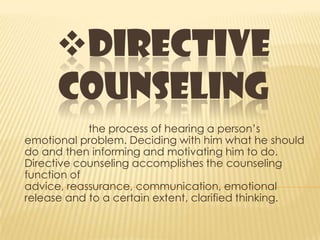
DIRECTIVE
COUNSELING
the process of hearing a person’s
emotional problem. Deciding with him what he should
do and then informing and motivating him to do.
Directive counseling accomplishes the counseling
function of
advice, reassurance, communication, emotional
release and to a certain extent, clarified thinking.
There are several questions to clarify:
1. Is it effective?
2. Does the counselor really understand the
employee’s problem?
3. Does the counselor have the technical
knowledge of human behavior and the
judgment to make the “right” decision?
4. Even if the decision is right, will the
employee follow it?
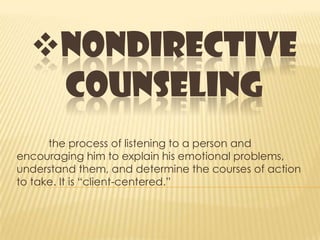
NONDIRECTIVE
COUNSELING
the process of listening to a person and
encouraging him to explain his emotional problems,
understand them, and determine the courses of action
to take. It is “client-centered.”
They do perform the four counseling
functions:
Communication
Emotional
Clarified Thinking
Employee’s Reorientation
Nondirective counseling operates in this manner:
1. Employees come to seek for help and the counselor
attempts to build a permissive relationship which
motivates the employee to open up and talk freely.
2. At this point the counselor attempts to define the
counseling relationship by explaining to the
employee that he cannot tell how to solve his
problem and that he may be able to help the
employee understand his problem and to deal
satisfactorily with it;
3. the employee then explains his feelings and the
counselor encourages their exposition; shows
interest in them, and accepts them without
blaming or praising;
4. the employees at this point should begin to get
some insight into his problem and to develop
alternative solutions to them. As a result, he then
feels a decreasing need for help and recognizes
that the counseling should cease at that point.
To keep the conversation going while he listens,
the counselor may:
1. Look and act interested;
2. Ask appropriate questions; and,
3. Restate or reflect feelings, that is, he merely
restates the employee’s last idea without adding
new ideas or appearing to agree or disagree.
 HOW NONDIRECTIVE COUNSELING
DIFFERS FROM DIRECTIVE COUNSELING
The main differences are the following:
 Counseling Method
 Responsibility
 Status
 Role
 Emphasis
Nondirective counseling has several limitations, among
which are the following:
1. It is more time-consuming and costly than directive
counseling.
2. Professional counselors require technical training
and are consequently expensive and short of supply.
3. It depends on a capable, willing employee who is
assumed to possess a drive for mental health, has
enough social intelligence to perceive his problems
and has sufficient emotional stability to deal with
them.
4. The nondirective counselor needs to be cautious not
to become a crutch for emotional hypochondriacs
to lean on while avoiding their work responsibilities.
5. It is generally a weak solution. It turns employee to
the same environment which caused his problems.
 COOPERATION
COUNSELING
It is defined as a mutual deliberation
over an employee’s emotional problem
and a cooperative effort to set up
conditions that will solve it.
 COMPANY COUNSELING
PROGRAMS
The reasons behind this are:
1. Counseling has been splintered among specialists
in many areas;
2. Supervisors of today are better trained to conduct
their own counseling;
3. The ready availability of counseling through public
agencies;
4. The high cost of counseling service;
5. Counselors, compared with managers, are
comparatively lacking in power to change the
employee’s work environment; and,
6. Employers are held partly responsible for
employee’s mental illness or physical disability
which is precipitated by emotional stress on the
job.
 OTHER TYPES OF
COUNSELORS
The counseling responsibility can be by the following:
1. The direct supervisor - his counseling responsibility is
threefold.
► He detects signs of poor mental health such as
increased errors, nervousness, absence and others.
► He provides counseling whenever appropriate and
refers serious cases to professional counselors.
► Supervisors should understand their own emotional
nature before they can deal with other’s emotional
problems.
2.The second type of counselor is a “friend.”
3.The third type is the specialist whose main
duty is something other than counseling.
4.A fourth type is the full-time staff counselor.

types of counseling

  • 2.
    DIRECTIVE COUNSELING the process ofhearing a person’s emotional problem. Deciding with him what he should do and then informing and motivating him to do. Directive counseling accomplishes the counseling function of advice, reassurance, communication, emotional release and to a certain extent, clarified thinking.
  • 3.
    There are severalquestions to clarify: 1. Is it effective? 2. Does the counselor really understand the employee’s problem? 3. Does the counselor have the technical knowledge of human behavior and the judgment to make the “right” decision? 4. Even if the decision is right, will the employee follow it?
  • 4.
    NONDIRECTIVE COUNSELING the process oflistening to a person and encouraging him to explain his emotional problems, understand them, and determine the courses of action to take. It is “client-centered.”
  • 5.
    They do performthe four counseling functions: Communication Emotional Clarified Thinking Employee’s Reorientation
  • 6.
    Nondirective counseling operatesin this manner: 1. Employees come to seek for help and the counselor attempts to build a permissive relationship which motivates the employee to open up and talk freely. 2. At this point the counselor attempts to define the counseling relationship by explaining to the employee that he cannot tell how to solve his problem and that he may be able to help the employee understand his problem and to deal satisfactorily with it;
  • 7.
    3. the employeethen explains his feelings and the counselor encourages their exposition; shows interest in them, and accepts them without blaming or praising; 4. the employees at this point should begin to get some insight into his problem and to develop alternative solutions to them. As a result, he then feels a decreasing need for help and recognizes that the counseling should cease at that point.
  • 8.
    To keep theconversation going while he listens, the counselor may: 1. Look and act interested; 2. Ask appropriate questions; and, 3. Restate or reflect feelings, that is, he merely restates the employee’s last idea without adding new ideas or appearing to agree or disagree.
  • 9.
     HOW NONDIRECTIVECOUNSELING DIFFERS FROM DIRECTIVE COUNSELING The main differences are the following:  Counseling Method  Responsibility  Status  Role  Emphasis
  • 10.
    Nondirective counseling hasseveral limitations, among which are the following: 1. It is more time-consuming and costly than directive counseling. 2. Professional counselors require technical training and are consequently expensive and short of supply. 3. It depends on a capable, willing employee who is assumed to possess a drive for mental health, has enough social intelligence to perceive his problems and has sufficient emotional stability to deal with them.
  • 11.
    4. The nondirectivecounselor needs to be cautious not to become a crutch for emotional hypochondriacs to lean on while avoiding their work responsibilities. 5. It is generally a weak solution. It turns employee to the same environment which caused his problems.
  • 12.
     COOPERATION COUNSELING It isdefined as a mutual deliberation over an employee’s emotional problem and a cooperative effort to set up conditions that will solve it.
  • 13.
     COMPANY COUNSELING PROGRAMS Thereasons behind this are: 1. Counseling has been splintered among specialists in many areas; 2. Supervisors of today are better trained to conduct their own counseling; 3. The ready availability of counseling through public agencies;
  • 14.
    4. The highcost of counseling service; 5. Counselors, compared with managers, are comparatively lacking in power to change the employee’s work environment; and, 6. Employers are held partly responsible for employee’s mental illness or physical disability which is precipitated by emotional stress on the job.
  • 15.
     OTHER TYPESOF COUNSELORS The counseling responsibility can be by the following: 1. The direct supervisor - his counseling responsibility is threefold. ► He detects signs of poor mental health such as increased errors, nervousness, absence and others. ► He provides counseling whenever appropriate and refers serious cases to professional counselors. ► Supervisors should understand their own emotional nature before they can deal with other’s emotional problems.
  • 16.
    2.The second typeof counselor is a “friend.” 3.The third type is the specialist whose main duty is something other than counseling. 4.A fourth type is the full-time staff counselor.